
林业科学 ›› 2026, Vol. 62 ›› Issue (4): 118-129.doi: 10.11707/j.1001-7488.LYKX20250501
赵丁洁1,3,孙涛1,贾宝全4,5,张守红2,3,许行2,3,杨启盟6,孙明琦2,3,薛雅文2,3,刘宝华2,3,张志强2,3,*( )
)
收稿日期:2025-08-11
出版日期:2026-04-15
发布日期:2026-04-11
通讯作者:
张志强
E-mail:zhqzhang@bjfu.edu.cn
基金资助:
Dingjie Zhao1,3,Tao Sun1,Baoquan Jia4,5,Shouhong Zhang2,3,Hang Xu2,3,Qimeng Yang6,Mingqi Sun2,3,Yawen Xue2,3,Baohua Liu2,3,Zhiqiang Zhang2,3,*()
Received:2025-08-11
Online:2026-04-15
Published:2026-04-11
Contact:
Zhiqiang Zhang
E-mail:zhqzhang@bjfu.edu.cn
摘要:
目的: 探究快速城市化、环境因子和人工栽培植物对城市植物群落中自生植物物种组成、空间分布格局和多样性的影响,为构建城市绿地低人工维护、近自然的植被群落提供科学依据。方法: 选取距市中心的距离和不透水地面百分比作为城市化强度的关键指标,采用十字样带法,在北京市六环内选取
中图分类号:
赵丁洁,孙涛,贾宝全,张守红,许行,杨启盟,孙明琦,薛雅文,刘宝华,张志强. 城市化对北京自生植物物种组成和多样性的影响[J]. 林业科学, 2026, 62(4): 118-129.
Dingjie Zhao,Tao Sun,Baoquan Jia,Shouhong Zhang,Hang Xu,Qimeng Yang,Mingqi Sun,Yawen Xue,Baohua Liu,Zhiqiang Zhang. Effects of Urbanization on Species Composition and Diversity of Spontaneous Plants in Beijing[J]. Scientia Silvae Sinicae, 2026, 62(4): 118-129.
表1
研究中使用的主要绿地因子指标"
| 绿地因子指标 Greenspace factor indicators | 分类或定义 Classification or definition |
| 木本植物冠层郁闭度 Tree canopy density (%) | 低木本冠层郁闭度 Low canopy density:0≤CD≤25 |
| 较低木本冠层郁闭度 Relatively low canopy density:25<CD≤50 | |
| 中木本冠层郁闭度 Medium canopy density:50<CD≤75 | |
| 高木本冠层郁闭度 High canopy density:75<CD≤100 | |
| 植物群落结构 Community structure of planted plants | 乔木?灌木?草地结构 Arbor-shrub-herb structure |
| 乔木?草地结构 Arbor-herb structure | |
| 灌木?草地结构 Shrub-herb structure | |
| 仅草地植被群落结构 Single-layered herbaceous structure | |
| 人工干扰强度 Intensity of disturbance | 轻度干扰:即绿地边缘有围栏或绿化隔离带,人类较难进入的绿地,无法在此类型绿地中游憩或休息 Low disturbance level: greenspaces enclosed by fencing or vegetated buffer strips, preventing public entry for recreation or rest |
| 中度干扰:即绿地周围仅有较矮的围栏或无围栏,游客不宜进入 Medium disturbance level: greenspaces with low or no perimeter fencing, where public access is discouraged or physically restricted | |
| 高度干扰:即绿地周围无任何围栏,可直接进入绿地休息或游憩 High disturbance level: greenspaces with no perimeter barriers, allowing and accommodating direct public access for recreation and rest | |
| 绿地坡度和朝向 Slope and aspect of greenspace | 绿地有坡度朝阴(即朝北)Greenspace with slope facing shade (north-facing slope) |
| 绿地无坡度 Greenspace nearly no slope | |
| 绿地有坡度并朝阳(即朝南) Greenspace with slope and sunrise (south-facing slope) |
表2
自生植物和栽培植物物种组成"
| 植物区系、来源和生活型 Plant flora, origin and lifeform | 自生植物 Spontaneous plant | 栽培植物 Cultivated plant | ||||
| 数量 Number | 百分比 Percentage (%) | 数量 Number | 百分比 Percentage (%) | |||
| 科 Family | 61 | — | 85 | — | ||
| 属 Genus | 172 | — | 252 | — | ||
| 种 Species | 本土植物 Native plant species | 134 | 70.2 | 180 | 53.4 | |
| 外来植物 Exotic plant species | 57 | 29.8 | 157 | 46.6 | ||
| 乔木 Arbor species | 本土植物 Native plant species | 21 | 11.0 | 52 | 15.4 | |
| 外来植物 Exotic plant species | 7 | 3.7 | 43 | 12.8 | ||
| 灌木 Shrub species | 本土植物 Native plant species | 8 | 4.2 | 31 | 9.2 | |
| 外来植物 Exotic plant species | 8 | 4.2 | 56 | 16.6 | ||
| 草本 Herb species | 本土植物 Native plant species | 105 | 54.9 | 97 | 28.8 | |
| 外来植物 Exotic plant species | 42 | 22.0 | 58 | 17.2 | ||
| 1年生草本Annual herb species | 70 | 36.9 | 64 | 19.0 | ||
| 多年生草本 Perennial herb species | 97 | 50.8 | 103 | 30.6 | ||
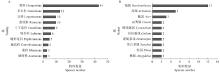
图1
自生植物物种数量排名前10的科(A)和属(B)"
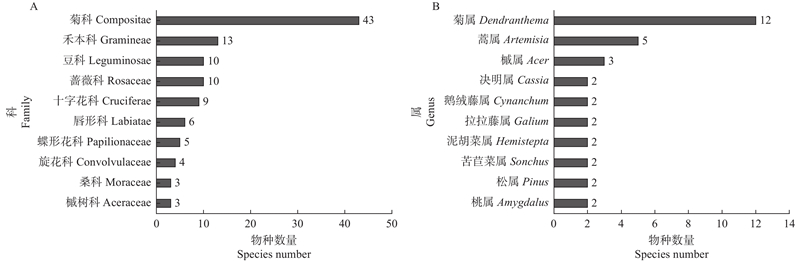
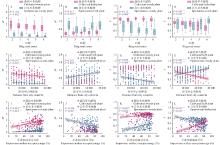
图2
环数(A、B、C、D)、距市中心的距离(E、F、G、H)和不透水地面百分比(I、J、K、L)对自生植物和栽培植物多样性的影响"
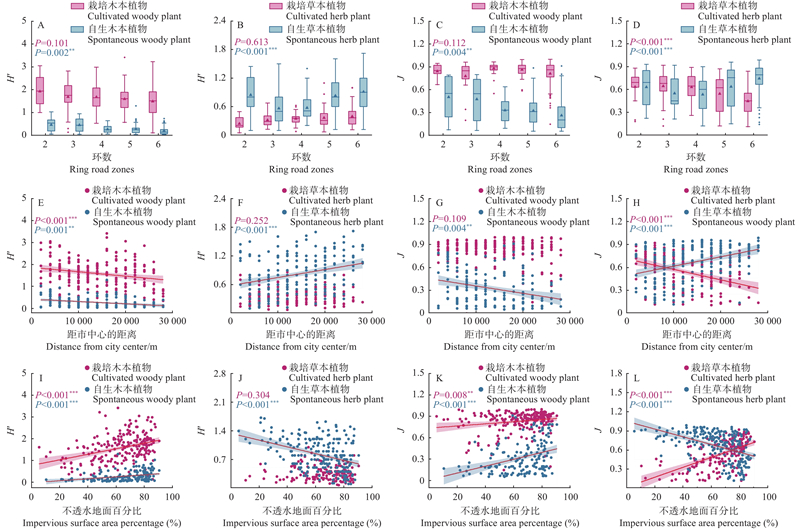
表3
自生植物Shannon-Wiener多样性和Pielou均匀度指数与环境变量关系的多元回归①"
| 变量 Variables | 自生木本植物 Spontaneous woody plant | 自生草本植物 Spontaneous herb plant | ||||||||||
| Shannon-Wiener 多样性指数a Shannon-Wiener diversity index | Pielou均匀度指数b Pielou evenness index | Shannon-Wiener 多样性指数c Shannon-Wiener diversity index | Pielou均匀度指数d Pielou evenness index | |||||||||
| 系数Coefficients | P | 系数Coefficients | P | 系数Coefficients | P | 系数Coefficients | P | |||||
| 绿地因子 Greenspace factor | 绿地类型Greenspace type | –0.076 | 0.354 | –0.043 | 0.618 | –0.026 | 0.734 | –0.155 | 0.020* | |||
| 绿化覆盖率 Greenspace area percentage | –0.060 | 0.463 | –0.084 | 0.341 | 0.001 | 0.991 | –0.061 | 0.368 | ||||
| 木本植物冠层郁闭度 Woody plant canopy density | 0.008 | 0.914 | 0.060 | 0.458 | 0.048 | 0.518 | 0.069 | 0.284 | ||||
| 植物群落结构Community structure of planted plants | 0.043 | 0.631 | 0.150 | 0.108 | –0.101 | 0.199 | 0.072 | 0.285 | ||||
| 人工干扰强度Intensity of disturbance | –0.042 | 0.642 | 0.029 | 0.759 | –0.271 | 0.001** | –0.188 | 0.015* | ||||
| 绿地坡度和朝向 Slope andaspect of greenspace | –0.007 | 0.927 | –0.074 | 0.369 | –0.094 | 0.193 | –0.012 | 0.849 | ||||
| 土壤因子 Soil characteristics | 土壤含水量 Soil water content | 0.166 | 0.043* | 0.157 | 0.066 | 0.014 | 0.856 | 0.065 | 0.349 | |||
| 土壤密度 Soil bulk density | –0.062 | 0.425 | 0.072 | 0.373 | 0.19 | 0.009** | 0.081 | 0.196 | ||||
| 全磷 Total phosphorus | 0.170 | 0.036* | 0.134 | 0.113 | –0.174 | 0.026* | –0.080 | 0.229 | ||||
| 全氮 Total nitrogen | 0.185 | 0.042* | 0.106 | 0.286 | 0.029 | 0.739 | 0.002 | 0.980 | ||||
| 有机质 Organic matter | –0.219 | 0.013* | –0.176 | 0.060 | 0.059 | 0.483 | –0.252 | 0.001** | ||||
| 有效磷 Available phosphorus | –0.006 | 0.938 | 0.037 | 0.666 | –0.070 | 0.372 | 0.017 | 0.808 | ||||
| 栽培植物 多样性 Diversity index of cultivated plant | 木本栽培植物香农多样性 Shannon-Wiener of cultivated woody plants | 0.368 | <0.001*** | — | — | — | — | — | — | |||
| 草本栽培植物香农多样性 Shannon-Wiener of cultivated herb plants | — | — | — | — | –0.212 | 0.003** | — | — | ||||
| 木本栽培植物均匀度 Pielou of cultivated woody plants | — | — | –0.047 | 0.591 | — | — | — | — | ||||
| 草本栽培植物均匀度 Pielou of cultivated herb plants | — | — | — | — | — | — | –0.497 | <0.001*** | ||||
表4
优势度前10的自生木本和草本植物"
| 生活型 Lifeform | 物种 Species | 本土 Native | 外来 Exotic | 落叶木本 植物/1年 生草本 Deciduous vegetation/ annual herbs | 常绿木本 植物/多年 生草本 Evergreen vegetation/ perennial herbs | 相对多度 Relative abundance (%) | 相对频度 Relative frequency (%) | 相对盖度 Relative canopy coverage (%) | 优势度/ 重要值 Dominant index/ important value(%) |
| 木本植物 Woody plant | 忍冬 Lonicera japonica | √ | √ | 47.05 | 34.59 | — | 40.82 | ||
| 栾 Koelreuteria paniculata | √ | √ | 32.70 | 17.97 | 25.33 | ||||
| 枸杞 Lycium chinense | √ | √ | 26.92 | 16.04 | 21.48 | ||||
| 榆 Ulmus pumila | √ | √ | 18.33 | 19.24 | 18.78 | ||||
| 桑 Morus alba | √ | √ | 9.78 | 17.97 | 13.87 | ||||
| 构 Broussonetia papyrifera | √ | √ | 10.66 | 10.86 | 10.76 | ||||
| 荆条 Vitex negundo var. heterophylla | √ | √ | 14.36 | 2.26 | 8.31 | ||||
| 臭椿 Ailanthus altissima | √ | √ | 5.74 | 9.59 | 7.67 | ||||
| 白蜡 Fraxinus chinesis | √ | √ | 3.29 | 4.33 | 3.81 | ||||
| 槐 Styphnolobium japonicum | √ | √ | 2.87 | 4.68 | 3.78 | ||||
| 草本植物 Herb plant | 黎 Chenopodium album | √ | √ | 12.95 | 9.22 | 7.08 | 9.75 | ||
| 狗尾草 Setaria viridis | √ | √ | 7.45 | 5.00 | 4.41 | 5.62 | |||
| 假还阳参 Crepidiastrum lanceolatum | √ | √ | 6.31 | 5.23 | 4.24 | 5.26 | |||
| 紫花地丁 Viola philippica | √ | √ | 2.31 | 5.76 | 3.81 | 3.96 | |||
| 苦荬菜 Ixeris polycephala | √ | √ | 4.29 | 4.48 | 2.84 | 3.87 | |||
| 独行菜 Lepidium apetalum | √ | √ | √ | 4.03 | 3.18 | 2.40 | 3.20 | ||
| 葎草 Humulus scandens | √ | √ | 2.56 | 2.37 | 1.84 | 2.26 | |||
| 早熟禾 Poa annua | √ | √ | 3.07 | 1.77 | 1.88 | 2.24 | |||
| 打碗花 Calystegia hederacea | √ | √ | 1.81 | 2.53 | 1.82 | 2.05 | |||
| 蒲公英 Taraxacum mongolicum | √ | √ | 0.60 | 3.79 | 1.77 | 2.05 |
图3
10种优势度最高的自生木本和草本物种的环境因子典型相关分析 GT:绿地类型 Greenspace type;GAP:绿化覆盖率 Greenspace area percentage;CD:木本植物冠层郁闭度 Canopy density of arbors;P-CS:植物群落结构 Plant community structure of planted plants;ID:人工干扰强度 Intensity of disturbance;SG:绿地坡度和朝向 Slope and aspect of greenspace;SWC:土壤含水量 Soil water content;BD:土壤密度 Soil bulk density;TP:全磷Total phosphorus;TN:全氮Total nitrogen;OM:有机质Organic matter;AP:有效磷Available phosphorus;CWP-SW:栽培木本植物多样性Shannon-Wiener of cultivated woody plants;CHP-SW:栽培草本植物多样性Shannon-Wiener of cultivated herbaceous plants;CWP-P:栽培木本植物均匀度Pielou of cultivated woody plants;CHP-P:栽培草本植物均匀度Pielou of cultivated herbaceous plants;L.jap:忍冬 Lonicera japonica;K.pan:栾 Koelreuteria paniculata;L.chi:枸杞 Lycium chinense;U.pum:榆 Ulmus pumila;M.alb:桑 Morus alba;B.pap:构 Broussonetia papyrifera;V.neg:荆条 Vitex negundo var. heterophylla;A.alt:臭椿 Ailanthus altissima;F.chi:白蜡 Fraxinus chinensis;S.jap:槐 Styphnolobium japonicum;C.alb:藜 Chenopodium album;S.vir:狗尾草 Setaria viridis;C.lan:假还阳参 Crepidiastrum lanceolatum;V.phi:紫花地丁 Viola philippica;I.pol:苦荬菜 Ixeridium polycephalum;L.ape:独行菜 Lepidium apetalum;H.sca:葎草 Humulus scandens;P.ann:早熟禾 Poa annua;C.hed:打碗花 Calystegia hederacea;T.mon:蒲公英 Taraxacum mongolicum."
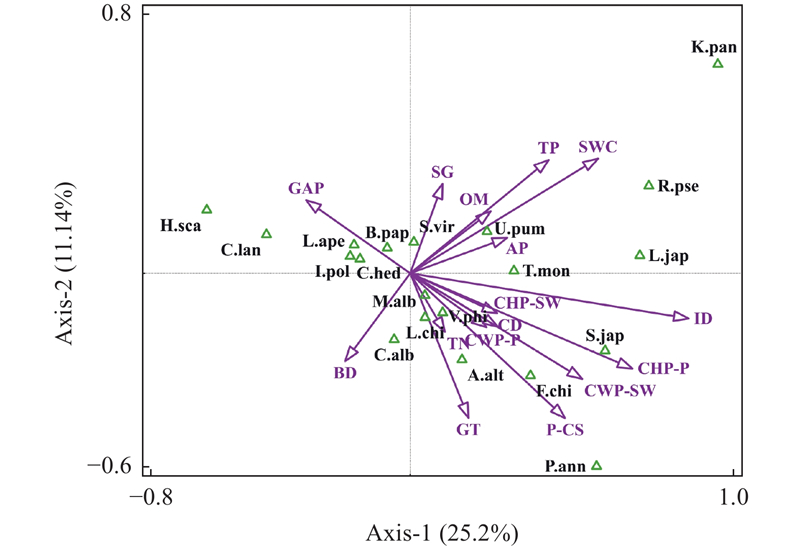
表5
环境因子对10种优势度最高的自生木本和草本物种组成的贡献和显著性检验①"
| 环境因子 Environmental factor | 解释度 Explains (%) | 贡献率 Contribution (%) | F | P |
| 绿地类型 Greenspace type | 0.5 | 3.5 | 1.3 | 0.19 |
| 绿化覆盖率 Greenspace area percentage | 0.3 | 2 | 0.7 | 0.764 |
| 木本植物冠层郁闭度 Woody plant canopy density | 0.5 | 3 | 1.1 | 0.334 |
| 植物群落结构 Community structure of planted plants | 0.7 | 4.3 | 1.6 | 0.056 |
| 人工干扰强度 Intensity of disturbance | 4.9 | 32.1 | 11.2 | 0.002** |
| 绿地坡度和朝向 Slope and aspect of greenspace | 0.7 | 4.8 | 1.8 | 0.052 |
| 土壤含水量 Soil water content | 0.8 | 5.2 | 1.9 | 0.022* |
| 土壤密度 Soil bulk density | 0.4 | 2.8 | 1 | 0.42 |
| 全磷Total phosphorus | 1.1 | 7.1 | 2.5 | 0.004** |
| 全氮Total nitrogen | 1.1 | 6.9 | 2.5 | 0.004** |
| 有机质Organic matter | 1.4 | 8.9 | 3.1 | 0.002** |
| 有效磷Available phosphorus | 0.4 | 2.5 | 0.9 | 0.512 |
| 栽培木本植物多样性Shannon-Wiener of cultivated woody plants | 1.1 | 7.1 | 2.5 | 0.006** |
| 栽培草本植物多样性Shannon-Wiener of cultivated herb plants | 0.7 | 4.8 | 1.8 | 0.038* |
| 栽培木本植物均匀度Pielou of cultivated woody plants | 0.3 | 1.9 | 0.7 | 0.802 |
| 栽培草本植物均匀度Pielou of cultivated herb plants | 0.5 | 3 | 1.1 | 0.322 |
| 鲍士旦. 2000. 土壤农化分析. 3版. 北京: 中国农业出版社. | |
| Bao S D. 2000. Soil and agricultural chemistry analysis. 3rd ed. Beijing: China Agriculture Press. [in Chinese] | |
| 常 满, 李晓鹏, 张 彤, 等. 成都绕城绿道自生植物扩散特征及与栽培植物的共存. 生态学报, 2025, 45 (18): 9052- 9065. | |
| Chang M, Li X P, Zhang T, et al. Spread characteristics of urban spontaneous plants and their coexistence with the cultivars along Chengdu ring road greenway. Acta Ecologica Sinica, 2025, 45 (18): 9052- 9065. | |
| 贺士元, 邢其华, 尹祖棠, 等. 1984. 北京植物志. 北京: 科学出版社. | |
| He S Y, Xing Q H, Yin Z T, et al. 1984. Flora of Beijing. Beijing: Science Press.[in Chinese] | |
| 李晓鹏, 董 丽, 关军洪, 等. 2018, 北京城市公园环境下自生植物物种组成及多样性时空特征. 生态学报, 38(2): 581−594. | |
| Li X P, Dong L, Guan J H, et al. 2018. Temporal and spatial characteristics of spontaneous plant composition and diversity in a Beijing urban park. Acta Ecologica Sinica, 38(2): 581−594. [in Chinese] | |
|
刘欣仪, 陈春谛, 毕凌岚, 等. 城市老旧小区植物多样性及其价值研究: 基于居民支付意愿法. 生态学报, 2025, 45 (18): 9092- 9101.
doi: 10.20103/j.stxb.202407161668 |
|
|
Liu X Y, Chen C D, Bi L L, et al. A study on plant diversity and its value in urban old residential areas: based on the willingness to pay method. Acta Ecologica Sinica, 2025, 45 (18): 9092- 9101.
doi: 10.20103/j.stxb.202407161668 |
|
|
骆沁宇, 张梦园, 李晓璐, 等. 北京城市绿地不同生境自生植物多样性特征及其功能性状组成. 生态学报, 2024, 44 (11): 4744- 4757.
doi: 10.20103/j.stxb.202311022387 |
|
|
Luo Q Y, Zhang M Y, Li X L, et al. Diversity characteristics and functional trait composition of spontaneous plants in different habitats of urban green space, Beijing. Acta Ecologica Sinica, 2024, 44 (11): 4744- 4757.
doi: 10.20103/j.stxb.202311022387 |
|
|
马 杰, 贾宝全, 张 文, 等. 北京市六环内城市森林结构总体特征. 生态学杂志, 2019, 38 (8): 2318- 2325.
doi: 10.13292/j.1000-4890.201908.035 |
|
|
Ma J, Jia B Q, Zhang W, et al. The characteristics of urban forest structure within the sixth ring road of Beijing. Chinese Journal of Ecology, 2019, 38 (8): 2318- 2325.
doi: 10.13292/j.1000-4890.201908.035 |
|
| 彭 羽, 王玟涛, 卢奕瞳, 等. 城市化景观格局对本土植物多样性的多尺度影响: 以北京市顺义区为例. 应用生态学报, 2020, 31 (12): 4058- 4066. | |
| Peng Y, Wang M T, Lu Y T, et al. Multiscale influences of urbanized landscape metrics on the diversity of indigenous plant species: a case study in Shunyi District of Beijing, China. Chinese Journal of Applied Ecology, 2020, 31 (12): 4058- 4066. | |
| 张梦园, 李 坤, 邢小艺, 等. 北京温榆河−北运河生态廊道自生植物多样性对城市化的响应. 生态学报, 2022, 42 (7): 2582- 2592. | |
| Zhang M Y, Li K, Xing X Y, et al. Responses of spontaneous plant diversity to urbanization in Wenyu River-North canal ecological corridor, Beijing. Acta Ecologica Sinica, 2022, 42 (7): 2582- 2592. | |
| 中国科学院中国植物志委员会. 1978. 中国植物志. 北京: 科学出版社. | |
| Editorial Committee of Flora of China, Chinese Academy of Sciences. 1978. Flora of China. Beijing: Science Press.[in Chinese] | |
| 周彦旭, 宗 桦, 杨珍茹, 等. 2025,. 自生植物研究进展与热点. 应用与环境生物学报, https://doi.org/10.19675/j.cnki.1006-687x.2025,.01004. | |
| Zhou Y X, Zong H, Yang Z R, et al. 2025,. Research progress and hotspots ofthe spontaneous plants at home and abroad. Chinese Journal of Appliedand Environmental Biology, https://doi.org/10.19675/j.cnki.1006-687x.2025,.01004. [in Chinese] | |
|
Cervelli E W, Lundholm J T, Du X. Spontaneous urban vegetation and habitat heterogeneity in Xi’an, China. Landscape and Urban Planning, 2013, 120, 25- 33.
doi: 10.1016/j.landurbplan.2013.08.001 |
|
|
Chang C R, Chen M C, Su M H. Natural versus human drivers of plant diversity in urban parks and the anthropogenic species-area hypotheses. Landscape and Urban Planning, 2021, 208, 104023.
doi: 10.1016/j.landurbplan.2020.104023 |
|
|
Chang M Y, Luo X Y, Zhang Y R, et al. Land-use diversity can better predict urban spontaneous plant richness than impervious surface coverage at finer spatial scales. Journal of Environmental Management, 2022, 323, 116205.
doi: 10.1016/j.jenvman.2022.116205 |
|
|
Chen X S, Wang W B, Liang H, et al. Dynamics of ruderal species diversity under the rapid urbanization over the past half century in Harbin, northeast China. Urban Ecosystems, 2014, 17 (2): 455- 472.
doi: 10.1007/s11252-013-0338-8 |
|
|
Cheng X L, Nizamani M M, Jim C Y, et al. Using SPOT data and FRAGSTAS to analyze the relationship between plant diversity and green space landscape patterns in the tropical coastal city of Zhanjiang, China. Remote Sensing, 2020, 12 (21): 3477.
doi: 10.3390/rs12213477 |
|
|
Cheng X L, Padullés Cubino J, Balfour K, et al. Drivers of spontaneous and cultivated species diversity in the tropical city of Zhanjiang, China. Urban Forestry & Urban Greening, 2022, 67, 127428.
doi: 10.1016/j.ufug.2021.127428 |
|
|
Chi Y, Shi H H, Wang X L, et al. Impact factors identification of spatial heterogeneity of herbaceous plant diversity on five southern islands of Miaodao Archipelago in north China. Chinese Journal of Oceanology and Limnology, 2016, 34 (5): 937- 951.
doi: 10.1007/s00343-016-5111-4 |
|
|
Chollet S, Brabant C, Tessier S, et al. From urban lawns to urban meadows: reduction of mowing frequency increases plant taxonomic, functional and phylogenetic diversity. Landscape and Urban Planning, 2018, 180, 121- 124.
doi: 10.1016/j.landurbplan.2018.08.009 |
|
|
Doroski D A, Duguid M C, Ashton M S. Forest patch size predicts seed bank composition in urban areas. Applied Vegetation Science, 2021, 24, e12534.
doi: 10.1111/avsc.12534 |
|
|
Fang Y T, Yoh M, Koba K, et al. Nitrogen deposition and forest nitrogen cycling along an urban–rural transect in southern China. Global Change Biology, 2011, 17 (2): 872- 885.
doi: 10.1111/j.1365-2486.2010.02283.x |
|
|
Gao Z W, Song K, Pan Y J, et al. Drivers of spontaneous plant richness patterns in urban green space within a biodiversity hotspot. Urban Forestry & Urban Greening, 2021, 61, 127098.
doi: 10.1016/j.ufug.2021.127098 |
|
|
Ginocchio R, León-Lobos P, Arellano E C, et al. Soil physicochemical factors as environmental filters for spontaneous plant colonization of abandoned tailing dumps. Environmental Science and Pollution Research, 2017, 24 (15): 13484- 13496.
doi: 10.1007/s11356-017-8894-8 |
|
|
Guo P P, Su Y B, Wan W X, et al. Urban plant diversity in relation to land use types in built-up areas of Beijing. Chinese Geographical Science, 2018, 28 (1): 100- 110.
doi: 10.1007/s11769-018-0934-x |
|
|
Guo Q F, Brown J H, Valone T J, et al. Constraints of seed size on plant distribution and abundance. Ecology, 2000, 81 (8): 2149- 2155.
doi: 10.1890/0012-9658(2000)081[2149:COSSOP]2.0.CO;2 |
|
|
Hu S W, Jin C, Huang L, et al. Characterizing composition profile and diversity patterns of spontaneous urban plants across China’s major cities. Journal of Environmental Management, 2022, 317, 115445.
doi: 10.1016/j.jenvman.2022.115445 |
|
|
Jha R K, Nölke N, Diwakara B N, et al. Differences in tree species diversity along the rural-urban gradient in Bengaluru, India. Urban Forestry & Urban Greening, 2019, 46, 126464.
doi: 10.1016/j.ufug.2019.126464 |
|
|
Li X P, Fan S X, Guan J H, et al. Diversity and influencing factors on spontaneous plant distribution in Beijing Olympic Forest Park. Landscape and Urban Planning, 2019, 181, 157- 168.
doi: 10.1016/j.landurbplan.2018.09.018 |
|
|
Li X T, Jia B Q, Li T, et al. Studying the spatial evolutionary behavior of urban forest patches from the perspective of pattern-process relationships. Urban Forestry & Urban Greening, 2023, 81, 127861.
doi: 10.1016/j.ufug.2023.127861 |
|
|
Li X T, Jia B Q, Zhang W, et al. Woody plant diversity spatial patterns and the effects of urbanization in Beijing, China. Urban Forestry & Urban Greening, 2020, 56, 126873.
doi: 10.1016/j.ufug.2020.126873 |
|
| Mueller-Dombois D, Ellenberg H. 1974. Aims and methods of vegetation ecology. New York: John Wiley & Sons. | |
|
Murakami K, Maenaka H, Morimoto Y. Factors influencing species diversity of ferns and fern allies in fragmented forest patches in the Kyoto city area. Landscape and Urban Planning, 2005, 70 (3/4): 221- 229.
doi: 10.1016/j.landurbplan.2003.10.019 |
|
|
Oldfield E E, Warren R J, Felson A J, et al. FORUM: Challenges and future directions in urban afforestation. Journal of Applied Ecology, 2013, 50 (5): 1169- 1177.
doi: 10.1111/1365-2664.12124 |
|
|
Pielou E C. The measurement of diversity in different types of biological collections. Journal of Theoretical Biology, 1967, 15 (1): 177.
doi: 10.1016/0022-5193(67)90048-3 |
|
|
Pregitzer C C, Ashton M S, Charlop-Powers S, et al. Defining and assessing urban forests to inform management and policy. Environmental Research Letters, 2019, 14 (8): 085002.
doi: 10.1088/1748-9326/ab2552 |
|
|
Qian S H, Qin D Y, Wu X, et al. Urban growth and topographical factors shape patterns of spontaneous plant community diversity in a mountainous city in southwest China. Urban Forestry & Urban Greening, 2020, 55, 126814.
doi: 10.1016/j.ufug.2020.126814 |
|
|
Shannon C E, Weaver W, Wiener N. The mathematical theory of communication. Physics Today, 1950, 3 (9): 31- 32.
doi: 10.4135/9781412959384.n229 |
|
| Tredici P D.2010,. Spontaneous urban vegetation: reflections of change in a globalized world. Nature and Culture, 5: 299–315. | |
|
Vakhlamova T, Rusterholz H P, Kamkin V, et al. Recreational use of urban and suburban forests affects plant diversity in a western Siberian city. Urban Forestry & Urban Greening, 2016, 17, 92- 103.
doi: 10.1016/j.ufug.2016.03.009 |
|
|
Vakhlamova T, Rusterholz H P, Kanibolotskaya Y, et al. Changes in plant diversity along an urban–rural gradient in an expanding city in Kazakhstan, western Siberia. Landscape and Urban Planning, 2014, 132, 111- 120.
doi: 10.1016/j.landurbplan.2014.08.014 |
|
|
Wang H F, Qureshi S, Qureshi B A, et al. A multivariate analysis integrating ecological, socioeconomic and physical characteristics to investigate urban forest cover and plant diversity in Beijing, China. Ecological Indicators, 2016, 60, 921- 929.
doi: 10.1016/j.ecolind.2015.08.015 |
|
|
Xiao L, Wang W J, He X Y, et al. Urban-rural and temporal differences of woody plants and bird species in Harbin City, northeastern China. Urban Forestry & Urban Greening, 2016, 20, 20- 31.
doi: 10.1016/j.ufug.2016.07.013 |
|
|
Yan Z G, Teng M J, He W, et al. Impervious surface area is a key predictor for urban plant diversity in a city undergone rapid urbanization. Science of the Total Environment, 2019, 650, 335- 342.
doi: 10.1016/j.scitotenv.2018.09.025 |
|
|
Yang F P, Ignatieva M, Wissman J, et al. Relationships between multi-scale factors, plant and pollinator diversity, and composition of park lawns and other herbaceous vegetation in a fast growing megacity of China. Landscape and Urban Planning, 2019, 185, 117- 126.
doi: 10.1016/j.landurbplan.2019.02.003 |
|
|
Yang J, Yan P B, He R X, et al. Exploring land-use legacy effects on taxonomic and functional diversity of woody plants in a rapidly urbanizing landscape. Landscape and Urban Planning, 2017, 162, 92- 103.
doi: 10.1016/j.landurbplan.2017.02.003 |
|
|
Zhang D, Zheng H F, He X Y, et al. Effects of forest type and urbanization on species composition and diversity of urban forest in Changchun, northeast China. Urban Ecosystems, 2016, 19 (1): 455- 473.
doi: 10.1007/s11252-015-0473-5 |
|
|
Zhao D J, Sun M Q, Xue Y W, et al. Spatial variations of plant species diversity in urban soil seed banks in Beijing, China: implications for plant regeneration and succession. Urban Forestry & Urban Greening, 2023a, 86, 128012.
doi: 10.1016/j.ufug.2023.128012 |
|
|
Zhao D J, Yang Q M, Sun M Q, et al. Urbanization and greenspace effect on plant biodiversity variations in Beijing, China. Urban Forestry & Urban Greening, 2023b, 89, 128119.
doi: 10.1016/j.ufug.2023.128119 |
| [1] | 杨慧,赵海艳,娄蓝,张凌峰,张梓苗,贾小明,毕泉鑫,王利兵. 文冠果自由授粉子代父本鉴定及遗传多样性分析[J]. 林业科学, 2026, 62(4): 142-153. |
| [2] | 高文强,雷相东,何潇,李玉堂. 东北温带森林类型和发育阶段的树种多样性−地上生物量关系分异性[J]. 林业科学, 2026, 62(4): 55-67. |
| [3] | 毛慧,赵飞飞,李杰,张春雨. 东北中温带森林树种多样性和环境因子对土壤多功能性的影响[J]. 林业科学, 2026, 62(2): 40-52. |
| [4] | 林昕怡,周星鲁,张磊,王丽娟,安新民,胡建军. 转BtCry1Ac基因杨树的生物安全性评价[J]. 林业科学, 2026, 62(2): 134-146. |
| [5] | 葛静茹,张荣霞,张金峰,杨济萍. 长白山阔叶红松林植物多样性的海拔梯度分异[J]. 林业科学, 2026, 62(2): 230-240. |
| [6] | 刘世荣,陈远其,聂秀青,明安刚,王晖. 树种多样性对森林生态系统多功能性和韧性的影响[J]. 林业科学, 2026, 62(1): 1-18. |
| [7] | 徐宇沛,郭璇,户佐佑,马冰倩,郭嘉欣,李阳,肖倩,董天心,徐程扬. 北京城市森林林分结构对视觉形态质量的影响[J]. 林业科学, 2025, 61(7): 220-230. |
| [8] | 陈泽光,迟德富. 赤松梢斑螟幼虫肠道细菌的多样性及可培养细菌鉴定[J]. 林业科学, 2025, 61(7): 251-261. |
| [9] | 吴庆明,孙雪颖,林晓刚,陈露,吕泓学,邹红菲,朱井丽. 挠力河保护区退耕模式对鸟类群落多样性的影响[J]. 林业科学, 2025, 61(7): 262-273. |
| [10] | 李威, 于珍珍, 何徽, 赵佳璐, 刘西军. 碳输入改变对湿地松人工成熟林土壤微生物群落的影响[J]. 林业科学, 2025, 61(6): 232-242. |
| [11] | 吴晓煜,赵秀海. 长白山阔叶红松林物种多样性格局及其尺度效应[J]. 林业科学, 2025, 61(2): 40-49. |
| [12] | 张建国,李云晓,段爱国,王兆山,张雄清,刘娟娟,何彩云. 杉木群体遗传结构的均一性显示:2 000年的栽培导致中国杉木已完全转化为人工林[J]. 林业科学, 2025, 61(12): 1-23. |
| [13] | 李晓,康小龙,魏美才. 中国阿扁蜂属(膜翅目:扁蜂科)4新种[J]. 林业科学, 2025, 61(12): 146-152. |
| [14] | 梁燕,王因花,燕丽萍,孔雨光,李庆华,仲伟国,田泽新,董元夫,张元帅. 刺槐群体遗传多样性分析及其核心种质初步筛选[J]. 林业科学, 2025, 61(11): 242-254. |
| [15] | 李琰,孙永江,齐建勋,史玉洁,宋健,陈永浩,翟长远,张俊佩,侯智霞,张赟齐. 核桃枝叶固废高效腐熟的菌剂筛选及堆肥过程变化[J]. 林业科学, 2025, 61(11): 102-115. |
| 阅读次数 | ||||||
|
全文 |
|
|||||
|
摘要 |
|
|||||

