
林业科学 ›› 2026, Vol. 62 ›› Issue (4): 142-153.doi: 10.11707/j.1001-7488.LYKX20250553
杨慧1,赵海艳1,娄蓝1,张凌峰2,张梓苗1,贾小明1,毕泉鑫2,王利兵1,2,*( )
)
收稿日期:2025-09-08
出版日期:2026-04-15
发布日期:2026-04-11
通讯作者:
王利兵
E-mail:wlibing@nwsuaf.edu.cn
基金资助:
Hui Yang1,Haiyan Zhao1,Lan Lou1,Lingfeng Zhang2,Zimiao Zhang1,Xiaoming Jia1,Quanxin Bi2,Libing Wang1,2,*()
Received:2025-09-08
Online:2026-04-15
Published:2026-04-11
Contact:
Libing Wang
E-mail:wlibing@nwsuaf.edu.cn
摘要:
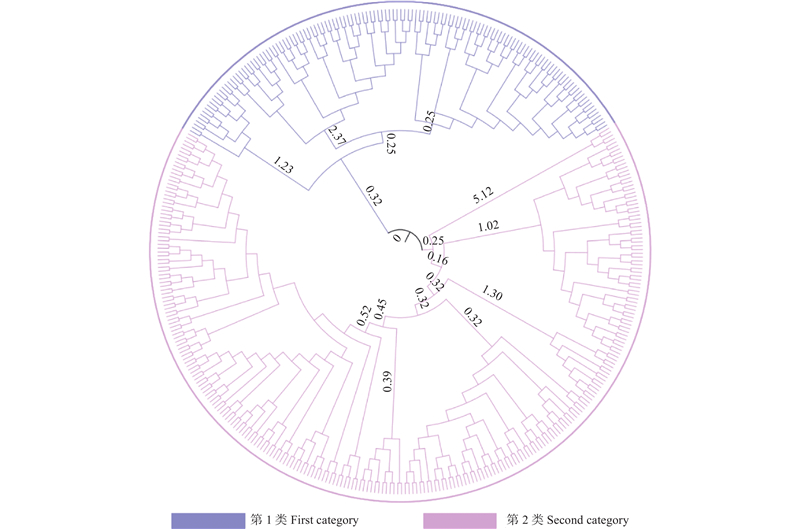
目的: 利用SSR标记对5个丰产文冠果品种的自由授粉子代群体进行父本鉴定,探索能使文冠果特定品种丰产的适宜授粉树或授粉品种,为文冠果品种配置和高产栽培提供参考。方法: 以5个丰产文冠果品种自由授粉产生的395 株子代及其288 株候选父本为材料,采用SSR分子标记技术筛选得到17个SSR标记,通过Cervus软件进行父本鉴定,并对子代群体进行遗传多样性分析。结果: 在95%的置信度下,有121株子代成功鉴定出父本,‘悄然薄壳’和‘中石4号’均为母树提供花粉,父本‘悄然薄壳’和母本‘中石4号’产生子代数最多,共6株;68株实生文冠果中有3 株父本产生子代数最多,共15 株;编号为12-150、12-193、6-144、6-107的4株文冠果总繁殖贡献率较高且部分花粉传播距离较远;编号为12-141、6-161的文冠果对母本‘中石9号’的繁殖贡献率分别为4.13%和3.31%,编号为6-107的文冠果对母本‘悄然薄壳’的繁殖贡献率为2.48%。通过对父本进行分析,未发现自交后代,表明文冠果自交现象极弱。文冠果有效花粉散布距离为6~154.1 m,平均距离为54.67 m,近源花粉(<60 m)占总花粉来源的62.28%;17个SSR位点在所有文冠果样本中的平均等位基因数、平均有效等位基因数、平均Shannon’s信息指数(I)、平均观测杂合度和平均期望杂合度分别为8.706、3.152、1.308、0.619、0.644,多态信息含量(PIC)的变化范围0.369~0.834,均值为0.588。群体遗传结构和聚类分析结果均表明,可将395 份文冠果种质分为两大类群。结论: 文冠果花粉来源整体较为分散,距离对文冠果授粉率的影响较大,‘悄然薄壳’品种适宜作‘中石4号’品种的授粉树,编号为12-150、12-193的文冠果适宜作‘中石1号’品种的授粉树,编号为6-144、9-200、6-107的文冠果分别适宜作‘中石4号’‘中石9号’和‘悄然薄壳’品种的授粉树;‘中石4号’半同胞家系遗传多样性最高,‘圆大硕种’半同胞家系遗传多样性最低。
中图分类号:
杨慧,赵海艳,娄蓝,张凌峰,张梓苗,贾小明,毕泉鑫,王利兵. 文冠果自由授粉子代父本鉴定及遗传多样性分析[J]. 林业科学, 2026, 62(4): 142-153.
Hui Yang,Haiyan Zhao,Lan Lou,Lingfeng Zhang,Zimiao Zhang,Xiaoming Jia,Quanxin Bi,Libing Wang. Paternal Identification and Genetic Diversity Analysis of Open-Pollinated Progeny of Xanthoceras sorbifolium[J]. Scientia Silvae Sinicae, 2026, 62(4): 142-153.
表1
17对引物信息"
| 引物名称 Primer name | 引物序列(5'–3') Primer sequence | 重复单元 Repeat motif | 片段大小 Fragment size/bp | 标记荧光 Fluorescent | 退火温度 Annealing temperature/℃ | |
| QXH049 | F: | CCCCAACAAATGGTAAGACG | CT | 196 | FAM | 55 |
| R: | GAATTTACAAGACAAGCAACAGC | |||||
| QXH083 | F: | AGCGGTCTCCTCCACTATCA | CT | 331 | HEX | 56 |
| R: | GAATTGAAGCGCAGAAGGA | |||||
| QXH177 | F: | TGTGGTGGTTTTGGCAGAC | AG | 208 | FAM | 55 |
| R: | CACCAAATAATGTCAATATCCTGT | |||||
| QXH262 | F: | TCTAACCGAAGAAGCCAACT | CT | 250 | HEX | 55 |
| R: | AGCGTGATATTCTGTTTCAACTAC | |||||
| QXH281 | F: | CACCGTAGTATCAACGCACAA | AG | 219 | FAM | 58 |
| R: | ATTTCCACTATTTCCCTCACATT | |||||
| QXH282 | F: | CCCAACAAATGGTAAGACGT | CT | 240 | HEX | 55 |
| R: | GTTTCATTTCATTTCCAGCATC | |||||
| QXH323 | F: | CACAACCCAAATCCCAGAAC | AG | 346 | HEX | 55 |
| R: | AACGACACGCACAATCATAAC | |||||
| QXR343 | F: | CACACTTTCTGAGTCCCGTAT | TG | 318 | FAM | 58 |
| R: | TGTTTCTCCTCTAATCCAAC | |||||
| QXH365 | F: | GTATATCTCTTTTACTCGTGAC | AC | 154 | FAM | 52 |
| R: | ATGATGGGTTGGGTTGAGTT | |||||
| QXH429 | F: | TGCGACAGCAACAGCATAA | AC | 146 | FAM | 54 |
| R: | TAAGGCAGCCAAAACATCAG | |||||
| QXH643 | F: | GCAGTTATGGAAAGGAATCA | CA,CT | 268 | HEX | 56 |
| R: | ATCAGTGTCGATTATTATCT | |||||
| QXHS371 | F: | ATTGGAGTGGCCTTCATACG | GT | 241 | FAM | 54 |
| R: | GCAAGCAGCTAAAGAAACAGC | |||||
| QBLB1 | F: | CACTCCTTGACCGTGTTCTT | GA | 252 | FAM | 54 |
| R: | ATTGGATGACTTTGGTTTCG | |||||
| QBLB4 | F: | ACCCCAAACCACTATCCAA | AG | 113 | FAM | 59 |
| R: | CCCTCCCTTTTCCTTTTACT | |||||
| QBLB65 | F: | TATCTCGCCACATCTGCC | TC | 355 | HEX | 53 |
| R: | CTGAAATGCCATTAACAAACAC | |||||
| QBLB72 | F: | CCGAACTCGTCAATGTCAAC | AT, AG | 352 | HEX | 52 |
| R: | CTCTGCCTCCATCGTCATC | |||||
| QBRB203 | F: | ACAAGTAGTGCTCATCGGTTTA | AT | 371 | HEX | 56 |
| R: | GAGTCTAATAGGTAAGGCTAGGAAC | |||||
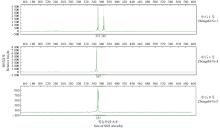
图1
部分文冠果在QBLB65引物的SSR扩增结果"
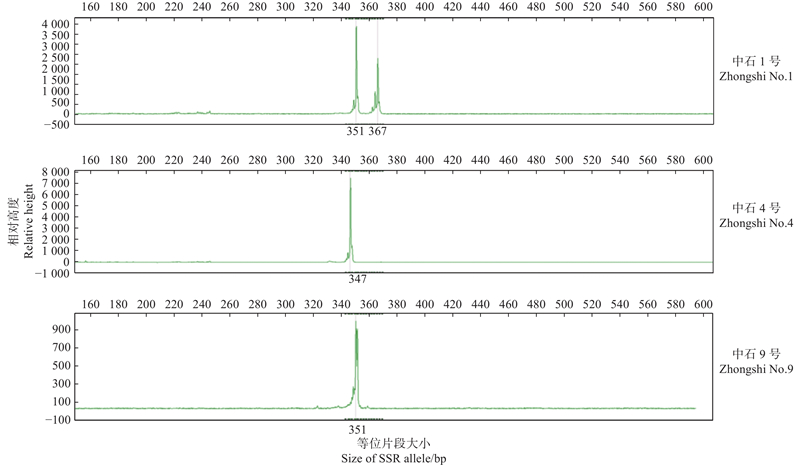
表2
95%置信度下文冠果自由授粉子代父本鉴定结果"
| 父本编号 Paternal parent number | 交配母本品种及其子代数 Mating female variety and number of sibs | 总子代数 Total number of sibs | 繁殖贡献率 Reproductive contribution rate (%) |
| 悄然薄壳Qiaoranboke | 中石4号(6)、中石9号(1)Zhongshi No.4(6), Zhongshi No.9(1) | 7 | 5.79 |
| 中石4号Zhongshi No.4 | 中石1号(1)Zhongshi No.1(1) | 1 | 0.83 |
| 6-161 | 中石9号(4)、悄然薄壳(1)Zhongshi No.9(4), Qiaoranboke(1) | 5 | 4.13 |
| 12-141 | 中石9号(5)Zhongshi No.9(5) | 5 | 4.13 |
| 12-150 | 中石4号(2)、中石9号(2)、中石1号(1) Zhongshi No.4(2), Zhongshi No.9(2), Zhongshi No.1(1) | 5 | 4.13 |
| 6-136 | 中石4号(2)、圆大硕种(2)Zhongshi No.4(2), Yuandashuozhong(2) | 4 | 3.31 |
| 12-128 | 中石9号(2)、圆大硕种(2)Zhongshi No.9(2), Yuandashuozhong(2) | 4 | 3.31 |
| 12-193 | 中石1号(2)、中石4号(1)、中石9号(1) Zhongshi No.1(2), Zhongshi No.4(1), Zhongshi No.9(1) | 4 | 3.31 |
| 6-107 | 悄然薄壳(3)Qiaoranboke(3) | 3 | 2.48 |
| 6-144 | 中石9号(2)、中石4号(1)Zhongshi No.9(2), Zhongshi No.4(1) | 3 | 2.48 |
| 6-150 | 中石1号(2)、圆大硕种(1)Zhongshi No.1(2), Yuandashuozhong(1) | 3 | 2.48 |
| 12-142 | 中石4号(2)、中石9号(1)Zhongshi No.4(2), Zhongshi No.9(1) | 3 | 2.48 |
| 其他(16)Others(16) | 2×16 | 1.65×16 | |
| 其他(42)Others(42) | 1×42 | 0.83×42 | |
| 合计Total | 121 | 100 |
表3
95%置信度下5个文冠果半同胞家系父本组成分析"
| 交配母本品种 Mating female variety | 父本编号及其子代数 Paternal parent number and number of sibs | 总子代数 Total number of sibs | 繁殖贡献率 Reproductive contribution rate (%) |
| 中石1号 Zhongshi No.1 | 中石4号(1)Zhongshi No.4(1) | 1 | 0.83 |
| 12-193(2), 6-135(2), 6-150(2) | 2×3 | 1.65×3 | |
| 其他(1)Others(1) | 1×12 | 0.83×12 | |
| 中石4号 Zhongshi No.4 | 悄然薄壳(6)Qiaoranboke(6) | 6 | 4.96 |
| 6-136(2), 12-142(2), 12-150(2) | 2×3 | 1.65×3 | |
| 其他(1)Others(1) | 1×14 | 0.83×14 | |
| 中石9号 Zhongshi No.9 | 悄然薄壳(1)Qiaoranboke(1) | 1 | 0.83 |
| 12-141(5) | 5 | 4.13 | |
| 6-161(4) | 4 | 3.31 | |
| 9-200(2), 11-161(2), 12-150(2), 12-128(2), 6-144(2) | 2×5 | 1.65×5 | |
| 其他(1)Others(1) | 1×19 | 0.83×19 | |
| 圆大硕种 Yuandashuozhong | 6-194(2), 6-100(2), 6-136(2), 12-128(2) | 2×4 | 1.65×4 |
| 其他(1)Others(1) | 1×13 | 0.83×13 | |
| 悄然薄壳 Qiaoranboke | 6-107(3) | 3 | 2.48 |
| 5-157(2) | 2 | 1.65 | |
| 其他(1)Others(1) | 1×11 | 0.83×11 | |
| 合计Total | 121 | 100 |
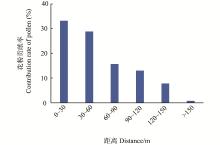
图2
文冠果有效花粉散布距离"
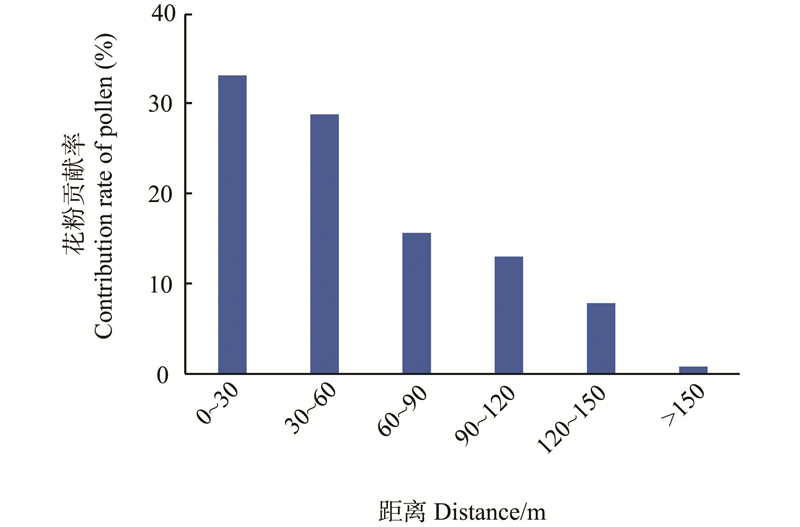
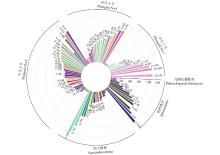
图3
文冠果子代父本来源分析 相同颜色的图柱代表相同的父本。The same colored columns represent the same paternal parent of yellowhorn."

表4
文冠果自由授粉子代遗传多样性分析"
| 位点 Locus | 个体数 Number of individuals | 等位基因数 Number of alleles (Na) | 有效等位基因数 Number of effective alleles (Ne) | Shannon’s 信息指数 Shannon’s information index (I) | 观测杂合度 Observed heterozygosity (Ho) | 期望杂合度 Expected heterozygosity (He) | 固定指数 Fixation index (F) | 多态信息含量 Polymorphic information content (PIC) |
| QXH049 | 394 | 5 | 3.987 | 1.469 | 0.789 | 0.749 | –0.054 | 0.708 |
| QXH643 | 393 | 14 | 2.623 | 1.438 | 0.740 | 0.619 | –0.197 | 0.591 |
| QXH177 | 393 | 9 | 3.180 | 1.332 | 0.700 | 0.686 | –0.021 | 0.628 |
| QBLB72 | 395 | 17 | 5.328 | 1.963 | 0.833 | 0.812 | –0.02 | 0.788 |
| QBLB1 | 393 | 7 | 1.926 | 0.917 | 0.272 | 0.481 | 0.434 | 0.434 |
| QXH282 | 394 | 5 | 3.957 | 1.464 | 0.787 | 0.747 | –0.053 | 0.705 |
| QBLB4 | 391 | 7 | 2.591 | 1.100 | 0.437 | 0.614 | 0.288 | 0.549 |
| QBRB203 | 395 | 5 | 2.860 | 1.172 | 0.689 | 0.650 | –0.059 | 0.584 |
| QXHS371 | 393 | 4 | 2.069 | 0.803 | 0.583 | 0.517 | –0.128 | 0.407 |
| QXH323 | 395 | 18 | 6.603 | 2.240 | 0.848 | 0.849 | 0.001 | 0.834 |
| QBLB65 | 395 | 11 | 3.460 | 1.598 | 0.762 | 0.711 | –0.072 | 0.673 |
| QXH429 | 394 | 3 | 1.873 | 0.705 | 0.439 | 0.466 | 0.058 | 0.369 |
| QXH262 | 395 | 13 | 2.765 | 1.405 | 0.671 | 0.638 | –0.051 | 0.599 |
| QXH365 | 390 | 5 | 2.728 | 1.156 | 0.518 | 0.633 | 0.182 | 0.567 |
| QXH281 | 394 | 3 | 2.126 | 0.811 | 0.652 | 0.530 | –0.232 | 0.419 |
| QXH083 | 391 | 16 | 3.338 | 1.681 | 0.708 | 0.700 | –0.011 | 0.673 |
| QXR343 | 393 | 6 | 2.166 | 0.978 | 0.094 | 0.538 | 0.825 | 0.463 |
| 平均值 Average | 8.706 | 3.152 | 1.308 | 0.619 | 0.644 | 0.052 | 0.588 |
表5
文冠果自由授粉子代群体遗传多样性分析"
群体 Group | 等位基因数 Number of alleles (Na) | 有效等位基因数 Number of effective alleles (Ne) | Shannon’s 信息指数 Shannon’s information index (I) | 观测杂合度 Observed heterozygosity (I) | 期望杂合度 Expected heterozygosity (He) | 固定指数 Fixation index (F) |
| 中石1号家系 ‘Zhongshi No.1’ family | 6.353 | 2.881 | 1.200 | 0.632 | 0.607 | –0.029 |
| 中石4号家系 ‘Zhongshi No.4’ family | 6.706 | 2.864 | 1.211 | 0.584 | 0.612 | 0.058 |
| 中石9号家系 ‘Zhongshi No.9’ family | 7.882 | 2.713 | 1.206 | 0.630 | 0.598 | –0.044 |
| 圆大硕种家系 ‘Yuandashuozhong’ family | 5.882 | 2.621 | 1.136 | 0.600 | 0.582 | –0.005 |
| 悄然薄壳家系 ‘Qiaoranboke’ family | 6.706 | 2.659 | 1.166 | 0.644 | 0.581 | –0.112 |
| 平均值 Average | 6.706 | 2.747 | 1.184 | 0.618 | 0.596 | –0.026 |
图4
K与ΔK的变化关系(A)及其K=2时395个文冠果群体遗传结构(B)"
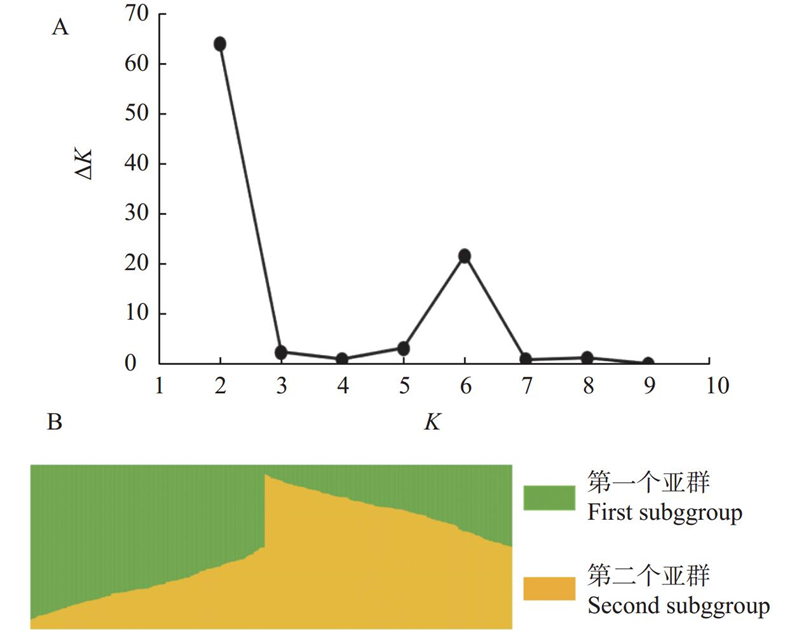
图5
395份文冠果的UPGMA聚类结果"
| 陈兴彬, 徐海宁, 肖复明, 等. 陈山红心杉1.5代种子园遗传多样性和子代父本分析. 南京林业大学学报(自然科学版), 2021, 45 (3): 87- 92. | |
| Chen X B, Xu H N, Xiao F M, et al. Genetic diversity and paternity analyses in a 1.5th generation seed orchard of Chenshan red-heart Chinese fir. Journal of Nanjing Forestry University (Natural Sciences Edition), 2021, 45 (3): 87- 92. | |
|
高秀丽, 原树生, 王敏超, 等. 蜜蜂对文冠果的辅助授粉效应. 江苏农业科学, 2018, 46 (20): 148- 151.
doi: 10.15889/j.issn.1002-1302.2018.20.038 |
|
|
Gao X L, Yuan S S, Wang M C, et al. Auxiliary pollination effect of honeybees on Xanthoceras sorbifolium. Jiangsu Agricultural Sciences, 2018, 46 (20): 148- 151.
doi: 10.15889/j.issn.1002-1302.2018.20.038 |
|
| 何田华, 葛 颂. 植物种群交配系统、亲本分析以及基因流动研究. 植物生态学报, 2001, 25 (2): 144- 154. | |
| He T H, Ge S. Mating system paternity analysis and gene flow in plant populations. Acta Phytoecologica Sinica, 2001, 25 (2): 144- 154. | |
|
李寄凡, 程一鸣, 潘冬梅, 等. 授粉品种对油茶结实及果实主要性状的影响. 湖北民族大学学报(自然科学版), 2024, 42 (1): 26- 32.
doi: 10.13501/j.cnki.42-1908/n.2024.03.004 |
|
|
Li J F, Cheng Y M, Pan D M, et al. Effect of pollination varieties on fruit-setting rate and main fruit characters of Camellia oleifera. Journal of Hubei Minzu University (Natural Science Edition), 2024, 42 (1): 26- 32.
doi: 10.13501/j.cnki.42-1908/n.2024.03.004 |
|
|
李思琪, 张文臣, 杨 柳, 等. 基于SSR标记的文冠果遗传多样性分析及指纹图谱构建. 生物技术通报, 2024, 40 (5): 74- 83.
doi: 10.13560/j.cnki.biotech.bull.1985.2023-1148 |
|
|
Li S Q, Zhang W C, Yang L, et al. Genetic diversity analysis and dna fingerprint construction based on SSR markers for Xanthoceras sorbifolium. Biotechnology Bulletin, 2024, 40 (5): 74- 83.
doi: 10.13560/j.cnki.biotech.bull.1985.2023-1148 |
|
| 李相花, 韩笑翀, 鹿 英, 等. 基于SSR分子标记的泰安老茶树资源遗传多样性分析. 山东农业科学, 2025, 57 (5): 69- 74. | |
| Li X H, Han X C, Lu Y, et al. Genetic diversity analysis of old tea tree resources in Taian based on SSR molecular markers. Shandong Agricultural Sciences, 2025, 57 (5): 69- 74. | |
|
林建维, 张丽丽, 杨 俊, 等. 文冠果药食价值及其应用前景. 内蒙古林业调查设计, 2024, 47 (4): 69- 73.
doi: 10.13387/j.cnki.nmld.2024.04.006 |
|
|
Lin J W, Zhang L L, Yang J, et al. Medicinal and edible value of Xanthoceras sorbifolium and its application prospects. Inner Mongolia Forestry Investigation and Design, 2024, 47 (4): 69- 73.
doi: 10.13387/j.cnki.nmld.2024.04.006 |
|
|
刘加能, 程秋如, 潘登浪, 等. 基于SSR分子标记的油棕遗传多样性及群体遗传结构分析. 中国油脂, 2025, 50 (4): 111- 118.
doi: 10.19902/j.cnki.zgyz.1003-7969.230668 |
|
|
Liu J N, Cheng Q R, Pan D L, et al. Analysis of genetic diversity and population genetic structure in oil palm based on SSR markers. China Oils and Fats, 2025, 50 (4): 111- 118.
doi: 10.19902/j.cnki.zgyz.1003-7969.230668 |
|
|
刘 杰, 王 斌, 侯静静, 等. 甘肃胡麻地方品种遗传多样性和群体结构分析. 中国农业科技导报, 2025, 27 (9): 69- 78.
doi: 10.13304/j.nykjdb.2024.0222 |
|
|
Liu J, Wang B, Hou J J, et al. Analysis of genetic diversity and population structure of flax local varieties in Gansu. Journal of Agricultural Science and Technology, 2025, 27 (9): 69- 78.
doi: 10.13304/j.nykjdb.2024.0222 |
|
|
卢 瑶, 袁平平, 金 鑫, 等. 基于SSR标记的马铃薯野生种和地方种遗传多样性分析和指纹图谱构建. 生物技术通报, 2025, 41 (9): 94- 104.
doi: 10.13560/j.cnki.biotech.bull.1985.2025-0142 |
|
|
Lu Y, Yuan P P, Jin X, et al. Genetic diversity analysis and fingerprinting of wild potato and landraces based on SSR markers. Biotechnology Bulletin, 2025, 41 (9): 94- 104.
doi: 10.13560/j.cnki.biotech.bull.1985.2025-0142 |
|
|
牛 媛, 敖 妍, 李 云, 等. 文冠果优良无性系授粉组合选择及结实性状分析. 浙江农林大学学报, 2020, 37 (2): 209- 219.
doi: 10.11833/j.issn.2095-0756.2020.02.003 |
|
|
Niu Y, Ao Y, Li Y, et al. Selection of pollination combinations and analysis of fruit and seed characters of excellent clones of Xanthoceras sorbifolium. Journal of Zhejiang A & F University, 2020, 37 (2): 209- 219.
doi: 10.11833/j.issn.2095-0756.2020.02.003 |
|
|
裴红霞, 汪露瑶, 李生梅, 等. 基于SCoT、SRAP和SSR分子标记的220份辣椒种质资源遗传多样性分析. 生物技术通报, 2025, 41 (8): 165- 174.
doi: 10.13560/j.cnki.biotech.bull.1985.2025-0208 |
|
|
Pei H X, Wang L Y, Li S M, et al. Genetic diversity of 220 pepper germplasm resources using SCoT, SRAP, and SSR molecular markers. Biotechnology Bulletin, 2025, 41 (8): 165- 174.
doi: 10.13560/j.cnki.biotech.bull.1985.2025-0208 |
|
|
戚建华, 姚增玉. 文冠果的生殖生物学与良种繁育研究进展. 西北林学院学报, 2012, 27 (3): 91- 96.
doi: 10.3969/j.issn.1001-7461.2012.03.19 |
|
|
Qi J H, Yao Z Y. Review on reproductive biology, propagation and breeding of Xanthoceras sorbifolium. Journal of Northwest Forestry University, 2012, 27 (3): 91- 96.
doi: 10.3969/j.issn.1001-7461.2012.03.19 |
|
|
邵文豪, 王兆山, 张建国. 基于SSR标记的油橄榄主要栽培品种子代父本分析. 林业科学研究, 2020, 33 (3): 22- 30.
doi: 10.13275/j.cnki.lykxyj.2020.03.003 |
|
|
Shao W H, Wang Z S, Zhang J G. Paternity analysis of main olive cultivars progenies based on SSR markers. Forest Research, 2020, 33 (3): 22- 30.
doi: 10.13275/j.cnki.lykxyj.2020.03.003 |
|
|
申 展, 马履一, 敖 妍, 等. 基于SSR标记的文冠果遗传多样性分析及核心种质构建. 分子植物育种, 2017, 15 (8): 3341- 3350.
doi: 10.13271/j.mpb.015.003341 |
|
|
Shen Z, Ma L Y, Ao Y, et al. Analysis of the genetic diversity and construction of core collection of Xanthoceras sorbifolium using microsatellite marker data. Molecular Plant Breeding, 2017, 15 (8): 3341- 3350.
doi: 10.13271/j.mpb.015.003341 |
|
|
谭小梅, 周志春, 金国庆, 等. 马尾松二代无性系种子园子代父本分析及花粉散布. 植物生态学报, 2011, 35 (9): 937- 945.
doi: 10.3724/SP.J.1258.2011.00937 |
|
|
Tan X M, Zhou Z C, Jin G Q, et al. Paternity analysis and pollen dispersal for the second generation clonal seed orchard of Pinus massoniana. Chinese Journal of Plant Ecology, 2011, 35 (9): 937- 945.
doi: 10.3724/SP.J.1258.2011.00937 |
|
|
田 英, 王娅丽, 王 钰, 等. 文冠果传粉生物学特性研究. 黑龙江农业科学, 2013, (6): 50- 55.
doi: 10.3969/j.issn.1002-2767.2013.06.015 |
|
|
Tian Y, Wang Y L, Wang Y, et al. Study on the pollination biology characteristic of Xanthoceras sorbifolium. Heilongjiang Agricultural Sciences, 2013, (6): 50- 55.
doi: 10.3969/j.issn.1002-2767.2013.06.015 |
|
|
王楠楠, 李金花, 王长海, 等. 基于SSR标记的父本分析研究油橄榄品种间的亲和性. 林业科学研究, 2017, 30 (4): 640- 647.
doi: 10.13275/j.cnki.lykxyj.2017.04.015 |
|
|
Wang N N, Li J H, Wang C H, et al. Paternity analysis using microsatellite markers to identify the pollen donors of olive open-pollinated offsprings. Forest Research, 2017, 30 (4): 640- 647.
doi: 10.13275/j.cnki.lykxyj.2017.04.015 |
|
|
王 瑞, 洪文娟, 罗 华, 等. 石榴品种SSR指纹图谱构建及杂种父本鉴定. 园艺学报, 2023, 50 (2): 265- 278.
doi: 10.16420/j.issn.0513-353x.2021-1008 |
|
|
Wang R, Hong W J, Luo H, et al. Construction of SSR fingerprints of pomegranate cultivars and male parent identification of hybrids. Acta Horticulturae Sinica, 2023, 50 (2): 265- 278.
doi: 10.16420/j.issn.0513-353x.2021-1008 |
|
|
魏雅君, 徐业勇, 冯贝贝, 等. 杏李品种授粉亲和性研究. 果树学报, 2017, 34 (2): 204- 214.
doi: 10.13925/j.cnki.gsxb.20160284 |
|
|
Wei Y J, Xu Y Y, Feng B B, et al. A study on the pollination compatibility of different cultivars of Prunus salicina×armeniaca with different pollenizers. Journal of Fruit Science, 2017, 34 (2): 204- 214.
doi: 10.13925/j.cnki.gsxb.20160284 |
|
| 吴承来, 张倩倩, 董炳雪, 等. 我国部分玉米自交系遗传关系和遗传结构解析. 作物学报, 2010, 36 (11): 1820- 1831. | |
| Wu C L, Zhang Q Q, Dong B X, et al. Analysis of genetic structure and genetic relationships of partial maize in-bred lines in China. Acta Agronomica Sinica, 2010, 36 (11): 1820- 1831. | |
|
谢云艳, 孙 妍, 王亦航, 等. 授粉品种配置对板栗结实性状与品质的影响. 西北林学院学报, 2025, 40 (4): 29- 36.
doi: 10.3969/j.issn.1001-7461.2025.04.04 |
|
|
Xie Y Y, Sun Y, Wang Y H, et al. Effect of pollination variety configuration on fruit set traits and quality of Chinese chestnut. Journal of Northwest Forestry University, 2025, 40 (4): 29- 36.
doi: 10.3969/j.issn.1001-7461.2025.04.04 |
|
|
闫锦源, 郑 斌, 王松标, 等. 基于荧光SSR标记的杧果控制授粉实生后代父本鉴定. 果树学报, 2025, 42 (6): 1190- 1199.
doi: 10.13925/j.cnki.gsxb.20240590 |
|
|
Yan J Y, Zheng B, Wang S B, et al. Paternal identification of mango controlled-pollination seedling progenies based on fluorescent SSR markers. Journal of Fruit Science, 2025, 42 (6): 1190- 1199.
doi: 10.13925/j.cnki.gsxb.20240590 |
|
|
杨晓伟, 朱宁华, 韩志强, 等. 铁心杉半同胞子代优株父本鉴定. 中南林业科技大学学报, 2021, 41 (12): 26- 35.
doi: 10.14067/j.cnki.1673-923x.2021.12.004 |
|
|
Yang X W, Zhu N H, Han Z Q, et al. Identification of paternal parents of half-sib progeny superior plants of the black-heart wood Chinese fir. Journal of Central South University of Forestry & Technology, 2021, 41 (12): 26- 35.
doi: 10.14067/j.cnki.1673-923x.2021.12.004 |
|
|
赵 丹, 隋 心, 孙晓艳, 等. 基于cpSSR标记的红松天然群体自由授粉子代的父本分析. 经济林研究, 2011, 29 (4): 23- 27.
doi: 10.3969/j.issn.1003-8981.2011.04.005 |
|
|
Zhao D, Sui X, Sun X Y, et al. Paternity analysis of open-pollinated progeny in natural Pinus koraiensis populations based on cpSSR markers. Nonwood Forest Research, 2011, 29 (4): 23- 27.
doi: 10.3969/j.issn.1003-8981.2011.04.005 |
|
| 郑崇文. 2022. 核桃控制杂交条件下F1代SSR分子标记亲子关系鉴定. 成都: 四川农业大学. | |
| Zheng C W. 2022. Identification of parent-child relationship with SSR molecular marker in F1 generation under controlled hybridization of Juglans regia L. Chengdu: Sichuan Agricultural University. [in Chinese] | |
| 周庆源, 傅德志. 文冠果生殖生物学的初步研究. 林业科学, 2010, 46 (1): 158- 162, 177. | |
| Zhou Q Y, Fu D Z. Preliminary studies on the reproductive biology of Xanthoceras sorbifolia. Scientia Silvae Sinicae, 2010, 46 (1): 158- 162, 177. | |
|
朱 鸣, 叶明彬, 谢子强, 等. 基于荧光标记SSR基因分析技术的绿海龟人工繁育群体亲缘关系鉴定. 海南热带海洋学院学报, 2022, 29 (5): 12- 19.
doi: 10.13307/j.issn.2096-3122.2022.05.02 |
|
|
Zhu M, Ye M B, Xie Z Q, et al. Genetic relationship identification of cultured populations in Chelonia mydas based on fluorescent SSR technique. Journal of Hainan Tropical Ocean University, 2022, 29 (5): 12- 19.
doi: 10.13307/j.issn.2096-3122.2022.05.02 |
|
| 朱仁斌. 2016. 中国特有植物文冠果(Xanthoceras sorbifolium)的谱系地理研究与应用. 杨凌: 西北农林科技大学. | |
| Zhu R B. 2016. Phylogeography of Xanthoceras sorbifolium, an endemic plant to China. Yangling: Northwest Agriculture and Forestry University. [in Chinese] | |
|
Bi Q X, Guan W B. Isolation and characterisation of polymorphic genomic SSRs markers for the endangered tree Xanthoceras sorbifolium Bunge. Conservation Genetics Resources, 2014, 6 (4): 895- 898.
doi: 10.1007/s12686-014-0234-4 |
|
|
Evanno G, Regnaut S, Goudet J. Detecting the number of clusters of individuals using the software STRUCTURE: a simulation study. Molecular Ecology, 2005, 14 (8): 2611- 2620.
doi: 10.1111/j.1365-294X.2005.02553.x |
|
|
Guan L P, Yang T, Li N, et al. Identification of superior clones by RAPD technology in Xanthoceras sorbifolium. Forestry Studies in China, 2010, 12 (1): 37- 40.
doi: 10.1007/s11632-010-0003-8 |
|
|
Ji X F, Chi T Y, Liu P, et al. The total triterpenoid saponins of Xanthoceras sorbifolium improve learning and memory impairments through against oxidative stress and synaptic damage. Phytomedicine, 2017, 25, 15- 24.
doi: 10.1016/j.phymed.2016.12.009 |
|
|
Jones M E, Shepherd M, Henry R, et al. Pollen flow in Eucalyptus grandis determined by paternity analysis using microsatellite markers. Tree Genetics & Genomes, 2008, 4 (1): 37- 47.
doi: 10.1007/s11295-007-0086-0 |
|
|
Letunic I, Bork P. Interactive Tree of Life (iTOL) v6: recent updates to the phylogenetic tree display and annotation tool. Nucleic Acids Research, 2024, 52 (W1): W78- W82.
doi: 10.1093/nar/gkae268 |
|
|
Ma Y X, Bi Q X, Li G T, et al. Provenance variations in kernel oil content, fatty acid profile and biodiesel properties of Xanthoceras sorbifolium Bunge in northern China. Industrial Crops and Products, 2020, 151, 112487.
doi: 10.1016/j.indcrop.2020.112487 |
|
|
Ritland K, Jain S. A model for the estimation of outcrossing rate and gene frequencies using n independent loci. Heredity, 1981, 47 (1): 35- 52.
doi: 10.1038/hdy.1981.57 |
|
|
Sakthipriya M, Vishnu S S, Sujith S, et al. Analysis of genetic diversity of Centella asiatica using SSR markers. International Journal of Applied Sciences and Biotechnology, 2018, 6 (2): 103- 109.
doi: 10.3126/ijasbt.v6i2.19583 |
|
|
Shaw D V, Brown A H D. Optimum number of marker loci for estimating outcrossing in plant populations. Theoretical and Applied Genetics, 1982, 61 (4): 321- 325.
doi: 10.1007/BF00272848 |
|
|
Taheri S, Lee Abdullah T, Yusop M R, et al. Mining and development of novel SSR markers using next generation sequencing (NGS) data in plants. Molecules, 2018, 23 (2): 399.
doi: 10.3390/molecules23020399 |
|
|
Tamura K, Stecher G, Kumar S. MEGA11: molecular evolutionary genetics analysis version 11. Molecular Biology and Evolution, 2021, 38 (7): 3022- 3027.
doi: 10.1093/molbev/msab120 |
|
|
Yao Z Y, Qi J H, Yin L M. Biodiesel production from Xanthoceras sorbifolium in China: Opportunities and challenges. Renewable and Sustainable Energy Reviews, 2013, 24, 57- 65.
doi: 10.1016/j.rser.2013.03.047 |
|
|
Zhang J, Yang J J, Lv Y, et al. Genetic diversity analysis and variety identification using SSR and SNP markers in melon. BMC Plant Biology, 2023, 23 (1): 39.
doi: 10.1186/s12870-023-04056-7 |
| [1] | 张建国,李云晓,段爱国,王兆山,张雄清,刘娟娟,何彩云. 杉木群体遗传结构的均一性显示:2 000年的栽培导致中国杉木已完全转化为人工林[J]. 林业科学, 2025, 61(12): 1-23. |
| [2] | 梁燕,王因花,燕丽萍,孔雨光,李庆华,仲伟国,田泽新,董元夫,张元帅. 刺槐群体遗传多样性分析及其核心种质初步筛选[J]. 林业科学, 2025, 61(11): 242-254. |
| [3] | 张俊红,王洋,周生财,吴小林,吴仁超,杨琪,张毓婷,童再康. 闽楠群体遗传结构分析与核心种质库构建[J]. 林业科学, 2024, 60(1): 68-79. |
| [4] | 丁晓磊,汪青桐,林司曦,赵瑞文,张悦,叶建仁. 广东省与江苏省松材线虫种群遗传结构差异分析[J]. 林业科学, 2022, 58(8): 1-9. |
| [5] | 潘文婷,孙建军,原勤勤,张利利,邓康桥,厉月桥. RAD-seq技术研究鹅掌楸属种源遗传多样性和遗传结构[J]. 林业科学, 2022, 58(4): 74-81. |
| [6] | 杜超群,孙晓梅,谢允慧,侯义梅. 北亚热带日本落叶松不同改良水平群体的遗传多样性[J]. 林业科学, 2021, 57(5): 68-76. |
| [7] | 李霞,王利宝,文亚峰,林军,武星彤,袁美灵,张原,王敏求,李鑫玉. 杉木不同世代育种群体的遗传多样性[J]. 林业科学, 2020, 56(11): 53-61. |
| [8] | 马松梅, 王春成, 孙芳芳, 魏博, 聂迎彬. 濒危植物新疆野扁桃的遗传多样性[J]. 林业科学, 2019, 55(9): 71-80. |
| [9] | 金玲, 刘明国, 董胜君, 吴月亮, 张欣. 97个山杏无性系的遗传多样性及SSR指纹图谱[J]. 林业科学, 2018, 54(7): 51-61. |
| [10] | 杨国栋, 钱慧蓉, 陈林, 王贤荣. 中国特有植物短丝木犀的繁育系统[J]. 林业科学, 2018, 54(4): 17-29. |
| [11] | 包文泉, 乌云塔娜, 杜红岩, 李铁柱, 刘慧敏, 王淋, 白玉娥. 基于SSR标记的西藏光核桃群体遗传多样性和遗传结构分析[J]. 林业科学, 2018, 54(2): 30-41. |
| [12] | 杨汉波, 张蕊, 王帮顺, 徐肇友, 陈焕伟, 周志春. 木荷优树无性系种质SSR标记的遗传多样性分析[J]. 林业科学, 2017, 53(5): 43-53. |
| [13] | 毛秀红, 郑勇奇, 孙百友, 张元帅, 韩丛聪, 位晓, 荀守华. 基于SSR的刺槐无性系遗传多样性分析和指纹图谱构建[J]. 林业科学, 2017, 53(10): 80-89. |
| [14] | 冯源恒, 李火根, 杨章旗, 黄永利, 罗群凤, 张远. 广西马尾松第2代育种群体的组建[J]. 林业科学, 2017, 53(1): 54-61. |
| [15] | 宋志姣, 杨合宇, 翁启杰, 周长品, 李发根, 李梅, 卢万鸿, 罗建中, 甘四明. 细叶桉群体的遗传多样性和受选择位点[J]. 林业科学, 2016, 52(9): 39-47. |
| 阅读次数 | ||||||
|
全文 |
|
|||||
|
摘要 |
|
|||||

