
林业科学 ›› 2026, Vol. 62 ›› Issue (8): 30-42.doi: 10.11707/j.1001-7488.LYKX20260082
李馥菡,李河*( )
)
收稿日期:2026-02-05
修回日期:2026-06-17
出版日期:2026-08-10
发布日期:2026-08-20
通讯作者:
李河
E-mail:csuftlihe@163.com
基金资助:
Fuhan Li,He Li*()
Received:2026-02-05
Revised:2026-06-17
Online:2026-08-10
Published:2026-08-20
Contact:
He Li
E-mail:csuftlihe@163.com
摘要:
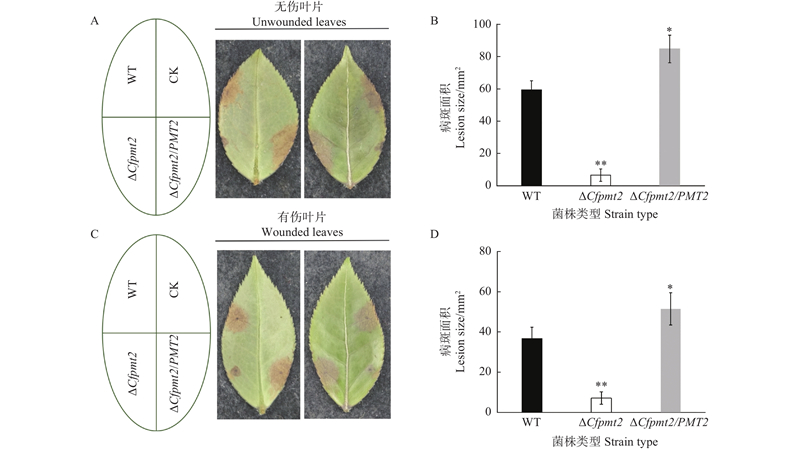
目的: 解析油茶果生炭疽菌O-甘露糖基转移酶CfPmt2的生物学功能,为油茶炭疽病防控提供参考。方法: 基于同源重组原理构建CfPMT2基因敲除载体,通过PEG介导的原生质体转化法获得CfPMT2基因缺失突变体(ΔCfpmt2)和回补菌株(ΔCfpmt2/PMT2)。对野生型、突变体和回补菌株的营养生长、分生孢子和附着胞形成情况、黏附能力、细胞壁胁迫和氧化胁迫敏感性、菌丝形成发育和致病力等生物学表型进行测定。结果: 1) 与野生型(WT)菌株相比,ΔCfpmt2在PDA、CM和MM培养基上的菌丝生长速率分别下降69.23%、74.77%和81.55%,分生孢子产量、萌发率和附着胞形成率分别降低约96%、17%、30%,附着胞畸形率升高至56%,且菌丝、分生孢子和附着胞的形态建成受损,黏附能力显著下降,只有WT菌株的46.12%和50.84%。2) qRT-PCR检测表明,突变体中黏附相关基因GAA1、GPI8和MSB2的相对表达量分别下调31.19%、30.81%和25.36%。3) ΔCfpmt2在含有细胞壁胁迫和氧化胁迫的PDA培养基上生长抑制率显著高于WT菌株,且菌丝、分生孢子和附着胞中几丁质和ROS稳态受到影响。4) 致病力分析发现,ΔCfpmt2的致病力显著下降,在有伤和无伤油茶叶片上的病斑面积仅为WT菌株的11.12%和19.2%。ΔCfpmt2/PMT2可恢复生长发育以及致病力缺陷,与WT菌株一致。结论: O-甘露糖基转移酶CfPmt2参与调控果生炭疽菌菌丝、分生孢子和附着胞形成发育和黏附、几丁质代谢和ROS稳态、外界胁迫响应以及致病过程。
中图分类号:
李馥菡,李河. 油茶果生炭疽菌O-甘露糖基转移酶CfPmt2的生物学功能[J]. 林业科学, 2026, 62(8): 30-42.
Fuhan Li,He Li. Functional Analysis of O-Mannosyltransferase CfPmt2 in Colletotrichum fructicola[J]. Scientia Silvae Sinicae, 2026, 62(8): 30-42.
表1
所用引物序列"
| 引物 Primer | 引物序列 Sequence(5′??3′?) |
| CfPMT2-1F | AGATGGTCTCGAACTCCAGT |
| CfPMT2-2R | TTGACCTCCACTAGCTCCAGCCAAGCCGGTGACGGCATGCTGTGTAG |
| CfPMT2-3F | CAAAGGAATAGAGTAGATGCCGACCGAGCACTCTTGGAGGTAATCT |
| CfPMT2-4R | TCGCTAAGCTCGTCTGCATT |
| CfPMT2-5F | TACGCAGCAAGTGATACTCG |
| H855R | GCTGATCTGACCAGTTGC |
| CfPMT2-7F | CTGGATTCGCGTAAAGTGCG |
| CfPMT2-8R | TGAAGAGGGCAGGAATGCAG |
| CfPMT2-9F | ACTCACTATAGGGCGAATTGGGTACTCAAATTG GTTTGAGGTTGTCGGAGGAAGAA |
| CfPMT2-10R | CACCACCCCGGTGAACAGCTCCTCGCCCTTGCT CACGTCAGACATCCTCCAGGTAT |
| Hyg-F | GGCTTGGCTGGAGCTAGTGGAGGTCAA |
| Hyg-R | CGGTCGGCATCTACTCTATTCCTTTG |
| GFP-F | ATGGTGAGCAAGGGCGAGG |
| GFP-R | CTTGTACAGCTCGTCCATGC |
| qRTPmt2F | CGCGAATTGAAGCTGAGACG |
| qRTPmt2R | CCAGAAGAACCATTCGGGCT |
| qRTGPI8F | TGCCAGGCCAACACAATGTA |
| qRTGPI8R | CCGTCTTCTTGGAGCTGAGG |
| qRTGAA1F | GGCACTTTCCGGAGTCTGAA |
| qRTGAA1R | CCACAATGGGAGGCTGTTCT |
| qRTMsb2F | AACACCACCGATGCTGAGAG |
| qRTMsb2R | CTGAACAACAGGCGTTTCGG |
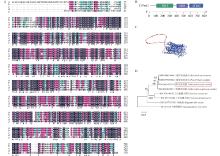
图1
CfPmt2的序列分析 A. CfPmt2及同源蛋白氨基酸序列的同源性分析;a:果生炭疽菌;b:胶孢炭疽菌;c:稻瘟菌;d:尖孢镰刀菌;e:酿酒酵母;B. CfPmt2的结构域分析;C. CfPmt2的三级结构;D. CfPmt2及其同源蛋白氨基酸序列的系统发育分析。A. Homology analysis of amino acid sequences of CfPmt2 and its homologous proteins; a: Colletotrichum fructicola; b: Colletotrichum gloeosporioides; c: Magnaporthe oryzae; d: Fusarium oxysporum; e: Saccharomyces cerevisiae; B. Domain analysis of CfPmt2; C. Tertiary structure of CfPmt2; D. Phylogenetic analysis of amino acid sequences of CfPmt2 and its homologous proteins."
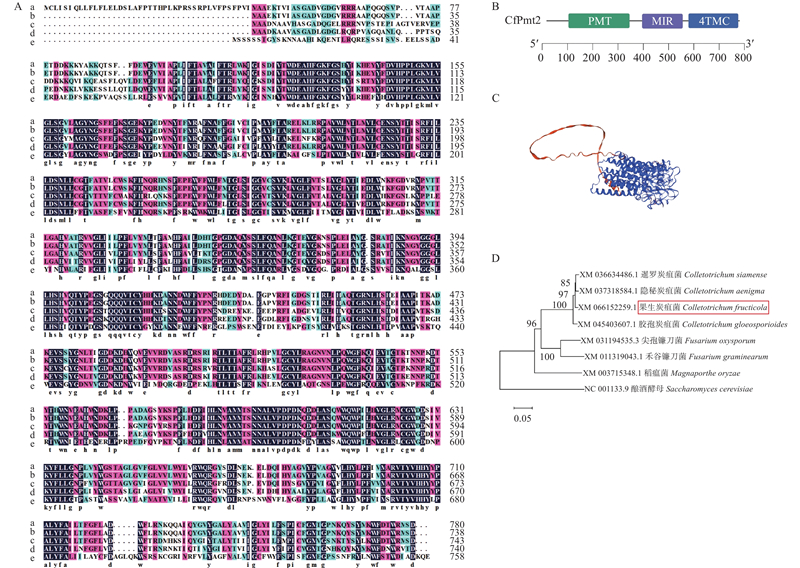
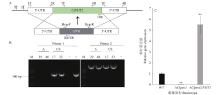
图2
CfPMT2基因敲除载体的构建以及突变体和互补菌株的获得 A. CfPMT2基因敲除策略模式;B. 突变体和回补菌株的电泳验证;M:分子量为5 000 marker;?:H2O阴性对照;+:WT阳性对照;Δ:突变体(编号为29、46);CS:回补菌株(编号为17、33);C. CfPMT2基因在各菌株中的表达量分析;**:表示差异极显著(P<0.01)。"
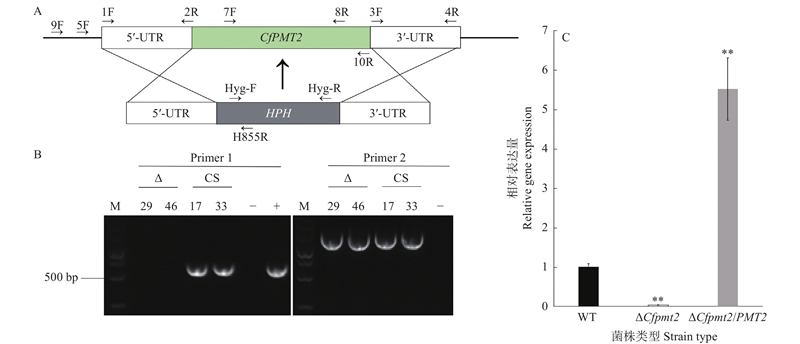
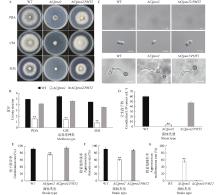
图3
ΔCfpmt2营养生长、分生孢子以及附着胞形成测定 A:WT、ΔCfpmt2和ΔCfpmt2/PMT2菌株在PDA、CM、MM培养基上的营养生长情况;B:各菌株的菌落大小统计;C:各菌株的分生孢子及附着胞,白色箭头表示芽管上的球状结构;标尺=10 μm;D:产孢量的统计分析;E:萌发率的统计分析;F:附着胞形成率的统计分析;G:附着胞畸形率的统计分析;**:表示差异极显著(P<0.01)。"
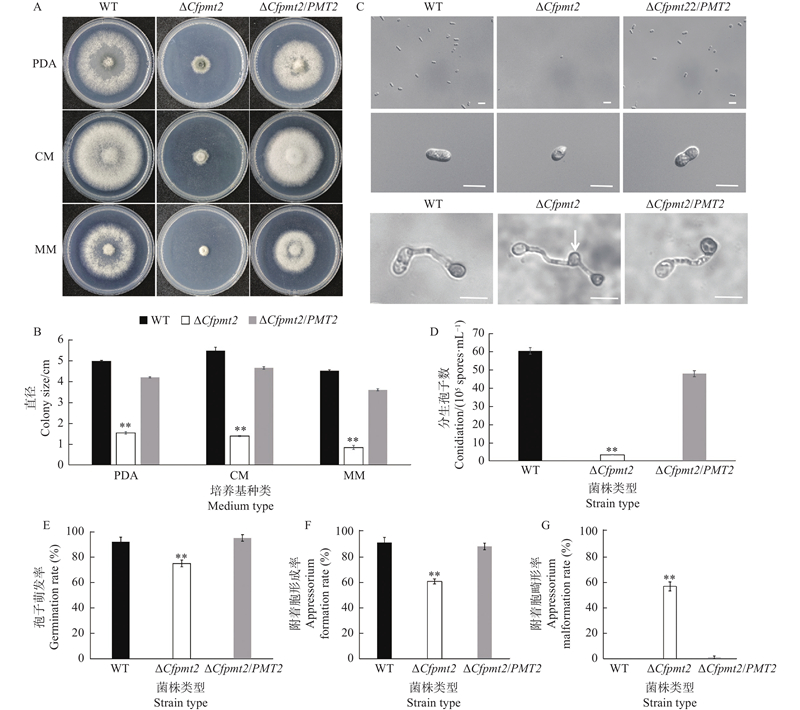
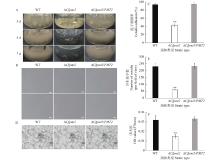
图4
ΔCfpmt2分生孢子的黏附分析 A. 各菌株在液体培养基PDB中培养3、5、7天培养液的情况;B. 无菌水冲洗前后疏水玻片上的分生孢子;上:未冲洗;下:冲洗后;标尺=20 μm;C. 对各菌株分生孢子黏附率的统计分析;D. PBS冲洗后经结晶紫染色的分生孢子;标尺=20 μm;E. 随机选取3~5个视野对结晶紫染色后的分生孢子数量的统计分析;F. 酶标仪对各菌株结晶紫染色后分生孢子OD值的统计分析;**:表示差异极显著(P<0.01)。"
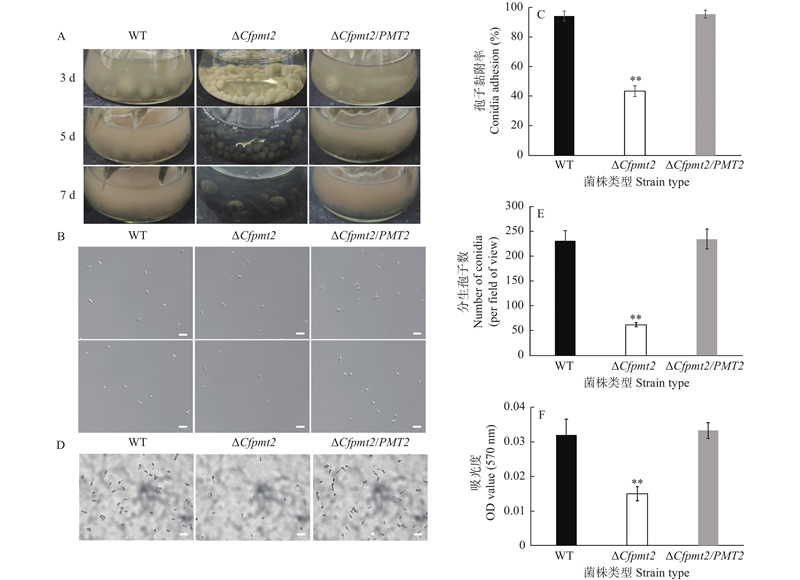
图5
ΔCfpmt2附着胞的黏附分析 A. 无菌水冲洗前后疏水玻片上的附着胞;上:未冲洗;下:冲洗后;标尺=20 μm;B. 对各菌株附着胞黏附率的统计分析;C. PBS冲洗后经结晶紫染色的附着胞;标尺=20 μm;D. 随机选取3~5个视野对结晶紫染色后的附着胞数量的统计分析;E. 酶标仪对各菌株结晶紫染色后附着胞OD值的统计分析;**:表示差异极显著(P<0.01)。"
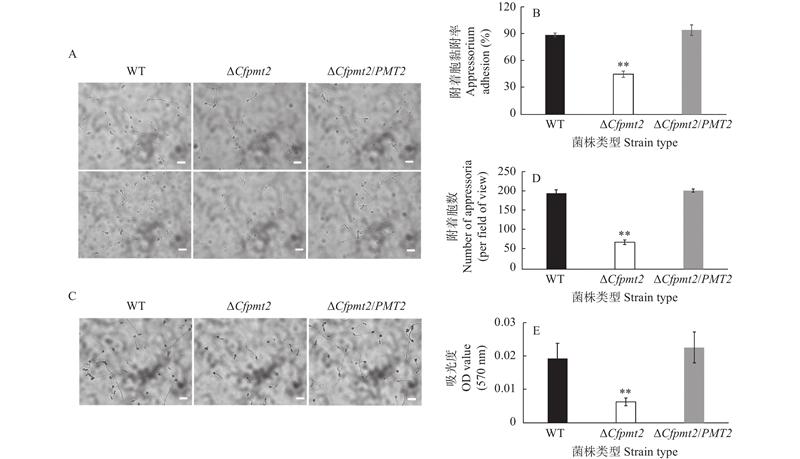
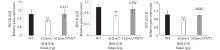
图6
ΔCfpmt2中GAA1、GPI8和MSB2基因相对表达水平的qRT-PCR分析"
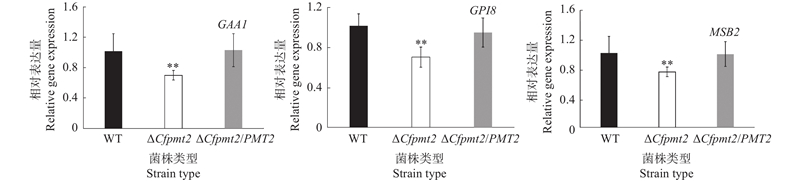
图7
ΔCfpmt2在细胞壁胁迫和氧化胁迫下的敏感性测定 A. WT、ΔCfpmt2和ΔCfpmt2/PMT2在添加400 μg·mL−1 CR的PDA培养基上的生长情况;B. WT、ΔCfpmt2和ΔCfpmt2/PMT2在添加5 mmol·L−1 H2O2和10 mmol·L−1 H2O2的PDA培养基上的生长情况;C. 各菌株抑制率的统计分析;**:表示差异极显著(P<0.01)。"
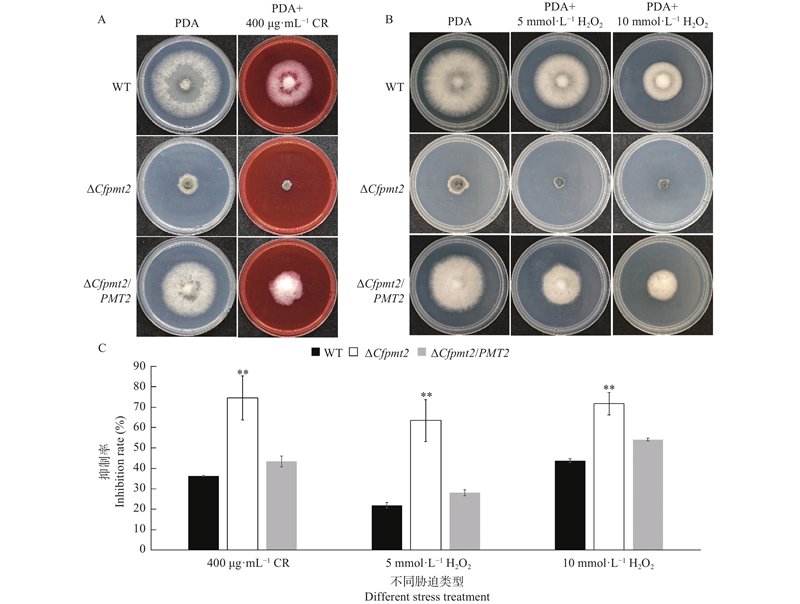
图8
ΔCfpmt2菌丝的形成和发育分析 A. 各菌株试管菌丝形成情况;B. 各菌株菌丝CFW染色情况分析,白色箭头表示隔膜;C. 各菌株菌丝DHR 123染色情况分析。"
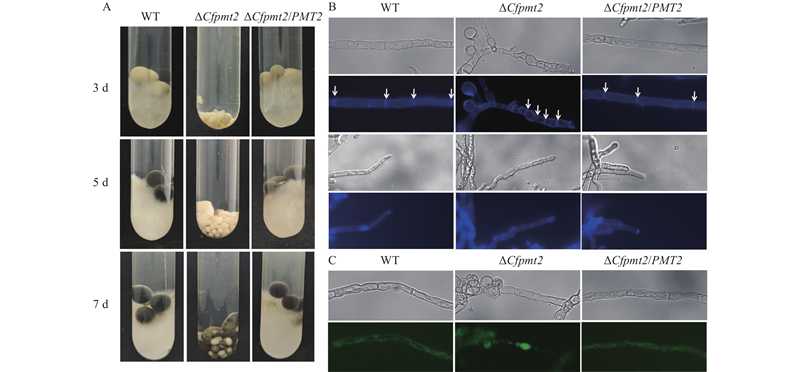
图9
ΔCfpmt2分生孢子、附着胞几丁质和活性氧的分布 A. 各菌株的分生孢子悬浮液在疏水玻片上培养2、4、6、和24 h后CFW染色情况;B. 各菌株的分生孢子悬浮液在疏水玻片上培养2、4、6、和24 h后DHR 123染色情况。"
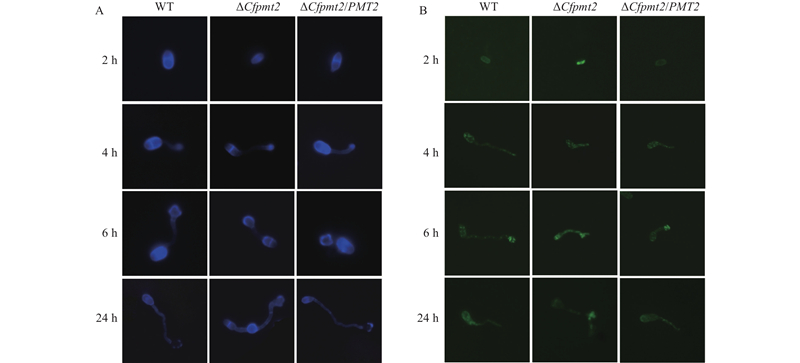
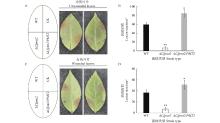
图10
ΔCfpmt2的致病力测定 A. 各菌株接种无伤油茶叶片的致病情况;B. 无伤油茶叶片上病斑大小的统计分析;C. 各菌株接种有伤油茶叶片的致病情况;D. 有伤油茶叶片上病斑大小的统计分析;**:表示差异极显著(P<0.01);*:表示差异显著(P<0.05)。"
| 范晶晶, 李冠辰, 王子瑄, 等. 组蛋白赖氨酸甲基转移酶CfDot1在果生刺盘孢中的功能. 菌物学报, 2025, 44 (2): 55- 67. | |
| Fan J J, Li G C, Wang Z X, et al. Function of histone lysine methyltransferase CfDot1 in Colletotrichum fructicola. Mycosystema, 2025, 44 (2): 55- 67. | |
| 高亚兰, 何苑皋, 李 河. 调控油茶果生刺盘孢bZIP转录因子CfAp1的生物学功能. 林业科学, 2020, 56 (9): 30- 39. | |
| Gao Y L, He Y H, Li H. Biological function bZIP-Type transcription factor CfAp1 in Colletotrichum fructicola. Scientia Silvae Sinicae, 2020, 56 (9): 30- 39. | |
| 郭树峰, 郭 源, 陈 妍, 等. 半胱氨酸蛋白酶CfAtg4在油茶果生刺盘孢中的功能分析. 林业科学, 2024, 60 (7): 65- 72. | |
| Guo S F, Guo Y, Chen Y, et al. Functional analysis of cysteine protease CfAtg4 in Colletotrichum fructicola on Camellia oleifera. Scientia Silvae Sinicae, 2024, 60 (7): 65- 72. | |
| 郭 源. 2024. CfSnt2调控油茶果生炭疽菌细胞自噬和致病力的分子机制. 长沙: 中南林业科技大学. | |
| Guo Y. 2024. Molecular mechanism of CfSnt2 regulating autophagy and pathogenicity of Colletotrichum fructicola on Camellia oleifera. Changsha: Central South University of Forestry and Technology. [in Chinese] | |
|
郭 源, 李 河, 周国英, 等. 自噬相关蛋白CfAtg8在果生刺盘孢中的功能分析. 菌物学报, 2021, 40 (3): 592- 602.
doi: 10.13346/j.mycosystema.200227 |
|
|
Guo Y, Li H, Zhou G Y, et al. Functional analysis of the autophagy-related protein CfAtg8 in Colletotrichum fructicola. Mycosystema, 2021, 40 (3): 592- 602.
doi: 10.13346/j.mycosystema.200227 |
|
| 刘田谷. 2023. ChGPI7介导的GPI锚定修饰调控玉米小斑病菌致病过程的机制研究. 武汉: 华中农业大学. | |
| Liu T G. 2023. ChGPI7-mediated GPI anchoring modification regulates pathogenic process of Cochlibolus heterostrophus. Wuhan: Huazhong Agricultural University. [in Chinese] | |
| 李茜雅. 2022. CfVPS35基因调控果生刺盘孢致病力的分子机制研究. 长沙: 中南林业科技大学. | |
| Li X Y. 2022. Molecular mechanism of CfVPS35 gene regulating pathogenicity in Colletotrichum fructicola. Changsha: Central South University of Forestry and Technology. [in Chinese] | |
| 李茜雅, 张盛培, 李 河. 油茶果生刺盘孢液泡分选蛋白CfVps26的功能. 林业科学, 2021, 57 (8): 94- 101. | |
| Li X Y, Zhang S P, Li H. Function of vacuolar protein sorting CfVps26 in Colletotrichum fructicola on Camellia oleifera. Scientia Silvae Sinicae, 2021, 57 (8): 94- 101. | |
| 杨 迪. 2024. 油茶果生刺盘孢甘露糖转移酶Cfpmt的功能研究. 长沙: 中南林业科技大学. | |
| Yang D. 2024. Functional study of mannose phosphate transferases Cfpmt in Colletotrichum fructicola. Changsha: Central South University of Forestry and Technology. [in Chinese] | |
| 靳爱仙, 周国英, 李 河. 油茶炭疽病的研究现状、问题与方向. 中国森林病虫, 2009, 28 (2): 27- 31. | |
| Jin A X, Zhou G Y, Li H. Progress, problem and prospect of oil Camelliae anthracnose (Colletotrichum gloeosporioides) research. Forest Pest and Disease, 2009, 28 (2): 27- 31. | |
| 杨淑凤, 邓国英, 刘 欣, 等. 2015. 真核生物蛋白质O-甘露糖基化的研究进展. 生命的化学, 35(1): 5−8. | |
| Yang S F, Deng G Y, Liu X, et al. 2015. Protein O-mannosylation in eukaryotes. Chemistry of Life. 35(1): 5−8. [in Chinese] | |
|
Aebi M. N-linked protein glycosylation in the ER. Biochimica et Biophysica Acta (BBA) - Molecular Cell Research, 2013, 1833 (11): 2430- 2437.
doi: 10.1016/j.bbamcr.2013.04.001 |
|
|
Bago B, Chamberland H, Goulet A, et al. Effect of nikkomycin Z, a chitin-synthase inhibitor, on hyphal growth and cell wall structure of two arbuscular-mycorrhizal fungi. Protoplasma, 1996, 192 (1): 80- 92.
doi: 10.1007/bf01273247 |
|
|
Dai H F, Wen Z Q, Xia Y X, et al. MaMsb2, a signaling mucin, is involved in conidiation, stress tolerances, and virulence in the entomopathogenic fungus Metarhizium acridum. Virulence, 2025, 16 (1): 2541708.
doi: 10.1080/21505594.2025.2541708 |
|
|
Du M G, Yuan Z N, Kovach A, et al. Pmt4 recognizes two separate acceptor sites to O-mannosylate in the S/T-rich regions of substrate proteins. Nature Communications, 2025, 16, 9726.
doi: 10.1038/s41467-025-64729-9 |
|
|
Essen L O, Vogt M S, Mösch H U. Diversity of GPI-anchored fungal adhesins. Biological Chemistry, 2020, 401 (12): 1389- 1405.
doi: 10.1515/hsz-2020-0199 |
|
|
Fang W X, Ding W P, Wang B, et al. Reduced expression of the O-mannosyltransferase 2 (AfPmt2) leads to deficient cell wall and abnormal polarity in Aspergillus fumigatus. Glycobiology, 2010, 20 (5): 542- 552.
doi: 10.1093/glycob/cwp206 |
|
|
Fernández-Álvarez A, Elías-Villalobos A, Ibeas J I. The O-mannosyltransferase PMT4 is essential for normal appressorium formation and penetration in Ustilago maydis. The Plant Cell, 2009, 21 (10): 3397- 3412.
doi: 10.1105/tpc.109.065839 |
|
|
Gentzsch M, Tanner W. Protein-O-glycosylation in yeast: protein-specific mannosyltransferases. Glycobiology, 1997, 7 (4): 481- 486.
doi: 10.1093/glycob/7.4.481 |
|
|
Girrbach V, Strahl S. Members of the evolutionarily conserved PMT family of protein O-mannosyltransferases form distinct protein complexes among themselves. Journal of Biological Chemistry, 2003, 278 (14): 12554- 12562.
doi: 10.1074/jbc.M212582200 |
|
|
Girrbach V, Zeller T, Priesmeier M, et al. Structure-function analysis of the dolichyl phosphate-mannose: protein O-mannosyltransferase ScPmt1p. Journal of Biological Chemistry, 2000, 275 (25): 19288- 19296.
doi: 10.1074/jbc.M001771200 |
|
|
González M, Brito N, Frías M, et al. Botrytis cinerea protein O-mannosyltransferases play critical roles in morphogenesis, growth, and virulence. PLoS One, 2013, 8 (6): e65924.
doi: 10.1371/journal.pone.0065924 |
|
| Goto M. 2007. Protein O-glycosylation in fungi: diverse structures and multiple functions. Bioscience, Biotechnology, and Biochemistry, 71(6): 1415−1427. | |
|
Goto M, Harada Y, Oka T, et al. Protein O-mannosyltransferases B and C support hyphal development and differentiation in Aspergillus nidulans. Eukaryotic Cell, 2009, 8 (10): 1465- 1474.
doi: 10.1128/EC.00371-08 |
|
|
Guo M, Tan L Y, Nie X, et al. The Pmt2p-mediated protein O-mannosylation is required for morphogenesis, adhesive properties, cell wall integrity and full virulence of Magnaporthe oryzae. Frontiers in Microbiology, 2016, 7, 630.
doi: 10.3389/fmicb.2016.00630 |
|
|
Harries E, Gandía M, Carmona L, et al. The Penicillium digitatum protein O-mannosyltransferase Pmt2 is required for cell wall integrity, conidiogenesis, virulence and sensitivity to the antifungal peptide PAF26. Molecular Plant Pathology, 2015, 16 (7): 748- 761.
doi: 10.1111/mpp.12232 |
|
|
Jayawardena R S. Colletotrichum: lifestyles, biology, morpho-species, species complexes and accepted species. Mycosphere, 2021, 12 (1): 519- 669.
doi: 10.5943/mycosphere/12/1/7 |
|
|
Kriangkripipat T, Momany M. Aspergillus nidulans protein O-mannosyltransferases play roles in cell wall integrity and developmental patterning. Eukaryotic Cell, 2009, 8 (10): 1475- 1485.
doi: 10.1128/EC.00040-09 |
|
|
Lehle L, Strahl S, Tanner W. Protein glycosylation, conserved from yeast to man: a model organism helps elucidate congenital human diseases. Angewandte Chemie International Edition, 2006, 45 (41): 6802- 6818.
doi: 10.1002/anie.200601645 |
|
|
Li H, Zhou G Y, Liu J A, et al. Population genetic analyses of the fungal pathogen Colletotrichum fructicola on tea-oil trees in China. PLoS One, 2016, 11 (6): e0156841.
doi: 10.1371/journal.pone.0156841 |
|
|
Loibl M, Strahl S. Protein O-mannosylation: What we have learned from baker’s yeast. Biochimica et Biophysica Acta (BBA) - Molecular Cell Research, 2013, 1833 (11): 2438- 2446.
doi: 10.1016/j.bbamcr.2013.02.008 |
|
|
Lommel M, Strahl S. Protein O-mannosylation: conserved from bacteria to humans. Glycobiology, 2009, 19 (8): 816- 828.
doi: 10.1093/glycob/cwp066 |
|
|
Mouyna I, Kniemeyer O, Jank T, et al. Members of protein O-mannosyltransferase family in Aspergillus fumigatus differentially affect growth, morphogenesis and viability. Molecular Microbiology, 2010, 76 (5): 1205- 1221.
doi: 10.1111/j.1365-2958.2010.07164.x |
|
|
Oliveira-Garcia E, Deising H B. The glycosylphosphatidylinositol anchor biosynthesis genes GPI12, GAA1, and GPI8 are essential for cell-wall integrity and pathogenicity of the maize anthracnose fungus Colletotrichum graminicola. Molecular Plant-Microbe Interactions®, 2016, 29 (11): 889- 901.
doi: 10.1094/MPMI-09-16-0175-R |
|
|
Olson G M, Fox D S, Wang P, et al. Role of protein O-mannosyltransferase Pmt4 in the morphogenesis and virulence of Cryptococcus neoformans. Eukaryotic Cell, 2007, 6 (2): 222- 234.
doi: 10.1128/EC.00182-06 |
|
|
Pan Y M, Pan R, Tan L Y, et al. Correction to: pleiotropic roles of O-mannosyltransferase MoPmt4 in development and pathogenicity of Magnaporthe oryzae. Current Genetics, 2019, 65 (1): 241.
doi: 10.1007/s00294-018-0888-7 |
|
|
Pejenaute-Ochoa M D, Santana-Molina C, Devos D P, et al. Structural, evolutionary, and functional analysis of the protein O-mannosyltransferase family in pathogenic fungi. Journal of Fungi, 2021, 7 (5): 328.
doi: 10.3390/jof7050328 |
|
|
Peng S F, Lu J, Zhang Z, et al. Global transcriptome and correlation analysis reveal cultivar-specific molecular signatures associated with fruit development and fatty acid determination in Camellia oleifera Abel. International Journal of Genomics, 2020 (1): 6162802.
doi: 10.1155/2020/6162802 |
|
|
Plaza V, Pasten A, López-Ramírez L A, et al. Botrytis cinerea PMT4 is involved in O-glycosylation, cell wall organization, membrane integrity, and virulence. Journal of Fungi, 2025, 11 (1): 71.
doi: 10.3390/jof11010071 |
|
|
Shaw B D, Momany M. Aspergillus nidulans polarity mutant swoA is complemented by protein O-mannosyltransferase pmtA. Fungal Genetics and Biology, 2002, 37 (3): 263- 270.
doi: 10.1016/S1087-1845(02)00531-5 |
|
|
Takayama T, Yamamoto K, Saito H, et al. Interaction between the transmembrane domains of Sho1 and Opy2 enhances the signaling efficiency of the Hog1 MAP kinase cascade in Saccharomyces cerevisiae. PLoS One, 2019, 14 (1): e0211380.
doi: 10.1371/journal.pone.0211380 |
|
|
Willer T, Brandl M, Sipiczki M, et al. Protein O-mannosylation is crucial for cell wall integrity, septation and viability in fission yeast. Molecular Microbiology, 2005, 57 (1): 156- 170.
doi: 10.1111/j.1365-2958.2005.04692.x |
|
|
Willer T, Valero M C, Tanner W, et al. O-mannosyl glycans: from yeast to novel associations with human disease. Current Opinion in Structural Biology, 2003, 13 (5): 621- 630.
doi: 10.1016/j.sbi.2003.09.003 |
|
|
Xu Y Q, Zhou H, Zhao G Y, et al. Genetical and O-glycoproteomic analyses reveal the roles of three protein O-mannosyltransferases in phytopathogen Fusarium oxysporum f. sp. cucumerinum. Fungal Genetics and Biology, 2020, 134, 103285.
doi: 10.1016/j.fgb.2019.103285 |
|
|
Zhou A T, Wang F, Yin J B, et al. Antifungal action and induction of resistance by Bacillus sp. strain YYC 155 against Colletotrichum fructicola for control of anthracnose disease in Camellia oleifera. Frontiers in Microbiology, 2022, 13, 956642.
doi: 10.3389/fmicb.2022.956642 |
|
|
Zhou H Q, Dong K K, Du Q J, et al. Biofilm-forming of Bacillus tequilensis DZY 6715 enhanced suppression the Camellia oleifera anthracnose caused by Colletotrichum fructicola and its mechanism. Scientia Horticulturae, 2024, 338, 113676.
doi: 10.1016/j.scienta.2024.113676 |
| [1] | 李庆松,徐道春,白效鹏,何源,马跃威,李文彬. 油茶树分布质量模型的构建与仿真试验[J]. 林业科学, 2026, 62(7): 197-207. |
| [2] | 刘佳,贾松林,王浩宇,罗静扬,郭建强,曹中宇,彭仁荣,吴玲利,李建安,谭晓风,李泽. 茶陵红花油茶特异种质挖掘及油脂品质分析比较[J]. 林业科学, 2026, 62(6): 191-204. |
| [3] | 杨春梅,单重阳,吴晓峰,周建波,张北航,李全罡,羿宏雷,李芝茹,谭志域,张卫国. 面向自动嫁接成型装置的油茶苗木力学特性[J]. 林业科学, 2026, 62(6): 224-235. |
| [4] | 钟慧奇,柴静瑜,王开良,滕建华,毕文玉,王安妮,林萍. 基于CARS-PLSR的油茶种仁油脂含量和脂肪酸成分的近红外光谱预测模型构建[J]. 林业科学, 2026, 62(2): 111-125. |
| [5] | 刘然,周建波,苗振坤,张宇,李腾飞,李芝茹,王石. 油茶嫁接苗无纺布育苗容器开袋条件与力学试验分析[J]. 林业科学, 2025, 61(8): 1-10. |
| [6] | 张婷,李建安,龚玉子,杨昕悦,刘彩霞,王浩宇,谭晓风,李泽. 湖南省5个主推油茶早中熟品种授粉配置技术[J]. 林业科学, 2025, 61(4): 153-168. |
| [7] | 郭树峰,郭源,陈妍,李河,张盛培. 半胱氨酸蛋白酶CfAtg4在油茶果生刺盘孢中的功能分析[J]. 林业科学, 2024, 60(7): 65-72. |
| [8] | 谭晓风,袁军,李泽,李建安. “三华油茶”的选育与推广应用[J]. 林业科学, 2024, 60(11): 199-202. |
| [9] | 李玲玲,朱原野,张盛培,李河. 油茶炭疽病复合病菌鉴定及室内药剂评价[J]. 林业科学, 2023, 59(5): 100-108. |
| [10] | 曹业凡,王曦茁,汪来发,汪祥,徐明,苏胜荣,郭伟. 不同致病力松材线虫对红松早期防御酶活性影响[J]. 林业科学, 2022, 58(8): 10-17. |
| [11] | 张守科,李子坤,殷昊,张威,舒金平,王浩杰,周旭东,汪阳东. 油茶抗性无性系茶皂素含量对茶籽象幼虫肠道菌群结构的影响[J]. 林业科学, 2022, 58(7): 120-127. |
| [12] | 李艳民,袁德义,叶天文,陈雅,韩春霞,肖诗鑫. 油茶种间杂交F1代18个优良单株核型分析[J]. 林业科学, 2022, 58(4): 165-174. |
| [13] | 李梓杨,陈晓琳,李丽丽,许诗萍,何苑皞. 油茶根系与内生细菌枯草芽孢杆菌互作早期的转录组分析[J]. 林业科学, 2022, 58(3): 48-58. |
| [14] | 陈永忠,刘彩霞,许彦明,张震,彭映赫,陈隆升,苏以荣,王瑞,唐炜. 生草栽培对油茶林土壤微生物群落结构和稳定性的影响[J]. 林业科学, 2022, 58(11): 61-70. |
| [15] | 陈星州,周国英,陈行钢,江玲玉,包安华,刘君昂. 油茶炭疽病菌果生刺盘孢效应子的筛选[J]. 林业科学, 2021, 57(9): 110-120. |
| 阅读次数 | ||||||
|
全文 |
|
|||||
|
摘要 |
|
|||||

