
Scientia Silvae Sinicae ›› 2025, Vol. 61 ›› Issue (11): 1-13.doi: 10.11707/j.1001-7488.LYKX20250243
• Frontiers and hot topics • Previous Articles Next Articles
Weiwei Shu1,3,Angang Ming1,*( ),Kun Yang1,Hua Li1,3,Huilin Min1,3,Yi Tao1,Zhongguo Li1,3,Juling Wei1,Shirong Liu2
Received:2025-04-19
Revised:2025-08-23
Online:2025-11-25
Published:2025-12-11
Contact:
Angang Ming
E-mail:mingangang0111@163.com
CLC Number:
Weiwei Shu,Angang Ming,Kun Yang,Hua Li,Huilin Min,Yi Tao,Zhongguo Li,Juling Wei,Shirong Liu. Effects of Close-to-Nature Transformation on the Chemical Stability of Soil Organic Carbon in Pinus massoniana and Cunninghamia lanceolata Plantations[J]. Scientia Silvae Sinicae, 2025, 61(11): 1-13.

Table 1
Basic information and management history of plantations"
| 年份 Years | 项目 Item | 杉木对照林Cunninghamia lanceolata control plantation | 杉木改造林Close-to-nature transformed Cunninghamia lanceolata plantation | 马尾松对照林 Pinus massoniana control plantation | 马尾松改造林 Close-to-nature transformed Pinus massoniana plantation |
| 1993 | 造林Afforestation | 种植2年生容器苗,初植密度 | 种植2年生容器苗,初植密度 | 种植2年生容器苗,初植密度 | 种植2年生容器苗,初植密度 |
| 1993— 1995 | 新造林抚育Tending of young plantation | 全铲抚育6次 Complete clearing (6 times) | 全铲抚育6次 Complete clearing (6 times) | 全铲抚育6次 Complete clearing (6 times) | 全铲抚育6次 Complete clearing (6 times) |
| 2000 | 透光伐Release cutting | 透光伐Release cutting | 透光伐Release cutting | 透光伐Release cutting | 透光伐Release cutting |
| 2004 | 生长伐Increment thinning | 保留密度 | 保留密度 | 保留密度 | 保留密度 |
| 2007 | 生长伐Increment thinning | 保留密度 | 保留密度600株? hm?2 Reserved density: 600 trees·hm?2 | 保留密度 | 保留密度600株?hm?2 Reserved density: 600 trees·hm?2 |
| 2008 | 林下补植Understory replanting | 不补植No replanting | 均匀补植大叶栎、格木各 300株?hm?2 Evenly replanting Quercus griffithii and Erythrophleum fordii (300 trees·hm?2 each) | 不补植No replanting | 均匀补植大叶栎、格木各 300株?hm?2 Evenly replanting Quercus griffithii and Erythrophleum fordii (300 trees·hm?2 each) |
| 2009 | 改造林抚育Tending in transformed plantation | 不抚育No tending | 抚育2次Tending (2 times) | 不抚育No tending | 抚育2次Tending (2 times) |
Table 2
Survey of plantations"
| 指标Indices | 树种 Tree species | 杉木对照林Cunninghamia lanceolatea control plantation | 杉木改造林Close-to-nature transformed Cunninghamia lanceolata plantation | 马尾松对照林Pinus massoniana control plantation | 马尾松改造林Close-to-nature transformed Pinus massoniana plantation |
| DBH/cm | 杉木Cunninghamia lanceolata | 14.87±4.31a | 20.78±3.47b | — | — |
| 马尾松Pinus massoniana | — | — | 26.91±7.56b | 35.33±6.32a | |
| 格木Erythrophleum fordii | — | 7.51±4.41a | — | 5.71±3.29a | |
| 大叶栎Quercus griffithii | — | 21.47±7.75a | — | 26.93±7.97a | |
| 树高Tree height/m | 杉木Cunninghamia lanceolata | 13.63±2.05a | 14.01±1.72a | — | — |
| 马尾松Pinus massoniana | — | — | 20.31±3.16a | 21.23±2.29a | |
| 格木Erythrophleum fordii | — | 7.23±3.43a | — | 6.29±3.53a | |
| 大叶栎Quercus griffithii | — | 13.92±2.72b | — | 18.49±4.38a | |
| 土层厚度 Soil thickness/cm | ≥100 | ≥100 | ≥100 | ≥100 | |
| 坡向 Slope aspect | 西南Southwest | 西南Southwest | 西北Northwest | 西北Northwest | |
| 坡度 Slope/ (°) | 24.6±2.6a | 23.1±2.9a | 21.3±3.6a | 22.4±4.1a | |
| 郁闭度 Canopy density | 0.78±0.09b | 0.79±0.11b | 0.71±0.09b | 0.88±0.03a | |
| 凋落物量 Litter fall/(t?hm?2a?1) | 9.02±0.19b | 9.54±0.34 | 10.23±0.94a | 10.84±0.49a |
Table 3
Soil chemical and biological properties"
| 指标Indices | 杉木对照林Cunninghamia lanceolata control plantation | 杉木改造林Close-to-nature transformed Cunninghamia lanceolata plantation | 马尾松对照林Pinus massoniana control plantation | 马尾松改造林Close-to-nature transformed Pinus massoniana plantation |
| 有机碳含量Organic carbon (SOC)content/(g·kg?1) | 21.10±4.08a | 23.03±0.42a | 30.35±2.84a | 30.38±2.82a |
| 全氮含量Total nitrogen(TN) content/(g·kg?1) | 1.50±0.25a | 1.37±0.03a | 1.82±0.01a | 1.93±0.04a |
| 全磷含量Total phosphorus (TP) content/(g·kg?1) | 0.23±0.01b | 0.25±0.02ab | 0.28±0.01ab | 0.29±0.01a |
| 有效磷含量Available phosphorus (AP) content/(mg·kg?1) | 1.11±0.03b | 1.16±0.03b | 1.55±0.02a | 1.28±0.12b |
| 硝态氮含量NO3?-N content/(mg·kg?1) | 5.38±0.88b | 4.37±1.24b | 5.71±0.24b | 12.65±1.56a |
| 铵态氮含量NH4+-N content/(mg·kg?1) | 7.81±0.10b | 15.89±4.38a | 4.23±1.31c | 9.26±0.23b |
| 微生物生物量碳含量Microbial biomass carbon (MBC) content/(mg·kg?1) | 234.44±14.75c | 312.50±16.26b | 301.12±12.27b | 388.13±5.88a |
| 微生物生物量氮含量Microbial biomass nitrogen (MBN) content/(mg·kg?1) | 36.41±3.22b | 46.51±2.11ab | 39.07±3.29b | 53.30±4.06a |
| 细菌Chao1多样性指数 Bacterial Chao1 diversity index | ||||
| 细菌Shannon-Wiener多样性指 数Bacterial Shannon-Wiener diversity index | 5.87±0.11a | 5.72±0.12a | 5.60±0.02a | 5.61±0.04a |
| 细根生物量 Fine root biomass (FRB)/(g·m?2) | 401.57±53.71b | 675.26±21.50ab | 536.92±65.16b | 862.86±202.43a |
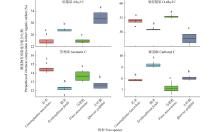
Fig.1
Chemical composition of organic carbon in litter of different tree species The organic carbon chemical components of litter of Pinus massoniana and Cunninghamia lanceolata are samples from a pure plantation, while those of Quercus griffithii and Erythrophleum fordii are samples from an improved plantation. Different lowercase letters within the same organic carbon component indicate significant differences among tree species (P<0.05)."
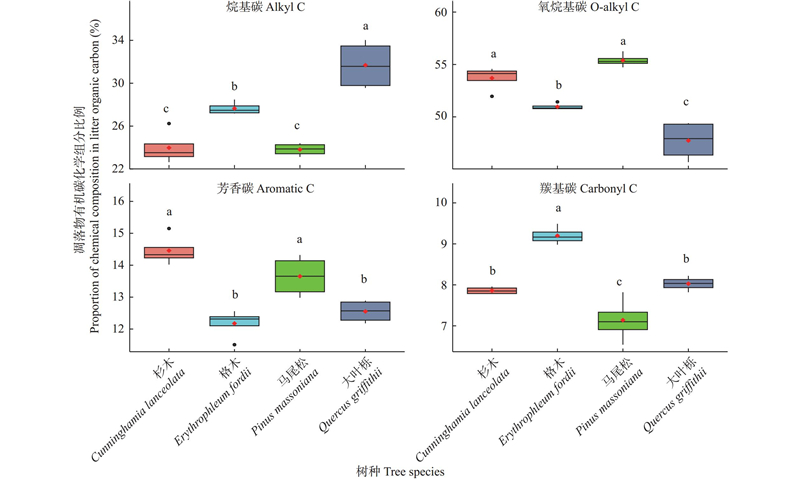
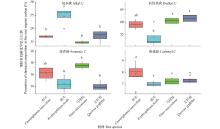
Fig.2
Chemical composition of organic carbon in fine roots of different tree species The organic carbon chemical components of fine roots of Pinus massoniana and Cunninghamia lanceolata are samples from pure plantation, while those of Quercus griffithii and Erythrophleum fordii are samples from improved plantation. Different lowercase letters within the same organic carbon component indicate significant differences among tree species (P<0.05)."
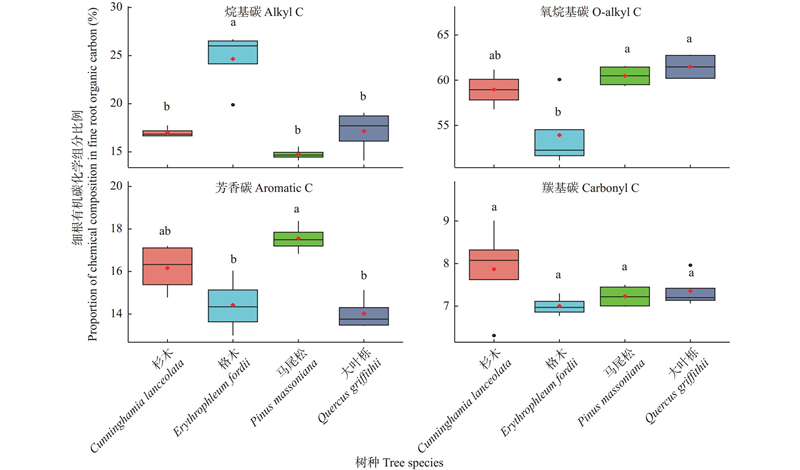
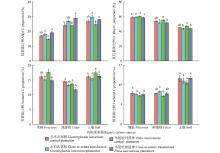
Fig.3
Chemical composition of litter, fine roots, and soil organic carbon in four types of plantations Different lowercase letters within the same source (fine roots, litter, soil) denote significant differences among forest stands (P<0.05)."
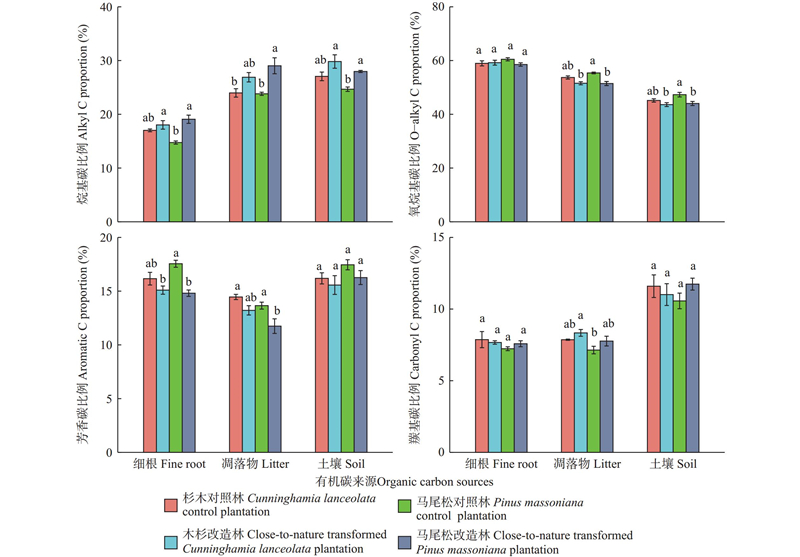
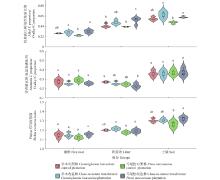
Fig.4
Differences in the alkyl C proportion/O-alkyl C proportion ratio, aromatic C proportion/O-alkyl C proportion ratio, and the distribution uniformity of various organic carbon components in the four types of plantations Different lowercase letters within the same source (fine roots, litter, soil) denote significant differences among forest stands (P<0.05)."
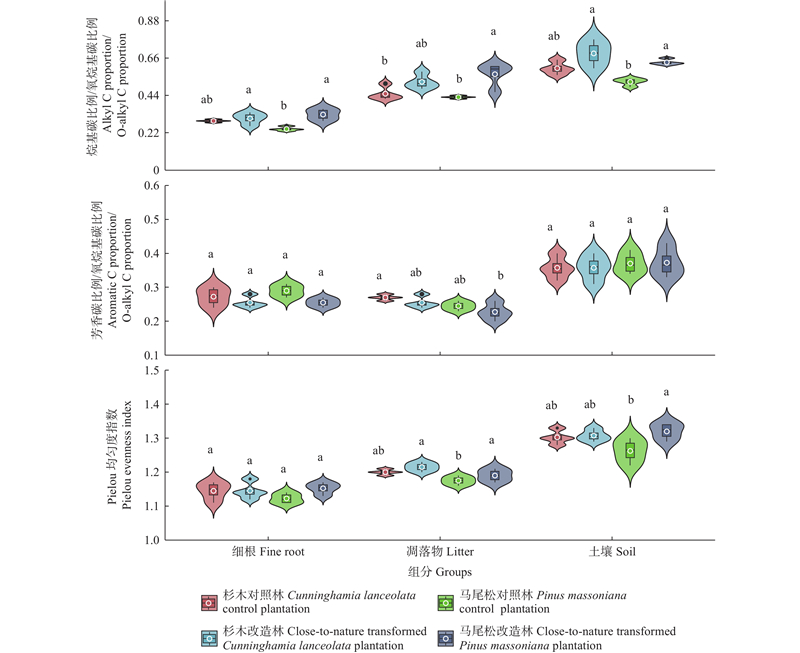
Fig.5
Correlation between soil organic carbon chemical components and plant, soil, and microbial indices"
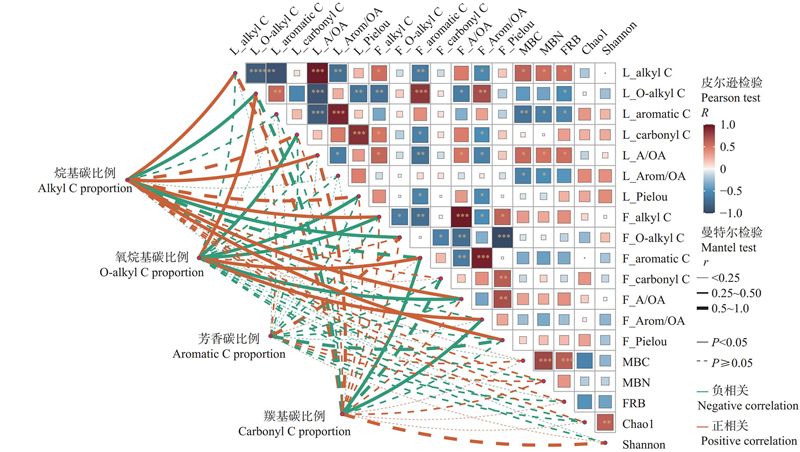
Fig.6
Relationships between the soil alkyl C proportion/O-alkyl C proportion ratio and that of litter and fine root in four types of plantations The shaded portion represents the 95% confidence interval."
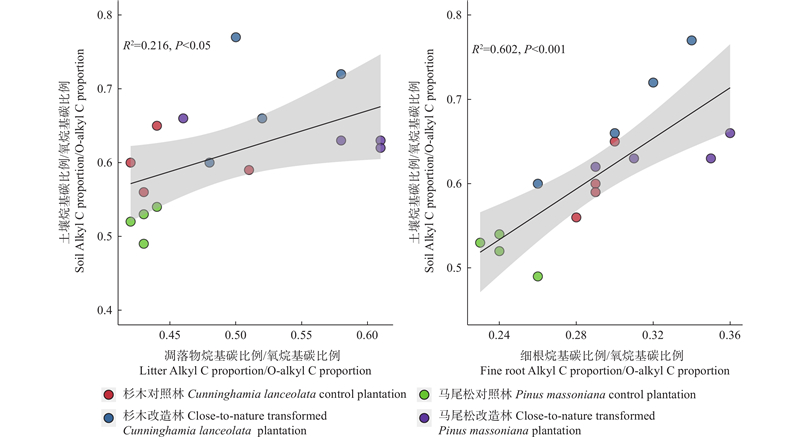
Fig.7
Random forest analysis of the influence of soil chemical properties on the proportions of alkyl C, O-alkyl C, aromatic C and carbonyl C"
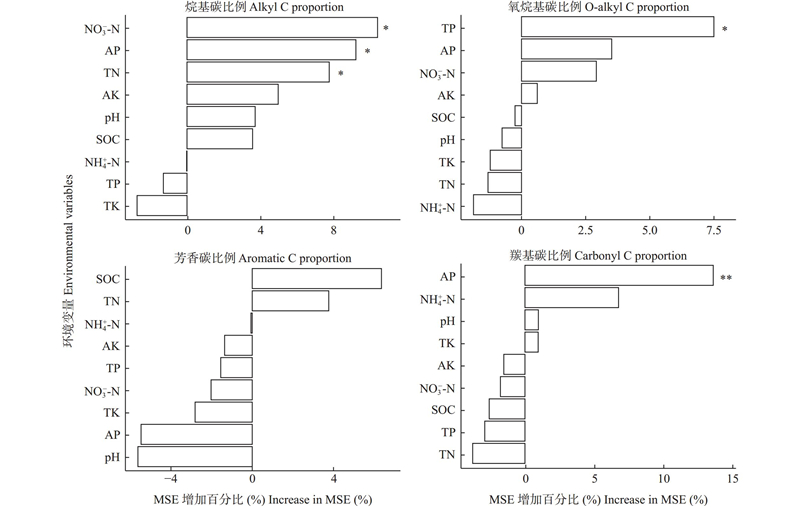
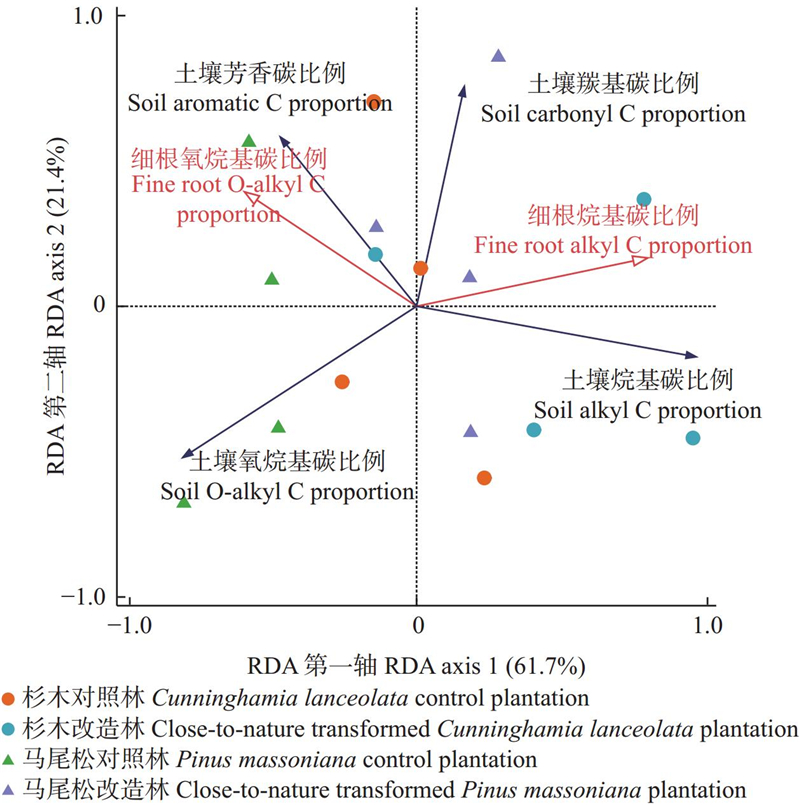
Fig.8
Redundancy Analysis (RDA) between soil organic carbon chemical components and litter, and fine root carbon chemical components in four types of plantations Soil organic carbon chemical composition (alkyl C, O-alkyl C, aromatic C, and carbonyl C) are the response variables, and fine root alkyl C proportion and fine root O-alkyl C proportion are the explanatory variables. Based on the permutation test (P<0.05), the plot only includes plant parameters that have a significant impact on the distribution of SOC chemical composition."
| 李克让, 陈育峰, 刘世荣, 等. 减缓及适应全球气候变化的中国林业对策. 地理学报, 1996, 51 (S1): 109- 119. | |
| Li K R, Chen Y F, Liu S R, et al. Mitigation and adaptation strategy of forestry in China to global climate change. Acta Geographica Sinica, 1996, 51 (S1): 109- 119. | |
| 刘世荣, 王 晖, 李海奎, 等. 碳中和目标下中国森林碳储量、碳汇变化预估与潜力提升途径. 林业科学, 2024, 60 (4): 157- 172. | |
| Liu S R, Wang H, Li H K, et al. Projections of china’s forest carbon storage and sequestration and ways of their potential capacity enhancement. Scientia Silvae Sinicae, 2024, 60 (4): 157- 172. | |
| 刘世荣, 王 晖, 栾军伟. 中国森林土壤碳储量与土壤碳过程研究进展. 生态学报, 2011, 31 (19): 5437- 5448. | |
| Liu SR, Wang H, Luan J W. A review of research progress and future prospective of forest soil carbon stock and soil carbon process in China. Acta Ecologica Sinica, 2011, 31 (19): 5437- 5448. | |
| 王 宁, 杨 雪, 李世兰, 等. 不同海拔红松混交林土壤微生物量碳、氮的生长季动态. 林业科学, 2016, 52 (1): 150- 158. | |
| Wang N, Yang X, Li S L, et al. Seasonal dynamics of soil microbial biomass carbon-nitrogen in the Korean pine mixed forests along elevation gradient. Scientia Silvae Sinicae, 2016, 52 (1): 150- 158. | |
| 王秋丽, Albert M. 近自然森林经营在德国的应用成效分析. 林业科学研究, 2019, 32 (3): 127- 134. | |
| Wang Q L, Albert M. Effect of close-to-nature forest management practice in Germany. Forest Research, 2019, 32 (3): 127- 134. | |
|
Augusto L, Boča A. Tree functional traits, forest biomass, and tree species diversity interact with site properties to drive forest soil carbon. Nature Communications, 2022, 13 (1): 1097.
doi: 10.1038/s41467-022-28748-0 |
|
|
Baldock J A, Oades J M, Waters A G, et al. Aspects of the chemical structure of soil organic materials as revealed by solid-state 13C NMR spectroscopy. Biogeochemistry, 1992, 16 (1): 1- 42.
doi: 10.1007/BF02402261 |
|
|
Bradford M A, Keiser A D, Davies C A, et al. Empirical evidence that soil carbon formation from plant inputs is positively related to microbial growth. Biogeochemistry, 2013, 113 (1/3): 271- 281.
doi: 10.1007/s10533-012-9822-0 |
|
| Chang J J, Zhu J X, Xu L, et al. Rational land-use types in the karst regions of China: insights from soil organic matter composition and stability. Catena, 2017, 160, 345- 353. | |
|
Crow S E, Lajtha K, Filley T R, et al. Sources of plant-derived carbon and stability of organic matter in soil: implications for global change. Global Change Biology, 2009, 15 (8): 2003- 2019.
doi: 10.1111/j.1365-2486.2009.01850.x |
|
|
Dixon R K, Solomon A M, Brown S. Carbon pools and flux of global forest ecosystems. Science, 1994, 263 (5144): 185- 190.
doi: 10.1126/science.263.5144.185 |
|
|
Ei Moujahid L, Le Roux X, Michalet S, et al. Effect of plant diversity on the diversity of soil organic compounds. PLoS ONE, 2017, 12 (2): e0170494.
doi: 10.1371/journal.pone.0170494 |
|
|
Gu S S, Cheng Q L, Bai Y Q, et al. Application of organic fertilizer improves microbial community diversity and alters microbial network structure in tea (Camellia sinensis) plantation soils. Soil Tillage Research, 2019, 195, 104356.
doi: 10.1016/j.still.2019.104356 |
|
|
Hannam K D, Quideau S A, Oh S W, et al. Forest floor composition in aspen- and spruce-dominated stands of the boreal mixedwood forest. Soil Science Society America Journal, 2004, 68 (5): 1735- 1743.
doi: 10.2136/sssaj2004.1735 |
|
|
Henneron L, Cros C, Picon-Cochard C, et al. Plant economic strategies of grassland species control soil carbon dynamics through rhizodeposition. Journal of Ecology, 2020, 108 (2): 528- 545.
doi: 10.1111/1365-2745.13276 |
|
| Huang X M, Liu S R, You Y M, et al. Microbial community and associated enzymes activity influence soil carbon chemical composition in Eucalyptus urophylla plantation with mixing N2-fixing species in subtropical China. Plant Soil, 2016, 414 (1/2): 199- 212. | |
| Johnson D, Booth R E, Whiteley A S, et al. Plant community composition affects the biomass, activity and diversity of microorganisms in limestone grassland soil. European Journal of Soil Science, 2010, 54 (4): 671- 678. | |
| Kelty M. The role of species mixtures in plantation forestry. Forest Ecology and Management, 2006, 233 (2/3): 195- 204. | |
|
Krishna M, Mohan M. Litter decomposition in forest ecosystems: a review. Energy Ecology and Environment, 2017, 2 (4): 236- 249.
doi: 10.1007/s40974-017-0064-9 |
|
|
Lehmann J, Hansel C M, Kaiser C, et al. Persistence of soil organic carbon caused by functional complexity. Nature Geoscience, 2020, 13 (8): 529- 534.
doi: 10.1038/s41561-020-0612-3 |
|
|
Lehmann J, Kleber M. The contentious nature of soil organic matter. Nature, 2015, 528 (7580): 60- 68.
doi: 10.1038/nature16069 |
|
| Liu S R, Wu S R, Wang H. Managing planted forests for multiple uses under a changing environment in China. New Zealand Journal of Forestry Science, 2014, 44 (Sup.1): 1−10. | |
|
Liu X, Trogisch S, He J S, et al. Tree species richness increases ecosystem carbon storage in subtropical forests. Proceedings of the Royal Society B: Biological Sciences, 2018, 285 (1885): 20181240.
doi: 10.1098/rspb.2018.1240 |
|
| Lorenz K, Lal R. Stabilization of organic carbon in chemically separated pools in reclaimed coal mine soils in Ohio. Geoderma, 2007, 141 (3/4): 294- 301. | |
|
Luan J W, Liu S R, Wang J X, et al. Tree species diversity promotes soil carbon stability by depressing the temperature sensitivity of soil respiration in temperate forests. Science of the Total Environment, 2018, 645, 623- 629.
doi: 10.1016/j.scitotenv.2018.07.036 |
|
|
Marcin C, Niklińska M. Effect of texture and tree species on microbial properties of mine soils. Applied Soil Ecology, 2010, 46 (2): 268- 275.
doi: 10.1016/j.apsoil.2010.08.002 |
|
|
Margenot A J, Calderón F J, Bowles T M, et al. Soil organic matter functional group composition in relation to organic carbon nitrogen, and phosphorus fractions in organically managed tomato fields. Soil Science Society of America Journal, 2015, 79 (3): 772- 782.
doi: 10.2136/sssaj2015.02.0070 |
|
|
Ming A G, Yang Y J, Liu S R, et al. The impact of near natural forest management on the carbon stock and sequestration potential of Pinus massoniana (Lamb. ) and Cunninghamia lanceolata (Lamb. ) Hook. plantations. Forests, 2019, 10 (8): 626.
doi: 10.3390/f10080626 |
|
| Mölder A, Sennhenn-Reulen H, Fischer C, et al. Success factors for high-quality oak forest (Quercus robur, Q. petraea) regeneration. Forest Ecosystems, 2019, 6 (1): 109- 125. | |
|
Mulder C P B, Bazeley-White E, Dimitrakopoulos P G, et al. Species evenness and productivity in experimental plant communities. Oikos, 2004, 107 (1): 50- 63.
doi: 10.1111/j.0030-1299.2004.13110.x |
|
|
Porazinska D L, Bardgett R D, Blaauw M B, et al. Relationships at the aboveground-belowground interface: plants, soil biota, and soil. Ecological Monographs, 2003, 73 (3): 377- 395.
doi: 10.1890/0012-9615(2003)073[0377:RATAIP]2.0.CO;2 |
|
|
Schmidt M W I, Knicker H, Hatcher P G, et al. Improvement of 13C and 15N CPMAS NMR spectra of bulk soils, particle size fractions and organic material by treatment with 10% hydrofluoric acid. European Journal of Soil Science, 1997, 48 (2): 319- 328.
doi: 10.1111/j.1365-2389.1997.tb00552.x |
|
|
Schmidt M W I, Torn M S, Abiven S, et al. Persistence of soil organic matter as an ecosystem property. Nature, 2011, 478 (7367): 49- 56.
doi: 10.1038/nature10386 |
|
|
Solomon D, Lehmann J, Kinyangi J, et al. Long-term impacts of anthropogenic perturbations on dynamics and speciation of organic carbon in tropical forest and subtropical grassland ecosystems. Global Change Biology, 2007, 13 (2): 511- 530.
doi: 10.1111/j.1365-2486.2006.01304.x |
|
|
Sun D S, Qiu X L, Feng J Y, et al. Forest types control the contribution of litter and roots to labile and persistent soil organic carbon. Biogeochemistry, 2024, 167 (12): 1609- 1617.
doi: 10.1007/s10533-024-01185-5 |
|
| Wang H, Liu S R, Mo J M, et al. Soil organic carbon stock and chemical composition in four plantations of indigenous tree species in subtropical China. Journal of Ecological Research, 2010, 25, 1071- 1079. | |
|
Wang H, Liu S R, Song Z C, et al. Introducing nitrogen-fixing tree species and mixing with Pinus massoniana alters and evenly distributes various chemical compositions of soil organic carbon in a planted forest in southern China. Forest Ecology and Management, 2019, 449, 117477.
doi: 10.1016/j.foreco.2019.117477 |
|
|
Wang H, Liu S R, Wang J X, et al. Mixed-species plantation with Pinus massoniana and Castanopsis hystrix accelerates C loss in recalcitrant coniferous litter but slows C loss in labile broadleaf litter in southern China. Forest Ecology and Management, 2018, 422, 207- 213.
doi: 10.1016/j.foreco.2018.04.024 |
|
|
Yang X, Wang B, Fakher A, et al. Contribution of roots to soil organic carbon: from growth to decomposition experiment. Catena, 2023, 231, 107317.
doi: 10.1016/j.catena.2023.107317 |
|
| Zhu E X, Liu T, Zhou L, et al. Leaching of organic carbon from grassland soils under anaerobiosis. Soil Biology and Biochemistry, 2019, 141, 107684. |
| Viewed | ||||||
|
Full text |
|
|||||
|
Abstract |
|
|||||
