
林业科学 ›› 2026, Vol. 62 ›› Issue (1): 231-242.doi: 10.11707/j.1001-7488.LYKX20250022
• 研究简报 • 上一篇
池成林1,2,王剑南1,2,崔嵘1,2,王千雪1,2,张吉利1,2,*( )
)
收稿日期:2025-01-17
修回日期:2025-03-29
出版日期:2026-01-25
发布日期:2026-01-14
通讯作者:
张吉利
E-mail:xtafktj@126.com
基金资助:
Chenglin Chi1,2,Jiannan Wang1,2,Rong Cui1,2,Qianxue Wang1,2,Jili Zhang1,2,*()
Received:2025-01-17
Revised:2025-03-29
Online:2026-01-25
Published:2026-01-14
Contact:
Jili Zhang
E-mail:xtafktj@126.com
摘要:
目的: 在全球气候变化导致的降水格局改变下,探究穿透雨减少对三江平原蒙古栎林大型土壤动物群落的影响,重点分析其组成、多样性和营养结构响应变化,为准确预测气候变化对东北生态功能区生物多样性的潜在影响提供科学依据。方法: 2024年7—9月,在黑龙江抚远森林生态系统定位观测研究站开展穿透雨控制试验。利用PEP膜截留穿透雨(处理组设置50%截留率,对照保持自然穿透雨),随机布设3对处理?对照样地,每块样地面积20 m×20 m。为验证处理有效性,采用烘干法测定0~10 cm土层土壤含水量,结果显示处理组土壤含水量较对照平均降低22.29%,表明穿透雨截留达到预期目标。在此基础上,采用陷阱法与手捡法相结合的方式调查大型土壤动物的类群和数量,同时测定土壤有机质含量、pH值和土壤养分(全氮、铵态氮、硝态氮、全磷、速效磷)含量等土壤理化指标,分析穿透雨减少对三江平原蒙古栎林土壤动物群落组成、多样性和营养结构的影响及其主导因素。结果: 1) 研究时段内共收集大型土壤动物23 953头,隶属于4纲13目34科,其中蚁科为优势类群(占比77.77%);穿透雨减少条件下,土壤动物群落组成与对照相比无显著差异(P>0.05)。2) 穿透雨减少极显著增加土壤动物群个体数、Simpson优势度指数(P<0.01),极显著降低Shannon-Wiener多样性指数、Pielou均匀度指数(P<0.001),对类群数无显著影响;同时显著增加肉食性类群的个体数、类群数和杂食性类群的个体数(P<0.05)。3) 穿透雨减少条件下,土壤动物群落主要受速效磷、铵态氮和土壤有机质含量影响。4) 穿透雨减少通过降低土壤含水量进而改变土壤有机质含量、pH值和土壤养分(全氮、铵态氮、硝态氮、全磷和速效磷)含量,对土壤动物营养结构无直接或间接影响。结论: 穿透雨减少处理可增加三江平原蒙古栎林中大型土壤动物群的个体数,降低其多样性,同时抑制土壤有机质含量、pH值和土壤养分含量对土壤动物群影响的有效性。三江平原地区未来穿透雨减少情景有可能造成蒙古栎林中土壤理化性质与大型土壤动物间解耦式响应,简化土壤动物群落结构,最终削弱土壤动物群落的多样性和稳定性。
中图分类号:
池成林,王剑南,崔嵘,王千雪,张吉利. 穿透雨减少对三江平原蒙古栎林大型土壤动物群落的影响[J]. 林业科学, 2026, 62(1): 231-242.
Chenglin Chi,Jiannan Wang,Rong Cui,Qianxue Wang,Jili Zhang. Effects of Throughfall Reduction on Soil Macrofaunal Communities in Quercus mongolica Forest in Sanjiang Plain[J]. Scientia Silvae Sinicae, 2026, 62(1): 231-242.
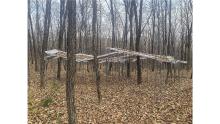
图1
蒙古栎天然林穿透雨减少样地现状"

表1
土壤理化性质变化①"
| 变量 Variable | 穿透雨减少 Throughfall reduction | 对照 Control | F | P |
| 土壤含水量 Soil water content (%) | 15.96±2.08 | 20.75±2.84 | 8.440 | 0.011* |
| pH | 6.10±0.09 | 6.21±0.15 | 7.781 | 0.025* |
| 土壤有机质含量 Soil organic matter (%) | 4.17±0.34 | 3.77±0.26 | 10.081 | 0.024* |
| 全氮含量 Total nitrogen / (g?kg?1) | 8.69±0.19 | 8.52±0.52 | 6.106 | 0.035* |
| 铵态氮含量 Ammonium nitrogen content / (mg?kg?1) | 35.70±8.93 | 27.64±8.36 | 480.140 | 0.000*** |
| 硝态氮含量 Nitrate nitrogen content / (mg?kg?1) | 733.01±143.83 | 1.996 | 0.225 | |
| 全磷含量 Total phosphorus content (%) | 0.23±0.03 | 0.21±0.02 | 38.878 | 0.001** |
| 速效磷含量 Available phosphorus content / (mg?kg?1) | 18.38±2.47 | 21.74±2.12 | 18.218 | 0.009** |
表2
大型土壤动物群落组成与分布"
| 类群 Group | 个体数 Individual | 百分比(个体数/ 总数) Percentage (individuals/total) (%) | 功能群 Guild | |||
| 穿透雨减少 Throughfall reduction | 对照 Control | |||||
| 昆虫纲 Insecta | 鞘翅目 Coleoptera | 步甲科 Carabidae | 539 | 8.07 | 肉食性 Carnivores | |
| 露尾甲科 Nitidulidae | 103 | 141 | 1.02 | 杂食性Omnivores | ||
| 隐翅虫科 Staphylinidae | 276 | 137 | 1.72 | 腐食性 Saprophages | ||
| 埋葬甲科 Silphidae | 43 | 5 | 0.20 | 腐食性 Saprophages | ||
| 象甲科 Curculionidae | 2 | 4 | 0.03 | 植食性 Herbivores | ||
| 金龟科 Scarabaeidae | 0 | 5 | 0.02 | 腐食性 Saprophages | ||
| 阎甲科 Histeridae | 5 | 1 | 0.03 | 肉食性 Carnivores | ||
| 叩甲科 Elateridae | 3 | 2 | 0.02 | 植食性 Herbivores | ||
| 金龟科幼虫 Scarabaeidae larvae | 2 | 0 | 0.01 | 植食性 Herbivores | ||
| 步甲科幼虫 Carabidae larvae | 5 | 2 | 0.03 | 肉食性 Carnivores | ||
| 埋葬甲科幼虫 Silphidae larvae | 1 | 0 | 0.00 | 腐食性 Saprophages | ||
| 直翅目 Orthoptera | 驼螽科 Rhaphidophoridae | 142 | 71 | 0.89 | 植食性 Herbivores | |
| 膜翅目 Hymenoptera | 蚁科 Formicidae | 77.77 | 杂食性 Omnivores | |||
| 姬蜂科 Ichneumonoidae | 75 | 51 | 0.53 | 植食性 Herbivores | ||
| 胡蜂科 Vespidae | 6 | 4 | 0.04 | 植食性 Herbivores | ||
| 泥蜂科 Sphecidae | 1 | 1 | 0.01 | 植食性 Herbivores | ||
| 革翅目 Dermaptera | 球螋科 Forficulidae | 194 | 315 | 2.12 | 杂食性 Omnivores | |
| 球螋科若虫 Forficulidae nymphs | 1 | 0 | 0.00 | 杂食性 Omnivores | ||
| 半翅目 Hemiptera | 姬蝽科 Nabidae | 64 | 27 | 0.38 | 肉食性 Carnivores | |
| 同蝽科 Acanthosomatidae | 0 | 1 | 0.00 | 植食性 Herbivores | ||
| 异蝽科 Urostylidae | 2 | 1 | 0.01 | 植食性 Herbivores | ||
| 双翅目 Diptera | 果蝇科 Drosophilidae | 75 | 95 | 0.71 | 腐食性 Saprophages | |
| 寄蝇科 Tachinidae | 163 | 162 | 1.36 | 植食性 Herbivores | ||
| 菌蚊科 Mycetophilidae | 13 | 40 | 0.22 | 植食性 Herbivores | ||
| 丽蝇科 Calliphoridae | 1 | 3 | 0.02 | 腐食性 Saprophages | ||
| 大蚊科幼虫 Tipulidae larvae | 13 | 9 | 0.09 | 腐食性 Saprophages | ||
| 鳞翅目 Lepidoptera | 夜蛾科 Noctuidae | 4 | 1 | 0.02 | 植食性 Herbivores | |
| 夜蛾科幼虫 Noctuidae larvae | 1 | 2 | 0.01 | 植食性 Herbivores | ||
| 蜻蜓目 Odonata | 蜓科稚虫 Aeshnidae naiads | 3 | 0 | 0.01 | 肉食性 Carnivores | |
| 唇足纲 Chilopoda | 蜈蚣目 Scolopendromorpha | 蜈蚣科 Scolopendridae | 97 | 109 | 0.86 | 肉食性 Carnivores |
| 地蜈蚣目 Geophilomorpha | 地蜈蚣科 Geophilidae | 29 | 70 | 0.41 | 肉食性 Carnivores | |
| 蛛形纲 Arachnida | 盲蛛目 Opiliones | 长奇盲蛛科 Phalangodidae | 452 | 258 | 2.96 | 杂食性 Omnivores |
| 蜘蛛目 Araneae | 平腹蛛科 Gnaphosidae | 71 | 26 | 0.40 | 肉食性 Carnivores | |
| 倍足纲 Diplopoda | 山蛩目 Spirobolida | 山蛩科幼虫 Spirobolidae larvae | 1 | 0 | 0.00 | 腐食性 Saprophages |
| 总计 Total | 100.00 | |||||
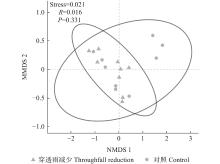
图2
大型土壤动物群落的非度量多维尺度分析"
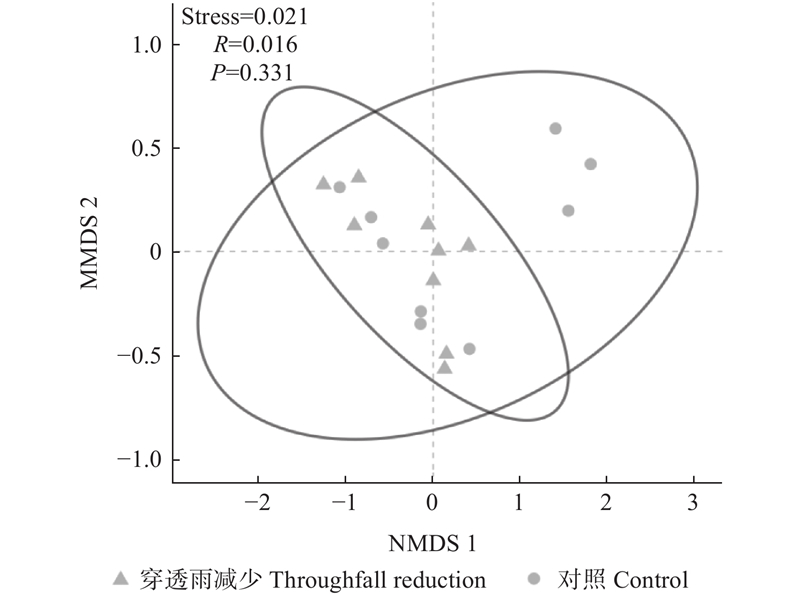
表3
大型土壤动物群落多样性参数的变化①"
| 参数 Parameter | 穿透雨减少 Throughfall reduction | 对照 Control | F | P |
| 个体数 Individual numbers | 69.246 | 0.001** | ||
| 类群数 Group numbers | 15.78±2.59 | 14.44±3.47 | 2.818 | 0.155 |
| Simpson优势度指数 Simpson index | 0.50±0.22 | 0.48±0.30 | 134.058 | 0.000*** |
| Shannon-Wiener多样性指数 Shannon-Wiener index | 1.20±0.55 | 1.25±0.69 | 85.560 | 0.000*** |
| Pielou均匀度指数 Pielou index | 0.23±0.10 | 0.30±0.18 | 161.409 | 0.000*** |
表4
大型土壤动物营养功能群变化①"
| 类群 Group | 参数 Parameter | 穿透雨减少 Throughfall reduction | 对照 Control | OR | P |
| 肉食性 Carnivores | 个体数 Individual numbers | 186.11±107.94 | 86.56±40.89 | 4.698×1072 | 0.001** |
| 类群数 Group numbers | 4.89±1.54 | 4.33±1.66 | 2.718 | 0.021* | |
| 杂食性Omnivores | 个体数 Individual numbers | 937.89±858.54 | 2.559×1034 | 0.008** | |
| 类群数 Group numbers | 3.44±0.88 | 3.00±1.00 | 1.948 | 0.064 | |
| 腐食性Saprophages | 个体数 Individual numbers | 45.56±38.15 | 28.22±20.05 | 3.089×10¹⁵ | 0.212 |
| 类群数 Group numbers | 3.22±0.67 | 3.33±1.00 | 0.717 | 0.540 | |
| 植食性Herbivores | 个体数 Individual numbers | 45.22±32.53 | 37.22±28.83 | 0.050 | 0.277 |
| 类群数 Group numbers | 4.22±1.09 | 3.78±1.20 | 1.396 | 0.140 |
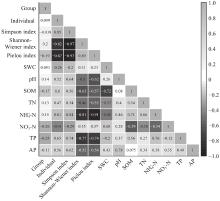
图3
大型土壤动物群落特征与土壤理化性质的相关分析 Group:类群数 Group numbers;Individual:个体数 Individual numbers;Simpson index:Simpson优势度指数Simpson index;Shannon-Wiener index:Shannon-Wiener多样性指数 Shannon-Wiener index;Pielou index:Pielou均匀度指数 Pielou index;SOM:土壤有机质含量 Soil organic matter;SWC:土壤含水量 Soil water content;TN:全氮含量 Total nitrogen;NH4+-N:铵态氮含量 Ammonium nitrogen content;NO3−-N:硝态氮含量 Nitrate nitrogen content;TP:全磷含量 Total phosphorus content;AP:速效磷含量 Available phosphorus content."
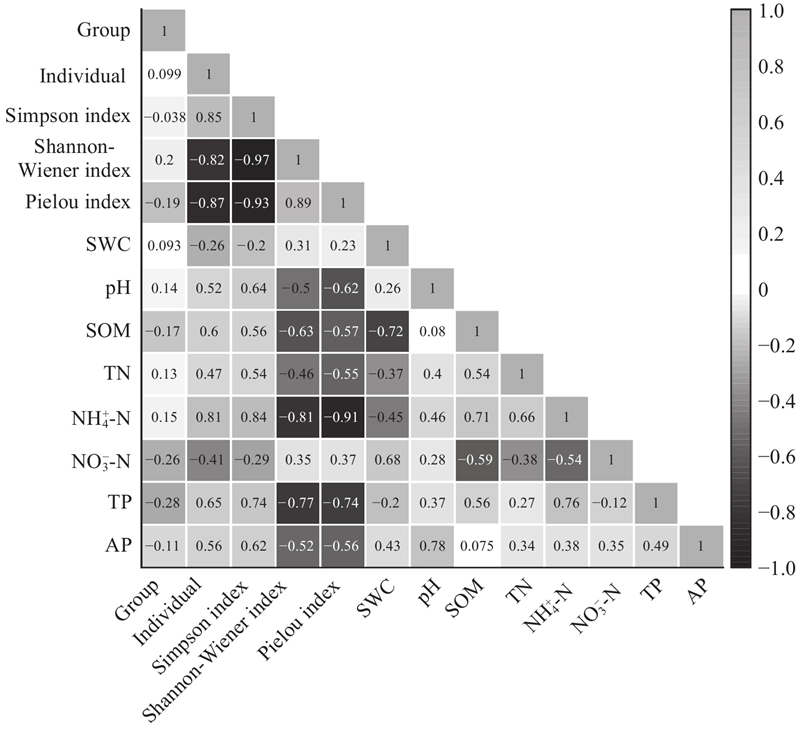
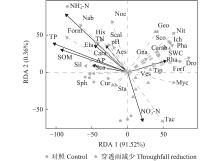
图4
土壤动物群落组成与理化性质关系的冗余分析(RDA) SOM:土壤有机质含量 Soil organic matter;SWC:土壤含水量 Soil water content;TN:全氮含量 Total nitrogen content;NH4+-N:铵态氮含量 Ammonium nitrogen content;NO3−-N:硝态氮含量 Nitrate nitrogen content;TP:全磷含量 Total phosphorus content;AP:速效磷含量 Available phosphorus content;Cara:步甲科 Carabidae;His:阎甲科 Histeridae;Carab:步甲科幼虫 Carabidae larvae;Ves:胡蜂科 Vespidae;Sph:泥蜂科 Sphecidae;Nab:姬蝽科 Ichneumonoidae;Aes:蜓科稚虫 Aeshnidae naiads;Sco:蜈蚣科 Scolopendridae;Geo:地蜈蚣科 Geophilidae;Gna:平腹蛛科 Gnaphosidae;Nit:露尾甲科 Nitidulidae;Form:蚁科 Formicidae;Forf:球螋科 Forficulidae;Pha:长奇盲蛛科 Phalangodidae;Sta:隐翅虫科 Staphylinidae;Sil:埋葬甲科 Silphidae;Sca:金龟科 Scarabaeidae;Dro:果蝇科 Drosophilidae;Tip:大蚊科幼虫 Tipulidae larvae;Cur:象甲科 Curculionidae;Ela:叩甲科 Elateridae;Scal:金龟科幼虫 Scarabaeidae larvae;Rha:驼螽科 Rhaphidophoridae;Ich:姬蜂科 Ichneumonoidae;Tac:寄蝇科 Tachinidae;Myc:菌蚊科 Mycetophilidae;Noc:夜蛾科 Noctuidae."
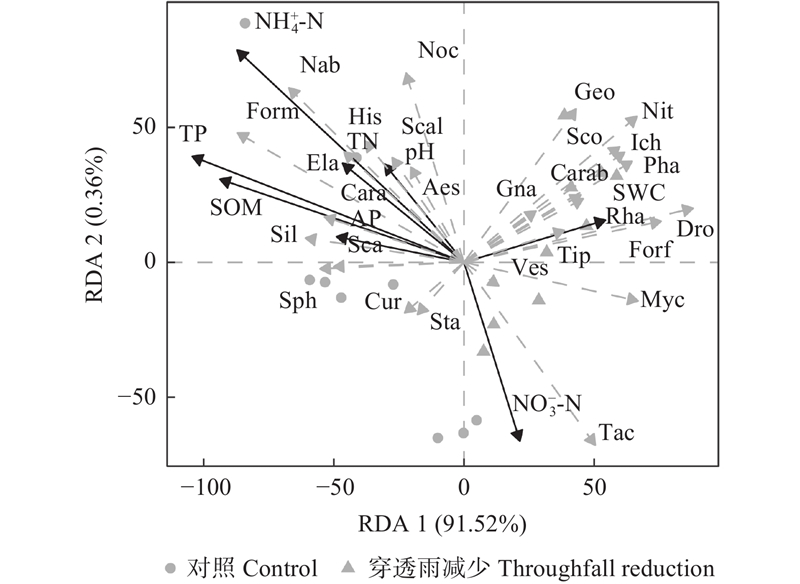
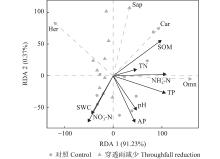
图5
土壤动物营养结构与理化性质关系的冗余分析(RDA) SOM:土壤有机质含量 Soil organic matter;SWC:土壤含水量 Soil water content;TN:全氮含量 Total nitrogen content;NH4+-N:铵态氮含量 Ammonium nitrogen content;NO3−-N:硝态氮含量 Nitrate nitrogen content;TP:全磷含量 Total phosphorus content;AP:速效磷含量 Available phosphorus content;TR:穿透雨减少 Throughfall reduction;CK:对照 Control;Car:肉食性 Carnivores;Omn:杂食性 Omnivores;Sap:腐食性 Saprophages;Her:植食性 Herbivores"
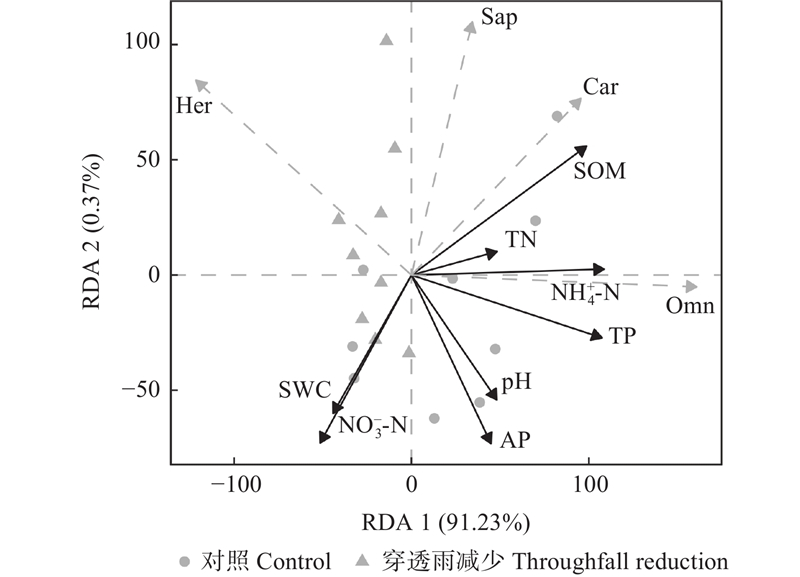
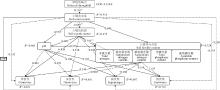
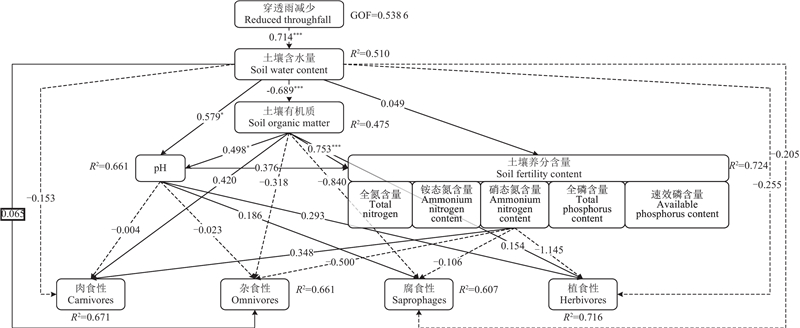
图6
穿透雨减少对大型土壤动物营养功能群的影响路径 实线表示正相关关系,虚线表示负相关关系。The solid line represents a positive correlation, while the dashed line represents a negative correlation. 箭头旁边的数字为标准化系数。The number next to the arrow indicates the standardization coefficient. GOF:拟合优度值Goodness of fit. R2:每个变量的解释方差比例Proportion of explained variance for each variable. *和***分别表示在P<0.05和P<0.001水平差异显著。* and *** denote statistical significance levels of P<0.05 and P<0.001, respectively."
| 鲍士旦. 2000. 土壤农化分析. 3版. 北京: 中国农业出版社, 1–495. | |
| Bao S D. 2000. Soil and agricultural chemistry analysis. 3rd edition. Beijing: China Agriculture Press, 1–495. [in Chinese] | |
| 陈雅昕, 邓娇娇, 周永斌, 等. 2018. 蒙古栎天然次生林土壤微生物群落特征及其与土壤理化特性的关系. 沈阳农业大学学报, 49 (4): 409–416. | |
| Chen Y X, Deng J J, Zhou Y B, et al. 2018. Characteristics of soil microbial community and its relationship with soil physical and chemical properties in natural secondary forests of Quercus mongolica. Journal of Shenyang Agricultural University, 49 (4): 409–416. [in Chinese] | |
| 贾天朝, 胡西武. 1985—2020年中国“两屏三带”生态屏障区土地利用时空动态演化特征. 水土保持研究, 2024, 31 (4): 348- 363. | |
| Jia T C, Hu X W. Spatiotemporal dynamic evolution characteristics of land use in China’s ‘Two Screens and Thress Belts’ ecological barrier areas from 1985 to 2020. Research of Soil and Water Conservation, 2024, 31 (4): 348- 363. | |
| 林英华, 贾旭东, 徐演鹏, 等. 大兴安岭典型森林沼泽类型地表土壤动物群落与生态位分析. 林业科学, 2015, 51 (12): 53- 62. | |
| Lin Y H, Jia X D, Xu Y P, et al. Ground-dwelling soil animal community and niche analysis of a typical forest swamp in Daxing’anling Mountains. Scientia Silvae Sinicae, 2015, 51 (12): 53- 62. | |
| 刘 爽, 王传宽. 2010. 五种温带森林土壤微生物生物量碳氮的时空格局. 生态学报, 30 (12): 3135–3143. | |
| Liu S, Wang C K. 2010. Spatio-temporal patterns of soil microbial biomass carbon and nitrogen in five temperate forest ecosystems. Acta Ecologica Sinica, 30 (12): 3135–3143. [in Chinese] | |
| 李雪峰, 韩士杰, 张 岩. 2007. 降水量变化对蒙古栎落叶分解过程的间接影响. 应用生态学报, (2): 261–266. | |
| Li X F, Han S J, Zhang Y. 2007. Indirect effects of precipitation on litter decomposition of Quercus mongolica. Chinese Journal of Applied Ecology, (2): 261–266. [in Chinese] | |
| 孙 新, 谢致敬, 乔志宏, 等. 2024. 基于功能性状的土壤动物群落生态学研究进展. 应用生态学报, 35(4): 1150–1158. | |
| Sun X, Xie Z J, Qiao Z H, et al. 2024. Research advances in trait-based approaches in soil animal community ecology. Chinese Journal of Applied Ecology, 35 (4): 1150–1158. [in Chinese] | |
| 尹文英. 1998. 中国土壤动物检索图鉴. 北京: 科学出版社. | |
| Yin W Y. 1998. Chinese soil animal search illustration. Beijing: Science Press. [in Chinese] | |
| 尹礼唱, 王晓峰, 张 琨, 等. 国家屏障区生态系统服务权衡与协同. 地理研究, 2019, 38 (9): 2162- 2172. | |
| Yin L C, Wang X F, Zhang K, et al. Trade-offs and synergy between ecosystem services in National Barrier Zone. Geographical Research, 2019, 38 (9): 2162- 2172. | |
| 张巍巍, 李元胜. 2011. 中国昆虫生态大图鉴. 2版. 重庆: 重庆大学出版社. | |
| Zhang W W, Li Y S. 2011. Chinese insect illustration. 2nd edition. Chongqing: Chongqing University Press. [in Chinese] | |
| 张巍巍. 2022. 昆虫家谱: 世界昆虫410科野外鉴别指南(标准版). 重庆: 重庆大学出版社. | |
| Zhang W W. 2022. Insect genealogy: a field guide to 410 families of insects worldwide (standard edition). Chongqing: Chongqing University Press. [in Chinese] | |
| 张兴云, 李 维, 胡译元. 生态系统保护和修复的初步探讨. 林业勘查设计, 2024, 53 (2): 46- 49. | |
| Zhang X Y, Li W, Hu Y Y. Preliminary exploration of ecosystem protection and restoration. Forest Investigation Design, 2024, 53 (2): 46- 49. | |
|
Andriuzzi W S, Adams B J, Barrett J E, et al. Observed trends of soil fauna in the Antarctic dry valleys: early signs of shifts predicted under climate change. Ecology, 2018, 99 (2): 312- 321.
doi: 10.1002/ecy.2090 |
|
| Bardgett R D, Bowman W D, Kaufmann R, et al. A temporal approach to linking aboveground and belowground ecology. Trends in Ecology & Evolution, 2005, 20 (11): 634- 641. | |
|
Bardgett R D. Causes and consequences of biological diversity in soil 1. Zoology, 2002, 105 (4): 367- 375.
doi: 10.1078/0944-2006-00072 |
|
|
Beier C, Beierkuhnlein C, Wohlgemuth T, et al. Precipitation manipulation experiments–challenges and recommendations for the future. Ecology Letters, 2012, 15 (8): 899- 911.
doi: 10.1111/j.1461-0248.2012.01793.x |
|
|
Benton M J, Wilf P, Sauquet H. The angiosperm terrestrial revolution and the origins of modern biodiversity. New Phytologist, 2022, 233 (5): 2017- 2035.
doi: 10.1111/nph.17822 |
|
|
Blankinship J C, Niklaus P A, Hungate B A. A meta-analysis of responses of soil biota to global change. Oecologia, 2011, 165 (3): 553- 565.
doi: 10.1007/s00442-011-1909-0 |
|
| Brussaard L. Biodiversity and ecosystem functioning in soil. Ambio-A Journal of the Human Environment, 1997, 26 (8): 563- 570. | |
|
Cerda A, Schnabel S, Ceballos A, et al. Soil hydrological response under simulated rainfall in the Dehesa land system (Extremadura, SW Spain) under drought conditions. Earth Surface Processes and Landforms, 1998, 23 (3): 195- 209.
doi: 10.1002/(SICI)1096-9837(199803)23:3<195::AID-ESP830>3.0.CO;2-I |
|
| Coleman D C, Callaham M A J, Crossley D A J, et al. 2018. Fundamentals of soil ecology. 3rd ed. Cambridge: Academic Press. | |
|
Couper L I, Sanders N J, Heller N E, et al. Multiyear drought exacerbates long-term effects of climate on an invasive ant species. Ecology, 2021, 102 (10): e03476.
doi: 10.1002/ecy.3476 |
|
|
Coyle D R, Nagendra U J, Taylor M K, et al. Soil fauna responses to natural disturbances, invasive species, and global climate change: current state of the science and a call to action. Soil Biology and Biochemistry, 2017, 110, 116- 133.
doi: 10.1016/j.soilbio.2017.03.008 |
|
|
Dai A G. Increasing drought under global warming in observations and models. Nature Climate Change, 2013, 3 (1): 52- 58.
doi: 10.1038/nclimate1633 |
|
|
Deng L, Peng C H, Kim D G, et al. Drought effects on soil carbon and nitrogen dynamics in global natural ecosystems. Earth-Science Reviews, 2021, 214, 103501.
doi: 10.1016/j.earscirev.2020.103501 |
|
|
Dunne J A, Williams R J. Cascading extinctions and community collapse in model food webs. Philosophical Transactions of the Royal Society B: Biological Sciences, 2009, 364 (1524): 1711- 1723.
doi: 10.1098/rstb.2008.0219 |
|
|
Fekete I, Francioso O, Simpson M J, et al. Qualitative and quantitative changes in soil organic compounds in central European oak forests with different annual average precipitation. Environments, 2023, 10 (3): 48.
doi: 10.3390/environments10030048 |
|
|
Feng Y L, Wang Y Z, Lin Y Y, et al. Effects of ant nest microhabitats on the diversity of soil macrofauna in Gobi ecosystems. Biodiversity Science, 2022, 30 (12): 22282.
doi: 10.17520/biods.2022282 |
|
|
Fischer E M, Knutti R. Anthropogenic contribution to global occurrence of heavy-precipitation and high-temperature extremes. Nature Climate Change, 2015, 5 (6): 560- 564.
doi: 10.1038/nclimate2617 |
|
|
Goldman A E, Bonebrake T C, Tsang T P N, et al. Drought and presence of ants can influence Hemiptera in tropical leaf litter. Biotropica, 2020, 52 (2): 221- 229.
doi: 10.1111/btp.12762 |
|
|
Gongalsky K B. Soil macrofauna: study problems and perspectives. Soil Biology and Biochemistry, 2021, 159, 108281.
doi: 10.1016/j.soilbio.2021.108281 |
|
|
González G, Seastedt T R. Comparison of the abundance and composition of litter fauna in tropical and subalpine forests. Pedobiologia, 2000, 44 (5): 545- 555.
doi: 10.1078/S0031-4056(04)70070-0 |
|
|
Handa I T, Aerts R, Berendse F, et al. Consequences of biodiversity loss for litter decomposition across biomes. Nature, 2014, 509 (7499): 218- 221.
doi: 10.1038/nature13247 |
|
|
Henneron L, Aubert M, Bureau F, et al. Forest management adaptation to climate change: a Cornelian dilemma between drought resistance and soil macro-detritivore functional diversity. Journal of Applied Ecology, 2015, 52 (4): 913- 927.
doi: 10.1111/1365-2664.12440 |
|
|
Izadi M, Habashi H. Changes in diversity, biomass and abundance of soil macrofauna, Parrotio-Carpinetum forest at organic and semi-organic horizons. Eurasian Journal of Soil Science (Ejss), 2016, 5 (3): 166.
doi: 10.18393/ejss.2016.3.166-171 |
|
|
Jamieson M A, Trowbridge A M, Raffa K F, et al. Consequences of climate warming and altered precipitation patterns for plant-insect and multitrophic interactions. Plant Physiology, 2012, 160 (4): 1719- 1727.
doi: 10.1104/pp.112.206524 |
|
| Kajak A. The role of soil predators in decomposition processes. European Journal of Entomology, 1995, 92, 573- 580. | |
| Knapp M, Knappová J, Jakubec P, et al. 2020. Incomplete species lists produced by pitfall trapping: how many carabid species and which functional traits are missing? Biological Conservation, 245: 108545. | |
|
Koricheva J, Larsson S, Haukioja E. Insect performance on experimentally stressed woody plants: a meta-analysis. Annual Review of Entomology, 1998, 43, 195- 216.
doi: 10.1146/annurev.ento.43.1.195 |
|
|
Kosakivska I V, Voytenko L V, et al. Morphological, physiological, and molecular components of the adaptive response to drought in the genus Quercus (Fagaceae). Ukrainian Botanical Journal, 2023, 80 (3): 251- 266.
doi: 10.15407/ukrbotj80.03.251 |
|
|
Kudureti A, Zhao S, Zhakyp D, et al. Responses of soil fauna community under changing environmental conditions. Journal of Arid Land, 2023, 15 (5): 620- 636.
doi: 10.1007/s40333-023-0009-4 |
|
|
Lamarre G P A, Hérault B, Fine P V A, et al. Taxonomic and functional composition of arthropod assemblages across contrasting Amazonian forests. Journal of Animal Ecology, 2016, 85 (1): 227- 239.
doi: 10.1111/1365-2656.12445 |
|
|
Lavelle P, Blanchart E, Martin A, et al. A hierarchical model for decomposition in terrestrial ecosystems: application to soils of the humid tropics. Biotropica, 1993, 25 (2): 130- 150.
doi: 10.2307/2389178 |
|
|
Lindberg N, Engtsson J B, Persson T. Effects of experimental irrigation and drought on the composition and diversity of soil fauna in a coniferous stand. Journal of Applied Ecology, 2002, 39 (6): 924- 936.
doi: 10.1046/j.1365-2664.2002.00769.x |
|
|
Liu T, Chen X Y, Gong X, et al. Earthworms coordinate soil biota to improve multiple ecosystem functions. Current Biology, 2019, 29 (20): 3420- 3429.
doi: 10.1016/j.cub.2019.08.045 |
|
|
Martin P A, Fisher L, Pérez-Izquierdo L, et al. Meta-analysis reveals that the effects of precipitation change on soil and litter fauna in forests depend on body size. Global Change Biology, 2024, 30 (5): e17305.
doi: 10.1111/gcb.17305 |
|
|
Maute K, Hose G C, Story P, et al. Surviving drought: a framework for understanding animal responses to small rain events in the arid zone. Ecology, 2019, 100 (11): e02884.
doi: 10.1002/ecy.2884 |
|
|
Mody K, Eichenberger D, Dorn S. Stress magnitude matters: different intensities of pulsed water stress produce non-monotonic resistance responses of host plants to insect herbivores. Ecological Entomology, 2009, 34 (1): 133- 143.
doi: 10.1111/j.1365-2311.2008.01053.x |
|
|
Nielsen U N, Wall D H, Six J. Soil biodiversity and the environment. Annual Review of Environment and Resources, 2015a, 40, 63- 90.
doi: 10.1146/annurev-environ-102014-021257 |
|
|
Nielsen U N, Ball B A. Impacts of altered precipitation regimes on soil communities and biogeochemistry in arid and semi-arid ecosystems. Global change biology, 2015b, 21 (4): 1407- 1421.
doi: 10.1111/gcb.12789 |
|
|
Ouedraogo J, Ouedraogo E, Traore M, et al. Interaction between the management of soil fertility and macrofauna reduces runoff on a lixisol in the north-sudanian zone of Burkina Faso. Experimental Agriculture, 2017, 53 (1): 12- 26.
doi: 10.1017/S0014479716000016 |
|
|
Peng Y, Peñuelas J, Vesterdal L, et al. Responses of soil fauna communities to the individual and combined effects of multiple global change factors. Ecology Letters, 2022, 25 (9): 1961- 1973.
doi: 10.1111/ele.14068 |
|
|
Potapov A M, Beaulieu F, Birkhofer K, et al. Feeding habits and multifunctional classification of soil-associated consumers from protists to vertebrates. Biological Reviews, 2022, 97 (3): 1057- 1117.
doi: 10.1111/brv.12832 |
|
| Santonja M, Fernandez C, Gauquelin T, et al. Climate change effects on litter decomposition: intensive drought leads to a strong decrease of litter mixture interactions. Plant and Soil, 2015, 393 (1): 69- 82. | |
|
Sardans J, Peñuelas J. Drought changes phosphorus and potassium accumulation patterns in an evergreen Mediterranean forest. Functional Ecology, 2007, 21 (2): 191- 201.
doi: 10.1111/j.1365-2435.2007.01247.x |
|
|
Scheu S, Schaefer M. Bottom-up control of the soil macrofauna community in a beechwood on limestone: manipulation of food resources. Ecology, 1998, 79 (5): 1573.
doi: 10.1890/0012-9658(1998)079[1573:BUCOTS]2.0.CO;2 |
|
| Seager R, LIS N, Feldman J, et al. Whither the 100th meridian? the once and future physical and human geography of America’s arid–humid divide. part I: the story so far. Earth Interactions, 2018, 22 (5): 1- 22. | |
| Sun H Z, Dai E F, Li Y Y, et al. Climate change and sustainable forestry: A regional perspective from northeast China. The Forestry Chronicle, 2018, 94 (3): 201- 207. | |
| Sun Y, Solomon S, Dai A G, et al. 2007. How often will it rain? Journal of Climate, 20(19): 4801–4818. | |
|
Thakur M P, Phillips H R P, Brose U, et al. Towards an integrative understanding of soil biodiversity. Biological Reviews, 2020, 95 (2): 350- 364.
doi: 10.1111/brv.12567 |
|
|
Valim J O S, Teixeira N C, Santos N A, et al. Drought-induced acclimatization of a fast-growing plant decreases insect performance in leaf-chewing and sap-sucking guilds. Arthropod-Plant Interactions, 2016, 10 (4): 351- 363.
doi: 10.1007/s11829-016-9440-1 |
|
|
van Groenigen J W, Lubbers I M, Vos H M J, et al. Earthworms increase plant production: a meta-analysis. Scientific Reports, 2014, 4, 6365.
doi: 10.1038/srep06365 |
|
| Whalen J K. Managing soil biota-mediated decomposition and nutrient mineralization in sustainable agroecosystems. Advances in Agriculture, 2014, 2014, 384604. | |
|
Williams R S, Marbert B S, Fisk M C, et al. Ground-dwelling beetle responses to long-term precipitation alterations in a hardwood forest. Southeastern Naturalist, 2014, 13 (1): 138- 155.
doi: 10.1656/058.013.0114 |
|
| FAO, ITPS, GSBI, et al. 2020. State of knowledge of soil biodiversity: Status, challenges, and potentialities. Rome: FAO, 1–618. | |
|
Zhang H Z, Shi L L, Lu H B, et al. Drought promotes soil phosphorus transformation and reduces phosphorus bioavailability in a temperate forest. Science of the Total Environment, 2020, 732, 139295.
doi: 10.1016/j.scitotenv.2020.139295 |
| [1] | 孙英杰,张德楠,沈育伊,徐广平,曹杨,黄科朝,陈运霜,毛馨月,滕秋梅,吕仕洪,褚俊智. 模拟氮沉降对中亚热带桉树人工林土壤微生物群落结构及酶活性的影响[J]. 林业科学, 2025, 61(5): 46-60. |
| [2] | 程子翰,张金池,姜姜,孟苗婧,李珈印,罗梅,方向华. 百山祖中山常绿阔叶林不同垂直层次优势种空间分布格局及关联性[J]. 林业科学, 2025, 61(3): 72-85. |
| [3] | 李峰卿,刘素贞,罗桂生,邹玉玲,黄维,曾满生. 不同生境沙氏鹿茸草根际土壤细菌群落结构和多样性分析[J]. 林业科学, 2025, 61(1): 47-56. |
| [4] | 肖欢,叶尔江·拜克吐尔汗,张春雨,赵秀海. 长白山阔叶红松林林层群落结构与生产力的关系[J]. 林业科学, 2024, 60(3): 57-64. |
| [5] | 刘相荣,孙启武,厚凌宇,庞忠义,张琰琳,丁昌俊. 松辽平原杨树人工林土壤微生物群落结构及其功能多样性的林龄差异[J]. 林业科学, 2024, 60(11): 25-36. |
| [6] | 谢宪,邓勋,宋丽文,梁军. 落叶松枯梢病罹病叶及病梢真菌多样性[J]. 林业科学, 2024, 60(10): 76-85. |
| [7] | 李志,薛晓焱,刘震,蔡齐飞,耿晓东,冯建,周慧娜,张涛,李明婉,王艳梅. 山桐子健康和感病植株不同器官区细菌群落结构、多样性与功能预测分析[J]. 林业科学, 2022, 58(8): 136-148. |
| [8] | 李斌,史鸿翔,刘兰兰,杨璞,张欣,陈航,冯颖,陈晓鸣. 女贞叶、茎、根及根际土壤真菌群落结构及功能群特征[J]. 林业科学, 2022, 58(5): 102-112. |
| [9] | 丛微,于晶晶,喻海茫,丁易,张于光. 不同气候带森林土壤微生物多样性和群落构建特征[J]. 林业科学, 2022, 58(2): 70-79. |
| [10] | 陈永忠,刘彩霞,许彦明,张震,彭映赫,陈隆升,苏以荣,王瑞,唐炜. 生草栽培对油茶林土壤微生物群落结构和稳定性的影响[J]. 林业科学, 2022, 58(11): 61-70. |
| [11] | 赵鹏宇,白雪,燕平梅,赵晓东,武晓英,柴宝峰. 华北落叶松林土壤细菌群落结构与表型的环境异质性响应[J]. 林业科学, 2021, 57(7): 101-110. |
| [12] | 庞荣荣,彭潔莹,闫琰. 太白山次生锐齿栎林地上生物量影响因素[J]. 林业科学, 2021, 57(10): 157-165. |
| [13] | 谢宪, 梁军, 朱彦鹏, 胡瑞瑞, 程元, 张星耀. 赤松纯林不同松枯梢病病级针叶的内生真菌多样性及群落结构[J]. 林业科学, 2020, 56(9): 51-57. |
| [14] | 刘昌霖,周国英,肖柏,刘君昂. 降香黄檀心材和边材内生真菌多样性[J]. 林业科学, 2020, 56(4): 109-120. |
| [15] | 王安宁, 黄秋娴, 李晓刚, 徐学华, 李玉灵. 冀北山区不同植被恢复类型根际土壤细菌群落结构及多样性[J]. 林业科学, 2019, 55(9): 130-141. |
| 阅读次数 | ||||||
|
全文 |
|
|||||
|
摘要 |
|
|||||

