
林业科学 ›› 2025, Vol. 61 ›› Issue (12): 1-23.doi: 10.11707/j.1001-7488.LYKX20250431
• 前沿热点 •
张建国1,2,李云晓1,3,段爱国1,2,王兆山1,2,张雄清1,2,刘娟娟1,2,何彩云1,2
收稿日期:2025-07-09
修回日期:2025-07-16
出版日期:2025-12-25
发布日期:2026-01-08
基金资助:Jianguo Zhang1,2,Yunxiao Li1,3,Aiguo Duan1,2,Zhaoshan Wang1,2,Xiongqing Zhang1,2,Juanjuan Liu1,2,Caiyun He1,2
Received:2025-07-09
Revised:2025-07-16
Online:2025-12-25
Published:2026-01-08
摘要:
目的: 理清杉木属植物的起源、演替和散布过程,解析现代杉木遗传多样性和遗传结构特征,揭示现代杉木分布格局形成的可能机制。方法: 通过梳理杉木大化石、孢粉化石和阴沉木相关文献资料,理清历史时期杉木属植物的起源、演替、散布及其与现代杉木分布的关系。以江西省大岗山1981年建立的全国杉木种源试验林183个种源1 440个单株、福建邵武种源试验林台湾杉木种源14个单株和四川德昌杉木种源20个单株为研究材料,将种源分别按10个种源区群体、14个省区种源群体和23个地理种源群体进行遗传多样性和遗传结构特征分析。对174个种源的1 352个单株进行SSR测序,对177个种源的531个单株、4株台湾杉木和6株德昌杉木进行叶绿体cpDNA测序。结果: 杉木不同地理种源群体内遗传变异占总变异的98.20%~99.16%,仅有0.84%~1.80%的变异来自于不同地理种源群体间,表明杉木不同地理种源群体间的遗传组成及其结构已趋于一致,不同地理种源群体的遗传结构没有显著差异。杉木为一属一种,台湾杉木可能从浙江或福建引入。德昌杉木因长期适应当地环境,形成了遗传结构相对独立的种源,该种源未受外来基因流影响,且已在区域内实现人工栽培。不同地理种源群体间遗传分化低,其原因主要是不同地理种源群体间存在较高的基因流水平(Nm:2.689~6.328),驱动这种高水平基因流的实现并非不同地理种源群体间自然产生的基因流,而是2 000年来大规模长距离引种栽培形成的结果。公元1000—1600年,我国南方地区通过种植杉木实现重新造林,称之中国南方大造林,为我国历史上“第一次森林革命”。杉木人工林的迅速发展是应对“宋代木材危机”进行税收改革的成果,成功地满足了宋、元、明、清时期大量的木材需求,影响至今。杉木至今仍是我国造林面积和蓄积量第一的主要造林树种,其栽培面积在1999—2003年间达到1 380万hm2峰值。结论: 第四纪末次冰盛期,杉木分布退缩至我国南部边缘地带,濒临灭绝。现代杉木可能起源于一个由叶绿体单倍型Hap14构成的极小孑遗种群或单株。不同地理种源群体遗传结构无显著差异,表明所研究的1955年之前起源的177个地理种源均为人工林,推测明清时杉木可能已完全转化为人工林。长达2 000年的栽培,特别是宋代以来我国南方大规模杉木造林开创了我国历史上“第一次森林革命”,长距离引种、栽培以及发达的木材贸易,导致杉木天然林消失殆尽,全部转化为人工林,成为世界林业史上的奇迹。杉木作为森林革命的标志性树种,暗示林业制度的建立以及造林学理论与技术的萌芽最早可追溯至我国宋代以前。
中图分类号:
张建国,李云晓,段爱国,王兆山,张雄清,刘娟娟,何彩云. 杉木群体遗传结构的均一性显示:2 000年的栽培导致中国杉木已完全转化为人工林[J]. 林业科学, 2025, 61(12): 1-23.
Jianguo Zhang,Yunxiao Li,Aiguo Duan,Zhaoshan Wang,Xiongqing Zhang,Juanjuan Liu,Caiyun He. Genetic Uniformity of Chinese Fir Populations Demonstrates that 2 000 Years of Cultivation Have Led to Their Complete Transformation into Plantations[J]. Scientia Silvae Sinicae, 2025, 61(12): 1-23.
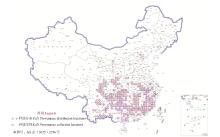
图1
杉木地理分布及种源采集点"
表S2
杉木11个微卫星位点的特征"
| 位点 Locus | 引物 Primers (5'–3') | 重复单元 Repeat motif | 片段大小 Size range/bp | 退火温度Ta /℃ | 等位基因个数 NA | 观测 杂合度 HO | 期望 杂合度 HE | 基因库序号 GenBank accession No. |
| SM19 | F:CACTTTGAATACGGTGCCTTTG | (TG)8 | 223~241 | 57 | 6 | 0.385 | 0.604 | KF873006 |
| R:CACGCAACCAAAACATGTAAAA | ||||||||
| SM37 | F:TAGGGTGAAAGGAGGATTTTGACAT | (TG)13 | 345~397 | 66 | 17 | 0.462 | 0.878 | KF873008 |
| R:ACATAGAGTGAGTGCCAATGCTCAT | ||||||||
| SM2 | F: CTCATCATTCTTGAACCCATCC | (GT)9 | 231~259 | 58 | 16 | 0.750 | 0.874 | KF873003 |
| R: AACCTGACCAATCCTTGCTCT | ||||||||
| SM51 | F: TCCTCTATCTTGTCAGTTTGGGTT | (AC)12 | 291~303 | 66 | 6 | 0.442 | 0.511 | KF873009 |
| R: TATTGGTGTTGCTCGTCATTCC | ||||||||
| SM14 | F: ATTTTCATTTTGAAGATCATCCGC | (AC)33 | 244~327 | 60 | 34 | 0.673 | 0.968 | KF873005 |
| R: CTTGTTTGGGTTTTGTTCTTCATC | ||||||||
| SM13 | F: TCGTGAGTTTCTTGGTCATTTCG | (AG)8 | 389~395 | 61 | 6 | 0.404 | 0.603 | KF873004 |
| R: CATAAGGGTTTTCCCCACGTATA | ||||||||
| XSM22 | F:AGATAGTTCTCCCAGGCTATCCAAGAT | (AG)33 | 207~289 | 69 | 31 | 0.596 | 0.961 | KF873007 |
| R:CCACCTACATACAACATAAGCGACCAA | ||||||||
| SM53 | F: CACATGAAGTGAATGCCAAAGTTA | (CA)6 | 354 | 62 | 1 | 0 | 0 | KF873010 |
| R: TTCCAGATAGTGTTGAATGGGGTA | ||||||||
| XSM8 | F:TCAGGGCATTTGAAACGAATAG | (CA)28 | 412~461 | 58 | 25 | 0.692 | 0.926 | KF873011 |
| R: TCAAGTGGGAGATTGTTGGGTA | ||||||||
| XSM24 | F:TTTCCCCTTAATGAACTTGTCTT | (CT)27 | 272~367 | 57 | 32 | 0.288 | 0.967 | KF873013 |
| R: ATTCAGATGGAGGCAACAGAG | ||||||||
| SM9 | F: TAGTGGCAAAGAAGGGAGAAAGG | (GT)41 | 256~334 | 63 | 26 | 0.327 | 0.953 | KF873012 |
| R:TGGTCTAAAAGTGCAAGTTGAGGA | ||||||||
| 平均 Mean | 18.182 | 0.456 | 0.749 | |||||
表S3
杉木cpDNA PCR扩增引物序列"
| 引物名称Primer name | 引物序列Primer sequences (5′–3′) | |
| 正向(F) | 反向(R) | |
| jzr-chlB | AGTCGCACGTTGCTTTCTA | ATGTATGCTGGTCCTGCTC |
| jzr-psbC | GCCGATATGGGAGATTGATG | AGGTATTCGTGCTTGGATGG |
| trnV-M | GCTATACGGGCTCGAACC | TACCTACTATTGGATTTGAACC |
| trnL-trnF | CGAAATCGGTAGACGCTACG | ATTTGAACTGGTGACACGAG |
| trnD-trnT | ACCAATTGAACTACAATCCC | CTACCACTGAGTTAAAAGGG |
| petG-trnP | GGTCTAATTCCTATAACTTTGGC | GGGATGTGGCGCAGCTTGG |
| petD | GCCGTMTTTATGTTAATGC | TTGACYCGTTTTTATAGTTTAC |
| psbA-trnH | GTTATGCATGAACGTAATGCTC | CGCGCATGGTGGATTCACATTCC |
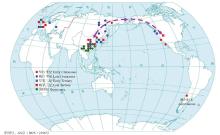
图2
从白垩纪到第四纪杉木属植物化石分布"
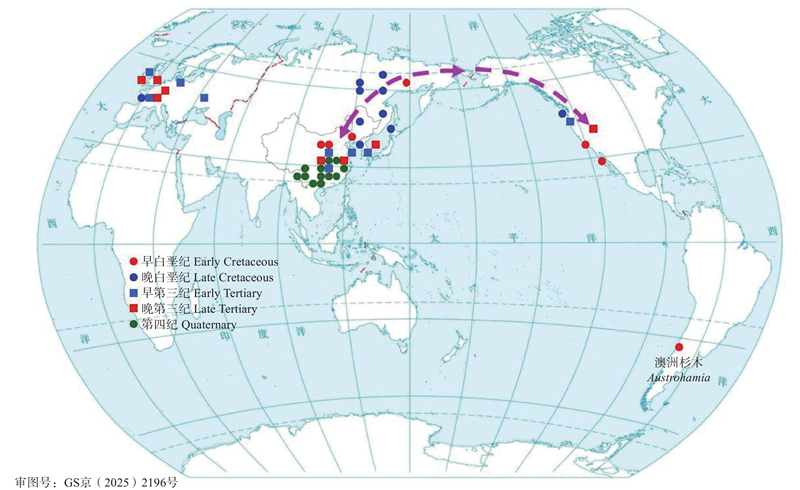
图3
全新世杉木属孢粉化石以及阴沉木的分布 晚更新世孢粉记录Fossil pollen records of the late Pleistocene 全新世孢粉记录 Fossil pollen records of the Holocene 阴沉木Buried wood (2 550~21 389 a)"
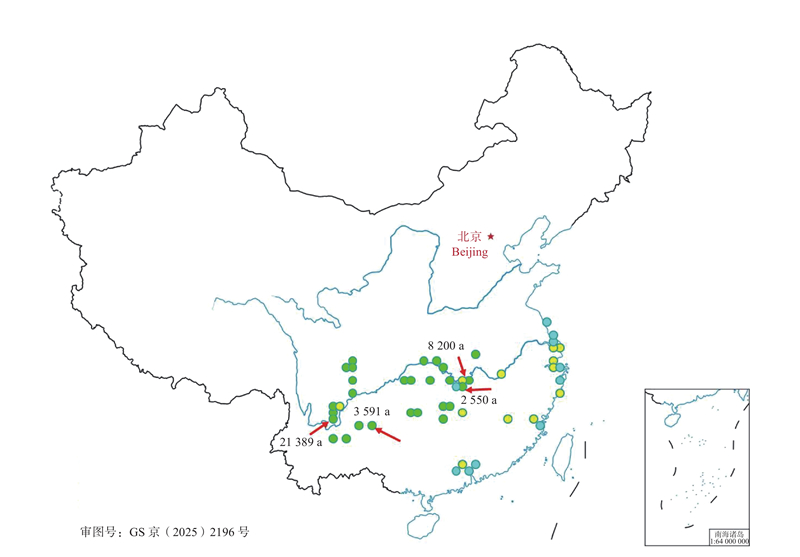
表1
杉木cpDNA 8个基因片段14种单倍型序列变异位点及单倍型多样性①"
| 单倍型Hap. | 变异位点 Variable sites | 样本数 Sample size | |||||||||||||||||
| jzr-chlB/bp | trnL-trnF/bp | trnV-M/bp | petG-trnP/bp | psbA-trnH/bp | petD/bp | ||||||||||||||
| 612 | 16 | 375 | 502 | 370 | 361 | 329~338 | 461 | 37 | 43 | 119 | 427 | 579 | |||||||
| Hap1 | A | C | A | G | A | G | □ | — | T | C | C | G | T | 1 | |||||
| Hap2 | G | G | A | G | A | G | □ | — | T | C | C | G | T | 1 | |||||
| Hap3 | G | C | T | G | A | G | □ | — | T | C | C | G | T | 1 | |||||
| Hap4 | G | C | A | A | A | G | □ | — | T | C | C | G | T | 1 | |||||
| Hap5 | G | C | A | G | T | G | □ | — | T | C | C | G | T | 1 | |||||
| Hap6 | G | C | A | G | A | G | — | — | T | C | C | G | T | 1 | |||||
| Hap7 | G | C | A | G | A | A | □ | — | T | C | C | G | T | 1 | |||||
| Hap8 | G | C | A | G | A | G | □ | G | T | C | C | G | T | 2 | |||||
| Hap9 | G | C | A | G | A | G | □ | — | T | C | T | G | T | 2 | |||||
| Hap10 | G | C | A | G | A | G | □ | — | T | C | C | G | A | 1 | |||||
| Hap11 | G | C | A | G | A | G | □ | — | T | A | C | G | T | 1 | |||||
| Hap12 | G | C | A | G | A | G | □ | — | C | C | C | G | T | 1 | |||||
| Hap13 | G | C | A | G | A | G | □ | — | T | C | C | A | T | 1 | |||||
| Hap14 | G | C | A | G | A | G | □ | — | T | C | C | G | T | 523 | |||||
表2
不同位点的杉木群体遗传多样性特征①"
| L | NA | NE | HO | HE | HT | I |
| SM19 | 12 | 2.358 | 0.428 | 0.576 | 0.576 | 1.080 |
| SM37 | 30 | 14.146 | 0.727 | 0.930 | 0.929 | 2.891 |
| SM2 | 21 | 8.182 | 0.789 | 0.878 | 0.878 | 2.338 |
| SM51 | 15 | 1.740 | 0.362 | 0.425 | 0.425 | 0.978 |
| SM14 | 48 | 30.269 | 0.635 | 0.967 | 0.967 | 3.588 |
| SM13 | 11 | 2.196 | 0.473 | 0.545 | 0.545 | 1.017 |
| CL12 | 19 | 4.406 | 0.360 | 0.773 | 0.773 | 1.738 |
| XSM8 | 32 | 11.837 | 0.696 | 0.916 | 0.916 | 2.857 |
| 平均Mean | 24 | 9.392 | 0.559 | 0.751 | 0.751 | 2.061 |
表3
杉木14个不同省区种源群体的遗传多样性统计①"
| Prpg | NA | NE | HO | HE | HT | I |
| HN | 8.000 | 5.746 | 0.541 | 0.704 | 0.674 | 1.595 |
| JS | 5.625 | 4.311 | 0.667 | 0.766 | 0.705 | 1.458 |
| AH | 15.625 | 8.228 | 0.571 | 0.766 | 0.760 | 2.005 |
| SC | 17.250 | 8.701 | 0.555 | 0.760 | 0.757 | 2.017 |
| ZJ | 14.625 | 7.287 | 0.497 | 0.751 | 0.744 | 1.926 |
| FJ | 19.125 | 8.582 | 0.570 | 0.740 | 0.737 | 1.997 |
| JX | 16.250 | 8.495 | 0.581 | 0.742 | 0.738 | 1.972 |
| HB | 17.500 | 8.479 | 0.563 | 0.747 | 0.744 | 2.010 |
| HuN | 18.750 | 9.341 | 0.551 | 0.745 | 0.743 | 2.030 |
| GD | 14.375 | 7.098 | 0.556 | 0.739 | 0.733 | 1.901 |
| GX | 17.625 | 6.946 | 0.558 | 0.747 | 0.744 | 1.939 |
| GZ | 17.125 | 9.149 | 0.561 | 0.758 | 0.755 | 2.011 |
| YN | 13.250 | 6.724 | 0.529 | 0.730 | 0.724 | 1.819 |
| TW | 8.714 | 5.604 | 0.667 | 0.777 | 0.746 | 1.755 |
| 平均Mean | 14.560 | 7.478 | 0.569 | 0.748 | 0.736 | 1.888 |
表4
杉木10个不同种源区群体的遗传多样性统计①"
| Pg | SS | NA | NE | HO | HE | HT | I |
| Q | 20 | 10.000 | 6.313 | 0.593 | 0.772 | 0.750 | 1.827 |
| S | 109 | 16.000 | 8.563 | 0.549 | 0.734 | 0.731 | 1.947 |
| G | 111 | 16.875 | 8.693 | 0.543 | 0.753 | 0.749 | 1.984 |
| M | 129 | 16.000 | 7.104 | 0.568 | 0.737 | 0.734 | 1.902 |
| N | 427 | 20.875 | 8.519 | 0.563 | 0.748 | 0.747 | 2.023 |
| X | 391 | 20.375 | 9.628 | 0.557 | 0.747 | 0.746 | 2.058 |
| H | 87 | 15.750 | 7.954 | 0.529 | 0.757 | 0.752 | 1.983 |
| D | 45 | 12.750 | 6.712 | 0.574 | 0.740 | 0.730 | 1.848 |
| Y | 19 | 5.571 | 3.133 | 0.543 | 0.609 | 0.581 | 1.197 |
| T | 14 | 8.714 | 5.604 | 0.667 | 0.777 | 0.746 | 1.755 |
| 平均Mean | 135.2 | 14.291 | 7.222 | 0.569 | 0.737 | 0.727 | 1.852 |
表5
23个杉木地理种源群体的遗传多样性统计①"
| Gpg | SS | NA | NE | HO | HE | HT | I |
| 1 | 43 | 13.000 | 6.725 | 0.562 | 0.716 | 0.707 | 1.829 |
| 2 | 20 | 8.625 | 5.078 | 0.472 | 0.720 | 0.699 | 1.622 |
| 3 | 64 | 14.000 | 7.877 | 0.554 | 0.751 | 0.745 | 1.915 |
| 4 | 10 | 7.250 | 4.918 | 0.556 | 0.738 | 0.699 | 1.568 |
| 5 | 23 | 9.625 | 6.491 | 0.593 | 0.738 | 0.720 | 1.739 |
| 6 | 104 | 16.625 | 8.787 | 0.547 | 0.751 | 0.747 | 2.002 |
| 7 | 106 | 16.750 | 8.751 | 0.580 | 0.760 | 0.756 | 2.028 |
| 8 | 71 | 16.250 | 8.272 | 0.578 | 0.749 | 0.743 | 2.004 |
| 9 | 45 | 13.000 | 7.681 | 0.544 | 0.734 | 0.724 | 1.869 |
| 10 | 77 | 14.750 | 7.626 | 0.493 | 0.743 | 0.738 | 1.927 |
| 11 | 45 | 13.125 | 6.924 | 0.577 | 0.744 | 0.735 | 1.865 |
| 12 | 91 | 13.500 | 5.678 | 0.577 | 0.736 | 0.731 | 1.797 |
| 13 | 52 | 14.000 | 6.334 | 0.539 | 0.719 | 0.711 | 1.847 |
| 14 | 43 | 12.625 | 6.477 | 0.559 | 0.732 | 0.722 | 1.825 |
| 15 | 45 | 12.625 | 6.650 | 0.574 | 0.739 | 0.730 | 1.842 |
| 16 | 39 | 13.500 | 7.950 | 0.560 | 0.740 | 0.729 | 1.917 |
| 17 | 68 | 14.250 | 8.439 | 0.568 | 0.744 | 0.738 | 1.927 |
| 18 | 79 | 15.000 | 7.364 | 0.579 | 0.743 | 0.738 | 1.912 |
| 19 | 119 | 17.750 | 8.116 | 0.567 | 0.734 | 0.730 | 1.968 |
| 20 | 68 | 15.250 | 7.720 | 0.543 | 0.746 | 0.739 | 1.925 |
| 21 | 107 | 16.625 | 8.059 | 0.542 | 0.760 | 0.756 | 2.009 |
| 22 | 19 | 5.571 | 3.133 | 0.543 | 0.609 | 0.581 | 1.197 |
| 23 | 14 | 8.714 | 5.604 | 0.667 | 0.777 | 0.746 | 1.755 |
| 平均Mean | 58.783 | 13.148 | 6.985 | 0.560 | 0.736 | 0.724 | 1.839 |
表6
不同杉木群体遗传分化系数及基因流①"
| 位点 Locus | 14省区种源群体 14 province provenance groups | 10个种源区群体 10 provenance groups | 23个群体 23 geographical provenance groups | |||||
| Fst | Nm | Fst | Nm | Fst | Nm | |||
| SM19 | 0.016 | 15.589 | 0.079 | 2.913 | 0.053 | 4.426 | ||
| SM37 | 0.024 | 10.107 | 0.032 | 7.669 | 0.029 | 8.322 | ||
| SM2 | 0.019 | 13.115 | 0.046 | 5.145 | 0.029 | 8.176 | ||
| SM51 | 0.020 | 12.548 | 0.185 | 1.105 | 0.111 | 1.996 | ||
| SM14 | 0.026 | 9.459 | 0.042 | 5.766 | 0.040 | 5.900 | ||
| SM13 | 0.183 | 1.113 | 0.390 | 0.391 | 0.224 | 0.862 | ||
| CL12 | 0.040 | 6.050 | 0.048 | 4.984 | 0.043 | 5.445 | ||
| XSM8 | 0.018 | 13.476 | 0.030 | 8.063 | 0.027 | 8.846 | ||
| 平均Mean | 0.038 | 6.328 | 0.085 | 2.689 | 0.058 | 4.017 | ||
表7
杉木14个省区种源群体间的遗传分化系数①"
| Prpg | HN | JS | AH | SC | ZJ | FJ | JX | HB | HuN | GD | GX | GZ | YN | TW |
| HN | 0.000 | |||||||||||||
| JS | 0.040 | 0.000 | ||||||||||||
| AH | 0.006 | 0.014 | 0.000 | |||||||||||
| SC | 0.010 | 0.016 | 0.011 | 0.000 | ||||||||||
| ZJ | 0.011 | 0.019 | 0.004 | 0.014 | 0.000 | |||||||||
| FJ | 0.003 | 0.018 | 0.007 | 0.007 | 0.009 | 0.000 | ||||||||
| JX | 0.001 | 0.023 | 0.005 | 0.008 | 0.003 | 0.002 | 0.000 | |||||||
| HB | 0.001 | 0.023 | 0.007 | 0.010 | 0.005 | 0.003 | 0.003 | 0.000 | ||||||
| HuN | 0.002 | 0.024 | 0.006 | 0.006 | 0.007 | 0.002 | 0.000 | 0.004 | 0.000 | |||||
| GD | 0.010 | 0.011 | 0.009 | 0.008 | 0.010 | 0.005 | 0.006 | 0.008 | 0.005 | 0.000 | ||||
| GX | 0.007 | 0.016 | 0.011 | 0.008 | 0.011 | 0.004 | 0.006 | 0.006 | 0.005 | 0.003 | 0.000 | |||
| GZ | 0.001 | 0.017 | 0.006 | 0.006 | 0.007 | 0.003 | 0.001 | 0.004 | 0.002 | 0.005 | 0.006 | 0.000 | ||
| YN | 0.012 | 0.032 | 0.018 | 0.010 | 0.014 | 0.007 | 0.007 | 0.009 | 0.009 | 0.015 | 0.011 | 0.010 | 0.000 | |
| TW | 0.127 | 0.064 | 0.096 | 0.073 | 0.099 | 0.098 | 0.107 | 0.099 | 0.098 | 0.076 | 0.087 | 0.095 | 0.102 | 0.000 |
表8
杉木10个种源区群体间的遗传分化系数①"
| Pg | Q | S | G | M | N | X | H | D | Y | T |
| Q | 0.000 | |||||||||
| S | 0.010 | 0.000 | ||||||||
| G | 0.007 | 0.003 | 0.000 | |||||||
| M | 0.009 | 0.005 | 0.005 | 0.000 | ||||||
| N | 0.008 | 0.003 | 0.004 | 0.001 | 0.000 | |||||
| X | 0.007 | 0.003 | 0.002 | 0.004 | 0.002 | 0.000 | ||||
| H | 0.003 | 0.009 | 0.007 | 0.009 | 0.007 | 0.004 | 0.000 | |||
| D | 0.006 | 0.012 | 0.006 | 0.009 | 0.010 | 0.008 | 0.007 | 0.000 | ||
| Y | 0.262 | 0.239 | 0.226 | 0.222 | 0.221 | 0.224 | 0.225 | 0.248 | 0.000 | |
| T | 0.092 | 0.097 | 0.099 | 0.082 | 0.091 | 0.098 | 0.090 | 0.110 | 0.209 | 0.000 |
表9
杉木不同种源群体的AMOVA分析"
| 变异来源 | 自由度 | 方差总和 | 方差分量 | 方差分量百分比 | P值 |
| Source of variation | d.f. | Sum of squares | Variance components | Percentage of variation (%) | P-value |
| 14个省区种源群体14 Province provenance groups | |||||
| 群体间 | 13 | 105.277 | 0.026 Va | 0.84 | <0.001 |
| Among populations | |||||
| 群体内 | 1 351 | 8 407.367 | 3.125 Vb | 99.16 | <0.001 |
| Within population | |||||
| 总共 | 1 364 | 8 512.644 | 3.151 | ||
| Total | |||||
| 10个种源区群体10 provenance groups | |||||
| 群体间 | 9 | 135.244 | 0.045 33 Va | 1.43 | <0.001 |
| Among populations | |||||
| 群体内 | 1 351 | 8 377.4 | 3.114 01 Vb | 98.57 | <0.001 |
| Within population | |||||
| 总共 | 1 360 | 8 512.644 | 3.159 34 | ||
| Total | |||||
| 23个地理种源群体23 geographical provenance groups | |||||
| 群体间 | 22 | 212.92 | 0.056 72 Va | 1.80 | <0.001 |
| Among populations | |||||
| 群体内 | 1 351 | 8 299.64 | 3.095 73 Vb | 98.20 | <0.001 |
| Within population | |||||
| 总共 | 1 373 | 8 512.56 | 3.15 | ||
| Total | |||||
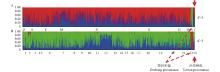
图4
杉木10个种源区群体与23个不同地理种源群体STRUCTURE图 A: 杉木10个种源区群体Genetic STRUCTURE of 10 provenance groups (K= 3);B: 23个不同地理种源群体Genetic STRUCTURE of 23 geographical provenance groups (K=3)."
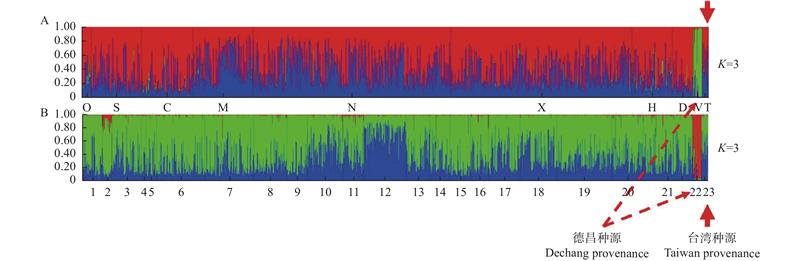
图5
杉木不同地理种源cpDNA单倍型多样特征性"
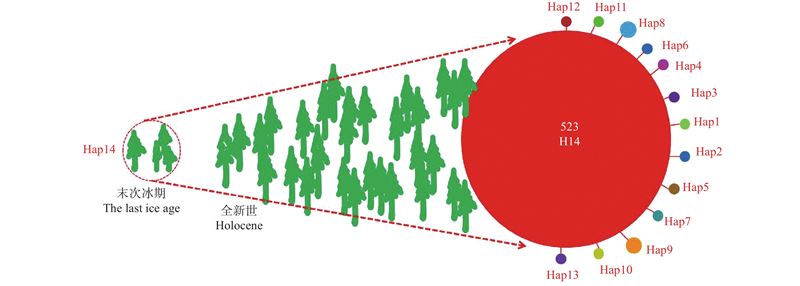
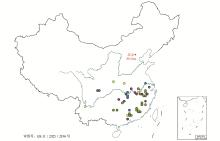
图6
杉木利用和栽培历史分布 晋代Jin dynasty (AD 265—420) 唐代Tang dynasty (AD 618—907) 宋代Song dynasty (AD 960—1279) Ming and Qing dynasty (AD 1368—1911)"
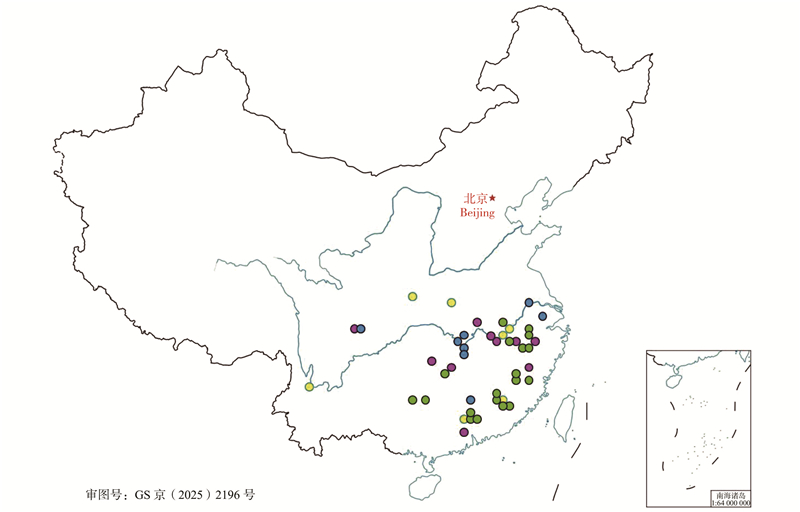
图7
历史上杉木木材贸易市场的分布 唐代Tang dynasty (AD 618—907) 宋代Song dynasty (AD 960—1279) Ming and Qing dynasty (AD 1368—1911)"
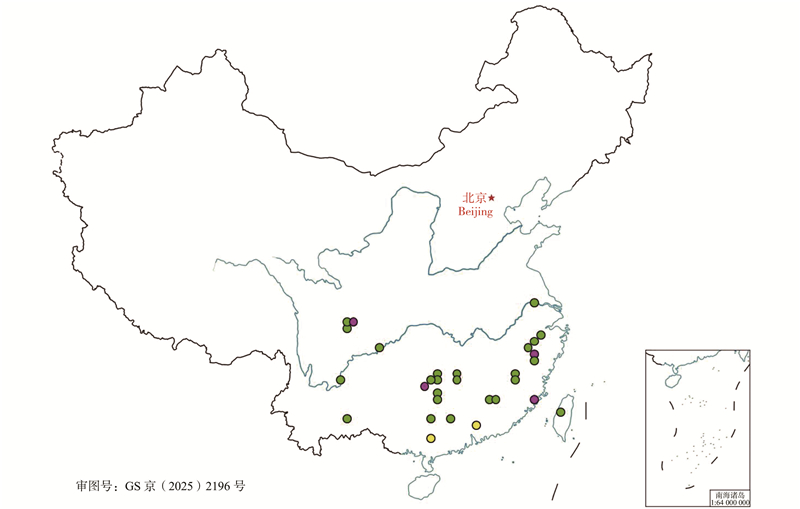
表S1
杉木不同省区、种源区、地理种源群体样本的划分"
| 省区种源群体 Province provenance groups | 种源区群体 Provenance groups | 地理种源群体 Geographical provenance groups | |||||
| Pn-Pg-Ss | 种源Provenance | Pgn-Pg-Ss | 种源Provenance | Pg-Ss | 种源Provenance | ||
| 安徽-AH-74 Anhu-AH-74 | 安徽太平 Taiping, Anhui | 秦巴山地-Q-20 Qinba Mountains-Q-20 | 湖北谷城 Gucheng, Hubei | 1-43 | 四川洪雅 Hongya, Sichuan | ||
| 安徽东至 Dongzhi, Anhui | 湖北竹山 Zhushan, Hubei | 四川荥经 Yingjing, Sichuan | |||||
| 安徽金寨 Jinzhai, Anhui | 四川盆地周围山地-S-109 Mountains around Sichuan Basin-S-109 | 四川南江 Nanjiang, Sichuan | 四川卢山 Lushan, Sichuan | ||||
| 安徽泾县 Jingxian, Anhui | 四川什邡 Shifang, Sichuan | 四川彭县 Pengxian, Sichuan | |||||
| 安徽祁门 Qimen, Anhui | 四川彭县 Pengxian, Sichuan | 四川邛崃 Qionglai, Sichuan | |||||
| 安徽石台 Shitai, Anhui | 四川荥经 Yingjing, Sichuan | 四川什邡 Shifang, Sichuan | |||||
| 安徽太湖 Taihu, Anhui | 四川邛崃 Qionglai, Sichuan | 2-20 | 云南会泽(2)Huize (2), Yunnan | ||||
| 安徽歙县 Shexian, Anhui | 四川卢山 Lushan, Sichuan | 云南富源 Fuyuan, Yunnan | |||||
| 安徽休宁 Xiuning, Anhui | 四川洪雅 Hongya, Sichuan | 云南会泽(1)Huize (1), Yunnan | |||||
| 安徽黟县 Yixian, Anhui | 四川筠连 Junlian, Sichuan | 3-64 | 四川合江 Hejiang, Sichuan | ||||
| 福建-FJ-186 Fujian-FJ-186 | 福建长汀 Changting, Fujian | 四川叙永 Xuyong, Sichuan | 四川江津 Jiangjin, Sichuan | ||||
| 福建崇安 Chongan, Fujian | 四川合江 Hejiang, Sichuan | 四川叙永 Xuyong, Sichuan | |||||
| 福建大田 Datian, Fujian | 四川江津 Jiangjin, Sichuan | 四川筠连 Junlian, Sichuan | |||||
| 福建德化 Dehua, Fujian | 四川永川 Yongchuan, Sichuan | 四川永川 Yongchuan, Sichuan | |||||
| 福建光泽 Guangze, Fujian | 四川邻水 Linshui, Sichuan | 贵州习水 Xishui, Guizhou | |||||
| 福建建瓯 Jian’ou, Fujian | 云南镇雄(2)Zhenxiong (2), Yunnan | 云南镇雄(1) Zhenxiong (1), Yunnan | |||||
| 福建建阳 Jianyang, Fujian | 云南镇雄(1)Zhenxiong (1), Yunnan | 云南镇雄(2)Zhenxiong (2), Yunnan | |||||
| 福建将乐 Jiangle, Fujian | 贵州山原-G-111 Guizhou mountain plateau-G-111 | 贵州婺川 Wuchuan, Guizhou | 4-10 | 四川南江 Nanjiang, Sichuan | |||
| 福建连城 Liancheng, Fujian | 贵州道真 Daozhen, Guizhou | 四川邻水 Linshui, Sichuan | |||||
| 福建南靖 Nanjing, Fujian | 贵州思南 Sinan, Guizhou | 5-23 | 贵州兴仁 Xingren, Guizhou | ||||
| 福建南平 Nanping, Fujian | 贵州江口 Jiangkou, Guizhou | 贵州黔西 Qianxi, Guizhou | |||||
| 福建浦城 Pucheng, Fujian | 贵州麻江 Majiang, Guizhou | 贵州平坝 Pingba, Guizhou | |||||
| 福建三明 Sanming, Fujian | 贵州黔西 Qianxi, Guizhou | 贵州六枝 Liuzhi, Guizhou | |||||
| 福建沙县 Shaxian, Fujian | 贵州平坝 Pingba, Guizhou | 6-104 | 四川秀山 Xiushan, Sichuan | ||||
| 福建上杭 Shanghang, Fujian | 贵州六枝 Liuzhi, Guizhou | 四川酉阳 Youyang, Sichuan | |||||
| 福建邵武 Shaowu, Fujian | 贵州兴仁 Xingren, Guizhou | 湖南新晃 Xinhuang, Hunan | |||||
| 福建顺昌 Shunchang, Fujian | 贵州习水 Xishui, Guizhou | 湖南凤凰 Fenghuang, Hunan | |||||
| 福建武平 Wuping, Fujian | 云南会泽(2) Huize (2), Yunnan | 贵州岑巩 Cengong, Guizhou | |||||
| 福建永安 Yongan, Fujian | 云南会泽(1) Huize (1), Yunnan | 贵州婺川 Wuchuan, Guizhou | |||||
| 福建永定 Yongding, Fujian | 贵州岑巩 Cengong, Guizhou | 贵州道真 Daozhen, Guizhou | |||||
| 福建尤溪 Youxi, Fujian | 贵州余庆 Yuqing, Guizhou | 贵州麻江 Majiang, Guizhou | |||||
| 福建漳平 Zhangping, Fujian | 云南富源 Fuyuan, Yunnan | 贵州思南 Sinan, Guizhou | |||||
| 广东-GD-79 Guangdong-GD-79 | 广东广宁Guangning, Guangdong | 闽粤桂滇南部山地丘陵-M-129 | 云南西畴 Xichou, Yunnan | 贵州余庆 Yuqing, Guizhou | |||
| 广东河源 Heyuan, Guangdong | Moutains and hills in the southern Minyueguidian-M-129 | 云南麻栗坡 Malipo, Yunnan | 贵州江口 Jiangkou, Guizhou | ||||
| 广东怀集 Huaiji, Guangdong | 云南屏边 Pingbian, Yunnan | 7-106 | 湖南会同 Huitong, Hunan | ||||
| 广东蕉岭 Jiaoling, Guangdong | 云南马关 Maguan, Yunnan | 湖南通道 Tongdao, Hunan | |||||
| 广东乐昌 Lechang, Guangdong | 广西宾阳 Binyang, Guangxi | 广西三江 Sanjiang, Guangxi | |||||
| 广东连南 Liannan, Guangdong | 广西桂平 Guiping, Guangxi | 广西罗城 Luocheng, Guangxi | |||||
| 广东连山 Lianshan, Guangdong | 广西博白 Bobai, Guangxi | 广西龙胜 Longsheng, Guangxi | |||||
| 广东平远 Pingyuan, Guangdong | 广西容县 Rongxian, Guangxi | 广西永福 Yongfu, Guangxi | |||||
| 广东始兴 Shixing, Guangdong | 广西苍梧 Cangwu, Guangxi | 广西融水四荣 Sirong, Rongshui, Guangxi | |||||
| 广东郁南 Yunan, Guangdong | 广西北流 Beiliu, Guangxi | 广西融水白云 Baiyun, Rongshui, Guangxi | |||||
| 广西-GX-197 Guangxi-GX-197 | 广西北流 Beiliu, Guangxi | 广东郁南 Yunan, Guangdong | 广西融安 Rongan, Guangxi | ||||
| 广西宾阳 Binyang, Guangxi | 广东怀集 Huaiji, Guangdong | 贵州从江 Congjiang, Guizhou | |||||
| 广西博白 Bobai, Guangxi | 广东河源 Heyuan, Guangdong | 贵州榕江 Rongjiang, Guizhou | |||||
| 广西苍梧 Cangwu, Guangxi | 广东广宁 Guangning, Guangdong | 贵州剑河 Jianhe, Guizhou | |||||
| 广西德保 Debao, Guangxi | 福建南靖 Nanjing, Fujian | 贵州三都 Sandu, Guizhou | |||||
| 广西灌阳 Guanyang, Guangxi | 广西德保 Debao, Guangxi | 8-71 | 湖北竹山 Zhushan, Hubei | ||||
| 广西桂平 Guiping, Guangxi | 福建德化 Dehua, Fujian | 湖北鹤峰 Hefeng, Hubei | |||||
| 广西贺县 Hexian, Guangxi | 南岭山地-N-427 Nanling moutains-N-427 | 贵州剑河 Jianhe, Guizhou | 湖北恩施 Enshi, Hubei | ||||
| 广西金秀 Jinxiu, Guangxi | 贵州从江 Congjiang, Guizhou | 湖北利川 Lichuan, Hubei | |||||
| 广西灵川 Lingchuan, Guangxi | 贵州榕江 Rongjiang, Guizhou | 湖北五峰 Wufeng, Hubei | |||||
| 广西龙胜 Longsheng, Guangxi | 贵州三都 Sandu, Guizhou | 湖北建始 Jianshi, Hubei | |||||
| 广西隆林 Longlin, Guangxi | 广西龙胜 Longsheng, Guangxi | 湖北谷城 Gucheng, Hubei | |||||
| 广西罗城 Luocheng, Guangxi | 广西三江 Sanjiang, Guangxi | 湖北宜昌 Yichang, Hubei | |||||
| 广西蒙山 Mengshan, Guangxi | 广西融安 Rongan, Guangxi | 湖北铜盆水 Tongpenshui, Hubei | |||||
| 广西平南 Pingnan, Guangxi | 广西融水四荣 Sirong, Rongshui, Guangxi | 9-45 | 湖南永顺 Yongshun, Hunan | ||||
| 广西全州 Quanzhou, Guangxi | 广西融水白云 Baiyun, Rongshui, Guangxi | 湖南沅陵 Yuanling, Hunan | |||||
| 广西容县 Rongxian, Guangxi | 广西罗城 Luocheng, Guangxi | 湖南安化 Anhua, Hunan | |||||
| 广西融安 Rongan, Guangxi | 广西资源 Ziyuan, Guangxi | 湖南新化 Xinhua, Hunan | |||||
| 广西融水白云 Baiyun, Rongshui, Guangxi | 广西兴安 Xing’an, Guangxi | 湖南辰溪 Chenxi, Hunan | |||||
| 广西融水四荣 Sirong, Rongshui, Guangxi | 广西灵川 Lingchuan, Guangxi | 湖南澧县 Lixian, Hunan | |||||
| 广西三江 Sanjiang, Guangxi | 广西永福 Yongfu, Guangxi | 10-77 | 湖南武冈 Wugang, Hunan | ||||
| 广西恭城 Gongcheng, Guangxi | 广西全州 Quanzhou, Guangxi | 湖南新宁 Xinning, Hunan | |||||
| 广西兴安 Xing’an, Guangxi | 广西灌阳 Guanyang, Guangxi | 湖南江永 Jiangyong, Hunan | |||||
| 广西永福 Yongfu, Guangxi | 广西恭城 Gongcheng, Guangxi | 湖南绥宁 Suining, Hunan | |||||
| 广西昭平 Zhaoping, Guangxi | 广西贺县 Hexian, Guangxi | 广西资源 Ziyuan, Guangxi | |||||
| 广西资源 Ziyuan, Guangxi | 广西蒙山 Mengshan, Guangxi | 广西兴安 Xing’an, Guangxi | |||||
| 贵州-GZ-121 Guizhou-GZ-121 | 贵州岑巩 Cengong, Guizhou | 广西昭平 Zhaoping, Guangxi | 广西灵川 Lingchuan, Guangxi | ||||
| 贵州从江 Congjiang, Guizhou | 广西金秀 Jinxiu, Guangxi | 广西灌阳 Guanyang, Guangxi | |||||
| 贵州道真 Daozhen, Guizhou | 广西隆林 Longlin, Guangxi | 广西全州 Quanzhou, Guangxi | |||||
| 贵州剑河 Jianhe, Guizhou | 广西平南 Pingnan, Guangxi | 11-45 | 广西隆林 Longlin, Guangxi | ||||
| 贵州江口 Jiangkou, Guizhou | 湖南兰山 Lanshan, Hunan | 广西德保 Debao, Guangxi | |||||
| 贵州六枝 Liuzhi, Guizhou | 湖南江华 Jianghua, Hunan | 云南马关 Maguan, Yunnan | |||||
| 贵州麻江 Majiang, Guizhou | 湖南江永 Jiangyong, Hunan | 云南屏边 Pingbian, Yunnan | |||||
| 贵州平坝 Pingba, Guizhou | 广东连南 Liannan, Guangdong | 云南西畴 Xichou, Yunnan | |||||
| 贵州榕江 Rongjiang, Guizhou | 广东乐昌 Lechang, Guangdong | 云南麻栗坡 Malipo, Yunnan | |||||
| 贵州三都 Sandu, Guizhou | 广东连山 Lianshan, Guangdong | 12-91 | 广东郁南 Yunan, Guangdong | ||||
| 贵州思南 Sinan, Guizhou | 广东蕉岭 Jiaoling, Guangdong | 广西金秀 Jinxiu, Guangxi | |||||
| 贵州婺川 Wuchuan, Guizhou | 广东平远 Pingyuan, Guangdong | 广西贺县 Hexian, Guangxi | |||||
| 贵州习水 Xishui, Guizhou | 广东始兴 Shixing, Guangdong | 广西昭平 Zhaoping, Guangxi | |||||
| 贵州兴仁 Xingren, Guizhou | 江西全南 Quannan, Jiangxi | 广西蒙山 Mengshan, Guangxi | |||||
| 贵州黔西 Qianxi, Guizhou | 江西瑞金 Ruijin, Jiangxi | 广西苍梧 Cangwu, Guangxi | |||||
| 贵州余庆 Yuqing, Guizhou | 福建武平 Wuping, Fujian | 广西容县 Rongxian, Guangxi | |||||
| 河南-HN-14 Henan-HN-14 | 河南商城 Shangcheng, Henan | 福建上杭 Shanghang, Fujian | 广西桂平 Guiping, Guangxi | ||||
| 河南新县 Xinxian, Henan | 福建永定 Yongding, Fujian | 广西北流 Beiliu, Guangxi | |||||
| 湖北-HB-113 Hubei-HB-113 | 湖北崇阳 Chongyang, Hubei | 福建南靖 Nanjing, Fujian | 广西博白 Bobai, Guangxi | ||||
| 湖北谷城 Gucheng, Hubei | 福建长汀 Changting, Fujian | 广西宾阳 Binyang, Guangxi | |||||
| 湖北鹤峰 Hefeng, Hubei | 福建连城 Liancheng, Fujian | 广西平南 Pingnan, Guangxi | |||||
| 湖北恩施 Enshi, Hubei | 福建漳平 Zhangping, Fujian | 广西恭城 Gongcheng, Guangxi | |||||
| 湖北建始 Jianshi, Hubei | 福建大田 Datian, Fujian | 13-52 | 湖南江华 Jianghua, Hunan | ||||
| 湖北利川 Lichuan, Hubei | 福建永安 Yongan, Fujian | 湖南桂阳 Guiyang, Hunan | |||||
| 湖北罗田 Luotian, Hubei | 福建三明 Sanming, Fujian | 湖南祁阳 Qiyang, Hunan | |||||
| 湖北麻城 Macheng, Hubei | 福建尤溪 Youxi, Fujian | 湖南兰山 Lanshan, Hunan | |||||
| 湖北通城 Tongcheng, Hubei | 福建沙县 Shaxian, Fujian | 湖南双牌 Shuangpai, Hunan | |||||
| 湖北通山 Tongshan, Hubei | 福建将乐 Jiangle, Fujian | 广东连山 Lianshan, Guangdong | |||||
| 湖北铜盆水 Tongpenshui, Hubei | 福建顺昌 Shunchang, Fujian | 广东怀集 Huaiji, Guangdong | |||||
| 湖北五峰 Wufeng, Hubei | 福建南平 Nanping, Fujian | 广东广宁 Guangning, Guangdong | |||||
| 湖北阳新 Yangxin, Hubei | 福建建阳 Jianyang, Fujian | 广东连南 Liannan, Guangdong | |||||
| 湖北宜昌 Yichang, Hubei | 福建建瓯 Jian’ou, Fujian | 14-43 | 江西武宁 Wuning, Jiangxi | ||||
| 湖北竹山 Zhushan, Hubei | 福建邵武 Shaowu, Fujian | 江西修水 Xiushui, Jiangxi | |||||
| 湖南-HuN-179 Hunan-HuN-179 | 湖南安化 Anhua, Hunan | 福建光泽 Guangze, Fujian | 湖北崇阳 Chongyang, Hubei | ||||
| 湖南辰溪 Chenxi, Hunan | 福建浦城 Pucheng, Fujian | 湖北通山 Tongshan, Hubei | |||||
| 湖南凤凰 Fenghuang, Hunan | 福建崇安 Chongan, Fujian | 湖北阳新 Yangxin, Hubei | |||||
| 湖南桂阳 Guiyang, Hunan | 湘鄂赣浙山地丘陵-X-391 Xiang’eganzhe mountains and hills-X-391 | 湖北宜昌 Yichang, Hubei | 湖北通城 Tongcheng, Hubei | ||||
| 湖南会同 Huitong, Hunan | 湖北建始 Jianshi, Hubei | 15-45 | 河南商城 Shangcheng, Henan | ||||
| 湖南江华 Jianghua, Hunan | 湖北恩施 Enshi, Hubei | 河南新县 Xinxian, Henan | |||||
| 湖南江永 Jiangyong, Hunan | 湖北利川 Lichuan, Hubei | 安徽太湖 Taihu, Anhui | |||||
| 湖南兰山 Lanshan, Hunan | 湖北鹤峰 Hefeng, Hubei | 安徽金寨 Jinzhai, Anhui | |||||
| 湖南澧县 Lixian, Hunan | 湖北五峰 Wufeng, Hubei | 湖北罗田 Luotian, Hubei | |||||
| 湖南祁阳 Qiyang, Hunan | 湖北崇阳 Chongyang, Hubei | 湖北麻城 Macheng, Hubei | |||||
| 湖南双牌 Shuangpai, Hunan | 湖北通山 Tongshan, Hubei | 16-39 | 江西安福 Anfu, Jiangxi | ||||
| 湖南浽城 Suicheng, Hunan | 湖北阳新 Yangxin, Hubei | 江西乐安 Le’an, Jiangxi | |||||
| 湖南绥宁 Suining, Hunan | 四川酉阳 Youyang, Sichuan | 江西宜春 Yichun, Jiangxi | |||||
| 湖南通道 Tongdao, Hunan | 四川秀山 Xiushan, Sichuan | 江西分宜 Fenyi, Jiangxi | |||||
| 湖南武冈 Wugang, Hunan | 湖南永顺 Yongshun, Hunan | 湖南攸县 Youxian, Hunan | |||||
| 湖南新化 Xinhua, Hunan | 湖南沅陵 Yuanling, Hunan | 17-68 | 江西全南 Quannan, Jiangxi | ||||
| 湖南新晃 Xinhuang, Hunan | 湖南凤凰 Fenghuang, Hunan | 江西崇义 Chongyi, Jiangxi | |||||
| 湖南新宁 Xinning, Hunan | 湖南辰溪 Chenxi, Hunan | 江西遂川 Suichuan, Jiangxi | |||||
| 湖南永顺 Yongshun, Hunan | 湖南新晃 Xinhuang, Hunan | 湖南浽城 Suicheng, Hunan | |||||
| 湖南攸县 Youxian, Hunan | 湖南会同 Huitong, Hunan | 湖南资兴 Zixing, Hunan | |||||
| 湖南沅陵 Yuanling, Hunan | 湖南泾县 Jingxian, Hunan | 广东乐昌 Lechang, Guangdong | |||||
| 湖南资兴 Zixing, Hunan | 湖南通道 Tongdao, Hunan | 广东河源 Heyuan, Guangdong | |||||
| 江苏-JS-7 Jiangsu-JS-7 | 江苏句容 Jurong, Jiangsu | 湖南绥宁 Suining, Hunan | 广东始兴 Shixing, Guangdong | ||||
| 江西-JX-109 Jiangxi-JX-109 | 江西安福 Anfu, Jiangxi | 湖南武冈 Wugang, Hunan | 18-79 | 福建连城 Liancheng, Fujian | |||
| 江西崇义 Chongyi, Jiangxi | 湖南新宁 Xinning, Hunan | 福建漳平 Zhangping, Fujian | |||||
| 江西分宜 Fenyi, Jiangxi | 湖南安化 Anhua, Hunan | 福建永定 Yongding, Fujian | |||||
| 江西景德镇 Jingdezhen, Jiangxi | 湖南新化 Xinhua, Hunan | 福建武平 Wuping, Fujian | |||||
| 江西乐安 Le’an, Jiangxi | 湖南祁阳 Qiyang, Hunan | 福建长汀 Changting, Fujian | |||||
| 江西黎川 Lichuan, Jiangxi | 湖南桂阳 Guiyang, Hunan | 福建南靖 Nanjing, Fujian | |||||
| 江西铅山 Yanshan, Jiangxi | 湖南资兴 Zixing, Hunan | 福建上杭 Shanghang, Fujian | |||||
| 江西全南 Quannan, Jiangxi | 湖南攸县 Youxian, Hunan | 江西瑞金 Ruijin, Jiangxi | |||||
| 江西瑞金 Ruijin, Jiangxi | 湖南双牌 Shuangpai, Hunan | 广东蕉岭 Jiaoling, Guangdong | |||||
| 江西遂川 Suichuan, Jiangxi | 湖南浽城 Suicheng, Hunan | 广东平远 Pingyuan, Guangdong | |||||
| 江西武宁 Wuning, Jiangxi | 江西景德镇 Jingdezhen, Jiangxi | 19-119 | 福建建阳 Jianyang, Fujian | ||||
| 江西婺源 Wuyuan, Jiangxi | 江西婺源 Wuyuan, Jiangxi | 福建建瓯 Jian’ou, Fujian | |||||
| 江西修水 Xiushui, Jiangxi | 江西武宁 Wuning, Jiangxi | 福建顺昌 Shunchang, Fujian | |||||
| 江西宜春 Yichun, Jiangxi | 江西修水 Xiushui, Jiangxi | 福建南平 Nanping, Fujian | |||||
| 江西玉山 Yushan, Jiangxi | 江西玉山 Yushan, Jiangxi | 福建邵武 Shaowu, Fujian | |||||
| 四川-SC-130 Sichuan-SC-130 | 四川彭县 Pengxian, Sichuan | 江西铅山 Yanshan, Jiangxi | 福建尤溪 Youxi, Fujian | ||||
| 四川合江 Hejiang, Sichuan | 江西分宜 Fenyi, Jiangxi | 福建大田 Datian, Fujian | |||||
| 四川洪雅 Hongya, Sichuan | 江西安福 Anfu, Jiangxi | 福建三明 Sanming, Fujian | |||||
| 四川江津 Jiangjin, Sichuan | 江西乐安 Le’an, Jiangxi | 福建德化 Dehua, Fujian | |||||
| 四川筠连 Junlian, Sichuan | 江西黎川 Lichuan, Jiangxi | 福建永安 Yongan, Fujian | |||||
| 四川邻水 Linshui, Sichuan | 江西遂川 Suichuan, Jiangxi | 福建沙县 Shaxian, Fujian | |||||
| 四川卢山 Lushan, Sichuan | 江西崇义 Chongyi, Jiangxi | 福建将乐 Jiangle, Fujian | |||||
| 四川南江 Nanjiang, Sichuan | 浙江开化 Kaihua, Zhejiang | 江西黎川 Lichuan, Jiangxi | |||||
| 四川邛崃 Qionglai, Sichuan | 浙江遂昌 Suichang, Zhejiang | 20-68 | 浙江遂昌 Suichang, Zhejiang | ||||
| 四川什邡 Shifang, Sichuan | 浙江丽水 Lishui, Zhejiang | 浙江龙泉 Longquan, Zhejiang | |||||
| 四川秀山 Xiushan, Sichuan | 浙江云和 Yunhe, Zhejiang | 浙江云和 Yunhe, Zhejiang | |||||
| 四川叙永 Xuyong, Sichuan | 江西宜春 Yichun, Jiangxi | 浙江丽水 Lishui, Zhejiang | |||||
| 四川荥经 Yingjing, Sichuan | 湖北通城 Tongcheng, Hubei | 福建浦城 Pucheng, Fujian | |||||
| 四川永川 Yongchuan, Sichuan | 浙江龙泉 Longquan, Zhejiang | 福建崇安 Chongan, Fujian | |||||
| 四川酉阳 Youyang, Sichuan | 黄山天目山-H-87 Huangshan mountain and Tianmu Mountain-H-87 | 江苏句容 Jurong, Jiangsu | 福建光泽 Guangze, Fujian | ||||
| 四川德昌 Dechang, Sichuan | 浙江安吉 Anji, Zhejiang | 江西铅山 Yanshan, Jiangxi | |||||
| 云南-YN-65 Yunnan-YN-65 | 云南富源 Fuyuan, Yunnan | 浙江建德 Jiande, Zhejiang | 江西玉山 Yushan, Jiangxi | ||||
| 云南会泽(1)Huize (1), Yunnan | 安徽泾县 Jingxian, Anhui | 21-107 | 江苏句容 Jurong, Jiangsu | ||||
| 云南会泽(2)Huize (2), Yunnan | 安徽太平 Taiping, Anhui | 安徽泾县 Jingxian, Anhui | |||||
| 云南麻栗坡 Malipo, Yunnan | 安徽石台 Shitai, Anhui | 安徽黟县 Yixian, Anhui | |||||
| 云南马关 Maguan, Yunnan | 安徽东至 Dongzhi, Anhui | 安徽太平 Taiping, Anhui | |||||
| 云南屏边 Pingbian, Yunnan | 安徽黟县 Yixian, Anhui | 安徽歙县 Shexian, Anhui | |||||
| 云南西畴 Xichou, Yunnan | 安徽歙县 Shexian, Anhui | 安徽祁门 Qimen, Anhui | |||||
| 云南镇雄(1) Zhenxiong (1), Yunnan | 安徽祁门 Qimen, Anhui | 安徽东至 Dongzhi, Anhui | |||||
| 云南镇雄(2)Zhenxiong (2), Yunnan | 安徽休宁 Xiuning, Anhui | 安徽石台 Shitai, Anhui | |||||
| 浙江-ZJ-64 Zhejiang-ZJ-64 | 浙江安吉 Anji, Zhejiang | 大别山桐柏山-D-45 Dabie mountain and Tongbai mountain-D-45 | 河南商城 Shangcheng, Henan | 安徽休宁 Xiuning, Anhui | |||
| 浙江建德 Jiande, Zhejiang | 河南新县 Xinxian, Henan | 浙江安吉 Anji, Zhejiang | |||||
| 浙江开化 Kaihua, Zhejiang | 安徽金寨 Jinzhai, Anhui | 浙江开化 Kaihua, Zhejiang | |||||
| 浙江丽水 Lishui, Zhejiang | 安徽太湖 Taihu, Anhui | 浙江建德 Jiande, Zhejiang | |||||
| 浙江龙泉 Longquan, Zhejiang | 湖北麻城 Macheng, Hubei | 江西景德镇 Jingdezhen, Jiangxi | |||||
| 浙江遂昌 Suichang, Zhejiang | 湖北罗田 Luotian, Hubei | 江西婺源 Wuyuan, Jiangxi | |||||
| 浙江云和 Yunhe, Zhejiang | YalongAnning-Y-19 | 四川德昌 Dechang, Sichuan | 22-19 | 四川德昌Dechang, Sichuan | |||
| 台湾-TW-14 Taiwan-TW-14 | 台湾Taiwan | 台湾-T-14 Taiwan-T-14 | 台湾Taiwan | 23-14 | 台湾 Taiwan | ||
| 安 静. 2012. 杉木种质分子亲缘关系研究. 长沙: 中南林业科技大学. | |
| An J. 2012. Research on molecular kinship of Chinese fir germplasm. Changsha: Central South University of Forestry and Technology. [in Chinese] | |
| 陈 芬, 杨关秀, 周蕙琴. 1981. 辽宁阜新盆地早白垩世植物群. 地球科学, 6(2): 39–51, 272–275. | |
| Chen F, Yang G X, Zhou H Q, 1981. Flora of the early Cretaceous in Fuxin basin, Liaoning Province. Earth Sciences, 6(2): 39–51, 272–275 [in Chinese] | |
| 陈岳武, 施季森. 杉木遗传改良中的若干基本问题. 南京林业大学学报(自然科学版), 1983 (4): 5- 19. | |
| Chen Y W, Shi J S. Some fundamental problems in genetic improvement of Chinese fir. Journal of Nanjing Institute of Forestry (Natural Sciences Edition), 1983 (4): 5- 19. | |
| 顾海滨. 湖南澧县彭头山遗址孢粉分析与古环境探讨. 文物, 1990 (8): 30- 32, 69. | |
| Gu H B. Sporopollen analysis and paleoenvironmental discussion of Pengtoushan site in Lixian County, Hunan Province. Cultural Relics, 1990 (8): 30- 32, 69. | |
| 黄镇国. 1982. 珠江三角洲形成发育演变. 广州: 科学普及出版社广州分社. | |
| Huang Z G. 1982. The formation, development and evolution of the Pearl River Delta. Guangzhou: Guangzhou Branch of Science Popularization Press. [in Chinese] | |
| 李云晓. 2015. 杉木种源遗传多样性和遗传结构研究. 北京: 中国林业科学研究院. | |
| Li Y X. 2015. Research on genetic diversity and genetic structure of Chinese Fir provenance. Beijing: Chinese Academy of Forestry. [in Chinese] | |
| 刘和林, 王德银, 李承彪. 1990. 四川省冕宁古森林环境变迁的研究//李承彪, 编著. 四川森林生态研究. 成都: 四川科技出版社, 175–184. | |
| Liu H L, Wang D Y, Li C B. 1990. Research on environmental changes of ancient forest in Mianning, Sichuan Province//Li C B. eds. Research on forest ecology in Sichuan. Chengdu: Sichuan Science and Technology Press. [in Chinese] | |
| 孟祥营, 陈 芬, 邓胜徽. 1988. 杉木属的一个化石种: 亚洲杉木. 植物学报, 30(6): 649–654, 685–687. | |
| Meng X Y, Chen F, Deng S W. 1988. A fossil species of Cunninghamia: Cunninghamia asiaca. Acta Botanica Sinica, 30(6): 649–654, 685–687.[in Chinese] | |
| 孟一衡. 2022. 杉木与帝国: 早期近代中国的森林革命. 张连伟, 李莉, 李飞等译.上海: 上海人民出版社. | |
| Miiller I M. 2022. Fir and Empir: the transformation of forests in early modern China. Translated by Zhang L W, Li L, Li F, et al. Shanghai: Shanghai People’s Publishing House. [in Chinese] | |
| 木村达明, 大花民子. 1979. 杉科各属地史分布的研究(一). 东京学芸大学纪要, 第四部门 (第31集): 225–268. | |
| Tatsuaki K, Minako O. 1979. Research on the historical distribution of various genera of the Taxaceae family (part one). Summary of Tokyo Gakuen University, Part Four (Episode 31): 225–268. [in Chinese] | |
| 奇文清, 胡适宜. 杉木叶绿体和线粒体遗传的研究. 植物学报, 1999, 41 (7): 695- 699. | |
| Qi W Q, Hu Y Y. Research on chloroplast and mitochondrial genetics of Chinese fir. Acta Botanica Sinica, 1999, 41 (7): 695- 699. | |
| 全国杉木种源试验协作组. 1994. 杉木造林优良种源选择. 林业科学研究, 7: 1–25. | |
| National Chinese fir provenance experiment collaboration group, 1994. Selection on superior provenance of Chinses fir for planting. Forest Research, 7: 1–25. [in Chinese] | |
| 施森季, 叶志宏, 洪菊生. 杉木遗传多态性与多基因位点遗传结构. 南京林业大学学报(自然科学版), 1993, 17 (3): 9- 15. | |
| Shi J S, Ye Z H, Hong J S. Genetic diversity and multilocus structure in Chinese fir. Journal of Nanjing Forestry University (Natural Sciences Edition), 1993, 17 (3): 9- 15. | |
| 王德银, 刘和林. 1982. 杉木属新种及新变种. 植物分类学报, 20(2): 230–232. | |
| Wang D Y, Liu H L. 1980. New species and new varieties of the genus Chinese fir. Acta Phytotaxonomica Sinica, 20(2): 230–232.[in Chinese] | |
| 王开发, 徐 馨. 1988. 第四纪孢粉学. 贵阳: 贵州人民出版社. | |
| Wang K F, Xu X. 1988. Quaternary palynology, Guiyang: Guizhou People’s Publishing House. [in Chinese] | |
| 王晓丽. 2004. 杉木及其近缘种的分子标记和遗传分析. 福州: 福建农林大学. | |
| Wang X L. 2004. Molecular Markers and genetic analysis of Chinese fir and its related species. Fuzhou: Fujian Agriculture and Forestry University. [in Chinese] | |
|
吴中伦. 杉木分布的初步研究. 地理学报, 1955, 21 (3): 273- 285.
doi: 10.11821/xb195503004 |
|
|
Wu Z L. A preliminary study on the distribution of Chinese fir. Acta Geographica Sinica, 1955, 21 (3): 273- 285.
doi: 10.11821/xb195503004 |
|
| 尤 勇. 应用RAPD标记对杉木属两个种遗传多态性的研究. 聊城师院学报 (自然科学版), 1998, 11 (4): 72- 74. | |
| You Y. The genetic polymorphic research between two Chinese Fir species using RAPD marker. Journal of Liaoeheng Teachers University (Natural Science), 1998, 11 (4): 72- 74. | |
| 于永福. 杉科植物的分类学研究. 植物研究, 1994, 14 (4): 369- 382. | |
| Yu Y F. Taxonomic research on taxaceae plants. Bulletin of Botanical Research, 1994, 14 (4): 369- 382. | |
| 于永福. 杉科植物的起源、演化及其分布. 植物分类学报, 1995, 33 (4): 362- 389. | |
| Yu Y F. The origin, evolution and distribution of Taxaceae plants. Acta Phytotaxonomica Sinica, 1995, 33 (4): 362- 389. | |
| 远藤隆次. 1966. 植物化石图谱. 东京: 朝仓书店. | |
| Takashi Endo. 1966. Atlas of plant fossils, Tokyo: Asakura Shoten. | |
| 张志诚. 1976. 植物界: 华北地区古生物图册, 内蒙古分册 (二). 北京: 地质出版社. | |
| Zhang Z C. 1976. Plant kingdom: paleontological atlas of north China, Inner Mongolia volume (part two). Beijing: Geological Publishing House. [in Chinese] | |
| 张志诚, 熊宪政. 1983. 黑龙江东宁盆地东宁组植物化石及其意义. 中国地质科学院沈阳地质矿产研究所文集. | |
| Zhang Z C, Xiong X Z. 1983. Plant fossils of the Dongning Formation in the Dongning Basin, Heilongjiang Province and their significance. Collected Works of Shenyang Institute of Geology and Mineral Resources, Chinese Academy of Geological Sciences. [in Chinese] | |
| 张志诚, 郑少林. 1980. 东北地区古生物图册 (二) 中新生代分册. 北京: 地质出版社. | |
| Zhang Z C, Zheng S L. 1980. Paleontological atlas of northeast China (Part II)-Mesozoic and Cenozoic generation volume. Beijing: Geological Publishing House. [in Chinese] | |
| 中国植物志编委会. 1978. 中国植物志. 北京: 科学出版社. | |
| Flora of China Editorial Committee. 1978. Flora of China. Beijing: Science Press.[in Chinese] | |
| 中国植物志编委会. 1999. 中国植物志. 北京: 科学出版社. | |
| Flora of China Editorial Committee. 1999. Flora of China. Beijing: Science Press.[in Chinese] | |
|
周 琦, 王 文. DNA 水平自然选择作用的检测. 动物学研究, 2004, 25 (1): 73- 80..
doi: 10.3321/j.issn:0254-5853.2004.01.014 |
|
|
Zhou Q, Wang W. Detection of natural selection at DNA level. Zoological Research, 2004, 25 (1): 73- 80..
doi: 10.3321/j.issn:0254-5853.2004.01.014 |
|
|
Allaye K B, Hardy O, Bouvet J M. Temporal and spatial genetic structure in Vitellaria paradoxa (shea tree) in an agroforestry system in southern Mali. Molecular Ecology, 2004, 13 (5): 1231- 1240.
doi: 10.1111/j.1365-294X.2004.02144.x |
|
|
Bandelt H J, Forster P, Röhl A. Median-joining networks for inferring intraspecific phylogenies. Molecular Biology and Evolution, 1999, 16 (1): 37- 48.
doi: 10.1093/oxfordjournals.molbev.a026036 |
|
| Brown A H D, Clegg M T, Kahler A L, et al. 1990. Plant population genetics, breeding, and genetic resources. Sunderland: Sinauer Associates Inc. | |
|
Dong C, Wang Y D, Yang X J, et al. Whole-plant reconstruction and updated phylogeny of Austrohamia acanthobractea (Cupressaceae) from the Middle Jurassic of northeast China. International Journal of Plant Sciences, 2018, 179 (8): 640- 662.
doi: 10.1086/699665 |
|
|
Du S H, Wang Z S, Ingvarsson P K, et al. Multilocus analysis of nucleotide variation and speciation in three closely related Populus (Salicaceae) species. Molecular Ecology, 2015, 24 (19): 4994- 5005.
doi: 10.1111/mec.13368 |
|
|
Earl D A, VonHoldt B M. STRUCTURE HARVESTER: a website and program for visualizing STRUCTURE output and implementing the Evanno method. Conservation Genetics Resources, 2012, 4 (2): 359- 361.
doi: 10.1007/s12686-011-9548-7 |
|
|
Evanno G, Regnaut S, Goudet J. Detecting the number of clusters of individuals using the software STRUCTURE: a simulation study. Molecular Ecology, 2005, 14 (8): 2611- 2620.
doi: 10.1111/j.1365-294X.2005.02553.x |
|
| Excoffier L, Laval G, Schneider S. Arlequin (version 3.0): an integrated software package for population genetics data analysis. Evolutionary Bioinformatics Online, 2005, 1, 47- 50. | |
| Ferguson D K. 1967. On the phytogeography of coniferales in the European Cenozoic. Palaeogeography, Palaeoclimatology, Palaeoecology, 3: 73–110. | |
| Gilbert K J, Andrew R L, Bock D G, et al. 2012. Recommendations for utilizing and reporting population genetic analyses: the reproducibility of genetic clustering using the program STRUCTURE. Molecular Ecology. 21 (20): 4925–4930. | |
| Hall T A. 1999. BioEdit: a user-friendly biological sequence alignment editor and analysis program for Windows 95/98/NT. Nucleic Acids Symposium Series, 41(41): 95–98. | |
|
Hollingsworth P M, Dawson I K, Goodall-Copestake W P, et al. SHORT COMMUNICATION: Do farmers reduce genetic diversity when they domesticate tropical trees? a case study from Amazonia. Molecular Ecology, 2005, 14 (2): 497- 501.
doi: 10.1111/j.1365-294X.2005.02431.x |
|
|
Hwang S Y, Lin T P, Ma C S, et al. Postglacial population growth of Cunninghamia konishii (Cupressaceae) inferred from phylogeographical and mismatch analysis of chloroplast DNA variation. Molecular Ecology, 2003, 12 (10): 2689- 2695.
doi: 10.1046/j.1365-294X.2003.01935.x |
|
| Johnson T A. 1936. Conifer new to the British lsles: Cunninghamia squamata. sp nov Memoirs and proceedings of the Manchester Literary & Philosophical Society. Manchester Literary and Philosophical Society. 80: 25–27. | |
| Kimura T, Horiuchi J. 1978. Cunninghamia nodensis sp. nov. , from the Palaeogene Noda group, northeast Japan. Proceedings of the Japan Academy, Series B: Physical and Biological Sciences, 54(10): 589–594. | |
|
Librado P, Rozas J. DnaSP v5: a software for comprehensive analysis of DNA polymorphism data. Bioinformatics, 2009, 25 (11): 1451- 1452.
doi: 10.1093/bioinformatics/btp187 |
|
|
Lu S Y, Peng C I, Cheng Y P, et al. Chloroplast DNA phylogeography of Cunninghamia konishii (Cupressaceae), an endemic conifer of Taiwan. Genome, 2001, 44 (5): 797- 807.
doi: 10.1139/g01-074 |
|
|
Miller C N. Petrified cones and needle-bearing twigs of a new taxodiaceous conifer from the Early Cretaceous of California. American Journal of Botany, 1975, 62 (7): 706- 713.
doi: 10.1002/j.1537-2197.1975.tb14103.x |
|
|
Miller C N, Crabtree D R. A new taxodiaceous seed cone from the Oligocene of Washington. American Journal of Botany, 1989, 76 (1): 133- 142.
doi: 10.1002/j.1537-2197.1989.tb11293.x |
|
|
Mogensen H L. The hows and whys of cytoplasmic inheritance in seed plants. American Journal of Botany, 1996, 83 (3): 383- 404.
doi: 10.1002/j.1537-2197.1996.tb12718.x |
|
| Nei M. 1987. Molecular Evolutionary Genetics. New York: Columbia University Press. | |
| Nishida M, Ohsawa T, Nishida H. Structure and affinities of the petrified plants from the Cretaceous of Northern Japan and Saghalien VIII. Partaiwa nia nihongi gen. et sp. nov. & taxodiaceous cone from the upper Cretaceous of Hokkaido. Journal of Japanese Botany, 1992, 67, 1- 9. | |
|
Nock C J, Hardner C M, Montenegro J D, et al. Wild origins of Macadamia domestication identified through intraspecific chloroplast genome sequencing. Frontiers in Plant Science, 2019, 10, 334.
doi: 10.3389/fpls.2019.00334 |
|
|
Peakall R, Smouse P E. Genalex 6: genetic analysis in Excel. Population genetic software for teaching and research. Molecular Ecology Notes, 2006, 6 (1): 288- 295.
doi: 10.1111/j.1471-8286.2005.01155.x |
|
|
Pritchard J K, Stephens M, Donnelly P. Inference of population structure using multilocus genotype data. Genetics, 2000, 155 (2): 945- 959.
doi: 10.1093/genetics/155.2.945 |
|
| Qi M. Genetic diversity of wide cross population of Cunninghamia lanceolata and Platycladus orientalis. Bulletin of Botanical Research, 2008, 28 (3): 299- 303. | |
|
Shi G L, Leslie A B, Herendeen P S, et al. Whole-plant reconstruction and phylogenetic relationship of Elatides zhoui sp. nov. (Cupressaceae) from the Early Cretaceous of Mongolia. International Journal of Plant Sciences, 2014, 175 (8): 911- 930.
doi: 10.1086/677651 |
|
|
Slatkin M. Inbreeding coefficients and coalescence times. Genetical Research, 1991, 58 (2): 167- 175.
doi: 10.1017/S0016672300029827 |
|
|
Thompson J D, Gibson T J, Plewniak F, et al. The CLUSTAL_X windows interface: flexible strategies for multiple sequence alignment aided by quality analysis tools. Nucleic Acids Research, 1997, 25 (24): 4876- 4882.
doi: 10.1093/nar/25.24.4876 |
|
|
Wang D S, Wang Z S, Kang X Y, et al. Genetic analysis of admixture and hybrid patterns of Populus hopeiensis and P. tomentosa. Scientific Reports, 2019, 9, 4821.
doi: 10.1038/s41598-019-41320-z |
|
| Wu Z Y, Raven P H, 1999. Flora of China. Vol. 4. Cycadaceae through Fagaceae. Beijing: Science Press. | |
| Yang Y L. Ma X Q, Zhang M Q. Molecular polymorphic analysis for different geographic provenances of Chinese fir. Journal of Tropical and Subtropical Botany, 2009, 17 (2): 183- 189. | |
| Yeh F C, Shi J S, Yang R C, et al. Genetic diversity and multilocus associations in Cunninghamia lanceolata (Lamb.) Hook from the People’s Republic of China. Theoretical and Applied Genetics, 1994, 88 (3/4): 465- 471. |
| [1] | 陈佳宇,李哲瀚,赵平欣,詹笑宇,马远帆,郭福涛. 林火烟气沉降背景下土壤理化性质对杉木挥发性有机物排放特征的影响[J]. 林业科学, 2025, 61(6): 85-98. |
| [2] | 刘明彤,庄和必,王紫彤,石帅宾,刘晓娟,林二培,胡现铬,黄华宏. 杉木次生壁发育调控转录因子基因ClNAC40的生物学功能[J]. 林业科学, 2025, 61(2): 131-141. |
| [3] | 梁燕,王因花,燕丽萍,孔雨光,李庆华,仲伟国,田泽新,董元夫,张元帅. 刺槐群体遗传多样性分析及其核心种质初步筛选[J]. 林业科学, 2025, 61(11): 242-254. |
| [4] | 舒韦维,明安刚,杨坤,李华,闵惠琳,陶怡,李忠国,韦菊玲,刘世荣. 近自然化改造对马尾松和杉木人工林土壤有机碳化学稳定性的影响[J]. 林业科学, 2025, 61(11): 1-13. |
| [5] | 马子威,赵瑞,蒋翔宇,普甜,潘悦,王娟,童美琪. 蒜头果半同胞家系苗期生长特性评价及配合选择[J]. 林业科学, 2025, 61(10): 96-110. |
| [6] | 宋成硕,Lim Kean-Jin,林二培,黄华宏. 杉木心边材过渡区ClBFN基因鉴定及解剖特征[J]. 林业科学, 2025, 61(10): 111-120. |
| [7] | 何江,覃林. 气候敏感的杉木天然林林分进界模型[J]. 林业科学, 2025, 61(1): 70-80. |
| [8] | 杨淑雅,王镜如,朱滢滢,伊力塔,刘美华. 杉木与浙江楠混交对根系分泌物和丛枝菌根真菌群落结构的影响[J]. 林业科学, 2024, 60(9): 59-68. |
| [9] | 都亚敏,李珠,蒋佳荔,殷方宇,吕建雄. 吸湿解吸循环过程中木材水分吸附特性[J]. 林业科学, 2024, 60(9): 150-158. |
| [10] | 李林鑫,杨贵云,郭昊澜,董强,李明,马祥庆,吴鹏飞. 繁殖方式对杉木幼苗根系不同序级生物量、形态性状和碳氮含量的影响[J]. 林业科学, 2024, 60(7): 47-55. |
| [11] | 阮颖超,苏比·热西塔洪,林熙,李明,范少辉,冯随起,陈志云,马祥庆,何宗明. 修枝强度对杉木人工林无节材形成及质量的影响[J]. 林业科学, 2024, 60(6): 50-59. |
| [12] | 吕梓晴, 段爱国. 不同产区杉木生物量与碳储量模型[J]. 林业科学, 2024, 60(2): 1-11. |
| [13] | 杨梦佳,邹显花,郭志娟,彭钊,何妍,彭志远,姚必达,黄国敏,朱丽琴,黄荣珍. 基于13C示踪的2个杉木家系幼苗光合碳分配动态[J]. 林业科学, 2024, 60(12): 35-46. |
| [14] | 贾辉,朱敏,余再鹏,万晓华,傅彦榕,王思荣,邹秉章,黄志群. 亚热带树种在未成林造林地的凋落物量和周转与叶片性状的关系[J]. 林业科学, 2024, 60(1): 12-18. |
| [15] | 张俊红,王洋,周生财,吴小林,吴仁超,杨琪,张毓婷,童再康. 闽楠群体遗传结构分析与核心种质库构建[J]. 林业科学, 2024, 60(1): 68-79. |
| 阅读次数 | ||||||
|
全文 |
|
|||||
|
摘要 |
|
|||||

