
林业科学 ›› 2026, Vol. 62 ›› Issue (2): 204-213.doi: 10.11707/j.1001-7488.LYKX20250082
• 研究论文 • 上一篇
劳万里1,吕斌1,李晓玲1,段新芳1,王军锋2,3,*( )
)
收稿日期:2025-02-16
修回日期:2025-08-25
出版日期:2026-02-25
发布日期:2026-03-04
通讯作者:
王军锋
E-mail:nfuwjf@163.com
基金资助:
Wanli Lao1,Bin Lü1,Xiaoling Li1,Xinfang Duan1,Junfeng Wang2,3,*()
Received:2025-02-16
Revised:2025-08-25
Online:2026-02-25
Published:2026-03-04
Contact:
Junfeng Wang
E-mail:nfuwjf@163.com
摘要:
目的: 建立新型室内铺地材料石木塑复合地板生命周期数据集,全面量化石木塑复合地板生产过程的环境影响和生物碳储量,与传统室内铺地材料的环境性能进行对比,提出石木塑复合地板环境性能提升举措并量化其提升潜力,为行业绿色低碳发展提供支撑。方法: 建立石木塑复合地板从摇篮到大门阶段的生命周期模型,并量化其一次能源消耗(PED)、非生物资源消耗潜值(ADP)、全球变暖潜值(GWP)、水资源消耗(WU)、酸化(AP)、富营养化潜值(EP)、可吸入无机物(RI)、臭氧层消耗(ODP)、光化学臭氧合成(POFP)、电离辐射?人体健康(IRP)、生态毒性(ET)等中点环境影响,以及节能减排综合指标(ECER)和生物碳储量。结果: 原材料获取阶段是中点环境指标的最大贡献者,对各指标的贡献度超过63%。地板制造阶段ET的贡献度达35.76%,运输阶段的环境影响较小。1 m2石木塑复合地板从摇篮到大门阶段的ECER为4.12E?11。聚氯乙烯(PVC)和聚乙烯生产过程是原材料获取阶段的主要环境热点,电力、天然气和柴油生产过程是地板制造阶段的主要环境热点。1 m2石木塑复合地板的生物碳储量为0.12 kg CO2 eq,占其GWP的1.1%。未来,应提高原料利用效率(节材),降低石木塑复合地板生产过程中PVC、聚乙烯和碳酸钙的消耗量,同时提高能源利用效率(节能),降低地板制造阶段的电耗,以提升石木塑复合地板环境性能。结论: 本研究填补了石木塑复合地板环境性能研究的空白,帮助地板制造商、建筑开发商、设计师、消费者和研究人员等认识石木塑复合地板这一新型铺地材料的综合环境性能,同时提出可操作性的提升举措,可为石木塑复合地板行业绿色低碳发展提供有益参考。
中图分类号:
劳万里,吕斌,李晓玲,段新芳,王军锋. 新型室内铺地材料石木塑复合地板生产过程的环境影响评价[J]. 林业科学, 2026, 62(2): 204-213.
Wanli Lao,Bin Lü,Xiaoling Li,Xinfang Duan,Junfeng Wang. Environmental Impact Assessment of the Production Process of a Novel Stone-Wood-Polymer Composite Floor for Indoor Flooring[J]. Scientia Silvae Sinicae, 2026, 62(2): 204-213.
表1
1 m2石木塑地板从摇篮到大门阶段的生命周期评价结果"
| 中点环境指标Midpoint environmental indicators | 原材料获取 阶段Raw material acquisition stage | 地板制造 阶段Flooring manufacturing stage | 原材料运输 阶段Raw material transportation stage | 合计 Total |
| 一次能源消耗Primary energy demand (PED)/MJ | 2.23E+02 | 7.80E+00 | 1.58E+00 | 2.32E+02 |
| 非生物资源消耗潜值Abiotic depletion potential (ADP)/kg antimony eq | 4.09E?05 | 1.08E?06 | 5.56E?07 | 4.26E?05 |
| 水资源消耗Water use (WU)/kg | 1.01E+02 | 5.86E?01 | 1.37E?01 | 1.02E+02 |
| 酸化Acidification potential (AP)/kg SO2 eq | 4.46E?02 | 1.84E?04 | 3.31E?03 | 4.81E?02 |
| 富营养化潜值Eutrophication potential (EP)/kg PO43-eq | 6.11E?03 | 1.73E?05 | 5.95E?04 | 6.72E?03 |
| 可吸入无机物Respiratory inorganics (RI)/kg PM2.5 eq | 1.23E?02 | 2.19E?05 | 6.26E?04 | 1.30E?02 |
| 臭氧层消耗Ozone depletion potential (ODP)/kg CFC-11 eq | 2.49E?07 | 9.16E?11 | 1.41E?08 | 2.63E?07 |
| 光化学臭氧合成Photochemical oxidation formation potential (POFP)/kg NMVOC eq | 2.27E?02 | 7.40E?06 | 1.00E?03 | 2.37E?02 |
| 电离辐射?人体健康Ionizing radiation potential (IRP)/kg U235 eq | 2.15E?01 | 1.55E?02 | 8.78E?04 | 2.32E?01 |
| 生态毒性Ecotoxicity (ET)/CTUe | 6.73E?01 | 3.79E?01 | 6.70E?03 | 1.06E+00 |
| 全球变暖潜值Global warming potential (GWP)/kg CO2 eq | 1.03E+01 | 2.87E?01 | 1.65E?01 | 1.07E+01 |
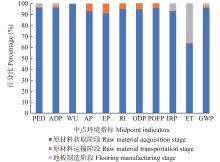
图1
生命周期阶段对生命周期评价结果的贡献度 PED: 一次能源消耗Primary energy demand; ADP: 非生物资源消耗潜值Abiotic depletion potential; WU: 水资源消耗Water use; AP: 酸化Acidi-fication potential; EP: 富营养化潜值Eutrophication potential; RI: 可吸入无机物Respiratory inorganics; ODP: 臭氧层消耗Ozone depletion potential; POFP: 光化学臭氧合成Photochemical oxidation formation potential; IRP: 电离辐射?人体健康Ionizing radiation potential; ET: 生态毒性Ecotoxicity; GWP: 全球变暖潜值Global warming potential."
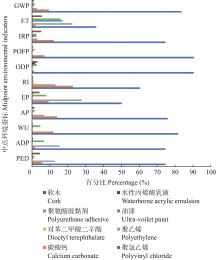
图2
原材料获取阶段清单对LCA结果的贡献度 PED: 一次能源消耗Primary energy demand; ADP: 非生物资源消耗潜值Abiotic depletion potential; WU: 水资源消耗Water use; AP: 酸化Acidi-fication potential; EP: 富营养化潜值Eutrophication potential; RI: 可吸入无机物Respiratory inorganics; ODP: 臭氧层消耗Ozone depletion potential; POFP: 光化学臭氧合成Photochemical oxidation formation potential; IRP: 电离辐射?人体健康Ionizing radiation potential; ET: 生态毒性Ecotoxicity; GWP: 全球变暖潜值Global warming potential."
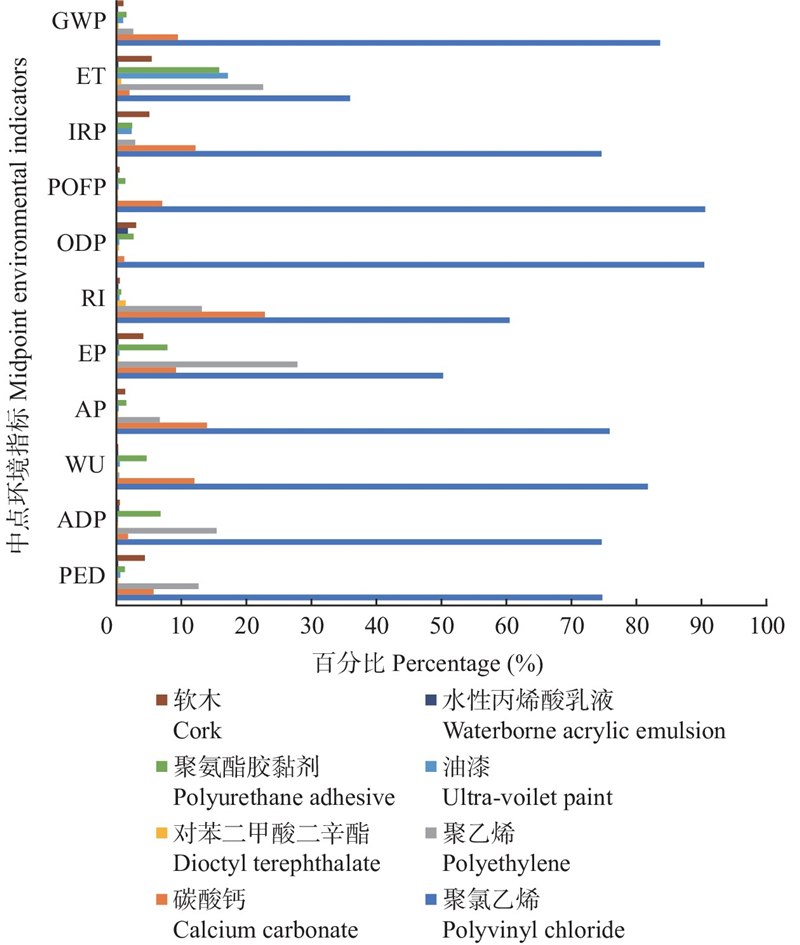
图3
地板制造阶段清单对生命周期评价结果的贡献度 PED: 一次能源消耗Primary energy demand; ADP: 非生物资源消耗潜值Abiotic depletion potential; WU: 水资源消耗Water use; AP: 酸化Acidi-fication potential; EP: 富营养化潜值Eutrophication potential; RI: 可吸入无机物Respiratory inorganics; ODP: 臭氧层消耗Ozone depletion potential; POFP: 光化学臭氧合成Photochemical oxidation formation potential; IRP: 电离辐射?人体健康Ionizing radiation potential; ET: 生态毒性Ecotoxicity; GWP: 全球变暖潜值Global warming potential."
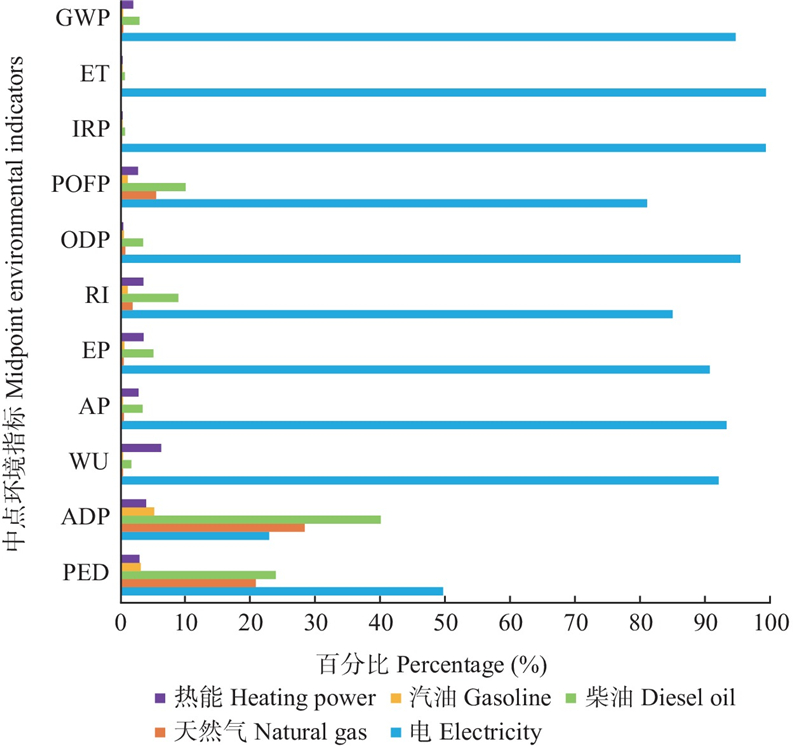
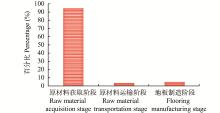
图4
生命周期阶段对节能减排综合指标的贡献度"
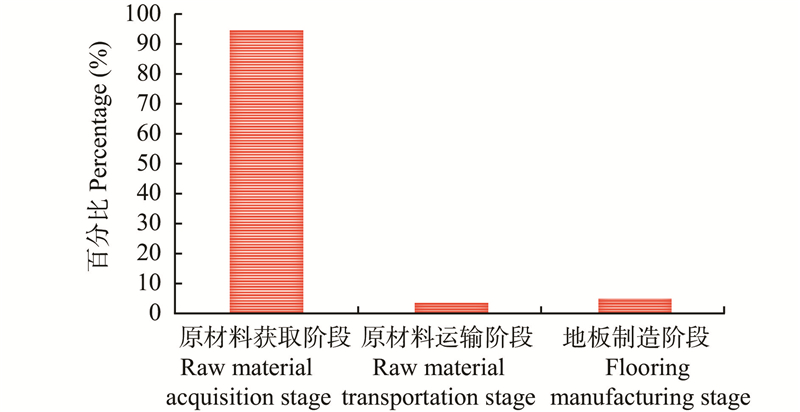
图5
原材料获取阶段清单对节能减排综合指标的贡献度"
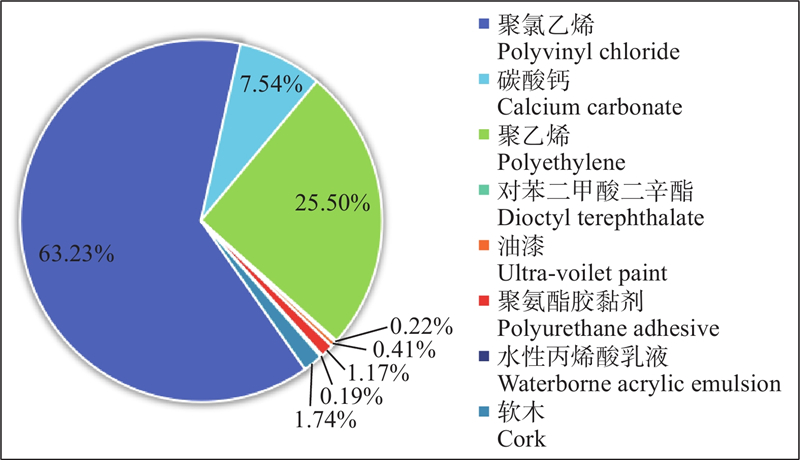
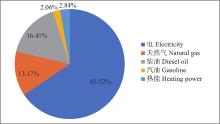
图6
地板制造阶段清单对节能减排综合指标的贡献度"
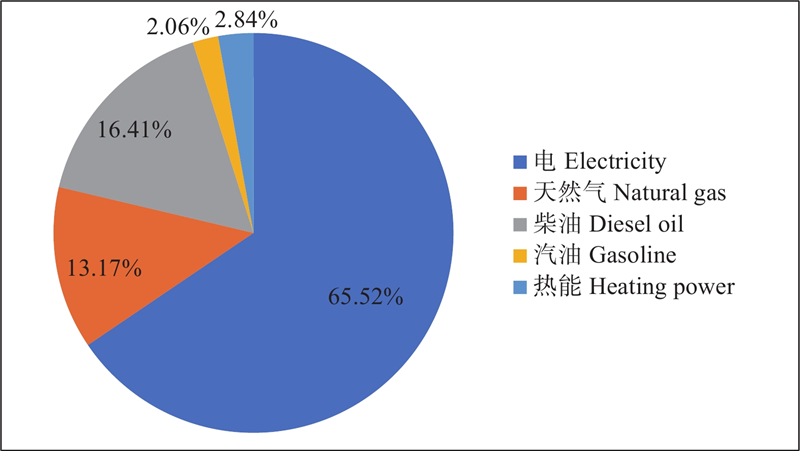
图7
二级指标对节能减排综合指标的贡献度 PED: 一次能源消耗Primary energy demand; COD: 化学需氧量Chemical oxygen demand; NOx: 氮氧化物Nitrogen oxides; IWU: 工业水资源消耗Industrial water use; CO2: 二氧化碳Carbon dioxide; NH3-N: 氨氮Ammonia nitrogen; VOC: 有机挥发物Organic volatile compounds."
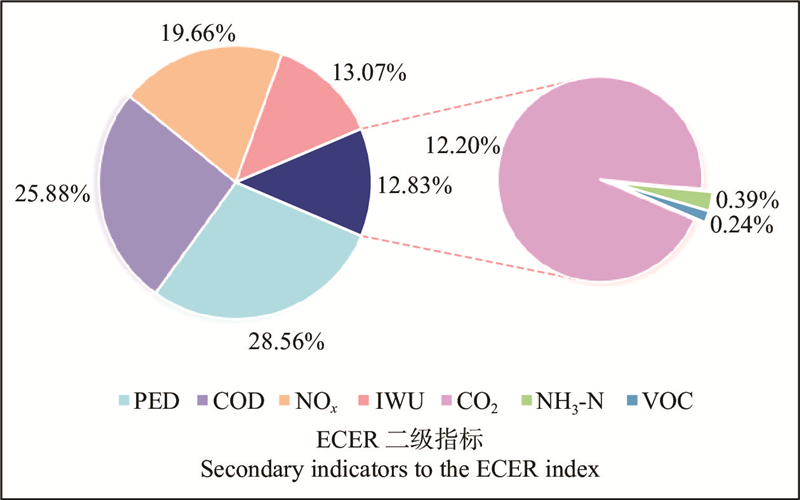
表2
1 m2其他种类铺地材料从摇篮到大门阶段的环境性能"
| 指标Indicators | 石木塑地板Stone-wood-polymer composite flooring | 陶瓷地板Ceramic flooring | 天然石材地板Natural stone flooring | 花岗岩地板Granite flooring | 石灰石地板Limestone flooring | 大理石地板Marble flooring | 实木地板Solid wooden flooring | 多层实木复合地板Multi-layer engineered wood flooring | 三层实木复合地板Three-layer engineered wood flooring | 强化地板Laminate flooring |
| 全球变暖潜值Global warming potential (GWP)/kg CO2 eq | 1.07E+01 | 7.78E+03 | 2.20E+01 | 2.40E+01 | 9.18E+00 | 3.28E+01 | 3.06E?02 | 9.70E?02 | 9.49E?02 | 1.90E?01 |
| 一次能源消耗Primary energy demand (PED)/MJ | 2.32E+02 | — | — | — | — | — | 2.39E+00 | 8.04E+00 | 5.34E+00 | 4.87E+00 |
| 非生物资源消耗潜值Abiotic depletion potential (ADP)/ kg antimony eq | 4.26E?05 | — | — | — | — | — | 2.40E?07 | 1.05E?06 | 5.61E?07 | 2.97E?06 |
| 水资源消耗Water use (WU)/kg | 1.02E+02 | 6.08E+01 | — | — | — | — | 8.03E?02 | 2.01E?01 | 3.53E?01 | 1.12E?01 |
| 酸化Acidification potential (AP)/ kg SO2 eq | 4.81E?02 | 3.87E+01 | 1.07E?01 | 1.29E?01 | 6.13E?02 | 1.11E?01 | 1.33E?04 | 7.45E?04 | 4.63E?04 | 1.34E?03 |
| 富营养化潜值Eutrophication potential (EP)/kg PO43-eq | 6.72E?03 | — | 1.51E?02 | 1.66E?02 | 7.40E?03 | 1.91E?02 | 7.18E?05 | 3.93E?04 | 1.79E?04 | 9.60E?01 |
| 可吸入无机物Respiratory inorganics (RI)/kg PM2.5 eq | 1.30E?02 | 1.66E+01 | 2.75E?02 | 1.27E?02 | 1.24E?02 | 4.09E?02 | 4.17E?05 | 2.37E?04 | 1.32E?04 | 2.58E?04 |
| 臭氧层消耗Ozone depletion potential (ODP)/kg CFC-11 eq | 2.63E?07 | 2.97E?04 | 1.13E?06 | 1.10E?06 | 4.22E?07 | 2.46E?06 | 2.06E?09 | 9.94E?09 | 5.01E?09 | 1.97E?08 |
| 光化学臭氧合成Photochemical oxidation formation potential (POFP)/kg NMVOC eq | 2.37E?02 | — | — | — | — | — | 1.45E?04 | 6.17E?04 | 3.53E?04 | 7.61E?04 |
| 生态毒性Ecotoxicity (ET)/CTUe | 1.06E+00 | 5.54E+01 | 2.38E+01 | 2.87E+01 | 1.09E+01 | 1.74E+01 | 2.71E?02 | 6.30E?02 | 7.93E?02 | 1.30E?01 |
| 电离辐射?人体健康Ionizing radiation potential (IRP)/ kg U235 eq | 2.32E?01 | — | — | — | — | — | — | — | — | — |
| 节能减排综合指标Energy conservation and emission reduction (ECER) | 4.12E?11 | — | — | — | — | — | 2.52E?12 | 4.19E?12 | 3.59E?12 | 6.76E?12 |
| 参考文献Reference | 本研究 This study | |||||||||
表3
不同原料消费量情景下石木塑复合地板节能减排综合指标的降幅"
| 材料类别 Material categories | 原材料获取阶段 Raw material acquisition stage | 摇篮到大门阶段 Cradle to gate | |||||
| 情景1 Scenario 1 | 情景2 Scenario 2 | 情景3 Scenario 3 | 情景1 Scenario 1 | 情景2 Scenario 2 | 情景3 Scenario 3 | ||
| 聚氯乙烯Polyvinyl chloride | 1.90 | 4.43 | 6.32 | 1.80 | 4.20 | 6.00 | |
| 碳酸钙Calcium carbonate | 0.23 | 0.53 | 0.75 | 0.21 | 0.50 | 0.72 | |
| 聚乙烯Polyethylene | 0.77 | 1.79 | 2.55 | 0.73 | 1.69 | 2.42 | |
| 综合 Total | 2.90 | 6.75 | 9.62 | 2.74 | 6.39 | 9.14 | |
表4
不同能源消费量情景下石木塑复合地板节能减排综合指标的降幅"
| 能源类别Energy categories | 地板制造阶段 Flooring manufacturing stage | 摇篮到大门阶段 Cradle to gate | |||||
| 情景1 Scenario 1 | 情景2 Scenario 2 | 情景3 Scenario 3 | 情景1 Scenario 1 | 情景2 Scenario 2 | 情景3 Scenario 3 | ||
| 电Electricity | 1.97 | 4.59 | 6.55 | 0.03 | 0.07 | 0.10 | |
| 天然气Natural gas | 0.39 | 0.92 | 1.32 | 0.01 | 0.01 | 0.02 | |
| 柴油Diesel oil | 0.49 | 1.15 | 1.64 | 0.01 | 0.02 | 0.02 | |
| 综合 Total | 2.85 | 6.66 | 9.51 | 0.05 | 0.10 | 0.14 | |
|
劳万里, 李晓玲, 段新芳. 木竹产品碳足迹评价研究进展. 林业科学, 2024, 60 (1): 142- 150.
doi: 10.11707/j.1001-7488.LYKX20230098 |
|
|
Lao W L, Li X L, Duan X F. Research progress for carbon footprint assessment of wood and bamboo products. Scientia Silvae Sinicae, 2024, 60 (1): 142- 150.
doi: 10.11707/j.1001-7488.LYKX20230098 |
|
| 宋文博, 董景峰, 陶新民. 2025,. 基于产品生命周期的木质家具制造企业. 森林工程, https://link.cnki.net/urlid/23.1388.S.20250711.1131.004. | |
| Song W B, Dong J F, Tao X M. 2025,. Wooden furniture manufacturing enterprises based on product life cycle. Forest Engineering, https://link.cnki.net/urlid/23.1388.S.20250711.1131.004. [in Chinese] | |
| 王洪涛. 通往节能减排目标的新途径: 生命周期节能减排评价方法. 高科技与产业化, 2011 (8): 49- 53. | |
| Wang H T. A new approach to energy conservation and emission reduction goals: life cycle energy conservation and emission reduction evaluation method. High-Technology & Commercialization, 2011 (8): 49- 53. | |
|
尹江苹, 唐召群, 郭文静, 等. 2023年中国木塑地板、石木塑地板等出口情况及贸易壁垒分析. 中国人造板, 2024, 31 (9): 7- 11.
doi: 10.12393/j.1673-5064.20240902 |
|
|
Yin J P, Tang Z Q, Guo W J, et al. Analysis of China’s 2023 WPC and SPC flooring export and trade barriers. China Wood-Based Panels, 2024, 31 (9): 7- 11.
doi: 10.12393/j.1673-5064.20240902 |
|
| Adhikari T, Minds S, Lewis K. 2022a. Life cycle assessment (LCA) of granite, limestone, and marble stone flooring by Polycor. Sustainable Minds Design Greener Products Right, from the Start, Polycor. | |
| Adhikari T, Minds S, Mellentine J, et al. 2022b. Life cycle assessment (LCA) of stone flooring by Natural Stone Institute (NSI). Sustainable Minds Design Greener Products Right, from the Start, Natural Stone Institute. | |
| Ajusree P A, Jenson J. 2020,. Environmental and economic impact assessment of flooring materials. Proceedings of SECON’19, Cham: Springer International Publishing, 83−89. | |
|
Ali A A M. Cradle-to-gate life cycle assessment of interior floor material alternatives in Egypt. Journal of Umm Al-Qura University for Engineering and Architecture, 2024, 15 (3): 282- 297.
doi: 10.1007/s43995-024-00057-1 |
|
|
Almeida M I, Dias A C, Demertzi M, et al. Environmental profile of ceramic tiles and their potential for improvement. Journal of Cleaner Production, 2016, 131, 583- 593.
doi: 10.1016/j.jclepro.2016.04.131 |
|
|
Balasbaneh A T, Yeoh D, Juki M I, et al. Applying three pillar indicator assessments on alternative floor systems: life cycle study. The International Journal of Life Cycle Assessment, 2021, 26 (7): 1439- 1455.
doi: 10.1007/s11367-021-01881-6 |
|
| Demertzi M, Garrido A, Dias A C, et al. Environmental performance of a cork floating floor. Materials & Design, 2015, 82, 317- 325. | |
|
Demertzi M, Sierra-Pérez J, Paulo J A, et al. Environmental performance of expanded cork slab and granules through life cycle assessment. Journal of Cleaner Production, 2017, 145, 294- 302.
doi: 10.1016/j.jclepro.2017.01.071 |
|
|
Dias A C, Boschmonart-Rives J, González-García S, et al. Analysis of raw cork production in Portugal and Catalonia using life cycle assessment. The International Journal of Life Cycle Assessment, 2014, 19 (12): 1985- 2000.
doi: 10.1007/s11367-014-0801-7 |
|
| Ding G K C. Life cycle assessment (LCA) of sustainable building materials: an overview. Eco-Efficient Construction and Building Materials, 2014, 49, 38- 62. | |
|
Feifel S, Stübs O, Seibert K, et al. Comparing wood-polymer composites with solid wood: the case of sustainability of terrace flooring. European Journal of Wood and Wood Products, 2015, 73 (6): 829- 836.
doi: 10.1007/s00107-015-0953-6 |
|
|
Fritter M, Lawrence R, Marcolin B, et al. A survey of life cycle inventory database implementations and architectures, and recommendations for new database initiatives. The International Journal of Life Cycle Assessment, 2020, 25 (8): 1522- 1531.
doi: 10.1007/s11367-020-01745-5 |
|
| Günkaya Z, Karacasulu L, Evlİyaoğlu G, et al. Life cycle assessment of marble plate production. Süleyman Demirel Ü niversitesi Fen Bilimleri Enstitüsü Dergisi, 2018, 22 (2): 521- 527. | |
|
Günther A, Langowski H C. Life cycle assessment study on resilient floor coverings. The International Journal of Life Cycle Assessment, 1997, 2 (2): 73- 80.
doi: 10.1007/BF02978763 |
|
| Gustafsson L M, Börjesson P. Life cycle assessment in green chemistry: a comparison of various industrial wood surface coatings. The International Journal of Life Cycle Assessment, 2007, 12 (3): 151- 159. | |
| Hellweg S, Messmer A. 2015,. Life cycle assessment (LCA) of adhesives used in wood constructions. Institute of Ecological System Design-ETH Zürich, Switzerland: Swiss Federal Institute of Technology Zurich. | |
|
Hu S Y, Guan X, Guo M H, et al. Environmental load of solid wood floor production from larch grown at different planting densities based on a life cycle assessment. Journal of Forestry Research, 2018, 29 (5): 1443- 1448.
doi: 10.1007/s11676-017-0529-x |
|
|
Ibáñez-Forés V, Bovea M D, Simó A. Life cycle assessment of ceramic tiles. Environmental and statistical analysis. The International Journal of Life Cycle Assessment, 2011, 16 (9): 916- 928.
doi: 10.1007/s11367-011-0322-6 |
|
|
Jönsson Å. Including the use phase in LCA of floor coverings. The International Journal of Life Cycle Assessment, 1999, 4 (6): 321- 328.
doi: 10.1007/BF02978521 |
|
|
Kalverkamp M, Helmers E, Pehlken A. Impacts of life cycle inventory databases on life cycle assessments: a review by means of a drivetrain case study. Journal of Cleaner Production, 2020, 269, 121329.
doi: 10.1016/j.jclepro.2020.121329 |
|
| Kamalakkannan S, Peiris R L, Kulatunga A K. 2019,. Life cycle assessment in ceramic floor tile industry in Sri Lanka. Proceedings of the International Conference on Industrial Engineering and Operations Management, Bangkok, Thailand, March, 5−7. | |
|
Kjaer L L, Pigosso D C A, McAloone T C, et al. Guidelines for evaluating the environmental performance of product/service-systems through life cycle assessment. Journal of Cleaner Production, 2018, 190, 666- 678.
doi: 10.1016/j.jclepro.2018.04.108 |
|
|
Lao W L. Assessing environmental burdens of China’s wooden flooring production based on life-cycle assessment. Journal of Cleaner Production, 2024, 446, 141341.
doi: 10.1016/j.jclepro.2024.141341 |
|
|
Li J Y, Zhang Z Z, Zhang S S, et al. Life cycle assessment of liquefied natural gas production from coke oven gas in China. Journal of Cleaner Production, 2021, 329, 129609.
doi: 10.1016/j.jclepro.2021.129609 |
|
| Li M, Wang Z, Sun D. Study on life cycle assessment of polythene production. Environmental Science & Technology, 2009, 32 (5): 191- 195. | |
|
Liu S Q, Liu J M, Gao Y, et al. Plantation model of soapberry (Sapindus mukorossi Gaertn. ) in southeast China in relation to environmental impact effect based on a life cycle assessment. BioEnergy Research, 2022, 15 (2): 1342- 1354.
doi: 10.1007/s12155-021-10312-1 |
|
|
Miettinen P, Hämäläinen R P. How to benefit from decision analysis in environmental life cycle assessment (LCA). European Journal of Operational Research, 1997, 102 (2): 279- 294.
doi: 10.1016/S0377-2217(97)00109-4 |
|
|
Minne E, Crittenden J C. Impact of maintenance on life cycle impact and cost assessment for residential flooring options. The International Journal of Life Cycle Assessment, 2015, 20 (1): 36- 45.
doi: 10.1007/s11367-014-0809-z |
|
|
Nicoletti G M, Notarnicola B, Tassielli G. Comparative life cycle assessment of flooring materials: ceramic versus marble tiles. Journal of Cleaner Production, 2002, 10 (3): 283- 296.
doi: 10.1016/S0959-6526(01)00028-2 |
|
|
Paratscha R, von der Thannen M, Smutny R, et al. Development of LCA benchmarks for Austrian torrent control structures. The International Journal of Life Cycle Assessment, 2019, 24 (11): 2035- 2053.
doi: 10.1007/s11367-019-01618-6 |
|
|
Paulsen J H. The maintenance of linoleum and PVC floor coverings in Sweden the significance of the usage phase in an LCA. The International Journal of Life Cycle Assessment, 2003, 8 (6): 357- 364.
doi: 10.1007/BF02978509 |
|
|
Petersen A K, Solberg B. Substitution between floor constructions in wood and natural stone: comparison of energy consumption, greenhouse gas emissions, and costs over the life cycle. Canadian Journal of Forest Research, 2003, 33 (6): 1061- 1075.
doi: 10.1139/x03-020 |
|
|
Sangwan K S, Choudhary K, Batra C. Environmental impact assessment of a ceramic tile supply chain: a case study. International Journal of Sustainable Engineering, 2018, 11 (3): 211- 216.
doi: 10.1080/19397038.2017.1394398 |
|
| Serenella S, Mathieux F, Pant R. 2015,. Life cycle assessment and sustainability supporting decision making by business and policy. Sustainability Assessment of Renewables‐Based Products: Methods and Case Studies, 201−214. | |
|
Shi J L, Li T, Peng S T, et al. Comparative life cycle assessment of remanufactured liquefied natural gas and diesel engines in China. Journal of Cleaner Production, 2015, 101, 129- 136.
doi: 10.1016/j.jclepro.2015.03.080 |
|
|
Sim J, Prabhu V. The life cycle assessment of energy and carbon emissions on wool and nylon carpets in the United States. Journal of Cleaner Production, 2018, 170, 1231- 1243.
doi: 10.1016/j.jclepro.2017.09.203 |
|
|
Traverso M, Rizzo G, Finkbeiner M. Environmental performance of building materials: life cycle assessment of a typical Sicilian marble. The International Journal of Life Cycle Assessment, 2010, 15 (1): 104- 114.
doi: 10.1007/s11367-009-0135-z |
|
| van Oers L, van der Voet E. 2013,. LCA case study cushion vinyl floor covering and DEHP: environmental impacts of use and recycling of additives (DEHP) in products. Global Risk-Based Management of Chemical Additives Ⅱ: Risk-Based Assessment and Management Strategies, 223−243. | |
|
Ye L P, Qi C C, Hong J L, et al. Life cycle assessment of polyvinyl chloride production and its recyclability in China. Journal of Cleaner Production, 2017, 142, 2965- 2972.
doi: 10.1016/j.jclepro.2016.10.171 |
|
|
Yu X, Zeng L Z, Zhang G F, et al. Environmental impact of bamboo laminated flooring and bamboo scrimber flooring investigated via life cycle assessment. BioResources, 2019, 14 (4): 9132- 9145.
doi: 10.15376/biores.14.4.9132-9145 |
|
|
Yue Y, Wang T, Liang S, et al. Life cycle assessment of high speed rail in China. Transportation Research Part D: Transport and Environment, 2015, 41, 367- 376.
doi: 10.1016/j.trd.2015.10.005 |
|
|
Zhang W J, Guo J F, Gu F, et al. Coupling life cycle assessment and life cycle costing as an evaluation tool for developing product service system of high energy-consuming equipment. Journal of Cleaner Production, 2018, 183, 1043- 1053.
doi: 10.1016/j.jclepro.2018.02.146 |
| [1] | 田惠玲,朱建华,何潇,陈新云,王冉,肖文发,雷相东. 中亚热带典型森林类型林分乔木碳储量生长模型[J]. 林业科学, 2026, 62(2): 15-24. |
| [2] | 陈碧雁,徐金梅,陈秀芳,张波. 基于IPCC生产法的我国木质林产品碳储量动态评估及驱动因素分析[J]. 林业科学, 2025, 61(12): 153-163. |
| [3] | 张聪,刘琪,李海奎,刘鹏举,詹思颖. 我国尺度兼容和树种分类的材积源森林碳储量模型[J]. 林业科学, 2025, 61(1): 57-69. |
| [4] | 杨润露,王娟,张春雨. 东北天然次生针阔混交林乔木层碳储量变化的采伐干扰响应[J]. 林业科学, 2024, 60(7): 17-27. |
| [5] | 刘世荣,王晖,李海奎,余振,栾军伟. 碳中和目标下中国森林碳储量、碳汇变化预估与潜力提升途径[J]. 林业科学, 2024, 60(4): 157-172. |
| [6] | 吕梓晴, 段爱国. 不同产区杉木生物量与碳储量模型[J]. 林业科学, 2024, 60(2): 1-11. |
| [7] | 劳万里,李晓玲,段新芳. 木竹产品碳足迹评价研究进展[J]. 林业科学, 2024, 60(1): 142-150. |
| [8] | 曾伟生,蒲莹,杨学云,易善军. 我国5种主要人工林乔木层碳储量生长模型及其气候驱动分析[J]. 林业科学, 2023, 59(3): 21-30. |
| [9] | 张煜星,王雪军. 1973—2018年我国桉树人工林生产力及碳汇能力[J]. 林业科学, 2023, 59(3): 54-64. |
| [10] | 郭泽鑫,胡中岳,曹聪,刘萍. 广东主要森林类型林分生物量和碳储量模型研建[J]. 林业科学, 2023, 59(12): 37-50. |
| [11] | 田惠玲,朱建华,何潇,陈新云,简尊吉,李宸宇,郭学媛,黄国胜,肖文发. 基于随机森林模型的东北三省乔木林生物质碳储量预测[J]. 林业科学, 2022, 58(4): 40-50. |
| [12] | 侯志康,曾松伟,莫路锋,周宇峰. 基于GA-BP神经网络的雷竹林CO2浓度反演[J]. 林业科学, 2022, 58(2): 42-48. |
| [13] | 王雪峰,陈珠琳,管青军,刘嘉政,王甜,袁莹. 基于林内图像的单位面积碳储量估计方法[J]. 林业科学, 2021, 57(1): 105-112. |
| [14] | 王振鹏,陈金磊,李尚益,张仕吉,方晰. 湘中丘陵区不同恢复阶段森林生态系统的碳储量特征[J]. 林业科学, 2020, 56(5): 19-28. |
| [15] | 武金翠,周军,张宇,余晓燕,石雷,漆良华. 毛竹林固碳增汇价值的动态变化:以福建省为例[J]. 林业科学, 2020, 56(4): 181-187. |
| 阅读次数 | ||||||
|
全文 |
|
|||||
|
摘要 |
|
|||||

