
Scientia Silvae Sinicae ›› 2026, Vol. 62 ›› Issue (4): 55-67.doi: 10.11707/j.1001-7488.LYKX20250710
• Research papers • Previous Articles Next Articles
Wenqiang Gao1,Xiangdong Lei1,*( ),Xiao He1,Yutang Li2
Received:2025-11-25
Online:2026-04-15
Published:2026-04-11
Contact:
Xiangdong Lei
E-mail:xdlei@ifirit.ac.cn
CLC Number:
Wenqiang Gao,Xiangdong Lei,Xiao He,Yutang Li. Variability in Tree Species Diversity-Aboveground Biomass Relationship in Temperate Forest Types and Developmental Stages in Northeast China[J]. Scientia Silvae Sinicae, 2026, 62(4): 55-67.

Table 1
Statistics of stand average age across five developmental stages for different forest types"
| 发育阶段 Developmental stage | 样地数量 Number of plots | 林分平均年龄 Stand average age/a | ||
| 阔叶纯林 Broad-leaved pure forest | 阔叶混交林 Broad-leaved mixed forest | 针阔混交林 Coniferous and broad-leaved mixed forest | ||
| 幼龄林 Young forest | 220 | 23 (5~30) | 25 (4~30) | 23 (5~30) |
| 中龄林 Middle-aged forest | 459 | 42 (6~50) | 42 (6~50) | 42 (7~50) |
| 近熟林 Near-mature forest | 843 | 62 (6~70) | 61 (6~70) | 60 (5~70) |
| 成熟林 Mature forest | 525 | 81 (9~100) | 81 (8~100) | 85 (8~100) |
| 过熟林 Over-mature forest | 345 | 126 (16~168) | 125 (16~203) | 134 (22~202) |
Table 2
Formulas of tree species diversity"
| 指标Index | 计算公式Formula |
| 物种丰富度Species richness (S) | S=Ns |
| 功能多样性Functional diversity (FD) | |
| 群落加权平均性状值 Community weighted mean trait values (CWM) | |
| 谱系多样性Phylogenetic diversity (PD) |
Table 3
Tree species functional traits statistics"
| 树种功能性状 Tree species functional traits | 单位 Units | 平均值 ± 标准差 Mean value ± standard deviation |
| 最大树高Maximum tree height | m | 23.824±11.061 |
| 叶面积Leaf area | m2 | 0.003±0.005 |
| 比叶面积Specific leaf area | m2·kg?1 | 19.904±10.168 |
| 单位面积叶质量 Leaf dry mass per unit area | kg·m?2 | 0.084±0.069 |
| 叶碳含量 Leaf carbon content | g·kg?1 | 422.288±84.501 |
| 叶氮含量Leaf nitrogen content | g·kg?1 | 18.914±7.422 |
| 叶磷含量Leaf phosphorus content | g·kg?1 | 1.786±0.753 |
| 木材密度Wood density | g·cm?3 | 0.512±0.121 |
Fig.1
Relationship between tree species diversity and aboveground biomass (AGB) in different forest types"
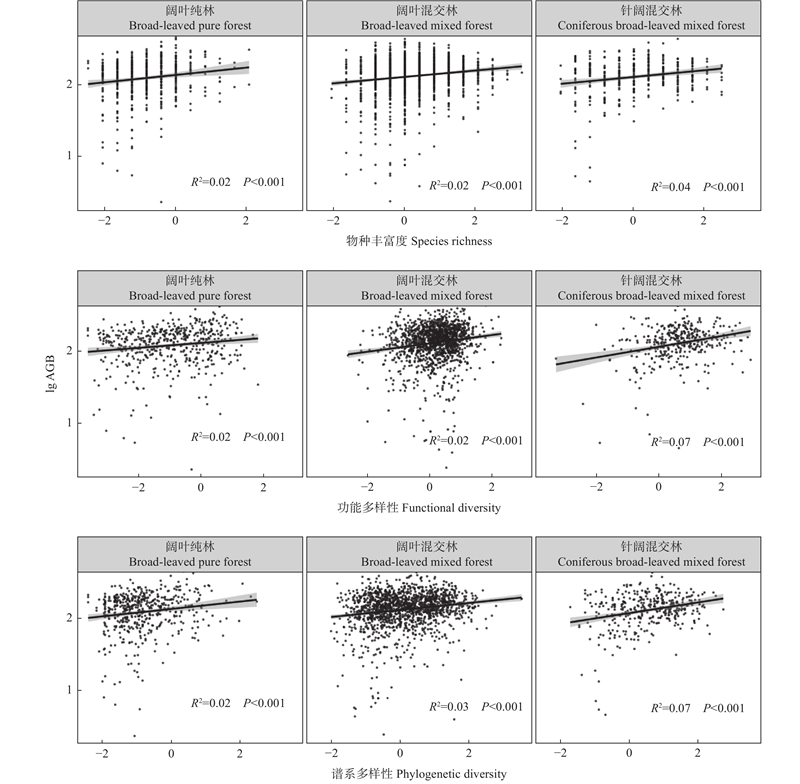
Fig.2
Relationship between community-weighted mean trait values and aboveground biomass (AGB) of broad-leaved pure forest"
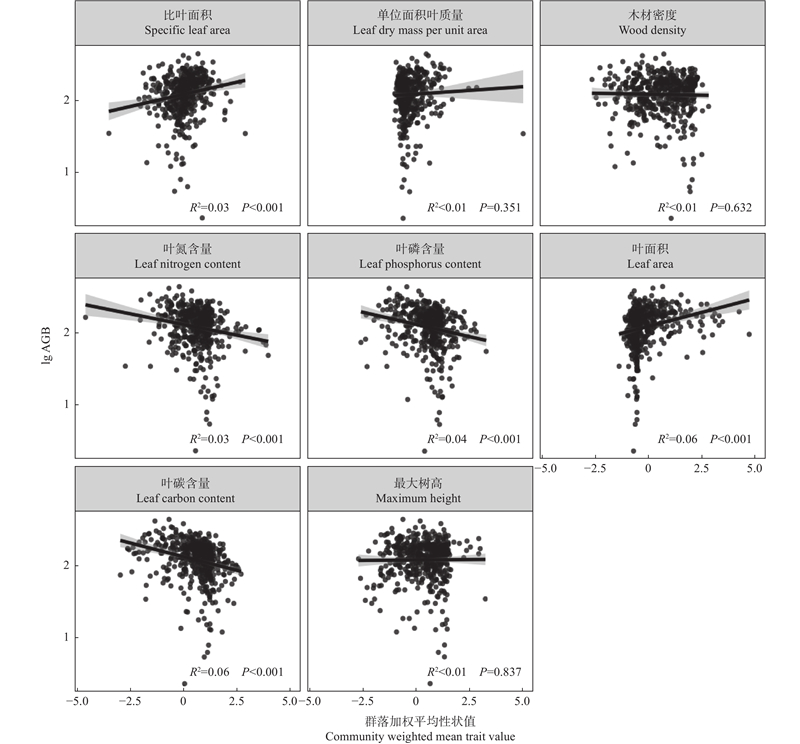
Fig.3
Relationship between community-weighted mean trait values and aboveground biomass (AGB) of broad-leaved mixed forest"
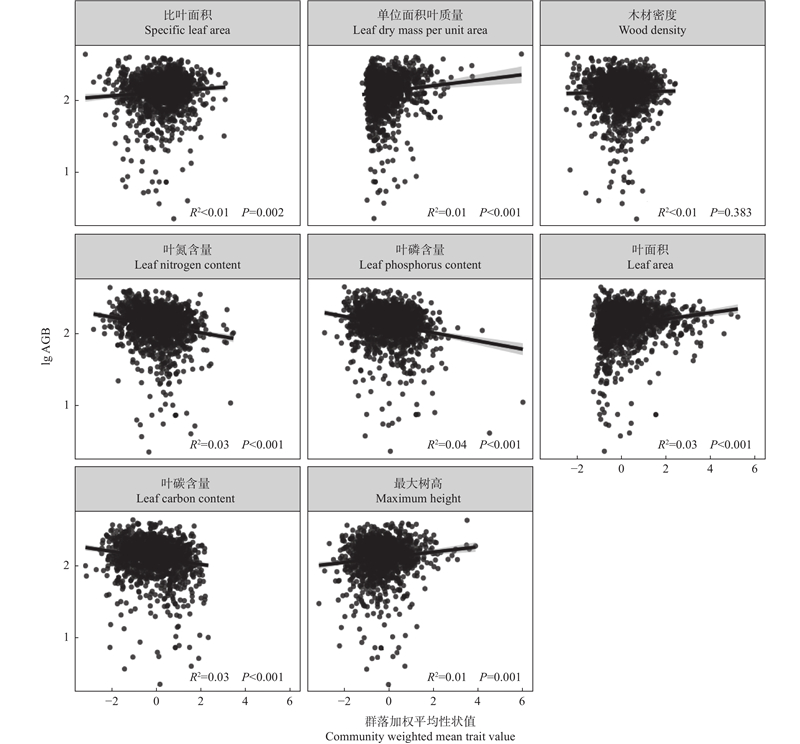
Fig.4
Relationship between community-weighted trait values and aboveground biomass (AGB) of coniferous and broad-leaved mixed forest"
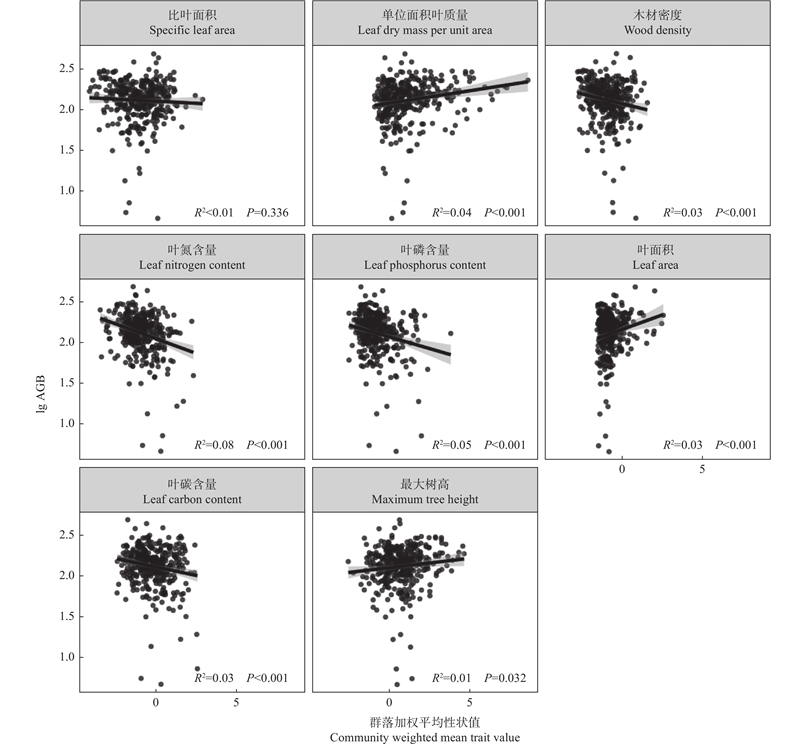
Fig.5
Relationship between tree species diversity and aboveground biomass across different forest types along developmental stages The effect sizes represent the slopes of the diversity-aboveground biomass relationships, which are derived from linear mixed-effects models. The curve illustrates the nonlinear relationship between these effect sizes and stand age, fitted using a generalized additive model (showing the mean and 95% confidence interval)."
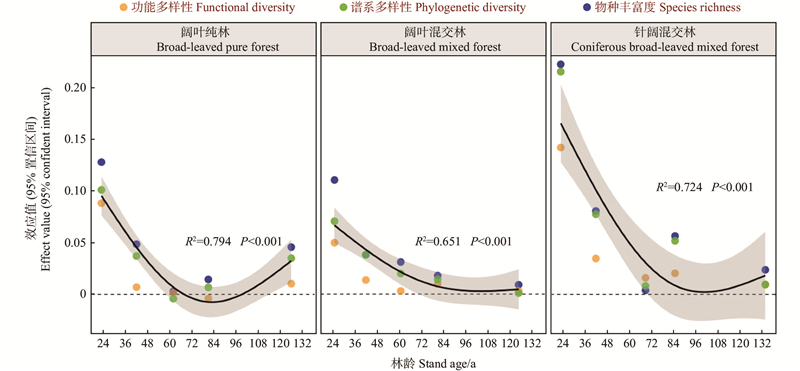
Fig.6
Effects of community-weighted mean traits values and functional diversity on aboveground biomass across different forest types along developmental stages The effect sizes represent the slopes of functional diversity or community-weighted traits values-aboveground biomass relationships, which are derived from linear mixed-effects models. The curve illustrates the nonlinear relationship between these effect sizes and stand age, fitted using a generalized additive model (showing the mean and 95% confidence interval)."
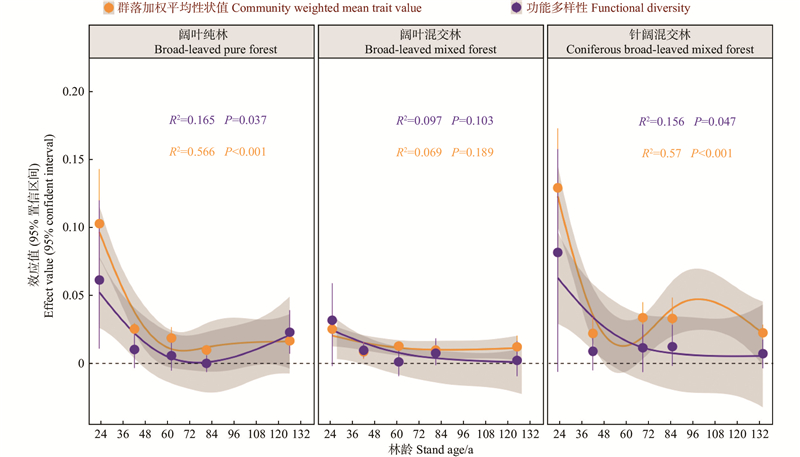
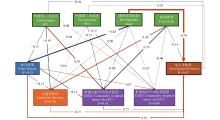
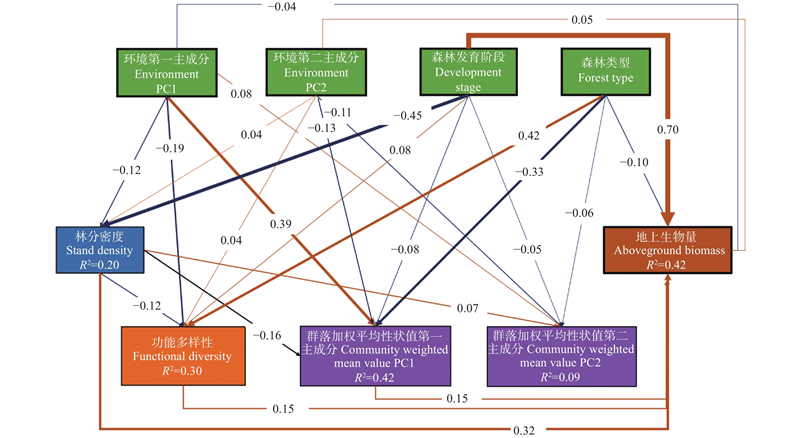
Fig.7
Structural equation model diagram illustrating the impact of biotic and abiotic factors on aboveground biomass in the temperate forests of northeast China Blue lines indicate significant negative correlations, while orange lines indicate significant positive correlations. The numerical values on the lines represent standardized path coefficients, with line thickness reflecting the magnitude of the coefficients."
| 国家林业和草原局. 2020. 森林资源连续清查技术规程(GB/T 38590—2020). 北京: 中国标准出版社. | |
| National Forestry and Grassland Administration. 2020. Technical regulations for continuous forest inventory (GB/T 38590—2020). Beijing: China Standard Press. [in Chinese] | |
| 欧阳志云, 王如松, 赵景柱. 生态系统服务功能及其生态经济价值评价. 应用生态学报, 1999, 10 (5): 635- 640. | |
| Ouyang Z Y, Wang R S, Zhao J Z. Ecosystem services and their economic valuation. Chinese Journal of Applied Ecology, 1999, 10 (5): 635- 640. | |
| 吴初平, 韩文娟, 江 波, 等. 浙江定海次生林内物种丰富度与生物量和生产力关系的环境依赖性. 生物多样性, 2018, 26 (6): 545- 553. | |
| Wu C P, Han W J, Jiang B, et al. Relationships between species richness and biomass/productivity depend on environmental factors in secondary forests of Dinghai, Zhejiang Province. Biodiversity Science, 2018, 26 (6): 545- 553. | |
| 吴兆飞, 张雨秋, 张忠辉, 等. 东北温带森林林分结构与生产力关系研究. 北京林业大学学报, 2019, 41 (5): 48- 55. | |
| Wu Z F, Zhang Y Q, Zhang Z H, et al. Study on the relationship between forest structure and productivity of temperate forests in northeast China. Journal of Beijing Forestry University, 2019, 41 (5): 48- 55. | |
|
袁鹤洋, 郝珉辉, 何怀江, 等. 长白山物种丰富度与物种组成对森林生产力的影响及其随演替的变化. 植物生态学报, 2024, 48 (12): 1602- 1611.
doi: 10.17521/cjpe.2024.0060 |
|
|
Yuan H Y, Hao M H, He H J, et al. Impact of species richness and composition on productivity and its changes with forest succession in Changbai Mountains, China. Chinese Journal of Plant Ecology, 2024, 48 (12): 1602- 1611.
doi: 10.17521/cjpe.2024.0060 |
|
| 徐 炜, 马志远, 井 新, 等. 生物多样性与生态系统多功能性: 进展与展望. 生物多样性, 2016, 24 (1): 55- 71. | |
| Xu W, Ma Z Y, Jing X, et al. Biodiversity and ecosystem multifunctionality: advances and perspectives. Biodiversity Science, 2016, 24 (1): 55- 71. | |
| 中国植物志编辑委员会. 2004. 中国植物志. 北京: 科学出版社. | |
| Editorial Committee of Flora of China. 2024. Flora reipublicae popularis sinicae. Beijing: Science Press. [in Chinese] | |
|
Ali A, Lin S L, He J K, et al. Climate and soils determine aboveground biomass indirectly via species diversity and stand structural complexity in tropical forests. Forest Ecology and Management, 2019, 432, 823- 831.
doi: 10.1016/j.foreco.2018.10.024 |
|
|
Ammer C. Diversity and forest productivity in a changing climate. The New Phytologist, 2019, 221 (1): 50- 66.
doi: 10.1111/nph.15263 |
|
|
Balvanera P, Pfisterer A B, Buchmann N, et al. Quantifying the evidence for biodiversity effects on ecosystem functioning and services. Ecology Letters, 2006, 9 (10): 1146- 1156.
doi: 10.1111/j.1461-0248.2006.00963.x |
|
|
Bongers F J, Schmid B, Bruelheide H, et al. Functional diversity effects on productivity increase with age in a forest biodiversity experiment. Nature Ecology & Evolution, 2021, 5 (12): 1594- 1603.
doi: 10.1038/s41559-021-01564-3 |
|
|
Bordin K M, Esquivel-Muelbert A, Klipel J, et al. No relationship between biodiversity and forest carbon sink across the subtropical Brazilian Atlantic Forest. Perspectives in Ecology and Conservation, 2023, 21 (2): 112- 120.
doi: 10.1016/j.pecon.2023.02.003 |
|
|
Cai H Y, Di X Y, Chang S X, et al. Stand density and species richness affect carbon storage and net primary productivity in early and late successional temperate forests differently. Ecological Research, 2016, 31 (4): 525- 533.
doi: 10.1007/s11284-016-1361-z |
|
|
Cardinale B J, Gross K, Fritschie K, et al. Biodiversity simultaneously enhances the production and stability of community biomass, but the effects are independent. Ecology, 2013, 94 (8): 1697- 1707.
doi: 10.1890/12-1334.1 |
|
|
Chapin III F S, Zavaleta E S, Eviner V T, et al. Consequences of changing biodiversity. Nature, 2000, 405 (6783): 234- 242.
doi: 10.1038/35012241 |
|
|
Chave J, Coomes D, Jansen S, et al. Towards a worldwide wood economics spectrum. Ecology Letters, 2009, 12 (4): 351- 366.
doi: 10.1111/j.1461-0248.2009.01285.x |
|
| Chen S P, Wang W T, Xu W T, et al. Plant diversity enhances productivity and soil carbon storage. Proceedings of the National Academy of Sciences of the United States of America, 2018, 115 (16): 4027- 4032. | |
|
Chiang J M, Spasojevic M J, Muller-Landau H C, et al. Functional composition drives ecosystem function through multiple mechanisms in a broadleaved subtropical forest. Oecologia, 2016, 182 (3): 829- 840.
doi: 10.1007/s00442-016-3717-z |
|
|
Dı́az S, Cabido M. Vive la différence: plant functional diversity matters to ecosystem processes. Trends in Ecology & Evolution, 2001, 16 (11): 646- 655.
doi: 10.1016/S0169-5347(01)02283-2 |
|
|
Faith D P. Conservation evaluation and phylogenetic diversity. Biological Conservation, 1992, 61 (1): 1- 10.
doi: 10.1016/0006-3207(92)91201-3 |
|
|
Feng Y H, Schmid B, Loreau M, et al. Multispecies forest plantations outyield monocultures across a broad range of conditions. Science, 2022, 376 (6595): 865- 868.
doi: 10.1126/science.abm6363 |
|
|
Finegan B, Peña-Claros M, de Oliveira A, et al. Does functional trait diversity predict above-ground biomass and productivity of tropical forests? Testing three alternative hypotheses. Journal of Ecology, 2015, 103 (1): 191- 201.
doi: 10.1111/1365-2745.12346 |
|
|
Forrester D I. The spatial and temporal dynamics of species interactions in mixed-species forests: from pattern to process. Forest Ecology and Management, 2014, 312, 282- 292.
doi: 10.1016/j.foreco.2013.10.003 |
|
|
Forrester D I, Ammer C, Annighöfer P J, et al. Effects of crown architecture and stand structure on light absorption in mixed and monospecific Fagus sylvatica and Pinus sylvestris forests along a productivity and climate gradient through Europe. Journal of Ecology, 2018, 106 (2): 746- 760.
doi: 10.1111/1365-2745.12803 |
|
|
Fotis A T, Murphy S J, Ricart R D, et al. Above-ground biomass is driven by mass-ratio effects and stand structural attributes in a temperate deciduous forest. Journal of Ecology, 2018, 106 (2): 561- 570.
doi: 10.1111/1365-2745.12847 |
|
|
Gao W Q, Lei X D, Gao D L, et al. Mass-ratio and complementarity effects simultaneously drive aboveground biomass in temperate Quercus forests through stand structure. Ecology and Evolution, 2021, 11 (23): 16806- 16816.
doi: 10.1002/ece3.8312 |
|
|
Gao W Q, Liang M W, Xiang W H, et al. Development stage-dependent effects of biodiversity on aboveground biomass of temperate forests. Ecography, 2025, 2025 (4): e07414.
doi: 10.1111/ecog.07414 |
|
|
Garnier E, Cortez J, Billès G, et al. Plant functional markers capture ecosystem properties during secondary succession. Ecology, 2004, 85 (9): 2630- 2637.
doi: 10.1890/03-0799 |
|
| Gonzalez A, Germain R M, Srivastava D S, et al. Scaling-up biodiversity-ecosystem functioning research. Ecology Letters, 2020, 23 (4): 757- 776. | |
|
Guerrero-Ramírez N R, Craven D, Reich P B, et al. Diversity-dependent temporal divergence of ecosystem functioning in experimental ecosystems. Nature Ecology & Evolution, 2017, 1 (11): 1639- 1642.
doi: 10.1038/s41559-017-0325-1 |
|
|
Hao M H, Messier C, Geng Y, et al. Functional traits influence biomass and productivity through multiple mechanisms in a temperate secondary forest. European Journal of Forest Research, 2020, 139 (6): 959- 968.
doi: 10.1007/s10342-020-01298-0 |
|
|
Hooper D U, Adair E C, Cardinale B J, et al. A global synthesis reveals biodiversity loss as a major driver of ecosystem change. Nature, 2012, 486 (7401): 105- 108.
doi: 10.1038/nature11118 |
|
|
Huang Y Y, Chen Y X, Castro-Izaguirre N, et al. Impacts of species richness on productivity in a large-scale subtropical forest experiment. Science, 2018, 362 (6410): 80- 83.
doi: 10.1126/science.aat6405 |
|
|
Jucker T, Avăcăriţei D, Bărnoaiea I, et al. Climate modulates the effects of tree diversity on forest productivity. Journal of Ecology, 2016, 104 (2): 388- 398.
doi: 10.1111/1365-2745.12522 |
|
|
Kröber W, Zhang S R, Ehmig M, et al. Linking xylem hydraulic conductivity and vulnerability to the leaf economics spectrum: a cross-species study of 39 evergreen and deciduous broadleaved subtropical tree species. PLoS One, 2014, 9 (11): e109211.
doi: 10.1371/journal.pone.0109211 |
|
|
Laganière J, Cavard X, Brassard B W, et al. The influence of boreal tree species mixtures on ecosystem carbon storage and fluxes. Forest Ecology and Management, 2015, 354, 119- 129.
doi: 10.1016/j.foreco.2015.06.029 |
|
|
Laliberté E, Legendre P. A distance-based framework for measuring functional diversity from multiple traits. Ecology, 2010, 91 (1): 299- 305.
doi: 10.1890/08-2244.1 |
|
|
Lasky J R, Uriarte M, Boukili V K, et al. The relationship between tree biodiversity and biomass dynamics changes with tropical forest succession. Ecology Letters, 2014, 17 (9): 1158- 1167.
doi: 10.1111/ele.12322 |
|
|
Lei X D, Wang W F, Peng C H. Relationships between stand growth and structural diversity in spruce-dominated forests in New Brunswick, Canada. Canadian Journal of Forest Research, 2009, 39 (10): 1835- 1847.
doi: 10.1139/X09-089 |
|
|
Liang J J, Crowther T W, Picard N, et al. Positive biodiversity-productivity relationship predominant in global forests. Science, 2016, 354 (6309): 8957.
doi: 10.1126/science.aaf8957 |
|
| Lohbeck M, Poorter L, Paz H, et al. 2012. Functional diversity changes during tropical forest succession. Perspectives in Plant Ecology, Evolution and Systematics, 14(2): 89−96. | |
| Loreau M. 1998. Biodiversity and ecosystem functioning: a mechanistic model. Proceedings of the National Academy of Sciences of the United States of America, 95: 5632–5636. | |
|
Luo Y H, Cadotte M W, Burgess K S, et al. Greater than the sum of the parts: how the species composition in different forest strata influence ecosystem function. Ecology Letters, 2019, 22 (9): 1449- 1461.
doi: 10.1111/ele.13330 |
|
|
Mahaut L, Fort F, Violle C, et al. Multiple facets of diversity effects on plant productivity: species richness, functional diversity, species identity and intraspecific competition. Functional Ecology, 2020, 34 (1): 287- 298.
doi: 10.1111/1365-2435.13473 |
|
| Niu C Y, Meinzer F C, Hao G Y. Divergence in strategies for coping with winter embolism among co-occurring temperate tree species. Functional Ecology, 2017, 31 (8): 1550- 1560. | |
| Norden N, Letcher S G, Boukili V, et al. Demographic drivers of successional changes in phylogenetic structure across life-history stages in plant communities. Ecology, 2012, 93 (8): 70- 82. | |
|
Pan Y D, Birdsey R A, Fang J Y, et al. A large and persistent carbon sink in the world’s forests. Science, 2011, 333 (6045): 988- 993.
doi: 10.1126/science.1201609 |
|
|
Paquette A, Messier C. The effect of biodiversity on tree productivity: from temperate to boreal forests. Global Ecology and Biogeography, 2011, 20 (1): 170- 180.
doi: 10.1111/j.1466-8238.2010.00592.x |
|
|
Poorter H, Niinemets Ü, Poorter L, et al. Causes and consequences of variation in leaf mass per area (LMA): a meta-analysis. New Phytologist, 2009, 182 (3): 565- 588.
doi: 10.1111/j.1469-8137.2009.02830.x |
|
|
Poorter L, Bongers F, Sterck F J, et al. Beyond the regeneration phase: differentiation of height-light trajectories among tropical tree species. Journal of Ecology, 2005, 93 (2): 256- 267.
doi: 10.1111/j.1365-2745.2004.00956.x |
|
|
Poorter L, van der Sande M T, Arets E J M M, et al. Biodiversity and climate determine the functioning of Neotropical forests. Global Ecology and Biogeography, 2017, 26 (12): 1423- 1434.
doi: 10.1111/geb.12668 |
|
|
Ruiz-Benito P, Ratcliffe S, Jump A S, et al. Functional diversity underlies demographic responses to environmental variation in European forests. Global Ecology and Biogeography, 2017, 26 (2): 128- 141.
doi: 10.1111/geb.12515 |
|
|
Satdichanh M, Ma H X, Yan K, et al. Phylogenetic diversity correlated with above-ground biomass production during forest succession: Evidence from tropical forests in Southeast Asia. Journal of Ecology, 2019, 107 (3): 1419- 1432.
doi: 10.1111/1365-2745.13112 |
|
|
Seidel D, Leuschner C, Scherber C, et al. The relationship between tree species richness, canopy space exploration and productivity in a temperate broad-leaf mixed forest. Forest Ecology and Management, 2013, 310, 366- 374.
doi: 10.1016/j.foreco.2013.08.058 |
|
|
Tatsumi S. Tree diversity effects on forest productivity increase through time because of spatial partitioning. Forest Ecosystems, 2020, 7 (1): 24.
doi: 10.1186/s40663-020-00238-z |
|
|
Taylor A R, Gao B L, Chen H Y H. The effect of species diversity on tree growth varies during forest succession in the boreal forest of central Canada. Forest Ecology and Management, 2020, 455, 117641.
doi: 10.1016/j.foreco.2019.117641 |
|
| Tilman D, Lehman C L, Thomson K T. Plant diversity and ecosystem productivity: theoretical considerations. Proceedings of the National Academy of Sciences of the United States of America, 1997, 94 (5): 1857- 1861. | |
|
van der Plas F. Biodiversity and ecosystem functioning in naturally assembled communities. Biological Reviews, 2019, 94 (4): 1220- 1245.
doi: 10.1111/brv.12499 |
|
|
Wang H, Harrison S P, Prentice I C, et al. The China plant trait database: toward a comprehensive regional compilation of functional traits for land plants. Ecology, 2018, 99 (2): 500.
doi: 10.1002/ecy.2091 |
|
|
Watson J E M, Evans T, Venter O, et al. The exceptional value of intact forest ecosystems. Nature Ecology & Evolution, 2018, 2 (4): 599- 610.
doi: 10.1038/s41559-018-0490-x |
|
| Webb C O, Ackerly D D, Kembel S W. 2008. Phylocom: software for the analysis of phylogenetic community structure and trait evolution. Bioinformatics, 24: 2098−2100. | |
|
Xu W, Luo W X, Zhang C Y, et al. Biodiversity-ecosystem functioning relationships of overstorey versus understorey trees in an old-growth temperate forest. Annals of Forest Science, 2019, 76 (3): 64.
doi: 10.1007/s13595-019-0845-8 |
|
|
Yuan Z Q, Wang S P, Ali A, et al. Aboveground carbon storage is driven by functional trait composition and stand structural attributes rather than biodiversity in temperate mixed forests recovering from disturbances. Annals of Forest Science, 2018, 75 (3): 67.
doi: 10.1007/s13595-018-0745-3 |
|
|
Yuan Z Q, Wang S P, Gazol A, et al. Multiple metrics of diversity have different effects on temperate forest functioning over succession. Oecologia, 2016, 182 (4): 1175- 1185.
doi: 10.1007/s00442-016-3737-8 |
|
|
Zhang Y, Chen H Y H, Reich P B. Forest productivity increases with evenness, species richness and trait variation: a global meta-analysis. Journal of Ecology, 2012, 100 (3): 742- 749.
doi: 10.1111/j.1365-2745.2011.01944.x |
| [1] | Min Deng,Huaijiang He,Xiangju Wu,Xinna Zhang,Chunyu Zhang,Xiuhai Zhao. Effects of Biomass Allocation Trade-Offs and Traits of Temperate Forests in Northeast China on Seedling Growth [J]. Scientia Silvae Sinicae, 2026, 62(3): 48-60. |
| [2] | Sheng Zhou,Fugen Jiang,Shuai Chen,Yi Long,Binbin Wang,Zige Song,Hua Sun. Estimation of Forest Aboveground Biomass Using Joint Spaceborne-UAV LiDAR and Sentinel-2 Data [J]. Scientia Silvae Sinicae, 2026, 62(3): 74-87. |
| [3] | Hui Mao,Feifei Zhao,Jie Li,Chunyu Zhang. Impacts of Tree Species Diversity and Environmental Factors on Soil Multifunctionality in the Middle Temperate Forests of Northeast China [J]. Scientia Silvae Sinicae, 2026, 62(2): 40-52. |
| [4] | Liuyuan Huang,Yan Zheng,Xinjie Cheng,Weisheng Zeng,Qing Xu,Zhengyang Hou. Estimation of Forest Aboveground Biomass Based on Non-Wall-to-Wall Remote Sensing Auxiliary Data [J]. Scientia Silvae Sinicae, 2025, 61(9): 22-38. |
| [5] | Yujiao Zhang,Hengqian Zhao,Hancong Fu,Ge Liu,Xiadan Huangfu,Xuanqi Liu. Inversion Model of Aboveground Biomass at Individual Tree Scale Based on the Multiple Features of UAV Remote Sensing [J]. Scientia Silvae Sinicae, 2025, 61(8): 129-141. |
| [6] | Xiaoyan Xiong,Caixia Li,Guoqi Chai,Long Chen,Xiang Jia,Lingting Lei,Xiaoli Zhang. Estimation of Aboveground Biomass in Regional Forests by Using Integrating UAV-LiDAR and GEDI Data [J]. Scientia Silvae Sinicae, 2025, 61(8): 142-153. |
| [7] | Yonglei Shi,Zhihui Wang,Shiming Li,Chunyi Li,Peiqing Xiao,Pan Zhang,Xiaoge Chang. A Method of Estimation Aboveground Biomass of Sparse Tree-Shrub Using Optical Remote Sensing [J]. Scientia Silvae Sinicae, 2022, 58(2): 13-22. |
| [8] | Xingjing Chen,Linyan Feng,Yuchao Zhang,Qingwang Liu,Zhaohui Yang,Liyong Fu,Jinhua Bai. Inversion of Aboveground Biomass in the Core Area of Chongli Winter Olympics Based on Airborne LiDAR [J]. Scientia Silvae Sinicae, 2022, 58(10): 35-46. |
| [9] | Jiaqi Ding,Wenli Huang,Yingchun Liu,Yang Hu. Estimation of Forest Aboveground Biomass in Northwest Hunan Province Based on Machine Learning and Multi-Source Data [J]. Scientia Silvae Sinicae, 2021, 57(10): 36-48. |
| [10] | Rongrong Pang,Jieying Peng,Yan Yan. Factors Influencing Aboveground Biomass in the Secondary Forest of Quercus aliena var. acutiserrata in Taibai Mountain [J]. Scientia Silvae Sinicae, 2021, 57(10): 157-165. |
| [11] | Lü Zhou,Guanglong Ou,Junfeng Wang,Hui Xu. Light Saturation Point Determination and Biomass Remote Sensing Estimation of Pinus kesiya var. langbianensis Forest Based on Spatial Regression Models [J]. Scientia Silvae Sinicae, 2020, 56(3): 38-47. |
| [12] | Hui Liu,Changcheng Mu,Bin Wu,Yue Zhang,Lijie Jing. Characterization of Greenhouse Gas Emissions from the Soil of Temperate Forest Types During Non-Growing Season in Maoer Mountain, Heilongjiang [J]. Scientia Silvae Sinicae, 2020, 56(10): 11-25. |
| [13] | Wang Chaoqun, Jiao Ruzhen, Dong Yuhong, Hou Lingyu, Zhao Jingjing, Zhao Shirong. Differences in Metabolic Functions of Soil Microbial Communities of Chinese Fir Plantations of Different Ages [J]. Scientia Silvae Sinicae, 2019, 55(5): 36-45. |
| [14] | Liu Luxia, Pang Yong, Ren Haibao, Li Zengyuan. Predict Tree Species Diversity from GF-2 Satellite Data in a Subtropical Forest of China [J]. Scientia Silvae Sinicae, 2019, 55(2): 61-74. |
| [15] | Zeng Weisheng, He Dongbei, Pu Ying, Xiao Qianhui. Individual Tree Biomass and Volume Equation System with Region and Origin in Variables for Pinus massoniana in China [J]. Scientia Silvae Sinicae, 2019, 55(2): 75-86. |
| Viewed | ||||||
|
Full text |
|
|||||
|
Abstract |
|
|||||
