
Scientia Silvae Sinicae ›› 2026, Vol. 62 ›› Issue (3): 48-60.doi: 10.11707/j.1001-7488.LYKX20250478
• Research papers • Previous Articles Next Articles
Min Deng1,Huaijiang He2,Xiangju Wu3,Xinna Zhang1,Chunyu Zhang1,Xiuhai Zhao1,*( )
)
Received:2025-07-27
Revised:2026-01-15
Online:2026-03-15
Published:2026-03-12
Contact:
Xiuhai Zhao
E-mail:zhaoxh@bjfu.edu.cn
CLC Number:
Min Deng,Huaijiang He,Xiangju Wu,Xinna Zhang,Chunyu Zhang,Xiuhai Zhao. Effects of Biomass Allocation Trade-Offs and Traits of Temperate Forests in Northeast China on Seedling Growth[J]. Scientia Silvae Sinicae, 2026, 62(3): 48-60.
Table 1
Species composition and mean height of seedlings of 13 tree species in the temperate forest of Jiaohe, Jilin Province"
| 树种 Tree species | 科 Family | 平均高 Mean height/cm |
| 白牛槭 Acer mandshuricum | 槭树科Aceraceae | 9.2 |
| 春榆Ulmus davidiana | 榆科Ulmaceae | 6.5 |
| 大果榆Ulmus macrocarpa | 榆科Ulmaceae | 12.3 |
| 红松Pinus koraiensis | 松科Pinaceae | 7.8 |
| 糠椴Tilia mandshurica | 锦葵科Malvaceae | 6.4 |
| 蒙古栎Quercus mongolica | 壳斗科Fagaceae | 12.7 |
| 拧筋槭Acer triflorum | 无患子科Sapindaceae | 12.1 |
| 千金榆Carpinus cordata | 桦木科Betulaceae | 5.5 |
| 青楷槭Acer tegmentosum | 无患子科Sapindaceae | 6.9 |
| 色木槭Acer pictum | 无患子科Sapindaceae | 9.3 |
| 水曲柳Fraxinus mandschurica | 木樨科Oleaceae | 8.0 |
| 杉松Abies holophylla | 松科Pinaceae | 7.0 |
| 紫椴Tilia amurensis | 锦葵科Malvaceae | 6.3 |
Table 2
Abbreviation, definition,and unit of functional traits"
| 性状类型 Trait types | 功能性状 Functional traits | 缩写 Abbreviation | 定义 Definition | |
| 生物量分配性状 | 叶质量分数 | LMF | 叶干质量与总干质量的比值 | g·g?1 |
| Biomass allocation traits | Leaf mass fraction | The ratio of leaf dry mass to total dry mass | ||
| 茎质量分数 | SMF | 茎干质量与总干质量的比值 | g·g?1 | |
| Stem mass fraction | The ratio of stem dry mass to total dry mass | |||
| 根质量分数 | RMF | 根干质量与总干质量的比值 | g·g?1 | |
| Root mass fraction | The ratio of root dry mass to total dry mass | |||
| 比茎长 | SSL | 茎长与茎干质量的比值 | cm·g?1 | |
| Specific stem length | The ratio of stem length to stem dry mass | |||
| 器官水平性状(叶) | 叶面积 | LA | 单叶叶片表面积 | cm2 |
| Organ-level traits (leaf) | Leaf area | Single leaf surface area | ||
| 比叶面积 | SLA | 单位干质量的叶面积 | cm2·g?1 | |
| Specific leaf area | Leaf surface area per dry mass | |||
| 叶片厚度 | LT | 单叶叶片厚度 | mm | |
| Leaf thickness | Single leaf thickness | |||
| 叶碳含量 | LCC | 单位叶片质量的碳含量 | % | |
| Leaf carbon content | Carbon content per leaf mass | |||
| 叶氮含量 | LNC | 单位叶片质量的氮含量 | % | |
| Leaf nitrogen content | Nitrogen content per leaf mass | |||
| 器官水平性状(根) | 比根长 | SRL | 根长与根干质量的比值 | cm·g?1 |
| Organ-level traits (root) | Specific root length | The ratio of root length to root dry mass | ||
| 比根面积 | SRA | 单位干质量的根表面积 | cm2·g?1 | |
| Specific root area | Root surface area per dry mass | |||
| 根平均直径 | RAD | 根的平均直径 | mm | |
| Root average diameter | Root mean diameter | |||
| 根组织密度 | RTD | 根干质量与根体积的比值 | g·cm?3 | |
| Root tissue density | The ratio of root dry mass to root volume |
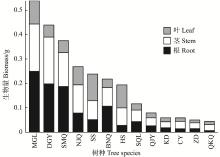
Fig.1
Seedling biomass allocation of 13 tree species in the temperate forest of Jiaohe, Jilin Province"
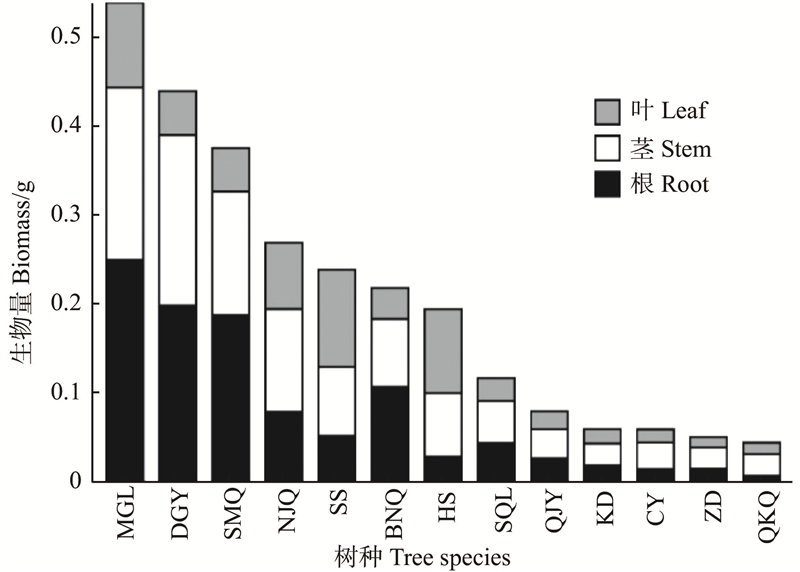
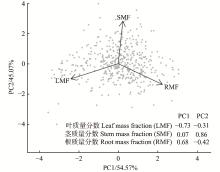
Fig.2
Principal component analysis of seedling biomass allocation traits in the temperate forest of Jiaohe, Jilin Province"
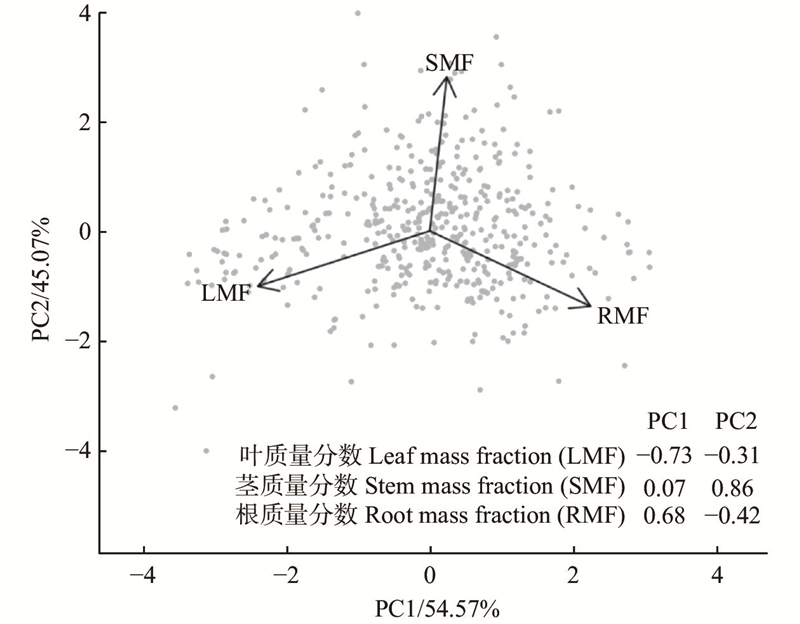
Table 3
AIC values and coefficient of determination of biomass allocation trade-offs models"
| 模型 Models | 赤池信息准则 Akaike information criterion (AIC) | 边际R2 Marginal R2 | 条件R2 Conditional R2 |
| 无交互作用的PC1模型PC1 model without interaction | 0.058 | 0.591 | |
| 有交互作用的PC1模型PC1 model with interaction | 0.078 | 0.590 | |
| 无交互作用的PC2模型 PC2 model without interaction | 0.026 | 0.146 | |
| 有交互作用的PC2模型PC2 model with interaction | 0.067 | 0.161 |
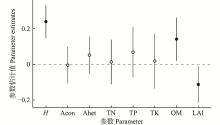
Fig.3
Parameter estimates and 95% confidence intervals of PC1 model"
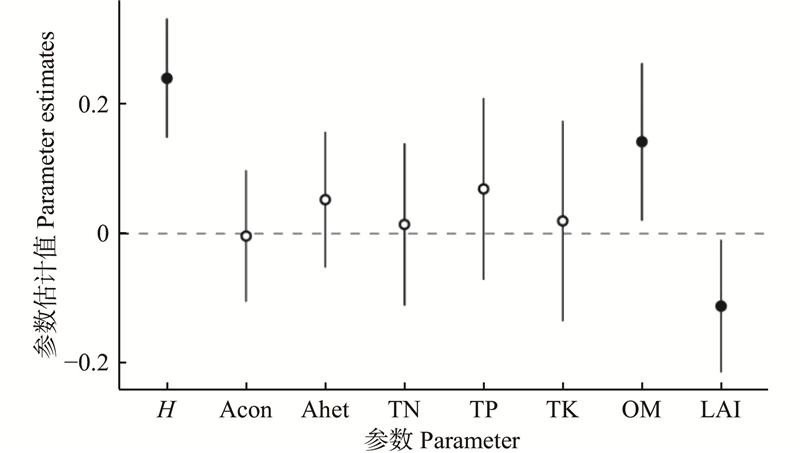
Table 4
Model results for the second principal component axis (PC2) of biomass allocation trade-offs with interaction"
| 变量Variables | 估计值Estimates | 标准误Standard error (SE) | t值t value | P值P value |
| 截距Intercept | 0.005 | 0.192 | 0.025 | 0.980 |
| 高度Height | –0.126 | 0.059 | –2.148 | 0.032* |
| 同种邻域指数Conspecific neighborhood index | –0.078 | 0.083 | –0.940 | 0.348 |
| 异种邻域指数Heterospecific neighborhood index | –0.066 | 0.063 | –1.055 | 0.294 |
| 土壤全氮含量Soil total nitrogen content | 0.122 | 0.080 | 1.533 | 0.132 |
| 土壤全磷含量Soil total phosphorus content | –0.105 | 0.160 | –0.658 | 0.513 |
| 土壤全钾含量Soil total potassium content | 0.048 | 0.193 | 0.249 | 0.804 |
| 土壤有机质含量Soil organic matter content | –0.057 | 0.079 | –0.723 | 0.473 |
| 叶面积指数Leaf area index | 0.070 | 0.062 | 1.144 | 0.257 |
| 同种邻域指数和异种邻域指数交互作用 Interaction between conspecific and heterospecific neighborhood indices | –0.137 | 0.076 | –1.803 | 0.072 |
| 土壤全氮含量和土壤全磷含量交互作用 Interaction between soil total nitrogen content and soil total phosphorus content | 0.023 | 0.091 | 0.247 | 0.805 |
| 土壤全氮含量和土壤全钾含量交互作用 Interaction between soil total nitrogen content and soil total potassium content | 0.293 | 0.116 | 2.518 | 0.017* |
| 土壤全氮含量和土壤有机质含量交互作用 Interaction between soil total nitrogen content and soil organic matter content | 0.033 | 0.063 | 0.522 | 0.603 |
| 土壤全氮含量和叶面积指数交互作用 Interaction between soil total nitrogen content and leaf area index | –0.057 | 0.075 | –0.764 | 0.447 |
| 土壤全磷含量和土壤全钾含量交互作用 Interaction between soil total phosphorus content and soil total potassium content | –0.030 | 0.199 | –0.148 | 0.883 |
| 土壤全磷含量和土壤有机质含量交互作用 Interaction between soil total phosphorus content and soil organic matter content | 0.111 | 0.100 | 1.106 | 0.272 |
| 土壤全磷含量和叶面积指数交互作用 Interaction between soil total phosphorus content and leaf area index | –0.043 | 0.095 | –0.455 | 0.650 |
| 土壤全钾含量和土壤有机质含量交互作用 Interaction between soil total potassium content and soil organic matter content | –0.028 | 0.125 | –0.226 | 0.823 |
| 土壤全钾含量和叶面积指数交互作用 Interaction between soil total potassium content and leaf area index | –0.006 | 0.103 | –0.056 | 0.955 |
| 土壤有机质含量和叶面积指数交互作用 Interaction between soil organic matter content and leaf area index | –0.050 | 0.064 | –0.782 | 0.436 |
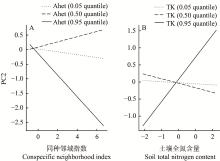
Fig.4
Effects of interactions on the second principal component axis (PC2) of biomass allocation trade-offs"
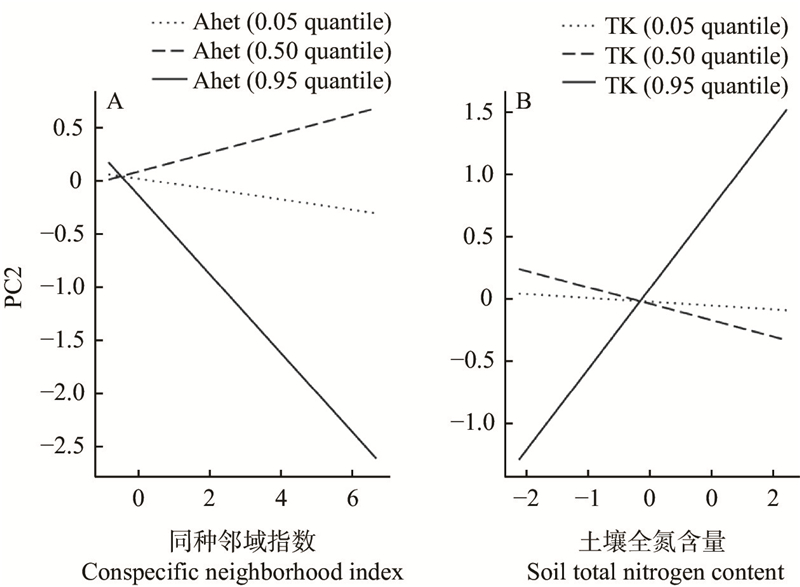
Table 5
AIC values and coefficient of determination of seedling growth models"
| 模型 Models | 赤池信息准则Akaike information criterion (AIC) | 边际R2 Marginal R2 | 条件R2 Conditional R2 |
| 无交互作用的生长模型 Growth model without interaction | 1 040.058 | 0.470 | 0.577 |
| 有交互作用的生长模型 Growth model with interaction | 1 036.887 | 0.501 | 0.569 |
Fig.5
Parameter estimates and 95% confidence intervals of growth model"
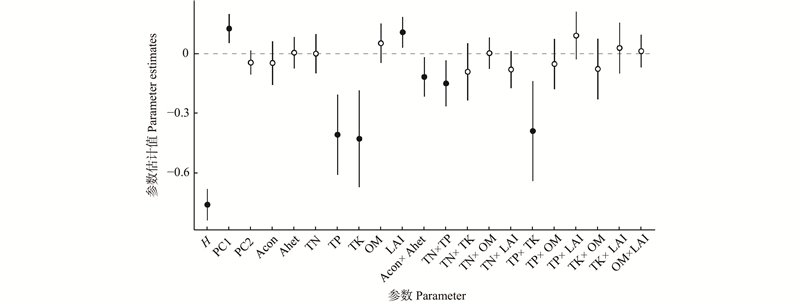
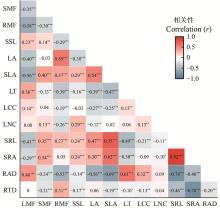
Fig.6
Correlation and significance among seedling functional traits"
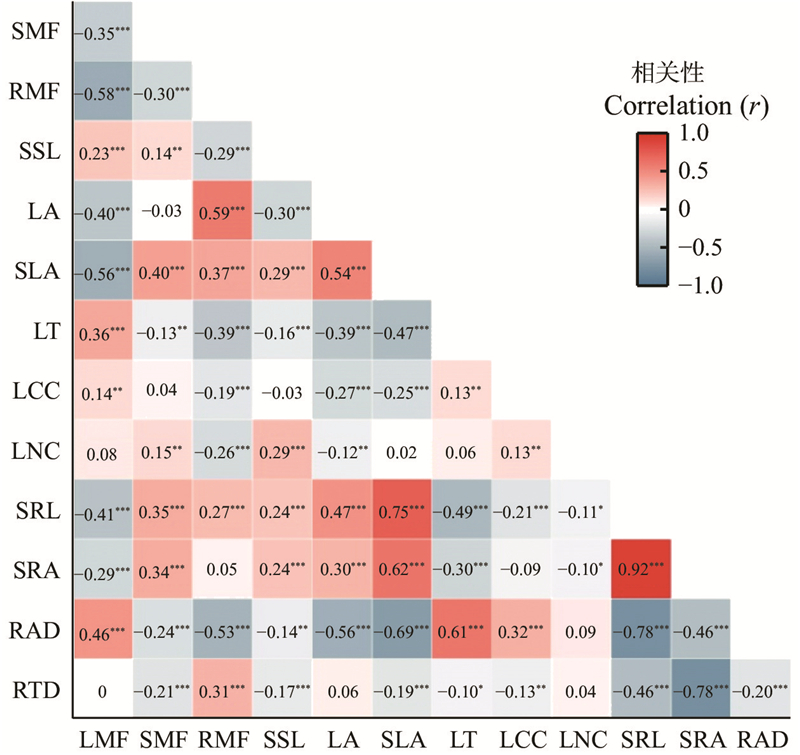
Fig.7
Parameter estimates and 95% confidence intervals of each functional trait in comparison model"
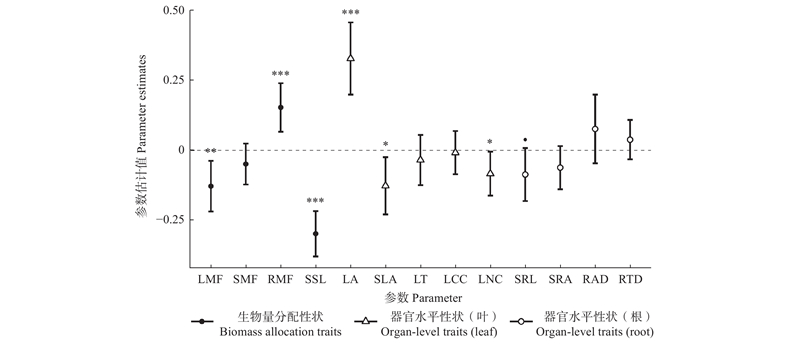
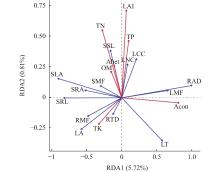
Fig.8
Redundancy analysis of functional traits with neighborhood competition and environmental factors"
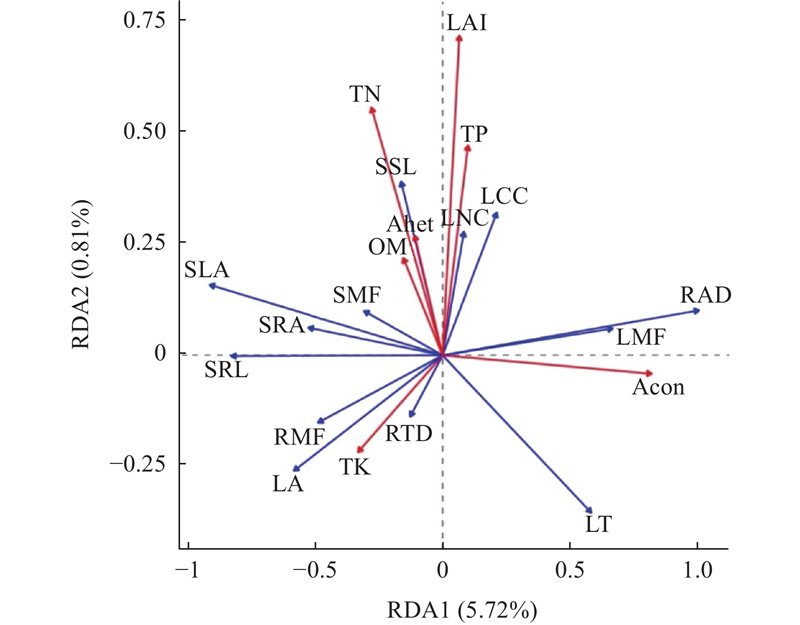
Table 6
Loadings, contribution rates, F values, and P values of variables on RDA axes"
| 变量Variables | RDA1 | RDA2 | 贡献 Contributions (%) | F | P |
| 同种邻域指数Conspecific neighborhood index | 0.823 | 0.041 | 36.99 | 19.104 | <0.001*** |
| 异种邻域指数Heterospecific neighborhood index | –0.110 | –0.270 | 3.64 | 1.912 | 0.092 |
| 土壤全氮含量Soil total nitrogen content | –0.280 | –0.557 | 16.99 | 2.817 | 0.027* |
| 土壤全磷含量Soil total phosphorus content | 0.100 | –0.472 | 9.68 | 3.597 | 0.008** |
| 土壤全钾含量Soil total potassium content | –0.333 | 0.218 | 7.99 | 5.412 | <0.001*** |
| 土壤有机质含量Soil organic matter content | –0.155 | –0.219 | 3.28 | 0.403 | 0.871 |
| 叶面积指数Leaf area index | 0.066 | –0.719 | 21.43 | 2.254 | 0.046* |
|
李宇婷, 马爱云, 苗 铮, 等. 邻域竞争对长白落叶松生物量及其分配的影响. 北京林业大学学报, 2025, 47 (4): 92- 102.
doi: 10.12171/j.1000-1522.20230322 |
|
|
Li Y T, Ma A Y, Miao Z, et al. Effects of neighborhood competition on biomass and its allocation of Larix olgensis. Journal of Beijing Forestry University, 2025, 47 (4): 92- 102.
doi: 10.12171/j.1000-1522.20230322 |
|
| 鲁如坤. 2000. 土壤农业化学分析方法. 北京: 中国农业科技出版社. | |
| Lu R K. 2000. Soil and agro-chemistry analytical methods. Beijing: China Agricultural Science and Technology Press. [in Chinese] | |
| 马莉薇. 2011. 不同生境栓皮栎种群种子库及幼苗定居过程研究. 杨凌: 西北农林科技大学. | |
| Ma L W. 2011. Study on seed bank and ecesis process of seedling and sprout of Quercus variabilis in different habitats. Yangling: Northwest A & F University. [in Chinese] | |
|
齐红岩, 李天来, 富宏丹, 等. 不同氮钾施用水平对番茄营养吸收和土壤养分变化的影响. 土壤通报, 2006, 37 (2): 2268- 2272.
doi: 10.3321/j.issn:0564-3945.2006.02.013 |
|
|
Qi H Y, Li T L, Fu H D, et al. Effects of different rates of nitrogen and potassium on nutrient levels in tomato and soil. Chinese Journal of Soil Science, 2006, 37 (2): 2268- 2272.
doi: 10.3321/j.issn:0564-3945.2006.02.013 |
|
|
强亚琪, 张新娜, 王 娟, 等. 东北天然次生林同种和异种密度制约效应随生活史阶段变化规律. 植物生态学报, 2024, 48 (12): 1612- 1622.
doi: 10.17521/cjpe.2023.0293 |
|
|
Qiang Y Q, Zhang X N, Wang J, et al. Variation of conspecific and heterospecific density-dependent survival along life stages in natural secondary forests in northeast China. Chinese Journal of Plant Ecology, 2024, 48 (12): 1612- 1622.
doi: 10.17521/cjpe.2023.0293 |
|
| 王荣辉, 王朝辉, 李生秀, 等. 施磷量对旱地小麦氮磷钾和干物质积累及产量的影响. 干旱地区农业研究, 2011, 29 (1): 115- 121. | |
| Wang R H, Wang Z H, Li S X, et al. Effects of P rates on N P K and dry matter accumulation and grain yield of winter wheat. Agricultural Research in the Arid Areas, 2011, 29 (1): 115- 121. | |
| 中国林业科学研究院林业研究所. 1986. 中国森林土壤. 北京: 科学出版社. | |
| Research Institute of Forestry, Chinese Academy of Forestry. 1986. Forest soils of China. Beijing: Science Press. [in Chinese] | |
|
Adler P B, Salguero-Gómez R, Compagnoni A, et al. Functional traits explain variation in plant life history strategies. Proceedings of the National Academy of Sciences of the United States of America, 2014, 111, 740- 745.
doi: 10.1073/pnas.1410430111 |
|
| Arnold S J. Morphology, performance and fitness. American Zoology, 1983, 361, 347- 361. | |
|
Bloom A J, Chapin F S, Mooney H A. Resource limitation in plants: an economic analogy. Annual Review of Ecology and Systematics, 1985, 16, 363- 392.
doi: 10.1146/annurev.es.16.110185.002051 |
|
| Brouwer R. Some aspects of the equilibrium between overground and underground plant parts. Jaarboek van het Instituut voor Biologisch en Scheikundig onderzoek aan Landbouwgewassen, 1963, 31- 39. | |
|
Comita L S, Hubbell S P. Local neighborhood and species’ shade tolerance influence survival in a diverse seedling bank. Ecology, 2009, 90, 328- 334.
doi: 10.1890/08-0451.1 |
|
| Connell J H. 1971. On the role of natural enemies in preventing competitive exclusion in some marine animals and in rain forest trees//Boer P J, Gradwell G R. Dynamics of populations. Wageningen: Centre for Agricultural Publishing and Documentation, 298–312. | |
|
de la Riva E G, Pérez-Ramos I M, Tosto A, et al. Disentangling the relative importance of species occurrence, abundance and intraspecific variability in community assembly: a trait-based approach at the whole-plant level in Mediterranean forests. Oikos, 2016, 125 (3): 354- 363.
doi: 10.1111/oik.01875 |
|
| Enquist B J, Niklas K J. Global allocation rules for patterns of biomass partitioning in seed plants. Science, 2002, 295, 1517- 1520. | |
| Garnier E. Resource capture, biomass allocation and growth in herbaceous plants. Trends in Ecology & Evolution, 1991, 6 (4): 126- 131. | |
| Grime J. 1994. Exploitation of environmental heterogeneity by plants: ecophysiological processes above-and belowground. New York: Academic Press, 1–19. | |
| Grime J P. 1979. Plant strategies and vegetation processes. New York: John Wiley and Sons, 1–222. | |
| Grime J P. 2006. Plant strategies, vegetation processes, and ecosystem properties. 2rd ed. New York: John Wiley & Sons. | |
| He W C, Wang Y, Wang X, et al. 2022. Stand structure adjustment influences the biomass allocation in naturally generated Pinus massoniana seedlings through environmental factors. Frontiers in Plant Science, 13. | |
|
Hong M G, Park H J, Kim J G. Nutrient effects on seedling survival and growth performance of Typha angustifolia in a mesocosm experiment. Journal of Plant Biology, 2020, 63, 43- 49.
doi: 10.1007/s12374-020-09228-8 |
|
|
Huang Z J, Liu Q Q, Tigabu M, et al. Plastic responses in growth, morphology, and biomass allocation of five subtropical tree species to different degrees of shading. Forests, 2022, 13 (7): 996.
doi: 10.3390/f13070996 |
|
|
Iida Y, Swenson N G. Towards linking species traits to demography and assembly in diverse tree communities: revisiting the importance of size and allocation. Ecological Research, 2020, 35, 947- 966.
doi: 10.1111/1440-1703.12175 |
|
| Janzen D H. Herbivores and the number of tree species intropical forests. American Naturalist, 1970, 104, 501- 528. | |
|
Kamel M S. A physiological study of shading and density effects on the growth and the efficiency of solar energy conversion in some field crops. Mededelingen van de Landbouwhogeschool Wageningen, 1959, 59 (5): 1- 101.
doi: 10.18174/182310 |
|
|
Kobe R K, Vriesendorp C F. Conspecific density dependence in seedlings varies with species shade tolerance in a wet tropical forest. Ecology Letters, 2011, 14, 503- 510.
doi: 10.1111/j.1461-0248.2011.01612.x |
|
|
Loehle C. Tree life history strategies: the role of defenses. Canadian Journal of Forest Research, 1988, 18, 209- 222.
doi: 10.1139/x88-032 |
|
|
Marks C O, Lechowicz M J. Alternative designs and the evolution of functional diversity. The American Naturalist, 2006, 167, 55- 66.
doi: 10.1086/498276 |
|
|
McCormack M L, Dickie I A, Eissenstat D M, et al. Redefining fine roots improves understanding of below-ground contributions to terrestrial biosphere processes. New Phytologist, 2015, 207 (3): 505- 518.
doi: 10.1111/nph.13363 |
|
|
Niinemets Ü. Global-scale climatic controls of leaf dry mass per area, density, and thickness in trees and shrubs. Ecology, 2001, 82, 453- 469.
doi: 10.1890/0012-9658(2001)082[0453:GSCCOL]2.0.CO;2 |
|
|
O'Brien E E, Gersani M, Brown J S. Root proliferation and seed yield in response to spatial heterogeneity of below-ground competition. New Phytologist, 2005, 168, 401- 412.
doi: 10.1111/j.1469-8137.2005.01520.x |
|
| Olson E C, Miller R L. 1958. Morphological integration. Chicago: The University of Chicago Press. | |
|
Poorter H, Niklas K J, Reich P B, et al. Biomass allocation to leaves, stems and roots: meta-analyses of interspecific variation and environmental control. New Phytologist, 2012, 193, 30- 50.
doi: 10.1111/j.1469-8137.2011.03952.x |
|
|
Poorter L. Growth responses of 15 rain-forest tree species to a light gradient: the relative importance of morphological and physiological traits. Functional Ecology, 1999, 13 (3): 396- 410.
doi: 10.1046/j.1365-2435.1999.00332.x |
|
|
Rehling F, Sandner T M, Matthies D. Biomass partitioning in response to intraspecific competition depends on nutrients and species characteristics: a study of 43 plant species. Journal of Ecology, 2021, 109, 2219- 2233.
doi: 10.1111/1365-2745.13635 |
|
| Reich P B. The world-wide “fast-slow” plant economics spectrum: a traits manifesto. Journal of Ecology, 2014, 102, 275- 301. | |
|
Reich P B, Tjoelker M G, Walters M B, et al. Close association of RGR, leaf and root morphology, seed mass and shade tolerance in seedlings of nine boreal tree species grown in high and low light. Functional Ecology, 1998, 12 (3): 327- 338.
doi: 10.1046/j.1365-2435.1998.00208.x |
|
|
Saito W, Kawamura K, Takeda H. Relative importance of overstory canopy openness and seedling density on crown morphology and growth of Acer nipponicum seedlings. Botany, 2012, 90 (11): 1152- 1160.
doi: 10.1139/b2012-079 |
|
|
Shipley B, Meziane D. The balanced-growth hypothesis and the allometry of leaf and root biomass allocation. Functional Ecology, 2002, 16 (3): 326- 331.
doi: 10.1046/j.1365-2435.2002.00626.x |
|
| Tilman D. 1988. Plant strategies and the dynamics and structure of plant communities. New Jersey: Princeton University Press. | |
| Umaña M N, Cao M, Lin L X, et al. Trade-offs in above- and below-ground biomass allocation influencing seedling growth in a tropical forest. Journal of Ecology, 2021a, 109, 1184- 1193. | |
|
Umaña M N, Swenson N G, Marchand P, et al. Relating leaf traits to seedling performance in a tropical forest: building a hierarchical functional framework. Ecology, 2021b, 102, e03385.
doi: 10.1002/ecy.3385 |
|
|
Umaña M N, Zhang C C, Cao M, et al. Quantifying the role of intra-specific trait variation for allocation and organ-level traits in tropical seedling communities. Journal of Vegetation Science, 2018, 29, 276- 284.
doi: 10.1111/jvs.12613 |
|
| Valladares F, Niinemets Ü. 2008. Shade tolerance, a key plant feature of complex nature and consequences. Annual Review of Ecology, Evolution, and Systematics, 39: 237–257. | |
| Violle C, Navas M L, Vile D, et al. 2007. Let the concept of trait be functional! Oikos, 116: 882–892. | |
| Wright S J, Kitajima K, Kraft N J B, et al. Functional traits and the growth-mortality trade-off in tropical trees. Ecology, 2010, 91, 3664- 3674. | |
|
Wright S J, Muller-Landau H C, Calderon O, et al. Annual and spatial variation in seedfall and seedling recruitment in a neotropical forest. Ecology, 2005, 86 (4): 848- 860.
doi: 10.1890/03-0750 |
|
| Wu J J, Swenson N G, Brown C, et al. 2016. How does habitat filtering affect the detection of conspecific and phylogenetic density dependence? Ecology, 97: 1182–1193. | |
|
Yang J, Cao M, Swenson N G. Why functional traits do not predict tree demographic rates. Trends in Ecology & Evolution, 2018, 33 (5): 326- 336.
doi: 10.1016/j.tree.2018.03.003 |
|
|
Yin J, Lin F, De Lombaerde E, et al. The effects of light, conspecific density and soil fungi on seedling growth of temperate tree species. Forest Ecology and Management, 2023, 529, 120683.
doi: 10.1016/j.foreco.2022.120683 |
|
|
Zhang C C, Gu R, Lin L X, et al. Functional traits and ecological niches as correlates of the interspecific growth-mortality trade-off among seedlings of 14 tropical tree species. Functional Ecology, 2024, 38, 1888- 1901.
doi: 10.1111/1365-2435.14624 |
| [1] | Shirong Liu,Yuanqi Chen,Xiuqing Nie,Angang Ming,Hui Wang. Effects of Tree Species Diversity on Multifunctionality and Resilience of Forest Ecosystems [J]. Scientia Silvae Sinicae, 2026, 62(1): 1-18. |
| [2] | Zhihui Yang,Liuduan Wei,Miao Yu,Tianxin Dong,Xingyu Zhang,Xinna Zhang,Bingqian Ma,Chengyang Xu. Drought Effect on the Seedling Growth of Four Species Depends on the Lower Order Root Traits [J]. Scientia Silvae Sinicae, 2025, 61(9): 81-89. |
| [3] | Han Bai,Minhui Hao,Huaijiang He,Xinna Zhang,Chunyu Zhang,Xiuhai Zhao. Response of Seedling Leaf Functional Traits to Simulated Nitrogen Deposition for the Major Tree Species of Northeast China [J]. Scientia Silvae Sinicae, 2025, 61(5): 23-32. |
| [4] | Lemei Yang,Baogang Zhang,Youchao Chen,Yanjiang Cai. Leaf Functional Traits of Understory Plants in a Moso Bamboo Forests in Response to Simulated Nitrogen Deposition [J]. Scientia Silvae Sinicae, 2025, 61(12): 61-71. |
| [5] | Min Chen,Huayan Lai,Shanshan Zheng,Ming Li,Xiangqing Ma,Pengfei Wu. Effects of Exogenous Ethylene on Growth and Phosphorus Use Efficiency of Chinese Fir Seedlings under Phosphorus Stress [J]. Scientia Silvae Sinicae, 2021, 57(7): 43-50. |
| [6] | Ruijing Xu,Xuan Hu,Guanglu Liu,Wen Guo,Changqiang Liang,Xianghe Kong. Differences of Leaf Functional Traits Between Two Climbing Bamboo Species in Tropical Lowland Rainforest of Hainan Island [J]. Scientia Silvae Sinicae, 2021, 57(12): 155-166. |
| [7] | Xue Zhang,Quanlin Zhong,Baoyin Li,Xiangming Yao,Chaobin Xu,Dongliang Cheng,Yuefang Zheng,Hua Yu. Relationship between the Leaf Functional Traits and the Diameter Growth in Even-Aged Stands of Zenia insignis [J]. Scientia Silvae Sinicae, 2020, 56(5): 168-175. |
| [8] | Hui Liu,Changcheng Mu,Bin Wu,Yue Zhang,Lijie Jing. Characterization of Greenhouse Gas Emissions from the Soil of Temperate Forest Types During Non-Growing Season in Maoer Mountain, Heilongjiang [J]. Scientia Silvae Sinicae, 2020, 56(10): 11-25. |
| [9] | Jiang Zheng, Yu Qiannan, Qiao Mingfeng, Xiao Juan, Zhang Ziliang, Yin Huajun. Effects of Root Exudates from Picea asperata Seedlings on the Seed Germination and Seedling Growth of Two Herb Species [J]. Scientia Silvae Sinicae, 2019, 55(6): 160-166. |
| [10] | Jiang Xiaoxu, Li Guolei, Shi Wenhui, Zhao Kaifen, Li Cheng. Effects of Cotyledon Loss Intensity and Time on Seedling Growth Status and Reserves Translocation in Quercus variabilis [J]. Scientia Silvae Sinicae, 2018, 54(8): 56-64. |
| [11] | Hao Minhui, Li Xiaoyu, Xia Mengjie, He Huaijiang, Zhang Chunyu, Zhao Xiuhai. Effects of Tending Felling on Functional and Phylogenetic Structures in a Multi-Species Temperate Secondary Forest at Jiaohe in Jilin Province [J]. Scientia Silvae Sinicae, 2018, 54(5): 1-9. |
| [12] | Zhang Junjie, Chai Shengfeng, Wei Xiao, Lv Shihong, Wu Shaohua. Germination Characteristics of the Seed of a Rare and Endangered Plant, Garcinia paucinervis [J]. Scientia Silvae Sinicae, 2018, 54(4): 174-185. |
| [13] | Shi Wenhui, Li Guolei, Su Shuchai, Liu Yong, Jia Liming, Shang Zhiguo. Combined Effects of Cotyledon Excision and Nursery Fertilization on Field Performance of Quercus variabilis Container Seedlings [J]. Scientia Silvae Sinicae, 2018, 54(1): 64-73. |
| [14] | Cheng Zhongqian, Li Guolei. Effects of Nitrogen Supply and Container Size on Seedling Growth, Root Characteristics, and Nutrient Status in Quercus variabilis Container Seedlings [J]. Scientia Silvae Sinicae, 2016, 52(4): 21-29. |
| [15] | An Hailong, Xie Qianjin, Liu Chao, Xia Xinli, Yin Weilun. Effects of Water Stress and Provenance on Leaf Functional Traits of Salix gordejevii [J]. Scientia Silvae Sinicae, 2015, 51(10): 75-84. |
| Viewed | ||||||
|
Full text |
|
|||||
|
Abstract |
|
|||||
