
Scientia Silvae Sinicae ›› 2026, Vol. 62 ›› Issue (4): 45-54.doi: 10.11707/j.1001-7488.LYKX20250079
• Research papers • Previous Articles Next Articles
Zhijun Qiu1,3,Hui Hu2,Xubing Guo2,Houben Zhao1,3,*( ),Zhaojia Li1,3
Received:2025-02-14
Online:2026-04-15
Published:2026-04-11
Contact:
Houben Zhao
E-mail:zhaohouben@163.com
CLC Number:
Zhijun Qiu,Hui Hu,Xubing Guo,Houben Zhao,Zhaojia Li. Medium to Long Term Effects of Ice Storm Disturbance on Community Characteristics, Spatial Structure, and Community Stability of Evergreen Broad-Leaved Forests in Northern Guangdong, China[J]. Scientia Silvae Sinicae, 2026, 62(4): 45-54.

Table 1
Basic information of Maozifeng and Qingzhangshan forest plots before the ice storm in 2008"
| 项目Item | 帽子峰Maozifeng | 青嶂山Qingzhangshan |
| 海拔Altitude/m | 487 | 506 |
| 坡向Aspect | 西南Southwest | 西北Northwest |
| 起源Origin | 天然次生林Natural secondary forest | 天然次生林Natural secondary forest |
| 年龄Age/a | 29 | 30 |
| 郁闭度Canopy density | 0.7 | 0.8 |
| 优势种Dominant species | 栲Castanopsis fargesii、罗浮锥 Castanopsis faberi、米槠Castanopsis carlesii | 罗浮锥Castanopsis faberi、木荷Schima superba、 青冈Quercus glauca、栲Castanopsis fargesii |
| 平均树高Mean tree height/m | 13.6 | 13.1 |
| 平均胸径Mean tree DBH/cm | 19.4 | 17.6 |
| 蓄积量Stand timber volume/(m3·hm?2) | 149.2 | 134.8 |
Table 2
Growth characteristics and community status indicators of main tree species in the plots of Maozifeng and Qingzhangshan"
| 地点Sites | 树种名 Tree species | 株数 Number of stems | 平均胸径 Mean DBH/ cm | 平均树高 Mean tree height/ m | 相对多度 Relative abundance (%) | 相对优势度 Relative dominance (%) | 相对频率 Relative frequency (%) | 重要值 Importance value (%) |
| 帽子峰 Maozifeng | 栲 Castanopsis fargesii | 382 | 13.3 | 9.1 | 9.1 | 25.8 | 4.5 | 13.1 |
| 米槠Castanopsis carlesii | 354 | 8.5 | 7.2 | 8.5 | 18.4 | 4.6 | 10.5 | |
| 罗浮锥Castanopsis faberi | 227 | 13.6 | 8.9 | 5.42 | 15. 8 | 3.7 | 8.3 | |
| 南酸枣 Choerospondias axillaris | 125 | 17.9 | 12.5 | 3.0 | 11. 7 | 3.9 | 6.2 | |
| 青嶂山 Qingzhangshan | 罗浮锥Castanopsis faberi | 352 | 15.4 | 9.3 | 16.0 | 37.9 | 12.9 | 22.3 |
| 木荷Schima superba | 364 | 13.6 | 9.1 | 16. 8 | 25.1 | 10.2 | 17.3 | |
| 青冈Quercus glauca | 282 | 7.1 | 6.1 | 13.2 | 5.9 | 9.7 | 9.6 |
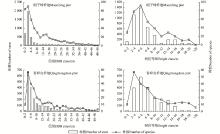
Fig.1
Distribution of DBH rank and tree height in Maozifeng and Qingzhangshan plots"
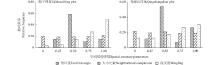
Fig.2
Frequency distribution of uniform angle, neighborhood comparison and mingling of Maozifeng and Qingzhangshan plots"
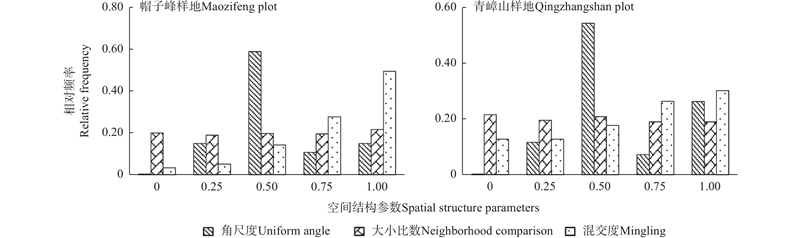
Table 3
Distribution of uniform angle, neighborhood comparison and mingling frequency of dominant tree species"
| 地点 Site | 优势种 Dominant species | 空间结构参数 Spatial structure parameter | 频率分布 Frequency distribution | 均值 Mean | ||||
| 0.00 | 0.25 | 0.50 | 0.75 | 1.00 | ||||
| 帽子峰 Maozifeng | 栲 Castanopsis fargesii | 角尺度Uniform angle | 0.00 | 0.15 | 0.57 | 0.13 | 0.14 | 0.56 |
| 大小比数 Neighborhood comparison | 0.39 | 0.22 | 0.19 | 0.12 | 0.10 | 0.33 | ||
| 混交度Mingling | 0.03 | 0.02 | 0.19 | 0.33 | 0.44 | 0.78 | ||
| 米槠Castanopsis carlesii | 角尺度Uniform angle | 0.01 | 0.16 | 0.57 | 0.09 | 0.17 | 0.56 | |
| 大小比数Neighborhood comparison | 0.22 | 0.20 | 0.20 | 0.20 | 0.19 | 0.49 | ||
| 混交度Mingling | 0.06 | 0.06 | 0.19 | 0.36 | 0.33 | 0.71 | ||
| 罗浮锥Castanopsis faberi | 角尺度Uniform angle | 0.01 | 0.19 | 0.54 | 0.14 | 0.13 | 0.50 | |
| 大小比数Neighborhood comparison | 0.40 | 0.23 | 0.14 | 0.10 | 0.12 | 0.33 | ||
| 混交度Mingling | 0.01 | 0.01 | 0.22 | 0.35 | 0.41 | 0.78 | ||
| 南酸枣 Choerospondias axillaris | 角尺度Uniform angle | 0.01 | 0.12 | 0.64 | 0.12 | 0.12 | 0.55 | |
| 大小比数Neighborhood comparison | 0.56 | 0.24 | 0.11 | 0.08 | 0.02 | 0.19 | ||
| 混交度Mingling | 0.00 | 0.01 | 0.09 | 0.20 | 0.71 | 0.90 | ||
| 青嶂山 Qingzhangshan | 罗浮锥Castanopsis faberi | 角尺度Uniform angle | 0.00 | 0.11 | 0.67 | 0.07 | 0.15 | 0.56 |
| 大小比数Neighborhood comparison | 0.39 | 0.15 | 0.12 | 0.13 | 0.12 | 0.32 | ||
| 混交度Mingling | 0.04 | 0.12 | 0.17 | 0.30 | 0.28 | 0.62 | ||
| 木荷 Schima superba | 角尺度Uniform angle | 0.00 | 0.15 | 0.50 | 0.08 | 0.26 | 0.61 | |
| 大小比数Neighborhood comparison | 0.23 | 0.28 | 0.22 | 0.17 | 0.10 | 0.41 | ||
| 混交度Mingling | 0.26 | 0.18 | 0.21 | 0.19 | 0.16 | 0.45 | ||
| 青冈 Quercus glauca | 角尺度Uniform angle | 0.00 | 0.11 | 0.51 | 0.05 | 0.33 | 0.65 | |
| 大小比数Neighborhood comparison | 0.13 | 0.12 | 0.20 | 0.16 | 0.18 | 0.43 | ||
| 混交度Mingling | 0.22 | 0.12 | 0.17 | 0.15 | 0.13 | 0.36 | ||
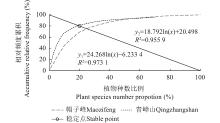
Fig.3
Community stability analysis diagram"
| 白 超. 2016. 空间结构参数及其在锐齿栎天然林结构动态分析中的应用. 北京: 中国林业科学研究院. | |
| Bai C. 2016. Spatial structure parameters and the application on studying structure dynamics of natural Quercus aliena var. acuteserrata forest. Beijing: Chinese Academy of Forestry. [in Chinese] | |
|
陈亚南, 杨 华, 马士友, 等. 长白山2种针阔混交林空间结构多样性研究. 北京林业大学学报, 2015, 37 (12): 48- 58.
doi: 10.13332/j.1000-1522.20150171 |
|
|
Chen Y N, Yang H, Ma S Y, et al. Spatial structure diversity of semi-natural and plantation stands of Larix gmelinii in Changbai Mountains, northeastern China. Journal of Beijing Forestry University, 2015, 37 (12): 48- 58.
doi: 10.13332/j.1000-1522.20150171 |
|
| 丁 晖, 杨云方, 徐海根, 等. 武夷山典型常绿阔叶林物种组成与群落结构. 生态学报, 2015, 35 (4): 1142- 1154. | |
| Ding H, Yang Y F, Xu H G, et al. Species composition and community structure of the typical evergreen broad-leaved forest in the Wuyi Mountains of southeastern China. Acta Ecologica Sinica, 2015, 35 (4): 1142- 1154. | |
| 樊海东, 陈海燕, 吴雁南, 等. 金华北山南坡主要植被类型的群落特征. 植物生态学报, 2019, 43 (10): 921- 928. | |
| Fan H D, Chen H Y, Wu Y N, et al. Community characteristics of main vegetation types on the southern slope of Beishan Mountain in Jinhua, Zhejiang, China. Chinese Journal of Plant Ecology, 2019, 43 (10): 921- 928. | |
| 韩 路, 陈家力, 王家强, 等. 塔河源荒漠河岸林群落物种组成、结构与植物区系特征. 植物科学学报, 2019, 37 (3): 324- 336. | |
| Han L, Chen J L, Wang J Q, et al. Species composition, community structure, and floristic characteristics of desert riparian forest community along the mainstream of Tarim River. Plant Science Journal, 2019, 37 (3): 324- 336. | |
|
黄川腾, 庄雪影, 李荣喜, 等. 冰灾后南岭五指山森林树种的受损与早期恢复. 生态学杂志, 2012, 31 (6): 1390- 1396.
doi: 10.13292/j.1000-4890.2012.0206 |
|
|
Huang C T, Zhuang X Y, Li R X, et al. Damaged status and early recovery of tree species in Wuzhishan of Nanling Mountains, south China after the ice storm in 2008. Chinese Journal of Ecology, 2012, 31 (6): 1390- 1396.
doi: 10.13292/j.1000-4890.2012.0206 |
|
| 惠刚盈, Gadow K V. 2003. 森林空间结构量化分析方法. 北京: 中国科学技术出版社, 20−22. | |
| Hui G Y, Gadow K V. 2003. Quantitative analysis method for forest spatial structure. Beijing: China Science and Technology Press, 20−22. [in Chinese] | |
|
惠刚盈, 李 丽, 赵中华, 等. 林木空间分布格局分析方法. 生态学报, 2007, 27 (11): 4717- 4728.
doi: 10.11707/j.1001-7488.20191109 |
|
|
Hui G Y, Li L, Zhao Z H, et al. The comparison of methods in analysis of the tree spatial distribution pattern. Acta Ecologica Sinica, 2007, 27 (11): 4717- 4728.
doi: 10.11707/j.1001-7488.20191109 |
|
|
李语晨, 程金花, 李明峰, 等. 湖北省九华山林场不同树种配置杉阔混交林林分空间结构特征分析. 生态学报, 2019, 39 (6): 1908- 1916.
doi: 10.5846/stxb201810122215 |
|
|
Li Y C, Cheng J H, Li M F, et al. Analysis of the stand spatial structure of Cunninghamia lanceolata-broadleaved mixed plantation on a Jiuhua Mountain Farm, Hubei Province. Acta Ecologica Sinica, 2019, 39 (6): 1908- 1916.
doi: 10.5846/stxb201810122215 |
|
|
区余端, 苏志尧, 解丹丹, 等. 雪灾后粤北山地常绿阔叶林优势树种幼苗更新动态. 生态学报, 2011, 31 (10): 2708- 2715.
doi: 10.20103/j.stxb.2011.10.007 |
|
|
Ou Y D, Su Z Y, Xie D D, et al. Dynamics of dominant tree seedlings in montane evergreen broadleaved forest following a snow disaster in north Guangdong. Acta Ecologica Sinica, 2011, 31 (10): 2708- 2715.
doi: 10.20103/j.stxb.2011.10.007 |
|
|
区余端, 苏志尧. 粤北山地常绿阔叶林自然干扰后冠层结构与林下光照动态. 生态学报, 2012, 32 (18): 5637- 5645.
doi: 10.5846/stxb201108191221 |
|
|
Ou Y D, Su Z Y. Dynamics of canopy structure and understory light in montane evergreen broadleaved forest following a natural disturbance in north Guangdong. Acta Ecologica Sinica, 2012, 32 (18): 5637- 5645.
doi: 10.5846/stxb201108191221 |
|
|
区余端, 王楚彪, 苏志尧. 自然干扰后冠层乔木的群落组成与结构动态. 中南林业科技大学学报, 2015, 35 (8): 36- 41.
doi: 10.14067/j.cnki.1673-923x.2015.08.008 |
|
|
Ou Y D, Wang C B, Su Z Y. Dynamics of canopy plant community compose and structure in evergreen broadleaved forest following a natural disturbance. Journal of Central South University of Forestry & Technology, 2015, 35 (8): 36- 41.
doi: 10.14067/j.cnki.1673-923x.2015.08.008 |
|
|
彭玉华, 何琴飞, 谭长强, 等. 广西极小种群单性木兰群落空间结构量化. 生态学杂志, 2016, 35 (2): 363- 369.
doi: 10.13292/j.1000-4890.201602.028 |
|
|
Peng Y H, He Q F, Tan C Q, et al. Quantitative analysis of stand spatial structure of a rare species Kmeria septentrionalis in Guangxi. Chinese Journal of Ecology, 2016, 35 (2): 363- 369.
doi: 10.13292/j.1000-4890.201602.028 |
|
| 彭玉华, 曾 健, 申文辉, 等. 九万山常绿阔叶林物种组成及空间结构特征分析. 中南林业科技大学学报, 2020, 40 (12): 17- 25. | |
| Peng Y H, Zeng J, Shen W H, et al. Analysis of species composition and spatial structure characteristics of evergreen broad-leaved forest in Jiuwan Mountain. Journal of Central South University of Forestry & Technology, 2020, 40 (12): 17- 25. | |
|
王世雄, 赵 亮, 李 娜, 等. 稀有种和常见种对植物群落物种丰富度格局的相对贡献. 生物多样性, 2016, 24 (6): 658- 664.
doi: 10.17520/biods.2015239 |
|
|
Wang S X, Zhao L, Li N, et al. The relative contributions of rare and common species to the patterns of species richness in plant communities. Biodiversity Science, 2016, 24 (6): 658- 664.
doi: 10.17520/biods.2015239 |
|
| 王 旭, 黄世能, 李家湘, 等. 冰雪灾害后南岭常绿阔叶林受损优势种萌条特性. 林业科学, 2010, 46 (11): 66- 72. | |
| Wang X, Huang S N, Li J X, et al. Sprouting characteristics of dominant species in evergreen broad-leaved forests damaged by frozen and snow disaster in Nanling Mountain. Scientia Silvae Sinicae, 2010, 46 (11): 66- 72. | |
|
吴晓永, 杨 华, 吕延杰, 等. 云杉-白桦混交林结构特征分析. 北京林业大学学报, 2019, 41 (1): 64- 72.
doi: 10.13332/j.1000-1522.20180211 |
|
|
Wu X Y, Yang H, Lü Y J, et al. Analysis of structure characteristics in Picea asperata-Betula platyphylla mixed forests. Journal of Beijing Forestry University, 2019, 41 (1): 64- 72.
doi: 10.13332/j.1000-1522.20180211 |
|
|
许 涵, 李意德, 林明献, 等. 海南尖峰岭热带山地雨林60 ha动态监测样地群落结构特征. 生物多样性, 2015, 23 (2): 192- 201.
doi: 10.17520/biods.2014157 |
|
|
Xu H, Li Y D, Lin M X, et al. Community characteristics of a 60 ha dynamics plot in the tropical montane rain forest in Jianfengling, Hainan Island. Biodiversity Science, 2015, 23 (2): 192- 201.
doi: 10.17520/biods.2014157 |
|
|
张岗岗, 王得祥, 张丛珊, 等. 小陇山百花林场次生松栎混交林群落及优势种群空间结构特征. 东北林业大学学报, 2015, 43 (8): 40- 45.
doi: 10.3969/j.issn.1000-5382.2015.08.010 |
|
|
Zhang G G, Wang D X, Zhang C S, et al. Spatial structure characteristics of secondary pine oak mixed forest community and dominant population in Baihua forest farm of Xiaolongshan. Journal of Northeast Forestry University, 2015, 43 (8): 40- 45.
doi: 10.3969/j.issn.1000-5382.2015.08.010 |
|
|
张天霖, 邱治军, 吴仲民, 等. 粤北针阔混交林不同器官碳氮磷钾的生态化学计量特征. 林业科学研究, 2021, 34 (2): 149- 157.
doi: 10.13275/j.cnki.lykxyj.2021.02.016 |
|
|
Zhang T L, Qiu Z J, Wu Z M, et al. Stoichiometric characteristics of carbon, nitrogen, phosphorus and potassium in organs of coniferous-broadleaved mixed forest in northern Guangdong. Forest Research, 2021, 34 (2): 149- 157.
doi: 10.13275/j.cnki.lykxyj.2021.02.016 |
|
|
赵 霞, 沈孝清, 黄世能, 等. 冰雪灾害对杨东山十二度水自然保护区木本植物机械损伤的初步调查. 林业科学, 2008, 44 (11): 164- 167.
doi: 10.3321/j.issn:1001-7488.2008.11.030 |
|
|
Zhao X, Shen X Q, Huang S N, et al. Mechanical damages to woody plants from a snow disaster in Yangdongshan Shierdushui Provincial Nature Reserve. Scientia Silvae Sinicae, 2008, 44 (11): 164- 167.
doi: 10.3321/j.issn:1001-7488.2008.11.030 |
|
|
赵中华, 惠刚盈, 胡艳波, 等. 角尺度判断林木水平分布格局的新方法. 林业科学, 2016, 52 (2): 10- 16.
doi: 10.11707/j.1001-7488.20160202 |
|
|
Zhao Z H, Hui G Y, Hu Y B, et al. The role of random structural pattern based on uniform angle index in maintaining forest stability. Scientia Silvae Sinicae, 2016, 52 (2): 10- 16.
doi: 10.11707/j.1001-7488.20160202 |
|
|
郑元润. 森林群落稳定性研究方法初探. 林业科学, 2000, 36 (5): 28- 32.
doi: 10.3321/j.issn:1001-7488.2000.05.005 |
|
|
Zheng Y R. Comparison of methods for studying stability of forest community. Scientia Silvae Sinicae, 2000, 36 (5): 28- 32.
doi: 10.3321/j.issn:1001-7488.2000.05.005 |
|
|
Baskent E Z, Keles S. Spatial forest planning: a review. Ecological Modelling, 2005, 188 (2−4): 145- 173.
doi: 10.1016/j.ecolmodel.2005.01.059 |
|
|
Beaudet M, Brisson J, Messier C, et al. Effect of a major ice storm on understory light conditions in an old-growth Acer-Fagus forest: pattern of recovery over seven years. Forest Ecology and Management, 2007, 242 (2/3): 553- 557.
doi: 10.1016/j.foreco.2007.01.068 |
|
|
Ge J L, Xiong G M, Zhao C M, et al. Short-term dynamic shifts in woody plants in a montane mixed evergreen and deciduous broadleaved forest in central China. Forest Ecology and Management, 2013, 310, 740- 746.
doi: 10.1016/j.foreco.2013.09.019 |
|
| Godron M. Some aspects of heterogeneity in grasslands of Cantal. Statistical Ecology, 1972, 3, 397- 415. | |
|
Olthof I, King D J, Lautenschlager R A. Overstory and understory leaf area index as indicators of forest response to ice storm damage. Ecological Indicators, 2003, 3 (1): 49- 64.
doi: 10.1016/S1470-160X(03)00010-4 |
|
|
Pommerening A. Evaluating structural indices by reversing forest structural analysis. Forest Ecology and Management, 2006, 224 (3): 266- 277.
doi: 10.1016/j.foreco.2005.12.039 |
|
|
Pretzsch H. Analysis and modeling of spatial stand structures. Methodological considerations based on mixed beech-larch stands in Lower Saxony. Forest Ecology and Management, 1997, 97 (3): 237- 253.
doi: 10.1016/S0378-1127(97)00069-8 |
|
|
Stone R. Natural disasters. Ecologists report huge storm losses in China’s forests. Science, 2008, 319 (5868): 1318- 1319.
doi: 10.1126/science.319.5868.1318 |
|
|
Wei L Z, Qiu Z J, Zhou G Y, et al. Rainfall interception recovery in a subtropical forest damaged by the great 2008 ice and snow storm in southern China. Journal of Hydrology, 2020a, 590, 125232.
doi: 10.1016/j.jhydrol.2020.125232 |
|
|
Wei L Z, Qiu Z J, Zhou G Y, et al. Stormflow threshold behaviour in a subtropical mountainous headwater catchment during forest recovery period. Hydrological Processes, 2020b, 34 (8): 1728- 1740.
doi: 10.1002/hyp.13658 |
|
|
Yang M, Cai T J, Ju C Y, et al. Evaluating spatial structure of a mixed broad-leaved/Korean pine forest based on neighborhood relationships in Mudanfeng National Nature Reserve, China. Journal of Forestry Research, 2019, 30 (4): 1375- 1381.
doi: 10.1007/s11676-019-00899-9 |
| [1] | Rui Chen,Mengping Tang. Comparison of Spatial Structure between Coniferous and Broad-Leaved Mixed Forest and Evergreen Broad-Leaved Forest in Tianmu Mountains [J]. Scientia Silvae Sinicae, 2023, 59(5): 21-31. |
| [2] | Shuai Yu,Tijiu Cai,Pide Zhang,Minglei Ren,Haiyu Zhang,Cunyong Ju. Scaling Effects of Edge Correction Methods on Spatial Structure Parameters [J]. Scientia Silvae Sinicae, 2023, 59(10): 57-65. |
| [3] | Lin Li,Shiguang Wei,Wanhui Ye,Juyu Lian,Zhifeng Wen,Jinggang Zhou. Spatial Distribution Pattern and Spatial Association of Dominant Species Groups in a Subtropical Evergreen Broad-Leaved Forest [J]. Scientia Silvae Sinicae, 2022, 58(9): 16-24. |
| [4] | Houben Zhao,Guangyi Zhou,Zhaojia Li,Zhijun Qiu,Zhongmin Wu,Xu Wang. Biomass Allocation and Allometric Growth Models of Four Common Tree Species in Southern Subtropical Evergreen Broad-Leaved Forest [J]. Scientia Silvae Sinicae, 2022, 58(2): 23-31. |
| [5] | Yongzhong Chen,Caixia Liu,Yanming Xu,Zhen Zhang,Yinghe Peng,Longsheng Chen,Yirong Su,Rui Wang,Wei Tang. Effects of Herbage Inter-Planting on Structure and Stability of Soil Microbial Community in Camellia oleifera Plantations [J]. Scientia Silvae Sinicae, 2022, 58(11): 61-70. |
| [6] | Gangying Hui,Zhonghua Zhao,Gongqiao Zhang,Yanbo Hu. The Role of Random Structural Pattern Based on Uniform Angle Index in Maintaining Forest Stability [J]. Scientia Silvae Sinicae, 2021, 57(2): 22-30. |
| [7] | Lei Deng,Chunyun Zhu,Shichuan Yu,Yinyan Qi,Wenhui Zhang,Sheng Du,Jinhong Guan. Effects of Mingling Intensity on Morphological Characteristics of Fine Roots of a Middle-Aged Picea crassifolia Natural Forests in Qilian Mountains [J]. Scientia Silvae Sinicae, 2020, 56(1): 191-200. |
| [8] | Xiao Jing, Huang Li, Yang Chao, Li Xiaohan, Wu Xiaoqi, Zhou Lihua, Qian Shenhua, Yang Yongchuan. Composition and Spatial-Temporal Variation of the Seed Rain in An Evergreen Broad-Leaved Forest on Jinyun Mountain [J]. Scientia Silvae Sinicae, 2019, 55(7): 163-169. |
| [9] | Li Yifan, Wang Yujie, Wang Bin, Li Tong. Soil Nitrogen Mineralization Characteristics of Evergreen Broad-Leaved Forest in Jinyun Mountain in Chongqing in the Acid Rain Zone, Southwest China [J]. Scientia Silvae Sinicae, 2019, 55(6): 1-12. |
| [10] | Liu Bao, Wang Minhuang, Yu Zaipeng, Lin Sizu, Lin Kaimin. Characterization of Soil Respiration after Conversion from Natural Forest to Plantations in Central-Subtropical Area [J]. Scientia Silvae Sinicae, 2019, 55(4): 1-12. |
| [11] | Huang Li, Gao Xiangyang, Qi Meng, Zhou Xia, Yang Chao, Li Xiaohan, Yang Shenghe, Qian Shenhua, Yang Yongchuan. Storage and Structural Characteristics of Coarse Woody Debris in an Evergreen Broadleaved Forest in Jinyun Mountain [J]. Scientia Silvae Sinicae, 2019, 55(1): 103-109. |
| [12] | Huang Yonghuai, Liang Jun, Ma Lin, Zhang Yingjun, Zhu Yanpeng, Hu Ruirui, Yuan Xiaowen, Zhang Xingyao. Impact of Forest Spatial Structure on the Population Density of Cephalcia kunyushanica(Hymenoptera: Pamphiliidae) [J]. Scientia Silvae Sinicae, 2018, 54(7): 84-90. |
| [13] | Wu Ju, Chen Yu, Liu Haixuan, Xu Lijuan, Jin Guixiang, Xu Chengyang. Effects of Stand Density and Mingling Intensity on Tree Morphology in Natural Scenic Forest in Changbai Mountain [J]. Scientia Silvae Sinicae, 2018, 54(12): 12-21. |
| [14] | Ma Zhibo, Huang Qinglin, Zhuang Chongyang, Zheng Qunrui, Wang Hong. Species Composition and Diversity of Typical Natural Broad-Leaved Forest in Central Subtropical:Based on Arbor Layer Stratification [J]. Scientia Silvae Sinicae, 2017, 53(10): 13-21. |
| [15] | Liang Jun, Ma Lin, Huang Yonghuai, Zhang Yingjun, Zhu Yanpeng, Zhang Xingyao. Impact of Forest Spatial Structure on Damaging Degree of Pine Needle Blight [J]. Scientia Silvae Sinicae, 2016, 52(8): 60-67. |
| Viewed | ||||||
|
Full text |
|
|||||
|
Abstract |
|
|||||
