
Scientia Silvae Sinicae ›› 2026, Vol. 62 ›› Issue (2): 40-52.doi: 10.11707/j.1001-7488.LYKX20250360
• Frontiers and hot topics • Previous Articles
Hui Mao,Feifei Zhao,Jie Li,Chunyu Zhang*( )
)
Received:2025-06-04
Revised:2025-12-15
Online:2026-02-25
Published:2026-03-04
Contact:
Chunyu Zhang
E-mail:zcy_0520@163.com
CLC Number:
Hui Mao,Feifei Zhao,Jie Li,Chunyu Zhang. Impacts of Tree Species Diversity and Environmental Factors on Soil Multifunctionality in the Middle Temperate Forests of Northeast China[J]. Scientia Silvae Sinicae, 2026, 62(2): 40-52.
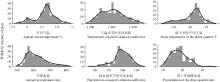
Fig.1
Frequency histogram of climate variables for 279 sample plots in the middle temperate forests of northeast China"
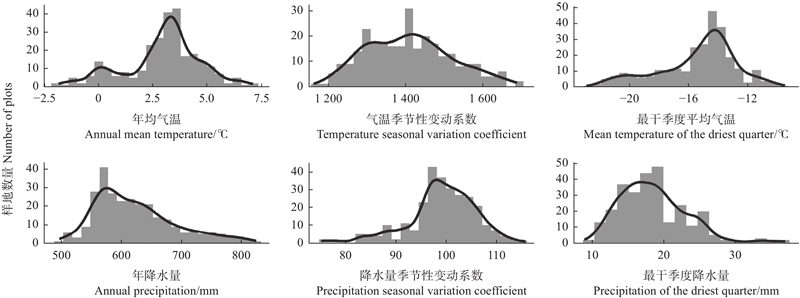
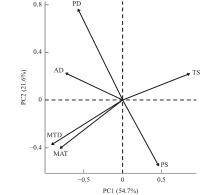
Fig.2
Principal component analysis (PCA) of the climate conditions of the middle temperate forests of northeast China"
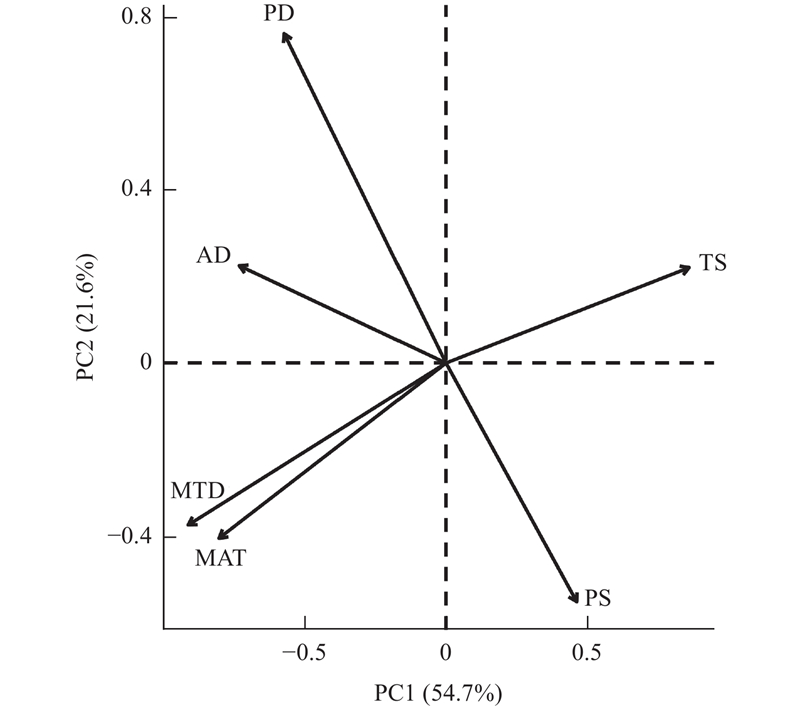

Table 1
Statistical description of soil, tree species diversity, nitrogen deposition flux, and topography in the middle temperate forests of northeast China"
| 统计量 Statistic | 最大值 Maximum | 最小值 Minimum | 平均值 Mean value | 标准差 Standard deviation | 标准误差 Standard error |
| 土壤多功能性指数Soil multifunctionality index | 2.45 | ?2.77 | 0.00 | 0.79 | 0.05 |
| 总有机碳含量Total organic carbon content (%) | 25.96 | 0.05 | 4.26 | 3.11 | 0.19 |
| 总氮含量Total nitrogen content (%) | 1.85 | 0.02 | 0.33 | 0.21 | 0.01 |
| 总磷含量Total phosphorus content/(g·kg?1) | 2.25 | 0.18 | 0.79 | 0.38 | 0.02 |
| 有效氮含量Available nitrogen content/(g·kg?1) | 2.47 | 0.06 | 0.45 | 0.28 | 0.02 |
| 有效磷含量Available phosphorus content/(mg·kg?1) | 85.84 | 1.99 | 13.77 | 14.44 | 0.87 |
| 土壤pH值Soil pH | 7.78 | 4.07 | 5.59 | 0.59 | 0.04 |
| 土壤碳氮比Soil carbon-to-nitrogen ratio | 18.32 | 2.39 | 12.75 | 1.77 | 0.11 |
| 树种多样性Tree species diversity | 20.00 | 1.00 | 7.39 | 4.23 | 0.25 |
| 氮沉降通量Nitrogen deposition flux/(kg·hm?2 a?1) | 59.82 | 17.70 | 28.26 | 4.70 | 0.28 |
| 海拔Elevation/m | 1 255.00 | 79.00 | 409.27 | 197.46 | 11.82 |
| 坡度Slope/(°) | 47.00 | 0.00 | 13.24 | 10.94 | 0.66 |
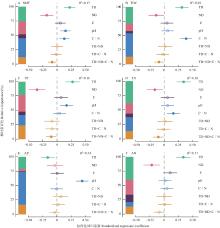
Fig.3
Multiple linear regression results for soil multifunctionality index (A) and individual functions indicators (B–F)"
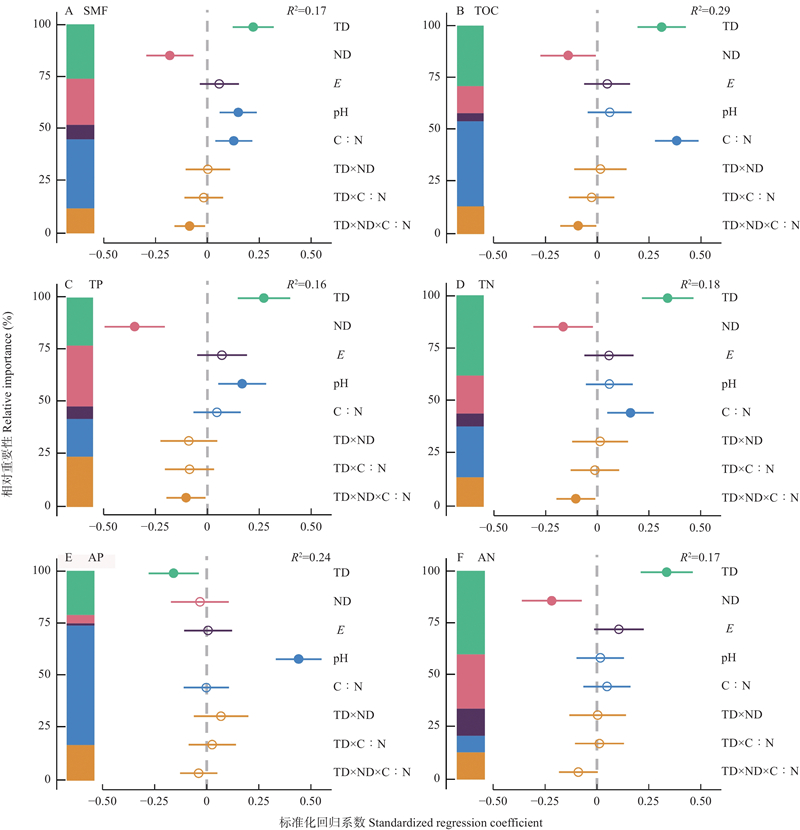
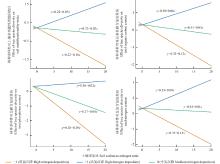
Fig.4
Impact of atmospheric nitrogen deposition and soil carbon-to-nitrogen ratio on the relationship between species diversity and soil multifunctionality"
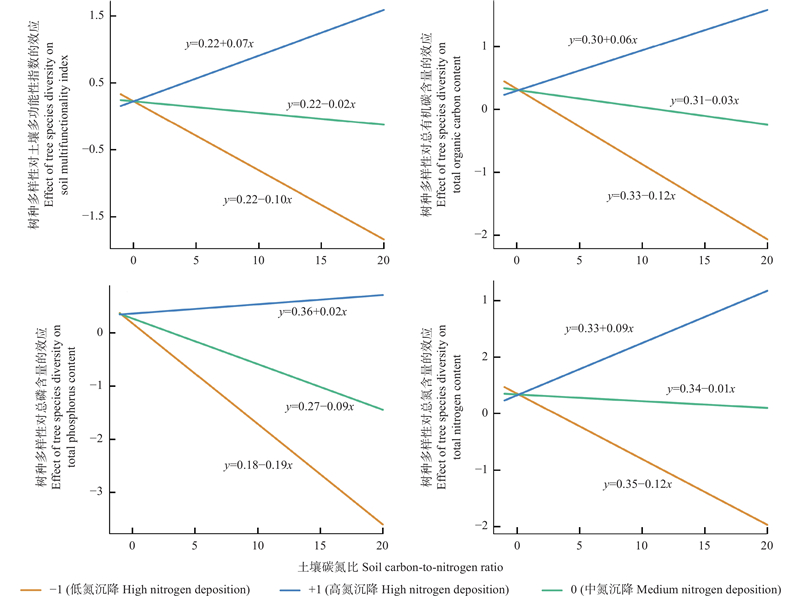
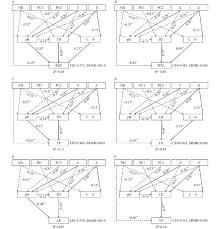
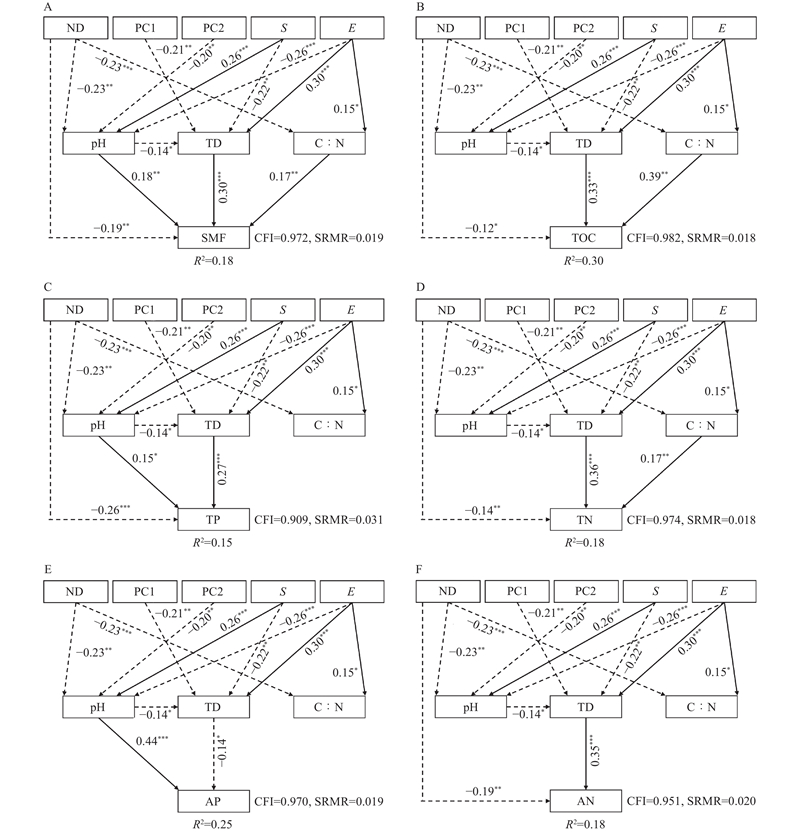
Fig.5
Results of the structural equation model for soil multifunctionality index (A) and individual functions indicators (B–F)"
|
付 伟, 武 慧, 赵爱花, 等. 陆地生态系统氮沉降的生态效应: 研究进展与展望. 植物生态学报, 2020, 44 (5): 475- 493.
doi: 10.17521/cjpe.2019.0163 |
|
|
Fu W, Wu H, Zhao A H, et al. Ecological impacts of nitrogen deposition on terrestrial ecosystems: research progresses and prospects. Chinese Journal of Plant Ecology, 2020, 44 (5): 475- 493.
doi: 10.17521/cjpe.2019.0163 |
|
| 贾彦龙, 王秋凤, 朱剑兴, 等. 1996—2015年中国大气无机氮湿沉降时空格局数据集. 中国科学数据, 2019, 4 (1): 8- 17. | |
| Jia Y L, Wang Q F, Zhu J X, et al. A spatial and temporal dataset of atmospheric inorganic nitrogen wet deposition in China (1996—2015). China Scientific Data, 2019, 4 (1): 8- 17. | |
| 贾彦龙, 王秋凤, 朱剑兴, 等. 2006—2015年中国大气无机氮干沉降时空格局数据集. 中国科学数据, 2021, 6 (2): 213- 221. | |
| Jia Y L, Wang Q F, Zhu J X, et al. A spatial and temporal dataset of atmospheric inorganic nitrogen dry deposition in China (2006—2015). China Scientific Data, 2021, 6 (2): 213- 221. | |
|
江康威, 张青青, 王亚菲, 等. 天山北坡中段草地生态系统多功能性对放牧的响应. 生态学报, 2024, 44 (8): 3440- 3456.
doi: 10.20103/j.stxb.202308111737 |
|
|
Jiang K W, Zhang Q Q, Wang Y F, et al. Response of grassland ecosystem multifunctionality to grazing in the middle part of the northern slope, Tianshan Mountain. Acta Ecologica Sinica, 2024, 44 (8): 3440- 3456.
doi: 10.20103/j.stxb.202308111737 |
|
|
李 杰, 郝珉辉, 范春雨, 等. 东北温带森林树种和功能多样性对生态系统多功能性的影响. 植物生态学报, 2023, 47 (11): 1507- 1522.
doi: 10.17521/cjpe.2023.0098 |
|
|
Li J, Hao M H, Fan C Y, et al. Effect of tree species and functional diversity on ecosystem multifunctionality in temperate forests of northeast China. Chinese Journal of Plant Ecology, 2023, 47 (11): 1507- 1522.
doi: 10.17521/cjpe.2023.0098 |
|
|
王 凯, 王 聪, 冯晓明, 等. 生物多样性与生态系统多功能性的关系研究进展. 生态学报, 2022, 42 (1): 11- 23.
doi: 10.5846/stxb202105141263 |
|
|
Wang K, Wang C, Feng X M, et al. Research progress on the relationship between biodiversity and ecosystem multifunctionality. Acta Ecologica Sinica, 2022, 42 (1): 11- 23.
doi: 10.5846/stxb202105141263 |
|
|
王 倩, 苏连波, 王克勤, 等. 滇中亚热带常绿阔叶林凋落物–土壤–微生物化学计量特征对氮沉降的响应. 西北农林科技大学学报(自然科学版), 2025, 53 (8): 1- 15.
doi: 10.13207/j.cnki.jnwafu.2025.08.009 |
|
|
Wang Q, Su L B, Wang K Q, et al. Response of litter-soil-microbial stoichiometric characteristics to nitrogen deposition of subtropical evergreen broad-leaved forest in Yunnan Province. Journal of Northwest A & F University(Natural Science Edition), 2025, 53 (8): 1- 15.
doi: 10.13207/j.cnki.jnwafu.2025.08.009 |
|
|
Ackerman D, Millet D B, Chen X. Global estimates of inorganic nitrogen deposition across four decades. Global Biogeochemical Cycles, 2019, 33 (1): 100- 107.
doi: 10.1029/2018GB005990 |
|
|
Angst Š, Angst G, Mueller K E, et al. Un(der)explored links between plant diversity and particulate and mineral-associated organic matter in soil. Nature Communications, 2025, 16 (1): 5548.
doi: 10.1038/s41467-025-60712-6 |
|
|
Bowman W D, Cleveland C C, Halada Ĺ, et al. Negative impact of nitrogen deposition on soil buffering capacity. Nature Geoscience, 2008, 1 (11): 767- 770.
doi: 10.1038/ngeo339 |
|
|
Byrnes J E K, Gamfeldt L, Isbell F, et al. Investigating the relationship between biodiversity and ecosystem multifunctionality: challenges and solutions. Methods in Ecology and Evolution, 2014, 5 (2): 111- 124.
doi: 10.1111/2041-210X.12143 |
|
|
Chen X, Chen H Y H, Searle E B, et al. Negative to positive shifts in diversity effects on soil nitrogen over time. Nature Sustainability, 2020, 4 (3): 225- 232.
doi: 10.1038/s41893-020-00641-y |
|
|
Delgado-Baquerizo M, Maestre F T, Reich P B, et al. Microbial diversity drives multifunctionality in terrestrial ecosystems. Nature Communications, 2016, 7, 10541.
doi: 10.1038/ncomms10541 |
|
|
Ding J Y, Eldridge D J. Climate and plants regulate the spatial variation in soil multifunctionality across a climatic gradient. Catena, 2021, 201, 105233.
doi: 10.1016/j.catena.2021.105233 |
|
|
Dong Z J, Li H B, Xiao J N, et al. Soil multifunctionality of paddy field is explained by soil pH rather than microbial diversity after 8-years of repeated applications of biochar and nitrogen fertilizer. Science of The Total Environment, 2022, 853, 158620.
doi: 10.1016/j.scitotenv.2022.158620 |
|
|
Elrys A S, Desoky E S M, Zhu Q, et al. Climate controls on nitrate dynamics and gross nitrogen cycling response to nitrogen deposition in global forest soils. Science of The Total Environment, 2024, 920, 171006.
doi: 10.1016/j.scitotenv.2024.171006 |
|
|
Fick S E, Hijmans R J. WorldClim 2: new 1‐km spatial resolution climate surfaces for global land areas. International Journal of Climatology, 2017, 37, 4302- 4315.
doi: 10.1002/joc.5086 |
|
|
Fox J, Monette G. Generalized collinearity diagnostics. Journal of the American Statistical Association, 1992, 87 (417): 178- 183.
doi: 10.1080/01621459.1992.10475190 |
|
|
Galloway J N, Townsend A R, Erisman J W, et al. Transformation of the nitrogen cycle: recent trends, questions, and potential solutions. Science, 2008, 320 (5878): 889- 892.
doi: 10.1126/science.1136674 |
|
|
Gamfeldt L, Snäll T, Bagchi R, et al. Higher levels of multiple ecosystem services are found in forests with more tree species. Nature Communications, 2013, 4 (1): 1340.
doi: 10.1038/ncomms2328 |
|
|
Garland G, Banerjee S, Edlinger A, et al. A closer look at the functions behind ecosystem multifunctionality: a review. Journal of Ecology, 2021, 109 (2): 600- 613.
doi: 10.1111/1365-2745.13511 |
|
|
Hu W G, Ran J Z, Dong L W, et al. Aridity-driven shift in biodiversity-soil multifunctionality relationships. Nature Communications, 2021, 12 (1): 5350.
doi: 10.1038/s41467-021-25641-0 |
|
|
Hu Y L, Deng Q, Kätterer T, et al. Depth-dependent responses of soil organic carbon under nitrogen deposition. Global Change Biology, 2024a, 30 (3): e17247.
doi: 10.1111/gcb.17247 |
|
|
Hu Z K, Delgado-Baquerizo M, Fanin N, et al. Nutrient-induced acidification modulates soil biodiversity-function relationships. Nature Communications, 2024b, 15 (1): 2858.
doi: 10.1038/s41467-024-47323-3 |
|
|
Isbell F, Calcagno V, Hector A, et al. High plant diversity is needed to maintain ecosystem services. Nature, 2011, 477 (7363): 199- U96.
doi: 10.1038/nature10282 |
|
|
Jiang M T, Huang W G, Ding J X, et al. Declining soil pH reduces microbial biomass-driven soil multifunctionality. Applied Soil Ecology, 2024, 203, 105623.
doi: 10.1016/j.apsoil.2024.105623 |
|
|
Kong D, Luo C, Liu H. Integrative remote sensing and machine learning approaches for SOC and TN spatial distribution: Unveiling C: N ratio in black soil region. Soil and Tillage Research, 2026, 255, 106809.
doi: 10.1016/j.still.2025.106809 |
|
|
Lai M, He S, Yu S, et al. Effects of experimental N addition on plant diversity in an old-growth temperate forest. Ecology and Evolution, 2018, 8 (11): 5900- 5911.
doi: 10.1002/ece3.4127 |
|
|
Le Bagousse-Pinguet Y, Soliveres S, Gross N, et al. Phylogenetic, functional, and taxonomic richness have both positive and negative effects on ecosystem multifunctionality. Proceedings of the National Academy of Sciences, 2019, 116 (17): 8419- 8424.
doi: 10.1073/pnas.1815727116 |
|
|
Li J, Hao M, Cheng Y, et al. Tree diversity across multiple scales and environmental heterogeneity promote ecosystem multifunctionality in a large temperate forest region. Global Ecology and Biogeography, 2024, 33, e13880.
doi: 10.1111/geb.13880 |
|
|
Lieberman H P, von Sperber C, Kallenbach C M. Soil phosphorus dynamics are an overlooked but dominant control on mineral-associated organic matter. Global Change Biology, 2025, 31 (7): e70307.
doi: 10.1111/gcb.70307 |
|
|
Lin S X, Fan C Y, Wang J, et al. Chronic anthropogenic disturbance mediates the biodiversity‐productivity relationship across stand ages in a large temperate forest region. Journal of Applied Ecology, 2024, 61 (3): 502- 512.
doi: 10.1111/1365-2664.14588 |
|
|
Lin S X, Qiao X T, Geng Y, et al. Environmental filtering drives biodiversity–spatial stability relationships in a large temperate forest region. Functional Ecology, 2023, 37 (6): 1688- 1702.
doi: 10.1111/1365-2435.14334 |
|
|
Liu X, Shi X, Zhang S. Soil abiotic properties and plant functional diversity co-regulate the impacts of nitrogen addition on ecosystem multifunctionality in an alpine meadow. Science of The Total Environment, 2021, 780, 146476.
doi: 10.1016/j.scitotenv.2021.146476 |
|
|
Liu Y, Trancoso R, Ma Q, et al. Carbon density in boreal forests responds non-linearly to temperature: an example from the Greater Khingan Mountains, northeast China. Agricultural and Forest Meteorology, 2023, 338, 109519.
doi: 10.1016/j.agrformet.2023.109519 |
|
|
Loreau M, De Mazancourt C. Biodiversity and ecosystem stability: a synthesis of underlying mechanisms. Ecology Letters, 2013, 16 (s1): 106- 115.
doi: 10.1111/ele.12073 |
|
|
Mack M C, Schuur E A G, Bret-Harte M S, et al. Ecosystem carbon storage in arctic tundra reduced by long-term nutrient fertilization. Nature, 2004, 431 (7007): 440- 443.
doi: 10.1038/nature02887 |
|
|
Maestre F T, Callaway R M, Valladares F, et al. Refining the stress‐gradient hypothesis for competition and facilitation in plant communities. Journal of Ecology, 2009, 97 (2): 199- 205.
doi: 10.1111/j.1365-2745.2008.01476.x |
|
|
Maestre F T, Quero J L, Gotelli N J, et al. Plant species richness and ecosystem multifunctionality in global drylands. Science, 2012, 335 (6065): 214- 218.
doi: 10.1126/science.1215442 |
|
| Manning P, Van Der Plas F, Soliveres S, et al. Redefining ecosystem multifunctionality. Nature Ecology & Evolution, 2018, 2 (3): 427- 436. | |
|
Marklein A R, Houlton B Z. Nitrogen inputs accelerate phosphorus cycling rates across a wide variety of terrestrial ecosystems. New Phytologist, 2012, 193 (3): 696- 704.
doi: 10.1111/j.1469-8137.2011.03967.x |
|
|
Mina M, Huber M O, Forrester D I, et al. Multiple factors modulate tree growth complementarity in central European mixed forests. Journal of Ecology, 2018, 106 (3): 1106- 1119.
doi: 10.1111/1365-2745.12846 |
|
| Moi D A, Lansac-Tôha F M, Romero G Q, et al. Human pressure drives biodiversity–multifunctionality relationships in large Neotropical wetlands. Nature Ecology & Evolution, 2022, 6 (9): 1279- 1289. | |
|
Poschenrieder C, Gunsé B, Corrales I, et al. A glance into aluminum toxicity and resistance in plants. Science of The Total Environment, 2008, 400 (1/3): 356- 368.
doi: 10.1016/j.scitotenv.2008.06.003 |
|
|
Qiao X T, Zhang N L, Zhang C Y, et al. Unravelling biodiversity–productivity relationships across a large temperate forest region. Functional Ecology, 2021, 35 (12): 2808- 2820.
doi: 10.1111/1365-2435.13922 |
|
| Radujkovic D, Verbruggen E, Seabloom E W, et al. 2021,. Soil properties as key predictors of global grassland production: have we overlooked micronutrients? Ecology Letters, 24(12): 2713–2725. | |
| Rosseel Y. Lavaan: an R package for structural equation modeling. Journal of Statistical Software, 2012, 48 (2): 1- 36. | |
|
Shen Y, Luo Y, Du L, et al. Nitrogen addition alleviates the negative effects of reduction in precipitation on soil multifunctionality in a typical steppe. Applied Soil Ecology, 2024, 204, 105727.
doi: 10.1016/j.apsoil.2024.105727 |
|
|
Song Z B, Zuo X A, Hu Y, et al. Plant functional traits predict soil multifunctionality under increased precipitation and nitrogen addition in a desert steppe. Catena, 2024, 247, 108486.
doi: 10.1016/j.catena.2024.108486 |
|
|
Spohn M, Bagchi S, Biederman L A, et al. The positive effect of plant diversity on soil carbon depends on climate. Nature Communications, 2023, 14 (1): 6624.
doi: 10.1038/s41467-023-42340-0 |
|
|
Tian D S, Niu S L. A global analysis of soil acidification caused by nitrogen addition. Environmental Research Letters, 2015, 10 (2): 024019.
doi: 10.1088/1748-9326/10/2/024019 |
|
|
Valencia E, Gross N, Quero J L, et al. Cascading effects from plants to soil microorganisms explain how plant species richness and simulated climate change affect soil multifunctionality. Global Change Biology, 2018, 24 (12): 5642- 5654.
doi: 10.1111/gcb.14440 |
|
|
Van Der Plas F. Biodiversity and ecosystem functioning in naturally assembled communities. Biological Reviews, 2019, 94 (4): 1220- 1245.
doi: 10.1111/brv.12499 |
|
|
Van Der Plas F, Manning P, Allan E, et al. Jack-of-all-trades effects drive biodiversity–ecosystem multifunctionality relationships in European forests. Nature Communications, 2016, 7 (1): 11109.
doi: 10.1038/ncomms11109 |
|
| Wagenmakers E J. 2003,. How many parameters does it take to fit an elephant? Journal of Mathematical Psychology, 47(5/6): 580–586. | |
| Wang C, Li X N, Hu Y X, et al. 2023,. Nitrogen addition weakens the biodiversity multifunctionality relationships across soil profiles in a grassland assemblage. Agriculture, Ecosystems & Environment, 342: 108241. | |
|
Wei C Z, Yu Q, Bai E, et al. Nitrogen deposition weakens plant–microbe interactions in grassland ecosystems. Global Change Biology, 2013, 19 (12): 3688- 3697.
doi: 10.1111/gcb.12348 |
|
|
Wei Y N, Jing X, Su F L, et al. Does pH matter for ecosystem multifunctionality? An empirical test in a semi‐arid grassland on the Loess Plateau. Functional Ecology, 2022, 36 (7): 1739- 1753.
doi: 10.1111/1365-2435.14057 |
|
|
Wen Z, Xu W, Li Q, et al. Changes of nitrogen deposition in China from 1980 to 2018. Environment International, 2020, 144, 106022.
doi: 10.1016/j.envint.2020.106022 |
|
|
Wu Z F, Zhang Z H, Wang J. Estimating the productive potential of five natural forest types in northeastern China. Forest Ecosystems, 2019, 6 (1): 42.
doi: 10.1186/s40663-019-0204-0 |
|
|
Xie H T, Wang G G, Yu M K. Ecosystem multifunctionality is highly related to the shelterbelt structure and plant species diversity in mixed shelterbelts of eastern China. Global Ecology and Conservation, 2018, 16, e00470.
doi: 10.1016/j.gecco.2018.e00470 |
|
|
Xu H W, Qu Q, Li G W, et al. Impact of nitrogen addition on plant-soil-enzyme C–N–P stoichiometry and microbial nutrient limitation. Soil Biology and Biochemistry, 2022, 170, 108714.
doi: 10.1016/j.soilbio.2022.108714 |
|
|
Yan P, Fernández‐Martínez M, Van Meerbeek K, et al. The essential role of biodiversity in the key axes of ecosystem function. Global Change Biology, 2023, 29 (16): 4569- 4585.
doi: 10.1111/gcb.16666 |
|
|
Yan Y Z, Zhang Q, Buyantuev A, et al. Plant functional β diversity is an important mediator of effects of aridity on soil multifunctionality. Science of The Total Environment, 2020, 726, 138529.
doi: 10.1016/j.scitotenv.2020.138529 |
|
|
Yang A, Zhu D, Zhang W X, et al. Canopy nitrogen deposition enhances soil ecosystem multifunctionality in a temperate forest. Global Change Biology, 2024, 30 (3): e17250.
doi: 10.1111/gcb.17250 |
|
|
Ye C C, Wang S, Wang Y, et al. Impacts of human pressure and climate on biodiversity-multifunctionality relationships on the Qinghai-Tibetan Plateau. Frontiers in Plant Science, 2023, 14, 1106035.
doi: 10.3389/fpls.2023.1106035 |
|
|
Yuan X B, Niu D C, Gherardi L A, et al. Linkages of stoichiometric imbalances to soil microbial respiration with increasing nitrogen addition: Evidence from a long-term grassland experiment. Soil Biology and Biochemistry, 2019, 138, 107580.
doi: 10.1016/j.soilbio.2019.107580 |
|
|
Yuan Z Q, Ali A, Ruiz‐Benito P, et al. Above- and below-ground biodiversity jointly regulate temperate forest multifunctionality along a local-scale environmental gradient. Journal of Ecology, 2020, 108 (5): 2012- 2024.
doi: 10.1111/1365-2745.13378 |
|
|
Zavaleta E S, Pasari J R, Hulvey K B, et al. Sustaining multiple ecosystem functions in grassland communities requires higher biodiversity. Proceedings of the National Academy of Sciences, 2010, 107 (4): 1443- 1446.
doi: 10.1073/pnas.0906829107 |
|
|
Zhang C F, Ndungu C N, Feng L, et al. Plant diversity is more important than soil microbial diversity in explaining soil multifunctionality in Qinghai-Tibetan plateau wetlands. Journal of Environmental Management, 2024, 365, 121509.
doi: 10.1016/j.jenvman.2024.121509 |
|
|
Zhang C Y, He F L, Zhang Z H, et al. Latitudinal gradients and ecological drivers of β-diversity vary across spatial scales in a temperate forest region. Global Ecology and Biogeography, 2020, 29 (7): 1257- 1264.
doi: 10.1111/geb.13101 |
|
|
Zhao F F, Hao M H, Yue Q M, et al. Community diversity and composition affect ecosystem multifunctionality across environmental gradients in boreal and temperate forests. Ecological Indicators, 2024, 159, 111692.
doi: 10.1016/j.ecolind.2024.111692 |
| [1] | Kaibo Wang,Guangze Jin,Zhili Liu. Changes of Resource Acquisition and Defense Capabilities of Temperate Broadleaf Tree Species at Different Life History Stages [J]. Scientia Silvae Sinicae, 2025, 61(8): 219-230. |
| [2] | Jiayu Chen,Zhehan Li,Pingxin Zhao,Xiaoyu Zhan,Yuanfan Ma,Futao Guo. Effects of Soil Physicochemical Properties on Emission Characteristics of Biogenic Volatile Organic Compounds from Cunninghamia lanceolata under Forest Fire Smoke Deposition [J]. Scientia Silvae Sinicae, 2025, 61(6): 85-98. |
| [3] | Xu Wang,Hao Guo, Baoyinmanda,Guangyi Zhou,Yuehua Chen,Dangren Li. Damaged Characteristics and Influencing Factors of Cunninghamia lanceolata Mixed Plantations in Subtropics under Extreme Drought Conditions [J]. Scientia Silvae Sinicae, 2025, 61(5): 12-22. |
| [4] | Shulei He,Yanmei Chen,Qianyuan Liu,Wenfang Guo. Phenotypic Characterizatics of Ziziphus jujuba var. spinosa Fruit in the Eastern Taihang Mountains and the Main Driving Factors [J]. Scientia Silvae Sinicae, 2025, 61(2): 101-112. |
| [5] | Jiangtao Guo,Jingjing Peng,Xin Ma,Fan Liu,Yongxiu Xia. Responses of Poplar Plantations in Northern China Sandy Land to Conventional Fertilization and Drip Fertigation [J]. Scientia Silvae Sinicae, 2025, 61(10): 135-145. |
| [6] | Wanting Ge,Ying Liu,Zhijia Zhao,Shen Zhang,Jie Li,Guijuan Yang,Guanzheng Qu,Junhui Wang,Wenjun Ma. Prediction of Potential Distribution for Huangxin (Catalpa) in China under Different Climate Scenarios [J]. Scientia Silvae Sinicae, 2024, 60(11): 63-74. |
| [7] | Zhang Xin, Zhang Qiuliang, Sun Shoujia, Wang Bing. CO2 Concentration and the δ13C Dynamics in Larix gmelinii Ecosystem in Response to Environmental Factors [J]. Scientia Silvae Sinicae, 2023, 59(9): 55-65. |
| [8] | Kai Zhang,Yanli Sun,Jichao Wei,Yaqian Fan,Xiaoxue Han,Lin Li,Xiaoshuai Wei,Xinhao Li,Peng Liu,Tianshan Zha. Control of Environmental Factors on the Sap Flow at Daily and Seasonal Scales in Ulmus macrocarpa in Beijing, China [J]. Scientia Silvae Sinicae, 2023, 59(7): 24-34. |
| [9] | Hongxing Wang,Xiaomei Sun,Dongsheng Chen,Chunyan Wu,Shougong Zhang. Effects of Moderate Thinning on Biological Diversity and Soil Multifunctionality in Larix kaempferi Plantations [J]. Scientia Silvae Sinicae, 2023, 59(6): 1-11. |
| [10] | Shuning Zhang,Junxing Chen,Dun Ao,Mei Hong,Yaqian Zhang,Fuhai Bao,Lin Wang,Tana Wuyun,Yu’e Bai,Wenquan Bao. Prediction of Potential Suitable Areas of Amygdalus pedunculata in China under Climate Change [J]. Scientia Silvae Sinicae, 2023, 59(12): 25-36. |
| [11] | Zhuhua Wu,Juan Song,Shulin Zhu,Xing Zhao,Xuexiang Yang,Jiahong Ren,Fengmao Chen. Effects of Plant Growth-Promoting Microorganisms on Rhizosphere Microbial Community and the Leaf Pigment Composition of Liquidambar formosana [J]. Scientia Silvae Sinicae, 2023, 59(12): 125-136. |
| [12] | Lixuan Wang,Guang Yang,Jiaqi Gao,Xin Zheng,Zhaoguo Li,Yuetai Weng,Xueying Di,Hongzhou Yu. Changes in the Flammability of Post-Fire Aboveground Litter of Larix gmelinii [J]. Scientia Silvae Sinicae, 2022, 58(6): 110-121. |
| [13] | Jiaqi Chen,Guangyu Zhao,Yanglong Li,Yuhong Dong,Lingyu Hou,Ruzhen Jiao. Age Changes of Soil Phosphorus Form and Content in Chinese Fir Plantations [J]. Scientia Silvae Sinicae, 2022, 58(5): 10-17. |
| [14] | Sha Zhou,Huanfei Ma,Jieying Wang,Chengjie Ren,Yaoxin Guo,Jun Wang,Fazhu Zhao. Latitudinal Distribution of Forest Soil Microbial Biomass Carbon and Its Affecting Factors in China [J]. Scientia Silvae Sinicae, 2022, 58(2): 49-57. |
| [15] | Xudong Chang,Guangze Jin. Effects of Topography and Soil Factors on the Decay of Living Trees of Korean Pine [J]. Scientia Silvae Sinicae, 2022, 58(11): 71-82. |
| Viewed | ||||||
|
Full text |
|
|||||
|
Abstract |
|
|||||
