
Scientia Silvae Sinicae ›› 2026, Vol. 62 ›› Issue (4): 187-193.doi: 10.11707/j.1001-7488.LYKX20250092
• Research papers • Previous Articles Next Articles
Yinlong Li( ),Zhi Liang,Xiaolong He,Ruijie Zhang,Longwa Zhang,Shijuan Wang*()
Received:2025-02-01
Online:2026-04-15
Published:2026-04-11
Contact:
Shijuan Wang
E-mail:2579608915@qq.com;sjwang@ahau.edu.cn
CLC Number:
Yinlong Li,Zhi Liang,Xiaolong He,Ruijie Zhang,Longwa Zhang,Shijuan Wang. Morphological and Biological Characteristics of Monellia caryella[J]. Scientia Silvae Sinicae, 2026, 62(4): 187-193.
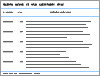
Table 1
Development duration of Monellia caryella"
世代 Generation | 时间Time | 累积历时 Accumulate time/d | |
| 范围Range/d | 平均时间 Mean time/d | ||
| 1龄若虫1st instar nymph | 1.00~2.75 | 1.76±0.40 | 1.76 |
| 2龄若虫2nd instar nymph | 1.00~3.00 | 1.67±0.34 | 3.43 |
| 3龄若虫3rd instar nymph | 0.75~2.75 | 1.61±0.33 | 5.04 |
| 4龄若虫4th instar nymph | 1.75~3.25 | 2.08±0.36 | 7.12 |
| 生殖前期Pre-reproductive period | 1.25~3.75 | 1.91±0.54 | 9.03 |
| 生殖期Reproductive period | 0.00~42.75 | 22.51±12.87 | 31.54 |
| 成虫期Adult period | 0.75~44.00 | 22.88±13.69 | 30.00 |
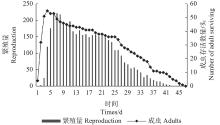
Fig.1
Survival time and reproduction of alate viviparous female"
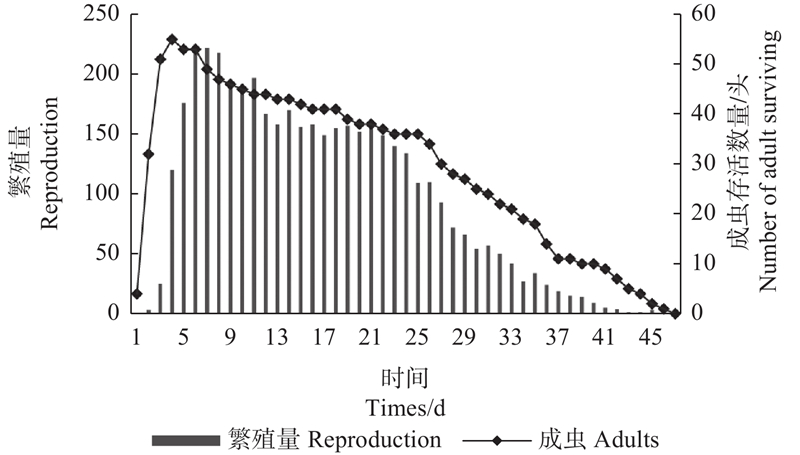
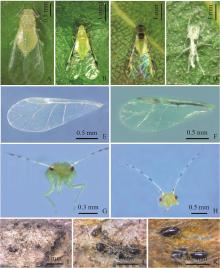
Fig.2
Morphology of Monellia caryella at different stages"
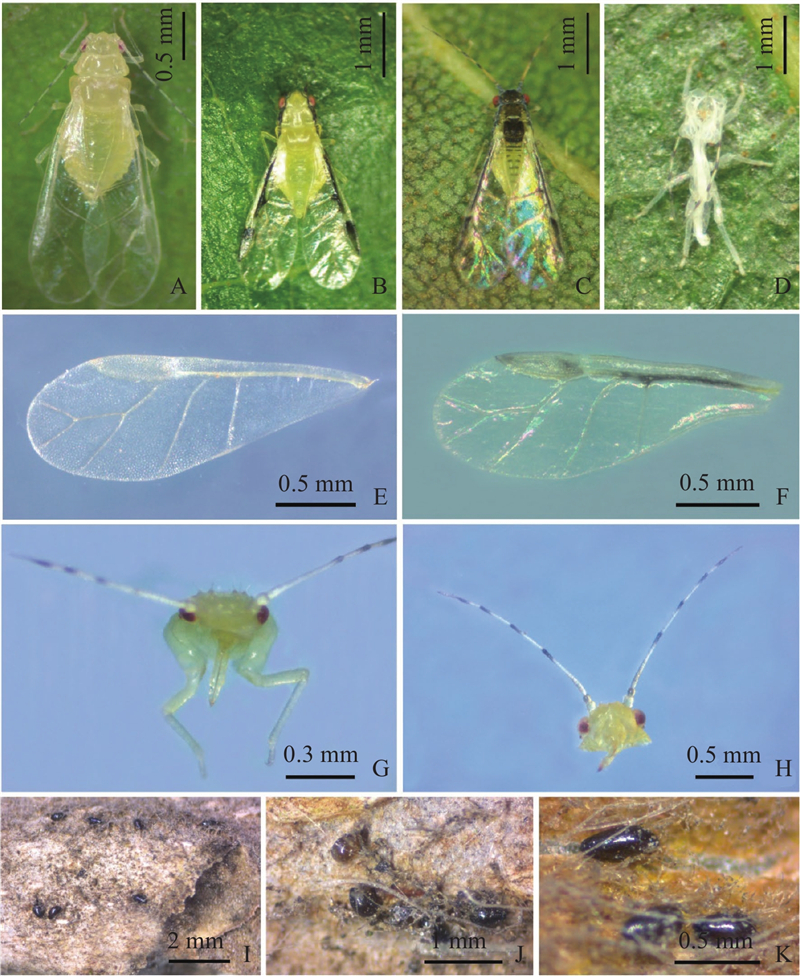
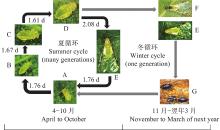
Fig.3
Life history and generation of M. caryella"
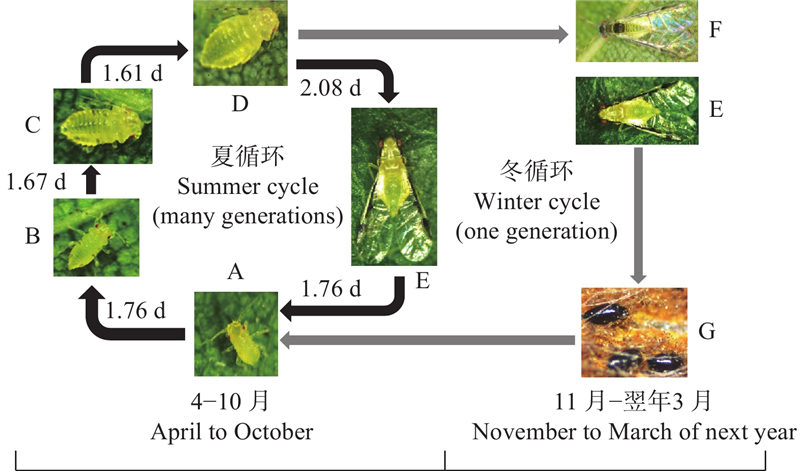
Table 2
Life history of M. caryella"
年份 Year | 12月—翌年3月 December to March | 4月 April | 5月 May | 6月 June | 7月 July | 8月 August | 9月 September | 10月 October | 11月 November | ||||||||||||||||||||||||||
| E | M | L | E | M | L | E | M | L | E | M | L | E | M | L | E | M | L | E | M | L | E | M | L | E | M | L | |||||||||
| 2 0 2 3 | ? | ? | ? | ? | ? | ? | ? | ? | ? | ? | |||||||||||||||||||||||||
| * | * | * | * | * | * | * | * | * | * | * | * | * | * | * | * | * | * | * | * | * | * | * | |||||||||||||
| ο | ο | ο | ο | ο | ο | ο | ο | ο | ο | ο | ο | ο | ο | ο | ο | ο | ο | ο | ο | ο | ο | ο | |||||||||||||
| + | + | + | + | ||||||||||||||||||||||||||||||||
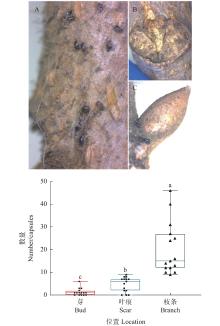
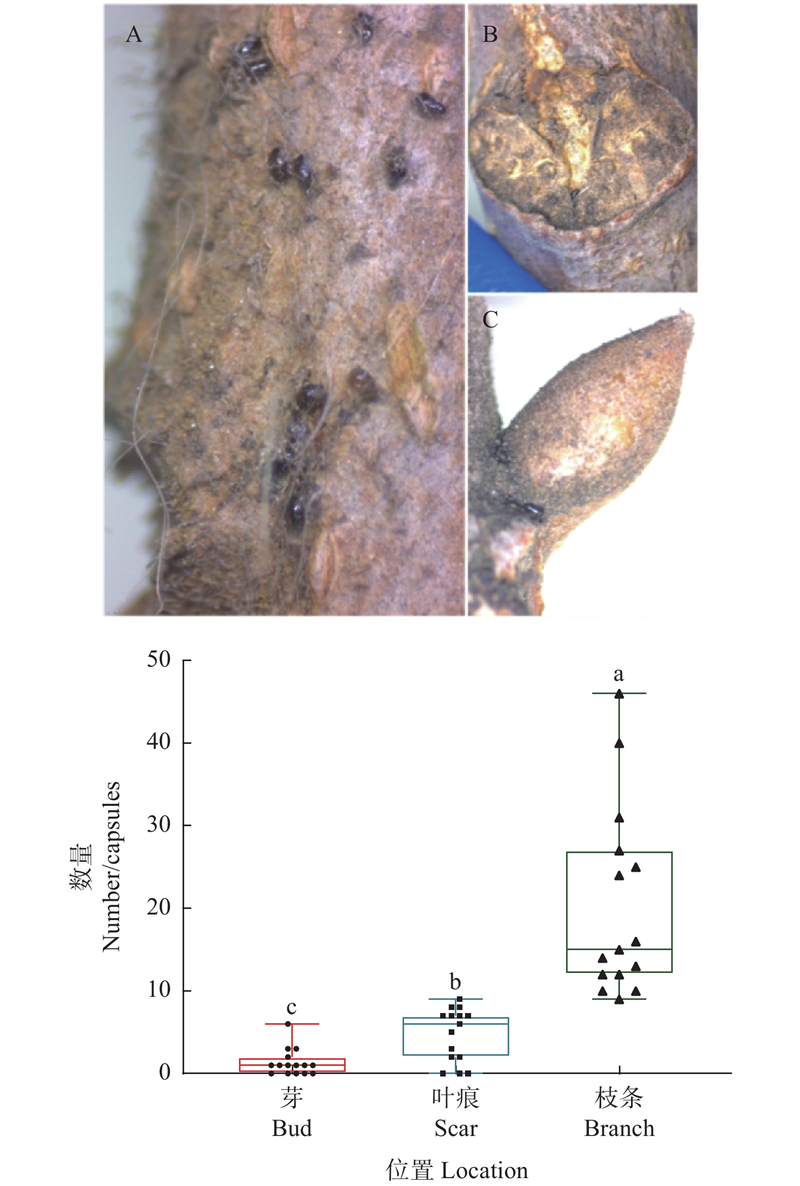
Fig.4
Ovipositional distribution of Monellia caryella"
|
陈 芬, 姚小华, 滕建华, 等. 薄壳山核桃无性系果实经济性状与品质比较. 中国粮油学报, 2016, 31 (8): 68- 74.
doi: 10.3969/j.issn.1003-0174.2016.08.012 |
|
|
Chen F, Yao X H, Teng J H, et al. A comparative study on the nut economy and quality characters of Caray illinoensis clones. Journal of the Chinese Cereals and Oils Association, 2016, 31 (8): 68- 74.
doi: 10.3969/j.issn.1003-0174.2016.08.012 |
|
|
杜军利, 武德功, 张廷伟, 等. 紫外线(UV-B)辐射对不同色型豌豆蚜生物学特性的影响. 中国生态农业学报, 2012, 20 (12): 1626- 1630.
doi: 10.3724/SP.J.1011.2012.01626 |
|
|
Du L J, Wu D G, Zhang T W, et al. Effects of UV-B radiation on biological characteristics of different color pea aphid morphs (Acyrthosiphon pisum). Chinese Journal of Eco-Agriculture, 2012, 20 (12): 1626- 1630.
doi: 10.3724/SP.J.1011.2012.01626 |
|
|
李 川, 姚小华, 王开良, 等. 12个薄壳山核桃无性系果(核)性状以及山核桃无性系果实性状指产量的比较. 西南大学学报(自然科学版), 2011, 33 (6): 40- 44.
doi: 10.13718/j.cnki.xdzk.2011.06.029 |
|
|
Li C, Yao X H, Wang K L, et al. A Comparative study on the fruit and nut characters of 12 pecan (Caray illinoensis) clones and their yield. Journal of Southwest University Natural Science Edition, 2011, 33 (6): 40- 44.
doi: 10.13718/j.cnki.xdzk.2011.06.029 |
|
| 李进步, 方丽平, 孟 玲, 等. 蚜虫体色多态性及生态进化功能. 生态学杂志, 2014, 33 (5): 1404- 1412. | |
| Li J B, Fang L P, Meng L, et al. Body-color polymorphism and its ecological and evolutionary function in aphids. Chinese Journal of Ecology, 2014, 33 (5): 1404- 1412. | |
|
李旭昭, 葛亚菲, 胡雪娇, 等. 梨小食心虫在桃园产卵位置偏嗜性选择. 应用昆虫学报, 2024, 60 (6): 1817- 1824.
doi: 10.7679/j.issn.2095-1353.2023.174 |
|
|
Li X Z, Ge Y F, Hu X J, et al. Preferred Grapholita molesta (Busck) oviposition sites in peach orchards. Chinese Journal of Applied Entomology, 2024, 60 (6): 1817- 1824.
doi: 10.7679/j.issn.2095-1353.2023.174 |
|
| 潘 飞, 陈绵才, 肖彤斌, 等. 变温对昆虫生长发育和繁殖影响的研究进展. 环境昆虫学报, 2014, 36 (2): 240- 246. | |
| Pan F, Chen M C, Xiao T B, et al. Research advances on effect of variable temperature on growth, development and reproduction of insect. Journal of Environmental Entomology, 2014, 36 (2): 240- 246. | |
|
邵淑霞, 杨子祥, 何 钊, 等. 角倍蚜瘿内干雌蜜露的排泄和糖分组成. 昆虫学报, 2022, 65 (10): 1306- 1313.
doi: 10.16380/j.kcxb.2022.10.007 |
|
|
Shao S X, Yang Z X, He Z, et al. Excretion and sugar composition of honeydew produced by Schlechtendalia chinensis (Hemiptera: Aphididae) fundatrigeniae living in horned gallnuts. Acta Entomologica Sinica, 2022, 65 (10): 1306- 1313.
doi: 10.16380/j.kcxb.2022.10.007 |
|
|
邵东华, 段立清, 段景攀. 油松大蚜的种群动态、有效积温及防治. 东北林业大学学报, 2017, 45 (7): 84- 88+93.
doi: 10.3969/j.issn.1000-5382.2017.07.017 |
|
|
Shao D H, Duan L Q, Duan J P. Population dynamics, effective accumulative temperatures and control method of Cinara formosana. Journal of Northeast Forestry University, 2017, 45 (7): 84- 88+93.
doi: 10.3969/j.issn.1000-5382.2017.07.017 |
|
|
王堇秀, 李学军, 王 宁. 温度对胡萝卜微管蚜生长发育繁殖的影响. 应用昆虫学报, 2016, 53 (3): 564- 573.
doi: 10.7679/j.issn.2095-1353.2016.072 |
|
|
Wang J X, Li X J, Wang N. Influence of temperature on the development, survival and reproduction of Semiaphis heracleid (Takahashi). Chinese Journal of Applied Entomology, 2016, 53 (3): 564- 573.
doi: 10.7679/j.issn.2095-1353.2016.072 |
|
|
武德功, 陈 青, 詹秋文, 等. 不同温度对高粱蚜的生长发育的影响. 草业科学, 2018, 35 (6): 1548- 1555.
doi: 10.11829/j.issn.1001-0629.2017-0358 |
|
|
Wu D G, Chen Q, Zhan Q W, et al. Effect of different temperatures on the growth and development of sorghum aphid (Melanaphis sacchari). Pratacultural Science, 2018, 35 (6): 1548- 1555.
doi: 10.11829/j.issn.1001-0629.2017-0358 |
|
| 俞春莲, 王正加, 夏国华, 等. 10个不同品种的薄壳山核桃脂肪含量及脂肪酸组成分析. 浙江农林大学学报, 2013, 30 (5): 714- 718. | |
| Yu C L, Wang Z J, Xia G H, et al. Fat content and fatty acid composition of ten Caray illinoensis cultivars. Journal of Zhejiang A & F University, 2013, 30 (5): 714- 718. | |
|
杨 标, 刘壮壮, 彭方仁, 等. 干旱胁迫和复水下不同薄壳山核桃品种的生长和光合特性. 浙江农林大学学报, 2017, 34 (6): 991- 998.
doi: 10.11833/j.issn.2095-0756.2017.06.004 |
|
|
Yang B, Liu Z Z, Peng F R, et al. Growth and photosynthetic characteristics for pecan cultivars during drought stress and recovery. Journal of Zhejiang A & F University, 2017, 34 (6): 991- 998.
doi: 10.11833/j.issn.2095-0756.2017.06.004 |
|
| 周晓榕, 卜庆国, 庞保平. 温度对桃蚜和马铃薯长管蚜实验种群生命表参数的影响. 昆虫学报, 2014, 57 (7): 837- 843. | |
| Zhou X R, Bu Q G, Pang B P. Effects of temperature on life table parameters of the laboratory populations of Myzus persicae and Macrosiphum euphorbiae ( Hemiptera: Aphididae). Acta Entomologica Sinica, 2014, 57 (7): 837- 843. | |
|
张育霞, 史 历, 袁 月, 等. 温度对豌豆蚜体型、生长发育及繁殖的影响. 甘肃农业大学学报, 2024, 59 (2): 165- 170.
doi: 10.13432/j.cnki.jgsau.2024.02.019 |
|
|
Zhang Y X, Shi L, Yuan Y, et al. Effect of temperature on body size, growth and reproduction of Acyrthosiphon pisum. Journal of Gansu Agricultural University, 2024, 59 (2): 165- 170.
doi: 10.13432/j.cnki.jgsau.2024.02.019 |
|
| 李伟伟, 安广池, 郭淑霞, 等. 青檀新害虫青檀绵叶蚜的生态学特性. 林业科学, 2016, 52 (5): 120- 125. | |
| Li W W, An G C, Guo S X, et al. Ecological characteristics of Shivaphis pteroceltis (Hemiptera: Aphididae), a new pest on Pteroceltis tatarinowii. Scientia Silvae Sinicae, 2016, 52 (5): 120- 125. | |
|
赵龙龙, 张未仲, 胡增丽, 等. 冬型中国梨木虱在梨树不同部位的产卵特点. 植物保护, 2019, 45 (4): 201- 204.
doi: 10.16688/j.zwbh.2018349 |
|
|
Zhao L L, Zhang M Z, Hu Z L, et al. Oviposition characteristics of winter-type pear psylla on different sites of pear tree. Plant Protection, 2019, 45 (4): 201- 204.
doi: 10.16688/j.zwbh.2018349 |
|
| Alasalvar C, Bolling B W. 2015,. Review of nut phytochemicals, fat-soluble bioactives, antioxidant components and health effects. British Journal of Nutrition, 113(2): S68–78. | |
| Ballabeni P, Wlodarczyk M, Rahier M. Does enemy-free space for eggs contribute to a leaf beetle’s oviposition preference for a nutritionally inferior host plant. Functional Ecology, 2001, 15 (3): 318- 324. | |
|
Patrícia Diniz C P, Fernando Sérgio Z. Oviposition behavior and performance aspects of Ascia monuste (Godart, 1919) (Lepidoptera, Pieridae) on kale (Brassica oleracea var. acephala). Revista Brasileira de Entomologia, 2003, 47 (2): 169- 174.
doi: 10.1590/s0085-56262003000200003 |
|
| Caillaud M C, Losey J E. Genetics of color polymorphism in the pea aphid, Acyrthosiphon pisum. Journal of Insect Science, 2010, 10 (95): 1- 13. | |
| De la Rosa L A, Alvarez-Parrilla E, Shahidi F. Phenolic compounds and antioxidant activity of kernels and shells of Mexican pecan (Caray illinoensis). Journal of Agricultural & Food Chemistry, 2011, 59 (1): 152- 162. | |
|
Edelson J V, Estes P M. Intracanopy distribution and seasonal abundance of the yellow pecan aphids Monellia caryella and monelliopsis nigropunctata (Homoptera: Aphididae). Environmental Entomology, 1983, 12 (3): 862- 867.
doi: 10.1093/ee/12.3.862 |
|
|
Foottit R G, Maw H E L, Von Dohlen C D, et al. Species identification of aphids (Insecta: Hemiptera: Aphididae) through DNA barcodes. Molecular Ecology Resources, 2008, 8 (6): 1189- 1201.
doi: 10.1111/j.1755-0998.2008.02297.x |
|
|
Harris M K. Integrated pest management of pecans. Annual Review of Entomology, 1983, 28 (1): 291- 318.
doi: 10.1146/annurev.en.28.010183.001451 |
|
|
Iizuka N, Miyamoto K, Okita K, et al. Inhibitory effect of Coptidis Rhizoma and berberine on the proliferation of human esophageal cancer cell lines. Cancer Letters, 2000, 148 (1): 19- 25.
doi: 10.1016/S0304-3835(99)00264-5 |
|
| Liao H-T, Harris M K, Gilstrap F E, et al. 1985,. Impact of natural enemies on the blackmargined pecan Aphid, Monellia caryella (Homoptera: Aphididae). Environmental Entomology 14(2): 122–126. | |
|
Moran N A, Jarvik T. Lateral transfer of genes from fungi underlies carotenoid production in aphids. Science, 2010, 328 (5978): 624- 627.
doi: 10.1126/science.1187113 |
|
|
Skrivanek S, Grauke L J, Martin D, et al. Relative susceptibility of pecan germplasm to blackmargined aphid. Southwestern Entomologist, 2009, 38 (1): 33- 40.
doi: 10.3958/059.038.0105 |
|
| Singer M S, Stireman Iii J O. Does anti-parasitoid defense explain host-plant selection by a polyphagous caterpillar?. Oikos, 2003, 100 (3): 554- 562. | |
|
Wood B W, Tedders W L, Thompson J M. Feeding influence of three pecan aphid species on carbon exchange and phloem integrity of seedling pecan foliage. Journal of the American Society for Horticultural Science, 1985, 110 (3): 393- 397.
doi: 10.21273/jashs.110.3.393 |
|
|
Wood B W, Tedders W L, Dutcher J D. Energy drain by three pecan aphid species (Homoptera: Aphididae) and their influence on in-shell pecan production. Environmental Entomology, 1987, 16 (5): 1045- 1056.
doi: 10.1093/ee/16.5.1045 |
| [1] | Kaibo Wang,Guangze Jin,Zhili Liu. Changes of Resource Acquisition and Defense Capabilities of Temperate Broadleaf Tree Species at Different Life History Stages [J]. Scientia Silvae Sinicae, 2025, 61(8): 219-230. |
| [2] | Xuefei Tang,Tingting Pu,Yujie Li,Jiaming Fan,Mengyao Zhou,Guoqiang Fan. Research Progress and Prospect of Paulownia [J]. Scientia Silvae Sinicae, 2025, 61(7): 114-128. |
| [3] | Shengxi Zhang,Yanhong He,Longfei Hao,Zhengying Nie,Tingyan Liu,Yunpeng Wang,Yongchun Hua. Regulating Effects of Soil Microorganisms and Nitrogen Addition on Rhizosphere Microhabitat and Root Morphology of Caragana korshinskii [J]. Scientia Silvae Sinicae, 2024, 60(9): 80-89. |
| [4] | Shuyang Wang,Li Tian,Shuntao Zhou,Yuee Chu,Di Mei,Jiaqiu Yuan,Yanhao Yu,Xiangxiang Fu. Effects of Polyploidization on Leaf Morphology, Photosynthetic Performance and Accumulation of Secondary Metabolites in Cyclocarya paliurus [J]. Scientia Silvae Sinicae, 2024, 60(8): 120-131. |
| [5] | Yongli Zhu,Jie Zhang. Flowering and Pollination Biology of Cultivated Michelia chapensis in Shanghai [J]. Scientia Silvae Sinicae, 2024, 60(6): 86-93. |
| [6] | Mengmeng Liu,Mingxuan Liu,Yujie Mou,Zejian Li,Meicai Wei. Revision of the Effective Species Name of Nematus trochanteratus (Hymenoptera: Tenthredinidae), a Defoliator of Willows in China [J]. Scientia Silvae Sinicae, 2024, 60(6): 102-110. |
| [7] | Lie Ma,Ting Zheng,Xiaoyan Ding,Jing Tian,Minghua Yu,Chengzhong Wang. Comparison on Pollen Characteristics and Breeding Systems of Three Syringa Species [J]. Scientia Silvae Sinicae, 2024, 60(11): 190-198. |
| [8] | Ping Liu,Yufeng Xie,Ting Yuan,Xian Gong,Lijun Qin. Seasonal Dynamics of Morphology, Fatty Acid Composition and Molecular Weight of Gum Particles in Eucommia ulmoides Leaves [J]. Scientia Silvae Sinicae, 2023, 59(4): 57-67. |
| [9] | Tongtong Li,Sujuan Guo,Yanhua Li. Identification of Chestnut Varieties Based on Digital Analysis of Leaf Morphology [J]. Scientia Silvae Sinicae, 2023, 59(3): 115-126. |
| [10] | Chang Meng,Yang Peng,Yang Zhao,Xiurong Wang,Feng Xiao. Morphological Structure and Photosynthetic Characteristics of Jatropha nigroviensrugosus cv. Yang and Jatropha curcas Seedlings with Different Leaf Types [J]. Scientia Silvae Sinicae, 2022, 58(12): 32-41. |
| [11] | Fengjuan Yin,Mingqi Wang,Guangze Jin,Zhili Liu. Trade-Off between Twig and Leaf of Pinus koraiensis at Different Life History Stages [J]. Scientia Silvae Sinicae, 2021, 57(4): 54-62. |
| [12] | Dong Qiao,Yong Liu,Shuyong Tian,Feng Zhang,Yajing Wang,Xiaoli Li,Xuejin Feng,Yanan Zhang. Effects of Water Management during Lignification on Morphology, Physiology and Afforestation Performance of Populus tomentosa Seedlings [J]. Scientia Silvae Sinicae, 2021, 57(11): 169-178. |
| [13] | Haili Guo,Jihong Li,Qin Li,Xiuhua Song,Xuejian Li,Jiageng Liu,Ruyue Wang,Lili Hou,Jinnan Wang. Flower Morphology and Spatiotemporal Dynamics of Aroma Components in Chionanthus retusus [J]. Scientia Silvae Sinicae, 2021, 57(10): 81-92. |
| [14] | Chunmei Yang,Ting Jiang,Jiuqing Liu,Yan Ma,Qian Miao,Wenji Yu. Ablation Mechanism and Experiment of Korean Pine by Water-Jet Guided Nanosecond Laser [J]. Scientia Silvae Sinicae, 2020, 56(8): 201-208. |
| [15] | Yanhui Liu,Yiju Hou,Deyuan Shu,Bing Yang,Yingchun Cui,Fangjun Ding. Properties and Spatio-Temporal Variation of Leaf Retained Particulate Matters of the Main Tree Species Planted in Guiyang City [J]. Scientia Silvae Sinicae, 2020, 56(6): 12-25. |
| Viewed | ||||||
|
Full text |
|
|||||
|
Abstract |
|
|||||
