
Scientia Silvae Sinicae ›› 2026, Vol. 62 ›› Issue (4): 154-163.doi: 10.11707/j.1001-7488.LYKX20250229
• Research papers • Previous Articles Next Articles
Xuezheng Zong1,Xiaorui Tian1,*( ),Wenbin Cui2,Lifu Shu1,Mingyu Wang1
Received:2025-04-13
Online:2026-04-15
Published:2026-04-11
Contact:
Xiaorui Tian
E-mail:tianxr@caf.ac.cn
CLC Number:
Xuezheng Zong,Xiaorui Tian,Wenbin Cui,Lifu Shu,Mingyu Wang. Dynamic Adjustment of Temporary Ground Firefighting Bases Based on Seasonal Fire Risk in Daxing’anling[J]. Scientia Silvae Sinicae, 2026, 62(4): 154-163.
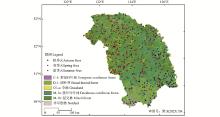
Fig.1
Geographical position, fuel types and historical fire records (2000—2020) of the study area C-5 represents mature evergreen coniferous forest. M-1a represents mixed stands with 75% deciduous forests and 25% coniferous forests. M-1b is the opposite of M-1a, representing mixed stands with 25% deciduous trees and 75% coniferous trees. D-1 is characterized by semimature aspen stands before bud break in the spring and following leaf fall in the autumn. O-1a represents grassland. The nonfuel areas include bare land, water bodies, urban areas, roads, and firebreaks."
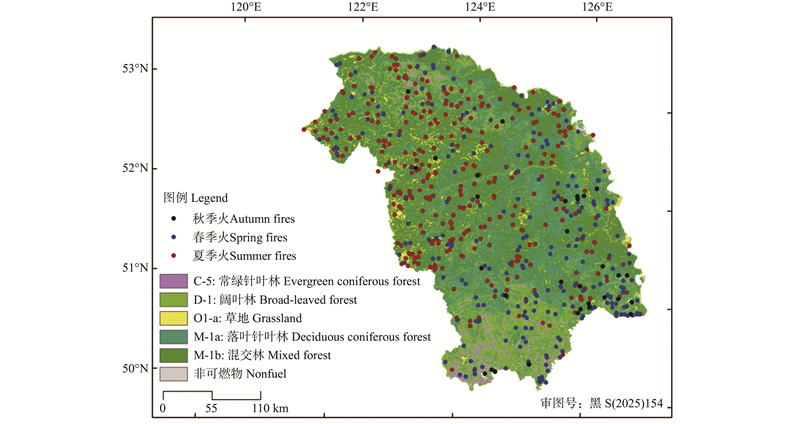
Table 1
Inputs and burning parameters for the BP model"
| 变量 Variable | 格式 Format | 覆盖期间 Period covered | 描述 Description |
| 可燃物类型 Fuel types | 栅格Raster(.asc) | 2020 | 可燃物类型包括5类:O-1a(草地)、C-5(常绿针叶林)、M-1a(落叶针叶林)、D-1 (阔叶林)和M-1b(混交林) Including five categories: O-1a (grassland), C-5 (evergreen coniferous forest), M-1a (deciduous coniferous forest), D-1 (broadleaf forest), and M-1b (mixed forest)( |
| 数字高程模型 DEM | 栅格Raster(.asc) | — | 研究区地形 Topography of the study area |
| 火发生密度Fire occurrence density | 栅格Raster(.asc) | 2000—2020 | 基于历史记录(3个季节的人为火和雷击火)生成6个火发生密度图 Six fire occurrence density maps generated based on historical records (including both human-caused and lightning-caused fires across three seasons) |
| 响应时间 Response time | 栅格Raster(.asc) | 2020 | 由扑火基地从地面或空中到达火场所需的最快时间 The minimum time required for firefighting teams to reach the fire site from ground or aerial bases( |
| 季节 Season | 字符Character | — | 根据物候和火活动将火险期划分为3个季节:春季(3—5月)、夏季(6—8月)和秋季(9—10月) The fire risk period is divided into three seasons based on phenology and fire activity: Spring (March–May), Summer (June–August), and Autumn (September–October) |
| 点燃概率 Ignition probability | 文件File(.csv) | 2000—2020 | 根据历史记录采用指数函数生成各季节雷击点燃概率、各季节人为点燃概率、日雷击火概率和人为火概率 Seasonal lightning ignition probability and human-caused ignition probability, and daily lightning fire probability and human-caused fire probability generated using an exponential function based on historical records |
| 火天气列表 Fire weather list | 文件File(.csv) | 2000—2020 | 使用R Studio的‘cffdrs’包根据观测天气数据计算 Calculated from observed weather data using the 'cffdrs' package in R Studio( |
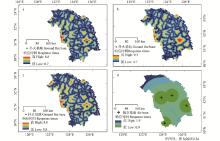
Fig.2
Response times from ground fire bases during spring (a), summer (b), and autumn (c) and response times by air base (d)"
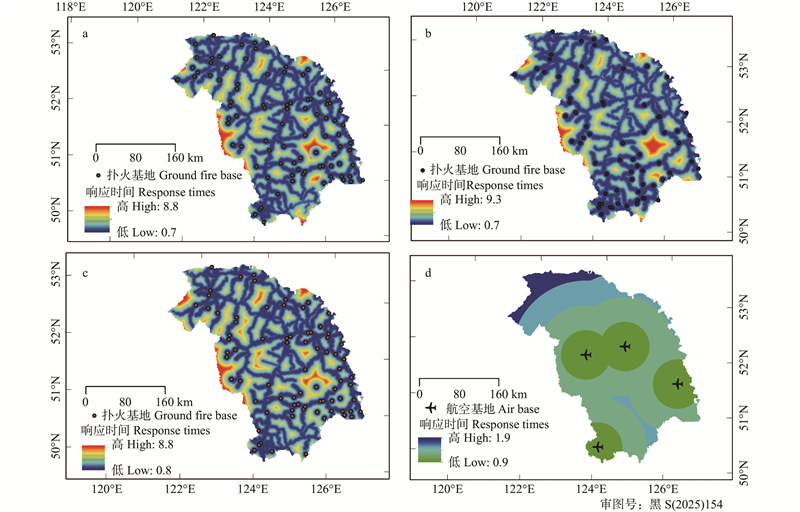
Fig.3
Optimized spatial locations of ground fire bases in spring (a), summer (b), and autumn (c) of the study area"
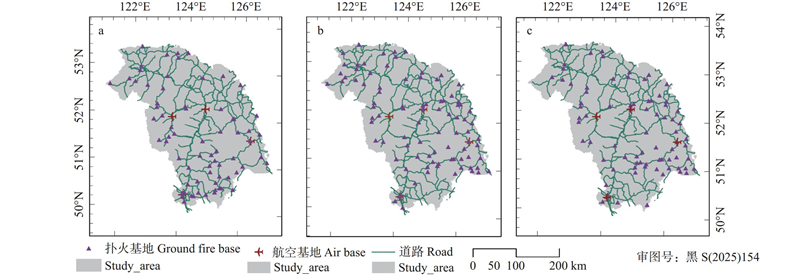
Fig.4
Burn probability of the study area in spring (a), summer (b), and autumn (c)"
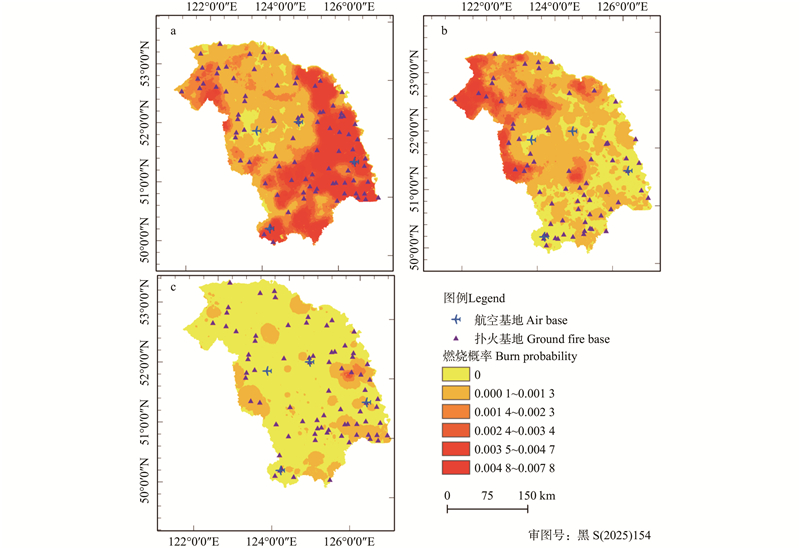
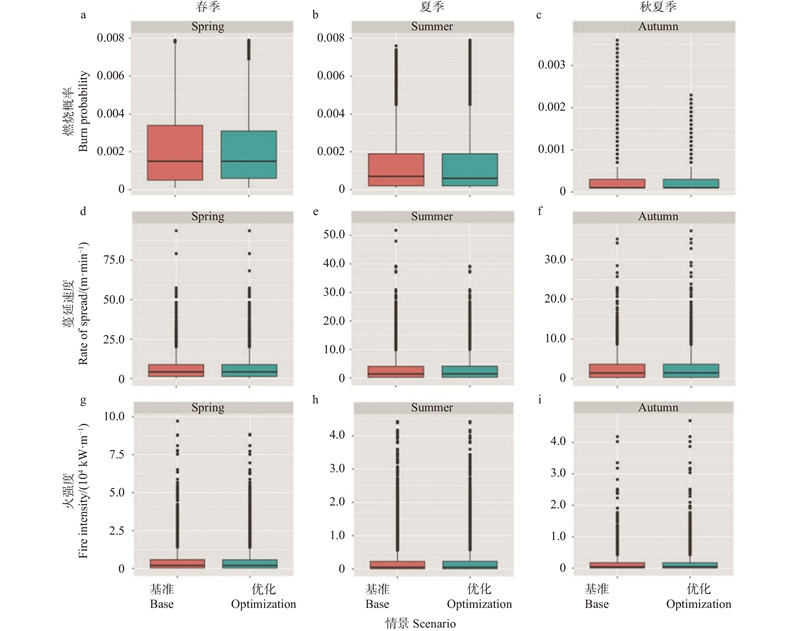
Fig.5
Boxplots for burn probability (a?c), rate of spread (d?f), and fire intensity (g?i) of the study area in three seasons under the base and optimal scenarios"
|
田晓瑞, 宗学政, 王明玉. 野外-城市交界域的火管理研究进展. 林业科学, 2023, 59 (6): 149- 158.
doi: 10.11707/j.1001-7488.LYKX20220265 |
|
|
Tian X R, Zong X Z, Wang M Y. A review of recent progress in fire management of wildland-urban interface. Scientia Silvae Sinicae, 2023, 59 (6): 149- 158.
doi: 10.11707/j.1001-7488.LYKX20220265 |
|
|
王 博, 程述龙, 常 宁, 等. 加强新形势下森林灭火安全的思考. 森林防火, 2023, 41 (2): 40- 43.
doi: 10.3969/j.issn.1002-2511.2023.02.010 |
|
|
Wang B, Cheng S L, Chang N, et al. Reflections on strengthening forest fire extinguishing safety under the new situation. Journal of Wildland Fire Science, 2023, 41 (2): 40- 43.
doi: 10.3969/j.issn.1002-2511.2023.02.010 |
|
| 肖功武, 姚庆学, 王 刚, 等. 2006. 森林火灾扑救技术规程(LY/T 1679—2006). 北京: 中国标准出版社. | |
| Xiao G W, Yao Q X, Wang G, et al. 2006. Technical regulations of forest fire suppression (LY/T 1679—2006). Beijing: China Standard Press. [in Chinese] | |
|
余 振, 孙鹏森, 刘世荣. 中国东部南北样带主要植被类型物候期的变化. 植物生态学报, 2010, 34 (3): 316- 329.
doi: 10.3773/j.issn.1005-264x.2010.03.009 |
|
|
Yu Z, Sun P S, Liu S R. Phenological change of main vegetation types along a north-south transect of eastern China. Chinese Journal of Plant Ecology, 2010, 34 (3): 316- 329.
doi: 10.3773/j.issn.1005-264x.2010.03.009 |
|
| 邹全程, 邸雪颖, 杨 光. 2010. 吉林省森林火灾扑救能力评价. 东北林业大学学报, 38(6): 63−65, 90. | |
| Zou Q C, Di X Y, Yang G. 2010. Evaluation on forest fire suppression capacity in Jilin Province. Journal of Northeast Forestry University, 38(6): 63−65, 90. [in Chinese] | |
|
Belval E J, Wei Y, Bevers M. A mixed integer program to model spatial wildfire behavior and suppression placement decisions. Canadian Journal of Forest Research, 2015, 45 (4): 384- 393.
doi: 10.1139/cjfr-2014-0252 |
|
| Collins K M, Price O F, Penman T D. Suppression resource decisions are the dominant influence on containment of Australian forest and grass fires. Journal of Environmental Management, 2018, 228, 373- 382. | |
|
Ellis T M, Bowman D M J S, Jain P, et al. Global increase in wildfire risk due to climate-driven declines in fuel moisture. Global Change Biology, 2022, 28 (4): 1544- 1559.
doi: 10.1111/gcb.16006 |
|
| Hirsch K G. 1996. Canadian forest fire behavior prediction (FBP) systems: user’s guide. Edmonton: Canadian Forest Service, Northwest Region, Northern Forestry Centre. | |
|
Hope E S, McKenney D W, Pedlar J H, et al. Wildfire suppression costs for Canada under a changing climate. PLoS One, 2016, 11 (8): e0157425.
doi: 10.1371/journal.pone.0157425 |
|
|
Johnston L M, Wang X L, Erni S, et al. Wildland fire risk research in Canada. Environmental Reviews, 2020, 28 (2): 164- 186.
doi: 10.1139/er-2019-0046 |
|
|
Katuwal H, Dunn C J, Calkin D E. Characterizing resource use and potential inefficiencies during large-fire suppression in the western US. International Journal of Wildland Fire, 2017, 26 (7): 604.
doi: 10.1071/WF17054 |
|
|
Lee Y, Fried J S, Albers H J, et al. Deploying initial attack resources for wildfire suppression: spatial coordination, budget constraints, and capacity constraints. Canadian Journal of Forest Research, 2013, 43 (1): 56- 65.
doi: 10.1139/cjfr-2011-0433 |
|
|
Liu Z H, Yang J, Chang Y, et al. Spatial patterns and drivers of fire occurrence and its future trend under climate change in a boreal forest of northeast China. Global Change Biology, 2012, 18 (6): 2041- 2056.
doi: 10.1111/j.1365-2486.2012.02649.x |
|
|
Miller C, Ager A A. A review of recent advances in risk analysis for wildfire management. International Journal of Wildland Fire, 2013, 22 (1): 1- 18.
doi: 10.1071/WF11114 |
|
|
Parisien M A, Dawe D A, Miller C, et al. Applications of simulation-based burn probability modelling: a review. International Journal of Wildland Fire, 2019, 28 (12): 913- 926.
doi: 10.1071/WF19069 |
|
| Parisien M A, Kafka V, Hirsch K, et al. 2005. Mapping wildfire susceptibility with the BURN-P3 simulation model. Edmonton: Natural Resources Canada, Canadian Forest Service, Northern Forestry Centre. | |
|
Plucinski M P. Fighting flames and forging firelines: wildfire suppression effectiveness at the fire edge. Current Forestry Reports, 2019, 5 (1): 1- 19.
doi: 10.1007/s40725-019-00084-5 |
|
|
Reimer J, Thompson D K, Povak N. Measuring initial attack suppression effectiveness through burn probability. Fire, 2019, 2 (4): 60.
doi: 10.3390/fire2040060 |
|
|
Rideout D, Wei Y, Kirsch A. Optimal allocation of initial attack resources to multiple wildfire events. International Journal of Safety and Security Engineering, 2011, 1 (3): 312- 325.
doi: 10.2495/SAFE-V1-N3-312-325 |
|
|
Rodrigues M, Alcasena F, Vega-García C. Modeling initial attack success of wildfire suppression in Catalonia, Spain. Science of the Total Environment, 2019, 666, 915- 927.
doi: 10.1016/j.scitotenv.2019.02.323 |
|
|
Sakellariou S, Parisien M A, Flannigan M, et al. Spatial planning of fire-agency stations as a function of wildfire likelihood in Thasos, Greece. Science of the Total Environment, 2020, 729, 139004.
doi: 10.1016/j.scitotenv.2020.139004 |
|
| Stockdale C, Barber Q, Saxena A, et al. Examining management scenarios to mitigate wildfire hazard to caribou conservation projects using burn probability modeling. Journal of Environmental Management, 2019, 233, 238- 248. | |
| Tang X Z, Machimura T, Li J F, et al. 2022. Evaluating seasonal wildfire susceptibility and wildfire threats to local ecosystems in the largest forested area of China. Earth’s Future, 10(5): e2021EF002199. | |
|
Tezcan B, Eren T. Forest fire management and fire suppression strategies: a systematic literature review. Natural Hazards, 2025, 121 (9): 10485- 10515.
doi: 10.1007/s11069-025-07227-x |
|
|
Tian X R, Cui W B, Shu L F. Evaluating fire management effectiveness with a burn probability model in Daxing’anling, China. Canadian Journal of Forest Research, 2020, 50 (7): 670- 679.
doi: 10.1139/cjfr-2019-0413 |
|
|
Tian X R, McRae D J, Jin J Z, et al. Wildfires and the Canadian forest fire weather index system for the Daxing’anling region of China. International Journal of Wildland Fire, 2011, 20 (8): 963- 973.
doi: 10.1071/WF09120 |
|
| Todd B. 1999. User documentation for the wildland fire growth model and the Wildfire display program. Edmonton: Canadian Forest Service, Fire Research Network. | |
|
Tymstra C, Stocks B J, Cai X L, et al. Wildfire management in Canada: review, challenges and opportunities. Progress in Disaster Science, 2020, 5, 100045.
doi: 10.1016/j.pdisas.2019.100045 |
|
| Van Wagner C E. 1987. The development and structure of the Canadian forest fire weather index system. Ottawa: Canadian Forest Service. | |
|
Wang X L, Parisien M A, Taylor S W, et al. Future burn probability in south-central British Columbia. International Journal of Wildland Fire, 2016, 25 (2): 200- 212.
doi: 10.1071/WF15091 |
|
|
Wang X L, Wotton B M, Cantin A S, et al. Cffdrs: an R package for the Canadian forest fire danger rating system. Ecological Processes, 2017, 6 (1): 5.
doi: 10.1186/s13717-017-0070-z |
|
|
Wei Y, Thompson M P, Haas J R, et al. Spatial optimization of operationally relevant large fire confine and point protection strategies: model development and test cases. Canadian Journal of Forest Research, 2018, 48 (5): 480- 493.
doi: 10.1139/cjfr-2017-0271 |
|
|
Wheatley M, Wotton B M, Woolford D G, et al. Modelling initial attack success on forest fires suppressed by air attack in the province of Ontario, Canada. International Journal of Wildland Fire, 2022, 31 (8): 774- 785.
doi: 10.1071/WF22006 |
|
|
White R H, Anderson S, Booth J F, et al. The unprecedented Pacific northwest heatwave of June 2021. Nature Communications, 2023, 14, 727.
doi: 10.1038/s41467-023-36289-3 |
|
|
Wu Z W, He H S, Keane R E, et al. Current and future patterns of forest fire occurrence in China. International Journal of Wildland Fire, 2020, 29 (2): 104- 119.
doi: 10.1071/WF19039 |
|
| Yang S Y, Huai Y J, Nie X Y, et al. 2024. Visualization of real-time forest firefighting inference and fire resource allocation simulation. Forests, 15(12): 2114. | |
|
Zhao F J, Liu Y Q, Shu L F. Change in the fire season pattern from bimodal to unimodal under climate change: the case of Daxing’anling in Northeast China. Agricultural and Forest Meteorology, 2020, 291, 108075.
doi: 10.1016/j.agrformet.2020.108075 |
|
|
Zhao F J, Liu Y Q. Important meteorological predictors for long-range wildfires in China. Forest Ecology and Management, 2021, 499, 119638.
doi: 10.1016/j.foreco.2021.119638 |
|
|
Zong X Z, Tian X R, Wang X L. An optimal firebreak design for the boreal forest of China. Science of the Total Environment, 2021a, 781, 146822.
doi: 10.1016/j.scitotenv.2021.146822 |
|
|
Zong X Z, Tian X R, Liu J L. A fire regime zoning system for China. Frontiers in Forests and Global Change, 2021b, 4, 717499.
doi: 10.3389/ffgc.2021.717499 |
|
|
Zong X Z, Tian X R, Yao Q C, et al. An analysis of fatalities from forest fires in China, 1951–2018. International Journal of Wildland Fire, 2022, 31 (5): 507- 517.
doi: 10.1071/WF21137 |
| Viewed | ||||||
|
Full text |
|
|||||
|
Abstract |
|
|||||
