
Scientia Silvae Sinicae ›› 2026, Vol. 62 ›› Issue (3): 100-110.doi: 10.11707/j.1001-7488.LYKX20250346
• Research papers • Previous Articles Next Articles
Shaohui Fan*( ),Shihui Zheng,Songpo Wei,Guanglu Liu
Received:2025-05-30
Revised:2025-11-10
Online:2026-03-15
Published:2026-03-12
Contact:
Shaohui Fan
E-mail:fansh@icbr.ac.cn
CLC Number:
Shaohui Fan,Shihui Zheng,Songpo Wei,Guanglu Liu. Key Environmental Factors Affecting Internode Length of Moso Bamboo[J]. Scientia Silvae Sinicae, 2026, 62(3): 100-110.
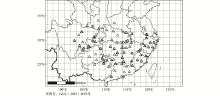
Fig.1
Distribution of sampling sites for moso bamboo"
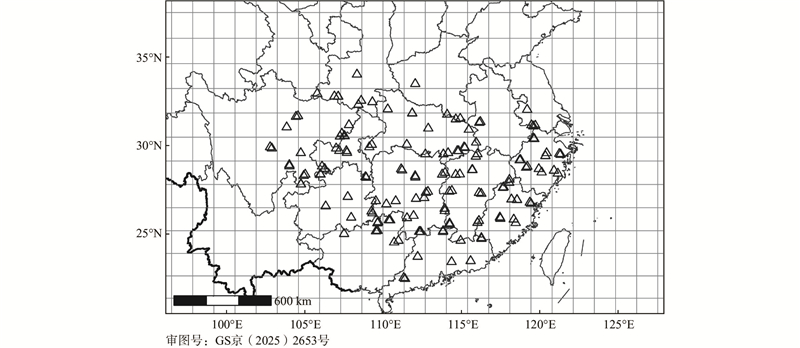
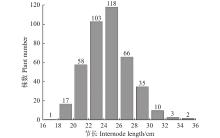
Fig.2
Distribution of bamboo plant numbers with different internode lengths"
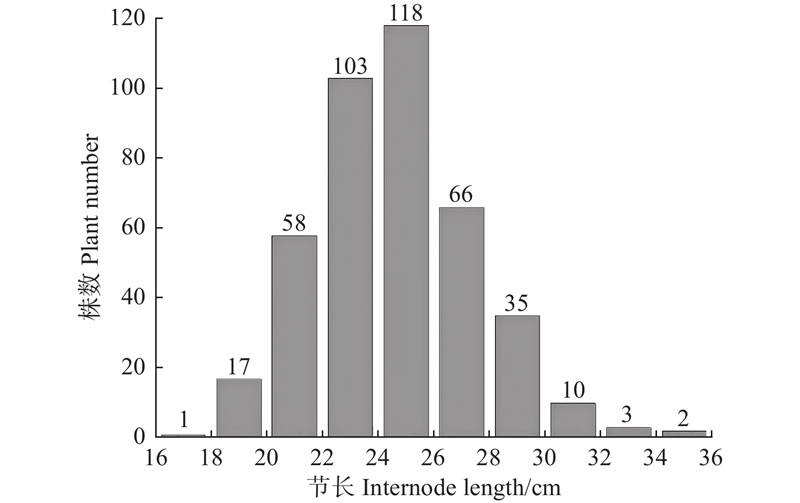
Fig.3
Relationships between internode length and longitude (a) and latitude (b)"
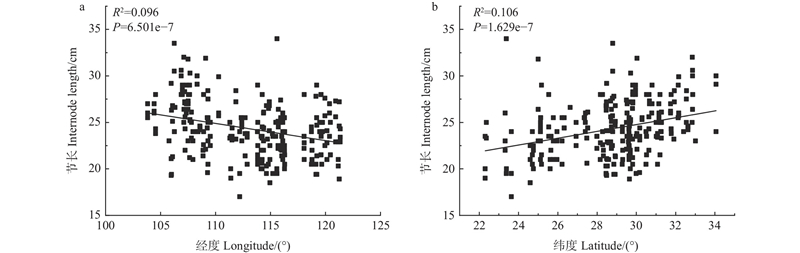
Fig.4
Relationships between internode length and annual average temperature (a), annual average precipitation (b), annual average sunshine hours (c) and annual average relative humidity (d)"
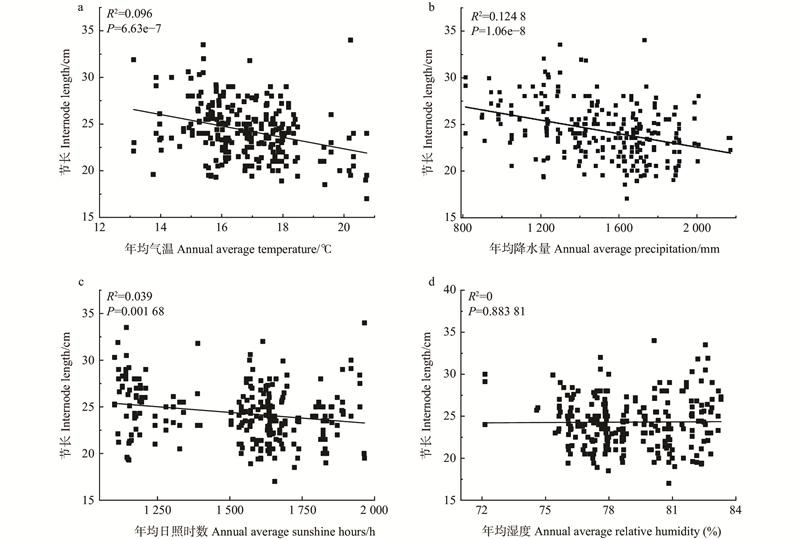
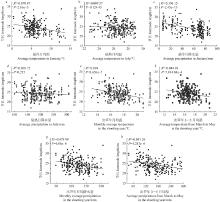
Fig.5
Relationships between internode length and climatic variables"
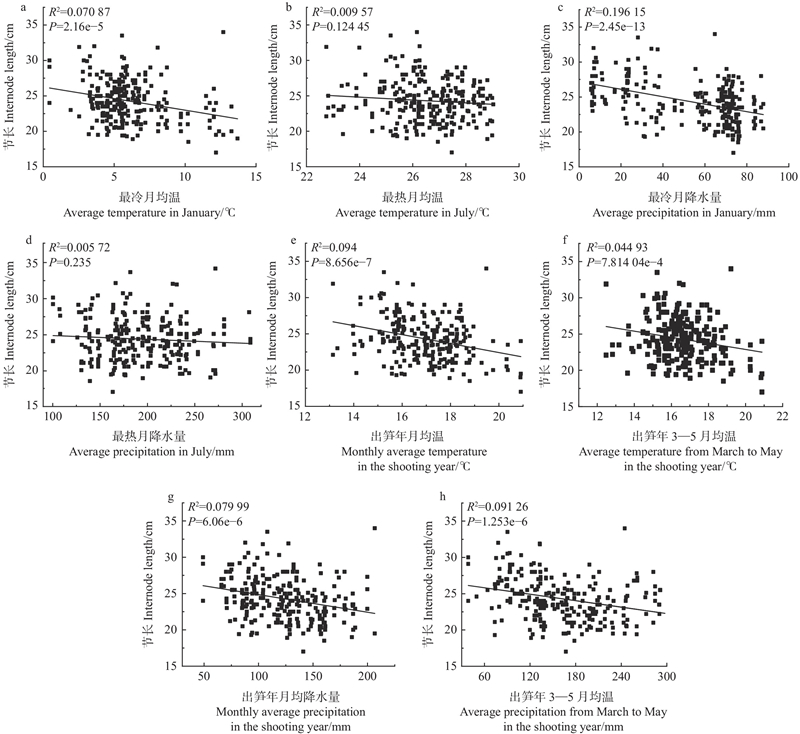
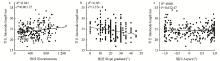
Fig.6
Relationship between internode length and elevation (a), slope gradient (b), and aspect (c)"
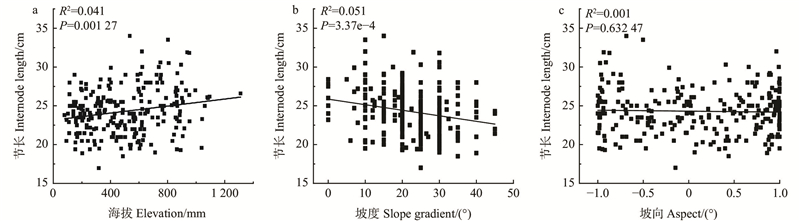
Fig.7
Relationships between internode length and soil non-capillary porosity (a), and soil bulk density (b)"
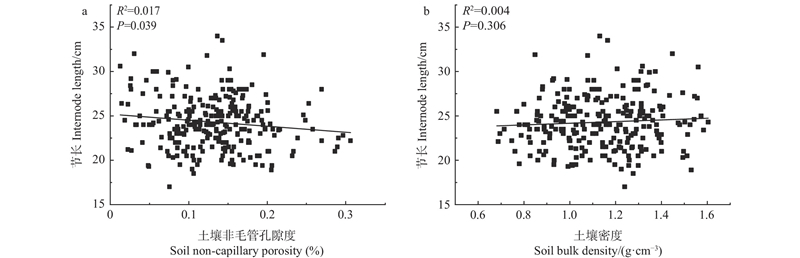
Fig.8
Relationships between internode length and soil nutrient factor"
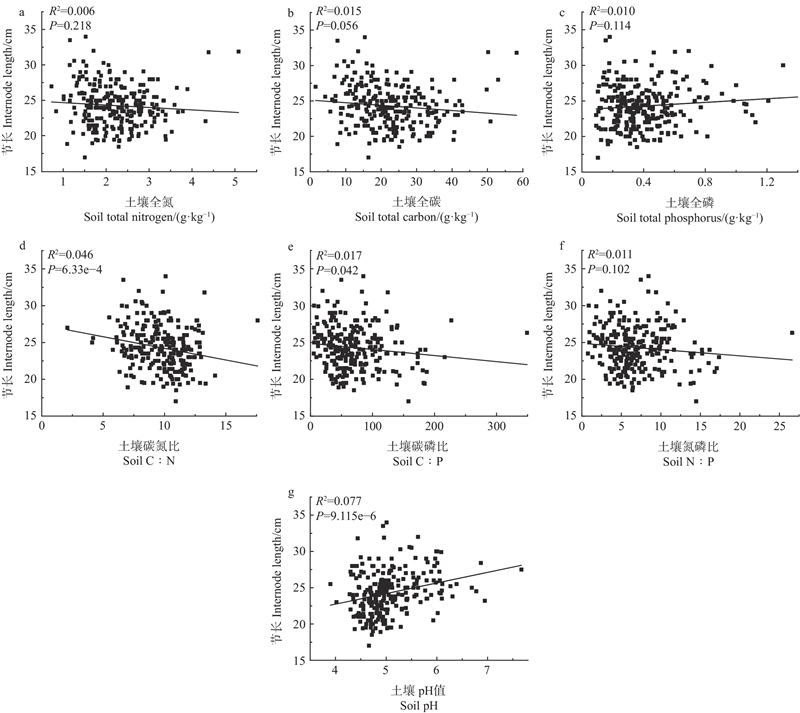
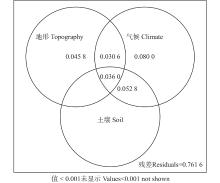
Fig.9
Wayne’ s variance decomposition of environmental factors and internode lengths"
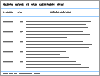
Table 1
Model-averaged coefficients of the relationship model between climate factors and internode lengths"
| 变量 Variable | 条件平均系数 Conditional mean coefficient | 标准误 Standard error | 调整后的标准误 Adjusted standard error | z值 z-value | P值 P-value | 显著性 Significance |
| 截距Intercept | 3.184 | 0.234 | 0.234 | 13.59 | 0 | *** |
| PRE_1 | ?0.002 | 0 | 0 | 5.34 | 0 | *** |
| TEM_1 | ?0.007 | 0.003 | 0.003 | 2.1 | 0.036 | * |
| TEM_7 | 0.009 | 0.006 | 0.006 | 1.51 | 0.132 | |
| PRE_g | 0 | 0 | 0 | 0.84 | 0.401 | |
| RHU | 0.003 | 0.004 | 0.004 | 0.7 | 0.485 | |
| PRE_7 | 0 | 0 | 0 | 0.58 | 0.562 | |
| PRE_g3 | 0 | 0 | 0 | 0.35 | 0.725 |
Table 2
Model-averaged coefficients of the relationship model between terrain factors and internode lengths"
| 变量 Variable | 条件平均系数 Conditional mean coefficient | 标准误 Standard error | 调整后的标准误 Adjusted standard error | z值 z-value | P值 P-value | 显著性 Significance |
| 截距Intercept | 3.254 | 0.02 | 0.02 | 164.54 | 0 | *** |
| SLO | ?0.003 | 0.001 | 0.001 | 3.87 | 0 | *** |
| ASP | ?0.015 | 0.01 | 0.01 | 1.45 | 0.147 |
Table 3
Model-averaged coefficients of the relationship model between soil factors and internode lengths"
| 变量 Variable | 条件平均系数 Conditional mean coefficient | 标准误 Standard error | 调整后的标准误 Adjusted standard error | z值 z-value | P值 P-value | 显著性 Significance |
| 截距Intercept | 2.989 | 0.122 | 0.122 | 24.5 | 0 | *** |
| C∶N | ?0.007 | 0.005 | 0.005 | 1.53 | 0.125 | |
| pH | 0.051 | 0.016 | 0.017 | 3.07 | 0.002 | ** |
| SNCP | ?0.225 | 0.133 | 0.133 | 1.69 | 0.091 | |
| SM | 0.096 | 0.104 | 0.104 | 0.92 | 0.356 | |
| N | 0.012 | 0.013 | 0.013 | 0.87 | 0.384 | |
| C∶P | 0 | 0 | 0 | 0.90 | 0.369 | |
| SBD | ?0.018 | 0.039 | 0.04 | 0.45 | 0.651 |
Table 4
Fixed effects coefficients and statistical tests of the relationship model between environmental factors and internode lengths"
| 变量 Variable | 系数 Coefficient | 标准误 Standard error | DF | t值 t-value | P值 P-value |
| (Intercept) | 3.310 | 0.089 | 243 | 37.30 | 0 |
| PRE_1 | ?0.002 | 0 | 243 | ?5.84 | 0 |
| SLO | ?0.003 | 0.001 | 243 | ?3.59 | 0 |
| pH | 0.010 | 0.014 | 243 | 0.73 | 0.467 |
| TEM_1 | ?0.003 | 0.003 | 243 | ?0.83 | 0.405 |
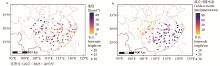
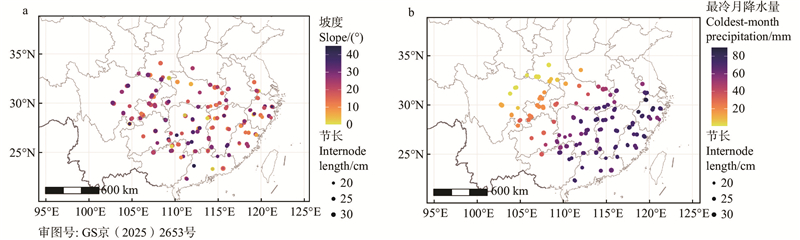
Fig.10
Distribution of moso bamboo internode lengths along slope (a) and precipitation of the coldest month (b)"
| 陈 铭. 2023. 毛竹(Phyllostachys edulis)笋快速生长的细胞路线图、转录组图谱及环境调控因子. 南京: 南京林业大学. | |
| Chen M. 2023. Cellular road map, transcriptome atlas, and environmental regulatory factors of rapid shoot growth in Phyllostachys edulis. Nanjing: Nanjing Forestry University. [in Chinese] | |
| 兰标新. 不同海拔高度毛竹秆形结构变化规律研究. 广东科技, 2014, 23 (2): 127- 128. | |
| Lan B X. Study on variation patterns of culm structure of Phyllostachys edulis at different altitudes. Guangdong Science & Technology, 2014, 23 (2): 127- 128. | |
|
李东宝, 吴 敏, 余 蓉, 等. 不同种源麻竹表型多样性及其与环境因子的相关性. 植物资源与环境学报, 2023, 32 (5): 39- 50.
doi: 10.3969/j.issn.1674-7895.2023.05.04 |
|
|
Li D B, Wu M, Yu R, et al. Phenotypic diversity of Dendrocalamus latiflorus from different provenances and its correlation with environmental factors. Journal of Plant Resources and Environment, 2023, 32 (5): 39- 50.
doi: 10.3969/j.issn.1674-7895.2023.05.04 |
|
|
李玉敏, 冯鹏飞. 基于第九次全国森林资源清查的中国竹资源分析. 世界竹藤通讯, 2019, 17 (6): 45- 48.
doi: 10.12168/sjzttx.2019.06.010 |
|
|
Li Y M, Feng P F. Bamboo resources in China based on the ninth national forest inventory data. World Bamboo and Rattan, 2019, 17 (6): 45- 48.
doi: 10.12168/sjzttx.2019.06.010 |
|
| 刘继平. 毛竹产区气候区划的研究. 竹子研究汇刊, 1987, 6 (3): 1- 12. | |
| Liu J P. A study on climatic zoning in Phyllostachys edulis distribution range. Journal of Bamboo Research, 1987, 6 (3): 1- 12. | |
|
苏文会, 顾小平, 岳晋军, 等. 大木竹秆形结构的研究. 林业科学研究, 2006, 19 (1): 98- 101.
doi: 10.3321/j.issn:1001-1498.2006.01.019 |
|
|
Su W H, Gu X P, Yue J J, et al. Study on the structure of culm form of Bambusa wenchouensis. Forest Research, 2006, 19 (1): 98- 101.
doi: 10.3321/j.issn:1001-1498.2006.01.019 |
|
|
汪阳东, 韦德煌. 气象因素对毛竹秆形生长变异的影响. 竹子研究汇刊, 2002, 21 (1): 46- 52.
doi: 10.3969/j.issn.1000-6567.2002.01.010 |
|
|
Wang Y D, Wei D H. The effect of weather factors on the culm growth of moso bamboo. Journal of Bamboo Research, 2002, 21 (1): 46- 52.
doi: 10.3969/j.issn.1000-6567.2002.01.010 |
|
| 谢 芳. 毛竹节间性状及其海拔效应研究. 江西农业大学学报, 2002, 24 (1): 86- 89. | |
| Xie F. A study on the main internode characters of Mao bamboo and its altitude effect. Acta Agriculturae Universitatis Jiangxiensis, 2002, 24 (1): 86- 89. | |
| 杨 帆, 汤孟平. 浙江省毛竹秆形结构特征. 浙江农林大学学报, 2021, 38 (6): 1289- 1296. | |
| Yang F, Tang M P. On the structure characteristics of culm form of Phyllostachys edulis in Zhejiang Province. Journal of Zhejiang A & F University, 2021, 38 (6): 1289- 1296. | |
|
于金光, 郝际平, 田黎敏, 等. 圆竹的力学性能及影响因素研究. 西安建筑科技大学学报(自然科学版), 2018, 50 (1): 30- 36.
doi: 10.15986/j.1006-7930.2018.01.006 |
|
|
Yu J G, Hao J P, Tian L M, et al. The study on the main influencing factors and mechanical properties of Phyllostachys pubescens. Journal of Xi’an University of Architecture & Technology, 2018, 50 (1): 30- 36.
doi: 10.15986/j.1006-7930.2018.01.006 |
|
| 张 雷, 杨光耀, 黎祖尧, 等. 不同产地厚竹秆形结构比较. 竹子学报, 2017, 36 (1): 19- 24. | |
| Zhang L, Yang G Y, Li Z Y, et al. Form and structure of bamboo culm of Phyllostachys edulis‘Pachyloen’growing in different habitats. Journal of Bamboo Research, 2017, 36 (1): 19- 24. | |
|
张闻博, 费本华, 田根林, 等. 不同地区毛竹生长和表型性状的比较. 东北林业大学学报, 2019, 47 (1): 1- 5.
doi: 10.3969/j.issn.1000-5382.2019.01.001 |
|
|
Zhang W B, Fei B H, Tian G L, et al. Comparative study on growth and phenotypic traits of Phyllostachys edulis in different areas. Journal of Northeast Forestry University, 2019, 47 (1): 1- 5.
doi: 10.3969/j.issn.1000-5382.2019.01.001 |
|
| 周文伟. 降水对毛竹林生长的影响分析. 竹子研究汇刊, 1991, 10 (2): 33- 39. | |
| Zhou W W. An analysis of the influence of precipitation on the growth of bamboo forest. Journal of Bamboo Research, 1991, 10 (2): 33- 39. | |
|
de Oliveira Buzatti R S, Pfeilsticker T R, Muniz A C, et al. Disentangling the environmental factors that shape genetic and phenotypic leaf trait variation in the tree Qualea grandiflora across the Brazilian savanna. Frontiers in Plant Science, 2019, 10, 1580.
doi: 10.3389/fpls.2019.01580 |
|
|
Chen M, Guo L, Ramakrishnan M, et al. Rapid growth of moso bamboo (Phyllostachys edulis): Cellular roadmaps, transcriptome dynamics, and environmental factors. The Plant Cell, 2022, 34 (10): 3577- 3610.
doi: 10.1093/plcell/koac193 |
|
|
Dong L B, Li J W, Zhang Y, et al. Effects of vegetation restoration types on soil nutrients and soil erodibility regulated by slope positions on the Loess Plateau. Journal of Environmental Management, 2022, 302, 113985.
doi: 10.1016/j.jenvman.2021.113985 |
|
|
Harrison X A, Donaldson L, Correa-Cano M E, et al. A brief introduction to mixed effects modelling and multi-model inference in ecology. PeerJ, 2018, 6, e4794.
doi: 10.7717/peerj.4794 |
|
|
Islam T, Hamid M, Nawchoo I A, et al. Leaf functional traits vary among growth forms and vegetation zones in the Himalaya. Science of the Total Environment, 2024, 906, 167274.
doi: 10.1016/j.scitotenv.2023.167274 |
|
| Läuchli A, Grattan S R. 2017. Plant stress under non-optimal soil pH //Shabala S. Plant Stress Physiology. 2nd Edition. Wallingford: CAB International, 201˗216. | |
|
Liu X, Zhou S X, Hu J, X et al. Variations and trade-offs in leaf and culm functional traits among 77 woody bamboo species. BMC Plant Biology, 2024, 24 (1): 387.
doi: 10.1186/s12870-024-05108-2 |
|
|
Meng X M, Zhang Z C, Wu Y D, et al. A comprehensive evaluation of the effects of bamboo nodes on the mechanical properties of bamboo culms. Engineering Structures, 2023, 297, 116975.
doi: 10.1016/j.engstruct.2023.116975 |
|
|
Rusmayadi G, Safruddin S. Effect of soil pH variation on peanut plant growth. West Science Agro, 2024, 2 (2): 63- 69.
doi: 10.58812/wsa.v2i02.944 |
|
|
Schäfer C, Rötzer T, Thurm E A, et al. Growth and tree water deficit of mixed Norway spruce and European beech at different heights in a tree and under heavy drought. Forests, 2019, 10 (7): 577.
doi: 10.3390/f10070577 |
|
|
Searle E B, Chen H Y H. Complementarity effects are strengthened by competition intensity and global environmental change in the central boreal forests of Canada. Ecology Letters, 2020, 23 (1): 79- 87.
doi: 10.1111/ele.13411 |
|
|
Shi Y J, Xu L, Zhou Y F, et al. Quantifying driving factors of vegetation carbon stocks of moso bamboo forests using machine learning algorithm combined with structural equation model. Forest Ecology and Management, 2018, 429, 406- 413.
doi: 10.1016/j.foreco.2018.07.035 |
|
|
Stotz G C, Salgado-Luarte C, Escobedo V M, et al. Phenotypic plasticity and the leaf economics spectrum: plasticity is positively associated with specific leaf area. Oikos, 2022, 2022 (11): e09342.
doi: 10.1111/oik.09342 |
|
|
Suarez E, Rescalvo F J, Fernandez A, et al. Influence of weathering on mechanical properties of culm samples of Guadua angustifolia Kunth bamboo with and without nodes. Wood Material Science & Engineering, 2023, 18 (2): 434- 445.
doi: 10.1080/17480272.2022.2039961 |
|
|
Taylor D, Kinane B, Sweeney C, et al. The biomechanics of bamboo: investigating the role of the nodes. Wood Science and Technology, 2015, 49 (2): 345- 357.
doi: 10.1007/s00226-014-0694-4 |
|
|
Wang Y L, Li Y. Genetic diversity analysis of phenotypic traits among 37 Xanthoceras sorbifolium elite germplasms. Journal of Forest Research, 2022, 27 (2): 140- 147.
doi: 10.1080/13416979.2021.2009094 |
|
|
Wei Q, Jiao C, Ding Y L, et al. Cellular and molecular characterizations of a slow-growth variant provide insights into the fast growth of bamboo. Tree Physiology, 2018, 38 (4): 641- 654.
doi: 10.1093/treephys/tpx129 |
|
|
Wright I J, Ackerly D D, Bongers F, et al. Relationships among ecologically important dimensions of plant trait variation in seven neotropical forests. Annals of Botany, 2007, 99 (5): 1003- 1015.
doi: 10.1093/aob/mcl066 |
|
|
Wu Y X, Guo J H, Tang Z Y, et al. Moso bamboo (Phyllostachys edulis) expansion enhances soil pH and alters soil nutrients and microbial communities. Science of the Total Environment, 2024, 912, 169346.
doi: 10.1016/j.scitotenv.2023.169346 |
|
|
Xia Y, Feng J N, Zhang H B, et al. Effects of soil pH on the growth, soil nutrient composition, and rhizosphere microbiome of Ageratina adenophora. PeerJ, 2024, 12, e17231.
doi: 10.7717/peerj.17231 |
|
|
Yao L J, Xu Y, Wu C P, et al. Variation in the functional traits of forest vegetation along compound habitat gradients in different climatic zones in China. Forests, 2023, 14 (6): 1232.
doi: 10.3390/f14061232 |
|
|
Yaqoob N, Malekian R, Farooque A A, et al. Topography-driven variability in soil greenhouse gas emissions during potato growth season. Soil Use and Management, 2024, 40 (4): e13123.
doi: 10.1111/sum.13123 |
|
|
Yaulilahua-Huacho R, Sumarriva-Bustinza L A, Gutierrez-Deza L I R, et al. Examining the adaptability of soil pH to soil dynamics using different methodologies: a concise review. Journal of Experimental Biology and Agricultural Sciences, 2024, 12 (4): 573- 587.
doi: 10.18006/2024.12(4).573.587 |
|
|
Zheng S H, Wei S P, Li J R, et al. The phenotypic variation in moso bamboo and the selection of key traits. Plants, 2024, 13 (12): 1625.
doi: 10.3390/plants13121625 |
| [1] | Yugao Sun,Yingchao Ji,Dehui Wang,Shuikun Li,Yongming Zheng,Shaohua He,Bin Zhang,Yanfen Zhang. Spatial and Temporal Analyses of Pest Occurrence in Forestry in China from 1992 to 2022 and the Influencing Factors [J]. Scientia Silvae Sinicae, 2026, 62(3): 122-132. |
| [2] | Xiaorong Wang,Miao Gong,Zhongchun Gu,Xingyi Hu,Lianghua Qi,Haishan Tan,Xue Dai,Qingping Liu,Shaodan Xia,Hu Zhao. Characteristics of Fine Root Decomposition and Nutrient Release during Phyllostachys edulis Expansion into Cunninghamia lanceolata Forest and Broad-Leaved Forest in Mufu Mountain Area [J]. Scientia Silvae Sinicae, 2025, 61(8): 46-57. |
| [3] | Xinxin Ma,You Wang,Jiajun Wang,Long Feng,Jianfeng Ma. Changes in Ash Composition of Bamboo during Pyrolysis and the Distribution Pattern of Silicon Transformation [J]. Scientia Silvae Sinicae, 2025, 61(2): 172-179. |
| [4] | Lemei Yang,Baogang Zhang,Youchao Chen,Yanjiang Cai. Leaf Functional Traits of Understory Plants in a Moso Bamboo Forests in Response to Simulated Nitrogen Deposition [J]. Scientia Silvae Sinicae, 2025, 61(12): 61-71. |
| [5] | Zongming Cai,Zhiwen Deng,Bingjun Li,Shikun Li,Weiqing Wen,Jundong Rong,Yushan Zheng,Liguang Chen. Effects of Strip-cutting Width on the Structural Characteristics of Underground Bamboo Rhizome in Moso Bamboo Forests [J]. Scientia Silvae Sinicae, 2023, 59(4): 79-87. |
| [6] | Yaxiong Zheng,Shaohui Fan,Xuan Zhang,Xiao Zhou,Fengying Guan. Productivity Dynamics of Moso Bamboo (Phyllostachys edulis) Forest after Strip Clearcutting [J]. Scientia Silvae Sinicae, 2023, 59(2): 22-29. |
| [7] | Meng Zhang,Xiuhua Fan,Qingmin Yue,Zhuoxiu Han,Yixin Huang. Effects of Biotic and Abiotic Factors on Productivity of Coniferous and Broad-LeavedMixed Forest in Jiaohe, Jilin Province [J]. Scientia Silvae Sinicae, 2023, 59(12): 71-77. |
| [8] | Linxin Dai,Zhihui Wang,Zhenrui Li,Jiajun Wang,Xing’e Liu,Jialong Wen,Jianfeng Ma. Pyrolysis Characteristics of the Main Components of Bamboo Cell Wall Using TG-FTIR [J]. Scientia Silvae Sinicae, 2023, 59(11): 85-94. |
| [9] | Caixia Liu,Junhui Chen,Hua Qin,Chenfei Liang,Qiufang Xu. Effects of Long-Term Combined Application of Organic and Inorganic Fertilizers on Soil CO2- and N2-Fixing Microorganisms in a Subtropical Bamboo Forest [J]. Scientia Silvae Sinicae, 2022, 58(7): 82-92. |
| [10] | Ruixiang Ma,Manchang Huang,Jiajia Zhang,Aoshun Zhao,Xingcui Ding,Zisheng Luo,Shenghui Liu,Zizhang Xiao,Kai Shen. Variation in Respiration Pathways of Post-Harvested Treatment Shoots of Moso Bamboo and the Effect of Hyperoxia Treatment [J]. Scientia Silvae Sinicae, 2022, 58(6): 33-46. |
| [11] | Xudong Chang,Guangze Jin. Effects of Topography and Soil Factors on the Decay of Living Trees of Korean Pine [J]. Scientia Silvae Sinicae, 2022, 58(11): 71-82. |
| [12] | Shunong Li,Yamei Zhang,Yanglun Yu,Wenji Yu. Study on the Hygroscopicity and Chemical Compositions of Boiling-Treated Moso Bamboo [J]. Scientia Silvae Sinicae, 2022, 58(1): 119-126. |
| [13] | Enbin Liu,Hongwen Yao,Zexi Ren,Guomo Zhou,Huaqiang Du. Bivariate Joint Distribution of DBH and Age of Moso Bamboo Based on Copula Density Function [J]. Scientia Silvae Sinicae, 2021, 57(11): 94-104. |
| [14] | Qianyong Shen,Mengping Tang. Stem Volume Models of Phyllostachys edulis in Zhejiang Province [J]. Scientia Silvae Sinicae, 2020, 56(5): 89-96. |
| [15] | Yulu Xiong,Yufeng Zhou,Pingheng Li,Liang Tong,Guomo Zhou,Yongjun Shi,Huaqiang Du. Non-Destructive Detection by Ground Penetrating Radar of Growth Characteristics and Spatial Structure of Rhizomes in Moso Bamboo Forest [J]. Scientia Silvae Sinicae, 2020, 56(12): 19-27. |
| Viewed | ||||||
|
Full text |
|
|||||
|
Abstract |
|
|||||
