
Scientia Silvae Sinicae ›› 2026, Vol. 62 ›› Issue (4): 142-153.doi: 10.11707/j.1001-7488.LYKX20250553
• Research papers • Previous Articles Next Articles
Hui Yang1,Haiyan Zhao1,Lan Lou1,Lingfeng Zhang2,Zimiao Zhang1,Xiaoming Jia1,Quanxin Bi2,Libing Wang1,2,*( )
)
Received:2025-09-08
Online:2026-04-15
Published:2026-04-11
Contact:
Libing Wang
E-mail:wlibing@nwsuaf.edu.cn
CLC Number:
Hui Yang,Haiyan Zhao,Lan Lou,Lingfeng Zhang,Zimiao Zhang,Xiaoming Jia,Quanxin Bi,Libing Wang. Paternal Identification and Genetic Diversity Analysis of Open-Pollinated Progeny of Xanthoceras sorbifolium[J]. Scientia Silvae Sinicae, 2026, 62(4): 142-153.
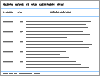
Table 1
Information of 17 pairs SSR primer"
| 引物名称 Primer name | 引物序列(5'–3') Primer sequence | 重复单元 Repeat motif | 片段大小 Fragment size/bp | 标记荧光 Fluorescent | 退火温度 Annealing temperature/℃ | |
| QXH049 | F: | CCCCAACAAATGGTAAGACG | CT | 196 | FAM | 55 |
| R: | GAATTTACAAGACAAGCAACAGC | |||||
| QXH083 | F: | AGCGGTCTCCTCCACTATCA | CT | 331 | HEX | 56 |
| R: | GAATTGAAGCGCAGAAGGA | |||||
| QXH177 | F: | TGTGGTGGTTTTGGCAGAC | AG | 208 | FAM | 55 |
| R: | CACCAAATAATGTCAATATCCTGT | |||||
| QXH262 | F: | TCTAACCGAAGAAGCCAACT | CT | 250 | HEX | 55 |
| R: | AGCGTGATATTCTGTTTCAACTAC | |||||
| QXH281 | F: | CACCGTAGTATCAACGCACAA | AG | 219 | FAM | 58 |
| R: | ATTTCCACTATTTCCCTCACATT | |||||
| QXH282 | F: | CCCAACAAATGGTAAGACGT | CT | 240 | HEX | 55 |
| R: | GTTTCATTTCATTTCCAGCATC | |||||
| QXH323 | F: | CACAACCCAAATCCCAGAAC | AG | 346 | HEX | 55 |
| R: | AACGACACGCACAATCATAAC | |||||
| QXR343 | F: | CACACTTTCTGAGTCCCGTAT | TG | 318 | FAM | 58 |
| R: | TGTTTCTCCTCTAATCCAAC | |||||
| QXH365 | F: | GTATATCTCTTTTACTCGTGAC | AC | 154 | FAM | 52 |
| R: | ATGATGGGTTGGGTTGAGTT | |||||
| QXH429 | F: | TGCGACAGCAACAGCATAA | AC | 146 | FAM | 54 |
| R: | TAAGGCAGCCAAAACATCAG | |||||
| QXH643 | F: | GCAGTTATGGAAAGGAATCA | CA,CT | 268 | HEX | 56 |
| R: | ATCAGTGTCGATTATTATCT | |||||
| QXHS371 | F: | ATTGGAGTGGCCTTCATACG | GT | 241 | FAM | 54 |
| R: | GCAAGCAGCTAAAGAAACAGC | |||||
| QBLB1 | F: | CACTCCTTGACCGTGTTCTT | GA | 252 | FAM | 54 |
| R: | ATTGGATGACTTTGGTTTCG | |||||
| QBLB4 | F: | ACCCCAAACCACTATCCAA | AG | 113 | FAM | 59 |
| R: | CCCTCCCTTTTCCTTTTACT | |||||
| QBLB65 | F: | TATCTCGCCACATCTGCC | TC | 355 | HEX | 53 |
| R: | CTGAAATGCCATTAACAAACAC | |||||
| QBLB72 | F: | CCGAACTCGTCAATGTCAAC | AT, AG | 352 | HEX | 52 |
| R: | CTCTGCCTCCATCGTCATC | |||||
| QBRB203 | F: | ACAAGTAGTGCTCATCGGTTTA | AT | 371 | HEX | 56 |
| R: | GAGTCTAATAGGTAAGGCTAGGAAC | |||||
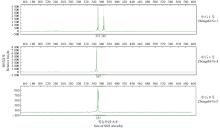
Fig.1
SSR amplification results of some yellowhorn with the QBLB65 primer"
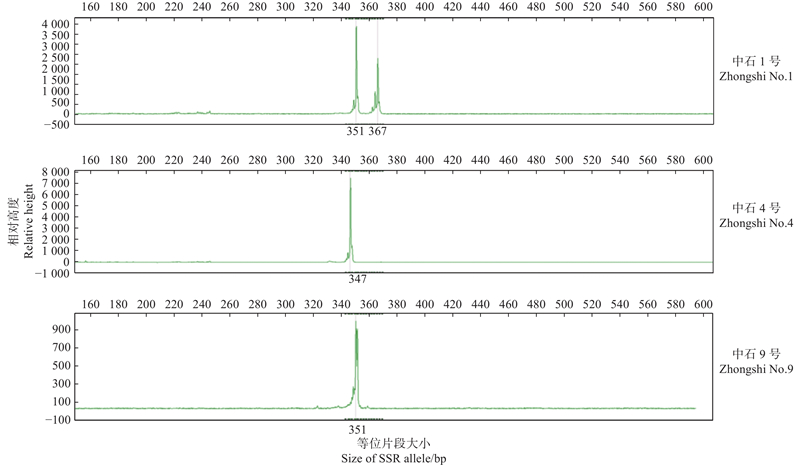
Table 2
Paternity identification results of the free-pollinated offspring of yellowhorn at a 95% confidence level"
| 父本编号 Paternal parent number | 交配母本品种及其子代数 Mating female variety and number of sibs | 总子代数 Total number of sibs | 繁殖贡献率 Reproductive contribution rate (%) |
| 悄然薄壳Qiaoranboke | 中石4号(6)、中石9号(1)Zhongshi No.4(6), Zhongshi No.9(1) | 7 | 5.79 |
| 中石4号Zhongshi No.4 | 中石1号(1)Zhongshi No.1(1) | 1 | 0.83 |
| 6-161 | 中石9号(4)、悄然薄壳(1)Zhongshi No.9(4), Qiaoranboke(1) | 5 | 4.13 |
| 12-141 | 中石9号(5)Zhongshi No.9(5) | 5 | 4.13 |
| 12-150 | 中石4号(2)、中石9号(2)、中石1号(1) Zhongshi No.4(2), Zhongshi No.9(2), Zhongshi No.1(1) | 5 | 4.13 |
| 6-136 | 中石4号(2)、圆大硕种(2)Zhongshi No.4(2), Yuandashuozhong(2) | 4 | 3.31 |
| 12-128 | 中石9号(2)、圆大硕种(2)Zhongshi No.9(2), Yuandashuozhong(2) | 4 | 3.31 |
| 12-193 | 中石1号(2)、中石4号(1)、中石9号(1) Zhongshi No.1(2), Zhongshi No.4(1), Zhongshi No.9(1) | 4 | 3.31 |
| 6-107 | 悄然薄壳(3)Qiaoranboke(3) | 3 | 2.48 |
| 6-144 | 中石9号(2)、中石4号(1)Zhongshi No.9(2), Zhongshi No.4(1) | 3 | 2.48 |
| 6-150 | 中石1号(2)、圆大硕种(1)Zhongshi No.1(2), Yuandashuozhong(1) | 3 | 2.48 |
| 12-142 | 中石4号(2)、中石9号(1)Zhongshi No.4(2), Zhongshi No.9(1) | 3 | 2.48 |
| 其他(16)Others(16) | 2×16 | 1.65×16 | |
| 其他(42)Others(42) | 1×42 | 0.83×42 | |
| 合计Total | 121 | 100 |
Table 3
Analysis of paternal composition in five half-sib families of yellowhorn at 95% confidence level"
| 交配母本品种 Mating female variety | 父本编号及其子代数 Paternal parent number and number of sibs | 总子代数 Total number of sibs | 繁殖贡献率 Reproductive contribution rate (%) |
| 中石1号 Zhongshi No.1 | 中石4号(1)Zhongshi No.4(1) | 1 | 0.83 |
| 12-193(2), 6-135(2), 6-150(2) | 2×3 | 1.65×3 | |
| 其他(1)Others(1) | 1×12 | 0.83×12 | |
| 中石4号 Zhongshi No.4 | 悄然薄壳(6)Qiaoranboke(6) | 6 | 4.96 |
| 6-136(2), 12-142(2), 12-150(2) | 2×3 | 1.65×3 | |
| 其他(1)Others(1) | 1×14 | 0.83×14 | |
| 中石9号 Zhongshi No.9 | 悄然薄壳(1)Qiaoranboke(1) | 1 | 0.83 |
| 12-141(5) | 5 | 4.13 | |
| 6-161(4) | 4 | 3.31 | |
| 9-200(2), 11-161(2), 12-150(2), 12-128(2), 6-144(2) | 2×5 | 1.65×5 | |
| 其他(1)Others(1) | 1×19 | 0.83×19 | |
| 圆大硕种 Yuandashuozhong | 6-194(2), 6-100(2), 6-136(2), 12-128(2) | 2×4 | 1.65×4 |
| 其他(1)Others(1) | 1×13 | 0.83×13 | |
| 悄然薄壳 Qiaoranboke | 6-107(3) | 3 | 2.48 |
| 5-157(2) | 2 | 1.65 | |
| 其他(1)Others(1) | 1×11 | 0.83×11 | |
| 合计Total | 121 | 100 |
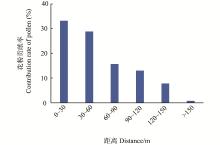
Fig.2
Effective pollen dispersal distance of yellowhorn"
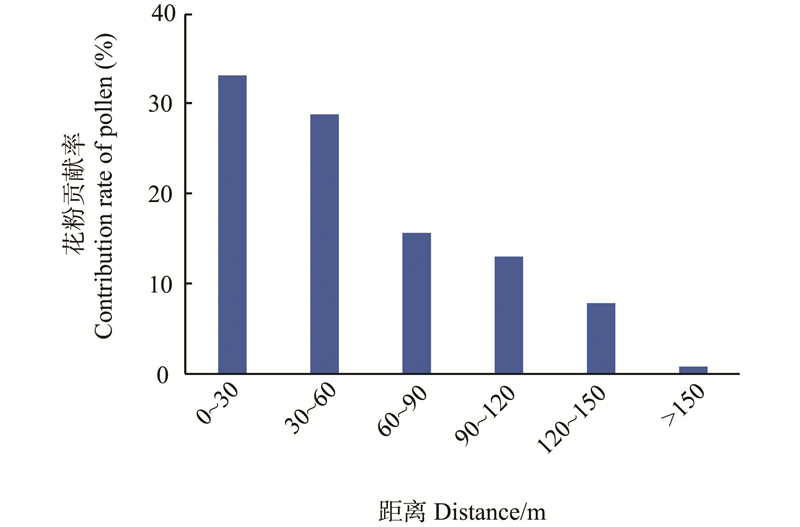
Fig.3
Analysis of the paternal origins of progeny of yellowhorn"

Table 4
Analysis on genetic diversity of open-pollinated progenies of yellowhorn"
| 位点 Locus | 个体数 Number of individuals | 等位基因数 Number of alleles (Na) | 有效等位基因数 Number of effective alleles (Ne) | Shannon’s 信息指数 Shannon’s information index (I) | 观测杂合度 Observed heterozygosity (Ho) | 期望杂合度 Expected heterozygosity (He) | 固定指数 Fixation index (F) | 多态信息含量 Polymorphic information content (PIC) |
| QXH049 | 394 | 5 | 3.987 | 1.469 | 0.789 | 0.749 | –0.054 | 0.708 |
| QXH643 | 393 | 14 | 2.623 | 1.438 | 0.740 | 0.619 | –0.197 | 0.591 |
| QXH177 | 393 | 9 | 3.180 | 1.332 | 0.700 | 0.686 | –0.021 | 0.628 |
| QBLB72 | 395 | 17 | 5.328 | 1.963 | 0.833 | 0.812 | –0.02 | 0.788 |
| QBLB1 | 393 | 7 | 1.926 | 0.917 | 0.272 | 0.481 | 0.434 | 0.434 |
| QXH282 | 394 | 5 | 3.957 | 1.464 | 0.787 | 0.747 | –0.053 | 0.705 |
| QBLB4 | 391 | 7 | 2.591 | 1.100 | 0.437 | 0.614 | 0.288 | 0.549 |
| QBRB203 | 395 | 5 | 2.860 | 1.172 | 0.689 | 0.650 | –0.059 | 0.584 |
| QXHS371 | 393 | 4 | 2.069 | 0.803 | 0.583 | 0.517 | –0.128 | 0.407 |
| QXH323 | 395 | 18 | 6.603 | 2.240 | 0.848 | 0.849 | 0.001 | 0.834 |
| QBLB65 | 395 | 11 | 3.460 | 1.598 | 0.762 | 0.711 | –0.072 | 0.673 |
| QXH429 | 394 | 3 | 1.873 | 0.705 | 0.439 | 0.466 | 0.058 | 0.369 |
| QXH262 | 395 | 13 | 2.765 | 1.405 | 0.671 | 0.638 | –0.051 | 0.599 |
| QXH365 | 390 | 5 | 2.728 | 1.156 | 0.518 | 0.633 | 0.182 | 0.567 |
| QXH281 | 394 | 3 | 2.126 | 0.811 | 0.652 | 0.530 | –0.232 | 0.419 |
| QXH083 | 391 | 16 | 3.338 | 1.681 | 0.708 | 0.700 | –0.011 | 0.673 |
| QXR343 | 393 | 6 | 2.166 | 0.978 | 0.094 | 0.538 | 0.825 | 0.463 |
| 平均值 Average | 8.706 | 3.152 | 1.308 | 0.619 | 0.644 | 0.052 | 0.588 |
Table 5
Analysis on genetic diversity of open-pollinated progenies population of yellowhorn"
群体 Group | 等位基因数 Number of alleles (Na) | 有效等位基因数 Number of effective alleles (Ne) | Shannon’s 信息指数 Shannon’s information index (I) | 观测杂合度 Observed heterozygosity (I) | 期望杂合度 Expected heterozygosity (He) | 固定指数 Fixation index (F) |
| 中石1号家系 ‘Zhongshi No.1’ family | 6.353 | 2.881 | 1.200 | 0.632 | 0.607 | –0.029 |
| 中石4号家系 ‘Zhongshi No.4’ family | 6.706 | 2.864 | 1.211 | 0.584 | 0.612 | 0.058 |
| 中石9号家系 ‘Zhongshi No.9’ family | 7.882 | 2.713 | 1.206 | 0.630 | 0.598 | –0.044 |
| 圆大硕种家系 ‘Yuandashuozhong’ family | 5.882 | 2.621 | 1.136 | 0.600 | 0.582 | –0.005 |
| 悄然薄壳家系 ‘Qiaoranboke’ family | 6.706 | 2.659 | 1.166 | 0.644 | 0.581 | –0.112 |
| 平均值 Average | 6.706 | 2.747 | 1.184 | 0.618 | 0.596 | –0.026 |
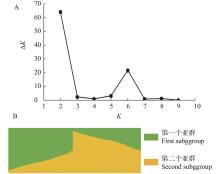
Fig.4
Variation between K and ΔK (A) and the population genetic structure of 395 groups of yellowhorn at K =2(B)"
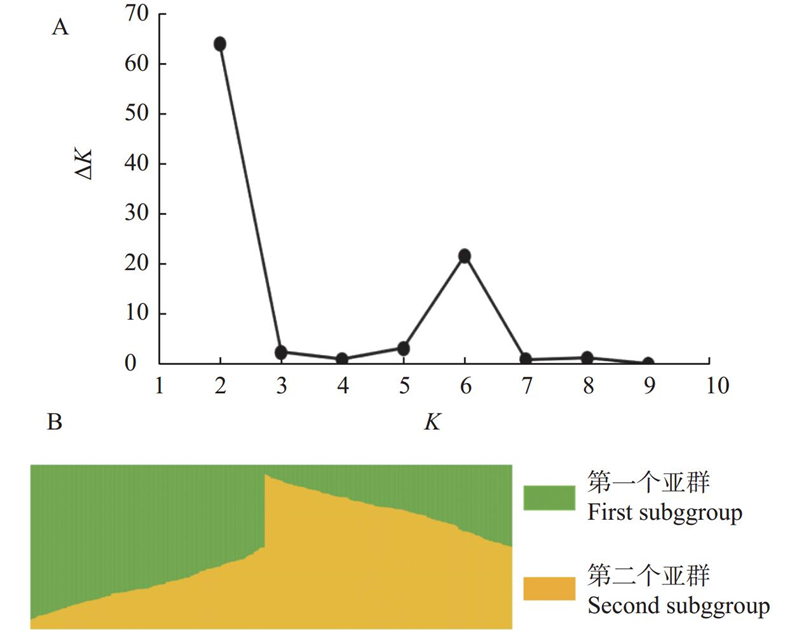
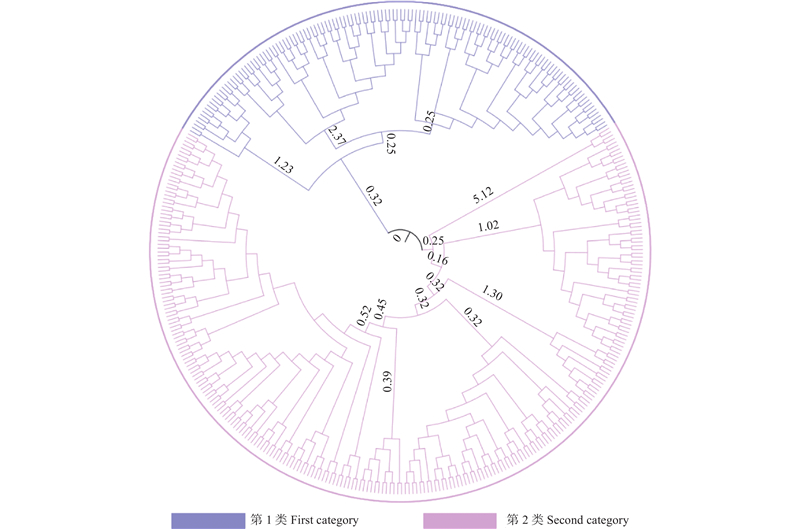
Fig.5
UPGMA clustering results of 395 yellowhorn"
| 陈兴彬, 徐海宁, 肖复明, 等. 陈山红心杉1.5代种子园遗传多样性和子代父本分析. 南京林业大学学报(自然科学版), 2021, 45 (3): 87- 92. | |
| Chen X B, Xu H N, Xiao F M, et al. Genetic diversity and paternity analyses in a 1.5th generation seed orchard of Chenshan red-heart Chinese fir. Journal of Nanjing Forestry University (Natural Sciences Edition), 2021, 45 (3): 87- 92. | |
|
高秀丽, 原树生, 王敏超, 等. 蜜蜂对文冠果的辅助授粉效应. 江苏农业科学, 2018, 46 (20): 148- 151.
doi: 10.15889/j.issn.1002-1302.2018.20.038 |
|
|
Gao X L, Yuan S S, Wang M C, et al. Auxiliary pollination effect of honeybees on Xanthoceras sorbifolium. Jiangsu Agricultural Sciences, 2018, 46 (20): 148- 151.
doi: 10.15889/j.issn.1002-1302.2018.20.038 |
|
| 何田华, 葛 颂. 植物种群交配系统、亲本分析以及基因流动研究. 植物生态学报, 2001, 25 (2): 144- 154. | |
| He T H, Ge S. Mating system paternity analysis and gene flow in plant populations. Acta Phytoecologica Sinica, 2001, 25 (2): 144- 154. | |
|
李寄凡, 程一鸣, 潘冬梅, 等. 授粉品种对油茶结实及果实主要性状的影响. 湖北民族大学学报(自然科学版), 2024, 42 (1): 26- 32.
doi: 10.13501/j.cnki.42-1908/n.2024.03.004 |
|
|
Li J F, Cheng Y M, Pan D M, et al. Effect of pollination varieties on fruit-setting rate and main fruit characters of Camellia oleifera. Journal of Hubei Minzu University (Natural Science Edition), 2024, 42 (1): 26- 32.
doi: 10.13501/j.cnki.42-1908/n.2024.03.004 |
|
|
李思琪, 张文臣, 杨 柳, 等. 基于SSR标记的文冠果遗传多样性分析及指纹图谱构建. 生物技术通报, 2024, 40 (5): 74- 83.
doi: 10.13560/j.cnki.biotech.bull.1985.2023-1148 |
|
|
Li S Q, Zhang W C, Yang L, et al. Genetic diversity analysis and dna fingerprint construction based on SSR markers for Xanthoceras sorbifolium. Biotechnology Bulletin, 2024, 40 (5): 74- 83.
doi: 10.13560/j.cnki.biotech.bull.1985.2023-1148 |
|
| 李相花, 韩笑翀, 鹿 英, 等. 基于SSR分子标记的泰安老茶树资源遗传多样性分析. 山东农业科学, 2025, 57 (5): 69- 74. | |
| Li X H, Han X C, Lu Y, et al. Genetic diversity analysis of old tea tree resources in Taian based on SSR molecular markers. Shandong Agricultural Sciences, 2025, 57 (5): 69- 74. | |
|
林建维, 张丽丽, 杨 俊, 等. 文冠果药食价值及其应用前景. 内蒙古林业调查设计, 2024, 47 (4): 69- 73.
doi: 10.13387/j.cnki.nmld.2024.04.006 |
|
|
Lin J W, Zhang L L, Yang J, et al. Medicinal and edible value of Xanthoceras sorbifolium and its application prospects. Inner Mongolia Forestry Investigation and Design, 2024, 47 (4): 69- 73.
doi: 10.13387/j.cnki.nmld.2024.04.006 |
|
|
刘加能, 程秋如, 潘登浪, 等. 基于SSR分子标记的油棕遗传多样性及群体遗传结构分析. 中国油脂, 2025, 50 (4): 111- 118.
doi: 10.19902/j.cnki.zgyz.1003-7969.230668 |
|
|
Liu J N, Cheng Q R, Pan D L, et al. Analysis of genetic diversity and population genetic structure in oil palm based on SSR markers. China Oils and Fats, 2025, 50 (4): 111- 118.
doi: 10.19902/j.cnki.zgyz.1003-7969.230668 |
|
|
刘 杰, 王 斌, 侯静静, 等. 甘肃胡麻地方品种遗传多样性和群体结构分析. 中国农业科技导报, 2025, 27 (9): 69- 78.
doi: 10.13304/j.nykjdb.2024.0222 |
|
|
Liu J, Wang B, Hou J J, et al. Analysis of genetic diversity and population structure of flax local varieties in Gansu. Journal of Agricultural Science and Technology, 2025, 27 (9): 69- 78.
doi: 10.13304/j.nykjdb.2024.0222 |
|
|
卢 瑶, 袁平平, 金 鑫, 等. 基于SSR标记的马铃薯野生种和地方种遗传多样性分析和指纹图谱构建. 生物技术通报, 2025, 41 (9): 94- 104.
doi: 10.13560/j.cnki.biotech.bull.1985.2025-0142 |
|
|
Lu Y, Yuan P P, Jin X, et al. Genetic diversity analysis and fingerprinting of wild potato and landraces based on SSR markers. Biotechnology Bulletin, 2025, 41 (9): 94- 104.
doi: 10.13560/j.cnki.biotech.bull.1985.2025-0142 |
|
|
牛 媛, 敖 妍, 李 云, 等. 文冠果优良无性系授粉组合选择及结实性状分析. 浙江农林大学学报, 2020, 37 (2): 209- 219.
doi: 10.11833/j.issn.2095-0756.2020.02.003 |
|
|
Niu Y, Ao Y, Li Y, et al. Selection of pollination combinations and analysis of fruit and seed characters of excellent clones of Xanthoceras sorbifolium. Journal of Zhejiang A & F University, 2020, 37 (2): 209- 219.
doi: 10.11833/j.issn.2095-0756.2020.02.003 |
|
|
裴红霞, 汪露瑶, 李生梅, 等. 基于SCoT、SRAP和SSR分子标记的220份辣椒种质资源遗传多样性分析. 生物技术通报, 2025, 41 (8): 165- 174.
doi: 10.13560/j.cnki.biotech.bull.1985.2025-0208 |
|
|
Pei H X, Wang L Y, Li S M, et al. Genetic diversity of 220 pepper germplasm resources using SCoT, SRAP, and SSR molecular markers. Biotechnology Bulletin, 2025, 41 (8): 165- 174.
doi: 10.13560/j.cnki.biotech.bull.1985.2025-0208 |
|
|
戚建华, 姚增玉. 文冠果的生殖生物学与良种繁育研究进展. 西北林学院学报, 2012, 27 (3): 91- 96.
doi: 10.3969/j.issn.1001-7461.2012.03.19 |
|
|
Qi J H, Yao Z Y. Review on reproductive biology, propagation and breeding of Xanthoceras sorbifolium. Journal of Northwest Forestry University, 2012, 27 (3): 91- 96.
doi: 10.3969/j.issn.1001-7461.2012.03.19 |
|
|
邵文豪, 王兆山, 张建国. 基于SSR标记的油橄榄主要栽培品种子代父本分析. 林业科学研究, 2020, 33 (3): 22- 30.
doi: 10.13275/j.cnki.lykxyj.2020.03.003 |
|
|
Shao W H, Wang Z S, Zhang J G. Paternity analysis of main olive cultivars progenies based on SSR markers. Forest Research, 2020, 33 (3): 22- 30.
doi: 10.13275/j.cnki.lykxyj.2020.03.003 |
|
|
申 展, 马履一, 敖 妍, 等. 基于SSR标记的文冠果遗传多样性分析及核心种质构建. 分子植物育种, 2017, 15 (8): 3341- 3350.
doi: 10.13271/j.mpb.015.003341 |
|
|
Shen Z, Ma L Y, Ao Y, et al. Analysis of the genetic diversity and construction of core collection of Xanthoceras sorbifolium using microsatellite marker data. Molecular Plant Breeding, 2017, 15 (8): 3341- 3350.
doi: 10.13271/j.mpb.015.003341 |
|
|
谭小梅, 周志春, 金国庆, 等. 马尾松二代无性系种子园子代父本分析及花粉散布. 植物生态学报, 2011, 35 (9): 937- 945.
doi: 10.3724/SP.J.1258.2011.00937 |
|
|
Tan X M, Zhou Z C, Jin G Q, et al. Paternity analysis and pollen dispersal for the second generation clonal seed orchard of Pinus massoniana. Chinese Journal of Plant Ecology, 2011, 35 (9): 937- 945.
doi: 10.3724/SP.J.1258.2011.00937 |
|
|
田 英, 王娅丽, 王 钰, 等. 文冠果传粉生物学特性研究. 黑龙江农业科学, 2013, (6): 50- 55.
doi: 10.3969/j.issn.1002-2767.2013.06.015 |
|
|
Tian Y, Wang Y L, Wang Y, et al. Study on the pollination biology characteristic of Xanthoceras sorbifolium. Heilongjiang Agricultural Sciences, 2013, (6): 50- 55.
doi: 10.3969/j.issn.1002-2767.2013.06.015 |
|
|
王楠楠, 李金花, 王长海, 等. 基于SSR标记的父本分析研究油橄榄品种间的亲和性. 林业科学研究, 2017, 30 (4): 640- 647.
doi: 10.13275/j.cnki.lykxyj.2017.04.015 |
|
|
Wang N N, Li J H, Wang C H, et al. Paternity analysis using microsatellite markers to identify the pollen donors of olive open-pollinated offsprings. Forest Research, 2017, 30 (4): 640- 647.
doi: 10.13275/j.cnki.lykxyj.2017.04.015 |
|
|
王 瑞, 洪文娟, 罗 华, 等. 石榴品种SSR指纹图谱构建及杂种父本鉴定. 园艺学报, 2023, 50 (2): 265- 278.
doi: 10.16420/j.issn.0513-353x.2021-1008 |
|
|
Wang R, Hong W J, Luo H, et al. Construction of SSR fingerprints of pomegranate cultivars and male parent identification of hybrids. Acta Horticulturae Sinica, 2023, 50 (2): 265- 278.
doi: 10.16420/j.issn.0513-353x.2021-1008 |
|
|
魏雅君, 徐业勇, 冯贝贝, 等. 杏李品种授粉亲和性研究. 果树学报, 2017, 34 (2): 204- 214.
doi: 10.13925/j.cnki.gsxb.20160284 |
|
|
Wei Y J, Xu Y Y, Feng B B, et al. A study on the pollination compatibility of different cultivars of Prunus salicina×armeniaca with different pollenizers. Journal of Fruit Science, 2017, 34 (2): 204- 214.
doi: 10.13925/j.cnki.gsxb.20160284 |
|
| 吴承来, 张倩倩, 董炳雪, 等. 我国部分玉米自交系遗传关系和遗传结构解析. 作物学报, 2010, 36 (11): 1820- 1831. | |
| Wu C L, Zhang Q Q, Dong B X, et al. Analysis of genetic structure and genetic relationships of partial maize in-bred lines in China. Acta Agronomica Sinica, 2010, 36 (11): 1820- 1831. | |
|
谢云艳, 孙 妍, 王亦航, 等. 授粉品种配置对板栗结实性状与品质的影响. 西北林学院学报, 2025, 40 (4): 29- 36.
doi: 10.3969/j.issn.1001-7461.2025.04.04 |
|
|
Xie Y Y, Sun Y, Wang Y H, et al. Effect of pollination variety configuration on fruit set traits and quality of Chinese chestnut. Journal of Northwest Forestry University, 2025, 40 (4): 29- 36.
doi: 10.3969/j.issn.1001-7461.2025.04.04 |
|
|
闫锦源, 郑 斌, 王松标, 等. 基于荧光SSR标记的杧果控制授粉实生后代父本鉴定. 果树学报, 2025, 42 (6): 1190- 1199.
doi: 10.13925/j.cnki.gsxb.20240590 |
|
|
Yan J Y, Zheng B, Wang S B, et al. Paternal identification of mango controlled-pollination seedling progenies based on fluorescent SSR markers. Journal of Fruit Science, 2025, 42 (6): 1190- 1199.
doi: 10.13925/j.cnki.gsxb.20240590 |
|
|
杨晓伟, 朱宁华, 韩志强, 等. 铁心杉半同胞子代优株父本鉴定. 中南林业科技大学学报, 2021, 41 (12): 26- 35.
doi: 10.14067/j.cnki.1673-923x.2021.12.004 |
|
|
Yang X W, Zhu N H, Han Z Q, et al. Identification of paternal parents of half-sib progeny superior plants of the black-heart wood Chinese fir. Journal of Central South University of Forestry & Technology, 2021, 41 (12): 26- 35.
doi: 10.14067/j.cnki.1673-923x.2021.12.004 |
|
|
赵 丹, 隋 心, 孙晓艳, 等. 基于cpSSR标记的红松天然群体自由授粉子代的父本分析. 经济林研究, 2011, 29 (4): 23- 27.
doi: 10.3969/j.issn.1003-8981.2011.04.005 |
|
|
Zhao D, Sui X, Sun X Y, et al. Paternity analysis of open-pollinated progeny in natural Pinus koraiensis populations based on cpSSR markers. Nonwood Forest Research, 2011, 29 (4): 23- 27.
doi: 10.3969/j.issn.1003-8981.2011.04.005 |
|
| 郑崇文. 2022. 核桃控制杂交条件下F1代SSR分子标记亲子关系鉴定. 成都: 四川农业大学. | |
| Zheng C W. 2022. Identification of parent-child relationship with SSR molecular marker in F1 generation under controlled hybridization of Juglans regia L. Chengdu: Sichuan Agricultural University. [in Chinese] | |
| 周庆源, 傅德志. 文冠果生殖生物学的初步研究. 林业科学, 2010, 46 (1): 158- 162, 177. | |
| Zhou Q Y, Fu D Z. Preliminary studies on the reproductive biology of Xanthoceras sorbifolia. Scientia Silvae Sinicae, 2010, 46 (1): 158- 162, 177. | |
|
朱 鸣, 叶明彬, 谢子强, 等. 基于荧光标记SSR基因分析技术的绿海龟人工繁育群体亲缘关系鉴定. 海南热带海洋学院学报, 2022, 29 (5): 12- 19.
doi: 10.13307/j.issn.2096-3122.2022.05.02 |
|
|
Zhu M, Ye M B, Xie Z Q, et al. Genetic relationship identification of cultured populations in Chelonia mydas based on fluorescent SSR technique. Journal of Hainan Tropical Ocean University, 2022, 29 (5): 12- 19.
doi: 10.13307/j.issn.2096-3122.2022.05.02 |
|
| 朱仁斌. 2016. 中国特有植物文冠果(Xanthoceras sorbifolium)的谱系地理研究与应用. 杨凌: 西北农林科技大学. | |
| Zhu R B. 2016. Phylogeography of Xanthoceras sorbifolium, an endemic plant to China. Yangling: Northwest Agriculture and Forestry University. [in Chinese] | |
|
Bi Q X, Guan W B. Isolation and characterisation of polymorphic genomic SSRs markers for the endangered tree Xanthoceras sorbifolium Bunge. Conservation Genetics Resources, 2014, 6 (4): 895- 898.
doi: 10.1007/s12686-014-0234-4 |
|
|
Evanno G, Regnaut S, Goudet J. Detecting the number of clusters of individuals using the software STRUCTURE: a simulation study. Molecular Ecology, 2005, 14 (8): 2611- 2620.
doi: 10.1111/j.1365-294X.2005.02553.x |
|
|
Guan L P, Yang T, Li N, et al. Identification of superior clones by RAPD technology in Xanthoceras sorbifolium. Forestry Studies in China, 2010, 12 (1): 37- 40.
doi: 10.1007/s11632-010-0003-8 |
|
|
Ji X F, Chi T Y, Liu P, et al. The total triterpenoid saponins of Xanthoceras sorbifolium improve learning and memory impairments through against oxidative stress and synaptic damage. Phytomedicine, 2017, 25, 15- 24.
doi: 10.1016/j.phymed.2016.12.009 |
|
|
Jones M E, Shepherd M, Henry R, et al. Pollen flow in Eucalyptus grandis determined by paternity analysis using microsatellite markers. Tree Genetics & Genomes, 2008, 4 (1): 37- 47.
doi: 10.1007/s11295-007-0086-0 |
|
|
Letunic I, Bork P. Interactive Tree of Life (iTOL) v6: recent updates to the phylogenetic tree display and annotation tool. Nucleic Acids Research, 2024, 52 (W1): W78- W82.
doi: 10.1093/nar/gkae268 |
|
|
Ma Y X, Bi Q X, Li G T, et al. Provenance variations in kernel oil content, fatty acid profile and biodiesel properties of Xanthoceras sorbifolium Bunge in northern China. Industrial Crops and Products, 2020, 151, 112487.
doi: 10.1016/j.indcrop.2020.112487 |
|
|
Ritland K, Jain S. A model for the estimation of outcrossing rate and gene frequencies using n independent loci. Heredity, 1981, 47 (1): 35- 52.
doi: 10.1038/hdy.1981.57 |
|
|
Sakthipriya M, Vishnu S S, Sujith S, et al. Analysis of genetic diversity of Centella asiatica using SSR markers. International Journal of Applied Sciences and Biotechnology, 2018, 6 (2): 103- 109.
doi: 10.3126/ijasbt.v6i2.19583 |
|
|
Shaw D V, Brown A H D. Optimum number of marker loci for estimating outcrossing in plant populations. Theoretical and Applied Genetics, 1982, 61 (4): 321- 325.
doi: 10.1007/BF00272848 |
|
|
Taheri S, Lee Abdullah T, Yusop M R, et al. Mining and development of novel SSR markers using next generation sequencing (NGS) data in plants. Molecules, 2018, 23 (2): 399.
doi: 10.3390/molecules23020399 |
|
|
Tamura K, Stecher G, Kumar S. MEGA11: molecular evolutionary genetics analysis version 11. Molecular Biology and Evolution, 2021, 38 (7): 3022- 3027.
doi: 10.1093/molbev/msab120 |
|
|
Yao Z Y, Qi J H, Yin L M. Biodiesel production from Xanthoceras sorbifolium in China: Opportunities and challenges. Renewable and Sustainable Energy Reviews, 2013, 24, 57- 65.
doi: 10.1016/j.rser.2013.03.047 |
|
|
Zhang J, Yang J J, Lv Y, et al. Genetic diversity analysis and variety identification using SSR and SNP markers in melon. BMC Plant Biology, 2023, 23 (1): 39.
doi: 10.1186/s12870-023-04056-7 |
| [1] | Jianguo Zhang,Yunxiao Li,Aiguo Duan,Zhaoshan Wang,Xiongqing Zhang,Juanjuan Liu,Caiyun He. Genetic Uniformity of Chinese Fir Populations Demonstrates that 2 000 Years of Cultivation Have Led to Their Complete Transformation into Plantations [J]. Scientia Silvae Sinicae, 2025, 61(12): 1-23. |
| [2] | Yan Liang,Yinhua Wang,Liping Yan,Yuguang Kong,Qinghua Li,Weiguo Zhong,Zexin Tian,Yuanfu Dong,Yuanshuai Zhang. Analysis of Genetic Diversity in Robinia pseudoacacia Populations and Preliminary Screening of the Core Germplasm [J]. Scientia Silvae Sinicae, 2025, 61(11): 242-254. |
| [3] | Junhong Zhang,Yang Wang,Shengcai Zhou,Xiaolin Wu,Renchao Wu,Qi Yang,Yuting Zhang,Zaikang Tong. Genetic Structure Analysis and Core Germplasm Collection Construction of Phoebe bournei Populations [J]. Scientia Silvae Sinicae, 2024, 60(1): 68-79. |
| [4] | Xiaolei Ding,Qingtong Wang,Sixi Lin,Ruiwen Zhao,Yue Zhang,Jianren Ye. Analysis of Genetic Variations of Bursaphelenchus xylophilus Populations between Guangdong and Jiangsu Provinces with SNP Marker [J]. Scientia Silvae Sinicae, 2022, 58(8): 1-9. |
| [5] | Wenting Pan,Jianjun Sun,Qinqin Yuan,Lili Zhang,Kangqiao Deng,Yueqiao Li. Analysis of Genetic Diversity and Structure in Different Provenances of Liriodendron by RAD-seq Technique [J]. Scientia Silvae Sinicae, 2022, 58(4): 74-81. |
| [6] | Chaoqun Du,Xiaomei Sun,Yunhui Xie,Yimei Hou. Genetic Diversity of Larix kaempferi Populations with Different Levels of Improvement in Northern Subtropical Region [J]. Scientia Silvae Sinicae, 2021, 57(5): 68-76. |
| [7] | Xia Li,Libao Wang,Yafeng Wen,Jun Lin,Xingtong Wu,Meiling Yuan,Yuan Zhang,Minqiu Wang,Xinyu Li. Genetic Diversity of Chinese Fir (Cunninghamia lanceolata) Breeding Populations among Different Generations [J]. Scientia Silvae Sinicae, 2020, 56(11): 53-61. |
| [8] | Ma Songmei, Wang Chuncheng, Sun Fangfang, Wei Bo, Nie Yingbin. Genetic Diversity of an Endangered Plant Amygdalus ledebouriana in Xinjiang [J]. Scientia Silvae Sinicae, 2019, 55(9): 71-80. |
| [9] | Jin Ling, Liu Mingguo, Dong Shengjun, Wu Yueliang, Zhang Xin. Genetic Diversity and Fingerprints of 97 Armeniaca sibirica Clones Based on SSR Markers [J]. Scientia Silvae Sinicae, 2018, 54(7): 51-61. |
| [10] | Bao Wenquan, Wuyun Tana, Du Hongyan, Li Tiezhu, Liu Huimin, Wang Lin, Bai Yu. Genetic Diversity and Population Structure of Amygdalus mira in the Tibet Plateau in China Based on SSR Markers [J]. Scientia Silvae Sinicae, 2018, 54(2): 30-41. |
| [11] | Yang Hanbo, Zhang Rui, Wang Bangshun, Xu Zhaoyou, Chen Huanwei, Zhou Zhichun. Analysis of Genetic Diversity in Schima superba Plus Tree Germplasms by SSR Markers [J]. Scientia Silvae Sinicae, 2017, 53(5): 43-53. |
| [12] | Mao Xiuhong, Zheng Yongqi, Sun Baiyou, Zhang Yuanshuai, Han Congcong, Wei Xiao, Xun Shouhua. Genetic Diversity and Fingerprints of Robinia pseudoacacia Clones Based on SSR Markers [J]. Scientia Silvae Sinicae, 2017, 53(10): 80-89. |
| [13] | Feng Yuanheng, Li Huogen, Yang Zhangqi, Huang Yongli, Luo Qunfeng, Zhang Yuan. Construction of Second Generation Breeding Population of Pinus massoniana in Guangxi [J]. Scientia Silvae Sinicae, 2017, 53(1): 54-61. |
| [14] | Song Zhijiao, Yang Heyu, Weng Qijie, Zhou Changpin, Li Fagen, Li Mei, Lu Wanhong, Luo Jianzhong, Gan Siming. Genetic Diversity and Selective Loci in Eucalyptus tereticornis Populations [J]. Scientia Silvae Sinicae, 2016, 52(9): 39-47. |
| [15] | Liao Boyong, Wang Fang, Chen Lijun, Liu Mingqian, Ouyang Kunxi, Que Qingmin, Xi Wenkai, Li Pei, Chen Xiaoyang. Genetic Diversity of Germplasm Resources of Melia azedarach Revealed by SRAP Markers [J]. Scientia Silvae Sinicae, 2016, 52(4): 48-58. |
| Viewed | ||||||
|
Full text |
|
|||||
|
Abstract |
|
|||||
