
林业科学 ›› 2026, Vol. 62 ›› Issue (8): 11-20.doi: 10.11707/j.1001-7488.LYKX20250679
刘鑫,郝元朔,董利虎,赵颖慧,李凤日*( )
)
收稿日期:2025-11-12
修回日期:2025-12-04
出版日期:2026-08-10
发布日期:2026-08-20
通讯作者:
李凤日
E-mail:fengrili@nefu.edu.cn
基金资助:
Xin Liu,Yuanshuo Hao,Lihu Dong,Yinghui Zhao,Fengri Li*()
Received:2025-11-12
Revised:2025-12-04
Online:2026-08-10
Published:2026-08-20
Contact:
Fengri Li
E-mail:fengrili@nefu.edu.cn
摘要:
目的: 基于高密度无人机激光雷达(UAV-LiDAR)数据构建长白落叶松人工林单木胸高断面积生长量(
中图分类号:
刘鑫,郝元朔,董利虎,赵颖慧,李凤日. 基于UAV-LiDAR的长白落叶松人工林单木断面积生长量估测模型研建[J]. 林业科学, 2026, 62(8): 11-20.
Xin Liu,Yuanshuo Hao,Lihu Dong,Yinghui Zhao,Fengri Li. Development of a Basal Area Growth Estimation Model for Individual Trees of Larix olgensis Plantations based on UAV-LiDAR Data[J]. Scientia Silvae Sinicae, 2026, 62(8): 11-20.

表1
UAV-LiDAR 数据集采集参数"
| 参数Parameters | 规格Specification |
| 激光雷达传感器LiDAR sensor | RIEGL VUX-1UAV |
| 无人机平台Unmanned aerial vehicle platform | DJI Matrice 600 Pro |
| 激光脉冲频率Laser frequency/kHz | 550 |
| 最大回波数Maximum echo number | 5 |
| 视场角Field of view/(°) | 330 |
| 扫描速度scanning speed/(scans·s–1) | 200 |
| 距地面飞行高度Flying altitude/m | 80 |
| 飞行速度Flying speed/(m·s–1) | 8 |
| 航带重叠宽度Strip interval/m | 80 |
| 扫描角Scan angle/(°) | ± 45 |
| 平均点云密度Mean point density/(pt·m–2) | 1 000 |
表2
长白落叶松解析木实测信息统计①"
| 变量类型Variable type | 变量Variable | 均值Mean | 标准差SD | 最小值Min. | 最大值Max. |
| 单木变量 Individual tree variables | 胸径Diameter at breast height ( | 16.4 | 7.0 | 5.5 | 33.4 |
| 树高Tree height ( | 17.3 | 6.2 | 6.9 | 28.8 | |
| 冠幅Crown width ( | 2.6 | 1.1 | 0.7 | 6.9 | |
| 枝下高Height to crown base ( | 4.8 | 2.2 | 0.5 | 14.3 | |
| 断面积增量Basal area increment ( | 4.88 | 3.51 | 0.27 | 16.59 | |
| 林分变量 Stand variables | 林分年龄Stand age ( | 36 | 16 | 13 | 62 |
| 林分密度Stand density ( | 1 406 | 732 | 249 | 3 033 | |
| 林分平均胸径Mean diameter at breast height (Dg)/cm | 17.5 | 5.8 | 8.8 | 31.5 | |
| 林分断面积Stand basal area ( | 36.8 | 11.5 | 15.7 | 64.8 | |
| 林分优势高Dominant height (Hd)/m | 22.3 | 5.5 | 12.5 | 32.0 | |
| 竞争指标 Competition indices | 大于对象木断面积和Basal area in larger trees ( | 24.1 | 12.5 | 0.0 | 60.4 |
| Hegyi竞争指数Hegyi competition index ( | 7.4 | 5.2 | 0.0 | 21.6 | |
| 基于高差的竞争指数 Height-difference-based competition index (( | 24.2 | 16.6 | 0.0 | 63.7 |
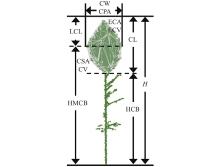
图1
UAV-LiDAR提取的树冠结构变量示意 $ H $:树高Tree height;$ \text{CW} $:冠幅Crown width;$ \text{CPA} $:树冠投影面积Crown projection area;$ \text{HCB} $:枝下高Height to crown base;$ \text{CL} $:冠长Crown length;$ \text{CSA} $:树冠表面积Crown surface area;$ \text{CV} $:树冠体积Crown volume;$ \text{HMCB} $:最大冠半径高度Height of maximum crown radius;$ \text{LCL} $:暴露冠长Length above maximum crown radius;$ \text{ECA} $:暴露冠表面积Exposed crown surface area;$ \text{ECV} $:暴露冠体积Exposed crown volume."
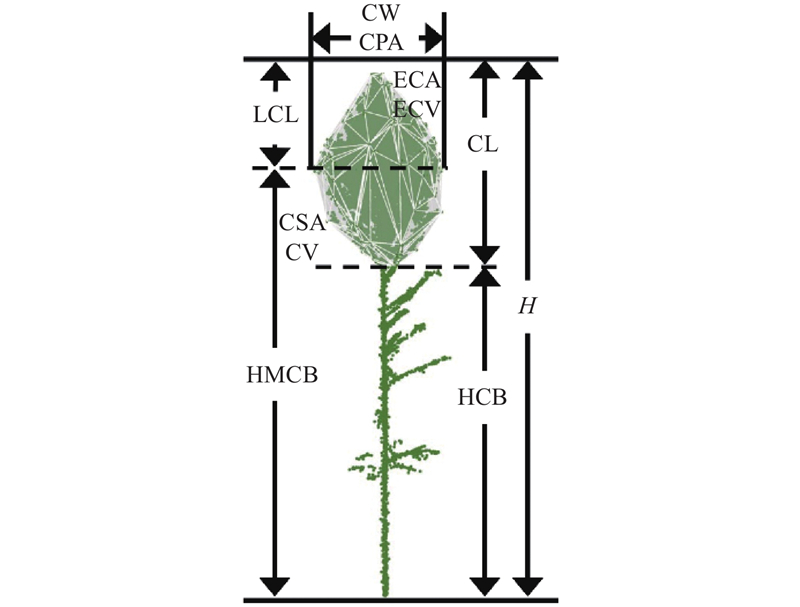
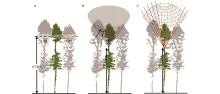
图2
UAV-LiDAR提取的竞争指标 A:冠层竞争比示意Schematic diagram of canopy competition proportion;B:竞争冠体积和竞争压力指数示意Schematic diagram of competitive canopy volume and competitive pressure index;C:光竞争指数示意Schematic diagram of light competition index;$ H $:树高Tree height;$ {\text{CPA}}_{{j}} $为目标树75%相对高处样地内第$ j $株树树冠投影面积 $ {\text{CPA}}_{{j}} $ is the crown projection area of the $ j $-th tree within the plot at 75% relative height of the target tree;$ {{V_{{\mathrm{cone}}_{{j}}}}} $为搜索锥内第$ j $个体素在搜索锥内的树冠体积 $ {{V_{{\mathrm{cone}}_{{j}}}}} $ is the crown volume of the $ j $-th voxel within the search cone;$ {D}_{j} $为搜索锥内第$ j $个竞争体素与目标树之间的最小欧氏距离 $ {D}_{j} $ is the minimum Euclidean distance between the $ j $-th competing voxel within the search cone and the target tree."
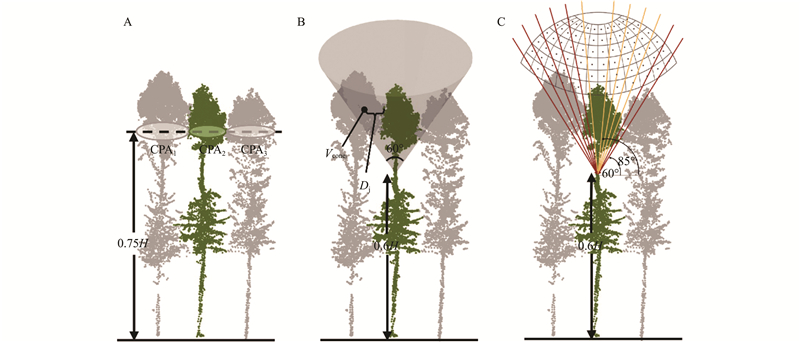
图3
$ \text{BAI} $与单木变量和竞争指标之间的Spearman相关性矩阵 $ \text{BAI} $:断面积增量Basal area increment;$ D $:胸径Diameter at breast height;$ H $:树高Tree height;$ \text{CPA} $:树冠投影面积Crown projection area;$ \text{CW} $:冠幅Crown width;$ \text{HCB} $:枝下高Height to crown base;$ \text{CL} $:冠长Crown length;$ \text{CSA} $:树冠表面积Crown surface area;$ \text{CV} $:树冠体积Crown volume;$ \text{HMCB} $:最大冠半径高度Height of maximum crown radius;$ \text{LCL} $:暴露冠长Length above maximum crown radius;$ \text{ECA} $:暴露冠表面积Exposed crown surface area;$ \text{ECV} $:暴露冠体积Exposed crown volume;$ \text{BAL} $:大于对象木断面积和Basal area in larger trees;$ \text{Hegyi} $:Hegyi竞争指数Hegyi competition index;$ \text{HCI} $:基于高差的竞争指数Height-difference-based competition index;$ \text{CCp} $:冠层竞争比Canopy competition proportion;$ \text{CCV} $:竞争冠体积Competitive canopy volume;$ \text{CPI} $:竞争压力指数Competitive pressure index;$ \text{LCI} $:光竞争指数示意Light competition index."
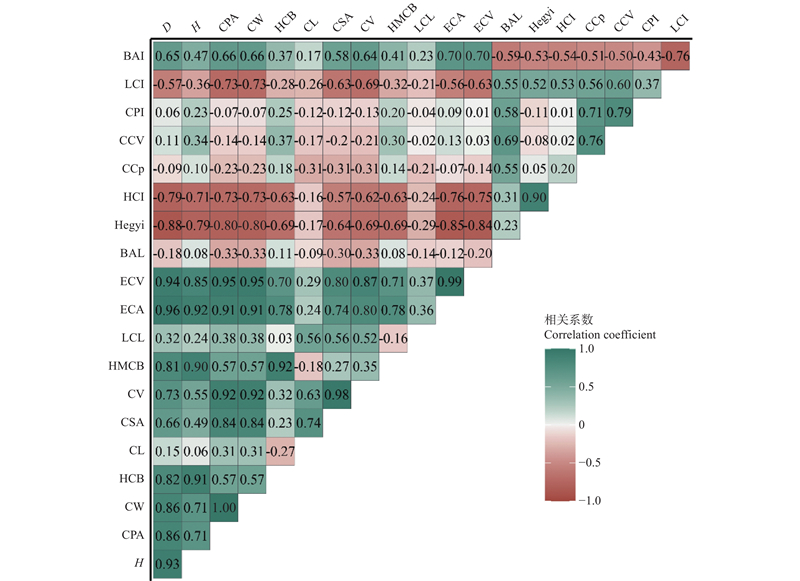
表3
基于UAV-LiDAR数据和基于实测数据模型参数估计结果与拟合统计量"
| 参数 Parameter | 基于UAV-LiDAR 数据的模型 UAV-LiDAR- based model | 基于实测数据 的模型 Field-measured- based model | |
| 固定效应参数估计值 (标准误) Fixed-effects parameter estimates (standard errors) | 3.62 (0.866) | 0.976 (0.364) | |
| –0.772 (0.252) | 8.52×10⁻² (1.32×10⁻²) | ||
| 2.69×10⁻³ (8.59×10⁻⁴) | –0.108 (1.59×10⁻²) | ||
| –1.42 (0.267) | –1.40×10⁻² (4.57×10⁻³) | ||
| –2.78×10⁻² (6.81×10⁻³) | –6.63×10⁻⁴ (1.03×10⁻⁴) | ||
| 4.47×10⁻² (1.22×10⁻²) | 3.91×10⁻² (1.61×10⁻²) | ||
| –3.02 (1.35) | — | ||
| 随机效应参数 方差估计值 Variance of random effects parameter estimates | 0.226 | 7.38×10⁻² | |
| 0.193 | 4.23×10⁻⁵ | ||
| –0.207 | –1.48×10⁻³ | ||
| –0.216 | –8.76×10⁻² | ||
| 1.06 | 1.06 | ||
| 拟合统计量 Fitting statistics | 0.846 | 0.741 | |
(cm2·a–1) | 1.35 | 1.76 | |
| 178 | 215 | ||
表4
基于UAV-LiDAR数据和基于实测数据的模型检验结果"
| 检验指标 Validation metrics | 基于UAV-LiDAR 数据的模型 UAV-LiDAR-based model | 基于实测数据 的模型 Field-measured-based model |
| –0.11 | 0.01 | |
| 1.26 | 1.51 | |
| –2.2 | 0.2 | |
| 25.7 | 30.9 |
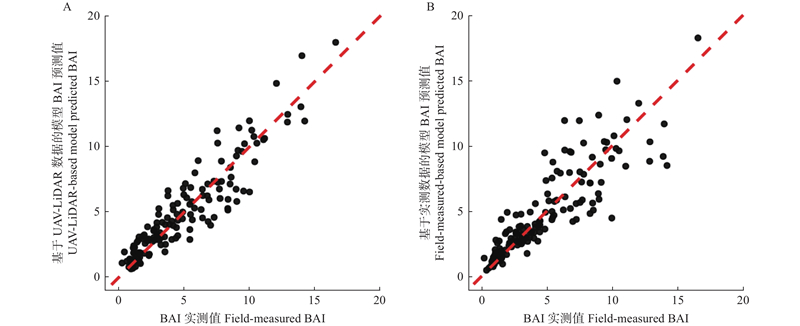
图4
2模型实测值与预测值对比 A:基于UAV-LiDAR数据的模型UAV-LiDAR-based model;B:基于实测数据的模型Field-measured-based model;红色虚线为y=x趋势线The red dashed lines representing y=x trend line."
| 白东雪, 刘 强, 董利虎, 等. 长白落叶松人工林有效冠高的确定及其影响因子. 北京林业大学学报, 2019, 41 (5): 76- 87. | |
| Bai D X, Liu Q, Dong L H, et al. Determination and analysis of height to effective crown for planted Larix olgensis trees. Journal of Beijing Forestry University, 2019, 41 (5): 76- 87. | |
|
陈东升, 李凤日, 孙晓梅, 等. 基于节子分析技术构建落叶松人工林树冠基部高动态模型. 林业科学, 2019, 55 (9): 103- 110.
doi: 10.11707/j.1001-7488.20190911 |
|
|
Chen D S, Li F R, Sun X M, et al. Reconstruction dynamic models of height to crown base of larch (Larix olgensis) plantation applying knot analysis technique. Scientia Silvae Sinicae, 2019, 55 (9): 103- 110.
doi: 10.11707/j.1001-7488.20190911 |
|
| 李春明. 基于两层次线性混合效应模型的杉木林单木胸径生长量模型. 林业科学, 2012, 48 (3): 66- 73. | |
| Li C M. Individual tree diameter increment model for Chinese Fir plantation based on two-level linear mixed effects models. Scientia Silvae Sinicae, 2012, 48 (3): 66- 73. | |
|
刘鲁霞, 庞 勇. 机载激光雷达和地基激光雷达林业应用现状. 世界林业研究, 2014, 27 (1): 49- 56.
doi: 10.13348/j.cnki.sjlyyj.2014.01.009 |
|
|
Liu L X, Pang Y. Applications of airborne laser scanning and terrestrial laser scanning to forestry. World Forestry Research, 2014, 27 (1): 49- 56.
doi: 10.13348/j.cnki.sjlyyj.2014.01.009 |
|
|
刘 强, 李凤日, 董利虎. 基于树冠竞争因子的落叶松人工林单木生长模型. 植物研究, 2014, 34 (4): 547- 553.
doi: 10.7525/j.issn.1673-5102.2014.04.020 |
|
|
Liu Q, Li F R, Dong L H. Individual tree growth model of larch plantation based on crown competition factors. Bulletin of Botanical Research, 2014, 34 (4): 547- 553.
doi: 10.7525/j.issn.1673-5102.2014.04.020 |
|
| 刘清旺, 李世明, 李增元, 等. 无人机激光雷达与摄影测量林业应用研究进展. 林业科学, 2017, 53 (7): 134- 148. | |
| Liu Q W, Li S M, Li Z Y, et al. Review on the applications of UAV-based LiDAR and photogrammetry in forestry. Scientia Silvae Sinicae, 2017, 53 (7): 134- 148. | |
| 谢龙飞. 2022. 长白落叶松和水曲柳混交林单木模型的构建. 哈尔滨: 东北林业大学. | |
| Xie L F. 2022. Developing individual tree models for mixed-species plantation of Changbai larch and Manshurica ash. Harbin: Northeast Forestry University. [in Chinese] | |
|
杨晨辉, 程寿民, 高谢雨, 等. 基于干形拟合的TLS长白落叶松树干参数提取. 林业科学, 2025, 61 (8): 154- 163.
doi: 10.11707/j.1001-7488.LYKX20240596 |
|
|
Yang C H, Cheng S M, Gao X Y, et al. Stem parameter estimation method for Larix olgensis based on TLS data of stem shape fitting. Scientia Silvae Sinicae, 2025, 61 (8): 154- 163.
doi: 10.11707/j.1001-7488.LYKX20240596 |
|
|
Biging G S, Dobbertin M. Evaluation of competition indices in individual tree growth models. Forest Science, 1995, 41 (2): 360- 377.
doi: 10.1093/forestscience/41.2.360 |
|
|
Cole W G, Lorimer C G. Predicting tree growth from crown variables in managed northern hardwood stands. Forest Ecology and Management, 1994, 67 (1/2/3): 159- 175.
doi: 10.1016/0378-1127(94)90014-0 |
|
|
Contreras M A, Affleck D, Chung W. Evaluating tree competition indices as predictors of basal area increment in western Montana forests. Forest Ecology and Management, 2011, 262 (11): 1939- 1949.
doi: 10.1016/j.foreco.2011.08.031 |
|
|
Coomes D A, Allen R B. Effects of size, competition and altitude on tree growth. Journal of Ecology, 2007, 95 (5): 1084- 1097.
doi: 10.1111/j.1365-2745.2007.01280.x |
|
|
Coomes D A, Dalponte M, Jucker T, et al. Area-based vs tree-centric approaches to mapping forest carbon in southeast Asian forests from airborne laser scanning data. Remote Sensing of Environment, 2017, 194, 77- 88.
doi: 10.1016/j.rse.2017.03.017 |
|
| Dambolena I G, Eriksen S E, Kopcso D P. 2009. Logarithmic transformations in regression: do you transform back correctly? Primus, 19(3): 280–295. | |
|
Das A. The effect of size and competition on tree growth rate in old-growth coniferous forests. Canadian Journal of Forest Research, 2012, 42 (11): 1983- 1995.
doi: 10.1139/x2012-142 |
|
|
Falkowski M J, Hudak A T, Crookston N L, et al. Landscape-scale parameterization of a tree-level forest growth model: a k-nearest neighbor imputation approach incorporating LiDAR data. Canadian Journal of Forest Research, 2010, 40 (2): 184- 199.
doi: 10.1139/X09-183 |
|
|
Irwin L A K, Coops N C, Riofrío J, et al. Prioritizing commercial thinning: quantification of growth and competition with high-density drone laser scanning. Forestry, 2025, 98 (2): 293- 307.
doi: 10.1093/forestry/cpae030 |
|
|
Jaakkola A, Hyyppä J, Yu X W, et al. Autonomous collection of forest field reference: the outlook and a first step with UAV laser scanning. Remote Sensing, 2017, 9 (8): 785.
doi: 10.3390/rs9080785 |
|
|
Liu X, Hao Y S, Widagdo F R A, et al. Predicting height to crown base of Larix olgensis in northeast China using UAV-LiDAR data and nonlinear mixed effects models. Remote Sensing, 2021, 13 (9): 1834.
doi: 10.3390/rs13091834 |
|
|
Liu X, Hao Y S, Zou X Y, et al. Dominant factors of individual tree mortality at stand scale: analyzing crown structure and neighbourhood competition via UAV laser scanning. Computers and Electronics in Agriculture, 2025a, 239, 111060.
doi: 10.1016/j.compag.2025.111060 |
|
|
Liu X, Li F R, Hao Y S, et al. Modeling tree radial growth with competition and crown characteristics from an aerial perspective. Forest Ecology and Management, 2025b, 576, 122387.
doi: 10.1016/j.foreco.2024.122387 |
|
|
Liu X, Zou X Y, Hao Y S, et al. A comprehensive comparison of individual tree crown delineation of plantations using UAV-LiDAR data: a case study for larch (Larix olgensis) forests in northeast China. IEEE Journal of Selected Topics in Applied Earth Observations and Remote Sensing, 2024, 17, 2396- 2408.
doi: 10.1109/JSTARS.2023.3345313 |
|
|
Metz J, Seidel D, Schall P, et al. Crown modeling by terrestrial laser scanning as an approach to assess the effect of aboveground intra- and interspecific competition on tree growth. Forest Ecology and Management, 2013, 310, 275- 288.
doi: 10.1016/j.foreco.2013.08.014 |
|
|
Mohamedou C, Korhonen L, Eerikäinen K, et al. Using LiDAR-modified topographic wetness index, terrain attributes with leaf area index to improve a single-tree growth model in south-eastern Finland. Forestry, 2019, 92 (3): 253- 263.
doi: 10.1093/forestry/cpz010 |
|
|
Olivier M D, Robert S, Fournier R A. Response of sugar maple (Acer saccharum, Marsh. ) tree crown structure to competition in pure versus mixed stands. Forest Ecology and Management, 2016, 374, 20- 32.
doi: 10.1016/j.foreco.2016.04.047 |
|
|
Owen H J F, Flynn W R M, Lines E R. Competitive drivers of interspecific deviations of crown morphology from theoretical predictions measured with terrestrial laser scanning. Journal of Ecology, 2021, 109 (7): 2612- 2628.
doi: 10.1111/1365-2745.13670 |
|
|
Pitkänen T P, Bianchi S, Kangas A. Quantifying the effects of competition on the dimensions of Scots pine and Norway spruce crowns. International Journal of Applied Earth Observation and Geoinformation, 2022, 112, 102941.
doi: 10.1016/j.jag.2022.102941 |
|
|
Pitkänen T P, Raumonen P, Liang X L, et al. Improving TLS-based stem volume estimates by field measurements. Computers and Electronics in Agriculture, 2021, 180, 105882.
doi: 10.1016/j.compag.2020.105882 |
|
|
Pommerening A, Sánchez Meador A J. Tamm review: tree interactions between myth and reality. Forest Ecology and Management, 2018, 424, 164- 176.
doi: 10.1016/j.foreco.2018.04.051 |
|
| Pretzsch H. 2009 Forest dynamics, growth and yield. Berlin: Springer. | |
|
Pretzsch H. Canopy space filling and tree crown morphology in mixed-species stands compared with monocultures. Forest Ecology and Management, 2014, 327, 251- 264.
doi: 10.1016/j.foreco.2014.04.027 |
|
|
Pretzsch H, Ahmed S, Jacobs M, et al. Linking crown structure with tree ring pattern: methodological considerations and proof of concept. Trees, 2022, 36 (4): 1349- 1367.
doi: 10.1007/s00468-022-02297-x |
|
|
Reitberger J, Schnörr C, Krzystek P, et al. 3D segmentation of single trees exploiting full waveform LiDAR data. ISPRS Journal of Photogrammetry and Remote Sensing, 2009, 64 (6): 561- 574.
doi: 10.1016/j.isprsjprs.2009.04.002 |
|
|
Seidel D, Hoffmann N, Ehbrecht M, et al. How neighborhood affects tree diameter increment–new insights from terrestrial laser scanning and some methodical considerations. Forest Ecology and Management, 2015, 336, 119- 128.
doi: 10.1016/j.foreco.2014.10.020 |
|
|
Shugart H H, Asner G P, Fischer R, et al. Computer and remote-sensing infrastructure to enhance large-scale testing of individual-based forest models. Frontiers in Ecology and the Environment, 2015, 13 (9): 503- 511.
doi: 10.1890/140327 |
|
|
Tompalski P, Coops N C, White J C, et al. Estimating changes in forest attributes and enhancing growth projections: a review of existing approaches and future directions using airborne 3D point cloud data. Current Forestry Reports, 2021, 7 (1): 1- 24.
doi: 10.1007/s40725-021-00135-w |
|
|
Watt M S, Jayathunga S, Mohan M, et al. Predicting tree-level diameter and volume for radiata pine using UAV LiDAR-derived metrics across a national trial series in New Zealand. Remote Sensing, 2025, 17 (8): 1456.
doi: 10.3390/rs17081456 |
|
|
Wyckoff P H, Clark J S. Tree growth prediction using size and exposed crown area. Canadian Journal of Forest Research, 2005, 35 (1): 13- 20.
doi: 10.1139/x04-142 |
|
|
Yrttimaa T, Luoma V, Saarinen N, et al. Exploring tree growth allometry using two-date terrestrial laser scanning. Forest Ecology and Management, 2022, 518, 120303.
doi: 10.1016/j.foreco.2022.120303 |
|
|
Zhang W M, Qi J B, Wan P, et al. An easy-to-use airborne LiDAR data filtering method based on cloth simulation. Remote Sensing, 2016, 8 (6): 501.
doi: 10.3390/rs8060501 |
|
|
Zhang X Q, Wang Z, Chhin S, et al. Relative contributions of competition, stand structure, age, and climate factors to tree mortality of Chinese fir plantations: long-term spacing trials in southern China. Forest Ecology and Management, 2020, 465, 118103.
doi: 10.1016/j.foreco.2020.118103 |
|
|
Zhu Z H, Kleinn C, Nölke N. Assessing tree crown volume: a review. Forestry, 2021, 94 (1): 18- 35.
doi: 10.1093/forestry/cpaa037 |
| [1] | 张诺,郝元朔,董利虎,赵颖慧,李凤日. 基于UAV-LiDAR数据的长白落叶松多维偏冠的邻体效应[J]. 林业科学, 2026, 62(7): 27-37. |
| [2] | 熊世梅,谭炳香,许文强,李骁尧,庞丽峰,胡冰. 基于无人机多光谱和激光雷达数据的荒漠梭梭林地上生物量估算[J]. 林业科学, 2026, 62(6): 96-108. |
| [3] | 孔欣茹,金星姬,Pukkala Timo,李凤日. 基于随机多准则可接受性分析的长白落叶松人工林多目标经营决策[J]. 林业科学, 2026, 62(4): 34-44. |
| [4] | 张宇娇,赵恒谦,付含聪,刘哿,皇甫霞丹,刘轩绮. 基于无人机遥感多特征的单木地上生物量反演模型[J]. 林业科学, 2025, 61(8): 129-141. |
| [5] | 熊晓燕,李彩霞,柴国奇,陈龙,贾翔,雷令婷,张晓丽. 联合UAV-LiDAR和GEDI数据的区域森林地上生物量估算[J]. 林业科学, 2025, 61(8): 142-153. |
| [6] | 杨晓慧,吴金卓,刘浩然,钟浩,林文树. 基于UAV-LiDAR的人工林林分郁闭度估测[J]. 林业科学, 2023, 59(8): 12-21. |
| [7] | 王宁宁, 尹文广, 黄秦军, 丁昌俊, 杨志岩, 苏晓华, 沈应柏. 三维扫描技术在获取杨树树冠结构特征参数上的应用[J]. 林业科学, 2015, 51(5): 108-116. |
| [8] | 殷鸣放;周立君;殷炜达. 长白落叶松人工林带状间伐方式对土壤有机碳含量的影响[J]. 林业科学, 2012, 48(7): 170-173. |
| [9] | 樊军锋;黄逢龙;;焦一杰;梁军. 青铜峡新疆杨林分个体树冠结构与溃疡病发生的关系[J]. 林业科学, 2010, 46(6): 171-175. |
| [10] | 刘兆刚 李凤日. 樟子松人工林树冠结构模型及三维图形可视化模拟*[J]. 林业科学, 2009, 12(6): 54-61. |
| [11] | 邬荣领 胡建军 韩一凡 刘红霞. 表型可塑性对木本植物树冠结构与发育的影响[J]. 林业科学, 2002, 38(4): 141-156. |
| [12] | 余雪标 徐大平 龙腾 莫晓勇. 连栽桉树人工林生长特性和树冠结构特征[J]. 林业科学, 2000, 36(zk): 137-142. |
| [13] | 朱春全 雷静品 刘晓东 成桂珍 李宝东. 集约与粗放经营杨树人工林树冠结构的研究[J]. 林业科学, 2000, 36(2): 60-68. |
| [14] | 刘奉觉 郑世锴 卢永农. 树冠结构对主干生长量垂直分配的影响[J]. , 1991, 27(1): 14-20. |
| 阅读次数 | ||||||
|
全文 |
|
|||||
|
摘要 |
|
|||||

