
林业科学 ›› 2026, Vol. 62 ›› Issue (7): 12-26.doi: 10.11707/j.1001-7488.LYKX20260005
王丽薇,王宏超,李颖,张燕,池秀莲*( ),孙楷*()
收稿日期:2026-01-05
出版日期:2026-07-10
发布日期:2026-07-14
通讯作者:
池秀莲,孙楷
E-mail:xiulian68@126.com;sunkaipku@163.com
基金资助:
Liwei Wang,Hongchao Wang,Ying Li,Yan Zhang,Xiulian Chi*(),Kai Sun*()
Received:2026-01-05
Online:2026-07-10
Published:2026-07-14
Contact:
Xiulian Chi,Kai Sun
E-mail:xiulian68@126.com;sunkaipku@163.com
摘要:
目的: 探究“三北”工程区药用植物资源组成,以物种丰富度表征物种多样性,揭示三大“战区”和三类区域(核心攻坚区、协同推进区、巩固拓展区)的资源分布差异,识别保护与利用热点区域,遴选适宜各区域开发利用的典型药用植物,为生态治理与中药产业协同提供科学依据。方法: 整合多源数据构建“三北”工程区药用植物名录和分布数据库,以县级行政区、三大“战区”和三类区域为单位统计物种丰富度,采用互补算法和物种丰富度排序法识别可开发利用以及应侧重保护的热点区域,依据植物分布广度和权威名录遴选典型药用植物。结果: 1) “三北”工程区共有药用植物7 693种(占本区植物的45.5%、全国药用植物的50.2%),其中特有种1 745种,国家重点保护野生植物174种,受威胁植物279种,生态工程建设药用植物1 820种,常用中药材基原植物326种,道地产区道地药材基原植物100种。2) 县域平均物种丰富度为431±291,高值区集中分布于大兴安岭、长白山、太行山、祁连山和天山山脉,低值区集中分布于嘎顺戈壁、柴达木盆地、河西走廊、海河平原和东北平原。3) 药用植物资源分布异质性显著,三大“战区”内,黄河“几字弯”攻坚战区的物种丰富度最高,道地药材和常用中药材也聚集分布于此,科尔沁和浑善达克沙地歼灭战区物种丰富度较低。三类区域中,物种丰富度呈现协同推进区>核心攻坚区>巩固拓展区的格局。4) 识别出可开发利用热点县115个,应侧重保护热点县143个,二者重叠县70个。5) 分区域遴选出可开发利用典型药用植物28种,其中生态工程建设药用植物15种,常用中药材和道地药材基原植物14种。结论: “三北”工程区药用植物物种丰富但分布不均,建议实施差异化策略:黄河“几字弯”攻坚战区重点发展道地药材产业;河西走廊—塔克拉玛干沙漠边缘阻击战区优先选用防风固沙药用植物构建生态屏障;科尔沁和浑善达克沙地歼灭战区强化本土药用植物在生态修复中的应用;协同推进区坚持保护优先下的可持续利用;巩固拓展区推动特色药材产业升级。上述策略可为“三北”工程区生态、经济与社会的高质量协同发展提供决策参考。
中图分类号:
王丽薇,王宏超,李颖,张燕,池秀莲,孙楷. “三北”工程区药用植物物种多样性特征及其对区域发展的启示[J]. 林业科学, 2026, 62(7): 12-26.
Liwei Wang,Hongchao Wang,Ying Li,Yan Zhang,Xiulian Chi,Kai Sun. Medicinal Plant Species Diversity in the Three-North Shelter Forest Project Area and Its Enlightenment for Regional Development[J]. Scientia Silvae Sinicae, 2026, 62(7): 12-26.
表1
“三北”工程区药用植物物种数统计"
| 研究区域 Study area | 药用植物物种总数 Total number of medicinal plant species | 应侧重保护的药用植物物种数 Number of medicinal plant species that should be prioritized for protection | 可开发利用的药用植物物种数 Number of medicinal plant species that should be developed and utilized | ||||||
| 特有种 Endemic species | 国家重点保护野生植物National key protected wild plants | 受威胁 植物 Threatened plants | 生态工程 建设植物 Plants for ecological engineering construction | 常用中药材 基原植物 Original plants of commonly used traditional Chinese medicinal materials | 道地产区道地药材基原植物 Original plants of Dao-di herbs from their Dao-di producing regions | ||||
| 总数 Total number | 《道地药材标准汇编》收录 Included in Compilation of Standards for Dao-di Medicinal Materials | ||||||||
| “三北”工程区 The area of the TNSP | 7 693 | 1 745 | 174 | 279 | 1 820 | 326 | 100 | 31 | |
| 核心攻坚区 Core battle zone | 5 663 | 1 196 | 121 | 182 | 1 410 | 300 | 63 | 15 | |
| 协同推进区 Coordinated promotion zone | 6 608 | 1 460 | 144 | 218 | 1 525 | 307 | 83 | 23 | |
| 巩固拓展区 Consolidation and expansion zone | 4 482 | 647 | 92 | 121 | 1 327 | 273 | 67 | 19 | |
| 黄河“几字弯”攻坚战区 Yellow River “Ji”-shaped bend battle zone | 4 183 | 947 | 92 | 119 | 1 193 | 276 | 35 | 10 | |
| 科尔沁和浑善达克沙地 歼灭战区 Korqin and Hunshandake Sands elimination zone | 2 812 | 345 | 49 | 57 | 855 | 220 | 24 | 8 | |
| 河西走廊?塔克拉玛干沙漠边缘阻击战区 Hexi Corridor-Taklamakan Desert perimeter battle zone | 3 019 | 579 | 57 | 82 | 741 | 161 | 22 | 4 | |
表2
“三北”工程建设药用植物中应侧重保护的植物物种数统计①"
| 研究区域 Study area | 生态工程建设药用植物中应侧重保护的植物物种数 Number of plant species that should be prioritized for protection among the medicinal plants for ecological engineering construction | 百分比 Percentage (% ) | |||
| 特有种 Endemic species | 国家重点保护野生植物 National key protected wild plants | 受威胁植物 Threatened plants | 总数 Total number | ||
| “三北”工程区 The area of the TNSP | 214 | 56 | 71 | 291 | 16.0 |
| 核心攻坚区 Core battle zone | 174 | 42 | 47 | 227 | 16.1 |
| 协同推进区 Coordinated promotion zone | 178 | 48 | 56 | 243 | 15.9 |
| 巩固拓展区 Consolidation and expansion zone | 141 | 36 | 39 | 191 | 14.4 |
| 黄河“几字弯”攻坚战区 Yellow River “Ji”-shaped bend battle zone | 159 | 39 | 31 | 200 | 16.8 |
| 科尔沁和浑善达克沙地歼灭战区 Korqin and Hunshandake Sands elimination zone | 75 | 26 | 23 | 108 | 12.6 |
| 河西走廊—塔克拉玛干沙漠边缘阻击战区 Hexi Corridor-Taklamakan Desert perimeter battle zone | 82 | 21 | 24 | 111 | 15.0 |
表3
“三北”工程区常用与道地产区道地药材基原植物中应侧重保护的植物物种数统计①"
| 研究区域 Study area | 常用与道地产区道地药材基原植物物种总数 Total number of plant species of the botanical origin of the commonly used and Dao-di herbs from their Dao-di producing regions | 常用与道地产区道地药材中应侧重保护的植物物种数 Number of plant species that should be prioritized for protection among the botanical origin of the commonly used and Dao-di herbs from their Dao-di producing regions | 百分比 Percentage (% ) | |||
| 特有种 Endemic species | 国家重点保护野生植物National key protected wild plants | 受威胁植物 Threatened plants | 总数 Total number | |||
| “三北”工程区 The area of the TNSP | 365 | 56 | 35 | 31 | 92 | 25.2 |
| 核心攻坚区 Core battle zone | 321 | 52 | 32 | 29 | 84 | 26.2 |
| 协同推进区 Coordinatedpromotion zone | 333 | 49 | 31 | 29 | 82 | 24.6 |
| 巩固拓展区 Consolidation and expansion zone | 291 | 39 | 26 | 24 | 67 | 23.0 |
| 黄河“几字弯”攻坚战区 Yellow River “Ji”-shaped bend battle zone | 285 | 49 | 27 | 23 | 77 | 27.0 |
| 科尔沁和浑善达克沙地 歼灭战区 Korqin and Hunshandake Sands elimination zone | 225 | 26 | 13 | 11 | 40 | 17.8 |
| 河西走廊—塔克拉玛干沙漠边缘阻击战区 Hexi Corridor-Taklamakan Desert perimeter battle zone | 175 | 21 | 21 | 18 | 39 | 22.3 |
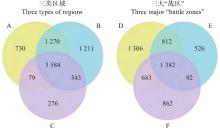
图1
“三北”工程区三类区域和三大“战区”药用植物物种组成韦恩图 A:核心攻坚区 Core battle zone;B:协同推进区 Coordinated promotion zone;C:巩固拓展区 Consolidation and expansion zone;D:黄河“几字弯”攻坚战区 Yellow River “Ji”-shaped bend battle zone;E:科尔沁和浑善达克沙地歼灭战区 Korqin and Hunshandake Sands elimination zone;F:河西走廊—塔克拉玛干沙漠边缘阻击战区 Hexi Corridor-Taklamakan Desert perimeter battle zone."
表4
“三北”工程区各区域药用植物物种数的均值与标准差统计"
| 研究区域 Study area | 药用植物物种总数 Total number of medicinal plant species | 应侧重保护的药用植物物种数 Number of medicinal plant species that should be prioritized for protection | 可开发利用的药用植物物种数 Number of medicinal plant species that should be developed and utilized | ||||||
| 特有种 Endemic species | 国家重点保护野生植物National key protected wild plants | 受威胁 植物Threatened plants | 生态工程 建设植物 Plants for ecological engineering construction | 常用中药材 基原植物 Original plants of commonly used traditional Chinese medicinal materials | 道地产区道地药材基原植物 Original plants of Dao-di herbs from their Dao-di producing regions | ||||
| 总数 Total number | 《道地药材标准汇编》收录 Included in Compilation of Standards for Dao-di Medicinal Materials | ||||||||
| “三北”工程区 The area of the TNSP | 431±291 | 47±56 | 7±6 | 7±7 | 431±291 | 47±56 | 7±6 | 7±7 | |
| 核心攻坚区 Core battle zone | 386±198 | 45±42 | 6±4 | 5±4 | 386±198 | 45±42 | 6±4 | 5±4 | |
| 协同推进区 Coordinated promotion zone | 626±338 | 73±77 | 10±7 | 11±8 | 626±338 | 73±77 | 10±7 | 11±8 | |
| 巩固拓展区 Consolidation and expansion zone | 278±231 | 21±23 | 5±4 | 4±5 | 278±231 | 21±23 | 5±4 | 4±5 | |
| 黄河“几字弯”攻坚战区 Yellow River “Ji”-shaped bend battle zone | 345±182 | 52±40 | 5±4 | 4±4 | 345±182 | 52±40 | 5±4 | 4±4 | |
| 科尔沁和浑善达克沙地 歼灭战区 Korqin and Hunshandake Sands elimination zone | 418±204 | 34±23 | 5±4 | 4±3 | 418±204 | 34±23 | 5±4 | 4±3 | |
| 河西走廊—塔克拉玛干沙漠边缘阻击战区 Hexi Corridor-Taklamakan Desert perimeter battle zone | 433±206 | 42±56 | 8±3 | 9±5 | 433±206 | 42±56 | 8±3 | 9±5 | |
表5
“三北”工程区可开发利用典型药用植物"
| 研究区域 Study area | 生态工程建设药用植物 Medicinal plants for ecological engineering construction | 常用中药材及道地药材基原植物 Botanical origin of commonly used traditional Chinese medicine and Dao-di herbs |
| 核心攻坚区 Core battle zone | 甘草 Glycyrrhiza uralensis、芦苇 Phragmites australis、 黄香草木樨 Melilotus officinalis、 马蔺 Iris lactea、苜蓿 Medicago sativa | 甘草 G. uralensis、远志 Polygala tenuifolia、 宁夏枸杞 Lycium barbarum、防风 Saposhnikovia divaricata、黄芪 Astragalus membranaceus |
| 协同推进区 Coordinated promotion zone | 芦苇 P. australis、黄香草木樨 M. officinalis、 马蔺 I. lactea、榆 Ulmus pumila、苜蓿 M. sativa | 防风 S. divaricata、甘草 G. uralensis、秦艽 Gentiana macrophylla、芍药 Paeonia lactiflora、 款冬 Tussilago farfara |
| 巩固拓展区 Consolidation and expansion zone | 黄香草木樨 M. officinalis、山楂Crataegus pinnatifida、胡枝子Lespedeza bicolor、 芦苇 P. australis、榆 U. pumila | 紫菀 Aster tataricus、防风 S. divaricata、 远志 P. tenuifolia、芍药 P. lactiflora、 五味子 Schisandra chinensis |
| 黄河“几字弯”攻坚战区 Yellow River “Ji”-shaped bend battle zone | 甘草 G. uralensis、侧柏 Platycladus orientalis、 芦苇 P. australis、黄香草木樨 M. officinalis、 苜蓿 M. sativa | 远志 P. tenuifolia、甘草 G. uralensis、 黄芪 A. membranaceus、宁夏枸杞 L. barbarum、 秦艽 G. macrophylla |
| 科尔沁和浑善达克沙地 歼灭战区 Korqin and Hunshandake Sands elimination zone | 兴安胡枝子 Lespedeza davurica、马蔺 I. lactea、 蕨麻 Argentina anserina、 黄芩 Scutellaria baicalensis、甘草 G. uralensis | 防风 S. divaricata、甘草 G. uralensis、 芍药 P. lactiflora、黄芪 A. membranaceus、 三花龙胆 Gentiana triflora |
| 河西走廊—塔克拉玛干沙漠边缘阻击战区 Hexi Corridor-Taklamakan Desert perimeter battle zone | 芦苇 P. australis、黑果枸杞 Lycium ruthenicum、 小果白刺 Nitraria sibirica、甘草 G. uralensis、 驼绒藜 Krascheninnikovia ceratoides | 甘草 G. uralensis、锁阳 Cynomorium songaricum、 肉苁蓉 Cistanche deserticola、 掌叶大黄Rheum palmatum |
| 艾铁民. 2017. 中国药用植物志. 北京: 北京大学医学出版社. | |
| Ai T M. 2017. Flora of medicinal plants in China. Beijing: Peking University Medical Press. [in Chinese] | |
| 陈 琳, 杨昊源, 李堂帅, 等. 黄河流域中药资源现状与产业高质量发展建议. 中国现代中药, 2026, 28 (1): 11- 16. | |
| Chen L, Yang H Y, Li T S, et al. Present situation of traditional chinese medicine resources in Yellow River basin and suggestions for high quality development of industry. Modern Chinese Medicine, 2026, 28 (1): 11- 16. | |
|
陈慧妹, 李文军, 邱 娟, 等. 新疆野生维管植物名录. 生物多样性, 2023, 31 (9): 56- 62.
doi: 10.17520/biods.2023124 |
|
|
Chen H M, Li W J, Qiu J, et al. A checklist of wild vascular plants in Xinjiang, China. Biodiversity Science, 2023, 31 (9): 56- 62.
doi: 10.17520/biods.2023124 |
|
|
陈幸良, 窦亚权. 林下经济高质量发展: 战略要义、技术突破与关键举措. 林业科学, 2025, 61 (7): 59- 71.
doi: 10.11707/j.1001-7488.LYKX20250377 |
|
|
Chen X L, Dou Y Q. High-quality development of non-timber forest-based economics: strategic essence, technological breakthroughs and key measures. Scientia Silvae Sinicae, 2025, 61 (7): 59- 71.
doi: 10.11707/j.1001-7488.LYKX20250377 |
|
| 陈亚宁, 郝兴明, 吴立宗. 2013. 塔里木河下游植物样地调查数据集(2000—2007). 国家青藏高原科学数据中心. https: //doi. org/10.11888/Ecolo. tpdc. 270607. https://cstr.cn/18406.11.Ecolo.tpdc.270607. | |
| Chen Y N, Hao X M, Wu L Z. 2013. Plant quadrats dataset in downstream of Tarim River (2000—2007). National Tibetan Plateau/Third Pole Environment Data Center. https: //doi. org/10.11888/Ecolo. tpdc. 270607. https://cstr.cn/18406.11.Ecolo.tpdc.270607. [in Chinese] | |
|
程洁婕, 李美君, 袁桃花, 等. 中国野生杜鹃花属植物名录与地理分布数据集. 生物多样性, 2021, 29 (9): 1175- 1180.
doi: 10.17520/biods.2021152 |
|
|
Cheng J J, Li M J, Yuan T H, et al. A dataset on wild Rhododendron and geographical distribution information in China. Biodiversity Scienc, 2021, 29 (9): 1175- 1180.
doi: 10.17520/biods.2021152 |
|
|
崔桂鹏, 党宏忠, 熊 伟, 等. 对“三北”工程区退化林修复策略的思考. 林业科学, 2025, 61 (1): 10- 16.
doi: 10.11707/j.1001-7488.LYKX20240502 |
|
|
Cui G P, Dang H Z, Xiong W, et al. Thoughts on restoration strategies of degraded plantations in the area of China’s Great Green Wall Project. Scientia Silvae Sinicae, 2025, 61 (1): 10- 16.
doi: 10.11707/j.1001-7488.LYKX20240502 |
|
|
董劭琼, 侯东杰, 曲孝云, 等. 柴达木盆地植物群落样方数据集. 植物生态学报, 2024, 48 (4): 534- 540.
doi: 10.17521/cjpe.2023.0024 |
|
|
Dong S Q, Hou D J, Qu X Y, et al. A plot-based dataset of plant communities on the Qaidam Basin, China. Chinese Journal of Plant Ecology, 2024, 48 (4): 534- 540.
doi: 10.17521/cjpe.2023.0024 |
|
| 董卓玉. 2024. 内蒙古额尔古纳国家湿地公园植物多样性研究. 呼和浩特: 内蒙古农业大学. https://doi.org/10.27229/d.cnki.gnmnu.2024.001655. | |
| Dong Z Y. 2024. Study on plant diversity in erguna national wetland park, inner mongolia. Hohhot: Inner Mongolia Agricultural University.https://doi.org/10.27229/d.cnki.gnmnu.2024.001655. [in Chinese] | |
| 国家中医药管理局《中华本草》编委会. 1999. 中华本草. 上海: 上海科学技术出版社. | |
| Editorial Committee of Chinese Materia Medica, State Administration of Traditional Chinese Medicine. 1999. Chinese materia medica. Shanghai: Shanghai Scientific & Technical Publishers. [in Chinese] | |
| 国家林业和草原局. 2022. 国家林业和草原局办公室关于印发《林草中药材产业发展指南》的通知. https://www.forestry.gov.cn/search/270489. | |
| National Forestry and Grassland Administration. 2022. Notice of the General Office of the National Forestry and Grassland Administration on issuing the “Guidelines for the Development of Chinese Medicinal Materials Industry in Forestry and Grasslands”. https://www.forestry.gov.cn/search/270489. [in Chinese] | |
| 国家林业和草原局政府网. 2021. 国家重点保护野生植物名录. https://www.forestry.gov.cn/c/www/gkml/11057.jhtml. | |
| National Forestry and Grassland Administration. 2021. List of nationally protected wild plants. https://www.forestry.gov.cn/c/www/gkml/11057.jhtml. [in Chinese] | |
| 国务院办公厅. 2025. “三北”工程总体规划. https://www.gov.cn/zhengce/zhengceku/202509/content_7040318.htm?f_link_type=f_linkinlinenote&flow_extra=eyJkb2NfaWQiOiI0Yjg0NGQ1ZTg4NGE0NDZiLTAwYzg2MzNhNDU0MTY4MDMiLCJpbmxpbmVfZGlzcGxheV9wb3NpdGlvbiI6MCwiZG9jX3Bvc2l0aW9uIjowfQ%3D%3D. | |
| The General Office of the State Council. 2025. Overall plan for the “Three North” project. https://www.gov.cn/zhengce/zhengceku/202509/content_7040318.htm?f_link_type=f_linkinlinenote&flow_extra=eyJkb2NfaWQiOiI0Yjg0NGQ1ZTg4NGE0NDZiLTAwYzg2MzNhNDU0MTY4MDMiLCJpbmxpbmVfZGlzcGxheV9wb3NpdGlvbiI6MCwiZG9jX3Bvc2l0aW9uIjowfQ%3D%3D. [in Chinese] | |
| 韩邦兴, 彭华胜, 黄璐琦. 中国道地药材研究进展. 自然杂志, 2011, 33 (5): 281- 285. | |
| Han B X, Peng H S, Huang L Q. Research advances of Dao-di herbs in China. Chinese Journal of Nature, 2011, 33 (5): 281- 285. | |
|
韩 赟, 迟晓峰, 余静雅, 等. 青海野生维管植物名录. 生物多样性, 2023, 31 (9): 63- 69.
doi: 10.3969/j.issn.1005-9393.2025.06.002 |
|
|
Han Y, Chi X F, Yu J Y, et al. A checklist of wild vascular plants in Qinghai, China. Biodiversity Science, 2023, 31 (9): 63- 69.
doi: 10.3969/j.issn.1005-9393.2025.06.002 |
|
| 胡世林. 1989. 中国道地药材. 哈尔滨: 黑龙江科学技术出版社. | |
| Hu S L. 1989. Genuine regional drugs of China. Harbin: Heilongjiang Science & Technology Press. [in Chinese] | |
| 黄璐琦. 2017. 道地药材“黄金”图谱精粹. 上海: 上海科学技术出版社. | |
| Huang L Q. 2017. Essence of “gold standard” atlas for genuine regional drugs. Shanghai: Shanghai Scientific & Technical Publishers. [in Chinese] | |
| 黄璐琦, 郭兰萍, 张小波, 等. 基于第四次全国中药资源普查的中国中药资源种类研究. 中国中药杂志, 2024, 49 (13): 3409- 3413. | |
| Huang L Q, Guo L P, Zhang X B, et al. Species of Chinese materia medica resources based on the fourth national survey of Chinese materia medica resources. China Journal of Chinese Materia Medica, 2024, 49 (13): 3409- 3413. | |
| 黄璐琦, 郭兰萍, 詹志来. 2020. 道地药材标准汇编. 北京: 北京科学技术出版社. | |
| Huang L Q, Guo L P, Zhan Z L. 2020. Compilation of standards for genuine regional drugs. Beijing: Beijing Science and Technology Press. [in Chinese] | |
| 黄璐琦, 马小军. 2019. 中国药用植物特有种. 北京: 人民卫生出版社. | |
| Huang L Q, Ma X J. 2019. Endemic medicinal plants of China. Beijing: People’s Medical Publishing House. [in Chinese] | |
| 纪 平, 邵全琴, 王 敏, 等. 中国三北防护林工程第二阶段生态效益综合评价. 林业科学, 2022, 58 (11): 31- 48. | |
| Ji P, Shao Q Q, Wang M, et al. Monitoring and assessment of ecological benefits of the shelter forest program in the Three-North region during 2001—2020. Scientia Silvae Sinicae, 2022, 58 (11): 31- 48. | |
| 贾敏如, 张 艺. 2016. 中国民族药辞典. 北京: 中国医药科技出版社. | |
| Jia M R, Zhang Y. 2016. Dictionary of Chinese ethnic medicine. Beijing: China Medical Science and Technology Press. [in Chinese] | |
| 江 泳, 张 村. 2016. 全国中药饮片炮制规范辑要. 北京: 人民卫生出版社. | |
| Jiang Y, Zhang C. 2016. Essentials of national processing standards for Chinese herbal pieces. Beijing: People’s Medical Publishing House. [in Chinese] | |
| 江纪武. 2015. 世界药用植物速查辞典. 北京: 中国医药科技出版社. | |
| Jiang J W. 2015. Quick-reference dictionary of world medicinal plants. Beijing: China Medical Science and Technology Press. [in Chinese] | |
| 金伊丽, 王皓言, 魏临风, 等. 青藏高原植物群落样方数据集. 植物生态学报, 2022, 46 (7): 846- 854. | |
| Jin Y L, Wang H Y, Wei L F, et al. A plot-based dataset of plant community on the Qingzang Plateau. Chinese Journal of Plant Ecology, 2022, 46 (7): 846- 854. | |
|
孔维远, 崔桂鹏, 高 攀, 等. “三北”工程的林草科技探索与实践. 林业科学, 2025, 61 (7): 72- 82.
doi: 10.11707/j.1001-7488.LYKX20250302 |
|
|
Kong W Y, Cui G P, Gao P, et al. Forestry science and technology innovation and application in the Great Green Wall Project of China. Scientia Silvae Sinicae, 2025, 61 (7): 72- 82.
doi: 10.11707/j.1001-7488.LYKX20250302 |
|
| 李景吉. 2021. 四川、青海、西藏道路沿线植物样方数据集(20200712-20200723). 国家青藏高原科学数据中心. https: //doi. org/10.11888/Ecolo. tpdc. 271506. https://cstr.cn/18406.11.Ecolo.tpdc.271506. | |
| Li J J. 2021. Data set of plant quadrats along roads in Sichuan, Qinghai and Tibet (20200712-20200723). National Tibetan Plateau / Third Pole Environment Data Center. https: //doi. org/10.11888/Ecolo. tpdc. 271506. https://cstr.cn/18406.11.Ecolo.tpdc.271506. [in Chinese] | |
|
李海涛, 孙 辉, 张小波, 等. 中国药用植物特有种分布格局及区域相似性分析. 中国中药杂志, 2017, 42 (22): 4329- 4335.
doi: 10.19540/j.cnki.cjcmm.2017.0179 |
|
|
Li H T, Sun H, Zhang X B, et al. Endemic plants for medicine use in China. China Journal of Chinese Materia Medica, 2017, 42 (22): 4329- 4335.
doi: 10.19540/j.cnki.cjcmm.2017.0179 |
|
|
李 勇, 李三青, 王 欢. 天津野生维管植物编目及分布数据集. 生物多样性, 2023, 31 (9): 49- 55.
doi: 10.17520/biods.2023128 |
|
|
Li Y, Li S Q, Wang H. A dataset of wild vascular plants and their distributions in Tianjin, China. Biodiversity Science, 2023, 31 (9): 49- 55.
doi: 10.17520/biods.2023128 |
|
| 吕丽莎, 蔡宏宇, 杨 永, 等. 中国裸子植物的物种多样性格局及其影响因子. 生物多样性, 2018, 26 (11): 1133- 1146. | |
| Lü L S, Cai H Y, Yang Y, et al. Geographic patterns and environmental determinants of gymnosperm species diversity in China. Biodiversity Science, 2018, 26 (11): 1133- 1146. | |
|
刘 娜, 吴明玥, 纪 旭, 等. 塔里木河流域牧草植物分布格局与养分分析. 草业学报, 2026, 35 (3): 26- 42.
doi: 10.11686/cyxb2025107 |
|
|
Liu N, Wu M Y, Ji X, et al. Analysis of the distribution pattern and nutrition profiles of forage plants in the Tarim River Basin. Acta Prataculturae Sinica, 2026, 35 (3): 26- 42.
doi: 10.11686/cyxb2025107 |
|
| 刘培亮, 卢 元, 杜 诚, 等. 陕西省维管植物名录(2021版). 生物多样性, 2022, 30 (6): 48- 52. | |
| Liu P L, Lu Y, Du C, et al. A checklist of vascular plants in Shaanxi Province, China (Version 2021). Biodiversity Science, 2022, 30 (6): 48- 52. | |
|
刘世荣, 陈远其, 聂秀青, 等. 树种多样性对森林生态系统多功能性和韧性的影响. 林业科学, 2026, 62 (1): 1- 18.
doi: 10.11707/j.1001-7488.LYKX20260001 |
|
|
Liu S R, Chen Y Q, Nie X Q, et al. Effects of tree species diversity on multifunctionality and resilience of forest ecosystems. Scientia Silvae Sinicae, 2026, 62 (1): 1- 18.
doi: 10.11707/j.1001-7488.LYKX20260001 |
|
|
卢 琦, 肖春蕾, 包英爽, 等. 打赢“三北”攻坚战, 再造一个“新三北”: 实现路径与战略规划. 中国科学院院刊, 2023, 38 (7): 956- 965.
doi: 10.16418/j.issn.1000-3045.20230706003 |
|
|
Lu Q, Xiao C L, Bao Y S, et al. Implementation path and strategic planning of winning the battle of “Three-North” and reconstructing “New Three-North”. Bulletin of Chinese Academy of Sciences, 2023, 38 (7): 956- 965.
doi: 10.16418/j.issn.1000-3045.20230706003 |
|
| 卢 琦, 褚建民, 马全林. 2024. “三北”工程常用植物. 北京: 中国林业出版社. | |
| Lu Q, Chu J M, Ma Q L. 2024. Common plants in the Three-North shelterbelt program. Beijing: China Forestry Publishing House. [in Chinese] | |
|
马登科, 何志斌, 赵文智, 等. 干旱区沙生药用植物生态效益综述. 中国沙漠, 2025, 45 (1): 55- 62.
doi: 10.7522/j.issn.1000-694X.2024.00100 |
|
|
Ma D K, He Z B, Zhao W Z, et al. Review on the ecological benefits of sandy medicinal plants in arid areas. Journal of Desert Research, 2025, 45 (1): 55- 62.
doi: 10.7522/j.issn.1000-694X.2024.00100 |
|
| 马国勇, 刘 欣, 刘艳迪. 山水林田湖草保护修复效率对林业新质生产力发展的影响及机制. 林业科学, 2025, 61 (12): 192- 205. | |
| Ma G Y, Liu X, Liu Y D. Influence and mechanism of the protection and restoration efficiency of mountains, waters, forests, fields, lakes and grasses on new quality productivity in forestry. Scientia Silvae Sinicae, 2025, 61 (12): 192- 205. | |
| 彭 成. 2011. 中华道地药材. 北京: 中国中医药出版社. | |
| Peng C. 2011. Chinese genuine regional drugs. Beijing: China Press of Traditional Chinese Medicine. [in Chinese] | |
| 祁 元, 张金龙, 曹永攀, 等. 2019. 祁连山重点区域植被参数数据集(2018). 国家青藏高原科学数据中心. https: //doi. org/10.11888/Geogra. tpdc. 270143. https://cstr.cn/18406.11.Geogra.tpdc.270143. | |
| Qi Y, Zhang J L, Cao Y P, et al. 2019. The vegetation parameter in the key area of Qilian Mountain (2018). National Tibetan Plateau / Third Pole Environment Data Center. https: //doi. org/10.11888/Geogra. tpdc. 270143. https://cstr.cn/18406.11.Geogra.tpdc.270143. [in Chinese] | |
| 全国中草药汇编编写组. 1975. 全国中草药汇编. 北京: 人民卫生出版社. | |
| National Chinese Herbal Medicine Compilation Group. 1975. National compilation of Chinese herbal medicine. Beijing: People’s Medical Publishing House. [in Chinese] | |
| 尚占环. 2021. 祁连县植被调查数据(2020). 国家青藏高原科学数据中心. https: //doi. org/10.11888/Ecolo. tpdc. 271402. https://cstr.cn/18406.11.Ecolo.tpdc.271402. | |
| Shang Z H. 2021. Vegetation survey data in Qilian County (2020). National Tibetan Plateau / Third Pole Environment Data Center. https: //doi. org/10.11888/Ecolo. tpdc. 271402. https://cstr.cn/18406.11.Ecolo.tpdc.271402. [in Chinese] | |
|
沈国舫. 关于现代林草业可持续发展的几点战略思考. 林业科学, 2025, 61 (7): 1- 7.
doi: 10.11707/j.1001-7488.LYKX20250325 |
|
|
Shen G F. Some strategic considerations on the sustainable development of modern forestry and grassland sector. Scientia Silvae Sinicae, 2025, 61 (7): 1- 7.
doi: 10.11707/j.1001-7488.LYKX20250325 |
|
| 生态环境部, 中国科学院. 2023. 关于发布《中国生物多样性红色名录—脊椎动物卷(2020)》和《中国生物多样性红色名录—高等植物卷(2020)》的公告. https://www.mee.gov.cn/xxgk2018/xxgk/xxgk01/202305/t20230522_1030745.html. | |
| Ministry of Ecology and Environment, Chinese Academy of Sciences. 2023. Announcement on the release of the “China Biodiversity Red List: Volume of Vertebrates (2020)” and the “China Biodiversity Red List: Volume of Higher Plants (2020)”. https://www.mee.gov.cn/xxgk2018/xxgk/xxgk01/202305/t20230522_1030745.html. [in Chinese] | |
|
佟 瑶, 曹 喆, 李梦琳, 等. 新疆资源植物多样性的组成特点及分布特征. 陆地生态系统与保护学报, 2024, 4 (1): 11- 22, 34.
doi: 10.12356/j.2096-8884.2023-0071 |
|
|
Tong Y, Cao Z, Li M L, et al. The diversity composition and distribution characteristics of resource plants in Xinjiang. Terrestrial Ecosystem and Conservation, 2024, 4 (1): 11- 22, 34.
doi: 10.12356/j.2096-8884.2023-0071 |
|
| 肖春蕾, 尚博譞, 卢 琦, 等. “三北”工程六期生态治理区划. 中国科学院院刊, 2025, 40 (6): 1032- 1045. | |
| Xiao C L, Shang B H, Lu Q, et al. Ecological governance zoning in Phase VI planning area of “Three-North” project. Bulletin of Chinese Academy of Sciences, 2025, 40 (6): 1032- 1045. | |
| 邢福武, 张 征. 2021. 中国能源植物数据集. 中国科学院植物科学数据中心. https: //doi. org/10.12282/plantdata. 0049. https://cstr.cn/34735.11.16082712609482. | |
| Xing F W, Zhang Z. 2021. Dataset of energy plants in China. Plant Data Center of Chinese Academy of Sciences. https: //doi. org/10.12282/plantdata. 0049. https://cstr.cn/34735.11.16082712609482. [in Chinese] | |
| 万修福, 蒋靖怡, 杨 野, 等. 2021年中药材生产概况与发展建议. 中国中药杂志, 2023, 48 (3): 608- 613. | |
| Wan X F, Jiang J Y, Yang Y, et al. Overview of Chinese medicinal materials industry in 2021 and development suggestions. China Journal of Chinese Materia Medica, 2023, 48 (3): 608- 613. | |
| 王翠红. 2004. 中国陆地生物多样性分布格局的研究. 太原: 山西大学. | |
| Wang C H. 2004. Study on the distribution patterns of terrestrial biodiversity in China. Taiyuan: Shanxi University. [in Chinese] | |
|
王洪峰, 董雪云, 穆立蔷. 黑龙江省野生维管植物名录. 生物多样性, 2022, 30 (6): 25- 30.
doi: 10.17520/biods.2022184 |
|
|
Wang H F, Dong X Y, Mu L Q. Checklist of tracheophyte in Heilongjiang Province. Biodiversity Science, 2022, 30 (6): 25- 30.
doi: 10.17520/biods.2022184 |
|
| 王 强. 2003. 道地药材图典. 福州: 福建科学技术出版社. | |
| Wang Q. 2003. Illustrated compendium of genuine regional drugs. Fuzhou: Fujian Science and Technology Publishing House. [in Chinese] | |
| 王 芊, 尚 策, 王春晶, 等. 2023. 青海省湟水河流域455个草本植物样方调查数据集. Science Data Bank. https://doi.org/10.57760/sciencedb.03329. | |
| Wang Q, Shang C, Wang C J, et al. 2023. A dataset of quadrat sampling of 455 herb quadrats in Huangshui River Basin, Qinghai Province. Science Data Bank. https://doi.org/10.57760/sciencedb.03329. [in Chinese] | |
| 王少昆. 2021. 甘肃荒漠植物群落调查数据集(2018). 国家青藏高原科学数据中心. https: //doi. org/10.11888/Terre. tpdc. 300278. https://cstr.cn/18406.11.Terre.tpdc.300278. | |
| Wang S K. 2021. Data of desert plant community survey in Gansu province (2018). National Tibetan Plateau / Third Pole Environment Data Center. https: //doi. org/10.11888/Terre. tpdc. 300278. https://cstr.cn/18406.11.Terre.tpdc.300278. [in Chinese] | |
| 徐宗学, 王子丰, 张淑荣. 2016. 黑河中游植被样方调查数据(2013—2014). 国家青藏高原科学数据中心. https: //doi. org/10.3972/heihe. 1012.2015. db. https://cstr.cn/18406.11.heihe.1012.2015.db. | |
| Xu Z X, Wang Z F, Zhang S R. 2016. Vegetation quadrat survey data in the middle of Heihe River Basin (2013—2014). National Tibetan Plateau / Third Pole Environment Data Center. https: //doi. org/10.3972/heihe. 1012.2015. db. https://cstr.cn/18406.11.heihe.1012.2015.db. [in Chinese] | |
| 杨洪军. 2011. 中药饮片用量标准研究. 福州: 福建科学技术出版社. | |
| Yang H J. 2011. Research on dosage standards of Chinese herbal pieces. Fuzhou: Fujian Science and Technology Publishing House. [in Chinese] | |
|
杨 永, 卫 伟, 王 琳, 等. 中国旱区样带尺度植物多样性和生产力与环境因子的关系. 生态学报, 2023, 43 (4): 1563- 1571.
doi: 10.5846/stxb202202110335 |
|
|
Yang Y, Wei W, Wang L, et al. Relationship between plant diversity, productivity and environmental factors at a transect scale in the dryland of China. Acta Ecologica Sinica, 2023, 43 (4): 1563- 1571.
doi: 10.5846/stxb202202110335 |
|
| 叶沁涵, 张军泽, 王 帅, 等. 2025. 人地系统可持续性风险评估与治理: 概念、方法与挑战. 地理科学, 46(1): 1−15. | |
| Ye Q H, Zhang J Z, Wang S, et al. 2025. Sustainability risk assessment and governance in human-earth system: Concepts, methods and challenges. Geographical Science, 46(1): 1−15. [in Chinese] | |
|
曾小宁, 王鹏行, 张梦帆, 等. 河南省野生木本植物名录. 生物多样性, 2023, 31 (6): 5- 9.
doi: 10.17520/biods.2022306 |
|
|
Zeng X N, Wang P H, Zhang M F, et al. List of the wild woody plants in Henan Province. Biodiversity Scienc, 2023, 31 (6): 5- 9.
doi: 10.17520/biods.2022306 |
|
|
张淑梅, 李 微, 李丁男. 辽宁省高等植物多样性编目. 生物多样性, 2022, 30 (6): 18- 24.
doi: 10.17520/biods.2022038 |
|
|
Zhang S M, Li W, Li D N. Inventory of species diversity of Liaoning higher plants. Biodiversity Science, 2022, 30 (6): 18- 24.
doi: 10.17520/biods.2022038 |
|
|
赵佳琛, 王艺涵, 翁倩倩, 等. 经典名方中甘草的本草考证. 中国现代中药, 2020, 22 (8): 1162- 1174.
doi: 10.13313/j.issn.1673-4890.20200528008 |
|
|
Zhao J C, Wang Y H, Weng Q Q, et al. Herbal textual research on glycyrrhizae radix et rhizoma in Chinese classical prescriptions. Modern Chinese Medicine, 2020, 22 (8): 1162- 1174.
doi: 10.13313/j.issn.1673-4890.20200528008 |
|
| 赵浩含, 颜世伟, 兰小明, 等. 中国西部特色沙生作物标准化建设研究. 中国麻业科学, 2025, 47 (5): 271- 282. | |
| Zhao H H, Yan S W, Lan X M, et al. Research on the standardization of sandy-land-crops in western China. Plant Fiber Sciences in China, 2025, 47 (5): 271- 282. | |
| 赵维良. 2017. 中国法定药用植物. 北京: 科学出版社. | |
| Zhao W L. 2017. Legally recognized medicinal plants of China. Beijing: Science Press. [in Chinese] | |
| 郑汉臣. 2007. 药用植物学. 北京: 人民卫生出版社. | |
| Zheng H C. 2007. Pharmaceutical botany. Beijing: People’s Medical Publishing House. [in Chinese] | |
| 中国药材公司. 1994. 中国中药资源志要. 北京: 科学出版社. | |
| China National Native Produce Corporation. 1994. Essential records of Chinese medicinal resources. Beijing: Science Press. [in Chinese] | |
| 中国药材公司. 1995. 中国常用中药材. 北京: 科学出版社. | |
| China National Native Produce Corporation. 1995. Commonly used Chinese medicinal materials. Beijing: Science Press. [in Chinese] | |
| 中华人民共和国国家卫生健康委员会. 2018. 国家基本药物目录-2018年版. https://www.nhc.gov.cn/wjw/jbywml/201810/8b68d28bd3754898b339e06da8c7d907.shtml. | |
| National Health Commission of the People’s Republic of China. 2018. National essential medicines list-2018 edition. https://www.nhc.gov.cn/wjw/jbywml/201810/8b68d28bd3754898b339e06da8c7d907.shtml. [in Chinese] | |
| 中国科学院中国植物志编辑委员会. 2004. 中国植物志. 北京: 科学出版社. | |
| Editorial Committee of Flora of China, Chinese Academy of Sciences. 2004. Flora of China. Beijing: Science Press. [in Chinese] | |
| 中国政府网. 2023. 习近平在内蒙古巴彦淖尔考察并主持召开加强荒漠化综合防治和推进“三北”等重点生态工程建设座谈会. https://www.gov.cn/yaowen/liebiao/202306/content_6884930.htm. | |
| Government of China. 2023. Xi Jinping inspected and presided over a symposium on strengthening comprehensive desertification prevention and control and advancing key ecological projects such as the “Three North” inannur, Inner Mongolia. https://www.gov.cn/yaowen/liebiao/202306/content_6884930.htm. [in Chinese] | |
| 朱教君, 宋立宁, 王国晨. 沙地樟子松引种70年的历史、进展与展望. 林业科学, 2025, 61 (7): 23- 34. | |
| Zhu J J, Song L L, Wang G C. 70 Years of introducing of Pinus sylvestris to sandy lands: History, progress, and perspectives. Scientia Silvae Sinicae, 2025, 61 (7): 23- 34. | |
| 朱教君, 郑 晓. 关于三北防护林体系建设的思考与展望: 基于40年建设综合评估结果. 生态学杂志, 2019, 38 (5): 1600- 1610. | |
| Zhu J J, Zheng X. The prospects of development of the Three-North Afforestation Program (TNAP): on the basis of the results of the 40-year construction general assessment of the TNAP. Chinese Journal of Ecology, 2019, 38 (5): 1600- 1610. | |
|
Chi X L, Zhang Z J, Xu X T, et al. Threatened medicinal plants in China: distributions and conservation priorities. Biological Conservation, 2017, 210, 89- 95.
doi: 10.1016/j.biocon.2017.04.015 |
|
|
Dobson A P, Rodriguez J P, Roberts W M, et al. Geographic distribution of endangered species in the United States. Science, 1997, 275, 550- 553.
doi: 10.1126/science.275.5299.550 |
|
|
Myers N, Mittermeier R A, Mittermeier C G, et al. Biodiversity hotspots for conservation priorities. Nature, 2000, 403, 853- 858.
doi: 10.1093/acrefore/9780199389414.013.95 |
|
| Pironon S, Ondo I, Diazgranados M, et al. The global distribution of plants used by humans. Science, 2024, 383 (6680): 293- 297. | |
|
Xia C Y, Huang Y F, Qi Y D, et al. Developing long-term conservation priority planning for medicinal plants in China by combining conservation status with diversity hotspot analyses and climate change prediction. BMC Biology, 2022, 20 (1): 89.
doi: 10.1186/s12915-022-01285-4 |
|
| Yu J H, Yue F, Gao F F. 2022. County distribution dataset of vascular plants in northeast China. V1. Science Data Bank. https://doi.org/10.57760/sciencedb.j00143.00006. | |
| Zhuang H F, Wang Y A, Wang Z, et al. 2021. A scientific dataset of useful plants of China. V1. Science Data Bank. https://doi.org/10.11922/sciencedb.j00001.00212. |
| [1] | 郑群芳,庞建壮,张祎帆,吴小云,张勤,许行,许杨,张志强. “三北”工程区植被水分利用效率的时空变化特征[J]. 林业科学, 2026, 62(2): 75-84. |
| [2] | 葛静茹,张荣霞,张金峰,杨济萍. 长白山阔叶红松林植物多样性的海拔梯度分异[J]. 林业科学, 2026, 62(2): 230-240. |
| [3] | 孔维远,崔桂鹏,高攀,崔梦淳,却晓娥,封焕英,卢琦. “三北”工程的林草科技探索与实践[J]. 林业科学, 2025, 61(7): 72-82. |
| [4] | 徐彩瑶,钱一莹,孔凡斌,柯水发,王浩. 乡村数字化影响林业新质生产力发展的理论逻辑与作用机制[J]. 林业科学, 2025, 61(6): 159-182. |
| [5] | 张少鹏,付瑶,朱洪革,赵梦涵. 天然林资源保护政策对重点国有林区林业新质生产力的影响——基于林业绿色全要素生产率视角[J]. 林业科学, 2025, 61(6): 183-195. |
| [6] | 吴晓煜,赵秀海. 长白山阔叶红松林物种多样性格局及其尺度效应[J]. 林业科学, 2025, 61(2): 40-49. |
| [7] | 李晓,康小龙,魏美才. 中国阿扁蜂属(膜翅目:扁蜂科)4新种[J]. 林业科学, 2025, 61(12): 146-152. |
| [8] | 黄栋才,郭鑫,王得祥,王韵淑,张欣,霍雪莹. 不同经营方法对秦岭华北落叶松林分生长和林下植被的影响[J]. 林业科学, 2024, 60(8): 57-66. |
| [9] | 杨润露,王娟,张春雨. 东北天然次生针阔混交林乔木层碳储量变化的采伐干扰响应[J]. 林业科学, 2024, 60(7): 17-27. |
| [10] | 薛亚东,孙戈,李佳,德力格尔其木格·达瓦苏仁,阿木古郎·洛布桑金巴,李广良,秦爱丽,金崑,肖文发. 蒙古国大戈壁保护区A区戈壁棕熊及同域分布动物多样性和分布格局[J]. 林业科学, 2024, 60(7): 95-104. |
| [11] | 徐彩瑶,任燕,翟郡,孔凡斌. 数字乡村建设对浙江省山区26县林业产业发展升级的影响[J]. 林业科学, 2024, 60(5): 67-88. |
| [12] | 肖欢,叶尔江·拜克吐尔汗,张春雨,赵秀海. 长白山阔叶红松林林层群落结构与生产力的关系[J]. 林业科学, 2024, 60(3): 57-64. |
| [13] | 柳帅,张德旭,张安安,李哲,龙文兴,臧润国,张志东,陈远,冯广,陈玉凯. 海南长臂猿现有天然林栖息地与松树林潜在栖息地的植物物种多样性比较[J]. 林业科学, 2023, 59(7): 115-127. |
| [14] | 杨林,熊忠平,刘霞,钱怡顺,杨蕊,韩秀,房华,徐正会. 新疆天山中部蚂蚁物种多样性[J]. 林业科学, 2023, 59(6): 102-111. |
| [15] | 张树梓,尹建庭,任启文,张树彬,王鑫,李联地,毕君. 冀北山地针阔混交林优势种对邻体物种多样性格局的影响[J]. 林业科学, 2022, 58(4): 32-39. |
| 阅读次数 | ||||||
|
全文 |
|
|||||
|
摘要 |
|
|||||

