
林业科学 ›› 2026, Vol. 62 ›› Issue (4): 164-177.doi: 10.11707/j.1001-7488.LYKX20250471
胡同欣1,王笑语1,于澄1,郭玉洁1,杨光1,宁吉彬1,高波2,许志波2,崔蒙2,孙小冬2,闫容华2,孙龙1,*( )
)
收稿日期:2025-07-23
出版日期:2026-04-15
发布日期:2026-04-11
通讯作者:
孙龙
E-mail:sunlong365@126.com
基金资助:
Tongxin Hu1,Xiaoyu Wang1,Cheng Yu1,Yujie Guo1,Guang Yang1,Jibin Ning1,Bo Gao2,Zhibo Xu2,Meng Cui2,Xiaodong Sun2,Ronghua Yan2,Long Sun1,*()
Received:2025-07-23
Online:2026-04-15
Published:2026-04-11
Contact:
Long Sun
E-mail:sunlong365@126.com
摘要:
目的: 为应对中蒙边境地区频发森林火灾带来的生态和经济威胁,探究兴安落叶松生物防火林带在不同环境配置下的火行为特征差异及其影响特征,给出适合该地区兴安落叶松生物防火林带建设的最佳密度配置,为中蒙边境地区生物防火林带的科学构建和阻火效能评估提供理论依据,并为提升“三北”防护林体系林火防控能力提供技术支撑。方法: 以东北中蒙边境白狼地区兴安落叶松生物防火林带为研究对象,基于可燃物特征分类系统(FCCS)模拟不同林带密度的生物防火林带在不同可燃物含水率、风速和坡度情景下的潜在火行为,采用熵权-TOPSIS法对多情景下各生物防火林带密度进行综合评价。结果: 1) 在不同风速和坡度条件下,较高密度(≥ 8 000株·hm?2)的生物防火林带相较对照样地能够显著抑制潜在地表火行为,火蔓延速度最大降幅可达93.94%,火焰高度最大降幅可达87.60%;2) 林带密度通过降低火蔓延速度可间接抑制火焰高度,风速和坡度也影响林带的潜在火行为,应综合优化林带结构与地形配置以提升防火效果;3) 熵权-TOPSIS法对多情景下不同林带密度的生物防火林带阻火效果综合评价结果表明,阻火效果表现为8 000株·hm?2 > 9 000株·hm?2 > 7 000株·hm?2> 6 000株·hm?2。结论: 合理提升生物防火林带密度可有效调控森林可燃性,降低潜在火灾风险。未来在中蒙边境高火险地区应优先采用高密度(≥8 000株·hm?2)的生物防火林带配置,并结合地形、风向等环境因素优化林草结构,以实现防火与生态效益的平衡。同时,需关注高密度林带可能带来的林下多样性下降和养分循环减缓等生态效应问题,进一步探讨密度调控对生态系统结构与功能的综合影响,为中蒙边境乃至北方高火险林区生物防火林带的优化配置提供一定理论依据。
中图分类号:
胡同欣,王笑语,于澄,郭玉洁,杨光,宁吉彬,高波,许志波,崔蒙,孙小冬,闫容华,孙龙. 基于可燃物特征分类系统的兴安落叶松防火林带密度阻火效率评估——以白狼林业局为例[J]. 林业科学, 2026, 62(4): 164-177.
Tongxin Hu,Xiaoyu Wang,Cheng Yu,Yujie Guo,Guang Yang,Jibin Ning,Bo Gao,Zhibo Xu,Meng Cui,Xiaodong Sun,Ronghua Yan,Long Sun. Assessment of Fire Control Efficiency of Different Densities of Larix gmelinii Firebreak Forest Belt Based on the Fuel Characteristic Classification System: a Case Study in Bailang Forestry Bureau[J]. Scientia Silvae Sinicae, 2026, 62(4): 164-177.
表1
1995—2023年白狼地区森林火灾发生次数与过火面积月度分布"
| 月份 Month | 火灾次数 Number of fires | 过火面积 Burned area/hm2 |
| 4 | 2 | 61.73 |
| 5 | 5 | 314.00 |
| 6 | 5 | |
| 7 | 1 | 195.86 |
表2
样地基本情况"
| 林带密度 Forest belt density/ (individual·hm?2) | 郁闭度 Canopy density | 树高 Tree height/m | 枝下高 Crown base height/m | 胸径Diameter at breast height (DBH)/ cm | 样地坐标 Plot coordinates | 林班 Forest unit | 小班 Subunit |
| 6 000 | 0.92±0.03 | 3.79±0.11 | 0.43±0.02 | 3.80±0.12 | 120°11′E, 47°07′N | 3 | 26 |
| 7 000 | 0.91±0.01 | 3.60±0.09 | 0.40±0.03 | 4.08±0.17 | 119°57′E, 47°04′N | 11 | 1 |
| 8 000 | 0.89±0.01 | 3.65±0.13 | 0.41±0.03 | 3.98±0.11 | 120°12′E, 47°08′N | 4 | 17 |
| 9 000 | 0.88±0.02 | 3.70±0.02 | 0.45±0.01 | 4.00±0.11 | 119°57′E,46°53′N | 35 | 35 |
表3
各林带可燃物特征①"
| 林带密度Forest belt density/ (individual· hm?2) | 可燃物梯(最低)Fuel ladder (minimum) /m | 灌木Shrub | 草本Herb | 地表凋落物 Surface litter | 倒死木质可燃物Downed woody fuel | |||||||||
| 平均高度Mean height/m | 活植株比例Live plant proportion (%) | 载量Fuel loads/ (t·hm?2) | 平均高度Mean height/cm | 活植株比例Live plant proportion (%) | 载量Fuel loads/ (t·hm?2) | 厚度 Thickness/cm | 盖度 Coverage (%) | 1 h 时滞可燃物载量1-hour time-lag fuel loads/ (t·hm?2) | 10 h时滞可燃物载量10-hour time-lag fuel loads/ (t·hm?2) | |||||
| 6 000 | 0.5±0.04 | 0.34±0.01 | 12±2 | 0.09±0.10 | 37±6.12 | 85±3 | 1.50±0.01 | 1.9±0.22 | 80±3 | 7.43±0.23 | 0.27±0.07 | |||
| 7 000 | 0.4±0.05 | 0.22±0.01 | 8±4 | 0.10±0.03 | 36±11.10 | 83±5 | 1.19±0.09 | 1.8±0.27 | 82±5 | 7.72±0.29 | 0.28±0.05 | |||
| 8 000 | 0.4±0.03 | 0.19±0.03 | 8±5 | 0.14±0.01 | 32±7.33 | 83±9 | 0.77±0.02 | 1.9±0.16 | 82±6 | 8.41±0.19 | 0.31±0.09 | |||
| 9 000 | 0.5±0.05 | — | — | — | 32±5.17 | 80±2 | 0.81±0.02 | 2.0±0.19 | 85±6 | 9.50±0.22 | 0.50±0.15 | |||
表4
样地本地化校正参数①"
| 林带密度 Forest belt density/ (individual·hm?2) | 主要草本 Main herb | 草本活叶片含水率 Moisture content of living herb leaves (%) | 主要灌木 Main shrub | 灌木活叶片含水率 Moisture content of living shrub leaves (%) | 1 h 时滞可燃物 含水率 1-hour time-lag fuel moisture content (%) | 10 h 时滞可燃物 含水率 10-hour time-lag fuel moisture content (%) |
| 6 000 | 苔草Carex spp. ; 玉竹 Polygonatum odoratum | 82 | 山荆子 Malus baccata 刺五加 Eleutherococcus senticosus | 67 | 8 | 9 |
| 7 000 | 81 | 66 | 9 | 8 | ||
| 8 000 | 85 | 70 | 11 | 8 | ||
| 9 000 | 89 | — | — | 12 | 16 |
表5
可燃物含水率情景"
| 情景 Scenario | 含水率情景描述 Scenario description of various moisture content | 草本 Herb | 灌木 Shrub | 树冠 Crown | 1 h 时滞 可燃物 1-hour time-lag fuel | 10 h 时滞 可燃物 10-hour time-lag fuel | 100 h 时滞 可燃物 100-hour time-lag fuel |
| D1L1 | 死可燃物含水率极低、草本植物全部干枯 Very low moisture content of dead fuels, fully cured herb | 30 | 60 | 60 | 3 | 4 | 5 |
| D1L2 | 死可燃物含水率极低、2/3 草本植物干枯 Very low moisture content of dead fuels, 2/3 cured herb | 60 | 90 | 90 | 3 | 4 | 5 |
| D1L3 | 死可燃物含水率极低、1/3 草本植物干枯 Very low moisture content of dead fuels, 1/3 cured herb | 90 | 120 | 120 | 3 | 4 | 5 |
| D1L4 | 死可燃物含水率极低、草本植物未干枯 Very low moisture content of dead fuels, fully green herb | 120 | 150 | 150 | 3 | 4 | 5 |
| D2L1 | 死可燃物含水率低、草本植物全部干枯 Low moisture content of dead fuels, fully cured herb | 30 | 60 | 60 | 6 | 7 | 8 |
| D2L2 | 死可燃物含水率低、2/3 草本植物干枯 Low moisture content of dead fuels, 2/3 cured herb | 60 | 90 | 60 | 6 | 7 | 8 |
| D2L3 | 死可燃物含水率低、1/3 草本植物干枯 Low moisture content of dead fuels, 1/3 cured herb | 90 | 120 | 60 | 6 | 7 | 8 |
| D2L4 | 死可燃物含水率低、草本植物未干枯 Low moisture content of dead fuels, fully green herb | 120 | 150 | 90 | 6 | 7 | 8 |
| D3L1 | 死可燃物含水率中等、草本植物全部干枯 Moderate moisture content of dead fuels, fully cured herb | 30 | 60 | 90 | 9 | 10 | 11 |
| D3L2 | 死可燃物含水率中等、2/3 草本植物干枯 Moderate moisture content of dead fuels, 2/3 cured herb | 60 | 90 | 90 | 9 | 10 | 11 |
| D3L3 | 死可燃物含水率中等、1/3 草本植物干枯 Moderate moisture content of dead fuels, 1/3 cured herb | 90 | 120 | 120 | 9 | 10 | 11 |
| D3L4 | 死可燃物含水率中等、草本植物未干枯 Moderate moisture content of dead fuels, fully green herb | 120 | 150 | 120 | 9 | 10 | 11 |
| D4L1 | 死可燃物含水率高、草本植物全部干枯 High moisture content of dead fuels, fully cured herb | 30 | 60 | 120 | 12 | 13 | 14 |
| D4L2 | 死可燃物含水率高、2/3 草本植物干枯 High moisture content of dead fuels, 2/3 cured herb | 60 | 90 | 150 | 12 | 13 | 14 |
| D4L3 | 死可燃物含水率高、1/3 草本植物干枯 High moisture content of dead fuels, 1/3 cured herb | 90 | 120 | 150 | 12 | 13 | 14 |
| D4L4 | 死可燃物含水率高、草本植物未干枯 High moisture content of dead fuels, fully green herb | 120 | 150 | 150 | 12 | 13 | 14 |
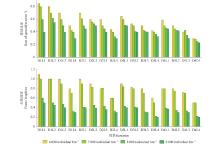
图1
不同可燃物含水率情景下各林带的潜在地表火行为"
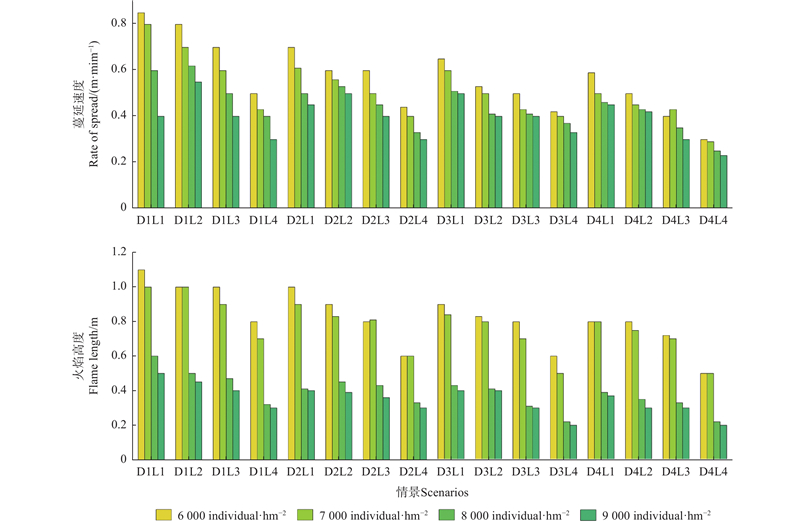
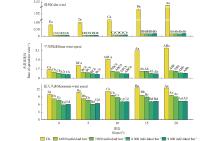
图2
不同坡度各密度生物防火林带的火蔓延速度 不同大写字母表示同一密度在不同坡度条件下的差异在0.05水平上显著;不同小写字母表示在相同坡度条件下,不同密度之间的差异在0.05水平上显著。"
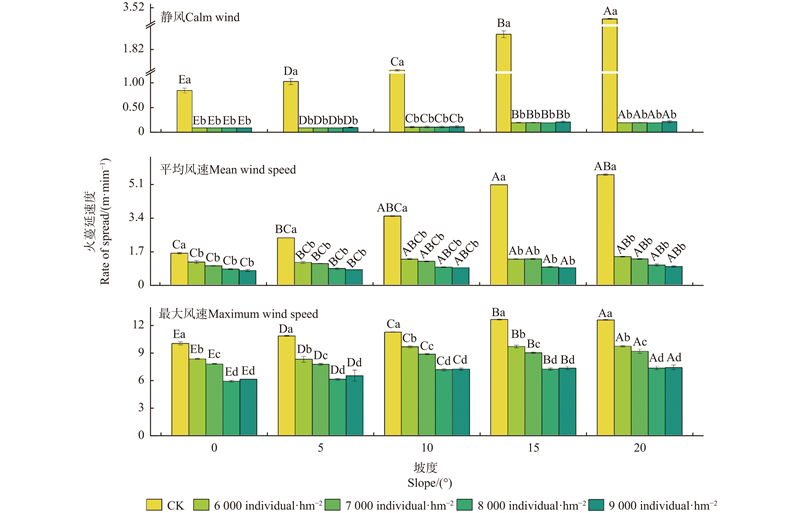
图3
不同坡度各密度生物防火林带的火焰高度 不同大写字母表示同一密度在不同坡度条件下的差异在0.05水平上显著;不同小写字母表示在相同坡度条件下,不同密度之间的差异在0.05水平上显著。"
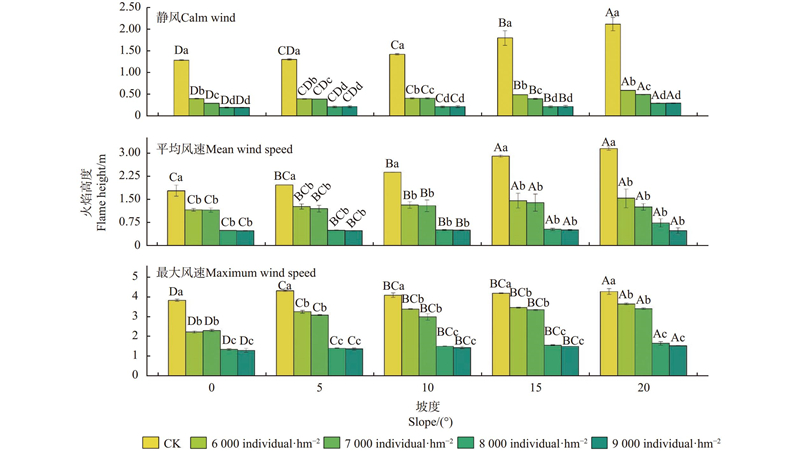
表6
D2L2情景下各生物防火林带密度情景潜在火行为指标"
| 林带密度 Forest belt density/ (individual·hm?2) | 潜在树冠火行为指数 Crown fire behavior potential index | 树冠火发生可能指数 Crown fire initiation potential index | 树冠火蔓延可能指数 Crown-to-crown transmissivity potential index | 树冠火蔓延速度指数 Crown fire spread rate index |
| 6 000 | 5.1 | 5.8 | 9.0 | 2.8 |
| 7 000 | 5.1 | 5.6 | 9.0 | 2.8 |
| 8 000 | 4.1 | 4.1 | 9.0 | 3.4 |
| 9 000 | 4.1 | 4.1 | 9.0 | 3.4 |
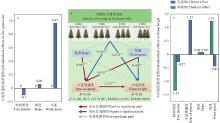
图4
生物防火林带潜在火行为结构方程 a. 火蔓延速度标准化效应;b. 生物防火林带密度对潜在火行为的影响结构方程;c. 火焰高度标准化效应。"
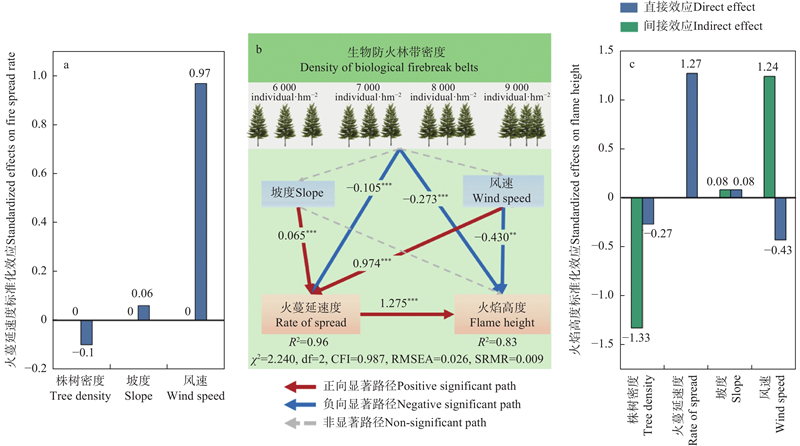
表7
基于熵权-TOPSIS法综合评价各林带密度阻火效果排名"
| 林带密度 Forest belt density/ (individual·hm?2) | 最优距离 Optimal distance | 最劣距离 Worst distance | 相对贴近度 Relative fit | 阻火效果排名 Ranking of fire control effectiveness |
| 6 000 | 0.148 4 | 0.102 8 | 0.415 6 | 4 |
| 7 000 | 0.128 9 | 0.109 1 | 0.448 0 | 3 |
| 8 000 | 0.032 6 | 0.194 9 | 0.846 5 | 1 |
| 9 000 | 0.057 1 | 0.188 9 | 0.768 8 | 2 |
| 陈存及. 中国的生物防火. 火灾科学, 1995, 4 (S1): 42- 48. | |
| Chen C J. The biological fire prevention research in China. Fire Safety Science, 1995, 4 (S1): 42- 48. | |
|
陈涤非, 王明玉, 司莉青, 等. 四川省生物防火隔离带树种选择. 陆地生态系统与保护学报, 2023, 3 (2): 56- 68.
doi: 10.12356/j.2096-8884.2022-0086 |
|
|
Chen D F, Wang M Y, Si L Q, et al. Study on tree species selection of biological fire barrier in Sichuan Province. Terrestrial Ecosystem and Conservation, 2023, 3 (2): 56- 68.
doi: 10.12356/j.2096-8884.2022-0086 |
|
| 高国平, 周志权, 王忠友. 森林可燃物研究综述. 辽宁林业科技, 1998, (4): 35- 38. | |
| Gao G P, Zhou Z Q, Wang Z Y. Review of forest combustible research. Journal of Liaoning Forestry Science & Technology, 1998, (4): 35- 38. | |
| 顾汪明, 卢泽洋, 黄春良, 等. 云南省建水县防火树种筛选研究. 北京林业大学学报, 2020, 42 (2): 49- 60. | |
| Gu W M, Lu Z Y, Huang C L, et al. Screening study of fire resistant tree species in Jianshui County, Yunnan Province of southwestern China. Journal of Beijing Forestry University, 2020, 42 (2): 49- 60. | |
|
韩喜越, 王晓迪, 崔晨曦, 等. 内蒙古大兴安岭根河林业局主要可燃物类型地表细小可燃物特征及其影响因素. 中南林业科技大学学报, 2023, 43 (12): 94- 103.
doi: 10.14067/j.cnki.1673-923x.2023.12.009 |
|
|
Han X Y, Wang X D, Cui C X, et al. Characteristics and influencing factors of surface fine fuels of main fuel types in Genhe Forestry Bureau, Daxing’an Mountains of Inner Mongolia. Journal of Central South University of Forestry & Technology, 2023, 43 (12): 94- 103.
doi: 10.14067/j.cnki.1673-923x.2023.12.009 |
|
| 何百娜. 2020. 白狼林业局森林火灾精准防控体系现状与对策分析. 呼和浩特: 内蒙古农业大学. | |
| He B N. 2020. Analysis of the current situation and countermeasures of precise forest fire prevention and control system in Bailang Forestry Bureau. Hohhot: Inner Mongolia Agricultural University. [in Chinese] | |
|
胡海清, 罗斯生, 罗碧珍, 等. 森林可燃物含水率及其预测模型研究进展. 世界林业研究, 2017, 30 (3): 64- 69.
doi: 10.13348/j.cnki.sjlyyj.2017.0029.y |
|
|
Hu H Q, Luo S S, Luo B Z, et al. Forest fuel moisture content and its prediction model. World Forestry Research, 2017, 30 (3): 64- 69.
doi: 10.13348/j.cnki.sjlyyj.2017.0029.y |
|
| 胡海清, 孙 龙. 2024. 林火生态与管理. 2版. 北京: 中国林业出版社. | |
| Hu H Q, Sun L. 2024. Forest fire ecology and management. 2nd edition. Beijing: China Forestry Publishing House. [in Chinese] | |
|
胡永宏. 对TOPSIS法用于综合评价的改进. 数学的实践与认识, 2002, 32 (4): 572- 575.
doi: 10.3969/j.issn.1000-0984.2002.04.009 |
|
|
Hu Y H. The improved method for TOPSIS in comprehensive evaluation. Mathematics in Practice and Theory, 2002, 32 (4): 572- 575.
doi: 10.3969/j.issn.1000-0984.2002.04.009 |
|
| 黄小荣, 申文辉, 庞世龙, 等. 南宁老虎岭松栎公益林的火潜势评估. 生态学杂志, 2014, 33 (3): 602- 610. | |
| Huang X R, Shen W H, Pang S L, et al. Evaluating fire potential of non-commercial pine-beech forests in Tiger Mountain, Nanning. Chinese Journal of Ecology, 2014, 33 (3): 602- 610. | |
|
黄小荣, 谭一波, 申文辉, 等. 广西三门江松栎公益林可燃物处理前后的树冠火风险. 中南林业科技大学学报, 2016, 36 (3): 46- 52.
doi: 10.14067/j.cnki.1673-923x.2016.03.009 |
|
|
Huang X R, Tan Y B, Shen W H, et al. Fuel treatment effectiveness in mitigating crown fire hazard of pine-fagus forest in Sanmengjiang, Guangxi. Journal of Central South University of Forestry & Technology, 2016, 36 (3): 46- 52.
doi: 10.14067/j.cnki.1673-923x.2016.03.009 |
|
|
贾 博, 张立存, 邹 璐, 等. 生物防火林带温湿度研究. 江西农业大学学报, 2014, 36 (4): 802- 810.
doi: 10.3969/j.issn.1000-2286.2014.04.017 |
|
|
Jia B, Zhang L C, Zou L, et al. A study of temperature and relative humidity in the biological fire prevention forest. Acta Agriculturae Universitatis Jiangxiensis, 2014, 36 (4): 802- 810.
doi: 10.3969/j.issn.1000-2286.2014.04.017 |
|
| 刘 军. 基于熵权和TOPSIS集成的农作物综合评价. 安徽农业科学, 2010, 38 (12): 6078- 6079. | |
| Liu J. Eomprehensive evaluation of crop based on entropy weight coefficient and TOPSIS. Journal of Anhui Agricultural Sciences, 2010, 38 (12): 6078- 6079. | |
| 马振宇, 陈博伟, 庞 勇, 等. 基于林火特征分类模型的森林火情等级制图. 国土资源遥感, 2020, 32 (1): 43- 50. | |
| Ma Z Y, Chen B W, Pang Y, et al. Forest fire potential forecast based on FCCS model. Remote Sensing for Land & Resources, 2020, 32 (1): 43- 50. | |
|
倪荣新, 宋其岩, 吴英俊, 等. 木荷生物防火林带与杉木林可燃物数量比较研究. 浙江林业科技, 2015, 35 (1): 45- 48.
doi: 10.3969/j.issn.1001-3776.2015.01.008 |
|
|
Ni R X, Song Q Y, Wu Y J, et al. Comparison on fuel load under Schima superba and Cunninghamia lanceolata stands. Journal of Zhejiang Forestry Science and Technology, 2015, 35 (1): 45- 48.
doi: 10.3969/j.issn.1001-3776.2015.01.008 |
|
| 彭张林, 张 强, 杨善林. 综合评价理论与方法研究综述. 中国管理科学, 2015, 23 (S1): 245- 256. | |
| Peng Z L, Zhang Q, Yang S L. Overview of comprehensive evaluation theory and methodology. Chinese Journal of Management Science, 2015, 23 (S1): 245- 256. | |
|
单延龙, 舒立福, 王洪伟, 等. Rothermel火蔓延模型特征参数的解析. 森林防火, 2003, 21 (1): 22- 25.
doi: 10.3969/j.issn.1002-2511.2003.01.012 |
|
|
Shan Y L, Shu L F, Wang H W, et al. Analysis of characteristic parameters of Rothermel’s fire spread model. Forest Fire Prevention, 2003, 21 (1): 22- 25.
doi: 10.3969/j.issn.1002-2511.2003.01.012 |
|
|
司莉青, 舒立福, 王明玉, 等. 生物防火林带阻火效率差异机理研究进展. 陆地生态系统与保护学报, 2022, 2 (4): 53- 59.
doi: 10.12356/j.2096-8884.2022-0022 |
|
|
Si L Q, Shu L F, Wang M Y, et al. Review on the difference of fireproof efficiency of biological fire-resistance forest belt. Terrestrial Ecosystem and Conservation, 2022, 2 (4): 53- 59.
doi: 10.12356/j.2096-8884.2022-0022 |
|
|
田晓瑞, 舒立福. 防火林带的应用与研究现状. 世界林业研究, 2000, 13 (1): 20- 26.
doi: 10.3969/j.issn.1001-4241.2000.01.004 |
|
|
Tian X R, Shu L F. The application and besearch of fire break forest belts. World Forestry Research, 2000, 13 (1): 20- 26.
doi: 10.3969/j.issn.1001-4241.2000.01.004 |
|
|
田晓瑞, Douglas J Mcrae, 张有慧. 森林火险等级预报系统评述. 世界林业研究, 2006, 19 (2): 39- 46.
doi: 10.3969/j.issn.1001-4241.2006.02.008 |
|
|
Tian X R, McRae D, Zhang Y H. Assessment of forest fire danger rating systems. World Forestry Research, 2006, 19 (2): 39- 46.
doi: 10.3969/j.issn.1001-4241.2006.02.008 |
|
|
田晓瑞, 宗学政, 王志成, 等. 小兴安岭林火动态研究. 陆地生态系统与保护学报, 2021, 1 (1): 47- 58.
doi: 10.12356/j.2096-8884.2021-0003 |
|
|
Tian X R, Zong X Z, Wang Z C, et al. Study on the fire regime in xiaoxing’an mountains, China. Terrestrial Ecosystem and Conservation, 2021, 1 (1): 47- 58.
doi: 10.12356/j.2096-8884.2021-0003 |
|
| 王明玉, 任云卯, 赵凤君, 等. 北京西山防火林带空间布局与规划. 林业科学研究, 2010, 23 (3): 399- 404. | |
| Wang M Y, Ren Y M, Zhao F J, et al. Spatial pattern and planning of shaded fuelbreak in Xishan of Beijing. Forest Research, 2010, 23 (3): 399- 404. | |
| 王 耀, 张昌顺, 刘春兰, 等. 三北防护林体系建设工程区森林水源涵养格局变化研究. 生态学报, 2019, 39 (16): 5847- 5856. | |
| Wang Y, Zhang C S, Liu C L, et al. Research on the pattern and change of forest water conservation in Three-North Shelterbelt Forest Program region, China. Acta Ecologica Sinica, 2019, 39 (16): 5847- 5856. | |
| 文定元. 防火林带研究现状. 森林防火, 1997, 15 (2): 23- 24. | |
| Wen D Y. Research status of fire forest belt. Forest Fire Prevention, 1997, 15 (2): 23- 24. | |
| 闫凯达, 赵凤君, 杨 光, 等. 基于MODIS火点数据的中国边境地区2001—2022年植被火分布特征. 应用生态学报, 2024, 35 (11): 3095- 3106. | |
| Yan K D, Zhao F J, Yang G, et al. Distribution characteristics of vegetation fires in border areas of China from 2001 to 2022 based on MODIS fire spot data. Chinese Journal of Applied Ecology, 2024, 35 (11): 3095- 3106. | |
|
杨 龙, 张 倩, 殷明龙, 等. 浅析生物防火林带营造技术. 农业与技术, 2023, 43 (1): 45- 47.
doi: 10.19754/j.nyyjs.20230115012 |
|
|
Yang L, Zhang Q, Yin M L, et al. Analysis on the construction technology of biological fireproof forest belt. Agriculture and Technology, 2023, 43 (1): 45- 47.
doi: 10.19754/j.nyyjs.20230115012 |
|
| 曾素平. 2020. 湖南主要防火树种抗火性能评价研究. 长沙: 中南林业科技大学. | |
| Zeng S P. 2020. Study on fire resistance performance evaluation of major fire prevention tree species in hunan province. Changsha: Central South University of Forestry and Technology. [in Chinese] | |
|
张吉利, 刘礴霏, 褚腾飞, 等. 广义Rothermel模型预测平地无风条件下红松-蒙古栎林地表混合可燃物的火行为. 应用生态学报, 2012, 23 (6): 1495- 1502.
doi: 10.13287/j.1001-9332.2012.0250 |
|
|
Zhang J L, Liu B F, Chu T F, et al. Fire behavior of ground surface fuels in Pinus koraiensis and Quercus mongolica mixed forest under no wind and zero slope condition: a prediction with extended Rothermel model. Chinese Journal of Applied Ecology, 2012, 23 (6): 1495- 1502.
doi: 10.13287/j.1001-9332.2012.0250 |
|
| 张 瑶. 2020. 广西高峰国家森林公园群落调查与防火优化研究. 南宁: 广西大学. | |
| Zhang Y. 2020. Community survey and fire prevention optimization study of Gaofeng National Forest Park, Guangxi. Nanning: Guangxi University. [in Chinese] | |
|
宗学政, 田晓瑞. 可燃物处理对大兴安岭地区主要林型火行为的影响. 林业科学, 2021, 57 (2): 139- 149.
doi: 10.11707/j.1001-7488.20210214 |
|
|
Zong X Z, Tian X R. Effects of fuel treatment on fire behavior of main forest types in the Greater Khingan Mountains. Forestry Science, 2021, 57 (2): 139- 149.
doi: 10.11707/j.1001-7488.20210214 |
|
| Andrews P, Finney M, Fischetti M. Wildfires: predicting and modeling fire behavior. Scientific American, 2007, 297 (2): 48- 55. | |
|
Bai L P, Luo Y, Shi D R, et al. TOPSIS-based screening method of soil remediation technology for contaminated sites and its application. Soil & Sediment Contamination An International Journal, 2015, 24 (4): 386- 397.
doi: 10.1080/15320383.2015.968915 |
|
|
Bao Y, Shinoda M, Yi K, et al. Satellite-based analysis of spatiotemporal wildfire pattern in the Mongolian Plateau. Remote Sensing, 2022, 15 (1): 190.
doi: 10.3390/rs15010190 |
|
|
Brad M, Leigh M, Colin B, et al. Selecting low-flammability plants as green firebreaks within sustainable urban garden design. Fire, 2018, 1 (1): 15.
doi: 10.3390/fire1010015 |
|
|
Cardil A, Rodrigues M, Tapia M, et al. Climate teleconnections modulate global burned area. Nature Communications, 2023, 14 (1): 427.
doi: 10.1038/s41467-023-36052-8 |
|
|
Cardoso A W, Oliveras I, Abernethy K A, et al. Grass species flammability, not biomass, frives changes in fire behavior at tropical forest-savanna transitions. Frontiers in Forests and Global Change, 2018, 1 (1): 6.
doi: 10.3389/ffgc.2018.00006 |
|
|
Cronan J B, Wright C S, Petrova M, et al. Effects of dormant and growing season burning on surface fuels and potential fire behavior in northern Florida longleaf pine (Pinus palustris) flatwoods. Forest Ecology and Management, 2015, 354, 318- 333.
doi: 10.1016/j.foreco.2015.05.018 |
|
|
Cruz M G, Hoffman C M, Fernandes P M, et al. Global synthesis of quantification of fire behaviour characteristics in forests and shrublands: recent progress. Current Forestry Reports, 2025, 11 (1): 8.
doi: 10.1007/s40725-024-00241-5 |
|
|
Cui X L, Alam M A, Perry G L, et al. Green firebreaks as a management tool for wildfires: lessons from China. Journal of Environmental Management, 2019, 233, 329- 336.
doi: 10.1016/j.jenvman.2018.12.043 |
|
|
D'Onofrio D, Hardenberg V J, Baudena M. Not only trees: grasses determine African tropical biome distributions via water limitation and fire. Global Ecology and Biogeography, 2018, 27 (5/6): 714- 725.
doi: 10.1111/geb.12735 |
|
|
Dodonov P, Harper K A, Silva-Matos D M, et al. The role of edge contrast and forest structure in edge influence: vegetation and microclimate at edges in the Brazilian cerrado. Plant Ecology, 2013, 214 (11): 1345- 1359.
doi: 10.1007/s11258-013-0256-0 |
|
|
García-Llamas P, Suárez-Seoane S, Taboada A, et al. Environmental drivers of fire severity in extreme fire events that affect Mediterranean pine forest ecosystems. Forest Ecology and Management, 2019, 433 (1): 24- 32.
doi: 10.1016/j.foreco.2018.10.051 |
|
|
Hempson G P, Archibald S, Donaldson J E, et al. Alternate grassy ecosystem states are determined by palatability-flammability trade-offs. Trends in Ecology & Evolution, 2019, 34 (4): 286- 290.
doi: 10.1016/j.tree.2019.01.007 |
|
|
Hoffmann W A, Jaconis S Y, Mckinley K L, et al. Fuels or microclimate? Understanding the drivers of fire feedbacks at savanna–forest boundaries. Austral Ecology, 2012, 37 (6): 634- 643.
doi: 10.1111/j.1442-9993.2011.02324.x |
|
|
Hollingsworth T L, Kurth L L, Parresol R B, et al. A comparison of geospatially modeled fire behavior and fire management utility of three data sources in the southeastern United States. Forest Ecology and Management, 2012, 273, 43- 49.
doi: 10.1016/j.foreco.2011.05.020 |
|
|
Ibanez T, Hély C, Gaucherel C, et al. Sharp transitions in microclimatic conditions between savanna and forest in New Caledonia: insights into the vulnerability of forest edges to fire. Austral Ecology, 2013, 38 (6): 680- 687.
doi: 10.1111/aec.12015 |
|
|
Jiang J, Wang Y P, Zhang H, et al. Contribution of litter layer to greenhouse gas fluxes between atmosphere and soil varies with forest succession. Forests, 2022, 13 (4): 544.
doi: 10.3390/f13040544 |
|
| Johnston L M, Wang X, Erni S, et al. Wildland fire risk research in Canada. Environmental Reviews, 2020, (7): 1- 23. | |
|
Just M G, Hohmann M G, Hoffmann W A, et al. Where fire stops: vegetation structure and microclimate influence fire spread along an ecotonal gradient. Plant Ecology, 2015, 217 (6): 631- 644.
doi: 10.1007/s11258-015-0545-x |
|
|
Kahiu N M, Hanan P N. Fire in sub‐Saharan Africa: the fuel, cure and connectivity hypothesis. Global Ecology and Biogeography, 2018, 27 (8): 946- 957.
doi: 10.1111/geb.12753 |
|
|
Keane R E, Gray K, Bacciu V, et al. Spatial scaling of wildland fuels for six forest and rangeland ecosystems of the northern Rocky Mountains, USA. Landscape Ecology, 2012, 27 (8): 1213.
doi: 10.1007/s10980-012-9773-9 |
|
|
Knapp E E, Lydersen J M, North M P, et al. Efficacy of variable density thinning and prescribed fire for restoring forest heterogeneity to mixed-conifer forest in the central Sierra Nevada, CA. Forest Ecology and Management, 2017, 406, 228- 241.
doi: 10.1016/j.foreco.2017.08.028 |
|
|
Kreye J K, Kobziar L N, Zipperer W C, et al. Effects of fuel load and moisture content on fire behaviour and heating in masticated litter-dominated fuels. International Journal of Wildland Fire, 2013, 22 (4): 440- 445.
doi: 10.1071/WF12147 |
|
| Krishna P M, Mohan M. 2017. Litter decomposition in forest ecosystems: a review. Energy, Ecology and Environment, 2(4): 236−249. | |
|
Li Y H, Xu S X, Fan Z F, et al. Risk factors and prediction of the probability of wildfire occurrence in the China–Mongolia–Russia cross-border area. Remote Sensing, 2022, 15 (1): 42.
doi: 10.3390/rs15010042 |
|
|
Little J J, Williams R J. Fire weather risk differs across rain forestusavanna boundaries in the humid tropics of north-eastern Australia. Austral Ecology, 2012, 37 (8): 915- 925.
doi: 10.1111/j.1442-9993.2011.02350.x |
|
|
Liu B C, Liao C R, Chang Y H, et al. Changing dynamic of tree species composition and diversity: a case study of secondary forests in northern China in response to climate change. Forests, 2024, 15 (2): 17.
doi: 10.3390/f15020322 |
|
|
Newberry B M, Power C R, Abreu R C R, et al. Flammability thresholds or flammability gradients? Determinants of fire across savanna–forest transitions. New Phytologist, 2020, 228 (3): 910- 921.
doi: 10.1111/nph.16742 |
|
| Ottmar R D, Sandberg D V, Riccardi C L, et al. An overview of the fuel characteristic classification system quantifying, classifying, and creating fuelbeds for resource planning. Revue Canadienne De Recherche Forestière, 2007, 37 (37): 2383- 2393. | |
| Pausas J G. 2014. Bark thickness and fire regime. Functional Ecology, 29(3): 315−327. | |
|
Pettinari M L, Chuvieco E. Generation of a global fuel data set using the Fuel Characteristic Classification System. Biogeosciences, 2016, 13 (7): 2061- 2076.
doi: 10.5194/bg-13-2061-2016 |
|
|
Rahman A, Muktadir M G. SPSS: an imperative quantitative data analysis tool for social science research. International Journal of Research and Innovation in Social Science, 2021, (10): 300- 302.
doi: 10.47772/ijriss.2021.51012 |
|
| Rocca G D, Danti R, Raddi P, et al. Implementation of the cypress system as a green firewall. Project CypFire, 2014, 3 (1): 275- 280. | |
|
Timothy C, George P, Sarah W, et al. Managing fire and biodiversity in the wildland-urban interface: a role for green firebreaks. Fire, 2017, 1 (1): 3.
doi: 10.3390/fire1010003 |
|
|
Tuo Y F, Wang Z Y, Zheng Y, et al. Effect of water and fertilizer regulation on the soil microbial biomass carbon and nitrogen, enzyme activity, and saponin content of Panax notoginseng. Agricultural Water Management, 2023, 278, 108145.
doi: 10.1016/j.agwat.2023.108145 |
|
|
Wang Z, Huang R, Yao Q C, et al. Strong winds drive grassland fires in China. Environmental Research Letters, 2023, 18 (1): 015005.
doi: 10.1088/1748-9326/aca921 |
|
|
Yin C M, Xing M F, Yebra M, et al. Relationships between burn severity and environmental drivers in the temperate coniferous forest of northern China. Remote Sensing, 2021, 13, 5127.
doi: 10.3390/rs13245127 |
|
|
Yu X M, Zhang J W, Zhang Y H, et al. Identification of optimal irrigation and fertilizer rates to balance yield, water and fertilizer productivity, and fruit quality in greenhouse tomatoes using TOPSIS. Scientia Horticulturae, 2023, 311, 111829.
doi: 10.1016/j.scienta.2023.111829 |
|
|
Zhang S W, Chen S H, Hu T T, et al. Optimization of irrigation and nitrogen levels for a trade-off: yield, quality, water use efficiency and environment effect in a drip-fertigated apple orchard based on TOPSIS method. Scientia Horticulturae, 2023, 309, 111700.
doi: 10.1016/j.scienta.2022.111700 |
|
|
Zong X Z, Tian X R, Wang X L, et al. An optimal firebreak design for the boreal forest of China. Science of the Total Environment, 2021, 781, 146822.
doi: 10.1016/j.scitotenv.2021.146822 |
| [1] | 宗学政,田晓瑞,崔文彬,舒立福,王明玉. 基于大兴安岭季节性火灾风险动态调整地面临时扑救基地[J]. 林业科学, 2026, 62(4): 154-163. |
| [2] | 闫凯达,周暖阳,司莉青,赵凤君,张建华,邹全程,彭志杰,韩冬,徐健楠,李笑笑,张师渊. 机械清除林区道路两侧可燃物降低火灾风险效果评估——以塞罕坝机械林场为例[J]. 林业科学, 2025, 61(12): 135-145. |
| [3] | 索奥丽,陈锋,龚俊伟,程定野,代世奥,马成功,刘晓东. 华北落叶松林和油松林地表可燃物特征、土壤理化性质及林下植物多样性对林间草地放牧的响应[J]. 林业科学, 2025, 61(10): 60-73. |
| [4] | 闫凯达,赵凤君,司莉青,舒立福,王明玉,李伟克,韩冬,李笑笑,周暖阳. 林火阻隔带和阻隔体系研究进展[J]. 林业科学, 2025, 61(1): 197-208. |
| [5] | 李保中,杨光,宁吉彬,于宏洲. 森林可燃物调控技术及其评价方法[J]. 林业科学, 2024, 60(10): 143-153. |
| [6] | 宗学政,田晓瑞. 可燃物处理对大兴安岭地区主要林型火行为的影响[J]. 林业科学, 2021, 57(2): 139-149. |
| [7] | 满子源, 孙龙, 胡海清, 张运林. 南方8种森林地表死可燃物在平地无风时的燃烧蔓延速率与预测模型[J]. 林业科学, 2019, 55(7): 197-204. |
| [8] | 苗庆林, 田晓瑞. 多气候情景下大兴安岭森林燃烧性评估[J]. 林业科学, 2016, 52(10): 109-116. |
| [9] | 田晓瑞 王明玉 殷丽 舒立福. 大兴安岭南部春季火行为特征及可燃物消耗[J]. 林业科学, 2009, 12(3): 90-95. |
| [10] | 高宝嘉;张桂娟 周国娜 张鸿军 于志勇 李利学 迟宝利. 承德县人工针叶林地表枯死可燃物参数估测及潜在地表火行为评价[J]. 林业科学, 2009, 12(10): 163-167. |
| [11] | 王秋华 舒立福 戴兴安 王明玉 田晓瑞. 冰雪灾害对南方森林可燃物及火行为的影响[J]. 林业科学, 2008, 44(11): 171-176. |
| [12] | 黄志伟;余树全 胡庭兴 应尚蛟. 不同木荷防火林带建设模式群落学特征比较[J]. 林业科学, 2008, 44(1): 101-106. |
| [13] | 金森. 林火图像测量中的火场边缘提取技术[J]. 林业科学, 2007, 43(9): 44-47. |
| [14] | 舒立福 王明玉 田晓瑞 张小罗 戴兴安. 关于森林燃烧火行为特征参数的计算与表述[J]. 林业科学, 2004, 40(3): 179-183. |
| [15] | 张景群 康永祥 吴宽让 周新华. 秦岭森林潜在火行为数量分类及划分指标研究[J]. 林业科学, 2001, 37(1): 101-106. |
| 阅读次数 | ||||||
|
全文 |
|
|||||
|
摘要 |
|
|||||

