
Scientia Silvae Sinicae ›› 2026, Vol. 62 ›› Issue (1): 67-82.doi: 10.11707/j.1001-7488.LYKX20240560
• Research papers • Previous Articles Next Articles
Wankuan Zhu1,Zhichao Wang1,Yuxing Xu1,Runxia Huang1,Yi Tao2,Yuanyuan Zhong2,Apeng Du1,*( )
)
Received:2024-09-29
Revised:2025-09-10
Online:2026-01-25
Published:2026-01-14
Contact:
Apeng Du
E-mail:dapzj@163.com
CLC Number:
Wankuan Zhu,Zhichao Wang,Yuxing Xu,Runxia Huang,Yi Tao,Yuanyuan Zhong,Apeng Du. Simulation of Soil Respiration in a Stratified Mixed Stand of Eucalyptus spp. and Manglietia glauca in Leizhou Peninsula Based on Machine Learning Algorithms[J]. Scientia Silvae Sinicae, 2026, 62(1): 67-82.

Table 1
Basic profile of the 0?10 cm soil layer in the study plots"
| 样地Plot | 坡度Slope/ (°) | 海拔Altitude/m | LAI | BD/ (g?cm–3) | SOC/ (g?kg–1) | TN/ (g?kg–1) | TP/ (g?kg–1) |
| 1 | <5 | 112 | 3.22±0.07a | 0.92±0.02a | 23.75±1.22a | 1.72±0.16ab | 0.56±0.08a |
| 2 | <5 | 110 | 3.20±0.03a | 0.95±0.06a | 29.92±4.27a | 1.56±0.14b | 0.38±0.13a |
| 3 | <5 | 111 | 2.98±0.12a | 0.98±0.02a | 23.13±1.90a | 1.61±0.09b | 0.54±0.05a |
| 4 | <5 | 110 | 3.31±0.09a | 0.95±0.02a | 27.05±2.17a | 2.10±0.04a | 0.49±0.06a |
Table 2
List of main abbreviations"
| 缩写 Abbreviation | 参数全称 Full name of parameters | 单位 Unit |
| Rs | 土壤呼吸 Soil respiration | μmol·m–2s–1 |
| Rsa | 土壤呼吸年累积量 Annual accumulation of soil respiration | g·m–2a–1 |
| Ts | 土壤温度 Soil temperature | ℃ |
| Ta | 空气温度 Air temperature | ℃ |
| SM | 土壤湿度 Soil moisture | m3·m–3 |
| EC | 土壤电导率 Electrical conductivity | dS·m–1 |
| SHF | 土壤热通量 Soil heat flux | W·m–2 |
| RH | 空气相对湿度 Relative air humidity | % |
| SR | 太阳辐射 Solar radiation | W·m–2 |
| PAR | 光合有效辐射 Photosynthetically active radiation | μmol·m–2s–1 |
| Pre | 降水量 Precipitation | mm |
Fig.1
Temporal dynamics of soil respiration, soil temperature, and soil moisture"
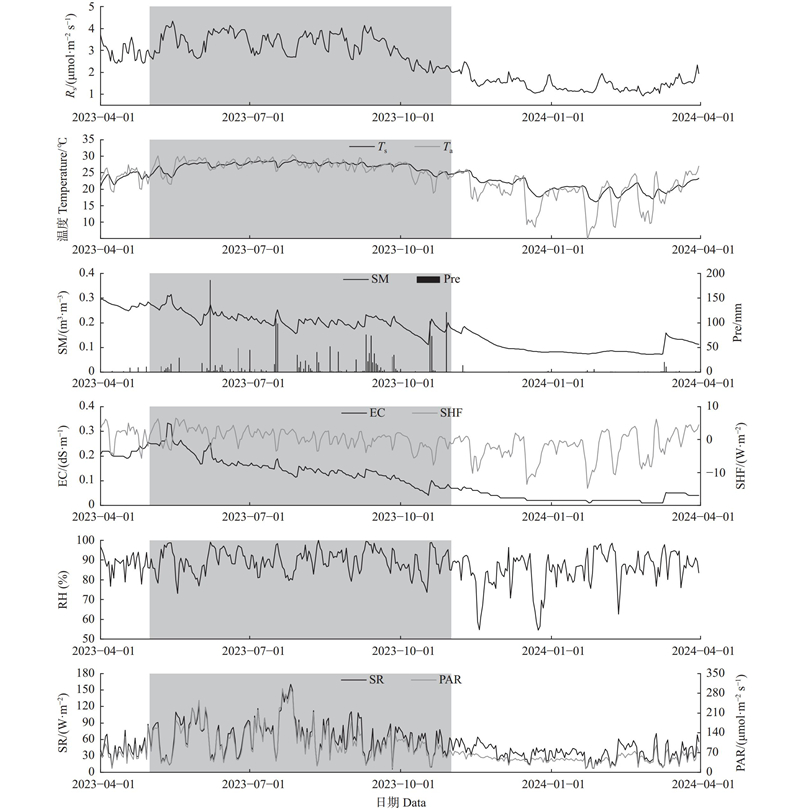
Fig.2
Relationship between soil respiration and environmental factors"
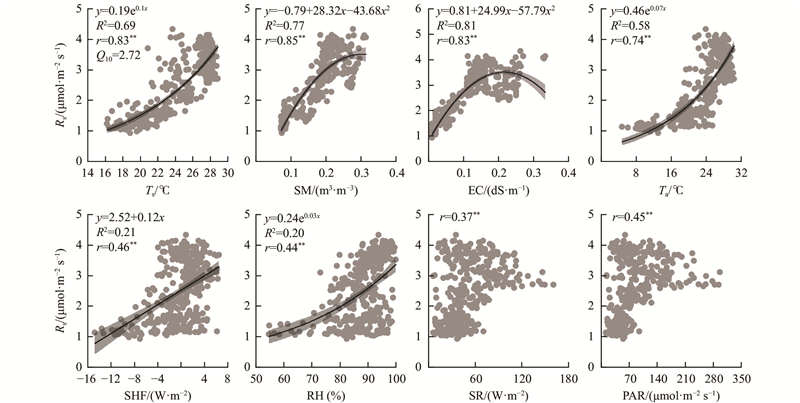
Fig.3
Change in monthly average of predicted and measured values"
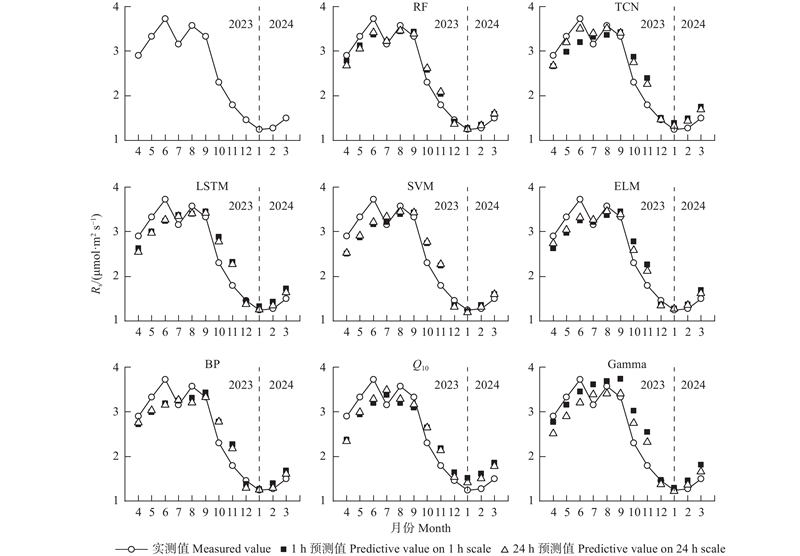
Fig.4
Evaluation indices of different models"
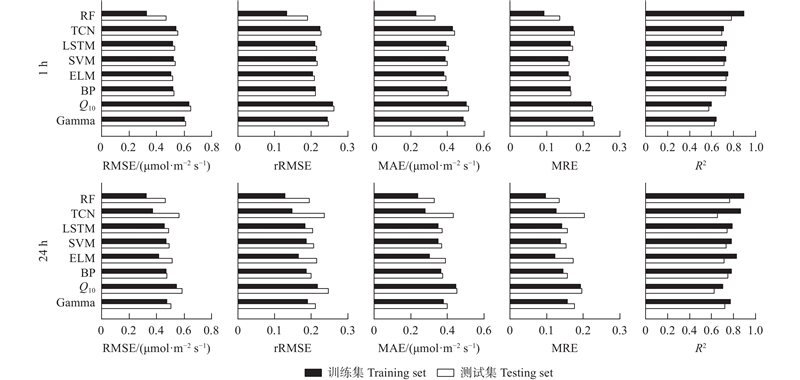
Fig.5
Linear relationship between predicted and measured values for each model"
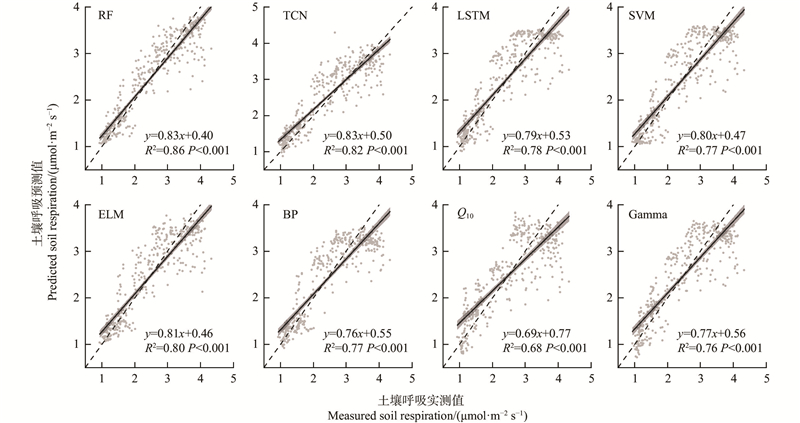
Fig.6
10-fold cross-validation (a, b, and c ) and learning curve (d) for random forest model"
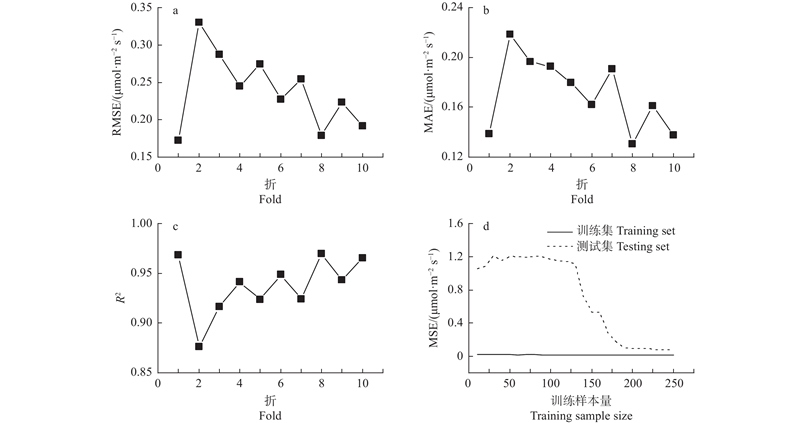
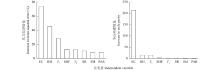
Fig.7
Relative importance of independent variables in random forest model"
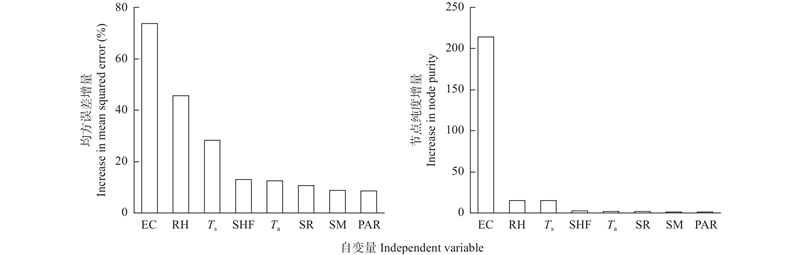
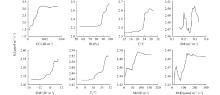
Fig.8
Partial dependence of independent variables in random forest model"
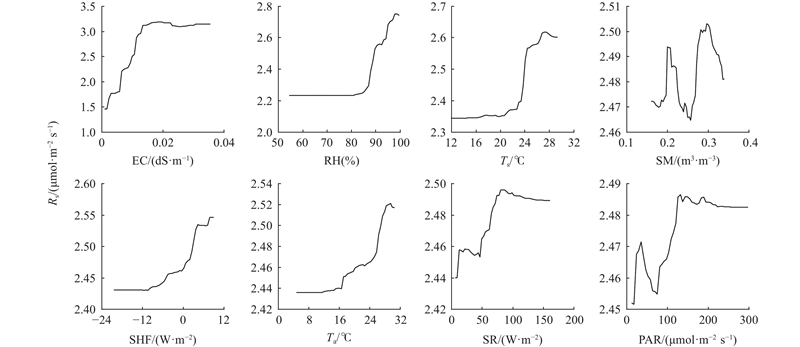
Table 3
Model evaluation indicators"
| 模型 Model | 训练集 Training set | 测试集 Test set | ||||||||
| RMSE/ (μmol·m–2s–1) | MAE/ (μmol·m–2s–1) | R2 | Adjusted R2 | RMSE/ (μmol·m–2s–1) | MAE/ (μmol·m–2s–1) | R2 | Adjusted R2 | |||
| 随机森林模型 Random forest model | 双变量 Bivariate | 0.32 | 0.24 | 0.89 | 0.89 | 0.46 | 0.33 | 0.76 | 0.76 | |
| 多变量 Multivariate | 0.10 | 0.07 | 0.99 | 0.99 | 0.26 | 0.19 | 0.93 | 0.93 | ||
Table 4
Soil carbon emissions from major plantations in tropical and subtropical regions"
| 研究区 Research area | 地理位置 Location | 植被类型 Vegetation types | 土壤类型 Soil type | 测定时间 Measurement time | Rs/ (μmol·m–2s–1) | Rsa/ (g·m–2a–1) | 数据来源 Data sources |
| 四川都江堰 Dujiangyan, Sichuan | 30? 59′ N 103? 37′ E | 含笑人工林 Michelia wilsonii plantation | 黄壤 Yellow soil | 2015?11—2017?10 | 1.94 | 793 | |
| 江西德安 De’an, Jiangxi | 29°16′—29° 17′N115°42′— 115°43′E | 湿地松人工林 Pinus elliottii plantation | 红壤 Red soil | 2015?01—2015?12 | 3.91 | 1 479.67 | |
| 福建建瓯 Jian’ou, Fujian | 27°01′—27°03′N 118°07′—118°09′E | 木荷人工林 Schima superba plantation | 红壤 Red soil | 2005?01—2007?12 | 2.53 | 962 | |
| 杉木人工林 Cunninghamia lanceolata plantation | 2005?01—2007?12 | 2.66 | 1 011 | ||||
| 26°16'36″N 118°37'17″E | 杉阔混交林 Mixed plantations of Cunninghamia lanceolata and broadleaved trees | 黄红壤 Yellow red soil | 2016?07—2017?07 | 4.39 | 1 661.32 | ||
| 福建三明 Sanming, Fujian | 26°11′N 117°28′E | 杉木人工林 Cunninghamia lanceolata plantation | 红壤 Red soil | 2010?10—2012?09 | 2.20 | 837 | |
| 马尾松人工林 Pinus massoniana plantation | 2010?10—2012?09 | 2.39 | 907 | ||||
| 26°48′N 117°58′E | 杉木人工林 Cunninghamia lanceolata plantation | 红壤 Red soil | 2011?10—2013?03 | 2.03 | 768.22 | ||
| 米老排人工林 Mytilaria laosensis plantations | 2011?10—2013?03 | 2.70 | 1 021.77 | ||||
| 26°11′N 117°28′E | 米槠人工林 Castanopsis carlesii plantations | 红壤 Red soil | 2013?01—2014?12 | 3.34 | 1 220 | ||
| 江西泰和 Taihe, Jiangxi | 26°44′39″N 115°03′33″E | 马尾松人工林 Pinus massoniana plantation | 红壤 Red soil | 2004?01—2007?07 | 1.94 | 736 | |
| 广东鹤山 Heshan, Guangdong | 22°34′N 112°50′E | 桉树人工林 Eucalyptus plantation | 红壤 Red soil | 2008?03—2009?03 | 1.77~2.26 | 670~856 | |
| 广西凭祥 Pingxiang, Guangxi | 22°10′N 106°50′E | 桉树人工林 Eucalyptus plantation | 赤红壤 Lateritic red soil | 2012?01—2012?12 | 3.03 | 1 147.41 | |
| 桉树×降香黄檀混交林 Mixed forest of Eucalyptus and Dalbergia odorifera | 2.23 | 844.07 | |||||
| 云南西双版纳 Xishuangbanna, Yunnan | 22°07′—22°09′N 100°40′—100°41′E | 热带季雨林 Tropical seasonal rain forest | 砖红壤 Latosol | 2014?11—2015?11 | 3.83 | 1 450 | |
| 橡胶人工林 Rubber plantation | 2014?11—2015?11 | 3.25 | 1 230 | ||||
| 广东湛江 Zhanjiang, Guangdong | 21°16′N 110°05′E | 尾巨桉人工林 E. urophylla × grandis | 砖红壤 Latosol | 2016?03—2017?02 | 2.34 | 893.31 | |
| 尾叶桉×灰木莲混交林 Mixed forest of E. urophylla and M. glauca | 2023?04—2024?03 | 2.47 | 936.64 | 本研究This paper |
| 陈荣荣, 刘全全, 王 俊, 等. 人工模拟降水条件下旱作农田土壤“Birch效应”及其响应机制. 生态学报, 2016, 36 (2): 306- 317. | |
| Chen R R, Liu Q Q, Wang J, et al. Response of soil “Birch Effect”to simulated rainfalls in dry croplands. Acta Ecologica Sinica, 2016, 36 (2): 306- 317. | |
| 邓娇娇, 周永斌, 殷 有, 等. 油松和蒙古栎混交对土壤微生物群落功能多样性的影响. 生态学杂志, 2017, 36 (11): 3028- 3035. | |
| Deng J J, Zhou Y B, Yin Y, et al. Effects of mixed Pinus tabuliformis and Quercus mongolica plantation on the functional diversity of soil microbial community. Chinese Journal of Ecology, 2017, 36 (11): 3028- 3035. | |
| 房焕英, 肖胜生, 余小芳, 等. 湿地松人工林土壤呼吸及其组分对模拟酸雨的响应. 林业科学, 2021, 57 (7): 20- 31. | |
| Fang H Y, Xiao S S, Yu X F, et al. Responses of soil respiration and its components to simulated acid rain in Pinus elliottii plantation. Scientia Silvae Sinicae, 2021, 57 (7): 20- 31. | |
| 黄雪蔓, 刘世荣, 尤业明. 第二代桉树人工纯林和混交林土壤呼吸及其组分研究. 林业科学研究, 2014, 27 (5): 575- 582. | |
| Huang X M, Liu S R, You Y M. Study on the soil respiration and its components of the second rotation Eucalyptus plantations in subtropical China. Forest Research, 2014, 27 (5): 575- 582. | |
| 李 伟, 刘小飞, 陈光水, 等. 凋落物对中亚热带米槠天然林和人工林土壤呼吸的影响. 林业科学, 2016, 52 (11): 11- 18. | |
| Li W, Liu X F, Chen G S, et al. Effects of litter manipulation on soil respiration in the natural forests and plantations of Castanopsis carlesii in mid-subtropical China. Scientia Silvae Sinicae, 2016, 52 (11): 11- 18. | |
| 梁慧玲, 林玉蕊, 杨 光, 等. 基于气象因子的随机森林算法在塔河地区林火预测中的应用. 林业科学, 2016, 52 (1): 89- 98. | |
| Liang H L, Lin Y R, Yang G, et al. Application of random forest algorithm on the forest fire prediction in Tahe area based on meteorological factors. Scientia Silvae Sinicae, 2016, 52 (1): 89- 98. | |
| 卢 闯, 胡海棠, 淮贺举, 等. 夏玉米-冬小麦轮作期土壤呼吸的温度敏感性分析. 中国农业气象, 2020, 41 (7): 403- 412. | |
| Lu C, Hu H T, Huai H J, et al. Characteristics of temperature sensitivity of soil respiration in a summer maize-winter wheat rotation cropland. Chinese Journal of Agrometeorology, 2020, 41 (7): 403- 412. | |
| 欧强新, 雷相东, 沈琛琛, 等. 基于随机森林算法的落叶松-云冷杉混交林单木胸径生长预测. 北京林业大学学报, 2019, 41 (9): 9- 19. | |
| Ou Q X, Lei X D, Shen C C, et al. Individual tree DBH growth prediction of larch-spruce-fir mixed forests based on random forest algorithm. Journal of Beijing Forestry University, 2019, 41 (9): 9- 19. | |
| 冉漫雪, 丁军军, 孙东宝, 等. 全球气候变化下土壤呼吸对温度和水分变化的响应特征综述. 中国农业气象, 2024, 45 (1): 1- 11. | |
| Ran M X, Ding J J, Sun D B, et al. A review of the response characteristics of soil respiration to temperature and moisture changes under global climate change. Chinese Journal of Agrometeorology, 2024, 45 (1): 1- 11. | |
| 沈琛琛, 肖文发, 朱建华, 等. 基于机器学习算法的华中天然林土壤有机碳特征与关键影响因子. 林业科学, 2024, 60 (3): 65- 77. | |
| Shen C C, Xiao W F, Zhu J H, et al. Characterization of soil organic carbon and key influencing factors of natural forests in Central China based on machine learning algorithms. Scientia Silvae Sinicae, 2024, 60 (3): 65- 77. | |
| 孙敬松, 周广胜, 韩广轩. 太阳辐射对玉米农田土壤呼吸作用的影响. 生态学报, 2010, 30 (21): 5925- 5932. | |
| Sun J S, Zhou G S, Han G X. Effects of solar radiation on soil respiration of a maize ecosystem. Acta Ecologica Sinica, 2010, 30 (21): 5925- 5932. | |
| 田惠玲, 朱建华, 何 潇, 等. 基于随机森林模型的东北三省乔木林生物质碳储量预测. 林业科学, 2022, 58 (4): 40- 50. | |
| Tian H L, Zhu J H, He X, et al. Projected biomass carbon stock of Arbor forest of three provinces in northeastern China based on random forest model. Scientia Silvae Sinicae, 2022, 58 (4): 40- 50. | |
| 王丹凤. 2024. 亚热带三种林型土壤呼吸特征及其影响因素研究. 长沙: 中南林业科技大学. | |
| Wang D F. 2024. Study on characterization of soil respiration in three subtropical forest types and its influencing factors. Changsha: Central South University of Forestry and Technology. [in Chinese] | |
| 王家骏, 王传宽, 韩 轶. 帽儿山不同年龄森林土壤呼吸速率的影响因子. 生态学报, 2018, 38 (4): 1194- 1202. | |
| Wang J J, Wang C K, Han Y. Factors affecting soil respiration in stands of different ages in the Mao’ershan region, northeast China. Acta Ecologica Sinica, 2018, 38 (4): 1194- 1202. | |
| 王晓楠, 苏文浩, 董灵波. 基于随机森林的兴安落叶松天然林单木年龄预估模型. 应用生态学报, 2024, 35 (4): 1055- 1063. | |
| Wang X N, Su W H, Dong L B. Age estimation model for individual tree in natural Larix gmelinii forest based on random forest model. Chinese Journal of Applied Ecology, 2024, 35 (4): 1055- 1063. | |
| 巫志龙, 周成军, 周新年, 等. 不同强度采伐5年后杉阔混交人工林土壤呼吸速率差异. 林业科学, 2019, 55 (6): 142- 149. | |
| Wu Z L, Zhou C J, Zhou X N, et al. Difference in soil respiration rates of the mixed plantations of Cunninghamia lanceolata and broadleaved trees 5 years after harvesting at different intensities. Scientia Silvae Sinicae, 2019, 55 (6): 142- 149. | |
| 吴敏娟. 2019. 杉木林皆伐改造对土壤呼吸及林分碳储量的影响. 杭州: 浙江农林大学. | |
| Wu M J. 2019. Effects of clear-cutting and stand conversion of Chinese fir forest on soil respiration and stand carbon stocks. Hangzhou: Zhejiang A&F University. [in Chinese] | |
| 谢育利. 2017. 黄土丘陵区油松、沙棘纯林及混交林土壤呼吸特征比较研究. 北京: 中国科学院大学. | |
| Xie Y L. 2017. Comparative study on soil respiration characteristics of Pinus tabulaeformis and Hippophae rhamnoides plantation and mixed forest in Loess Hilly Region. Beijing: University of Chinese Academy of Sciences. [in Chinese] | |
| 杨 璐, 汪金松, 赵 博, 等. 长期施氮对暖温带油松林土壤呼吸及其组分的影响. 林业科学, 2021, 57 (1): 1- 11. | |
| Yang L, Wang J S, Zhao B, et al. Effects of long-term nitrogen application on soil respiration and its components in warm-temperate forest of Pinus tabulaeformis. Scientia Silvae Sinicae, 2021, 57 (1): 1- 11. | |
| 杨知涵. 2023. 基于机器学习的中国陆地生态系统土壤呼吸温度敏感性时空格局研究. 成都: 成都理工大学. | |
| Yang Z H. 2023. Spatiotemporal patterns of temperature sensitivity of soil respiration across China based on machine learning. Chengdu: Chengdu University of Technology. [in Chinese] | |
| 张梦飞. 2021. 基于机地协同的夏玉米农田土壤碳排放估算方法研究. 杨凌: 西北农林科技大学. | |
| Zhang M F. 2021. Estimation of soil carbon emission from summer maize field based on ground measurement and UAV remote sensing. Yangling: Northwest A&F University. [in Chinese] | |
| 周洪华, 李卫红, 杨余辉, 等. 干旱区不同土地利用方式下土壤呼吸日变化差异及影响因素. 地理科学, 2011, 31 (2): 190- 196. | |
| Zhou H H, Li W H, Yang Y H, et al. Soil respiration variant and its effecting factors at different land use in arid land. Scientia Geographica Sinica, 2011, 31 (2): 190- 196. | |
| 朱诗豪, 吴志伟, 李政杰, 等. 赣南马尾松林地表细小死可燃物含水率动态及模型. 林业科学, 2024, 60 (5): 158- 168. | |
| Zhu S H, Wu Z W, Li Z J, et al. Moisture dynamics and modeling of ground surface fine dead combustibles in Pinus massoniana forest in southern Jiangxi, China. Scientia Silvae Sinicae, 2024, 60 (5): 158- 168. | |
| 竹万宽, 许宇星, 王志超, 等. 尾巨桉人工林土壤呼吸对林下植被管理措施的响应. 浙江农林大学学报, 2023, 40 (1): 164- 175. | |
| Zhu W K, Xu Y X, Wang Z C, et al. Response of soil respiration to understory vegetation management in Eucalyptus urophylla × E. grandis plantation. Journal of Zhejiang A& F University, 2023, 40 (1): 164- 175. | |
| 竹万宽, 王志超, 许宇星, 等. 雷州半岛尾巨桉人工林土壤呼吸动态变化及其对气象因子的响应. 热带亚热带植物学报, 2018, 26 (4): 346- 354. | |
| Zhu W K, Wang Z C, Xu Y X, et al. Soil respiration of Eucalyptus urophylla × E. grandis plantation and its response to meteorological factors in Leizhou Peninsula. Journal of Tropical and Subtropical Botany, 2018, 26 (4): 346- 354. | |
| 竹万宽. 2017. 不同桉树人工林土壤呼吸时空异质性及其影响要素. 北京: 中国林业科学研究院. | |
| Zhu W K. 2017. Spatial and temporal heterogeneity and factors of soil respiration in different Eucalyptus plantations. Beijing: Chinese Academy of Forestry. [in Chinese] | |
| Abukari A, Cobbinah P. 2024. Can biochar made from rice husk affect Savanna soils’ pH, electrical conductivity, and soil respiration? Turkish Journal of Agriculture-Food Science and Technology, 12(6): 978–983. | |
| Adhikari K, Anderson K R, Smith D R, et al. Identifying key factors controlling potential soil respiration in agricultural fields. Agricultural & Environmental Letters, 2023, 8 (2): e20117. | |
| Ali J, Khan R, Ahmad N, et al. Random forests and decision trees. International Journal of Computer Science Issues, 2012, 9, 272- 278. | |
| Bai S J, Kolter J Z, Koltun V. 2018. An empirical evaluation of generic convolutional and recurrent networks for sequence modeling. Https://Arxiv.Org/Abs/1803.01271. | |
|
Berryman E M, Vanderhoof M K, Bradford J B, et al. Estimating soil respiration in a subalpine landscape using point, terrain, climate, and greenness data. Journal of Geophysical Research-Biogeosciences, 2018, 123 (10): 3231- 3249.
doi: 10.1029/2018JG004613 |
|
| Bini D, Figueiredo A F, da Silva M C P, et al. Microbial biomass and activity in litter during the initial development of pure and mixed plantations of Eucalyptus grandis and Acacia mangium. Revista Brasileira de Ciência Do Solo, 2013, 37 (1): 76- 85. | |
|
Bodesheim P, Jung M, Gans F, et al. Upscaled diurnal cycles of land-atmosphere fluxes: a new global half-hourly data product. Earth System Science Data, 2018, 10 (3): 1327- 1365.
doi: 10.5194/essd-10-1327-2018 |
|
|
Bond-Lamberty B, Bunn A G, Thomson A M. Multi-year lags between forest browning and soil respiration at high northern latitudes. PLoS One, 2012, 7 (11): e50441.
doi: 10.1371/journal.pone.0050441 |
|
|
Breiman L. Random forests. Machine Learning, 2001, 45 (1): 5- 32.
doi: 10.1023/A:1010933404324 |
|
|
Brereton R G, Lloyd G R. Support vector machines for classification and regression. The Analyst, 2010, 135 (2): 230- 267.
doi: 10.1039/B918972F |
|
| Buscema M. Back propagation neural networks. Substance Use & Misuse, 1998, 33 (2): 233- 270. | |
|
Canteral K F F, Vicentini M E, de Lucena W B, et al. Machine learning for prediction of soil CO2 emission in tropical forests in the Brazilian Cerrado. Environmental Science and Pollution Research, 2023, 30 (21): 61052- 61071.
doi: 10.1007/s11356-023-26824-6 |
|
|
Chang S X, Shi Z, Thomas B R. Soil respiration and net ecosystem productivity in a chronosequence of hybrid poplar plantations. Canadian Journal of Soil Science, 2020, 100 (4): 488- 502.
doi: 10.1139/cjss-2020-0006 |
|
| Chen X L, Chen H Y H, Chang S X. Meta-analysis shows that plant mixtures increase soil phosphorus availability and plant productivity in diverse ecosystems. Nature Ecology & Evolution, 2022, 6 (8): 1112- 1121. | |
| Chowdhury N, Marschner P, Burns R. Response of microbial activity and community structure to decreasing soil osmotic and matric potential. Plant and Soil, 2011, 344 (1): 241- 254. | |
|
Crisci C, Ghattas B, Perera G. A review of supervised machine learning algorithms and their applications to ecological data. Ecological Modelling, 2012, 240, 113- 122.
doi: 10.1016/j.ecolmodel.2012.03.001 |
|
| Cruz-Paredes C, Tájmel D, Rousk J. 2021. Can moisture affect temperature dependences of microbial growth and respiration? Soil Biology and Biochemistry, 156: 108223. | |
|
Cui H, Bai J H, Du S D, et al. Interactive effects of groundwater level and salinity on soil respiration in coastal wetlands of a Chinese delta. Environmental Pollution, 2021, 286, 117400.
doi: 10.1016/j.envpol.2021.117400 |
|
| Curiel Yuste J, Baldocchi D D, Gershenson A, et al. Microbial soil respiration and its dependency on carbon inputs, soil temperature and moisture. Global Change Biology, 2007, 13 (9): 2018- 2035. | |
|
De’Ath G. Boosted trees for ecological modeling and prediction. Ecology, 2007, 88 (1): 243- 251.
doi: 10.1890/0012-9658(2007)88[243:BTFEMA]2.0.CO;2 |
|
|
Diao H Y, Wang A Z, Yuan F H, et al. Autotrophic respiration modulates the carbon isotope composition of soil respiration in a mixed forest. Science of the Total Environment, 2022, 807, 150834.
doi: 10.1016/j.scitotenv.2021.150834 |
|
|
Du H, Zeng F P, Peng W X, et al. Carbon storage in a Eucalyptus plantation chronosequence in southern China. Forests, 2015, 6 (6): 1763- 1778.
doi: 10.3390/f6061763 |
|
|
Du Y, Wang Y P, Su F L, et al. The response of soil respiration to precipitation change is asymmetric and differs between grasslands and forests. Global Change Biology, 2020, 26 (10): 6015- 6024.
doi: 10.1111/gcb.15270 |
|
|
Fan J L, Wu L F, Zhang F C, et al. Empirical and machine learning models for predicting daily global solar radiation from sunshine duration: A review and case study in China. Renewable and Sustainable Energy Reviews, 2019, 100, 186- 212.
doi: 10.1016/j.rser.2018.10.018 |
|
|
Friedman S P. Soil properties influencing apparent electrical conductivity: a review. Computers and Electronics in Agriculture, 2005, 46 (1/3): 45- 70.
doi: 10.1016/j.compag.2004.11.001 |
|
|
Gatto A, Barros N F D, Novais R F, et al. Carbon storage in the soil and in the biomass of Eucalyptus plantations. Revista Brasileira De Ciencia Do Solo, 2010, 34 (4): 1069- 1079.
doi: 10.1590/S0100-06832010000400007 |
|
| Goldberg S D, Zhao Y L, Harrison R D, et al. 2017. Soil respiration in sloping rubber plantations and tropical natural forests in Xishuangbanna, China. Agriculture, Ecosystems & Environment, 249: 237−246. | |
| Guenet B, Orliac J, Cécillon L, et al. Spatial biases reduce the ability of earth system models to simulate soil heterotrophic respiration fluxes. Biogeosciences, 2024, 21 (2): 657- 669. | |
| Guo J H, Kneeshaw D, Peng C H, et al. 2025. Positive effects of species mixing on biodiversity of understory plant communities and soil health in forest plantations. PNAS, 122(11): e2418090122. | |
|
Guo J F, Yang Z J, Lin C F, et al. Conversion of a natural evergreen broadleaved forest into coniferous plantations in a subtropical area: effects on composition of soil microbial communities and soil respiration. Biology and Fertility of Soils, 2016, 52 (6): 799- 809.
doi: 10.1007/s00374-016-1120-x |
|
|
Hamdi S, Moyano F, Sall S, et al. Synthesis analysis of the temperature sensitivity of soil respiration from laboratory studies in relation to incubation methods and soil conditions. Soil Biology and Biochemistry, 2013, 58, 115- 126.
doi: 10.1016/j.soilbio.2012.11.012 |
|
|
Heuvelink G B M, Angelini M E, Poggio L, et al. Machine learning in space and time for modelling soil organic carbon change. European Journal of Soil Science, 2021, 72 (4): 1607- 1623.
doi: 10.1111/ejss.12998 |
|
|
Hicks Pries C E, Castanha C, Porras R C, et al. The whole-soil carbon flux in response to warming. Science, 2017, 355 (6332): 1420- 1423.
doi: 10.1126/science.aal1319 |
|
|
Hochreiter S, Schmidhuber J. Long short-term memory. Neural Computation, 1997, 9 (8): 1735- 1780.
doi: 10.1162/neco.1997.9.8.1735 |
|
|
Huang G B, Zhu Q Y, Siew C K. Extreme learning machine: theory and applications. Neurocomputing, 2006, 70 (1-3): 489- 501.
doi: 10.1016/j.neucom.2005.12.126 |
|
|
Huang N, Wang L, Song X P, et al. Spatial and temporal variations in global soil respiration and their relationships with climate and land cover. Science Advances, 2020, 6 (41): eabb8508.
doi: 10.1126/sciadv.abb8508 |
|
|
Huang W J, Han T F, Liu J X, et al. Changes in soil respiration components and their specific respiration along three successional forests in the subtropics. Functional Ecology, 2016, 30 (8): 1466- 1474.
doi: 10.1111/1365-2435.12624 |
|
| Huang X M, Liu S R, You Y M, et al. 2021. Different mechanisms underlying the divergent responses of soil respiration components to an introduction of N2-fixer tree species into Eucalyptus plantations. Agricultural and Forest Meteorology, 308–309: 108536. | |
| Huang Z Q, Yu Z P, Wang M H. Environmental controls and the influence of tree species on temporal variation in soil respiration in subtropical China. Plant and Soil, 2014, 382 (1): 75- 87. | |
|
Hursh A, Ballantyne A, Cooper L, et al. The sensitivity of soil respiration to soil temperature, moisture, and carbon supply at the global scale. Global Change Biology, 2017, 23 (5): 2090- 2103.
doi: 10.1111/gcb.13489 |
|
|
Huxman T E, Snyder K A, Tissue D, et al. Precipitation pulses and carbon fluxes in semiarid and arid ecosystems. Oecologia, 2004, 141 (2): 254- 268.
doi: 10.1007/s00442-004-1682-4 |
|
| Irvine J, Law B E, Martin J G, et al. Interannual variation in soil CO2 efflux and the response of root respiration to climate and canopy gas exchange in mature ponderosa pine. Global Change Biology, 2008, 14 (12): 2848- 2859. | |
|
Jiang K, Pan Z H, Pan F F, et al. Combined influence of soil moisture and atmospheric humidity on land surface temperature under different climatic background. iScience, 2023, 26 (6): 106837.
doi: 10.1016/j.isci.2023.106837 |
|
|
Jung M, Reichstein M, Schwalm C R, et al. Compensatory water effects link yearly global land CO2 sink changes to temperature. Nature, 2017, 541 (7638): 516- 520.
doi: 10.1038/nature20780 |
|
|
Ke Y F, Li H, Luo T Y, et al. Reforestation increases the aggregate organic carbon concentration induced by soil microorganisms in a degraded red soil, subtropical China. Microorganisms, 2023, 11 (8): 2008.
doi: 10.3390/microorganisms11082008 |
|
| Khomik M, Arain M A, Brodeur J J, et al. 2010. Relative contributions of soil, foliar, and woody tissue respiration to total ecosystem respiration in four pine forests of different ages. Journal of Geophysical Research: Biogeosciences, 115(G3): 2009JG001089. | |
| Khomik M, Arain M A, Liaw K L, et al. 2009. Debut of a flexible model for simulating soil respiration–soil temperature relationship: Gamma model. Journal of Geophysical Research: Biogeosciences, 114(G3): 2008JG000851. | |
|
Kim H N, Park J H. Monitoring of soil EC for the prediction of soil nutrient regime under different soil water and organic matter contents. Applied Biological Chemistry, 2024, 67 (1): 1.
doi: 10.1186/s13765-023-00849-4 |
|
|
Kong Y H, Ma N L, Yang X T, et al. Examining CO2 and N2O pollution and reduction from forestry application of pure and mixture forest. Environmental Pollution, 2020, 265, 114951.
doi: 10.1016/j.envpol.2020.114951 |
|
| Kuhn M, Johnson K. 2013. Applied predictive modeling. New York: Springer. | |
|
Lange M, Eisenhauer N, Sierra C A, et al. Plant diversity increases soil microbial activity and soil carbon storage. Nature Communications, 2015, 6, 6707.
doi: 10.1038/ncomms7707 |
|
|
Li C, Xu Y X, Wang Z C, et al. Mixing planting with native tree species reshapes soil fungal community diversity and structure in multi-generational eucalypt plantations in Southern China. Frontiers in Microbiology, 2023, 14, 1132875.
doi: 10.3389/fmicb.2023.1132875 |
|
|
Li C Z, Wang Q C, Wu H R, et al. Effects of tree species composition in plantation forest on soil aggregate stability and organic carbon pools in northeastern China. Geoderma Regional, 2024, 39, e00899.
doi: 10.1016/j.geodrs.2024.e00899 |
|
|
Li L C, Wang B, Feng P Y, et al. Developing machine learning models with multi-source environmental data to predict wheat yield in China. Computers and Electronics in Agriculture, 2022, 194, 106790.
doi: 10.1016/j.compag.2022.106790 |
|
| Li W B, Bai Z, Jin C J, et al. The influence of tree species on small scale spatial heterogeneity of soil respiration in a temperate mixed forest. Science of the Total Environment, 2017, 590/591, 242- 248. | |
| Lin Q, Wu Q, Chen C, et al. 2025. Species-specific effects of litter management on soil respiration dynamics in urban green spaces: implications for carbon cycling and climate regulation. Forests, 16(4): 642. | |
|
Liu J N, Hu J G, Liu H Q, et al. Global soil respiration estimation based on ecological big data and machine learning model. Scientific Reports, 2024, 14, 13231.
doi: 10.1038/s41598-024-64235-w |
|
|
Liu W X, Zhang Z, Wan S Q. Predominant role of water in regulating soil and microbial respiration and their responses to climate change in a semiarid grassland. Global Change Biology, 2009, 15 (1): 184- 195.
doi: 10.1111/j.1365-2486.2008.01728.x |
|
|
Liu Y L, Wang J F, Jiang G L, et al. Differences in respiration components and their dominant regulating factors across three alpine grasslands on the Qinghai-Tibet Plateau. Advances in Climate Change Research, 2023, 14 (3): 437- 448.
doi: 10.1016/j.accre.2023.04.005 |
|
| Lowry A L, McGowan H A, Gray M A. 2021. Multi-year carbon and water exchanges over contrasting ecosystems on a sub-tropical sand island. Agricultural and Forest Meteorology, 304/305: 108404. | |
| Michener W K, Jones M B. Ecoinformatics: supporting ecology as a data-intensive science. Trends in Ecology & Evolution, 2012, 27 (2): 85- 93. | |
|
Mo J M, Zhang W, Zhu W X, et al. Nitrogen addition reduces soil respiration in a mature tropical forest in Southern China. Global Change Biology, 2008, 14 (2): 403- 412.
doi: 10.1111/j.1365-2486.2007.01503.x |
|
| Nguyen H, Bellingham P J, Fergus A J, et al. Comparing forest carbon fluxes at locations with different land-use histories and restoration strategies. Plant and Soil, 2024, 509 (1): 67- 82. | |
| Pan J, Liu Y, He N, et al. The influence of forest-to-cropland conversion on temperature sensitivity of soil microbial respiration across tropical to temperate zones. Soil Biology and Biochemistry, 2024, 191, 109322. | |
| Peng Y Y, Thomas S C, Tian D. Forest management and soil respiration: Implications for carbon sequestration. Environmental Reviews, 2008, 16, 93- 111. | |
|
Phillips C L, Nickerson N, Risk D, et al. Interpreting diel hysteresis between soil respiration and temperature. Global Change Biology, 2011, 17 (1): 515- 527.
doi: 10.1111/j.1365-2486.2010.02250.x |
|
| Phillips S C, Varner R K, Frolking S, et al. 2010. Interannual, seasonal, and diel variation in soil respiration relative to ecosystem respiration at a wetland to upland slope at harvard forest. Journal of Geophysical Research: Biogeosciences, 115(G2): 2008JG000858. | |
|
Qi D D, Feng F J, Lu C, et al. C: N: P stoichiometry of different soil components after the transition of temperate primary coniferous and broad-leaved mixed forests to secondary forests. Soil and Tillage Research, 2022, 216, 105260.
doi: 10.1016/j.still.2021.105260 |
|
|
Raich J W, Tufekciogul A. Vegetation and soil respiration: Correlations and controls. Biogeochemistry, 2000, 48 (1): 71- 90.
doi: 10.1023/A:1006112000616 |
|
|
Schuur E A G, McGuire A D, Schädel C, et al. Climate change and the permafrost carbon feedback. Nature, 2015, 520 (7546): 171- 179.
doi: 10.1038/nature14338 |
|
|
Setia R, Marschner P, Baldock J, et al. Relationships between carbon dioxide emission and soil properties in salt-affected landscapes. Soil Biology and Biochemistry, 2011, 43 (3): 667- 674.
doi: 10.1016/j.soilbio.2010.12.004 |
|
|
Sheng H, Yang Y S, Yang Z J, et al. The dynamic response of soil respiration to land-use changes in subtropical China. Global Change Biology, 2010, 16 (3): 1107- 1121.
doi: 10.1111/j.1365-2486.2009.01988.x |
|
|
Song X Z, Peng C H, Zhao Z Y, et al. Quantification of soil respiration in forest ecosystems across China. Atmospheric Environment, 2014, 94, 546- 551.
doi: 10.1016/j.atmosenv.2014.05.071 |
|
|
Speiser J L, Miller M E, Tooze J, et al. A comparison of random forest variable selection methods for classification prediction modeling. Expert Systems with Applications, 2019, 134, 93- 101.
doi: 10.1016/j.eswa.2019.05.028 |
|
|
Tang X L, Fan S H, Du M Y, et al. Spatial and temporal patterns of global soil heterotrophic respiration in terrestrial ecosystems. Earth System Science Data, 2020, 12 (2): 1037- 1051.
doi: 10.5194/essd-12-1037-2020 |
|
|
Thurm E A, Pretzsch H. Improved productivity and modified tree morphology of mixed versus pure stands of European beech (Fagus sylvatica) and Douglas-fir (Pseudotsuga menziesii) with increasing precipitation and age. Annals of Forest Science, 2016, 73 (4): 1047- 1061.
doi: 10.1007/s13595-016-0588-8 |
|
|
Todd-Brown K E O, Randerson J T, Hopkins F, et al. Changes in soil organic carbon storage predicted by earth system models during the 21st century. Biogeosciences, 2014, 11 (8): 2341- 2356.
doi: 10.5194/bg-11-2341-2014 |
|
| Vardag S N, Metz E M, Artelt L, et al. 2025. CO2 release during soil rewetting shapes the seasonal carbon dynamics in south american temperate region. Geophysical Research Letters, 52(8): e2024GL111725. | |
| Wang F, Zhang T, Zhang J, et al. Dynamic characteristics of soil respiration in park green spaces in Qingdao city. Sustainability, 2024, 16 (21): 9336. | |
|
Wang Y D, Li Q K, Wang H M, et al. Precipitation frequency controls interannual variation of soil respiration by affecting soil moisture in a subtropical forest plantation. Canadian Journal of Forest Research, 2011, 41 (9): 1897- 1906.
doi: 10.1139/x11-105 |
|
| Wei D, Yue L, Pei H, et al. Nitrogen addition decreases soil respiration without changing the temperature sensitivity in a semiarid grassland. Journal of Resources and Ecology, 2020, 11 (2): 129. | |
|
Weiland L, Rogers C A, Sothe C, et al. Satellite-based land surface temperature and soil moisture observations accurately predict soil respiration in temperate deciduous and coniferous forests. Agricultural and Forest Meteorology, 2023, 340, 109618.
doi: 10.1016/j.agrformet.2023.109618 |
|
|
Wu J P, Liu Z F, Huang G M, et al. Response of soil respiration and ecosystem carbon budget to vegetation removal in Eucalyptus plantations with contrasting ages. Scientific Reports, 2014, 4, 6262.
doi: 10.1038/srep06262 |
|
|
Xiao S S, Wang G G, Tang C J, et al. Effects of one-year simulated nitrogen and acid deposition on soil respiration in a subtropical plantation in China. Forests, 2020, 11 (2): 235.
doi: 10.3390/f11020235 |
|
|
Xu M, Qi Y. Soil‐surface CO2 efflux and its spatial and temporal variations in a young ponderosa pine plantation in northern California. Global Change Biology, 2001, 7 (6): 667- 677.
doi: 10.1046/j.1354-1013.2001.00435.x |
|
|
Xu Y X, Li C, Zhu W K, et al. Effects of enrichmemt planting with native tree species on bacterial community structure and potential impact on Eucalyptus plantations in Southern China. Journal of Forestry Research, 2022, 33 (4): 1349- 1363.
doi: 10.1007/s11676-021-01433-6 |
|
|
Yang K J, Yang Y L, Xu Z F, et al. Soil respiration in a subtropical forest of southwestern China: Components, patterns and controls. PLoS One, 2018, 13 (9): e0204341.
doi: 10.1371/journal.pone.0204341 |
|
| Yao H, Peng H, Hong B, et al. Seasonal and diurnal variation in ecosystem respiration and environmental controls from an alpine wetland in arid northwest China. Journal of Plant Ecology, 2022, 15 (5): 933- 946. | |
|
Yao Y T, Wang X H, Li Y, et al. Spatiotemporal pattern of gross primary productivity and its covariation with climate in China over the last thirty years. Global Change Biology, 2018, 24 (1): 184- 196.
doi: 10.1111/gcb.13830 |
|
| Yi Z G, Fu S L, Yi W M, et al. Partitioning soil respiration of subtropical forests with different successional stages in South China. Forest Ecology and Management, 2007, 243 (2/3): 178- 186. | |
| Yu S, Mo Q, Chen Y, et al. Effects of seasonal precipitation change on soil respiration processes in a seasonally dry tropical forest. Ecology and Evolution, 2020, 10 (1): 467- 479. | |
| Zhou L, Liu S, Gu Y, et al. Fire decreases soil respiration and its components in terrestrial ecosystems. Functional Ecology, 2023, 37 (12): 3124- 3135. | |
|
Zhu X B, He H L, Ma M G, et al. Estimating ecosystem respiration in the grasslands of northern China using machine learning: model evaluation and comparison. Sustainability, 2020, 12 (5): 2099.
doi: 10.3390/su12052099 |
|
|
Zou H M, Chen J Q, Shao C L, et al. Model selection for ecosystem respiration needs to be site specific: lessons from grasslands on the Mongolian Plateau. Land, 2022, 11 (1): 87.
doi: 10.3390/land11010087 |
| [1] | Hongwei Zhou,Yongzheng Li,Wenhui Guo,Yifan Chen,Haochang Hu,Siyan Zhang,Di Cui,Yumo Chen. Prediction of Subcompartment-Scale Spread of Pine Wilt Disease Based on Cellular Automata Model [J]. Scientia Silvae Sinicae, 2026, 62(1): 133-143. |
| [2] | Jiaheng Hao,Yichao Guo,Hao Li,Aiqing Zhu,Lei Shi. Vegetation Cover Extraction of Bamboo Forest in China Based on Time-Series Remote Sensing Indices [J]. Scientia Silvae Sinicae, 2025, 61(9): 1-11. |
| [3] | Xiaoyan Xiong,Caixia Li,Guoqi Chai,Long Chen,Xiang Jia,Lingting Lei,Xiaoli Zhang. Estimation of Aboveground Biomass in Regional Forests by Using Integrating UAV-LiDAR and GEDI Data [J]. Scientia Silvae Sinicae, 2025, 61(8): 142-153. |
| [4] | Yingjie Sun,Denan Zhang,Yuyi Shen,Guangping Xu,Yang Cao,Kechao Huang,Yunshuang Chen,Xinyue Mao,Qiumei Teng,Shihong Lü,Junzhi Chu. Effects of Simulated Nitrogen Deposition on Soil Microbial Community Structure and Enzyme Activities in Eucalyptus Plantations in Mid-subtropical Region [J]. Scientia Silvae Sinicae, 2025, 61(5): 46-60. |
| [5] | Caihong Duan,Hui Lin,Jiangping Long,Peisong Yang,Zilin Ye,Tingchen Zhang,Xunwei Li,Lixin Zhu. Remote Sensing Estimation of Eucalyptus Age and Stem Volume Combining Improved Simulating Continuous Change Detection with Classification Algorithm [J]. Scientia Silvae Sinicae, 2025, 61(4): 46-55. |
| [6] | Shihao Zhu,Zhiwei Wu,Zhengjie Li,Shun Li. Moisture Dynamics and Modeling of Ground Surface Fine Dead Combustibles in Pinus massoniana Forest in Southern Jiangxi, China [J]. Scientia Silvae Sinicae, 2024, 60(5): 158-168. |
| [7] | Shoujia Liu,Tuo He,Yang Lu,Lichao Jiao,Juan Guo,Wiedenhoeft Alex C,Yafang Yin. Quantitative Anatomy Analysis on Wood Feature Variability and Wood Identification of Swietenia Species [J]. Scientia Silvae Sinicae, 2024, 60(5): 169-176. |
| [8] | Jinlian Huang,Hongxia Cui,Wanpeng Tang,Chen Hu,Zhiyuan Ma,Jingpin Lei. Effects of Insect Disturbance on Characteristics of Soil Enzyme Activity and C∶N∶P Stoichiometry in Pinus armandii Forest [J]. Scientia Silvae Sinicae, 2023, 59(10): 128-137. |
| [9] | Huiling Tian,Jianhua Zhu,Xiao He,Xinyun Chen,Zunji Jian,Chenyu Li,Xueyuan Guo,Guosheng Huang,Wenfa Xiao. Projected Biomass Carbon Stock of Arbor Forest of Three Provinces in Northeastern China Based on Random Forest Model [J]. Scientia Silvae Sinicae, 2022, 58(4): 40-50. |
| [10] | Xinyuan Liu,Guang Yang,Jibin Ning,Daotong Geng,Hongzhou Yu,Xueying Di. Quality and Influencing Factors of Particulate Matter Released by Surface Fuel Combustion in Korean Pine Plantation [J]. Scientia Silvae Sinicae, 2022, 58(3): 97-106. |
| [11] | Chubiao Wang,Jianzhong Luo,Wenliang He,Wanhong Lu,Yan Lin,Yuduan Ou. G×E Analysis and Selection of Eucalyptus Clones by Multi-Region Combined Test [J]. Scientia Silvae Sinicae, 2022, 58(11): 108-117. |
| [12] | Xiaofang Zhang,Xuzhan Guo,Liang Hong,Tao Chen,Liyong Fu,Huiru Zhang. Comparison of Single Tree Crown Prediction Models of Larix principis-rupprechtii and Betula platyphylla in the Core Area of the Winter Olympics in China [J]. Scientia Silvae Sinicae, 2022, 58(10): 89-100. |
| [13] | Xuzhan Guo,Qiao Chen,Xiaofang Zhang,Liang Hong,Yuanyuan You,Shouzheng Tang,Liyong Fu. Extraction of Healthy Canopy of New Afforestation for Pinus tabulaeformis Based on UAV High-Resolution Image [J]. Scientia Silvae Sinicae, 2022, 58(10): 111-120. |
| [14] | Zixuan Wang,Ding Wang,Pengwu Zhao,Qiyue Zhang,Lei Yang,Mei Zhou. Effects of Management Methods of Burned Wood on Soil Respiration and Its Components in the Permafrost Region of Cold Temperate Zone [J]. Scientia Silvae Sinicae, 2021, 57(8): 13-23. |
| [15] | Zhongqiu Sun,Jinping Gao,Fayun Wu,Xianlian Gao,Yang Hu,Jianxin Gao. Estimating Forest Stock Volume via Small-Footprint LiDAR Point Cloud Data and Random Forest Algorithm [J]. Scientia Silvae Sinicae, 2021, 57(8): 68-81. |
| Viewed | ||||||
|
Full text |
|
|||||
|
Abstract |
|
|||||
