
林业科学 ›› 2026, Vol. 62 ›› Issue (5): 213-226.doi: 10.11707/j.1001-7488.LYKX20250305
周超凡1,雷相东1,张晓红2,刘兆刚3,齐静3,卢军1,*( )
)
收稿日期:2025-05-13
修回日期:2025-11-18
出版日期:2026-05-10
发布日期:2026-05-12
通讯作者:
卢军
E-mail:junlu@ifrit.ac.cn
基金资助:
Chaofan Zhou1,Xiangdong Lei1,Xiaohong Zhang2,Zhaogang Liu3,Jing Qi3,Jun Lu1,*()
Received:2025-05-13
Revised:2025-11-18
Online:2026-05-10
Published:2026-05-12
Contact:
Jun Lu
E-mail:junlu@ifrit.ac.cn
摘要:
森林阶段划分是理解森林动态和实施森林可持续经营的核心科学问题。针对当前研究中概念混淆、方法适用性不清的挑战,本研究系统梳理和评述主流的森林全周期阶段划分方法,明晰其理论基础和应用边界,以期为森林精准经营提供理论依据和实践指南。首先,辩证地厘清“森林演替”(群落尺度物种更替)和“森林发育”(林分尺度结构动态)两大核心概念的内涵、区别与联系,为后续方法评述和归类奠定理论基础。进而,从历史演进视角将现有方法归纳为四大范式体系:1) 时序范式(龄组划分法)——以林龄为单一划分指标,服务于木材永续利用,该方法操作简便,但难以刻画复杂森林的结构特征;2) 结构范式(森林循环阶段划分法)——基于林隙动态理论,揭示原始林的自然结构循环过程,是生物多样性保护的生态标尺;3) 生态范式(正向演替阶段划分法)——依据物种功能群的替代序列,阐释群落演替的宏观规律,为生态恢复提供理论框架;4) 融合范式(近自然发育阶段划分法)——面向全周期经营,将结构动态与经营目标相结合,是连接生态理论和经营实践的桥梁。综合分析表明,四大范式各有其独特的产生背景、适用尺度和局限性,方法选择取决于具体应用场景或经营目标。当前,该领域面临三大核心挑战,即概念融合的复杂性、量化与标准化不足以及气候变化对传统发育和演替路径干扰带来的不确定性。未来,森林全周期阶段划分研究将迈向以精准化、智能化、动态化为特征的深度融合发展新阶段,重点发展方向包括构建融合结构与生态功能的精确量化指标体系,发展能够整合气候预测模型的“气候智能型”动态划分框架,最终通过深度融合先进探测技术与人工智能算法,有望实现从“人工判别”到“智能感知”的范式革命,为全球森林的精准监测和高质量经营提供颠覆性的技术支撑。
中图分类号:
周超凡,雷相东,张晓红,刘兆刚,齐静,卢军. 森林全周期阶段划分方法综述:概念、范式与展望[J]. 林业科学, 2026, 62(5): 213-226.
Chaofan Zhou,Xiangdong Lei,Xiaohong Zhang,Zhaogang Liu,Jing Qi,Jun Lu. Review of Forest Life-Cycle Stage Classification Methods: Concepts, Paradigms, and Prospects[J]. Scientia Silvae Sinicae, 2026, 62(5): 213-226.
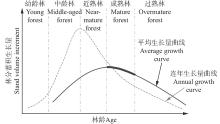
图1
各阶段的林分蓄积生长量"
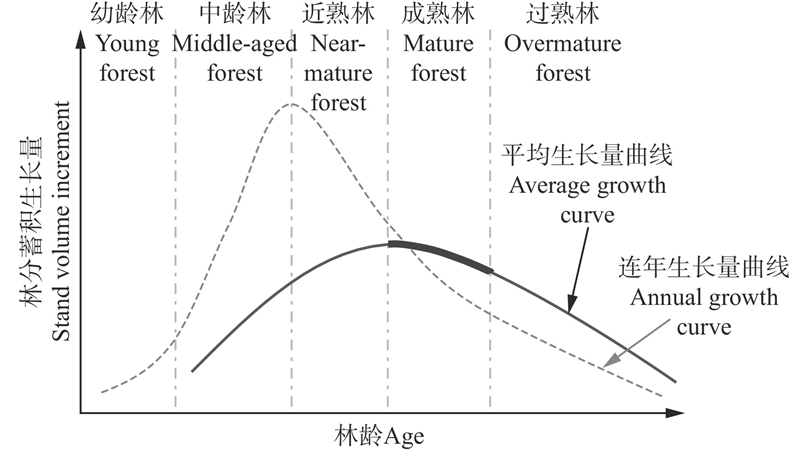

表1
我国主要速生、中生和慢生树种龄组划分示例"
| 主要树种 Main tree species | 速生种(杉木) Fast-growing (Cunninghamia lanceolata) | 中生种(马尾松) Medium-growing (Pinus massoniana) | 慢生种(红松) Slow-growing (Pinus koraiensis) | |
| 区域Region | 南方Southern China | 南方Southern China | 北方Northern China | |
| 林分起源Origin | 人工Artificial | 天然Natural | 人工Artificial | |
| 龄组 Age group/a | 幼龄林Young forest | ≤10 | ≤20 | ≤40 |
| 中龄林Middle-aged forest | 11~20 | 21~30 | 41~60 | |
| 近熟林Near-mature forest | 21~25 | 31~40 | 61~80 | |
| 成熟林Mature forest | 26~35 | 41~60 | 81~120 | |
| 过熟林Overmature forest | ≥36 | ≥61 | ≥121 | |
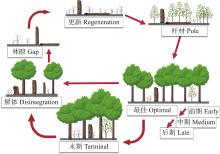
图2
森林循环阶段示意(Begehold et al.,2015) 各阶段典型特征:林隙阶段(郁闭度< 30%、更新盖度<50%);更新阶段(郁闭度< 30%、更新盖度>50%);杆材阶段(郁闭度>30%、最大胸径<20 cm);最佳阶段(最大胸径,前期20~40 cm,中期40~60 cm,后期>60 cm);终末阶段(最大树高>85%潜在最大树高,死木蓄积<30%);解体阶段(死木蓄积>30%、更新盖度<50%)。更新指胸径小于7 cm的所有幼树。"
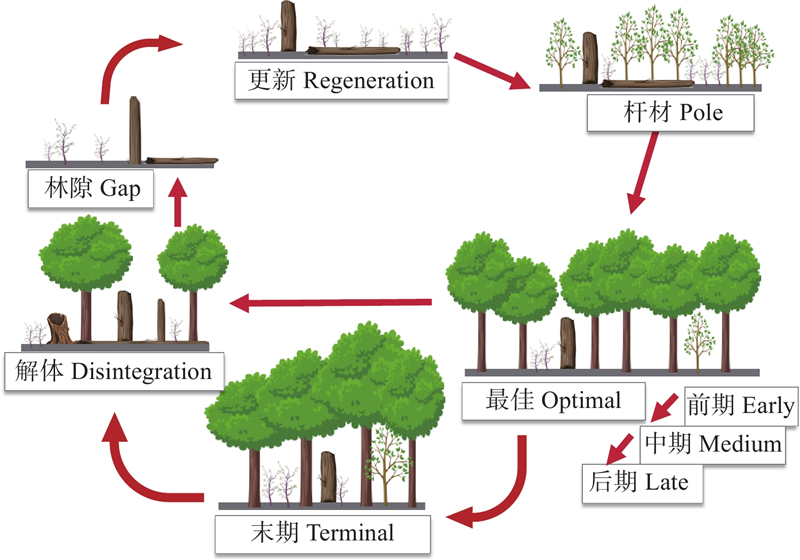
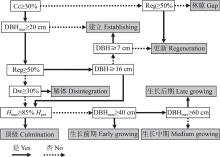
图3
森林循环阶段划分二分决策树方法(Winter et al.,2011) Cc:林冠郁闭度Canopy cover;DBH:胸高直径Diameter at breast height;DBHmax:最大胸径Maximum DBH;DBHø:平均胸径Mean DBH;Dw:枯立木和枯倒木的蓄积占比Proportion of standing and lying deadwood on the total stock volume;Hmax:最大树高Maximum tree height;Hpot:潜在最大树高Potential maximum tree height;Reg:更新盖度Percentage of the plot covered by tree regeneration."
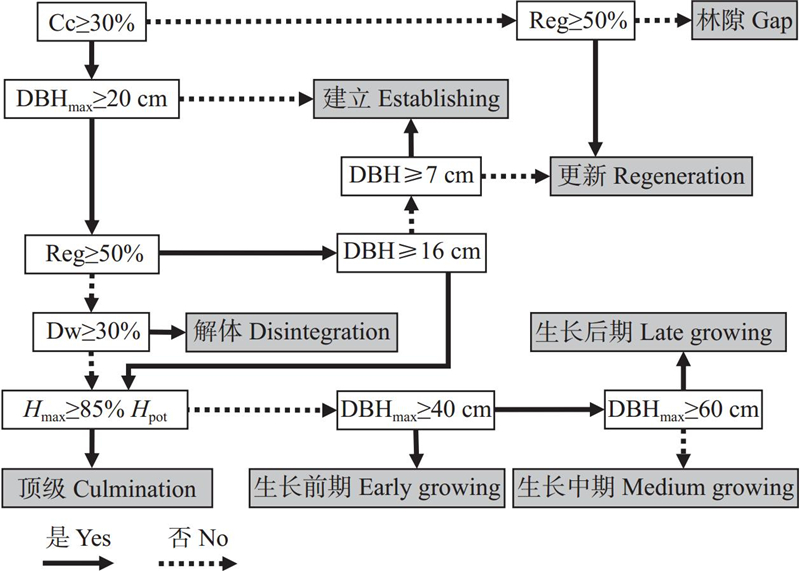
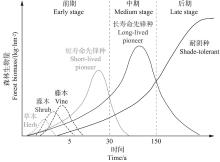
图4
森林正向演替阶段示意(Poorter et al.,2023)"
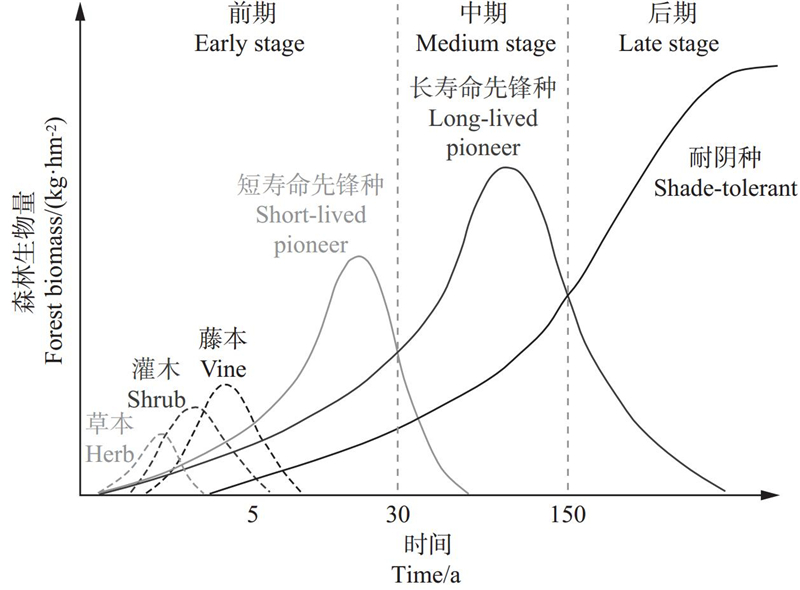
图5
森林近自然发育阶段示意"
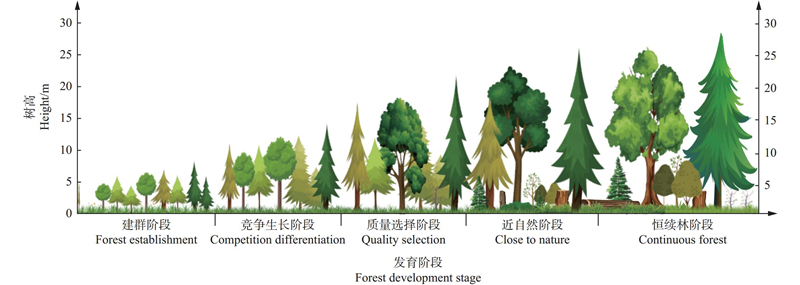
表2
各范式的核心特征对比"
| 比较维度 Comparison dimension | 时序范式 (龄组划分法) Temporal paradigm (age-class division) | 结构范式 (森林循环阶段划分法) Structural paradigm (forest cycle stage classification) | 生态范式 (正向演替阶段划分法) Ecological paradigm (forward succession stage classification) | 融合范式 (近自然发育阶段划分法) Integrated paradigm (close-to-nature development stage classification) |
| 核心理论 Core theory | 法正林理论 Normal forest theory | 林隙动态理论 Gap dynamics theory | 经典演替理论 Classical succession theory | 全周期经营理论 Life-cycle management theory |
| 空间尺度 Spatial scale | 林分 Stand | 林分-斑块 Stand-patch | 景观/生态系统 Landscape/ecosystem | 林分 Stand |
| 时间尺度 Temporal scale | 经营周期 (数年至数十年) Management cycle (from years to decades) | 自然循环周期 (数十年至数百年) Natural cycle (from decades to centuries) | 演替周期 (数十年至数百年) Succession cycle (from decades to centuries) | 生命周期/经营周期 Life cycle/management cycle |
| 主导指标 Dominant indicators | 林分年龄 Stand age | 林分结构特征 (如郁闭度、死木蓄积量) Stand structural attributes (e.g., canopy cover, deadwood volume) | 物种功能群更替 Replacement of species functional groups | 结构指标为主,结合物种 (如树高胸径比) Mainly based on structural indicators, combined with species (e.g., height-to-diameter ratio) |
| 主要应用场景 Primary application context | 人工林、相对同龄林木材 生产与资源清查 Plantation, even-aged forest for timber production and resource inventory | 原始林保护、自然保护区 管理、生态学研究 Primary forest conservation, nature reserve management, ecological research | 植被恢复、生态修复、 长期群落动态研究 Vegetation restoration, ecological rehabilitation, long-term community dynamics research | 多功能森林经营、近自然林业、 人工林改培 Multi-functional forest management, close-to-nature forestry, improvement of plantations |
|
包 青, 郑晓光, 王广山, 等. 天然落叶松林分生长阶段划分与定向经营. 东北林业大学学报, 1997, 25 (1): 12- 14.
doi: 10.13759/j.cnki.dlxb.1997.01.004 |
|
|
Bao Q, Zheng X G, Wang G S, et al. The division of growth stages and aim-classification management of nature larch stand. Journal of Northeast Forestry University, 1997, 25 (1): 12- 14.
doi: 10.13759/j.cnki.dlxb.1997.01.004 |
|
|
胡雪凡, 张会儒, 张晓红. 中国代表性森林经营技术模式对比研究. 森林工程, 2019, 35 (4): 32- 38.
doi: 10.3969/j.issn.1006-8023.2019.04.006 |
|
|
Hu X F, Zhang H R, Zhang X H. Contrastive research on practice and application of forest management technology mode in China. Forest Engineering, 2019, 35 (4): 32- 38.
doi: 10.3969/j.issn.1006-8023.2019.04.006 |
|
| 贾 珂, 王新杰, 和敬渊, 等. 基于TWINSPAN分类的汪清县温带森林发育演替阶段分析. 南京林业大学学报(自然科学版), 2024, 48 (1): 179- 186. | |
| Jia K, Wang X J, He J Y, et al. Analyses of the temperate forests development and succession stage in Wangqing County based on TWINSPAN. Journal of Nanjing Forestry University (Natural Sciences Edition), 2024, 48 (1): 179- 186. | |
| 李婷婷, 陆元昌, 张显强, 等. 经营的马尾松森林类型发育演替阶段量化指标研究. 北京林业大学学报, 2014, 36 (3): 9- 17. | |
| Li T T, Lu Y C, Zhang X Q, et al. Quantitative indices to identify succession stages of managed Pinus massoniana forest. Journal of Beijing Forestry University, 2014, 36 (3): 9- 17. | |
| 陆 鑫, 巴乐金, 乌兰·吾尚. 等. 海拔对塔城地区野果林生态位与种间关联影响. 森林工程, 2024, 40 (3): 76- 86. | |
| Lu X, Balejin, Wulan·W, et al. The impact of elevation on the ecological niche and interspecific association of wild fruit forests in Tacheng area. Forest Engineering, 2024, 40 (3): 76- 86. | |
| 栾兆平, 郭滨德, 吴金卓. 长白山地区黄檗阔叶混交林主要乔木种群生态位特征. 森林工程, 2023, 39 (4): 78- 85. | |
| Luan Z P, Guo B D, Wu J Z. Niche characteristics of main tree populations in broad-leaved mixed forest of Phellodendron amurense in Changbai Mountain area. Forest Engineering, 2023, 39 (4): 78- 85. | |
| 陆元昌. 2006. 近自然森林经营的理论与实践. 北京: 科学出版社. | |
| Lu Y C. 2006. Theory and practice of close-natural forest management. Beijing: Science Press. [in Chinese] | |
| 陆元昌, 蒋三乃, 雷相东. 2016. 森林抚育规程解读. 北京: 中国林业出版社. | |
| Lu Y C, Jiang S N, Lei X D. 2016. Interpretation of the regulations for forest tending. Beijing: China Forestry Publishing House. [in Chinese] | |
|
陆元昌, 雷相东, 谢阳生, 等. 森林全周期经营: 基于不同演替理论和经营目标的计划模式及应用价值. 南京林业大学学报(自然科学版), 2025, 49 (6): 1- 12.
doi: 10.12302/j.issn.1000-2006.202507006 |
|
|
Lu Y C, Lei X D, Xie Y S, et al. Life-cycle forest management: planning models and application value under different succession theories and management objectives. Journal of Nanjing Forestry University (Natural Science Edition), 2025, 49 (6): 1- 12.
doi: 10.12302/j.issn.1000-2006.202507006 |
|
|
陆元昌, 刘宪钊, 雷相东, 等. 人工林多功能经营技术体系. 中南林业科技大学学报, 2017, 37 (7): 1- 10.
doi: 10.14067/j.cnki.1673-923x.2017.07.001 |
|
|
Lu Y C, Liu X Z, Lei X D, et al. Technical system for plantation multi-function management. Journal of Central South University of Forestry & Technology, 2017, 37 (7): 1- 10.
doi: 10.14067/j.cnki.1673-923x.2017.07.001 |
|
| 彭少麟. 1996. 南亚热带森林群落动态学. 北京: 科学出版社. | |
| Peng S L. 1996. The dynamics of forest community in southern-subtropical region. Beijing: Science Press. [in Chinese] | |
| 王红春. 龄组划分的公式化表达及其应用. 林业资源管理, 2011 (3): 72- 75. | |
| Wang H C. Study on formulation of age-group division and its application. Forest Resources Management, 2011 (3): 72- 75. | |
| 谢阳生, 陆元昌, 刘宪钊, 等. 2019. 多功能森林经营方案编制技术及案例. 北京: 中国林业出版社. | |
| Xie Y S, Lu Y C, Liu X Z. 2019. Multifunctional forest management programming technology and case study. Beijing: China Forestry Publishing House. [in Chinese] | |
|
徐德鹏, 许芳泽, 孙海龙, 等. 天然混交林林分发育阶段划分方法的比较. 北京林业大学学报, 2024, 46 (7): 139- 152.
doi: 10.12171/j.1000-1522.20230174 |
|
|
Xu D P, Xu F Z, Sun H L, et al. Comparison of methods for dividing developmental stages of natural mixed forest stands. Journal of Beijing Forestry University, 2024, 46 (7): 139- 152.
doi: 10.12171/j.1000-1522.20230174 |
|
| 于政中. 1993. 森林经理学. 2版. 北京: 中国林业出版社. | |
| Yu Z Z. 1993. Forest management. 2nd ed. Beijing: China Forestry Publishing House. [in Chinese] | |
|
臧润国, 徐化成. 林隙(GAP)干扰研究进展. 林业科学, 1998, 34 (1): 90- 98.
doi: 10.3321/j.issn:1001-7488.1998.01.013 |
|
|
Zang R G, Xu H C. Advances in forest gap disturbance research. Scientia Silvae Sinicae, 1998, 34 (1): 90- 98.
doi: 10.3321/j.issn:1001-7488.1998.01.013 |
|
|
张 超, 黄清麟. 林业区划研究综述. 林业资源管理, 2005 (5): 16- 20, 23.
doi: 10.3969/j.issn.1002-6622.2005.05.004 |
|
|
Zhang C, Huang Q L. Review on research of forest division. Forest Resources Management, 2005 (5): 16- 20, 23.
doi: 10.3969/j.issn.1002-6622.2005.05.004 |
|
|
张会儒, 雷相东, 张春雨, 等. 森林质量评价及精准提升理论与技术研究. 北京林业大学学报, 2019, 41 (5): 1- 18.
doi: 10.13332/j.1000-1522.20190219 |
|
|
Zhang H R, Lei X D, Zhang C Y, et al. Research on theory and technology of forest quality evaluation and precision improvement. Journal of Beijing Forestry University, 2019, 41 (5): 1- 18.
doi: 10.13332/j.1000-1522.20190219 |
|
| 张会儒, 汤孟平. 金沟岭林场混交林TWINSPAN分类及演替序列分析. 南京林业大学学报(自然科学版), 2009, 33 (1): 37- 42. | |
| Zhang H R, Tang M P. Classification and succession analysis of mixed forest in Jingouling forest farm using the TWINSPAN method. Journal of Nanjing Forestry University (Natural Sciences Edition), 2009, 33 (1): 37- 42. | |
| 张家来. 应用最优分割法划分森林群落演替阶段的研究. 植物生态学与地植物学学报, 1993, 17 (3): 224- 231. | |
| Zhang J L. Study on dividing the successional stages of forest communities with division method of optimization. Acta Phytoecologica et Geobotanica Sinica, 1993, 17 (3): 224- 231. | |
| 张凌峰, 刘兆刚, 董灵波. 帽儿山天然硬阔叶林发育阶段划分及林分结构特征. 北京林业大学学报, 2025, 47 (2): 10- 22. | |
| Zhang L F, Liu Z G, Dong L B. Development stage division and stand structure characteristics of natural hard broadleaved forest in Maor Mountain, Heilongjiang Province of northeastern China. Journal of Beijing Forestry University, 2025, 47 (2): 10- 22. | |
|
周超凡, 张会儒, 卢 军, 等. 东北主要天然次生林干扰与演替规律. 林业科学研究, 2021, 34 (4): 175- 183.
doi: 10.13275/j.cnki.lykxyj.2021.04.021 |
|
|
Zhou C F, Zhang H R, Lu J, et al. Disturbances and succession laws of main natural secondary forests in northeast China. Forest Research, 2021, 34 (4): 175- 183.
doi: 10.13275/j.cnki.lykxyj.2021.04.021 |
|
| 周梦丽, 雷相东, 国 红, 等. 基于TWINSPAN分类的天然云冷杉−阔叶混交林发育阶段划分. 林业科学研究, 2019, 32 (3): 49- 55. | |
| Zhou M L, Lei X D, Guo H, et al. Determining the development stage of natural spruce-fir-broadleaved mixed forest based on TWINSPAN. Forest Research, 2019, 32 (3): 49- 55. | |
| Assmann E. 1970. The principles of forest yield study: studies in the organic production, structure, increment, and yield of forest stands. Oxford: Pergamon Press. | |
| Bartsch N, von Lüpke B, Röhrig E. 2020. Waldbau auf ökologischer Grundlage. 8th Ed. Stuttgart, Deutschland: Verlag Eugen Ulmer. | |
| Bauhus J, van der Meer P, Kanninen M. 2010. Ecosystem goods and services: the key for sustainable plantations//Ecosystem goods and services from plantation forests. London: Routledge. | |
|
Begehold H, Rzanny M, Flade M. Forest development phases as an integrating tool to describe habitat preferences of breeding birds in lowland beech forests. Journal of Ornithology, 2015, 156 (1): 19- 29.
doi: 10.1007/s10336-014-1095-z |
|
|
Bobiec A, van der Burgt H, Meijer K, et al. Rich deciduous forests in Białowieża as a dynamic mosaic of developmental phases: premises for nature conservation and restoration management. Forest Ecology and Management, 2000, 130 (1/2/3): 159- 175.
doi: 10.1016/s0378-1127(99)00181-4 |
|
|
Boncina A. Comparison of structure and biodiversity in the Rajhenav virgin forest remnant and managed forest in the Dinaric region of Slovenia. Global Ecology and Biogeography, 2000, 9 (3): 201- 211.
doi: 10.1046/j.1365-2699.2000.00155.x |
|
|
Brang P, Spathelf P, Larsen J B, et al. Suitability of close-to-nature silviculture for adapting temperate European forests to climate change. Forestry, 2014, 87 (4): 492- 503.
doi: 10.1093/forestry/cpu018 |
|
| Chazdon R L. 2008. Chance and determinism in tropical forest succession//Carson W P, Schnitzer S A. Tropical forest community ecology. Oxford: Wiley-Blackwell. | |
|
Chazdon R L, Finegan B, Capers R S, et al. Composition and dynamics of functional groups of trees during tropical forest succession in northeastern costa rica. Biotropica, 2010, 42 (1): 31- 40.
doi: 10.1111/j.1744-7429.2009.00566.x |
|
| Clements F E. 1916. Plant succession; an analysis of the development of vegetation. Washington: Carnegie Institution of Washington. | |
| Davis L S, Johnson K N. 1987. Forest management. 3rd ed. New York: McGraw-Hill Book Company. | |
|
Duncker P S, Barreiro S M, Hengeveld G M, et al. Classification of forest management approaches: a new conceptual framework and its applicability to European forestry. Ecology and Society, 2012, 17 (4): 51.
doi: 10.5751/es-05262-170451 |
|
|
Dufrêne M, Legendre P. Species assemblages and indicator species: the need for a flexible asymmetrical approach. Ecological Monographs, 1997, 67 (3): 345- 366.
doi: 10.2307/2963459 |
|
|
Emborg J, Christensen M, Heilmann-Clausen J. The structural dynamics of Suserup Skov, a near-natural temperate deciduous forest in Denmark. Forest Ecology and Management, 2000, 126 (2): 173- 189.
doi: 10.1016/S0378-1127(99)00094-8 |
|
|
Fassnacht F E, White J C, Wulder M A, et al. Remote sensing in forestry: current challenges, considerations and directions. Forestry: an International Journal of Forest Research, 2024, 97 (1): 11- 37.
doi: 10.1093/forestry/cpad024 |
|
|
Finegan B. Forest succession. Nature, 1984, 312 (5990): 109- 114.
doi: 10.1038/312109a0 |
|
|
Finegan B. Pattern and process in neotropical secondary rain forests: the first 100 years of succession. Trends in Ecology & Evolution, 1996, 11 (3): 119- 124.
doi: 10.1016/0169-5347(96)81090-1 |
|
|
Franklin J F, Spies T A, Van Pelt R, et al. Disturbances and structural development of natural forest ecosystems with silvicultural implications, using Douglas-fir forests as an example. Forest Ecology and Management, 2002, 155 (1/2/3): 399- 423.
doi: 10.3410/f.726131299.793514344 |
|
|
Frelich L E, Lorimer C G. Natural disturbance regimes in hemlock-hardwood forests of the upper great lakes region. Ecological Monographs, 1991, 61 (2): 145- 164.
doi: 10.2307/1943005 |
|
|
Führer E. Forest functions, ecosystem stability and management. Forest Ecology and Management, 2000, 132 (1): 29- 38.
doi: 10.1016/S0378-1127(00)00377-7 |
|
| Gamborg C, Larsen J B. 2003. ‘Back to nature’: a sustainable future for forestry? Forest Ecology and Management, 179(1/2/3): 559−571. | |
| Garet J, Raulier F, Pothier D, et al. 2012. Forest age class structures as indicators of sustainability in boreal forest: are we measuring them correctly? Ecological Indicators, 23: 202−210. | |
| Glatthorn J, Feldmann E, Tabaku V, et al. 2018. Classifying development stages of primeval European beech forests: is clustering a useful tool? BMC Ecology, 18(1): 47. | |
|
Grime J P. Evidence for the existence of three primary strategies in plants and its relevance to ecological and evolutionary theory. The American Naturalist, 1977, 111 (982): 1169- 1194.
doi: 10.1086/283244 |
|
|
Goodell L, Faber-Langendoen D. Development of stand structural stage indices to characterize forest condition in Upstate New York. Forest Ecology and Management, 2007, 249 (3): 158- 170.
doi: 10.1016/j.foreco.2007.04.052 |
|
|
Gough C M, Atkins J W, Bond-Lamberty B, et al. Forest structural complexity and biomass predict first-year carbon cycling responses to disturbance. Ecosystems, 2021, 24 (3): 699- 712.
doi: 10.1007/s10021-020-00544-1 |
|
|
Holl K D. Restoring tropical forests from the bottom up. Science, 2017, 355 (6324): 455- 456.
doi: 10.1126/science.aam5432 |
|
|
Johnson E A, Miyanishi K. Testing the assumptions of chronosequences in succession. Ecology Letters, 2008, 11 (5): 419- 431.
doi: 10.1111/j.1461-0248.2008.01173.x |
|
|
Koop H, Hilgen P. Forest dynamics and regeneration mosaic shifts in unexploited beech (Fagus sylvatica) stands at Fontainebleau (France). Forest Ecology and Management, 1987, 20 (1/2): 135- 150.
doi: 10.1016/0378-1127(87)90155-1 |
|
| Korpel S. Degree of equilibrium and dynamical changes of the forest on example of natural forests of Slovakia. Acta Facultatis Forestalis Zvolen, 1982, 24, 9- 31. | |
|
Král K, Shue J, Vrška T, et al. Fine-scale patch mosaic of developmental stages in northeast American secondary temperate forests: the European perspective. European Journal of Forest Research, 2016, 135 (5): 981- 996.
doi: 10.1007/s10342-016-0988-1 |
|
|
Král K, Vrška T, Hort L, et al. Developmental phases in a temperate natural spruce-fir-beech forest: determination by a supervised classification method. European Journal of Forest Research, 2010, 129 (3): 339- 351.
doi: 10.1007/s10342-009-0340-0 |
|
|
Larrieu L, Cabanettes A, Gonin P, et al. Deadwood and tree microhabitat dynamics in unharvested temperate mountain mixed forests: a life-cycle approach to biodiversity monitoring. Forest Ecology and Management, 2014, 334, 163- 173.
doi: 10.1016/j.foreco.2014.09.007 |
|
| Larsen J B. 2012. Close-to-nature forest management: the Danish approach to sustainable forestry. Sustainable Forest Management, Current Research. Croatia: InTech. | |
|
Lavorel S, McIntyre S, Landsberg J, et al. Plant functional classifications: from general groups to specific groups based on response to disturbance. Trends in Ecology & Evolution, 1997, 12 (12): 474- 478.
doi: 10.1016/S0169-5347(97)01219-6 |
|
| Legendre P, Legendre L. 2012. Numerical ecology. 3rd ed. Netherlands: Elsevier. | |
| Leibundgut H. 1959. Über zweck und methodik der struktur- und zuwachsanalyse von urwäldern. Schweiz Z Forstwes. 110: 111−124. | |
|
Lindenmayer D B, Franklin J F, Fischer J. General management principles and a checklist of strategies to guide forest biodiversity conservation. Biological Conservation, 2006, 131 (3): 433- 445.
doi: 10.1016/j.biocon.2006.02.019 |
|
|
Lorimer C G, Halpin C R. Classification and dynamics of developmental stages in late-successional temperate forests. Forest Ecology and Management, 2014, 334, 344- 357.
doi: 10.1016/j.foreco.2014.09.003 |
|
|
McRoberts R E, Tomppo E O. Remote sensing support for national forest inventories. Remote Sensing of Environment, 2007, 110 (4): 412- 419.
doi: 10.1016/j.rse.2006.09.034 |
|
| Messier C, Puettmann K J, Coates K D. 2015. Managing forests as complex adaptive systems: building resilience to the challenge of global change. New York: Routledge. | |
|
Millar C I, Stephenson N L. Temperate forest health in an era of emerging megadisturbance. Science, 2015, 349 (6250): 823- 826.
doi: 10.1126/science.aaa9933 |
|
|
Norden N, Angarita H A, Bongers F, et al. Successional dynamics in Neotropical forests are as uncertain as they are predictable. PNAS, 2015, 112 (26): 8013- 8018.
doi: 10.1073/pnas.1500403112 |
|
| O’Hara K L. 2014. Multiaged silviculture: managing for complex forest stand structures. Oxford: Oxford University Press. | |
| Oliver C D, Larson B C. 1996. Forest stand dynamics. New York: Wiley. | |
|
Peet R K, Christensen N L. Competition and tree death. BioScience, 1987, 37 (8): 586- 595.
doi: 10.2307/1310669 |
|
| Peterken G F. 1996. Natural woodland: ecology and conservation in northern temperate regions. Cambridge: Cambridge University Press. | |
|
Pickett S T A, Cadenasso M L, Meiners S J. Ever since Clements: from succession to vegetation dynamics and understanding to intervention. Applied Vegetation Science, 2009, 12 (1): 9- 21.
doi: 10.1111/j.1654-109X.2009.01019.x |
|
|
Pommerening A, Murphy S T. A review of the history, definitions and methods of continuous cover forestry with special attention to afforestation and restocking. Forestry, 2004, 77 (1): 27- 44.
doi: 10.1093/forestry/77.1.27 |
|
|
Poorter L, Amissah L, Bongers F, et al. Successional theories. Biological Reviews, 2023, 98, 2049- 2077.
doi: 10.1111/brv.12995 |
|
|
Reichstein M, Camps-Valls G, Stevens B, et al. Deep learning and process understanding for data-driven earth system science. Nature, 2019, 566 (7743): 195- 204.
doi: 10.1038/s41586-019-0912-1 |
|
| Runkle J R. 1985. Disturbance regimes in temperate forests//The ecology of natural disturbance and patch dynamics. New York: Academic Press. | |
|
Schütz J P, Saniga M, Diaci J, et al. Comparing close-to-nature silviculture with processes in pristine forests: lessons from central Europe. Annals of Forest Science, 2016, 73 (4): 911- 921.
doi: 10.1007/s13595-016-0579-9 |
|
|
Seidl R, Thom D, Kautz M, et al. Forest disturbances under climate change. Nature Climate Change, 2017, 7 (6): 395- 402.
doi: 10.1038/nclimate3303 |
|
| Smith W B. 2002. Forest inventory and analysis: a national inventory and monitoring program. Environmental Pollution, 116(suppl 1): 233−242. | |
| Spies T A. 1998. Forest structure: a key to the ecosystem. Northwest Science, 72(2): 34−39. | |
|
Trumbore S, Brando P, Hartmann H. Forest health and global change. Science, 2015, 349 (6250): 814- 818.
doi: 10.1126/science.aac6759 |
|
|
Vilén T, Gunia K, Verkerk P J, et al. Reconstructed forest age structure in Europe 1950—2010. Forest Ecology and Management, 2012, 286, 203- 218.
doi: 10.1016/j.foreco.2012.08.048 |
|
| Walker L R, Moral R. 2003. Primary succession and ecosystem rehabilitation. Cambridge: Cambridge University Press. | |
|
Watt A S. On the ecology of British beechwoods with special reference to their regeneration: part Ⅱ, sections Ⅱ and Ⅲ. The development and structure of beech communities on the Sussex Downs. The Journal of Ecology, 1925, 13 (1): 27- 73.
doi: 10.2307/2255556 |
|
|
White J C, Coops N C, Wulder M A, et al. Remote sensing technologies for enhancing forest inventories: a review. Canadian Journal of Remote Sensing, 2016, 42 (5): 619- 641.
doi: 10.1080/07038992.2016.1207484 |
|
|
Whitmore T C. Canopy gaps and the two major groups of forest trees. Ecology, 1989, 70 (3): 536- 538.
doi: 10.2307/1940195 |
|
|
Whittaker R H. A consideration of climax theory: the climax as a population and pattern. Ecological Monographs, 1953, 23 (1): 41- 78.
doi: 10.2307/1943519 |
|
|
Winter S, Brambach F. Determination of a common forest life cycle assessment method for biodiversity evaluation. Forest Ecology and Management, 2011, 262 (12): 2120- 2132.
doi: 10.1016/j.foreco.2011.07.036 |
|
|
Wulder M A, Loveland T R, Roy D P, et al. Current status of Landsat program, science, and applications. Remote Sensing of Environment, 2019, 225, 127- 147.
doi: 10.1016/j.rse.2019.02.015 |
|
|
Zang R G, Tao J P, Li C Y. Within community patch dynamics in a tropical montane rain forest of Hainan Island, south China. Acta Oecologica, 2005, 28 (1): 39- 48.
doi: 10.1016/j.actao.2005.02.001 |
|
|
Zenner E K, Peck J E, Hobi M L, et al. Validation of a classification protocol: meeting the prospect requirement and ensuring distinctiveness when assigning forest development phases. Applied Vegetation Science, 2016, 19 (3): 541- 552.
doi: 10.1111/avsc.12231 |
|
|
Zenner E K, Sagheb-Talebi K, Akhavan R, et al. Integration of small-scale canopy dynamics smoothes live-tree structural complexity across development stages in old-growth Oriental beech (Fagus orientalis Lipsky) forests at the multi-gap scale. Forest Ecology and Management, 2015, 335, 26- 36.
doi: 10.1016/j.foreco.2014.09.023 |
|
|
Zhou C F, Ding Y, Zang R G. Compositional changes at neighborhood and stand scales during recovery of a tropical lowland rainforest after shifting cultivation on Hainan Island, China. Journal of Environmental Management, 2024, 351, 119951.
doi: 10.1016/j.jenvman.2023.119951 |
| [1] | 高文强,雷相东,何潇,李玉堂. 东北温带森林类型和发育阶段的树种多样性−地上生物量关系分异性[J]. 林业科学, 2026, 62(4): 55-67. |
| [2] | 杜月伟,萨日娜,金海炎,胡艳波,张弓乔,刘文桢,赵中华. 基于林分状态特征的次生林发育阶段划分方法——以锐齿槲栎次生林为例[J]. 林业科学, 2026, 62(3): 111-121. |
| [3] | 叶琦,刘峰,付涛,李文,张乐,王志龙. 分子与形态学证据支持蔷薇科李属樱亚属新种——四明山樱桃[J]. 林业科学, 2026, 62(2): 147-153. |
| [4] | 江雨琦,牛健植,王迪,杨涛,戴正宇,郑佳玉. 基于染色示踪和探地雷达的辽宁老秃顶子天然次生林土壤优先流特征[J]. 林业科学, 2025, 61(8): 32-45. |
| [5] | 吴庆明,孙雪颖,林晓刚,陈露,吕泓学,邹红菲,朱井丽. 挠力河保护区退耕模式对鸟类群落多样性的影响[J]. 林业科学, 2025, 61(7): 262-273. |
| [6] | 吕梦燕,任军,张立民,陈思羽,赵佳丽,鲁佳乐,孔晨,戴维,金桂香. 基于光合指标的平欧杂种榛扦插苗根系生长发育评价模型[J]. 林业科学, 2025, 61(3): 100-107. |
| [7] | 刘明彤,庄和必,王紫彤,石帅宾,刘晓娟,林二培,胡现铬,黄华宏. 杉木次生壁发育调控转录因子基因ClNAC40的生物学功能[J]. 林业科学, 2025, 61(2): 131-141. |
| [8] | 刘彩霞,王慧敏,张美丽,梁玲瑜,蔡泱莲,汪杨,王正,吕全. 钝翅细小蠹对樟子松的危害及其传播松枯梢病的潜在作用[J]. 林业科学, 2025, 61(1): 17-25. |
| [9] | 谭凤森,李清河. 荒漠灌木的木质部解剖结构与功能权衡——以内蒙西部18种灌木为例[J]. 林业科学, 2025, 61(1): 81-94. |
| [10] | 朱铭玮,赵薇,付威,高云鹏,王文武,解志军,李淑娴. 国槐种子成熟过程及其水分时空变化[J]. 林业科学, 2024, 60(9): 41-49. |
| [11] | 李心钰,钱铖,陶静,宗世祥. 入侵害虫长林小蠹线粒体全基因组的测定与分析[J]. 林业科学, 2024, 60(8): 164-173. |
| [12] | 涂晓云,赵洋毅,王克勤,欧阳田甜,李志成,和娴越. 中亚热带不同演替阶段森林土壤水分时空异质性[J]. 林业科学, 2024, 60(6): 13-24. |
| [13] | 耿显胜,舒金平,刘莹,刘军. 浙江省香椿溃疡病病原菌的分离和鉴定[J]. 林业科学, 2024, 60(5): 151-157. |
| [14] | 车冰雁, 余尚妍, 李志能, 李先源. 蜡梅花发育相关基因CpUFO表达特性与功能分析[J]. 林业科学, 2024, 60(2): 87-96. |
| [15] | 杨雪晴, 刘文义, 陈静, 孙士淼, 周立峰, 胡加付. 松材线虫cul-1基因的表达特性与功能[J]. 林业科学, 2023, 59(9): 95-105. |
| 阅读次数 | ||||||
|
全文 |
|
|||||
|
摘要 |
|
|||||

