
林业科学 ›› 2026, Vol. 62 ›› Issue (7): 230-239.doi: 10.11707/j.1001-7488.LYKX20250708
韩学正1,2,何念鹏1,3,*( ),蔡伟祥4,李维刚1
收稿日期:2025-11-24
出版日期:2026-07-10
发布日期:2026-07-16
通讯作者:
何念鹏
E-mail:henp@igsnrr.ac.cn
基金资助:
Xuezheng Han1,2,Nianpeng He1,3,*(),Weixiang Cai4,Weigang Li1
Received:2025-11-24
Online:2026-07-10
Published:2026-07-16
Contact:
Nianpeng He
E-mail:henp@igsnrr.ac.cn
摘要:
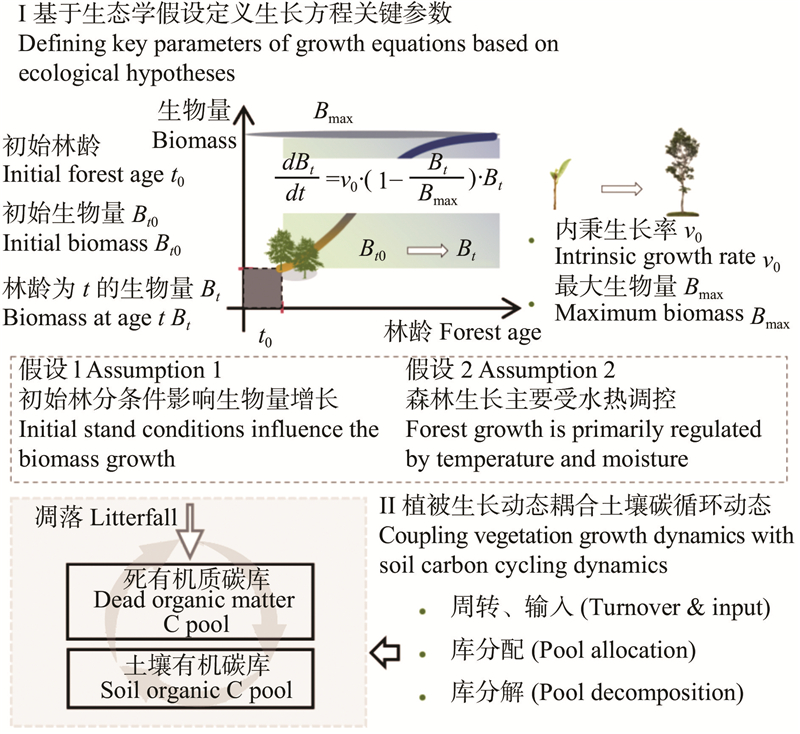
森林生态系统是陆地生态系统碳汇功能的主体部分,科学、准确评估森林碳汇是提升陆地生态系统碳汇能力和应对气候变化的前提,尤其是预测其长期动态变化,对优化森林经营策略和实现我国“双碳”战略目标具有重要价值。目前应用较多的过程模型主要基于森林生态系统生产力的预测思路,依托“光量子传递?大叶模型”解析森林碳汇形成机理,借助 GPP、NPP 等生态系统生产力指标研判森林碳汇短期动态,弥补了传统实地观测法难以预判森林生态系统碳汇变化的短板。理论上,森林群落属性在很大程度上决定了森林生态系统碳汇功能的时空变化特征。在气候作用与物种相互竞争的双向调节下,森林碳汇动态主要受群落林龄和植被生长状况调控。因此,在开展森林碳汇动态评估时,需充分考量该调控机制。然而,目前有关森林生态系统碳汇形成机制的研究难以科学地解释森林群落的动态增长模式,导致基于生产力的森林碳汇预测思路无法支持过程模型去评估未来生态系统碳汇的长期增长规律及其时空变异动态,进而使得相关评估结果难以为政府制定森林生态系统碳汇提升策略提供有效的科学依据。针对上述不足,本文系统阐述了基于林木生长过程预测森林生态系统长期碳汇动态的研究框架。该框架基于生长方程,刻画了林龄驱动的森林生物质碳库长期增长模式,并在传统森林植被生长规律的科学假设中融入了森林碳汇对气候、土壤因素的响应机制,从而实现了基于林木生长过程的森林植被碳汇动态预测。基于该框架,本研究发展了森林碳固持(forest carbon sequestration, FCS )模型。该模型采用 Logistic 生长方程与关键参数刻画森林植被碳汇的长期动态规律,并在此基础上借鉴过程模型的碳周转研究思路,构建了由森林植被动态驱动其他主要碳库(死有机质碳库、土壤有机碳库)储量增长的森林生态系统碳汇预测模型。利用中国典型森林生态系统的系统调查数据对模型进行参数化,研究表明 FCS 模型能够很好地量化森林生态系统碳汇在时空协变过程中的变异规律。基于林木生长过程的森林生态系统碳汇预测框架为森林碳汇预测提供了新的理论范式,有效提升了森林生态系统碳汇长期动态变化的模拟能力。
中图分类号:
韩学正,何念鹏,蔡伟祥,李维刚. 基于林木生长过程的森林生态系统碳汇长期预测方法——理论基础与构架分析[J]. 林业科学, 2026, 62(7): 230-239.
Xuezheng Han,Nianpeng He,Weixiang Cai,Weigang Li. Methods of the Long-Term Dynamics Prediction for Forest Ecosystem Carbon Sink based on Forest Growth Processes: Theoretical Basis and Framework Analysis[J]. Scientia Silvae Sinicae, 2026, 62(7): 230-239.
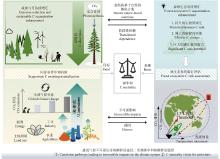
图1
森林生态系统巨大的固碳能力对实现碳中和目标的重要作用"
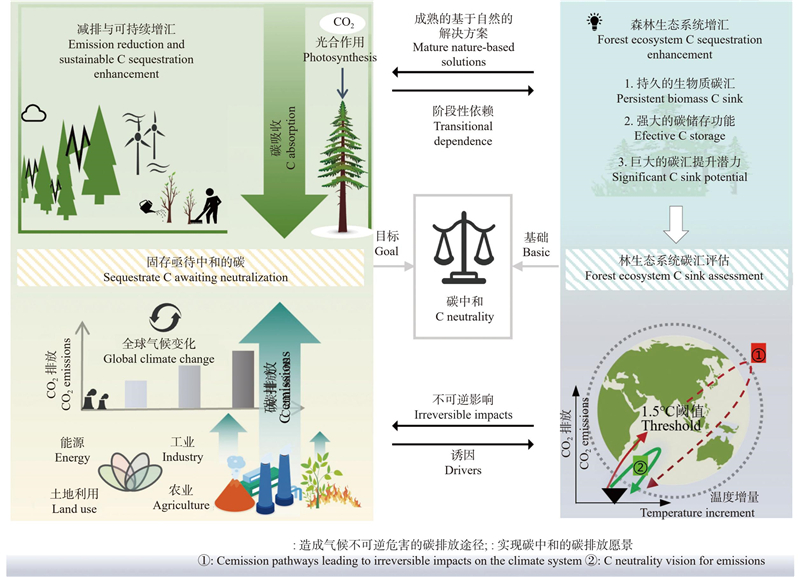
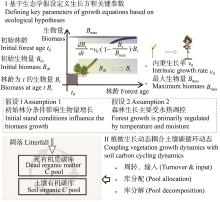
图2
基于林木生长规律构建森林碳汇长期预测的理论框架"
|
方精云. 碳中和的生态学透视. 植物生态学报, 2021, 45 (11): 1173- 1176.
doi: 10.17521/cjpe.2021.0394 |
|
|
Fang J Y. Ecological perspectives of carbon neutrality. Chinese Journal of Plant Ecology, 2021, 45 (11): 1173- 1176.
doi: 10.17521/cjpe.2021.0394 |
|
|
付 晓, 张煜星, 王雪军. 2060年前我国森林生物量碳库及碳汇潜力预测. 林业科学, 2022, 58 (2): 32- 41.
doi: 10.11707/j.1001-7488.20220204 |
|
|
Fu X, Zhang Y X, Wang X J. Prediction of forest biomass carbon pool and carbon sink potential in China before 2060. Scientia Silvae Sinicae, 2022, 58 (2): 32- 41.
doi: 10.11707/j.1001-7488.20220204 |
|
|
韩广轩, 周广胜. 土壤呼吸作用时空动态变化及其影响机制研究与展望. 植物生态学报, 2009, 33 (1): 197- 205.
doi: 10.3773/j.issn.1005-264x.2009.01.022 |
|
|
Han G X, Zhou G S. Review of spatial and temporal variations of soil respiration and driving mechanisms. Chinese Journal of Plant Ecology, 2009, 33 (1): 197- 205.
doi: 10.3773/j.issn.1005-264x.2009.01.022 |
|
| 李小文, 王祎婷. 定量遥感尺度效应刍议. 地理学报, 2013, 68 (9): 1163- 1169. | |
| Li X W, Wang Y T. Prospects on future developments of quantitative remote sensing. Acta Geographica Sinica, 2013, 68 (9): 1163- 1169. | |
|
刘世荣, 王 晖, 李海奎, 等. 碳中和目标下中国森林碳储量、碳汇变化预估与潜力提升途径. 林业科学, 2024, 60 (4): 157- 172.
doi: 10.11707/j.1001-7488.LYKX20230206 |
|
|
Liu S R, Wang H, Li H K, et al. Projections of China’s forest carbon storage and sequestration and ways of their potential capacity enhancement. Scientia Silvae Sinicae, 2024, 60 (4): 157- 172.
doi: 10.11707/j.1001-7488.LYKX20230206 |
|
|
罗云建, 张小全, 王效科, 等. 森林生物量的估算方法及其研究进展. 林业科学, 2009, 45 (8): 129- 134.
doi: 10.3321/j.issn:1001-7488.2009.08.023 |
|
|
Luo Y J, Zhang X Q, Wang X K, et al. Forest biomass estimation methods and their prospects. Scientia Silvae Sinicae, 2009, 45 (8): 129- 134.
doi: 10.3321/j.issn:1001-7488.2009.08.023 |
|
| 朴世龙, 何 悦, 王旭辉, 等. 中国陆地生态系统碳汇估算: 方法、进展、展望. 中国科学: 地球科学, 2022, 52 (6): 1010- 1020. | |
| Piao S L, He Y, Wang X H, et al. Estimation of China’s terrestrial ecosystem carbon sink: Methods, progress and prospects. Science China Earth Sciences, 2022, 52 (6): 1010- 1020. | |
| 唐 诚, 王春胜, 曾 杰, 等. 立地指数-环境因子模型评价森林立地生产力研究进展. 世界林业研究, 2018, 31 (4): 48- 53. | |
| Tang C, Wang C S, Zeng J, et al. Advances in forest site productivity evaluation with relationship model of site index and environmental factors. World Forestry Research, 2018, 31 (4): 48- 53. | |
| 徐 冰, 郭兆迪, 朴世龙, 等. 2000—2050年中国森林生物量碳库: 基于生物量密度与林龄关系的预测. 中国科学: 生命科学, 2010, 40 (7): 587- 594. | |
| Xu B, Guo Z D, Piao S L, et al. Biomass carbon stocks in China’s forests between 2000 and 2050: a prediction based on forest biomass-age relationships. Science China Life Sciences, 2010, 40 (7): 587- 594. | |
|
徐 丽, 于贵瑞, 何念鹏. 1980s-2010s中国陆地生态系统土壤碳储量的变化. 地理学报, 2018, 73 (11): 2150- 2167.
doi: 10.11821/dlxb201811008 |
|
|
Xu L, Yu G R, He N P. Changes of soil organic carbon storage in Chinese terrestrial ecosystems from the 1980s to the 2010s. Acta Geographica Sinica, 2018, 73 (11): 2150- 2167.
doi: 10.11821/dlxb201811008 |
|
| 于贵瑞, 朱剑兴, 徐 丽, 等. 中国生态系统碳汇功能提升的技术途径: 基于自然解决方案. 中国科学院院刊, 2022, 37 (4): 490- 501. | |
| Yu G R, Zhu J X, Xu L, et al. Technological approaches to enhance ecosystem carbon sink in China: nature-based solutions. Bulletin of Chinese Academy of Sciences, 2022, 37 (4): 490- 501. | |
|
Almeida A C, Landsberg J J, Sands P J. Parameterisation of 3-PG model for fast-growing Eucalyptus grandis plantations. Forest Ecology and Management, 2004, 193 (1/2): 179- 195.
doi: 10.1016/j.foreco.2004.01.029 |
|
|
Augusto L, Borelle R, Boča A, et al. Widespread slow growth of acquisitive tree species. Nature, 2025, 640 (8058): 395- 401.
doi: 10.1038/s41586-025-08692-x |
|
|
Bossio D A, Cook-Patton S C, Ellis P W, Fargione J, Sanderman J, Smith P, et al. The role of soil carbon in natural climate solutions. Nature Sustainability, 2020, 3 (5): 391- 398.
doi: 10.1038/s41893-020-0491-z |
|
|
Cai W X, He N P, Li M X, et al. Carbon sequestration of Chinese forests from 2010 to 2060: spatiotemporal dynamics and its regulatory strategies. Science Bulletin, 2022, 67 (8): 836- 843.
doi: 10.1016/j.scib.2021.12.012 |
|
|
Cai W X, Xu L, Li M X, et al. Imbalance of inter-provincial forest carbon sequestration rate from 2010 to 2060 in China and its regulation strategy. Journal of Geographical Sciences, 2023a, 33 (1): 3- 17.
doi: 10.1007/s11442-023-2071-4 |
|
|
Cai W X, He N P, Xu L, et al. Spatial-temporal variation of the carbon sequestration rate of afforestation in China: Implications for carbon trade and planning. Science of the Total Environment, 2023b, 884, 163792.
doi: 10.1016/j.scitotenv.2023.163792 |
|
|
Cai Y T, Zhu P, Li X, et al. Dynamics of China’s forest carbon storage: the first 30 m annual aboveground biomass mapping from 1985 to 2023. Earth System Science Data, 2025a, 17 (12): 6993- 7018.
doi: 10.5194/essd-17-6993-2025 |
|
|
Cai W X, Xu L, Wen D, et al. The carbon sequestration potential of vegetation over the Tibetan Plateau. Renewable and Sustainable Energy Reviews, 2025b, 207, 114937.
doi: 10.1016/j.rser.2024.114937 |
|
|
Cao M K, Woodward F I. Net primary and ecosystem production and carbon stocks of terrestrial ecosystems and their responses to climate change. Global Change Biology, 1998, 4 (2): 185- 198.
doi: 10.1046/j.1365-2486.1998.00125.x |
|
|
Carvalhais N, Forkel M, Khomik M, et al. Global covariation of carbon turnover times with climate in terrestrial ecosystems. Nature, 2014, 514 (7521): 213- 217.
doi: 10.1038/nature13731 |
|
| Cheng K, Zhang Y X, Yang H T, et al. 2025. China’s naturally regenerated forests currently have greater aboveground carbon accumulation rates than newly planted forests. Communications Earth & Environment, 6: 345. | |
|
Dubayah R, Armston J, Healey S P, et al. GEDI launches a new era of biomass inference from space. Environmental Research Letters, 2022, 17 (9): 095001.
doi: 10.1088/1748-9326/ac8694 |
|
|
Farquhar G D, von Caemmerer S, Berry J A. A biochemical model of photosynthetic CO2 assimilation in leaves of C3 species. Planta, 1980, 149 (1): 78- 90.
doi: 10.1007/BF00386231 |
|
|
Fesenmyer K A, Poor E E, Terasaki Hart D E, et al. Addressing critiques refines global estimates of reforestation potential for climate change mitigation. Nature Communications, 2025, 16, 4572.
doi: 10.1038/s41467-025-59799-8 |
|
|
Foley J A. An equilibrium model of the terrestrial carbon budget. Tellus B: Chemical and Physical Meteorology, 1995, 47 (3): 310- 319.
doi: 10.3402/tellusb.v47i3.16050 |
|
| Gong C, Wang S L, Zeng Z Q, et al. Carbon storage and its distribution pattern of evergreen broad-leaved forests at different succession stages in mid-subtropical China. Chinese Journal of Ecology, 2011, 30, 1935- 1941. | |
|
Gower S T, McMurtrie R E, Murty D. Aboveground net primary production decline with stand age: potential causes. Trends in Ecology & Evolution, 1996, 11 (9): 378- 382.
doi: 10.1016/0169-5347(96)10042-2 |
|
| Griscom B W, Adams J, Ellis P W, et al. Natural climate solutions. Proceedings of the National Academy of Sciences of the United States of America, 2017, 114 (44): 11645- 11650. | |
|
Han L F, Sun K, Jin J, et al. Some concepts of soil organic carbon characteristics and mineral interaction from a review of literature. Soil Biology and Biochemistry, 2016, 94, 107- 121.
doi: 10.1016/j.soilbio.2015.11.023 |
|
|
Hardiman B S, Bohrer G, Gough C M, et al. The role of canopy structural complexity in wood net primary production of a maturing northern deciduous forest. Ecology, 2011, 92 (9): 1818- 1827.
doi: 10.1890/10-2192.1 |
|
|
He N P, Wen D, Zhu J X, et al. Vegetation carbon sequestration in Chinese forests from 2010 to 2050. Global Change Biology, 2017, 23 (4): 1575- 1584.
doi: 10.1111/gcb.13479 |
|
|
Hu Z M, Jin C, Peng S Y, et al. Simulating climatic responses of vegetation production with ecological optimality theories. The Innovation Geoscience, 2025, 3 (3): 100153.
doi: 10.59717/j.xinn-geo.2025.100153 |
|
| IPCC. 2022. Climate change and land: IPCC special report on climate change, desertification, land degradation, sustainable land management, food security, and greenhouse gas fluxes in terrestrial ecosystems. Cambridge, UK: Cambridge University Press. | |
|
Jung M, Reichstein M, Margolis H A, et al. Global patterns of land-atmosphere fluxes of carbon dioxide, latent heat, and sensible heat derived from eddy covariance, satellite, and meteorological observations. Journal of Geophysical Research: Biogeosciences, 2011, 116 (G3): G00J07.
doi: 10.1029/2010jg001566 |
|
|
Keenan T F, Luo X, Stocker B D, et al. A constraint on historic growth in global photosynthesis due to rising CO2. Nature Climate Change, 2023, 13 (12): 1376- 1381.
doi: 10.1038/s41558-023-01867-2 |
|
|
Leng Y, Li W, Ciais P, et al. Forest aging limits future carbon sink in China. One Earth, 2024, 7 (5): 822- 834.
doi: 10.1016/j.oneear.2024.04.011 |
|
|
Leuning R, van Gorsel E, Massman W J, et al. Reflections on the surface energy imbalance problem. Agricultural and Forest Meteorology, 2012, 156, 65- 74.
doi: 10.1016/j.agrformet.2011.12.002 |
|
|
Liski J, Palosuo T, Peltoniemi M, et al. Carbon and decomposition model Yasso for forest soils. Ecological Modelling, 2005, 189 (1/2): 168- 182.
doi: 10.1016/j.ecolmodel.2005.03.005 |
|
| Liu H J. The ecological application of Miami model. Ecological Science, 1997, 16 (1): 4. | |
|
Liu Y C, Yu G R, Wang Q F, et al. Carbon carry capacity and carbon sequestration potential in China based on an integrated analysis of mature forest biomass. Science China Life Sciences, 2014, 57 (12): 1218- 1229.
doi: 10.1007/s11427-014-4776-1 |
|
|
Luo X Z, Chen J M, Liu J, et al. Comparison of big-leaf, two-big-leaf, and two-leaf upscaling schemes for evapotranspiration estimation using coupled carbon-water modeling. Journal of Geophysical Research: Biogeosciences, 2018, 123 (1): 207- 225.
doi: 10.1002/2017JG003978 |
|
|
Luo Y Q, Keenan T F, Smith M. Predictability of the terrestrial carbon cycle. Global Change Biology, 2015, 21 (5): 1737- 1751.
doi: 10.1111/gcb.12766 |
|
|
Meentemeyer V. Macroclimate and lignin control of litter decomposition rates. Ecology, 1978, 59 (3): 465- 472.
doi: 10.2307/1936576 |
|
|
Odum E P. The strategy of ecosystem development. Science, 1969, 164 (3877): 262- 270.
doi: 10.1126/science.164.3877.262 |
|
|
Pan S F, Pan N Q, Tian H Q, et al. Evaluation of global terrestrial evapotranspiration using state-of-the-art approaches in remote sensing, machine learning and land surface modeling. Hydrology and Earth System Sciences, 2020, 24 (3): 1485- 1509.
doi: 10.5194/hess-24-1485-2020 |
|
|
Pan Y D, Birdsey R A, Phillips O L, et al. The enduring world forest carbon sink. Nature, 2024, 631 (8021): 563- 569.
doi: 10.1038/s41586-024-07602-x |
|
|
Parton W J, Scurlock J M O, Ojima D S, et al. Observations and modeling of biomass and soil organic-matter dynamics for the grassland biome worldwide. Global Biogeochemical Cycles, 1993, 7 (4): 785- 809.
doi: 10.1029/93GB02042 |
|
|
Pechanec V, Purkyt J, Benc A, et al. Modelling of the carbon sequestration and its prediction under climate change. Ecological Informatics, 2018, 47, 50- 54.
doi: 10.1016/j.ecoinf.2017.08.006 |
|
|
Peng B, Zhou Z Y, Cai W X, et al. Maximum potential of vegetation carbon sink in Chinese forests. Science of the Total Environment, 2023, 905, 167325.
doi: 10.1016/j.scitotenv.2023.167325 |
|
|
Peylin P, Law R M, Gurney K R, et al. Global atmospheric carbon budget: results from an ensemble of atmospheric CO2 inversions. Biogeosciences, 2013, 10 (10): 6699- 6720.
doi: 10.5194/bg-10-6699-2013 |
|
|
Piao S L, Wang J W, Li X Y, et al. Spatio-temporal changes in the speed of canopy development and senescence in temperate China. Global Change Biology, 2022, 28 (24): 7366- 7375.
doi: 10.1111/gcb.16408 |
|
| Pugh T A M, Lindeskog M, Smith B, et al. Role of forest regrowth in global carbon sink dynamics. Proceedings of the National Academy of Sciences of the United States of America, 2019, 116 (10): 4382- 4387. | |
|
Raich J W, Potter C S. Global patterns of carbon dioxide emissions from soils. Global Biogeochemical Cycles, 1995, 9 (1): 23- 36.
doi: 10.1029/94GB02723 |
|
|
Ray T, Delory B M, Beugnon R, et al. Tree diversity increases productivity through enhancing structural complexity across mycorrhizal types. Science Advances, 2023, 9 (40): eadi2362.
doi: 10.1126/sciadv.adi2362 |
|
|
Ren C J, Wang J Y, Bastida F, et al. Microbial traits determine soil C emission in response to fresh carbon inputs in forests across biomes. Global Change Biology, 2022, 28 (4): 1516- 1528.
doi: 10.1111/gcb.16004 |
|
|
Shang R, Chen J M, Xu M Z, et al. China’s current forest age structure will lead to weakened carbon sinks in the near future. The Innovation, 2023, 4 (6): 100515.
doi: 10.1016/j.xinn.2023.100515 |
|
|
Sitch S, Huntingford C, Gedney N, et al. Evaluation of the terrestrial carbon cycle, future plant geography and climate-carbon cycle feedbacks using five Dynamic Global Vegetation Models (DGVMs). Global Change Biology, 2008, 14 (9): 2015- 2039.
doi: 10.1111/j.1365-2486.2008.01626.x |
|
|
Tang J W, Luyssaert S, Richardson A D, et al. Steeper declines in forest photosynthesis than respiration explain age-driven decreases in forest growth. Proceedings of the National Academy of Sciences of the United States of America, 2014, 111 (24): 8856- 8860.
doi: 10.1073/pnas.1320761111 |
|
| Tang X L, Zhao X, Bai Y F, et al. Carbon pools in China’s terrestrial ecosystems: New estimates based on an intensive field survey. Proceedings of the National Academy of Sciences of the United States of America, 2018, 115 (16): 4021- 4026. | |
|
Tian H L, Zhu J H, Lei X D, et al. Models considering the theoretical stand age will underestimate the future forest carbon sequestration potential. Forest Ecology and Management, 2024, 562, 121982.
doi: 10.1016/j.foreco.2024.121982 |
|
|
Wang Y J, Zhu Y K, Cook-Patton S C, et al. Land availability and policy commitments limit global climate mitigation from forestation. Science, 2025, 389 (6763): 931- 934.
doi: 10.1126/science.adj6841 |
|
|
Xiao J F, Baldocchi D, Ichii K, et al. Insights into terrestrial carbon and water cycling from the global eddy covariance network. Nature Reviews Earth & Environment, 2026, 7 (1): 60- 79.
doi: 10.1038/s43017-025-00743-1 |
|
| Xu H, Yue C, Zhang Y, et al. 2023. Forestation at the right time with the right species can generate persistent carbon benefits in China. Proceedings of the National Academy of Sciences of the United States of America, 120(41): e2304988120. | |
|
Yang Y H, Luo Y Q, Finzi A C. Carbon and nitrogen dynamics during forest stand development: a global synthesis. New Phytologist, 2011, 190 (4): 977- 989.
doi: 10.1111/j.1469-8137.2011.03645.x |
|
|
Yang Z K, Qi Z Y, Chen Y L, et al. Revealing the spatial distribution of crown base height across China based on close-range Lidar data. Remote Sensing of Environment, 2025, 331, 115030.
doi: 10.1016/j.rse.2025.115030 |
|
|
Yao Y T, Li Z J, Wang T, et al. A new estimation of China’s net ecosystem productivity based on eddy covariance measurements and a model tree ensemble approach. Agricultural and Forest Meteorology, 2018, 253, 84- 93.
doi: 10.1016/j.agrformet.2018.02.007 |
|
|
Yu G R, Chen Z, Piao S L, et al. High carbon dioxide uptake by subtropical forest ecosystems in the East Asian monsoon region. Proceedings of the National Academy of Sciences of the United States of America, 2014, 111 (13): 4910- 4915.
doi: 10.1073/pnas.1317065111 |
|
|
Yu Z, Liu S R, Li H K, et al. Maximizing carbon sequestration potential in Chinese forests through optimal management. Nature Communications, 2024, 15, 3154.
doi: 10.1038/s41467-024-47143-5 |
|
|
Yuan W P, Zheng Y, Piao S L, et al. Increased atmospheric vapor pressure deficit reduces global vegetation growth. Science Advances, 2019, 5 (8): eaax1396.
doi: 10.1126/sciadv.aax1396 |
|
| Zhang M Y, He H L, Zhang L, et al. 2025a. A terrestrial ecosystem carbon sink assessment model considering forest age dynamics (CEVSA-AgeD). Journal of Advances in Modeling Earth Systems, 17(2): e2024MS004575. | |
| Zhang L, Li P, Yu G, et al. 2025b. Response of China’s terrestrial carbon uptake to shift in nitrogen deposition. Earth’s Future, 13(6): e2024EF004946. | |
|
Zhang M Y, He H L, Brandt M, et al. Enhanced forest management rather than afforestation has dominated China’s carbon sink over recent decades. Communications Earth & Environment, 2026, 7, 153.
doi: 10.1038/s43247-025-03176-2 |
|
|
Zhang Y X, Guo X W, Chen L X, et al. Global pattern of organic carbon pools in forest soils. Global Change Biology, 2024, 30 (6): e17386.
doi: 10.1111/gcb.17386 |
|
|
Zhu J X, Hu H F, Tao S L, et al. Carbon stocks and changes of dead organic matter in China’s forests. Nature Communications, 2017, 8, 151.
doi: 10.1038/s41467-017-00207-1 |
| [1] | 胡建文,刘常富,勾蒙蒙,雷蕾,陈会玲,张佳佳,朱粟锋,斛如媛,肖文发. 马尾松人工林土壤有机碳及其组分对林龄的响应及驱动因素[J]. 林业科学, 2025, 61(6): 75-84. |
| [2] | 陈汝婷,迟德富. 病虫害干扰对森林碳汇影响的研究进展[J]. 林业科学, 2025, 61(2): 1-11. |
| [3] | 张孝琰,倪晓凤,蔡琼,吉成均. 塞罕坝不同林龄华北落叶松人工林林下植物叶解剖特征及其氮添加响应[J]. 林业科学, 2025, 61(1): 37-46. |
| [4] | 韩新生,王彦辉,于澎涛,李振华,于艺鹏,王晓. 宁夏六盘山北部华北落叶松林树高与胸径生长的多因子响应耦合模型构建[J]. 林业科学, 2024, 60(11): 13-24. |
| [5] | 刘相荣,孙启武,厚凌宇,庞忠义,张琰琳,丁昌俊. 松辽平原杨树人工林土壤微生物群落结构及其功能多样性的林龄差异[J]. 林业科学, 2024, 60(11): 25-36. |
| [6] | 周小成, 黄婷婷, 李媛, 肖祥希, 朱洪如, 陈芸芝, 冯芝淸. 结合遥感林龄因子的亚热带森林蓄积量估算方法[J]. 林业科学, 2023, 59(4): 88-99. |
| [7] | 肖文发,朱建华,曾立雄,简尊吉,雷蕾. 森林碳汇助力碳中和的几点认识[J]. 林业科学, 2023, 59(3): 1-11. |
| [8] | 游巍斌,李颖,周艳,何东进. 武夷山国家公园马尾松林改为茶园后影响表层土壤碳含量的林缘效应[J]. 林业科学, 2023, 59(10): 41-49. |
| [9] | 孔凡斌,曹露丹,徐彩瑶. 基于碳收支核算的钱塘江流域森林碳补偿机制[J]. 林业科学, 2022, 58(9): 1-15. |
| [10] | 罗斯生,罗碧珍,魏书精,胡海清,李小川,王振师,周宇飞,宋兆,钟映霞. 中度火灾一年后马尾松林土壤碳库特征[J]. 林业科学, 2022, 58(9): 25-35. |
| [11] | 陈嘉琪,赵光宇,李仰龙,董玉红,厚凌宇,焦如珍. 杉木人工林土壤磷素形态及含量的林龄变化[J]. 林业科学, 2022, 58(5): 10-17. |
| [12] | 付晓,张煜星,王雪军. 2060年前我国森林生物量碳库及碳汇潜力预测[J]. 林业科学, 2022, 58(2): 32-41. |
| [13] | 王淑真,梁晶晶,包明琢,潘菲,周垂帆. 不同林龄杉木林土壤磷形态与解磷菌变化[J]. 林业科学, 2022, 58(2): 58-69. |
| [14] | 朱爱琴,顾蕾,朱玮强,冯贻勇,陈伟,周国模. 外生激励和价值认同对农户持续参与森林碳汇项目意愿的影响[J]. 林业科学, 2021, 57(8): 176-188. |
| [15] | 赵珮杉,郭米山,高广磊,丁国栋,张英. 科尔沁沙地樟子松根内真菌群落结构和功能群特征[J]. 林业科学, 2020, 56(9): 87-96. |
| 阅读次数 | ||||||
|
全文 |
|
|||||
|
摘要 |
|
|||||

