
林业科学 ›› 2026, Vol. 62 ›› Issue (8): 144-157.doi: 10.11707/j.1001-7488.LYKX20250784
曹明嵘,周振渊,贾东旭,刘成功,黄秦军,李金花*( )
)
收稿日期:2025-12-28
修回日期:2026-04-27
出版日期:2026-08-10
发布日期:2026-08-20
通讯作者:
李金花
E-mail:lijinh@caf.ac.cn
基金资助:
Mingrong Cao,Zhenyuan Zhou,Dongxu Jia,Chenggong Liu,Qinjun Huang,Jinhua Li*()
Received:2025-12-28
Revised:2026-04-27
Online:2026-08-10
Published:2026-08-20
Contact:
Jinhua Li
E-mail:lijinh@caf.ac.cn
摘要:
目的: 以小黑杨×欧洲黑杨杂交子代为材料,通过苗期干旱胁迫试验,评价其耐旱性表现,筛选优良耐旱基因型,为杨树耐旱育种提供材料和依据。方法: 以小黑杨无性系‘ZL-3’为母本、欧洲黑杨无性系‘N188’为父本杂交获得的145个子代为材料,在温室盆栽条件下设置正常供水(NW)与干旱胁迫(LW)处理,测定生长、光合、叶片形态、气孔及根系等相关性状,并计算耐旱系数(LWindex)。利用混合效应模型,通过限制最大似然法/最佳线性无偏预测(REML/BLUP)估算各性状遗传参数与育种值,并采用基于因子分析与基因型?理想型距离指数(FAI-BLUP)、基于BLUP和LWindex的多性状基因型?理想型距离指数(MGIDI_BLUP、MGIDI_LWindex)3种多性状选择策略(FAI-BLUP、MGIDI_BLUP和MGIDI_LWindex),对杂交子代进行耐旱性综合评价与排序。结果: 所有测定性状均受干旱胁迫显著影响。遗传参数分析显示,生长与根系性状具有较高遗传力,而叶片形态、光合参数和气孔性状遗传力普遍较低。基于这些结果,最终确定3个生长性状(D2、H2、DS)和4个根系性状(RDW、TRL、RSA、AD)以及2个光合参数(TR、WUE)共9个性状用于多性状综合评价。在选择强度(SI)25%时,基于BLUP值和LWindex的3种多性状指数(FAI-BLUP、MGIDI_BLUP和MGIDI_LWindex),各筛选出了36个优良基因型,其生长性状的选择增益(SG)分别为7.916%~12.172%、8.907%~13.672%和4.331%~22.058%,其中4个基因型(E4-148、E4-410、E4-79和E4-371)被共同筛选出。与生物量积累和耐旱指数相关性状在FAI-BLUP与MGIDI分析中表现出较高的选择差(SD)和选择增益(SG),表明这些性状可作为杨树耐旱性筛选的评价指标。结论: 筛选出的杂交子代耐旱基因型为杨树耐旱性选择育种提供了新的候选材料。FAI-BLUP与MGIDI多性状指数法在耐旱性综合评价中具有较好的选择效果,可为杨树耐旱基因型筛选提供方法支持。
中图分类号:
曹明嵘,周振渊,贾东旭,刘成功,黄秦军,李金花. 杨树杂交子代耐旱性MGIDI及FAI-BLUP指数多性状评价[J]. 林业科学, 2026, 62(8): 144-157.
Mingrong Cao,Zhenyuan Zhou,Dongxu Jia,Chenggong Liu,Qinjun Huang,Jinhua Li. Multi-trait Comprehensive Evaluation of Drought Tolerance in Poplar Hybrid Progeny Using MGIDI and FAI-BLUP Index[J]. Scientia Silvae Sinicae, 2026, 62(8): 144-157.
表1
混合线性模型的方差分量和遗传参数①"
| 性状 Traits | 表型方差 Phenotypic variance | 广义遗传力 h2g | 均值遗传力 h2gm | 基因型?环境互作效应的 决定系数R2GEI | 基因型?环境 相关系数rge | 选择准确性 Ac | 遗传变异系数 CVg |
| H2 | 112.007 | 0.281 | 0.537 | 0.367 | 0.510 | 0.733 | 15.835 |
| HS | 45.241 | 1.087E-10 | 4.447E-10 | 0.233 | 0.233 | 2.109E-05 | 8.358E-04 |
| D2 | 1.109 | 0.380 | 0.719 | 0.136 | 0.219 | 0.848 | 13.592 |
| DS | 0.664 | 0.130 | 0.443 | 0.057 1 | 0.065 7 | 0.666 | 25.186 |
| LA | 26.169 | 0 | 0 | 0.085 6 | 0.085 6 | 0 | 0 |
| FW | 0.021 5 | 0.014 6 | 0.079 8 | 0.014 1 | 0.014 3 | 0.282 | 2.901 |
| TW | 0.030 8 | 0.012 9 | 0.068 1 | 0.034 3 | 0.034 8 | 0.267 | 2.797 |
| LDW | 0.010 8 | 0.011 2 | 0.063 4 | 0.001 2 | 0.001 2 | 0.252 | 5.490 |
| RWC | 0.001 1 | 7.293E-09 | 3.997E-08 | 0.047 5 | 0.047 5 | 1.999 E-04 | 2.520E-04 |
| PN | 8.449 | 0.038 5 | 0.182 | 0.037 7 | 0.039 3 | 0.426 | 5.815 |
| GS | 2.727 | 0 | 0 | 0 | 0 | 0 | 0 |
| CI | 1.059 | 0 | 0 | 0.002 5 | 0.002 5 | 0 | 0 |
| TR | 1.662 | 0.052 9 | 0.215 | 0.105 | 0.111 | 0.464 | 7.760 |
| WUE | 1.610 | 0.053 8 | 0.240 | 0.037 4 | 0.039 6 | 0.490 | 9.936 |
| LS | 6.565E-03 | 0 | 0 | 2.747E-15 | 2.747E-15 | 0 | 0 |
| SD | 787.402 | 0.043 3 | 0.214 | 0 | 0 | 0.462 | 4.642 |
| SL | 6.501 | 0.043 5 | 0.214 | 0 | 0 | 0.463 | 3.164 |
| SW | 1.840 | 0 | 0 | 0 | 0 | 0 | 0 |
| SA | 481.133 | 0.013 | 0.071 | 0 | 0 | 0.267 | 3.323 |
| RDW | 0.371 | 0.187 | 0.426 | 0.352 | 0.433 | 0.652 | 15.798 |
| TRL | 0.696 | 0.198 | 0.596 | 2.625E-16 | 3.271E-16 | 0.772 | 17.103 |
| RSA | 0.080 | 0.261 | 0.679 | 0 | 0 | 0.824 | 20.082 |
| AD | 0.104 | 0.189 | 0.583 | 0 | 0 | 0.763 | 15.335 |
表2
FAI-BLUP指数中选杂交子代性状选择差和选择增益①"
| 性状 Traits | 因子1 FA1 | 因子2 FA2 | 因子3 FA3 | 因子4 FA4 | 共同度 Communality | 变量 VAR | 因子 Factor | 总体均 值Xo | 中选均 值Xs | 选择差 SD | 选择增 益SG% | 方向 Sense | 目标 Goal | |
| H2 | –0.757 | –0.084 | 0.135 | 0.175 | 0.628 | H2 | FA1 | 35.409 | 38.212 | 2.803 | 7.916 | 上升Increase | 100 | |
| D2 | –0.931 | –0.062 | –0.010 | 0.106 | 0.882 | D2 | FA1 | 4.775 | 5.207 | 0.432 | 9.045 | 上升Increase | 100 | |
| DS | –0.809 | –0.065 | –0.015 | –0.027 | 0.659 | DS | FA1 | 1.168 | 1.310 | 0.142 | 12.172 | 上升Increase | 100 | |
| RDW | –0.739 | 0.141 | –0.138 | –0.081 | 0.592 | RDW | FA1 | 1.668 | 1.847 | 0.179 | 10.711 | 上升Increase | 100 | |
| TRL | –0.159 | –0.103 | –0.684 | –0.361 | 0.634 | TR | FA2 | 3.822 | 3.727 | –0.096 | –2.506 | 下降Decrease | 100 | |
| RSA | –0.125 | –0.058 | 0.745 | –0.359 | 0.703 | WUE | FA2 | 2.962 | 3.056 | 3.162 | 上升Increase | 100 | ||
| AD | –0.128 | 0.041 | –0.025 | 0.853 | 0.746 | TRL | FA3 | 2.169 | 2.201 | 1.481 | 上升Increase | 100 | ||
| TR | 0.017 | –0.874 | –0.023 | –0.105 | 0.776 | RSA | FA3 | 0.721 | 0.731 | 0.100 | 1.372 | 上升Increase | 100 | |
| WUE | 0.060 | 0.883 | 0.007 | –0.037 | 0.785 | AD | FA4 | 0.913 | 0.924 | 0.011 | 1.157 | 上升Increase | 100 | |
| 特征值 Eigenvalues | 2.729 | 1.613 | 1.061 | 1.002 | ||||||||||
| 方差 Variance (%) | 30.317 | 17.918 | 11.793 | 11.138 | ||||||||||
| 累计方差 Cum.variance(%) | 30.317 | 48.235 | 60.028 | 71.166 |
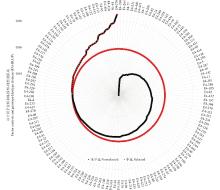
图1
基于FAI-BLUP 指数的基因型排序和中选基因型"
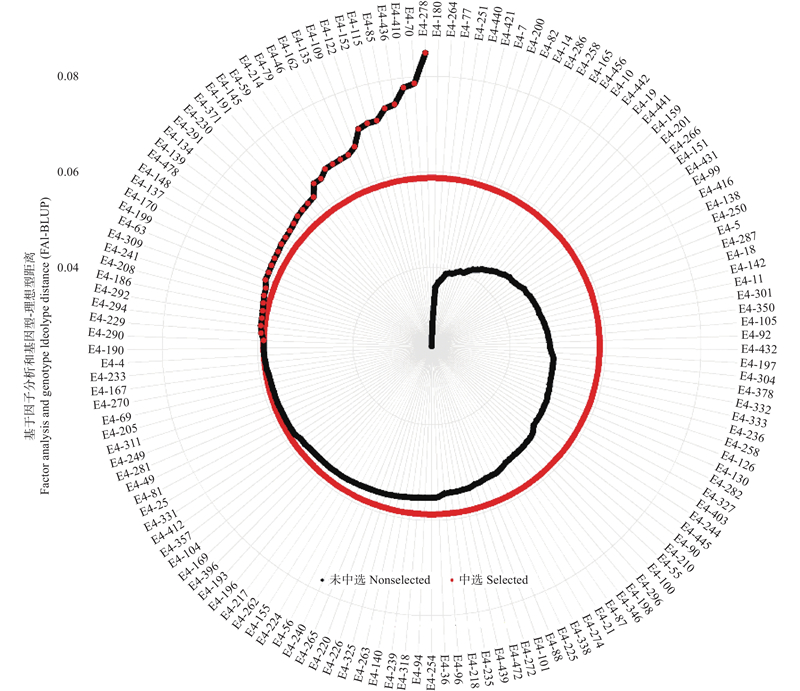
表3
基于BLUP的MGIDI中选基因型性状选择差和选择增益①"
| 性状 Traits | 因子1 FA1 | 因子2 FA2 | 因子3 FA3 | 因子4 FA4 | 共同度 Communality | 唯一性 Uniquenesses | 变量 VAR | 因子 Factor | 总体均 值Xo | 中选均 值Xs | 选择 差SD | 选择增 益SG% | 方向 Sense | 目标 Goal | |
| H2 | –0.757 | –0.084 | 0.135 | –0.175 | 0.628 | 0.372 | H2 | FA1 | 35.4 | 38.563 | 3.154 | 8.907 | 上升Increase | 100 | |
| D2 | –0.931 | –0.062 | –0.010 | –0.106 | 0.882 | 0.118 | D2 | FA1 | 4.78 | 5.298 | 0.523 | 10.948 | 上升Increase | 100 | |
| DS | –0.809 | –0.065 | –0.015 | 0.027 | 0.659 | 0.341 | DS | FA1 | 1.168 | 1.328 | 0.156 | 13.672 | 上升Increase | 100 | |
| RDW | –0.739 | 0.141 | –0.138 | 0.081 | 0.592 | 0.408 | RDW | FA1 | 1.668 | 1.857 | 0.189 | 11.319 | 上升Increase | 100 | |
| TRL | –0.159 | –0.103 | –0.684 | 0.361 | 0.634 | 0.366 | TR | FA2 | 3.822 | 3.762 | –0.061 | –1.583 | 下降Decrease | 100 | |
| RSA | –0.125 | –0.057 | 0.745 | 0.359 | 0.703 | 0.297 | WUE | FA2 | 2.962 | 2.984 | 0.022 | 0.755 | 上升Increase | 100 | |
| AD | –0.128 | 0.041 | –0.025 | –0.853 | 0.746 | 0.254 | TRL | FA3 | 2.169 | 2.195 | 0.026 | 1.197 | 上升Increase | 100 | |
| TR | –0.017 | 0.874 | 0.023 | –0.105 | 0.776 | 0.224 | RSA | FA3 | 0.721 | 0.741 | 0.020 | 2.833 | 上升Increase | 100 | |
| WUE | 0.060 | 0.883 | 0.007 | 0.037 | 0.785 | 0.215 | AD | FA4 | 0.913 | 0.949 | 3.925 | 上升Increase | 100 | ||
| 特征值Eigenvalues | 2.729 | 1.613 | 1.061 | 1.002 | |||||||||||
| 方差 Variance (%) | 30.317 | 17.917 | 11.793 | 11.138 | |||||||||||
| 累计方差 Cum.variance(%) | 30.317 | 48.235 | 60.028 | 71.166 |
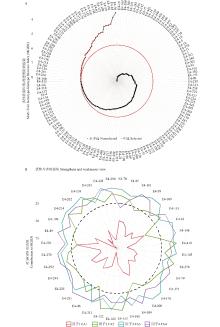
图2
基于BLUP的MGIDI指数的基因型排序(A)与中选基因型优势和劣势(B)"
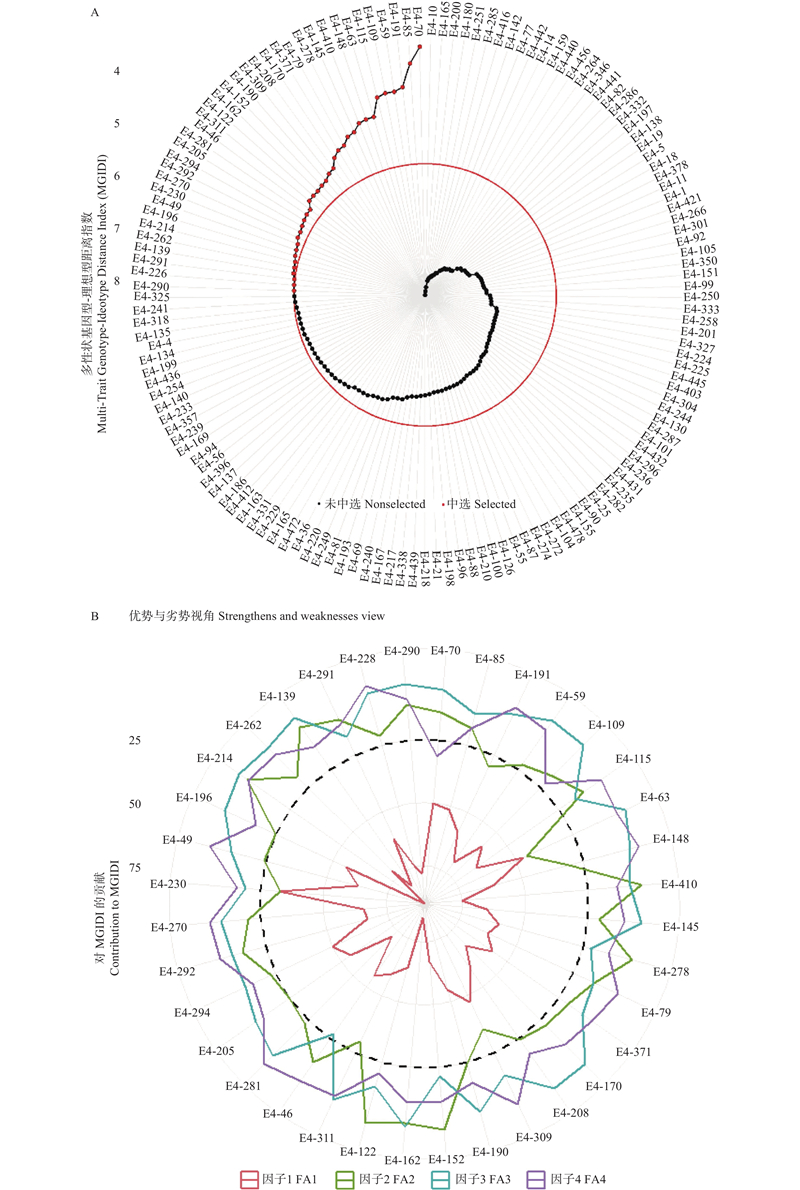
表4
基于LWindex的MGIDI中选基因型性状选择差和选择增益①"
| 变量 VAR | 因子1 FA1 | 因子2 FA2 | 因子3 FA3 | 因子4 FA4 | 共同度 Communality | 唯一性 Uniquenesses | 变量 VAR | 因子 Factor | 总体均 值Xo | 中选均 值Xs | 选择差 SD | 选择增 益SG% | 方向 Sense | 目标 Goal | |
| H2 | –0.623 | 0.089 | 0.416 | –0.101 | 0.582 | 0.418 | H2 | FA1 | 0.965 | 0.174 | 22.058 | 上升Increase | 100 | ||
| D2 | –0.895 | – | – | 0.811 | 0.189 | D2 | FA1 | 0.882 | 0.957 | 8.489 | 上升Increase | 100 | |||
| DS | –0.679 | – | –0.335 | 0.311 | 0.671 | 0.329 | DS | FA1 | 1.019 | 4.331 | 上升Increase | 100 | |||
| RDW | –0.136 | 0.183 | 0.464 | 0.269 | 0.731 | TR | FA2 | 0.620 | 0.607 | – | –2.130 | 下降Decrease | 100 | ||
| TRL | 0.192 | 0.131 | 0.372 | –0.304 | 0.285 | 0.715 | WUE | FA2 | 1.236 | 1.239 | 0.237 | 上升Increase | 100 | ||
| RSA | –0.149 | 0.750 | 0.595 | 0.405 | RDW | FA3 | 0.871 | 0.947 | 8.702 | 上升Increase | 100 | ||||
| AD | –0.061 | – | –0.120 | –0.927 | 0.885 | 0.115 | TRL | FA3 | 1.034 | 1.035 | 0.129 | 上升Increase | 100 | ||
| TR | –0.010 | 0.892 | – | 0.802 | 0.198 | RSA | FA3 | 0.993 | 0.994 | 上升Increase | 100 | ||||
| WUE | – | 0.871 | 0.763 | 0.237 | AD | FA4 | 0.733 | 0.740 | 0.974 | 上升Increase | 100 | ||||
| 特征值 Eigenvalues | 1.792 | 1.627 | 1.211 | 1.031 | |||||||||||
| 方差 Variance (%) | 19.914 | 18.075 | 13.456 | 10.270 | |||||||||||
| 累计方差 Cum.variance(%) | 19.914 | 37.988 | 51.447 | 62.903 |
图3
基于LWindex的MGIDI的基因型排序(A)和中选基因型优势与劣势(B)"
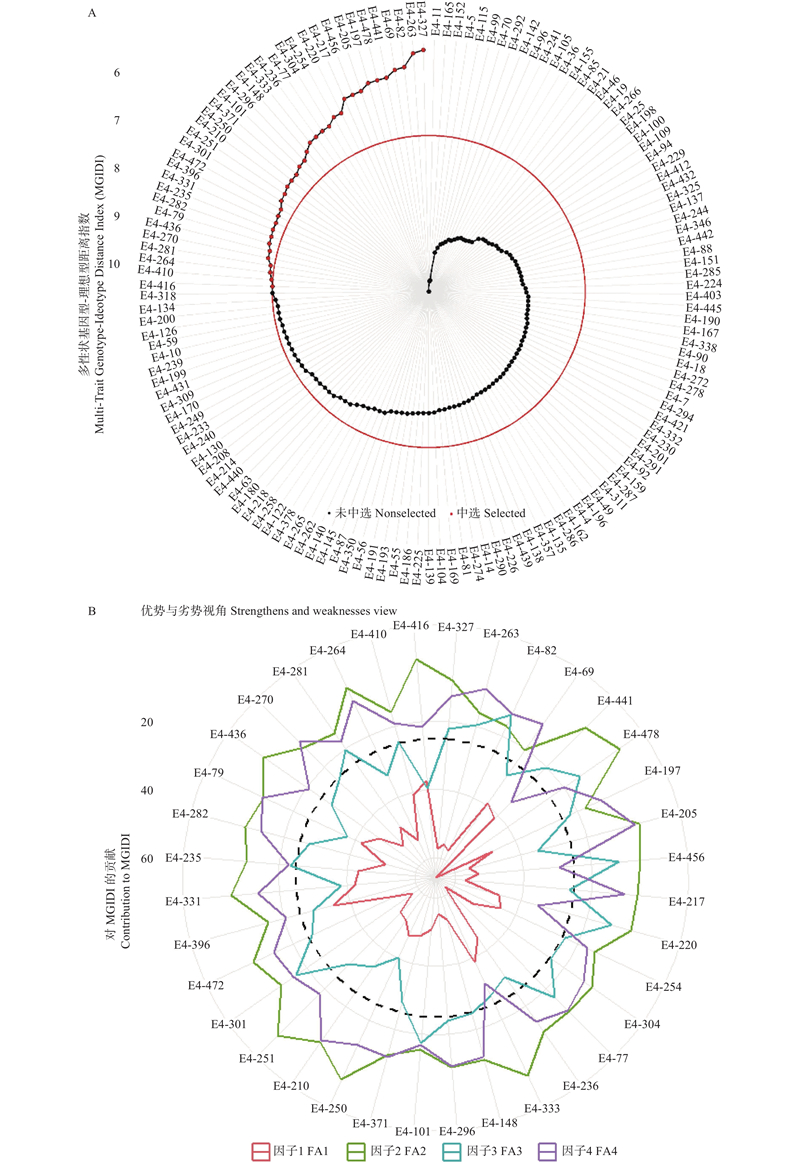
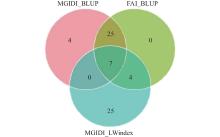
图4
基于FAI-BLUP、MGIDI_BLUP和MGIDI_LWindex选择基因型数量韦恩图"
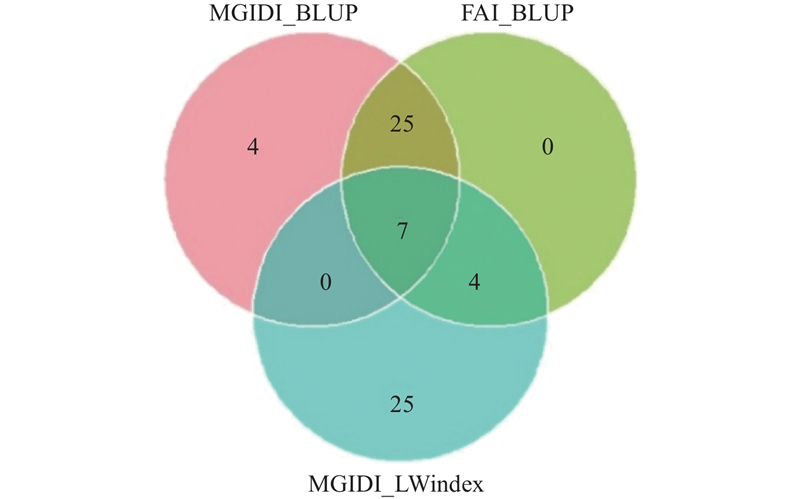
表5
3种选择指数共选基因型"
| 选择指数1 Selection index 1 | 选择指数2 Selection index 2 | 中选基因型数量 Number of selected genotypes | 3种选择策略中选基因型 Selected genotypes of three selection strategies | 共选基因型 Co-selected genotypes |
| FAI-BLUP | MGIDI_BLUP | 27 | E4-70、E4-85、E4-191、E4-59、E4-109、E4-115、E4-63、 E4-148、E4-410、E4-145、E4-278、E4-79、E4-371、E4-170、 E4-208、E4-309、E4-152、E4-162、E4-122、E4-46、E4-294、 E4-292、E4-230、E4-214、E4-139、E4-291、E4-290 | E4-148、E4-410、 E4-79、E4-371 |
| MGIDI_BLUP | MGIDI_LWindex | 7 | E4-148、E4-410、E4-79、E4-371、E4-281、E4-205、E4-270 | |
| MGIDI_LWindex | FAI-BLUP | 6 | E4-410、E4-436、E4-79、E4-371、E4-478、E4-148 |
| 国家林业和草原局. 2019. 中国森林资源报告(2014—2018). 北京: 中国林业出版社. | |
| National Forestry and Grassland Administration. 2019. China forest resources report 2014—2018. Beijing: China Forestry Publishing House. [in Chinese] | |
| 康向阳. 林木遗传育种研究进展. 南京林业大学学报(自然科学版), 2020, 44 (3): 1- 10. | |
| Kang X Y. Research progress of forest genetics and tree breeding. Journal of Nanjing Forestry University (Natural Sciences Edition), 2020, 44 (3): 1- 10. | |
| 李春情, 刘翔宇, 闫 鹏, 等. 不同玉米品种抗旱性的生理鉴定与综合评价. 作物杂志, 2024, 40 (4): 253- 362. | |
| Li C Q, Liu X Y, Yan P, et al. Physiological identification and comprehensive evaluation of drought resistance of different maize varieties. Crops, 2024, 40 (4): 253- 362. | |
| 牛晋鸿, 王天欣, 曹明嵘, 等. 基于FAI-BLUP多性状选择指数的耐低氮杨树品种筛选. 林业科学研究, 2025, 38 (1): 61- 72. | |
| Niu J H, Wang T X, Cao M R, et al. Screening of poplar varieties with low-nitrogen tolerance based on FAI-BLUP multiple trait selection index. Forest Research, 2025, 38 (1): 61- 72. | |
|
乔滨杰, 王德秋, 高海燕, 等. 干旱胁迫下杨树无性系苗期光合与气孔形态变异研究. 植物研究, 2020, 40 (2): 177- 188.
doi: 10.7525/j.issn.1673-5102.2020.02.003 |
|
|
Qiao B J, Wang D Q, Gao H Y, et al. Photosynthetic and stomatal morphological variation of poplar clones in seedling stage under drought stress. Bulletin of Botanical Research, 2020, 40 (2): 177- 188.
doi: 10.7525/j.issn.1673-5102.2020.02.003 |
|
| 苏晓华, 丁昌俊, 马常耕. 我国杨树育种的研究进展及对策. 林业科学研究, 2010, 23 (1): 31- 37. | |
| Su X H, Ding C J, Ma C G. Research progress and strategies of poplar breeding in China. Forest Research, 2010, 23 (1): 31- 37. | |
| 孙 佩, 姬慧娟, 张亚红, 等. 丹红杨×通辽1号杨杂交子代苗期抗旱性初步评价. 植物遗传资源学报, 2019, 20 (2): 297- 308. | |
| Sun P, Ji H J, Zhang Y H, et al. Preliminary evaluation of drought resistance for Populus deltoides 'Danhong' × P. simonii 'Tongliao1' hybrid progenies at the seedling stage. Journal of Plant Genetic Resources, 2019, 20 (2): 297- 308. | |
|
王天欣, 牛晋鸿, 曹明嵘, 等. 低氮下小黑杨×欧洲黑杨杂交子代苗期性状遗传变异和选择. 林业科学, 2025, 61 (2): 142- 151.
doi: 10.11707/j.1001-7488.LYKX20240374 |
|
|
Wang T X, Niu J H, Cao M R, et al. Genetic variation and selection of seedling traits in the progeny of Populus simonigra × P. nigra under low nitrogen condition. Scientia Silvae Sinicae, 2025, 61 (2): 142- 151.
doi: 10.11707/j.1001-7488.LYKX20240374 |
|
| 席本野. 2019. 杨树根系形态、分布、动态特征及其吸水特性. 北京林业大学学报, 41(12): 37–49. | |
| Xi B Y. 2019. Morphology, distribution, dynamic characteristics of poplar roots and its water uptake habits. Journal of Beijing Forestry University, 41(12): 37–49. [in Chinese] | |
|
张 蕾, 姜鹏飞, 王一鸣, 等. 苦杨×小叶杨杂交F1代苗期抗旱性比较研究. 植物学报, 2023, 58 (4): 519- 534.
doi: 10.11983/CBB22086 |
|
|
Zhang L, Jiang P F, Wang Y M, et al. Comparative study on the drought resistance of young seedling from Populus laurifolia × P. simonii F1 progeny. Chinese Bulletin of Botany, 2023, 58 (4): 519- 534.
doi: 10.11983/CBB22086 |
|
|
Amjid M, Üstün R. Selection of soybean genotypes exhibiting drought resistance by assessing morphological and yield traits. Euphytica, 2025, 221 (4): 44.
doi: 10.1007/s10681-025-03493-9 |
|
|
Basavaraj P S, Babar R, Gangurde A, et al. Unveiling drought-tolerant mungbean genotypes through integrated multi-trait selection. Scientific Reports, 2026, 16 (1): 6018.
doi: 10.1038/s41598-026-36830-6 |
|
|
Biselli C, Vietto L, Rosso L, et al. Advanced breeding for biotic stress resistance in poplar. Plants, 2022, 11 (15): 2032.
doi: 10.3390/plants11152032 |
|
| Céron-Rojas J J, Crossa J. 2018. Linear phenotypic eigen selection index methods. In: Linear selection indices in modern plant breeding. Cham: Springer International Publishing: 149-176. | |
|
Costa C S R, de Lima M A C, Neto F P L, et al. Genetic parameters and selection of mango genotypes using the FAI-BLUP multitrait index. Scientia Horticulturae, 2023, 317, 112049.
doi: 10.1016/j.scienta.2023.112049 |
|
| Dastfall M, Najafi Mirak T, Zali H. Selection of durum wheat (Triticum turgidum L. var. durum) genotypes tolerant to terminal season drought stress using multi-trait indices (MGIDI). Iranian Journal of Crop Sciences, 2024, 25 (4): 342- 361. | |
|
Debnath P, Chakma K, Bhuiyan M S U, et al. A novel multi trait genotype ideotype distance index (MGIDI) for genotype selection in plant breeding: application, prospects, and limitations. Crop Design, 2024, 3 (4): 100074.
doi: 10.1016/j.cropd.2024.100074 |
|
|
Du C J, Sun P, Cheng X Q, et al. QTL mapping of drought-related traits in the hybrids of Populus deltoides ‘Danhong’ × Populus simoni ‘Tongliao1’. BMC Plant Biology, 2022, 22, 238.
doi: 10.1186/s12870-022-03613-w |
|
|
Duruflé H, Déjardin A, Jorge V, et al. Natural variation in chalcone isomerase defines a major locus controlling radial stem growth variation among Populus nigra populations. Peer Community Journal, 2025, 5, e50.
doi: 10.24072/pcjournal.559 |
|
| FAO. 2021. Synthesis of country progress reports received, prepared for the 26th session of the international poplar and other fast-growing trees sustaining people and the environment. Rome: IPC. | |
|
Farid M, Anshori M F, Mantja K, et al. Selection of lowland tomato advanced lines using selection indices based on PCA, path analysis, and the Smith-Hazel index. SABRAO Journal of Breeding and Genetics, 2024, 56 (2): 708- 718.
doi: 10.54910/sabrao2024.56.2.22 |
|
|
Getman-Pickering Z L, Campbell A, Aflitto N, et al. LeafByte: a mobile application that measures leaf area and herbivory quickly and accurately. Methods in Ecology and Evolution, 2020, 11 (2): 215- 221.
doi: 10.1111/2041-210X.13340 |
|
| Ghavidel S, Pour-Aboughadareh A, Mostafavi K. Identification of drought-tolerant genotypes of barley (Hordeum vulgare L.) based on selection indices. Crop Science Research in Arid Regions, 2024, 5 (3): 671- 687. | |
|
Gunes A, Inal A, Adak M S, et al. Effect of drought stress implemented at pre-or post-anthesis stage on some physiological parameters as screening criteria in chickpea cultivars. Russian Journal of Plant Physiology, 2008, 55 (1): 59- 67.
doi: 10.1134/S102144370801007X |
|
|
Himes A, Emerson P, McClung R, et al. Leaf traits indicative of drought resistance in hybrid poplar. Agricultural Water Management, 2021, 246, 106676.
doi: 10.1016/j.agwat.2020.106676 |
|
| Isebrands J, G. Aronsson P, Carlson M, et al. 2014. Environmental applications of poplars and willows//Isebrands J G, Richardson J. Eds. Poplars and willows: trees for society and the environment. Oxfordshire, England: CABI, 258–336. | |
|
Khan A, Gong X W, Zhang C, et al. Contrasts in hydraulics underlie the divergent performances of Populus and native tree species in water-limited sandy land environments. Physiologia Plantarum, 2025, 177 (1): e70075.
doi: 10.1111/ppl.70075 |
|
|
Kutsokon N K, Jose S, Holzmueller E. A global analysis of temperature effects on Populus plantation production potential. American Journal of Plant Science, 2015, 6 (1): 23- 33.
doi: 10.4236/ajps.2015.61004 |
|
|
Mokarroma N, Uddin M R, Ahmed I M, et al. Multivariate analysis for identifying drought-tolerant barley (Hordeum vulgare L.) genotypes using stress indices. Data in Brief, 2025, 59, 111452.
doi: 10.1016/j.dib.2025.111452 |
|
|
Mohammadi R. Efficiency of yield-based drought tolerance indices to identify tolerant genotypes in durum wheat. Euphytica, 2016, 211 (1): 71- 89.
doi: 10.1007/s10681-016-1727-x |
|
| Mohi-Ud-Din M, Hossain M. A, Rohman M M, et al. Multi-trait index-based selection of drought tolerant wheat: physiological and biochemical profiling. Plants, 2025, 14 (1): 35. | |
|
Olivoto T, Lúcio A. D. Metan: an R package for multi-environment trial analysis. Methods in Ecology and Evolution, 2020, 11 (6): 783- 789.
doi: 10.1111/2041-210X.13384 |
|
|
Olivoto T, Diel M I, Schmidt D, et al. MGIDI: a powerful tool to analyze plant multivariate data. Plant Methods, 2022, 18 (1): 121.
doi: 10.1186/s13007-022-00952-5 |
|
|
Olivoto T, Nardino M. MGIDI: toward an effective multivariate selection in biological experiments. Bioinformatics, 2021, 37 (10): 1383- 1389.
doi: 10.1093/bioinformatics/btaa981 |
|
|
Pathy T L, Vinu V, Arunkumar R, et al. Multi-trait index based Elucidation of drought tolerance potential of Saccharum spontaneum. Plant Physiology Reports, 2025, 30 (4): 928- 941.
doi: 10.1007/s40502-025-00911-x |
|
|
Rocha J R A S C, Machado J C, Carneiro P C S. Multitrait index based on factor analysis and ideotype-design: proposal and application on elephant grass breeding for bioenergy. GCB Bioenergy, 2018, 10 (1): 52- 60.
doi: 10.1111/gcbb.12443 |
|
| Rosso L, Cantamessa S, Bergante S, et al. 2023. Responses to drought stress in poplar: what do we know and what can we learn? Life, 13(2): 533. | |
|
Rovida Kojima E A, González C V, Mundo I A, et al. Mechanisms of drought resistance in Populus deltoides and P. × canadensis clones to possible situations of water restriction in irrigated systems in drylands. Trees, 2024, 38 (5): 1267- 1281.
doi: 10.1007/s00468-024-02551-4 |
|
|
Safdar A, Hameed A, Hassan H M. Biochemical and morpho-physiological insights revealed low moisture stress adaptation mechanisms in cotton (Gossypium hirsutum L.). Scientific Reports, 2024, 14 (1): 25942.
doi: 10.1038/s41598-024-77204-0 |
|
|
Salami M, Tan H, Alizadeh B, et al. Photosynthetic performance, pigments and biochemicals influence seed yield in rapeseed under water deficit conditions: MGIDI index helps screening drought-tolerant genotypes. Field Crops Research, 2025, 322, 109733.
doi: 10.1016/j.fcr.2024.109733 |
|
|
Shani M Y, Ditta A, Khan M K R, et al. Deciphering drought tolerance in cotton genotypes through integrated morpho-physiological and biochemical markers at flowering stage. Scientific Reports, 2025, 15 (1): 44123.
doi: 10.1038/s41598-025-28237-6 |
|
|
Song R J, Shi P C, Xiang L, et al. Evaluation of barley genotypes for drought adaptability: based on stress indices and comprehensive evaluation as criteria. Frontiers in Plant Science, 2024, 15, 1436872.
doi: 10.3389/fpls.2024.1436872 |
|
|
Sorwar Jahan M A H, Azam M G, Mohi-Ud-Din M, et al. Agronomic parameters and drought tolerance indices of bread wheat genotypes as influenced by well-watered and water deficit conditions. BMC Plant Biology, 2025, 25 (1): 1342.
doi: 10.1186/s12870-025-07355-3 |
|
|
Sun P, Jia H X, Cheng X Q, et al. Genetic architecture of leaf morphological and physiological traits in a Populus deltoides ‘Danhong’ × P. simonii ‘Tongliao1’ pedigree revealed by quantitative trait locus analysis. Tree Genetics & Genomes, 2020, 16 (3): 45.
doi: 10.1007/s11295-020-01438-y |
|
|
Wang X Y, Li X M, Zhao W, et al. Current views of drought research: experimental methods, adaptation mechanisms and regulatory strategies. Frontiers in Plant Science, 2024, 15, 1371895.
doi: 10.3389/fpls.2024.1371895 |
|
|
Yan C J, Song S H, Wang W B, et al. Screening diverse soybean genotypes for drought tolerance by membership function value based on multiple traits and drought-tolerant coefficient of yield. BMC Plant Biology, 2020, 20 (1): 321.
doi: 10.1186/s12870-020-02519-9 |
|
|
Zahedi S M, Karimi M, Venditti A, et al. Plant adaptation to drought stress: the role of anatomical and morphological characteristics in maintaining the water status. Journal of Soil Science and Plant Nutrition, 2025, 25 (1): 409- 427.
doi: 10.1007/s42729-024-02141-w |
|
|
Zhou Z Y, Cao M R, Jia D X, et al. Integrating multivariate selection indices with weighted rank aggregation to identify drought-tolerant Populus simonii × P. nigra F1 progenies. BMC Plant Biology, 2026, 26 (1): 291.
doi: 10.1186/s12870-025-08054-9 |
| [1] | 王智勇,周梦岩,陈文义,麻文俊,王军辉,张一,吴创业,罗志斌,周婧. 楸树高产高氮利用效率无性系筛选及G×E互作分析[J]. 林业科学, 2025, 61(8): 96-105. |
| [2] | 王楚彪,罗建中,何文亮,卢万鸿,林彦,区余端. 桉树无性系多区域联合测试的G×E分析及选优[J]. 林业科学, 2022, 58(11): 108-117. |
| [3] | 李金花. 基于BLUP和GGE双标图的黑杨派无性系生长性状基因型与环境互作效应[J]. 林业科学, 2021, 57(6): 64-73. |
| [4] | 周心怡,闫丽琼,吕云彤,孙丽丽,朱靖闻,曹传旺. 舞毒蛾取食诱导小黑杨苯丙烷代谢酶活性及其相关基因的表达[J]. 林业科学, 2021, 57(3): 108-116. |
| [5] | 郑聪慧, 张鸿景, 王玉忠, 代剑锋, 党磊, 杜子春, 刘建婷, 高运茹. 基于BLUP和GGE双标图的华北落叶松家系区域试验分析[J]. 林业科学, 2019, 55(8): 73-83. |
| [6] | 李媛媛, 张凯, 李霜雯, 严善春. 失叶率对小黑杨和兴安落叶松幼苗生物量和叶绿素含量的影响[J]. 林业科学, 2015, 51(3): 93-101. |
| [7] | 董利虎, 张连军, 李凤日. 立木生物量模型的误差结构和可加性[J]. 林业科学, 2015, 51(2): 28-36. |
| [8] | 王润辉;胡德活;郑会全;韦茹萍;黄越茂;蔡维就. 杉木无性系生长和材性变异及多性状指数选择[J]. 林业科学, 2012, 48(3): 45-50. |
| [9] | 赵丽娟;李淑娟;于金海;王柏臣;杨传平. 小黑杨花粉离体萌发和细胞学分析[J]. 林业科学, 2011, 47(6): 36-41. |
| [10] | 王志英 张福丽;王占斌. 小黑杨转几丁质酶基因及酶活性[J]. 林业科学, 2010, 46(2): 147-151. |
| [11] | 范少辉; 冯慧想 张 群 刘广路 宗亦尘 费本华. 华北沙地小黑杨人工林生长特性[J]. 林业科学, 2008, 44(3): 29-33. |
| [12] | 高慧 刘杏娥 张利萍 张亚伟 方小东. 小黑杨幼龄材与成熟材制浆性能的比较[J]. 林业科学, 2008, 44(2): 111-115. |
| [13] | 江泽慧 范少辉;冯慧想 张群 刘广路 宗亦尘. 华北沙地小黑杨人工林生物量及其分配规律[J]. 林业科学, 2007, 43(11): 15-20. |
| [14] | 刘桂丰 杨传平 蔡智军 程贵兰 詹立平. 转betA基因小黑杨的耐盐性分析及优良转基因株系的选择[J]. 林业科学, 2006, 42(7): 33-36. |
| [15] | 杨传平 刘桂丰 梁宏伟 张慧. 耐盐基因Bet-A转化小黑杨的研究[J]. 林业科学, 2001, 37(6): 34-38. |
| 阅读次数 | ||||||
|
全文 |
|
|||||
|
摘要 |
|
|||||

