
林业科学 ›› 2026, Vol. 62 ›› Issue (7): 113-125.doi: 10.11707/j.1001-7488.LYKX20250687
周艳萍1,李涵宇1,黄政强1,王楠2,李青粉1,*( )
)
收稿日期:2025-11-17
出版日期:2026-07-10
发布日期:2026-07-14
通讯作者:
李青粉
E-mail:li63757416@163.com
基金资助:
Yanping Zhou1,Hanyu Li1,Zhengqiang Huang1,Nan Wang2,Qingfen Li1,*()
Received:2025-11-17
Online:2026-07-10
Published:2026-07-14
Contact:
Qingfen Li
E-mail:li63757416@163.com
摘要:
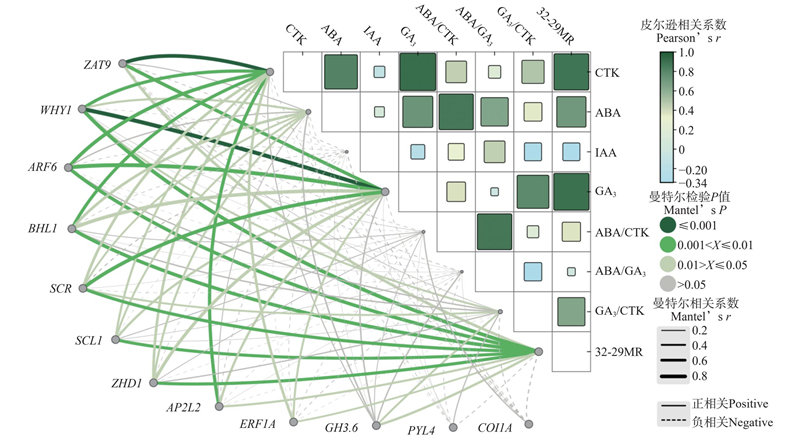
目的: 阐明长期继代培养对欧洲云杉胚性愈伤组织生理和分子水平的调控效应,揭示体细胞胚胎发生能力衰退的内在机制,为优化其体胚发生体系和针叶树规模化无性繁殖提供理论依据。方法: 以不同继代次数欧洲云杉不同细胞系的胚性愈伤组织为研究材料,对其长期继代培养后进行组织细胞学观察,并综合分析内源激素含量和基因表达模式与愈伤组织分化能力间的相关性。结果: 1) 组织细胞形态学和分化能力分析显示,随着继代次数增加,欧洲云杉胚性愈伤组织出现结构致密化和褐化现象,并伴有细胞系的分化能力衰退,4个细胞系的分化能力衰退情况存在显著差异,但不同细胞系的分化能力均呈先升后降的单峰式变化趋势,其中32-29号细胞系维持分化能力的潜力更强。2) 内源激素含量分析表明,随着欧洲云杉胚性愈伤组织的长期继代,细胞分裂素(CTK)和赤霉素(GA3)含量的动态变化与胚性愈伤组织分化率的变化一致,均呈先升高后降低的趋势,且二者存在显著正相关,表明这类激素可能在调节愈伤组织分化能力中起重要作用。生长素(IAA)含量一直维持在较低水平,整体呈短暂上升后缓慢下降的波动趋势,脱落酸(ABA)含量总体呈下降趋势。3) 基因表达量、体细胞胚数量与内源激素含量的联合分析揭示,ARF6、BLH1、GH3.6和SCL1等基因的表达量随着继代次数增加显著下调,且与分化的体细胞胚数量呈显著正相关,是体胚发生中潜在的正向调控因子,而ZAT9、WHY1、ZHD1、SCR和AP2L2等基因的表达量则随着继代次数增加显著上调,可能是负向调控因子,且这些关键基因的表达量变化与细胞分裂素(CTK)、赤霉素(GA3)激素信号通路密切相关,其中WHY1、BLH1、SCR、SCL1和ZHD1的表达量与ABA含量显著正相关,可能共同调控胚性愈伤组织分化能力的维持和体细胞胚的发育。结论: 欧洲云杉胚性愈伤组织分化能力衰退是一个由细胞分裂能力减弱、内源激素稳态失衡和体胚发生关键基因异常表达共同调控的生物学过程。
中图分类号:
周艳萍,李涵宇,黄政强,王楠,李青粉. 欧洲云杉胚性愈伤组织长期继代培养的内源激素含量及基因表达变化[J]. 林业科学, 2026, 62(7): 113-125.
Yanping Zhou,Hanyu Li,Zhengqiang Huang,Nan Wang,Qingfen Li. Changes in Endogenous Hormone Content and Gene Expression during Long-Term Subculture of Picea abies Embryogenic Callus[J]. Scientia Silvae Sinicae, 2026, 62(7): 113-125.
表1
相关基因qRT-PCR的特异性引物"
| 基因名称 Gene names | 基因编号 Gene_ID | 正向引物序列 Forward primer sequences | 反向引物序列 Reverse primer sequence |
| ZAT9 | MA_85675g0010 | GTTAAGAAGGCCAGGTACAA | TTCCAGCATCACAATCATCA |
| AP2L2 | MA_75070g0010 | ACTCTCACCGACTATCAAGA | CTCGTGTGAGATTGTTTGTG |
| WHY1 | MA_709537g0010 | AACCCAAAGCACCTGAGTAT | ACTTACGAAGGTTGAAGAAGT |
| ZHD1 | MA_69304g0010 | GAAAAGCGGTGAGATACAGA | GCCGTATTGTCGTTATTGTG |
| PYL4 | MA_554564g0010 | CTCAGGAATTGTGGAGATCG | TCTCCTCTTTCGTATTCCCA |
| ARF6 | MA_55076g0010 | CTCAATCTCAGTCGCCATTA | CGTAACAGAAAACGAACTGG |
| SCR | MA_1793g0010 | CATCCAGTAGCAGAAAAGGT | CAACCCAATTTCAAAGTCCC |
| BLH1 | MA_111188g0010 | TCATCAAAGTGGGAAAACCA | GATAAACCATCAGTGCGTTG |
| SCL1 | MA_10435549g0020 | GAAAGCAGAGATCGTGTGAA | AGTCCTTGCTTCTTAATGCC |
| COI1A | MA_10428988g0010 | CATTGGAGACTGTTGGAGAA | GCCAGAGAATAGTAAGCCAA |
| GH3.6 | MA_10330250g0010 | CATGGCCTATTTTGAGTTCC | TTGATTTATGGATGCCCCTC |
| ERF1A | MA_10031781g0010 | TCACCCATCCTCAATATCCT | CCGTTTCTTCTTTACCTCTCT |
| Histone2A | / | CGGGACAACAAGAAGAATCGTAT | CTCGTCATTCCGAACAGCAA |
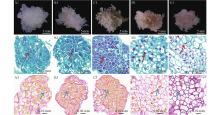
图1
欧洲云杉愈伤组织的组织细胞学观察 A1–E1分别代表32-29号细胞系的第7、9、17(胚性愈伤组织)、19、21(非胚性愈伤组织)代的愈伤组织;A2–E2及A3–E3分别代表相应的愈伤组织番红?固绿及PAS?萘酚黄染色切片。"
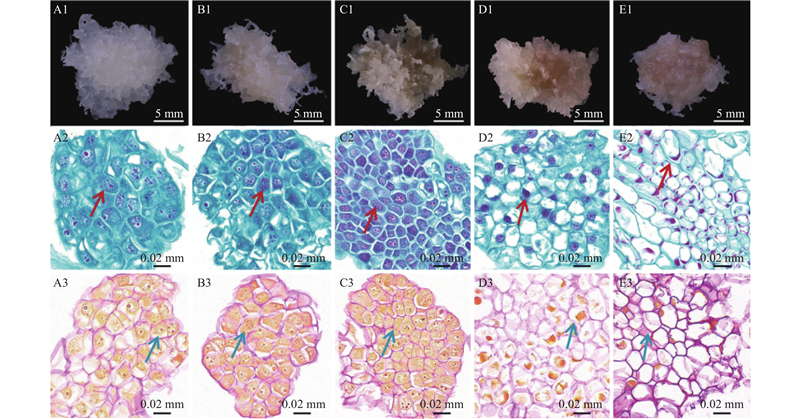
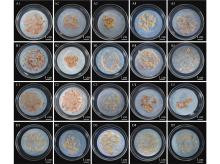
图2
不同增殖代数的欧洲云杉愈伤组织的分化情况 A1–A5代表32-14细胞系的第11~15代,其中A3(第13代)是分化率峰值;B1–B5代表32-23细胞系的第11~15代,其中B4(第14代)是分化率峰值;C1–C5代表32-26细胞系的第10~14代,其中C3(第12代)是分化率峰值;D1–D5代表32-29细胞系的第15~19代,其中D3(第17代)是分化率峰值。"
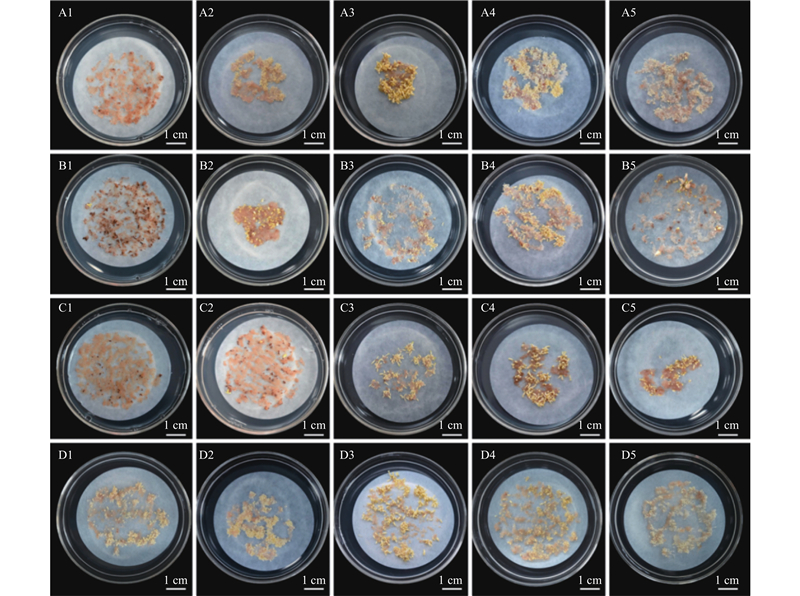
图3
不同细胞系之间增殖代数与愈伤组织分化率峰值的比较 图中未标注连线的组合表示无显著差异。标注星号表示差异显著(* P<.05,** P<0.01,*** P<0.001)。"
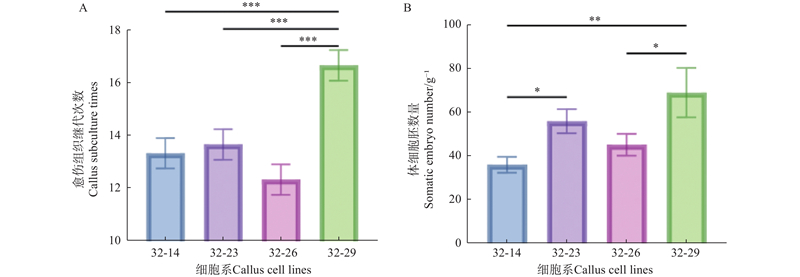
图4
不同增殖代数的欧洲云杉愈伤组织的分化率 横坐标的数字代表愈伤组织的继代次数。误差线上不同字母表示处理间差异显著(P<0.05)。"
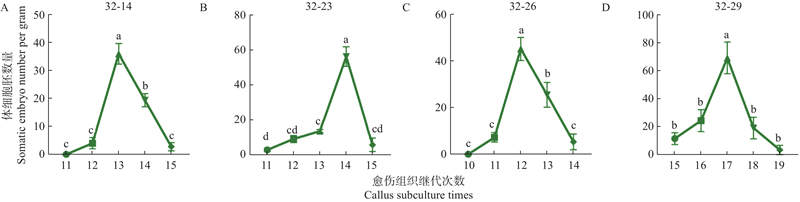
图5
不同增殖代数的欧洲云杉愈伤组织中的内源激素含量 横坐标的数字代表愈伤组织的继代次数。误差线上不同字母表示处理间差异显著(P<0.05)。"
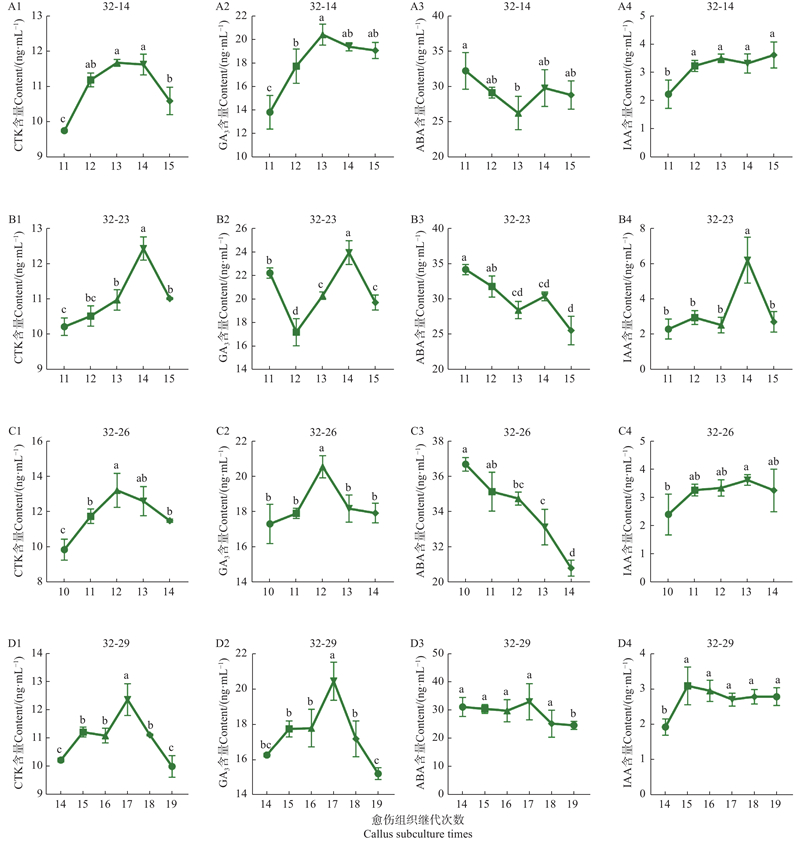
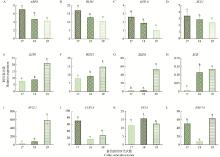
图6
欧洲云杉不同继代次数愈伤组织中的基因相对表达量 横坐标的数字代表愈伤组织的继代次数。误差线上不同字母表示处理间差异显著(P<0.05)。"
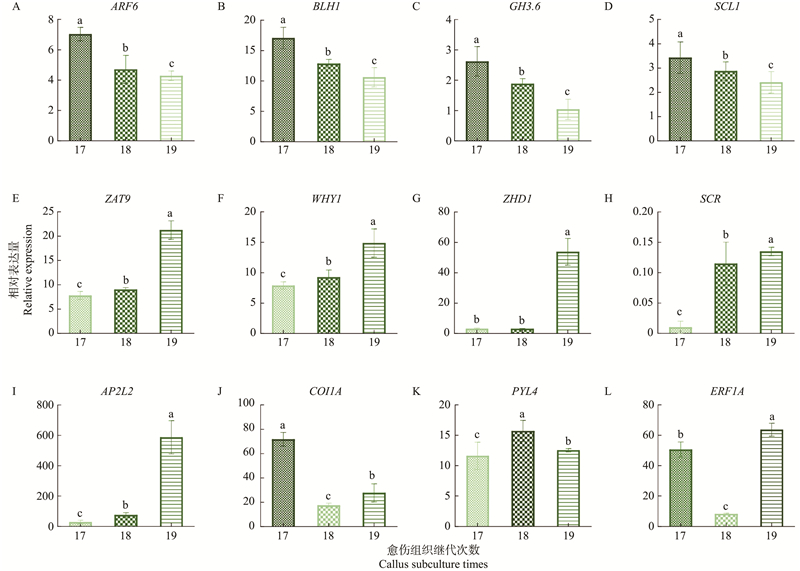
图7
体胚相关基因与内源激素含量及愈伤组织分化率之间的Mantel检验分析 CTK:细胞分裂素;ABA:脱落酸;IAA:吲哚乙酸;GA3:赤霉素。32-29MR代表32-29号细胞系体细胞胚分化数量。"
|
安三平, 欧阳芳群, 马建伟, 等. 欧洲云杉无性系遗传变异及早期选择. 西北林学院学报, 2018, 33 (6): 61- 65.
doi: 10.3969/j.issn.1001-7461.2018.06.10 |
|
|
An S P, Ouyang F Q, Ma J W, et al. Genetic variation and early evaluation of Picea abies clones. Journal of Northwest Forestry University, 2018, 33 (6): 61- 65.
doi: 10.3969/j.issn.1001-7461.2018.06.10 |
|
| 岑云昕, 刘 佳, 陈发菊, 等. 农杆菌介导的楸树遗传转化体系. 林业科学, 2021, 57 (8): 195- 204. | |
| Cen Y X, Liu J, Chen F J, et al. Agrobacterium-mediated genetic transformation system of Catalpa bungei. Scientia Silvae Sinicae, 2021, 57 (8): 195- 204. | |
| 陈千敏, 周艳萍, 李涵宇, 等. PI-55对欧洲云杉胚性愈伤组织增殖的作用研究. 南京林业大学学报(自然科学版), 2025, 49 (4): 88- 96. | |
| Chen Q M, Zhou Y P, Li H Y, et al. Research on the role of PI-55 in the embryonic callus proliferation of Picea abies. Journal of Nanjing Forestry University (Natural Sciences Edition), 2025, 49 (4): 88- 96. | |
|
高本旺, 欧阳芳群, 高 晗, 等. 鄂西地区欧洲云杉幼龄无性系生长差异及早期评价与选择. 林业科学研究, 2021, 34 (5): 88- 94.
doi: 10.13275/j.cnki.lykxyj.2021.005.010 |
|
|
Gao B W, Ouyang F Q, Gao H, et al. Growth difference and early evaluation and selection of young Picea abies clones in western Hubei. Forest Research, 2021, 34 (5): 88- 94.
doi: 10.13275/j.cnki.lykxyj.2021.005.010 |
|
| 葛晓阳. 2016. 棉花体细胞胚发育组学分析及JA和ABA调控的研究. 北京: 中国农业大学. | |
| Ge X Y. 2016. Omics analysis of Gossypium hirsutum somatic embryo development and regulation by JA and ABA. Beijing: China Agricultural University. [in Chinese] | |
| 郭生虎, 陈虞超, 朱永兴. 桃儿七体细胞胚胎发生过程中的内源激素变化. 分子植物育种, 2022, 20 (24): 8264- 8271. | |
| Guo S H, Chen Y C, Zhu Y X. Changes of endogenous hormones during somatic embryogenesis of Sinopodophyllum emodi. Molecular Plant Breeding, 2022, 20 (24): 8264- 8271. | |
| 李青粉, 王军辉, 张建华, 等. 云杉引种及种和种源早期评价. 林业科学研究, 2012, 25 (5): 644- 650. | |
| Li Q F, Wang J H, Zhang J H, et al. Introduction and early evaluation of species and provenances of spruce. Forest Research, 2012, 25 (5): 644- 650. | |
| 李 泽, 马芳芳, 张 慧, 等. 油桐芽苗砧嫁接育苗技术及解剖结构观察. 林业科学, 2024, 60 (1): 80- 92. | |
| Li Z, Ma F F, Zhang H, et al. Grafting techniques of tung tree seedlings with hypocotyle rootstocks and the anatomical structure. Scientia Silvae Sinicae, 2024, 60 (1): 80- 92. | |
| 刘福平. 植物体细胞胚胎发生的信号传导. 生命科学研究, 2005, 9 (4): 60- 65. | |
| Liu F P. Plant somatic embryogenesis and signial transduction. Life Science Research, 2005, 9 (4): 60- 65. | |
| 麻文俊. 2025. 我国首个云杉国家良种通过审定. 林业科技通讯 (1): 56. | |
| Ma W J. 2025. China’s first national improved spruce variety passed the examination and approval. Forest Science and Technology, (1): 56. [in Chinese] | |
|
马 浩, 陈科屹, 徐干君, 等. 青海省不同生境下青海云杉胸径生长模型研究. 林业科学研究, 2024, 37 (1): 119- 129.
doi: 10.12403/j.1001-1498.20230097 |
|
|
Ma H, Chen K Y, Xu G J, et al. Diameter growth models of Picea crassifolia from different habitats in Qinghai Province. Forest Research, 2024, 37 (1): 119- 129.
doi: 10.12403/j.1001-1498.20230097 |
|
|
时 英, 靳紫宸, 高一林, 等. 欧洲云杉引种试验阶段报告. 吉林林业科技, 1987, (6): 1- 4.
doi: 10.16115/j.cnki.issn.1005-7129.1987.06.001 |
|
|
Shi Y, Jin Z C, Gao Y L, et al. Interim report on introduction experiment of Picea abies. Jilin Forestry Science and Technology, 1987, (6): 1- 4.
doi: 10.16115/j.cnki.issn.1005-7129.1987.06.001 |
|
| 苏玉晓. 2011. ABA在拟南芥体细胞胚胎发生过程中的功能研究. 泰安: 山东农业大学. | |
| Su Y X. 2011. Functional study of ABA in somatic embryogenesis of Arabidopsis thaliana. Tai’an: Shandong Agricultural University. [in Chinese] | |
| 孙 丹, 李宏博, 李 千, 等. 北五味子体细胞胚发生过程中内源IAA、ABA和GA3含量的动态变化. 植物生理学报, 2013, 49 (1): 70- 74. | |
| Sun D, Li H B, Li Q, et al. Dynamic variation of endogenous hormone during somatic embryo development of Schisandra incarnata. Plant Physiology Journal, 2013, 49 (1): 70- 74. | |
| 王翠玉, 刘月娣. 欧洲云杉引种试验研究. 造纸装备及材料, 2021, 50 (9): 138- 139. | |
| Wang C Y, Liu Y D. Introduction experiment of Picea abies. Papermaking Equipment and Materials, 2021, 50 (9): 138- 139. | |
| 吴夏雷, 韩 超, 孙宇涵, 等. 杉木体细胞胚胎发生胚性愈伤组织诱导条件的优化. 北京林业大学学报, 2020, 42 (2): 79- 86. | |
| Wu X L, Han C, Sun Y H, et al. Optimization of induction conditions for embryogenic callus of somatic embryogenesis in Cunninghamia lanceolata. Journal of Beijing Forestry University, 2020, 42 (2): 79- 86. | |
| 向太和, 梁海曼, 钟华鑫, 等. 水稻胚性悬浮细胞系建立过程中生理生化变化—Ⅱ. 氨基酸、多胺及内源激素的变化. 作物学报, 1997, 23 (3): 353- 359. | |
| Xiang T H, Liang H M, Zhong H X, et al. Physiological and biochemical changes during establishment of Oryza sativa embryogenic suspension cell line—Ⅱ. changes in amino acids, polyamines and endogenous hormones. Acta Agronomica Sinica, 1997, 23 (3): 353- 359. | |
| 邢更妹, 李 杉, 崔凯荣, 等. 植物体细胞胚发生中某些机理探讨. 自然科学进展, 2000, 10 (8): 684- 692. | |
| Xing G M, Li S, Cui K R, et al. Discussion on some mechanisms of plant somatic embryogenesis. Progress in Natural Science, 2000, 10 (8): 684- 692. | |
| 于 娅, 刘传亮, 马峙英, 等. 2004. 陆地棉中棉所 24胚性愈伤组织的诱导及植株再生. 西北植物学报, 24(2): 306–310. | |
| Yu Y, Liu C L, Ma Z Y, et al. 2004. Embryogenic callus induction and plant regeneration from Gossypium hirsutum “CCRI 24”. Acta Botanica Boreali-Occidentalia Sinica, 24(2): 306–310. [in Chinese] | |
|
赵 珊, 董 静, 郑 帅, 等. 长期继代培养的楸树胚性愈伤组织难以分化的成因. 林业科学, 2025, 61 (6): 130- 138.
doi: 10.11707/j.1001-7488.LYKX20240340 |
|
|
Zhao S, Dong J, Zheng S, et al. Reasons for the difficulty of differentiation of embryogenic callus in long-term subculture of Catalpa bungei. Scientia Silvae Sinicae, 2025, 61 (6): 130- 138.
doi: 10.11707/j.1001-7488.LYKX20240340 |
|
|
Akhter S, Westrin K J, Zivi N, et al. Cone-setting in spruce is regulated by conserved elements of the age-dependent flowering pathway. New Phytologist, 2022, 236 (5): 1951- 1963.
doi: 10.1111/nph.18449 |
|
|
Cheng Z S, Jin C F, Yi M, et al. Long term proliferation and physiological response of embryogenic callus in Slash pine (Pinus elliottii Engelm). Scientific Reports, 2025, 15 (1): 21327.
doi: 10.1038/s41598-025-06436-5 |
|
|
Cordeiro D, Canhoto J, Correia S. Analysing the loss of embryogenic competence in long-term cell lines of Solanum betaceum Cav. : involvement of miR827, phosphate and sugar. BMC Plant Biology, 2025, 25 (1): 851.
doi: 10.1186/s12870-025-06786-2 |
|
|
Di Laurenzio L, Wysocka-Diller J, Malamy J E, et al. The SCARECROW gene regulates an asymmetric cell division that is essential for generating the radial organization of the Arabidopsis root. Cell, 1996, 86 (3): 423- 433.
doi: 10.1016/S0092-8674(00)80115-4 |
|
|
Ezura K, Nakamura A, Mitsuda N. Genome-wide characterization of the TALE homeodomain family and the KNOX-BLH interaction network in tomato. Plant Molecular Biology, 2022, 109 (6): 799- 821.
doi: 10.1007/s11103-022-01277-6 |
|
|
Golldack D, Li C, Mohan H, et al. Gibberellins and abscisic acid signal crosstalk: living and developing under unfavorable conditions. Plant Cell Reports, 2013, 32 (7): 1007- 1016.
doi: 10.1007/s00299-013-1409-2 |
|
|
Hazubska-Przybył T, Ratajczak E, Obarska A, et al. Different roles of auxins in somatic embryogenesis efficiency in two Picea species. International Journal of Molecular Sciences, 2020, 21 (9): 3394.
doi: 10.3390/ijms21093394 |
|
|
Hu Y L, Zhou L M, Huang M K, et al. Gibberellins play an essential role in late embryogenesis of Arabidopsis. Nature Plants, 2018, 4 (5): 289- 298.
doi: 10.1038/s41477-018-0143-8 |
|
|
Jiménez V M. Involvement of plant hormones and plant growth regulators on in vitro somatic embryogenesis. Plant Growth Regulation, 2005, 47 (2/3): 91- 110.
doi: 10.1007/s10725-005-3478-x |
|
|
Jofuku K D, den Boer B G, Van Montagu M, et al. Control of Arabidopsis flower and seed development by the homeotic gene APETALA2. Plant Cell, 1994, 6 (9): 1211- 1225.
doi: 10.2307/3869820 |
|
|
Lelu-Walter M A, Thompson D, Harvengt L, et al. Somatic embryogenesis in forestry with a focus on Europe: state-of-the-art, benefits, challenges and future direction. Tree Genetics & Genomes, 2013, 9 (4): 883- 899.
doi: 10.1007/s11295-013-0620-1 |
|
|
Long Y, Yang Y, Pan G T, et al. New insights into tissue culture plant-regeneration mechanisms. Frontiers in Plant Science, 2022, 13, 926752.
doi: 10.3389/fpls.2022.926752 |
|
|
Luo P, Li T T, Shi W M, et al. The roles of GRETCHEN HAGEN3 (GH3)-dependent auxin conjugation in the regulation of plant development and stress adaptation. Plants, 2023, 12 (24): 4111.
doi: 10.3390/plants12244111 |
|
|
Marquez-Lopez R E, Perez-Hernandez C, Ku-Gonzalez A, et al. Localization and transport of indole-3-acetic acid during somatic embryogenesis in Coffea canephora. Protoplasma, 2018, 255 (2): 695- 708.
doi: 10.1007/s00709-017-1181-1 |
|
| Mauri P V, Manzanera J A. 2004. Effect of abscisic acid and stratification on somatic embryo maturation and germination of holm oak (Quercus ilex L.). In Vitro Cellular & Developmental Biology-Plant, 40(5): 495–498. | |
|
Miao Y, Jiang J J, Ren Y J, et al. The single-stranded DNA-binding protein WHIRLY1 represses WRKY53 expression and delays leaf senescence in a developmental stage-dependent manner in Arabidopsis. Plant Physiology, 2013, 163 (2): 746- 756.
doi: 10.1104/pp.113.223412 |
|
|
Nystedt B, Street N R, Wetterbom A, et al. The Norway spruce genome sequence and conifer genome evolution. Nature, 2013, 497 (7451): 579- 584.
doi: 10.1038/nature12211 |
|
| Paque S, Weijers D. Q&A: auxin: the plant molecule that influences almost anything. BMC Biology, 2016, 14, 57- 67. | |
|
Park S, Fung P, Nishimura N, et al. Abscisic acid inhibits type 2C protein phosphatases via the PYR/PYL family of START proteins. Science, 2009, 324 (5930): 1068- 1071.
doi: 10.1126/science.1173041 |
|
| Ramirez-Mosqueda M A. Overview of somatic embryogenesis. Methods in Molecular Biology, 2022, 2527, 1- 8. | |
|
Ren Y H, Yu X Q, Xing H L, et al. Interaction of subculture cycle, hormone ratio, and carbon source regulates embryonic differentiation of somatic cells in Pinus koraiensis. Forests, 2022, 13 (10): 1557.
doi: 10.3390/f13101557 |
|
|
Rudus I, Weiler E W, Kepczynska E. Do stress-related phytohormones, abscisic acid and jasmonic acid play a role in the regulation of Medicago sativa L. Plant Growth Regulation, 2009, 59 (2): 159- 169.
doi: 10.1007/s10725-009-9399-3 |
|
|
Simonini S, Bencivenga S, Trick M, et al. Auxin-induced modulation of ETTIN activity orchestrates gene expression in Arabidopsis. Plant Cell, 2017, 29 (8): 1864- 1882.
doi: 10.1105/tpc.17.00389 |
|
|
Staswick P E, Serban B, Rowe M, et al. Characterization of an Arabidopsis enzyme family that conjugates amino acids to indole-3-acetic acid. Plant Cell, 2005, 17 (2): 616- 627.
doi: 10.1105/tpc.104.026690 |
|
|
Sutton B. Commercial delivery of genetic improvement to conifer plantations using somatic embryogenesis. Annals of Forest Science, 2002, 59 (5/6): 657- 661.
doi: 10.1051/forest:2002052 |
|
| Syman K, Dham A, Sh Ridha H, et al. Afforestation of the biosphere reserve of Iraq with Norway spruce (Picea abies) and Austrian pine (Pinus nigra) seedlings: a quantitative and qualitative study. Journal of Nuts, 2023, 14 (3): 201- 210. | |
|
To A, Valon C, Savino G, et al. A network of local and redundant gene regulation governs Arabidopsis seed maturation. Plant Cell, 2006, 18 (7): 1642- 1651.
doi: 10.1105/tpc.105.039925 |
|
|
Wang P B, Duan Y Y, Quan R M, et al. CsTCP14-CsIAA4 module-mediated repression of auxin signaling regulates Citrus somatic embryogenesis. New Phytologist, 2025, 246 (2): 567- 580.
doi: 10.1111/nph.20442 |
|
|
Wang Y, Li B, Du M W, et al. Mechanism of phytohormone involvement in feedback regulation of cotton leaf senescence induced by potassium deficiency. Journal of Experimental Botany, 2012, 63 (16): 5887- 5901.
doi: 10.1093/jxb/ers238 |
|
|
Xu Z P, Wang G Y, Zhu X Q, et al. Genome assembly of two allotetraploid cotton germplasms reveals mechanisms of somatic embryogenesis and enables precise genome editing. Nature Genetics, 2025, 57 (8): 2028- 2039.
doi: 10.1038/s41588-025-02258-3 |
|
|
Yang X Y, Zhang X L, Yuan D J, et al. Transcript profiling reveals complex auxin signalling pathway and transcription regulation involved in dedifferentiation and redifferentiation during somatic embryogenesis in cotton. BMC Plant Biology, 2012, 12, 110.
doi: 10.1186/1471-2229-12-110 |
|
|
Yang Y, Wei J, Wang Y, et al. Auxin signaling mediated embryogenic cell formation during the early stage of somatic embryogenesis in Malus domestica “Gala”. Plant Journal, 2025, 122 (6): 70287.
doi: 10.1111/tpj.70287 |
|
|
Yuan Y J, Xu X, Gong Z H, et al. Auxin response factor 6A regulates photosynthesis, sugar accumulation, and fruit development in tomato. Horticulture Research, 2019, 6, 85.
doi: 10.1038/s41438-019-0167-x |
|
|
Zhao W N, Liu Y, Wang C, et al. 5-AzaC facilitates somatic embryogenesis and germination across two embryogenic lines in Larix olgensis. Plants, 2025, 14 (18): 2818.
doi: 10.3390/plants14182818 |
| [1] | 孙可心,张晨洁,牛童非,马慧丽,张祖奇,郭丽丽,侯小改. 两种栽培方式对‘洛阳红’牡丹挥发性香气成分释放及其相关基因表达的影响[J]. 林业科学, 2026, 62(7): 140-151. |
| [2] | 常艳婷,胡陶,张雪,江泽慧,马艳军,邓雅云,张闻博. 牡丹PoLEC1基因的克隆及其功能[J]. 林业科学, 2025, 61(9): 138-145. |
| [3] | 赵珊,董静,郑帅,陈发菊,刘文,梁宏伟. 长期继代培养的楸树胚性愈伤组织难以分化的成因[J]. 林业科学, 2025, 61(6): 130-138. |
| [4] | 张嘉嘉,杜改改,李莉,刁松锋. 柿嫩枝扦插生根过程中生理变化特征[J]. 林业科学, 2025, 61(5): 98-107. |
| [5] | 黄锦,张俊红,童再康,杨琪. 人工脱水对闽楠种子萌发特性的影响[J]. 林业科学, 2025, 61(4): 249-256. |
| [6] | 唐子燕,刘济明,黄小龙,陈敬忠,王灯,李丽霞,刘欢,梁格林,代丽. 米槁种子萌发过程中生理动态变化[J]. 林业科学, 2025, 61(3): 135-146. |
| [7] | 宗自豪,刘瑞玲,吴伟杰,陈慧芝,童川,韩树人,靳政时,叶先明,郜海燕. 模拟运输下减振包装对猕猴桃货架品质和苹果酸代谢的影响[J]. 林业科学, 2025, 61(2): 122-130. |
| [8] | 王朵朵,魏冬峰,郭琪,李昱莹,杨雪婷,牛童非,张楠楠,侯小改. 不同花型牡丹成花过程中表型及理化指标动态变化[J]. 林业科学, 2025, 61(10): 26-37. |
| [9] | 吴翠萍,金曹亮,应建平,索金伟,吴家胜,胡渊渊. 近成熟期定额灌水对香榧假种皮开裂的解剖学变化及基因表达的影响[J]. 林业科学, 2025, 61(1): 115-125. |
| [10] | 李琳,陈航,陈有忠,朱天辉,韩珊,刘韩,李姝江. 撑绿杂交竹基腐病生防菌的促生机制[J]. 林业科学, 2024, 60(11): 93-106. |
| [11] | 成豪,吴家胜,马爽,仲嘉玥,胡渊渊,喻卫武,俞晨良,宋丽丽,索金伟. 树形调整对香榧成花和坐果的影响[J]. 林业科学, 2023, 59(11): 49-58. |
| [12] | 王娜,王佳茜,李国雷,李箐,朱琳,李田,刘文. 栓皮栎种子萌发出苗特征与生理生化变化[J]. 林业科学, 2022, 58(4): 1-10. |
| [13] | 吕庚鑫,孟益德,庆军,何凤,刘攀峰,杜庆鑫,杜红岩,杜兰英,王璐. ‘华仲6号’杜仲嫩枝扦插生根的解剖及生理变化[J]. 林业科学, 2022, 58(2): 113-124. |
| [14] | 张苗,周生财,吴梦洁,童再康,韩潇,张俊红,程龙军. 闽楠中WRKY家族成员鉴定及缺磷胁迫下表达分析[J]. 林业科学, 2022, 58(2): 133-147. |
| [15] | 唐芳,赵树堂,王丽娟,宋学勤,卢孟柱. 毛白杨次生维管系统再生过程的基因表达[J]. 林业科学, 2021, 57(9): 52-65. |
| 阅读次数 | ||||||
|
全文 |
|
|||||
|
摘要 |
|
|||||

