
Scientia Silvae Sinicae ›› 2026, Vol. 62 ›› Issue (3): 211-222.doi: 10.11707/j.1001-7488.LYKX20250455
• Scientific notes • Previous Articles Next Articles
Xiahui Hua1,2,Xianyin Ding1,Shaoze Wu1,Qinyun Huang1,3,Shu Diao1,Yadi Wu1,Qifu Luan1,*( )
)
Received:2025-07-26
Revised:2025-12-12
Online:2026-03-15
Published:2026-03-12
Contact:
Qifu Luan
E-mail:qifu.luan@caf.ac.cn
CLC Number:
Xiahui Hua,Xianyin Ding,Shaoze Wu,Qinyun Huang,Shu Diao,Yadi Wu,Qifu Luan. Aboveground Biomass Models for Young Pinus elliottii Plantations Based on Various Growth Factors[J]. Scientia Silvae Sinicae, 2026, 62(3): 211-222.
Table 1
Statistical analysis of growth parameters of slash pine"
| 生长因子 Growth parameter | 最小值 Minimum | 最大值 Maximum | 平均值 Average | 标准差 Standard deviation | 变异系数 Coefficient of variation(%) |
| 树高Tree height(H)/m | 2.820 | 5.740 | 4.130 | 0.548 | 13.27 |
| 胸径 Diameter at breast height(DBH)/cm | 4.043 | 9.708 | 6.910 | 1.180 | 17.08 |
| 地上部分生物量Aboveground biomass(AGB)/kg | 2.012 | 15.373 | 7.750 | 3.000 | 38.79 |
| 主干生物量 Stem biomass(SB)/kg | 0.933 | 6.920 | 3.530 | 1.351 | 38.29 |
| 分枝生物量Branch biomass (BB)/kg | 0.213 | 3.800 | 1.370 | 0.715 | 52.22 |
| 针叶生物量 Leaf biomass(LB)/kg | 0.741 | 6.460 | 2.850 | 1.141 | 40.06 |
| 木材密度Density of wood(ρ)/(g·cm?3) | 0.286 | 0.605 | 0.400 | 0.047 | 11.76 |
| 地径Ground diameter(SB)/cm | 4.775 | 14.579 | 10.05 | 1.774 | 17.65 |
| 距地1.0 m树干直径Diameter at 1.0 m height(D1.0 m)/cm | 4.200 | 10.190 | 7.220 | 1.198 | 16.60 |
| 距地1.5 m树干直径Diameter at 1.5 m height(D1.5 m)/cm | 3.597 | 9.167 | 6.380 | 1.218 | 19.10 |
| 地上部分碳储量Aboveground carbon storage(ACG)/kg | 1.035 | 7.420 | 3.838 | 1.496 | 38.97 |
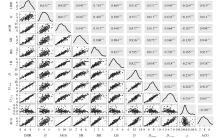
Fig.1
Correlation of growth parameters of slash pine"
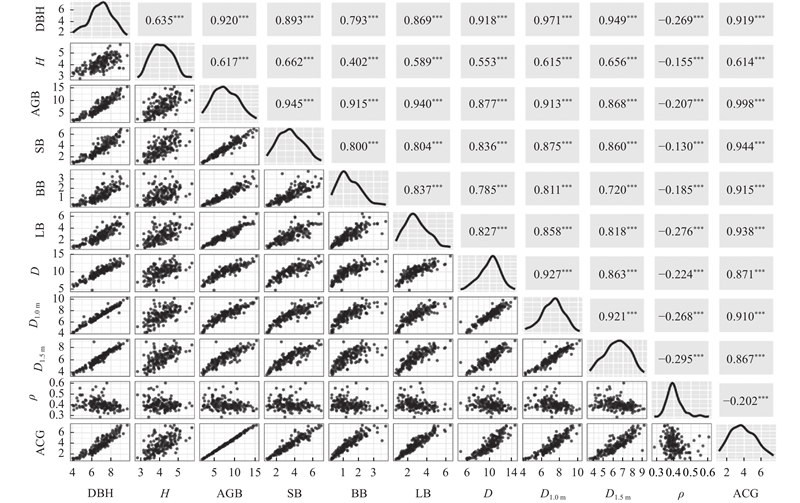
Table 2
Statistical analysis of tree height and crown area derived from UAV data"
| 指标Index | 树木编号Tree No. | 平均值 Average | 标准差 Standard deviation | |||||
| 1 | 2 | 3 | ... | 169 | 170 | |||
| 无人机估测树高UAV-estimated tree height (He)/m | 5.668 | 5.506 | 5.411 | ... | 3.164 | 3.121 | 4.221 | 0.550 |
| 冠幅面积Canopy area (Ac)/m2 | 6.500 | 6.064 | 5.954 | ... | 1.065 | 0.988 | 2.975 | 1.034 |
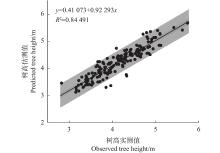
Fig.2
Regression analysis between UAV-estimated tree height and measured tree height"
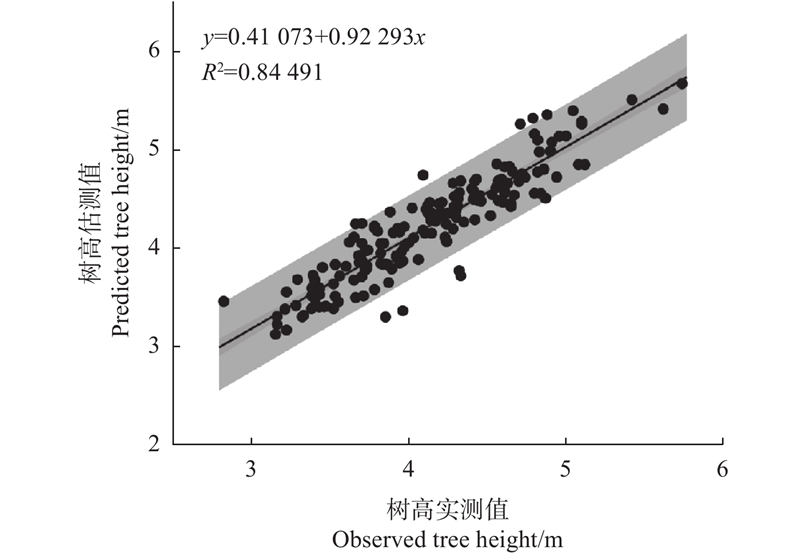
Table 3
Biomass models of slash pine fitted using different growth parameters"
| 模型 Model | 器官生物量 Organ biomass | R2 | RMSE | MAE | MAPE(%) | 参数 Parameter | |
| a | b | ||||||
W=aDBHb | 地上部分生物量Aboveground biomass | 0.857 | 1.134 | 0.893 | 12.46 | 0.107 | 2.198 |
| 主干生物量 Stem biomass | 0.802 | 0.599 | 0.451 | 13.77 | 0.061 | 2.080 | |
| 分枝生物量Branch biomass | 0.635 | 0.431 | 0.317 | 27.97 | 0.009 | 2.547 | |
| 针叶生物量 Leaf biomass | 0.770 | 0.546 | 0.411 | 15.33 | 0.041 | 2.175 | |
W=a(DBHH)b | 地上部分生物量Aboveground biomass | 0.751 | 1.496 | 1.171 | 16.78 | 0.116 | 1.247 |
| 主干生物量 Stem biomass | 0.764 | 0.654 | 0.493 | 49.33 | 0.054 | 1.241 | |
| 分枝生物量Branch biomass | 0.460 | 0.524 | 0.381 | 36.46 | 0.017 | 1.301 | |
| 针叶生物量 Leaf biomass | 0.675 | 0.649 | 0.488 | 18.51 | 0.045 | 1.227 | |
W=a(DBH2H)b | 地上部分生物量Aboveground biomass | 0.825 | 1.255 | 0.960 | 13.50 | 0.088 | 0.840 |
| 主干生物量 Stem biomass | 0.814 | 0.581 | 0.432 | 13.36 | 0.044 | 0.822 | |
| 分枝生物量Branch biomass | 0.544 | 0.482 | 0.348 | 31.82 | 0.016 | 0.912 | |
| 针叶生物量 Leaf biomass | 0.741 | 0.580 | 0.434 | 16.25 | 0.035 | 0.827 | |
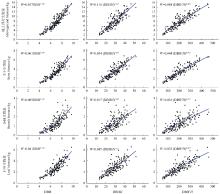
Fig.3
Scatter plots and allometric growth model curves for slash pine fitted using different growth parameters"
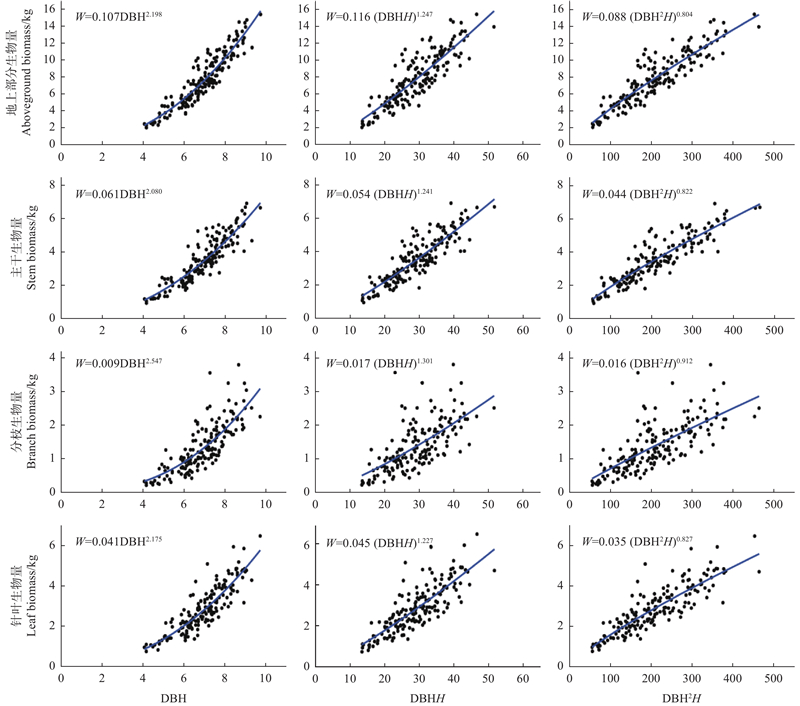
Table 4
Biomass models of slash pine fitted using different trunk diameters at different tree heights"
| 模型 Model | 器官生物量 Organ biomass | R2 | RMSE | MAE | MAPE(%) | 参数 Parameter | |
| a | b | ||||||
W=aDb | 地上部分生物量Aboveground biomass | 0.783 | 1.398 | 1.118 | 15.85 | 0.066 | 2.05 |
| 主干生物量 Stem biomass | 0.703 | 0.734 | 0.589 | 18.01 | 0.044 | 1.887 | |
| 分枝生物量Branch biomass | 0.628 | 0.435 | 0.321 | 28.18 | 0.004 | 2.477 | |
| 针叶生物量 Leaf biomass | 0.706 | 0.617 | 0.47 | 18.12 | 0.025 | 2.044 | |
W=aD1.0 mb | 地上部分生物量Aboveground biomass | 0.838 | 1.206 | 0.931 | 12.90 | 0.093 | 2.217 |
| 主干生物量 Stem biomass | 0.764 | 0.655 | 0.495 | 14.75 | 0.058 | 2.063 | |
| 分枝生物量Branch biomass | 0.665 | 0.413 | 0.302 | 26.51 | 0.006 | 2.666 | |
| 针叶生物量 Leaf biomass | 0.749 | 0.571 | 0.432 | 16.28 | 0.036 | 2.19 | |
W=aD1.5 mb | 地上部分生物量Aboveground biomass | 0.752 | 1.492 | 1.111 | 16.45 | 0.268 | 1.801 |
| 主干生物量 Stem biomass | 0.737 | 0.692 | 0.505 | 16.09 | 0.134 | 1.752 | |
| 分枝生物量Branch biomass | 0.514 | 0.497 | 0.371 | 34.68 | 0.032 | 1.999 | |
| 针叶生物量 Leaf biomass | 0.67 | 0.654 | 0.485 | 19.10 | 0.106 | 1.765 | |
Table 5
Biomass models of slash pine incorporating measured tree height and wood density"
| 模型 Model | 器官生物量 Organ biomass | R2 | RMSE | MAE | MAPE(%) | 参数 Parameter | |||
| a | b | c | d | ||||||
W=aDBHbHc | 地上部分生物量Aboveground biomass | 0.861 | 1.118 | 0.866 | 12.13 | 0.094 | 2.107 | 0.216 | |
| 主干生物量 Stem biomass | 0.824 | 0.565 | 0.421 | 12.89 | 0.046 | 1.868 | 0.496 | ||
| 分枝生物量Branch biomass | 0.647 | 0.424 | 0.318 | 28.20 | 0.013 | 2.730 | -0.478 | ||
| 针叶生物量Leaf biomass | 0.773 | 0.542 | 0.407 | 15.17 | 0.036 | 2.085 | 0.204 | ||
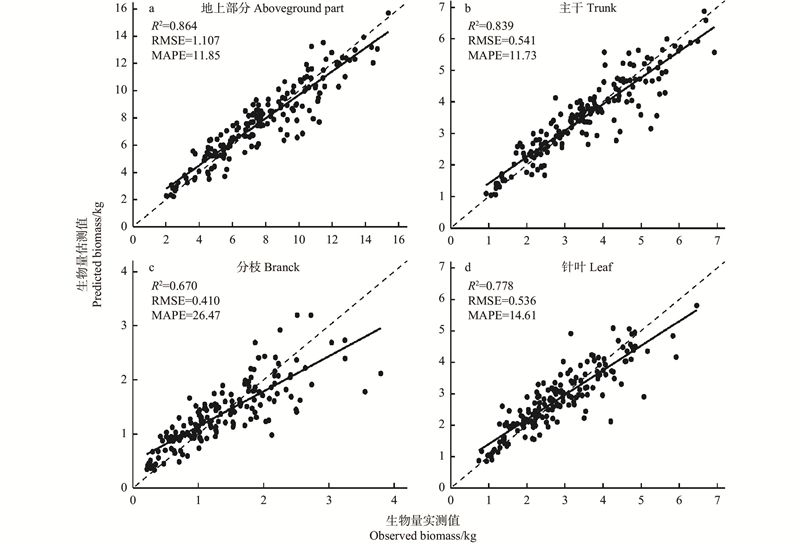
W=aDBHbHcρd | 地上部分生物量Aboveground biomass | 0.864 | 1.107 | 0.849 | 11.85 | 0.104 | 2.167 | 0.190 | 0.202 |
| 主干生物量 Stem biomass | 0.839 | 0.541 | 0.387 | 11.73 | 0.058 | 1.997 | 0.442 | 0.449 | |
| 分枝生物量Branch biomass | 0.650 | 0.422 | 0.316 | 27.84 | 2.834 | -0.527 | 0.309 | ||
| 针叶生物量Leaf biomass | 0.775 | 0.540 | 0.409 | 15.26 | 2.040 | 0.224 | -0.153 | ||
Table 6
Biomass models of slash pine incorporating estimated tree height and crown projection area"
| 模型 Model | 器官生物量 Organ biomass | R2 | RMSE | MAE | MAPE(%) | 参数 Parameter | |||
| a | b | c | d | ||||||
| W=aDBHbHec | 地上部分生物量Aboveground biomass | 0.860 | 1.123 | 0.870 | 12.17 | 0.096 | 2.106 | 0.194 | |
| 主干生物量 Stem biomass | 0.820 | 0.572 | 0.435 | 13.24 | 0.048 | 1.853 | 0.473 | ||
| 分枝生物量Branch biomass | 0.648 | 0.423 | 0.317 | 28.11 | 0.013 | 2.781 | 0.533 | ||
| 针叶生物量 Leaf biomass | 0.773 | 0.542 | 0.405 | 15.15 | 0.037 | 2.071 | 0.213 | ||
| W=aDBHb(HeAc)c | 地上部分生物量Aboveground biomass | 0.862 | 1.112 | 0.846 | 11.78 | 0.121 | 1.999 | 0.103 | |
| 主干生物量 Stem biomass | 0.804 | 0.596 | 0.452 | 13.77 | 0.006 | 1.959 | 0.062 | ||
| 分枝生物量Branch biomass | 0.642 | 0.426 | 0.308 | 27.05 | 0.011 | 2.232 | 0.161 | ||
| 针叶生物量 Leaf biomass | 0.778 | 0.537 | 0.393 | 14.62 | 0.048 | 1.929 | 0.127 | ||
| W=aDBHbHecAcd | 地上部分生物量Aboveground biomass | 0.863 | 1.110 | 0.843 | 11.75 | 0.113 | 1.983 | 0.185 | 0.087 |
| 主干生物量 Stem biomass | 0.820 | 0.572 | 0.434 | 13.23 | 0.047 | 1.873 | 0.474 | 0.014 | |
| 分枝生物量Branch biomass | 0.670 | 0.410 | 0.303 | 26.47 | 0.023 | 2.318 | 0.542 | 0.303 | |
| 针叶生物量 Leaf biomass | 0.778 | 0.536 | 0.392 | 14.61 | 0.045 | 1.915 | 0.197 | 0.113 | |
Table 7
ANOVA results for the models of W=aDBHb and W=aDBHbHcρd"
| 模型 Model | 残差自由度 Residual degrees of freedom | 残差平方和 Residual sum of squares | 自由度 Degrees of freedom | 平方和 Sum of squares | F | P |
| W=aDBHb | 168 | 218.70 | 2 | 10.462 | ||
| W=aDBHbHcρd | 166 | 208.24 |
Table 8
ANOVA results for the models of W=aDBHb and W=aDBHbHecAcd"
| 模型 Model | 残差自由度 Residual degrees of freedom | 残差平方和 Residual sum of squares | 自由度 Degrees of freedom | 平方和 Sum of squares | F | P |
| W=aDBHb | 168 | 218.70 | 2 | |||
| W=aDBHbHecAcd | 166 | 209.36 |
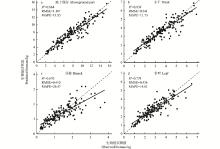
Fig.4
Relations between observed and predicted values in optimal allometric growth models for biomass of different organs"
| 陈文义, 王智勇, 周梦岩, 等. 幼龄楸树生物量分配规律与异速生长模型. 植物生态学报, 2025, 49 (2): 356- 366. | |
| Chen W Y, Wang Z Y, Zhou M Y, et al. Biomass allocation and allometric growth model of young Catalpa bungei. Chinese Journal of Plant Ecology, 2025, 49 (2): 356- 366. | |
| 丁 伟, 谷振军, 黄文晖, 等. 美国引种湿地松在赣南地区生长适应性评价. 南方林业科学, 2020, 48 (5): 37- 40. | |
| Ding W, Gu Z J, Huang W J, et al. Evaluation of growth and adaptability of American Pinus elliottii in south Jiangxi. South China Forestry Seience, 2020, 48 (5): 37- 40. | |
| 冯宗炜, 陈楚莹, 张家武, 等. 湖南会同地区马尾松林生物量的测定. 林业科学, 1982, 28 (2): 127- 134. | |
| Feng Z W, Chen C Y, Zhang J W, et al. Biomass estimation of Pinus massoniana forests in huitong region, Hunan Province. Scientia Silvae Sinicae, 1982, 28 (2): 127- 134. | |
| 国家林业局. 2014,. 立木生物量模型及碳计量参数—湿地松. 北京: 中国标准出版社. | |
| National Forestry Administration. 2014,. Tree biomass models and related parameters to carbon accounting for Pinus elliottii. Beijing: Standards Press of China. [in Chinese] | |
| 侯燕南, 吴惠俐, 项文化, 等. 亚热带4种森林生物量估算转换参数的研究. 中南林业科技大学学报, 2016, 36 (8): 57- 65. | |
| Hou Y N, Wu H L, Xiang W H, et al. Conversion parameters determination for stand biomass estimation off our subtropical forest types based on national forest inventory system. Journal of Central South University of Forestry & Technology, 2016, 36 (8): 57- 65. | |
| 冷寒冰, 景 军, 奉树成. 上海两种常绿阔叶树种生物量分配及异速生长模型. 生态学杂志, 2018, 37 (12): 3590- 3596. | |
| Leng H B, Jing J, Feng S C, et al. Biomass distribution and allometric model of two evergreen broad-leaved tree species in Shanghai. Chinese Journal of Ecology, 2018, 37 (12): 3590- 3596. | |
| 李康杰, 胡中岳, 刘 萍, 等. 广东省珠三角乔木林生物量碳储量评估. 林业资源管理, 2022, 51 (4): 54- 60. | |
| Li K J, Hu Z Y, Liu P, et al. Evaluation on forest biomass and carbon storage in Pearl River Delta in Guangdong Province. Forest and Grassland Resources Research, 2022, 51 (4): 54- 60. | |
| 林 力. 2011,. 马尾松人工林生物量模型的研究. 福州: 福建农林大学. | |
| Lin L. 2011,. Studies on the biomass model of Pinus massoniana plantations. Fuzhou: Fujian Agriculture and Forestry University. [in Chinese] | |
| 刘 坤, 曹 林, 汪贵斌, 等. 银杏生物量分配格局及异速生长模型. 北京林业大学学报, 2017, 39 (4): 12- 20. | |
| Liu K, Cao L, Wang G B, et al. Biomass allocation patterns and allometric models of Ginkgo biloba. Jouranl of Beijing Forestry University, 2017, 39 (4): 12- 20. | |
| 刘晓华, 杜阿朋, 许宇星, 等. 桉树、相思、湿地松生物量估算系数差异特征及其影响因素. 桉树科技, 2023, 40 (4): 9- 16. | |
| Liu X H, Du A P, Xu Y X, et al. Differences in biomass estimation coefficients of Eucalyptus spp. , Acacia spp., and Pinus elliottii and their key influencing factors. Eucalypt Science & Technology, 2023, 40 (4): 9- 16. | |
| 刘迎春, 高显连, 付 超, 等. 基于森林资源清查数据估算中国森林生物量固碳潜力. 生态学报, 2019, 39 (11): 4002- 4010. | |
| Liu Y C, Gao X L, Fu C, et al. Estimation of carbon sequestration potential of forest biomass in China based on National Forest Resources Inventory. Acta Ecologica Sinica, 2019, 39 (11): 4002- 4010. | |
| 马学威, 熊康宁, 张 俞, 等. 森林生态系统碳储量研究进展与展望. 西北林学院学报, 2019, 34 (5): 62- 72. | |
| Ma X W, Xiong K N, Zhang Y, et al. Research progresses and prospects of carbon storage in forest ecosystems. Journal of Northwest Forestry University, 2019, 34 (5): 62- 72. | |
| 孟盛旺, 谷振军, 肖平江, 等. 江西省吉安地区火炬松地上生物量分配特征及模型研建. 北京林业大学学报, 2022, 44 (12): 41- 51. | |
| Meng S W, Gu Z J, Xiao P J, et al. Characteristics of aboveground biomass allocation and model construction for Pinus taeda in Ji ’an Region, Jiangxi Province of eastern China. Jouranl of Beijing Forestry University, 2022, 44 (12): 41- 51. | |
| 欧光龙, 胥 辉. 森林生物量模型研究综述. 西南林业大学学报(自然科学), 2020, 40 (1): 1- 11. | |
| Ou G L, Xu H. A review on forest biomass models. Journal of Southwest Forestry University(Natural Sciences), 2020, 40 (1): 1- 11. | |
| 孙操稳, 仲文雯, 洑香香, 等. 2022,. 青钱柳幼林地上部分生物量生长模型研究. 南京林业大学学报(自然科学版), 46(1): 138-144. | |
| Sun C W, Zhong W W, Fu X X, et al. 2022,. A study on growth and aboveground biomass production of juvenile Cyclocarya paliurus plantations. Journal of Nanjing Forestry University(Natural Sciences Edition), 46(1): 138-144. [in Chinese] | |
| 唐守正, 张会儒, 胥 辉. 相容性生物量模型的建立及其估计方法研究. 林业科学, 2000, 46 (S1): 19- 27. | |
| Tang S Z, Zhang H R, Xu H. Study on edtimate method of method oecompatible biomass model. Scientia Silvae Sinicae, 2000, 46 (S1): 19- 27. | |
|
王辽阔, 何介南. 湘北湿地松人工林生物量分配格局与碳汇潜力研究. 湖南林业科技, 2025, 52 (2): 10- 18.
doi: 10.3969/j.issn.1003-5710.2025.02.002 |
|
|
Wang L K, He J N. Study on biomass allocation pattern and carbon sink potential of Pinus elliottii plantation in northern Hunan. Hunan Forestry Science & Technology, 2025, 52 (2): 10- 18.
doi: 10.3969/j.issn.1003-5710.2025.02.002 |
|
| 王轶夫, 孙玉军. 马尾松生物量模型的对比研究. 中南林业科技大学学报, 2012, 32 (10): 29- 33. | |
| Wang Y F, Sun Y J. Comparative study on biomass models for Pinus massoniana. Journal of Central South University of Forestry & Technology, 2012, 32 (10): 29- 33. | |
| 韦理电, 唐生森, 韦钧翔, 等. 湿地松人工林生长规律. 广西林业科学, 2016, 45 (3): 276- 279,287. | |
| Wei L D, Tang S S, Wei J X, et al. The growth rules of slash pine plantation. Guangxi Forestry Science, 2016, 45 (3): 276- 279,287. | |
| 向 玮, 雷相东, 刘 刚, 等. 近天然落叶松云冷杉林单木枯损模型研究. 北京林业大学学报, 2008, 30 (6): 90- 98. | |
| Xiang W, Lei X D, Liu G, et al. Individual tree mortality models for semi-natural larch-spruce-fir forests in Jilin Province, northeastern China. Journal of Beijing Forestry University, 2008, 30 (6): 90- 98. | |
| 叶功富, 高 伟, 郑兆飞, 等. 闽北高海拔地区湿地松人工林的生物量和生长量研究. 林业资源管理, 2013, 42 (6): 76- 80. | |
| Ye G F, Gao W, Zheng Z F, et al. Biomass and increment of Pinus elliottii plantationin high altitude area of northern Fujian. Forest Resources Management, 2013, 42 (6): 76- 80. | |
|
曾伟生. 森林蓄积量和生物量多元混合模型研建. 林业资源管理, 2021, 50 (6): 23- 28.
doi: 10.13466/j.cnki.lyzygl.2021.06.005 |
|
|
Zeng W S. Development of multivariate mixed models for forest volume and biomass. Forest Resources Management, 2021, 50 (6): 23- 28.
doi: 10.13466/j.cnki.lyzygl.2021.06.005 |
|
| 曾伟生, 唐守正. 一个新的通用性相对生长生物量模型. 林业科学, 2012, 48 (1): 48- 52. | |
| Zeng W S, Tang S Z. A new general biomass allometric model. Scientia Silvae Sinicae, 2012, 48 (1): 48- 52. | |
| 张帅楠, 栾启福, 姜景民. 基于无损检测技术的湿地松生长及材性性状遗传变异分析. 林业科学, 2017, 53 (6): 30- 36. | |
| Zhang S N, Luan Q F, Jiang J M. Genetic variation analysis for growth and wood properties of slash pine based on the non-destructive testing technologies. Scientia Silvae Sinicae, 2017, 53 (6): 30- 36. | |
| 张宇娇, 赵恒谦, 付含聪, 等. 基于无人机遥感多特征的单木地上生物量反演模型研究. 林业科学, 2025, 61 (8): 1- 16. | |
| Zhang Y J, Zhao H Q, Fu H C, et al. Research on the inversion model of aboveground biomass at individual tree scale based on the multiple features of UAV remote sensing. Scientia Silvae Sinicae, 2025, 61 (8): 1- 16. | |
|
Aabeyir R, Adu-Bredu S, Agyare W A, et al. Allometric models for estimating aboveground biomass in the tropical woodlands of Ghana, West Africa. Forest Ecosystems, 2020, 7 (1): 41.
doi: 10.1186/s40663-020-00250-3 |
|
| Basuki T M, van Laake P E, Skidmore A K, et al. Allometric equations for estimating the above-ground biomass in tropical lowland Dipterocarp forests. Forest Ecology and Management, 2009, 257 (8): 1684- 1694. | |
|
Chave J, Andalo C, Brown S, et al. Tree allometry and improved estimation of carbon stocks and balance in tropical forests. Oecologia, 2005, 145 (1): 87- 99.
doi: 10.1007/s00442-005-0100-x |
|
|
Chave J, Réjou‐Méchain M, Búrquez A, et al. Improved allometric models to estimate the aboveground biomass of tropical trees. Global Change Biology, 2014, 20 (10): 3177- 3190.
doi: 10.1111/gcb.12629 |
|
| Ding X, Pelser P B, Xu C, et al. Leveraging close-range UAV phenotyping and GWAS for enhanced understanding of slash pine growth dynamics. Information Processing in Agriculture, 2025, 12 (4): 550- 564. | |
|
Du L, Zhou T, Zou Z, et al. Mapping forest biomass using remote sensing and national forest inventory in China. Forests, 2014, 5 (6): 1267- 1283.
doi: 10.3390/f5061267 |
|
|
Feldpausch T R, Lloyd J, Lewis S L, et al. Tree height integrated into pantropical forest biomass estimates. Biogeosciences, 2012, 9 (8): 3381- 3403.
doi: 10.5194/bg-9-3381-2012 |
|
|
Fortier J, Truax B, Gagnon D, et al. Allometric equations for estimating compartment biomass and stem volume in mature hybrid poplars: general or site-specific?. Forests, 2017, 8 (9): 309.
doi: 10.3390/f8090309 |
|
|
Jaakkola A, Hyyppä J, Kukko A, et al. A low-cost multi-sensoral mobile mapping system and its feasibility for tree measurements. ISPRS Journal of Photogrammetry and Remote Sensing, 2010, 65 (6): 514- 522.
doi: 10.1016/j.isprsjprs.2010.08.002 |
|
|
Kittredge J. Estimation of the amount of foliage of trees and stands. Journal of Forestry, 1944, 42 (12): 905- 912.
doi: 10.1093/jof/42.12.905 |
|
|
Luo Y, Wang X, Ouyang Z, et al. A review of biomass equations for China’s tree species. Earth System Science Data, 2020, 12 (1): 21- 40.
doi: 10.5194/essd-12-21-2020 |
|
|
Ma Z, Hartmann H, Wang H, et al. Carbon dynamics and stability between native masson pine and exotic slash pine plantations in subtropical China. European Journal of Forest Research, 2014, 133 (2): 307- 321.
doi: 10.1007/s10342-013-0763-5 |
|
| Pan Y, Birdsey R A, Phillips O L, et al. 2013,. The structure, distribution, and biomass of the world’s forests. Annual Review of Ecology, Evolution, and Systematics, 44(1): 593−622. | |
|
Peichl M, Arain M A. Allometry and partitioning of above- and belowground tree biomass in an age-sequence of white pine forests. Forest Ecology and Management, 2007, 253 (1−3): 68- 80.
doi: 10.1016/j.foreco.2007.07.003 |
|
|
Poorter H, Niklas K J, Reich P B, et al. Biomass allocation to leaves, stems and roots: meta-analyses of interspecific variation and environmental control. New Phytologist, 2012, 193 (1): 30- 50.
doi: 10.1111/j.1469-8137.2011.03952.x |
|
|
Quegan S, Le Toan T, Chave J, et al. The European space agency biomass mission: measuring forest above-ground biomass from space. Remote Sensing of Environment, 2019, 227, 44- 60.
doi: 10.1016/j.rse.2019.03.032 |
|
| Riofrío J, Herrero C, Grijalva J, et al., 2015,. Aboveground tree additive biomass models in Ecuadorian highland agroforestry systems. Biomass and Bioenergy, 80: 252-259. | |
|
Ter-Mikaelian M T, Korzukhin M D. Biomass equations for sixty-five North American tree species. Forest Ecology and Management, 1997, 97 (1): 1- 24.
doi: 10.1016/S0378-1127(97)00019-4 |
|
| Wang C. Biomass allometric equations for 10 co-occurring tree species in Chinese temperate forests. Forest Ecology and Management, 2006, 222 (1): 9- 16. | |
|
Xiang W, Liu S, Deng X, et al. General allometric equations and biomass allocation of Pinus massoniana trees on a regional scale in southern China. Ecological Research, 2011, 26 (4): 697- 711.
doi: 10.1007/s11284-011-0829-0 |
|
| Xu Y, Zhang J, Franklin S B, et al. Improving allometry models to estimate the above- and belowground biomass of subtropical forest, China. Ecosphere, 2015, 6 (12): 1- 15. | |
|
Zeng W, Duo H, Lei X, et al. Individual tree biomass equations and growth models sensitive to climate variables for Larix spp. in China. European Journal of Forest Research, 2017, 136 (2): 233- 249.
doi: 10.1007/s10342-017-1024-9 |
| [1] | Min Deng,Huaijiang He,Xiangju Wu,Xinna Zhang,Chunyu Zhang,Xiuhai Zhao. Effects of Biomass Allocation Trade-Offs and Traits of Temperate Forests in Northeast China on Seedling Growth [J]. Scientia Silvae Sinicae, 2026, 62(3): 48-60. |
| [2] | Sheng Zhou,Fugen Jiang,Shuai Chen,Yi Long,Binbin Wang,Zige Song,Hua Sun. Estimation of Forest Aboveground Biomass Using Joint Spaceborne-UAV LiDAR and Sentinel-2 Data [J]. Scientia Silvae Sinicae, 2026, 62(3): 74-87. |
| [3] | Yuwei Zhang,Mengting Mo,Bo Shu,Jiajia Yao,Zhilin Yuan. Fungal Elicitors Promote Flavonoid Biosynthesis in Sanghuangporus vaninii and the Underlying Mechanisms [J]. Scientia Silvae Sinicae, 2026, 62(3): 146-160. |
| [4] | Huiqi Zhong,Jingyu Chai,Kailiang Wang,Jianhua Teng,Wenyu Bi,Anni Wang,Ping Lin. Construction of Near Infrared Spectroscopy Prediction Models Based on CARS-PLSR for Determining Oil Content and Fatty Acid Composition of Camellia oleifera Kernel [J]. Scientia Silvae Sinicae, 2026, 62(2): 111-125. |
| [5] | Wankuan Zhu,Zhichao Wang,Yuxing Xu,Runxia Huang,Yi Tao,Yuanyuan Zhong,Apeng Du. Simulation of Soil Respiration in a Stratified Mixed Stand of Eucalyptus spp. and Manglietia glauca in Leizhou Peninsula Based on Machine Learning Algorithms [J]. Scientia Silvae Sinicae, 2026, 62(1): 67-82. |
| [6] | Hongwei Zhou,Yongzheng Li,Wenhui Guo,Yifan Chen,Haochang Hu,Siyan Zhang,Di Cui,Yumo Chen. Prediction of Subcompartment-Scale Spread of Pine Wilt Disease Based on Cellular Automata Model [J]. Scientia Silvae Sinicae, 2026, 62(1): 133-143. |
| [7] | Liuyuan Huang,Yan Zheng,Xinjie Cheng,Weisheng Zeng,Qing Xu,Zhengyang Hou. Estimation of Forest Aboveground Biomass Based on Non-Wall-to-Wall Remote Sensing Auxiliary Data [J]. Scientia Silvae Sinicae, 2025, 61(9): 22-38. |
| [8] | Zhiyong Wang,Mengyan Zhou,Wenyi Chen,Wenjun Ma,Junhui Wang,Yi Zhang,Chuangye Wu,Zhibin Luo,Jing Zhou. Selection of Catalpa bungei Clones with High Productivity and High Nitrogen Utilization Efficiency and Analysis of G × E Interaction [J]. Scientia Silvae Sinicae, 2025, 61(8): 96-105. |
| [9] | Yujiao Zhang,Hengqian Zhao,Hancong Fu,Ge Liu,Xiadan Huangfu,Xuanqi Liu. Inversion Model of Aboveground Biomass at Individual Tree Scale Based on the Multiple Features of UAV Remote Sensing [J]. Scientia Silvae Sinicae, 2025, 61(8): 129-141. |
| [10] | Xiaoyan Xiong,Caixia Li,Guoqi Chai,Long Chen,Xiang Jia,Lingting Lei,Xiaoli Zhang. Estimation of Aboveground Biomass in Regional Forests by Using Integrating UAV-LiDAR and GEDI Data [J]. Scientia Silvae Sinicae, 2025, 61(8): 142-153. |
| [11] | Jiamin Wu,Yaxin Wang,Bin Sun,Zhijie Ma,Weina Sun,Liang Hong. Remote Sensing Estimation of Biomass of Caragana korshinskii with UAV [J]. Scientia Silvae Sinicae, 2025, 61(6): 13-24. |
| [12] | Yadi Wu,Shu Diao,Xianyin Ding,Qinyun Huang,Qifu Luan. Construction of a DNA Fingerprinting of Elite Varieties of Introduced Exotic Pines in China Based on 51K Liquid-Phased Probes [J]. Scientia Silvae Sinicae, 2025, 61(6): 109-119. |
| [13] | Li Wei, Yu Zhenzhen, He Hui, Zhao Jialu, Liu Xijun. Effects of Carbon Input Change on Soil Bacterial and Fungal Community Structure and Diversity in a Mature Pinus elliottii Plantation [J]. Scientia Silvae Sinicae, 2025, 61(6): 232-242. |
| [14] | Feifei Yang,Wangfei Zhang,Lei Zhao,Han Zhao,Yongjie Ji,Mengjin Wang. Two-Stage Remote Sensing Feature Optimization and GF-1 Data-Supported Forest Above-Ground Biomass Inversion [J]. Scientia Silvae Sinicae, 2025, 61(4): 9-19. |
| [15] | Xia Liu,Chengxing Ling,Yongfu Chen,Hua Liu,Zhenping He,Zejiang Li,Weina Sun,Zhijie Ma,Haixia You,Wen Lü,Feng Zhao,Haowei Zeng,Xinmiao Wang. Additive Biomass Models and Carbon Content of Thirteen Typical Shrubs in Erdos Region [J]. Scientia Silvae Sinicae, 2025, 61(4): 117-128. |
| Viewed | ||||||
|
Full text |
|
|||||
|
Abstract |
|
|||||
