
Scientia Silvae Sinicae ›› 2026, Vol. 62 ›› Issue (5): 213-226.doi: 10.11707/j.1001-7488.LYKX20250305
• Reviews • Previous Articles Next Articles
Chaofan Zhou1,Xiangdong Lei1,Xiaohong Zhang2,Zhaogang Liu3,Jing Qi3,Jun Lu1,*( )
)
Received:2025-05-13
Revised:2025-11-18
Online:2026-05-10
Published:2026-05-12
Contact:
Jun Lu
E-mail:junlu@ifrit.ac.cn
CLC Number:
Chaofan Zhou,Xiangdong Lei,Xiaohong Zhang,Zhaogang Liu,Jing Qi,Jun Lu. Review of Forest Life-Cycle Stage Classification Methods: Concepts, Paradigms, and Prospects[J]. Scientia Silvae Sinicae, 2026, 62(5): 213-226.
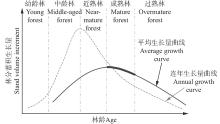
Fig.1
Stand volume increment at each stage"
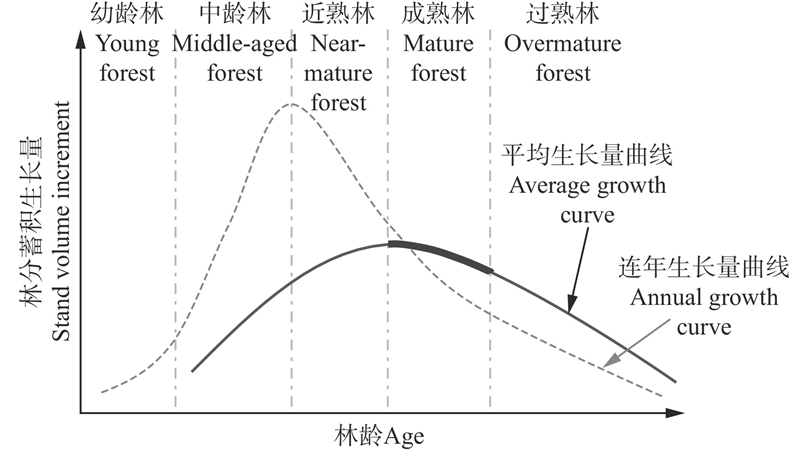

Table 1
Example of age group classification for major fast-growing, medium-growing, and slow-growing tree species in China"
| 主要树种 Main tree species | 速生种(杉木) Fast-growing (Cunninghamia lanceolata) | 中生种(马尾松) Medium-growing (Pinus massoniana) | 慢生种(红松) Slow-growing (Pinus koraiensis) | |
| 区域Region | 南方Southern China | 南方Southern China | 北方Northern China | |
| 林分起源Origin | 人工Artificial | 天然Natural | 人工Artificial | |
| 龄组 Age group/a | 幼龄林Young forest | ≤10 | ≤20 | ≤40 |
| 中龄林Middle-aged forest | 11~20 | 21~30 | 41~60 | |
| 近熟林Near-mature forest | 21~25 | 31~40 | 61~80 | |
| 成熟林Mature forest | 26~35 | 41~60 | 81~120 | |
| 过熟林Overmature forest | ≥36 | ≥61 | ≥121 | |
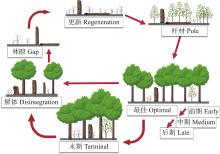
Fig.2
Schematic diagram of the forest cycle stages Typical characteristics of each stage: gap stage (canopy cover < 30%, regeneration coverage < 50%); regeneration stage (canopy cover < 30%, regeneration coverage > 50%); pole stage (canopy cover > 30%, maximum DBH < 20 cm); optimal stage (maximum DBH, 20?40 cm in the early stage, 40?60 cm in the medium stage, and >60 cm in the late stage); terminal stage (maximum tree height >85% potential maximum tree height, proportion of dead wood volume < 30%); disintegration stage (proportion of dead wood volume > 30%, regeneration coverage < 50%). Regeneration refers to all saplings with a DBH less than 7 cm."
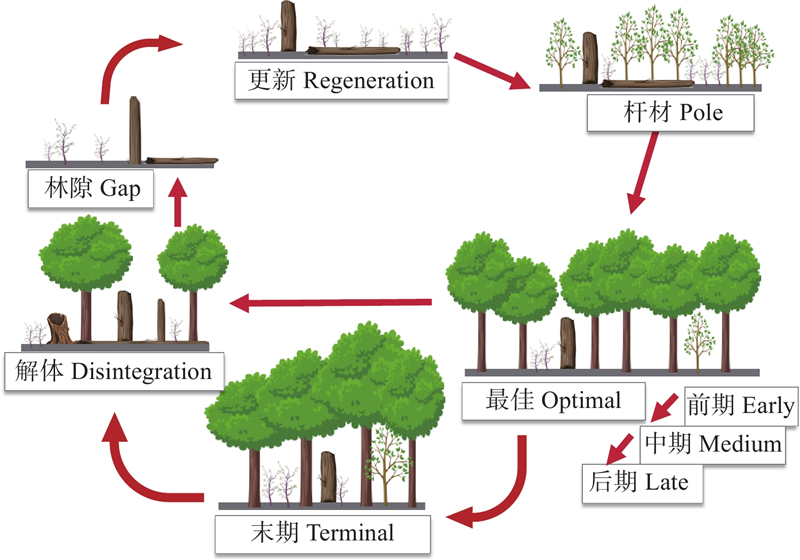
Fig.3
Dichotomous decision tree method for forest cycle stages division"
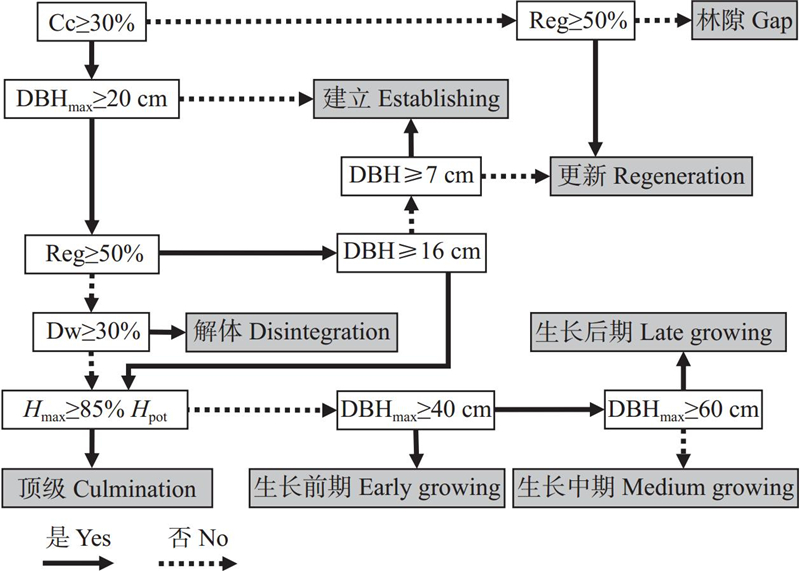
Fig.4
Schematic diagram of forest forward succession stages"
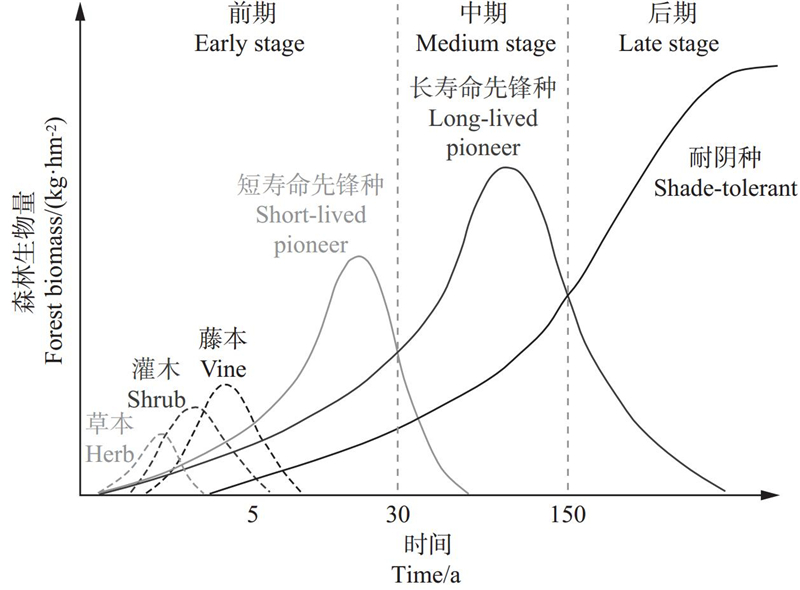
Fig.5
Schematic diagram of close-to-nature forest development stages"
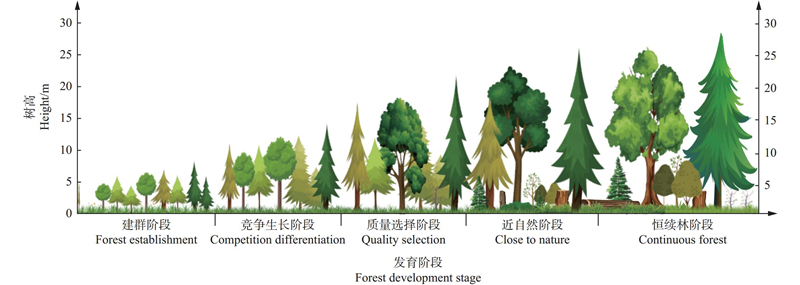
Table 2
Comparison of core features of each paradigm"
| 比较维度 Comparison dimension | 时序范式 (龄组划分法) Temporal paradigm (age-class division) | 结构范式 (森林循环阶段划分法) Structural paradigm (forest cycle stage classification) | 生态范式 (正向演替阶段划分法) Ecological paradigm (forward succession stage classification) | 融合范式 (近自然发育阶段划分法) Integrated paradigm (close-to-nature development stage classification) |
| 核心理论 Core theory | 法正林理论 Normal forest theory | 林隙动态理论 Gap dynamics theory | 经典演替理论 Classical succession theory | 全周期经营理论 Life-cycle management theory |
| 空间尺度 Spatial scale | 林分 Stand | 林分-斑块 Stand-patch | 景观/生态系统 Landscape/ecosystem | 林分 Stand |
| 时间尺度 Temporal scale | 经营周期 (数年至数十年) Management cycle (from years to decades) | 自然循环周期 (数十年至数百年) Natural cycle (from decades to centuries) | 演替周期 (数十年至数百年) Succession cycle (from decades to centuries) | 生命周期/经营周期 Life cycle/management cycle |
| 主导指标 Dominant indicators | 林分年龄 Stand age | 林分结构特征 (如郁闭度、死木蓄积量) Stand structural attributes (e.g., canopy cover, deadwood volume) | 物种功能群更替 Replacement of species functional groups | 结构指标为主,结合物种 (如树高胸径比) Mainly based on structural indicators, combined with species (e.g., height-to-diameter ratio) |
| 主要应用场景 Primary application context | 人工林、相对同龄林木材 生产与资源清查 Plantation, even-aged forest for timber production and resource inventory | 原始林保护、自然保护区 管理、生态学研究 Primary forest conservation, nature reserve management, ecological research | 植被恢复、生态修复、 长期群落动态研究 Vegetation restoration, ecological rehabilitation, long-term community dynamics research | 多功能森林经营、近自然林业、 人工林改培 Multi-functional forest management, close-to-nature forestry, improvement of plantations |
|
包 青, 郑晓光, 王广山, 等. 天然落叶松林分生长阶段划分与定向经营. 东北林业大学学报, 1997, 25 (1): 12- 14.
doi: 10.13759/j.cnki.dlxb.1997.01.004 |
|
|
Bao Q, Zheng X G, Wang G S, et al. The division of growth stages and aim-classification management of nature larch stand. Journal of Northeast Forestry University, 1997, 25 (1): 12- 14.
doi: 10.13759/j.cnki.dlxb.1997.01.004 |
|
|
胡雪凡, 张会儒, 张晓红. 中国代表性森林经营技术模式对比研究. 森林工程, 2019, 35 (4): 32- 38.
doi: 10.3969/j.issn.1006-8023.2019.04.006 |
|
|
Hu X F, Zhang H R, Zhang X H. Contrastive research on practice and application of forest management technology mode in China. Forest Engineering, 2019, 35 (4): 32- 38.
doi: 10.3969/j.issn.1006-8023.2019.04.006 |
|
| 贾 珂, 王新杰, 和敬渊, 等. 基于TWINSPAN分类的汪清县温带森林发育演替阶段分析. 南京林业大学学报(自然科学版), 2024, 48 (1): 179- 186. | |
| Jia K, Wang X J, He J Y, et al. Analyses of the temperate forests development and succession stage in Wangqing County based on TWINSPAN. Journal of Nanjing Forestry University (Natural Sciences Edition), 2024, 48 (1): 179- 186. | |
| 李婷婷, 陆元昌, 张显强, 等. 经营的马尾松森林类型发育演替阶段量化指标研究. 北京林业大学学报, 2014, 36 (3): 9- 17. | |
| Li T T, Lu Y C, Zhang X Q, et al. Quantitative indices to identify succession stages of managed Pinus massoniana forest. Journal of Beijing Forestry University, 2014, 36 (3): 9- 17. | |
| 陆 鑫, 巴乐金, 乌兰·吾尚. 等. 海拔对塔城地区野果林生态位与种间关联影响. 森林工程, 2024, 40 (3): 76- 86. | |
| Lu X, Balejin, Wulan·W, et al. The impact of elevation on the ecological niche and interspecific association of wild fruit forests in Tacheng area. Forest Engineering, 2024, 40 (3): 76- 86. | |
| 栾兆平, 郭滨德, 吴金卓. 长白山地区黄檗阔叶混交林主要乔木种群生态位特征. 森林工程, 2023, 39 (4): 78- 85. | |
| Luan Z P, Guo B D, Wu J Z. Niche characteristics of main tree populations in broad-leaved mixed forest of Phellodendron amurense in Changbai Mountain area. Forest Engineering, 2023, 39 (4): 78- 85. | |
| 陆元昌. 2006. 近自然森林经营的理论与实践. 北京: 科学出版社. | |
| Lu Y C. 2006. Theory and practice of close-natural forest management. Beijing: Science Press. [in Chinese] | |
| 陆元昌, 蒋三乃, 雷相东. 2016. 森林抚育规程解读. 北京: 中国林业出版社. | |
| Lu Y C, Jiang S N, Lei X D. 2016. Interpretation of the regulations for forest tending. Beijing: China Forestry Publishing House. [in Chinese] | |
|
陆元昌, 雷相东, 谢阳生, 等. 森林全周期经营: 基于不同演替理论和经营目标的计划模式及应用价值. 南京林业大学学报(自然科学版), 2025, 49 (6): 1- 12.
doi: 10.12302/j.issn.1000-2006.202507006 |
|
|
Lu Y C, Lei X D, Xie Y S, et al. Life-cycle forest management: planning models and application value under different succession theories and management objectives. Journal of Nanjing Forestry University (Natural Science Edition), 2025, 49 (6): 1- 12.
doi: 10.12302/j.issn.1000-2006.202507006 |
|
|
陆元昌, 刘宪钊, 雷相东, 等. 人工林多功能经营技术体系. 中南林业科技大学学报, 2017, 37 (7): 1- 10.
doi: 10.14067/j.cnki.1673-923x.2017.07.001 |
|
|
Lu Y C, Liu X Z, Lei X D, et al. Technical system for plantation multi-function management. Journal of Central South University of Forestry & Technology, 2017, 37 (7): 1- 10.
doi: 10.14067/j.cnki.1673-923x.2017.07.001 |
|
| 彭少麟. 1996. 南亚热带森林群落动态学. 北京: 科学出版社. | |
| Peng S L. 1996. The dynamics of forest community in southern-subtropical region. Beijing: Science Press. [in Chinese] | |
| 王红春. 龄组划分的公式化表达及其应用. 林业资源管理, 2011 (3): 72- 75. | |
| Wang H C. Study on formulation of age-group division and its application. Forest Resources Management, 2011 (3): 72- 75. | |
| 谢阳生, 陆元昌, 刘宪钊, 等. 2019. 多功能森林经营方案编制技术及案例. 北京: 中国林业出版社. | |
| Xie Y S, Lu Y C, Liu X Z. 2019. Multifunctional forest management programming technology and case study. Beijing: China Forestry Publishing House. [in Chinese] | |
|
徐德鹏, 许芳泽, 孙海龙, 等. 天然混交林林分发育阶段划分方法的比较. 北京林业大学学报, 2024, 46 (7): 139- 152.
doi: 10.12171/j.1000-1522.20230174 |
|
|
Xu D P, Xu F Z, Sun H L, et al. Comparison of methods for dividing developmental stages of natural mixed forest stands. Journal of Beijing Forestry University, 2024, 46 (7): 139- 152.
doi: 10.12171/j.1000-1522.20230174 |
|
| 于政中. 1993. 森林经理学. 2版. 北京: 中国林业出版社. | |
| Yu Z Z. 1993. Forest management. 2nd ed. Beijing: China Forestry Publishing House. [in Chinese] | |
|
臧润国, 徐化成. 林隙(GAP)干扰研究进展. 林业科学, 1998, 34 (1): 90- 98.
doi: 10.3321/j.issn:1001-7488.1998.01.013 |
|
|
Zang R G, Xu H C. Advances in forest gap disturbance research. Scientia Silvae Sinicae, 1998, 34 (1): 90- 98.
doi: 10.3321/j.issn:1001-7488.1998.01.013 |
|
|
张 超, 黄清麟. 林业区划研究综述. 林业资源管理, 2005 (5): 16- 20, 23.
doi: 10.3969/j.issn.1002-6622.2005.05.004 |
|
|
Zhang C, Huang Q L. Review on research of forest division. Forest Resources Management, 2005 (5): 16- 20, 23.
doi: 10.3969/j.issn.1002-6622.2005.05.004 |
|
|
张会儒, 雷相东, 张春雨, 等. 森林质量评价及精准提升理论与技术研究. 北京林业大学学报, 2019, 41 (5): 1- 18.
doi: 10.13332/j.1000-1522.20190219 |
|
|
Zhang H R, Lei X D, Zhang C Y, et al. Research on theory and technology of forest quality evaluation and precision improvement. Journal of Beijing Forestry University, 2019, 41 (5): 1- 18.
doi: 10.13332/j.1000-1522.20190219 |
|
| 张会儒, 汤孟平. 金沟岭林场混交林TWINSPAN分类及演替序列分析. 南京林业大学学报(自然科学版), 2009, 33 (1): 37- 42. | |
| Zhang H R, Tang M P. Classification and succession analysis of mixed forest in Jingouling forest farm using the TWINSPAN method. Journal of Nanjing Forestry University (Natural Sciences Edition), 2009, 33 (1): 37- 42. | |
| 张家来. 应用最优分割法划分森林群落演替阶段的研究. 植物生态学与地植物学学报, 1993, 17 (3): 224- 231. | |
| Zhang J L. Study on dividing the successional stages of forest communities with division method of optimization. Acta Phytoecologica et Geobotanica Sinica, 1993, 17 (3): 224- 231. | |
| 张凌峰, 刘兆刚, 董灵波. 帽儿山天然硬阔叶林发育阶段划分及林分结构特征. 北京林业大学学报, 2025, 47 (2): 10- 22. | |
| Zhang L F, Liu Z G, Dong L B. Development stage division and stand structure characteristics of natural hard broadleaved forest in Maor Mountain, Heilongjiang Province of northeastern China. Journal of Beijing Forestry University, 2025, 47 (2): 10- 22. | |
|
周超凡, 张会儒, 卢 军, 等. 东北主要天然次生林干扰与演替规律. 林业科学研究, 2021, 34 (4): 175- 183.
doi: 10.13275/j.cnki.lykxyj.2021.04.021 |
|
|
Zhou C F, Zhang H R, Lu J, et al. Disturbances and succession laws of main natural secondary forests in northeast China. Forest Research, 2021, 34 (4): 175- 183.
doi: 10.13275/j.cnki.lykxyj.2021.04.021 |
|
| 周梦丽, 雷相东, 国 红, 等. 基于TWINSPAN分类的天然云冷杉−阔叶混交林发育阶段划分. 林业科学研究, 2019, 32 (3): 49- 55. | |
| Zhou M L, Lei X D, Guo H, et al. Determining the development stage of natural spruce-fir-broadleaved mixed forest based on TWINSPAN. Forest Research, 2019, 32 (3): 49- 55. | |
| Assmann E. 1970. The principles of forest yield study: studies in the organic production, structure, increment, and yield of forest stands. Oxford: Pergamon Press. | |
| Bartsch N, von Lüpke B, Röhrig E. 2020. Waldbau auf ökologischer Grundlage. 8th Ed. Stuttgart, Deutschland: Verlag Eugen Ulmer. | |
| Bauhus J, van der Meer P, Kanninen M. 2010. Ecosystem goods and services: the key for sustainable plantations//Ecosystem goods and services from plantation forests. London: Routledge. | |
|
Begehold H, Rzanny M, Flade M. Forest development phases as an integrating tool to describe habitat preferences of breeding birds in lowland beech forests. Journal of Ornithology, 2015, 156 (1): 19- 29.
doi: 10.1007/s10336-014-1095-z |
|
|
Bobiec A, van der Burgt H, Meijer K, et al. Rich deciduous forests in Białowieża as a dynamic mosaic of developmental phases: premises for nature conservation and restoration management. Forest Ecology and Management, 2000, 130 (1/2/3): 159- 175.
doi: 10.1016/s0378-1127(99)00181-4 |
|
|
Boncina A. Comparison of structure and biodiversity in the Rajhenav virgin forest remnant and managed forest in the Dinaric region of Slovenia. Global Ecology and Biogeography, 2000, 9 (3): 201- 211.
doi: 10.1046/j.1365-2699.2000.00155.x |
|
|
Brang P, Spathelf P, Larsen J B, et al. Suitability of close-to-nature silviculture for adapting temperate European forests to climate change. Forestry, 2014, 87 (4): 492- 503.
doi: 10.1093/forestry/cpu018 |
|
| Chazdon R L. 2008. Chance and determinism in tropical forest succession//Carson W P, Schnitzer S A. Tropical forest community ecology. Oxford: Wiley-Blackwell. | |
|
Chazdon R L, Finegan B, Capers R S, et al. Composition and dynamics of functional groups of trees during tropical forest succession in northeastern costa rica. Biotropica, 2010, 42 (1): 31- 40.
doi: 10.1111/j.1744-7429.2009.00566.x |
|
| Clements F E. 1916. Plant succession; an analysis of the development of vegetation. Washington: Carnegie Institution of Washington. | |
| Davis L S, Johnson K N. 1987. Forest management. 3rd ed. New York: McGraw-Hill Book Company. | |
|
Duncker P S, Barreiro S M, Hengeveld G M, et al. Classification of forest management approaches: a new conceptual framework and its applicability to European forestry. Ecology and Society, 2012, 17 (4): 51.
doi: 10.5751/es-05262-170451 |
|
|
Dufrêne M, Legendre P. Species assemblages and indicator species: the need for a flexible asymmetrical approach. Ecological Monographs, 1997, 67 (3): 345- 366.
doi: 10.2307/2963459 |
|
|
Emborg J, Christensen M, Heilmann-Clausen J. The structural dynamics of Suserup Skov, a near-natural temperate deciduous forest in Denmark. Forest Ecology and Management, 2000, 126 (2): 173- 189.
doi: 10.1016/S0378-1127(99)00094-8 |
|
|
Fassnacht F E, White J C, Wulder M A, et al. Remote sensing in forestry: current challenges, considerations and directions. Forestry: an International Journal of Forest Research, 2024, 97 (1): 11- 37.
doi: 10.1093/forestry/cpad024 |
|
|
Finegan B. Forest succession. Nature, 1984, 312 (5990): 109- 114.
doi: 10.1038/312109a0 |
|
|
Finegan B. Pattern and process in neotropical secondary rain forests: the first 100 years of succession. Trends in Ecology & Evolution, 1996, 11 (3): 119- 124.
doi: 10.1016/0169-5347(96)81090-1 |
|
|
Franklin J F, Spies T A, Van Pelt R, et al. Disturbances and structural development of natural forest ecosystems with silvicultural implications, using Douglas-fir forests as an example. Forest Ecology and Management, 2002, 155 (1/2/3): 399- 423.
doi: 10.3410/f.726131299.793514344 |
|
|
Frelich L E, Lorimer C G. Natural disturbance regimes in hemlock-hardwood forests of the upper great lakes region. Ecological Monographs, 1991, 61 (2): 145- 164.
doi: 10.2307/1943005 |
|
|
Führer E. Forest functions, ecosystem stability and management. Forest Ecology and Management, 2000, 132 (1): 29- 38.
doi: 10.1016/S0378-1127(00)00377-7 |
|
| Gamborg C, Larsen J B. 2003. ‘Back to nature’: a sustainable future for forestry? Forest Ecology and Management, 179(1/2/3): 559−571. | |
| Garet J, Raulier F, Pothier D, et al. 2012. Forest age class structures as indicators of sustainability in boreal forest: are we measuring them correctly? Ecological Indicators, 23: 202−210. | |
| Glatthorn J, Feldmann E, Tabaku V, et al. 2018. Classifying development stages of primeval European beech forests: is clustering a useful tool? BMC Ecology, 18(1): 47. | |
|
Grime J P. Evidence for the existence of three primary strategies in plants and its relevance to ecological and evolutionary theory. The American Naturalist, 1977, 111 (982): 1169- 1194.
doi: 10.1086/283244 |
|
|
Goodell L, Faber-Langendoen D. Development of stand structural stage indices to characterize forest condition in Upstate New York. Forest Ecology and Management, 2007, 249 (3): 158- 170.
doi: 10.1016/j.foreco.2007.04.052 |
|
|
Gough C M, Atkins J W, Bond-Lamberty B, et al. Forest structural complexity and biomass predict first-year carbon cycling responses to disturbance. Ecosystems, 2021, 24 (3): 699- 712.
doi: 10.1007/s10021-020-00544-1 |
|
|
Holl K D. Restoring tropical forests from the bottom up. Science, 2017, 355 (6324): 455- 456.
doi: 10.1126/science.aam5432 |
|
|
Johnson E A, Miyanishi K. Testing the assumptions of chronosequences in succession. Ecology Letters, 2008, 11 (5): 419- 431.
doi: 10.1111/j.1461-0248.2008.01173.x |
|
|
Koop H, Hilgen P. Forest dynamics and regeneration mosaic shifts in unexploited beech (Fagus sylvatica) stands at Fontainebleau (France). Forest Ecology and Management, 1987, 20 (1/2): 135- 150.
doi: 10.1016/0378-1127(87)90155-1 |
|
| Korpel S. Degree of equilibrium and dynamical changes of the forest on example of natural forests of Slovakia. Acta Facultatis Forestalis Zvolen, 1982, 24, 9- 31. | |
|
Král K, Shue J, Vrška T, et al. Fine-scale patch mosaic of developmental stages in northeast American secondary temperate forests: the European perspective. European Journal of Forest Research, 2016, 135 (5): 981- 996.
doi: 10.1007/s10342-016-0988-1 |
|
|
Král K, Vrška T, Hort L, et al. Developmental phases in a temperate natural spruce-fir-beech forest: determination by a supervised classification method. European Journal of Forest Research, 2010, 129 (3): 339- 351.
doi: 10.1007/s10342-009-0340-0 |
|
|
Larrieu L, Cabanettes A, Gonin P, et al. Deadwood and tree microhabitat dynamics in unharvested temperate mountain mixed forests: a life-cycle approach to biodiversity monitoring. Forest Ecology and Management, 2014, 334, 163- 173.
doi: 10.1016/j.foreco.2014.09.007 |
|
| Larsen J B. 2012. Close-to-nature forest management: the Danish approach to sustainable forestry. Sustainable Forest Management, Current Research. Croatia: InTech. | |
|
Lavorel S, McIntyre S, Landsberg J, et al. Plant functional classifications: from general groups to specific groups based on response to disturbance. Trends in Ecology & Evolution, 1997, 12 (12): 474- 478.
doi: 10.1016/S0169-5347(97)01219-6 |
|
| Legendre P, Legendre L. 2012. Numerical ecology. 3rd ed. Netherlands: Elsevier. | |
| Leibundgut H. 1959. Über zweck und methodik der struktur- und zuwachsanalyse von urwäldern. Schweiz Z Forstwes. 110: 111−124. | |
|
Lindenmayer D B, Franklin J F, Fischer J. General management principles and a checklist of strategies to guide forest biodiversity conservation. Biological Conservation, 2006, 131 (3): 433- 445.
doi: 10.1016/j.biocon.2006.02.019 |
|
|
Lorimer C G, Halpin C R. Classification and dynamics of developmental stages in late-successional temperate forests. Forest Ecology and Management, 2014, 334, 344- 357.
doi: 10.1016/j.foreco.2014.09.003 |
|
|
McRoberts R E, Tomppo E O. Remote sensing support for national forest inventories. Remote Sensing of Environment, 2007, 110 (4): 412- 419.
doi: 10.1016/j.rse.2006.09.034 |
|
| Messier C, Puettmann K J, Coates K D. 2015. Managing forests as complex adaptive systems: building resilience to the challenge of global change. New York: Routledge. | |
|
Millar C I, Stephenson N L. Temperate forest health in an era of emerging megadisturbance. Science, 2015, 349 (6250): 823- 826.
doi: 10.1126/science.aaa9933 |
|
|
Norden N, Angarita H A, Bongers F, et al. Successional dynamics in Neotropical forests are as uncertain as they are predictable. PNAS, 2015, 112 (26): 8013- 8018.
doi: 10.1073/pnas.1500403112 |
|
| O’Hara K L. 2014. Multiaged silviculture: managing for complex forest stand structures. Oxford: Oxford University Press. | |
| Oliver C D, Larson B C. 1996. Forest stand dynamics. New York: Wiley. | |
|
Peet R K, Christensen N L. Competition and tree death. BioScience, 1987, 37 (8): 586- 595.
doi: 10.2307/1310669 |
|
| Peterken G F. 1996. Natural woodland: ecology and conservation in northern temperate regions. Cambridge: Cambridge University Press. | |
|
Pickett S T A, Cadenasso M L, Meiners S J. Ever since Clements: from succession to vegetation dynamics and understanding to intervention. Applied Vegetation Science, 2009, 12 (1): 9- 21.
doi: 10.1111/j.1654-109X.2009.01019.x |
|
|
Pommerening A, Murphy S T. A review of the history, definitions and methods of continuous cover forestry with special attention to afforestation and restocking. Forestry, 2004, 77 (1): 27- 44.
doi: 10.1093/forestry/77.1.27 |
|
|
Poorter L, Amissah L, Bongers F, et al. Successional theories. Biological Reviews, 2023, 98, 2049- 2077.
doi: 10.1111/brv.12995 |
|
|
Reichstein M, Camps-Valls G, Stevens B, et al. Deep learning and process understanding for data-driven earth system science. Nature, 2019, 566 (7743): 195- 204.
doi: 10.1038/s41586-019-0912-1 |
|
| Runkle J R. 1985. Disturbance regimes in temperate forests//The ecology of natural disturbance and patch dynamics. New York: Academic Press. | |
|
Schütz J P, Saniga M, Diaci J, et al. Comparing close-to-nature silviculture with processes in pristine forests: lessons from central Europe. Annals of Forest Science, 2016, 73 (4): 911- 921.
doi: 10.1007/s13595-016-0579-9 |
|
|
Seidl R, Thom D, Kautz M, et al. Forest disturbances under climate change. Nature Climate Change, 2017, 7 (6): 395- 402.
doi: 10.1038/nclimate3303 |
|
| Smith W B. 2002. Forest inventory and analysis: a national inventory and monitoring program. Environmental Pollution, 116(suppl 1): 233−242. | |
| Spies T A. 1998. Forest structure: a key to the ecosystem. Northwest Science, 72(2): 34−39. | |
|
Trumbore S, Brando P, Hartmann H. Forest health and global change. Science, 2015, 349 (6250): 814- 818.
doi: 10.1126/science.aac6759 |
|
|
Vilén T, Gunia K, Verkerk P J, et al. Reconstructed forest age structure in Europe 1950—2010. Forest Ecology and Management, 2012, 286, 203- 218.
doi: 10.1016/j.foreco.2012.08.048 |
|
| Walker L R, Moral R. 2003. Primary succession and ecosystem rehabilitation. Cambridge: Cambridge University Press. | |
|
Watt A S. On the ecology of British beechwoods with special reference to their regeneration: part Ⅱ, sections Ⅱ and Ⅲ. The development and structure of beech communities on the Sussex Downs. The Journal of Ecology, 1925, 13 (1): 27- 73.
doi: 10.2307/2255556 |
|
|
White J C, Coops N C, Wulder M A, et al. Remote sensing technologies for enhancing forest inventories: a review. Canadian Journal of Remote Sensing, 2016, 42 (5): 619- 641.
doi: 10.1080/07038992.2016.1207484 |
|
|
Whitmore T C. Canopy gaps and the two major groups of forest trees. Ecology, 1989, 70 (3): 536- 538.
doi: 10.2307/1940195 |
|
|
Whittaker R H. A consideration of climax theory: the climax as a population and pattern. Ecological Monographs, 1953, 23 (1): 41- 78.
doi: 10.2307/1943519 |
|
|
Winter S, Brambach F. Determination of a common forest life cycle assessment method for biodiversity evaluation. Forest Ecology and Management, 2011, 262 (12): 2120- 2132.
doi: 10.1016/j.foreco.2011.07.036 |
|
|
Wulder M A, Loveland T R, Roy D P, et al. Current status of Landsat program, science, and applications. Remote Sensing of Environment, 2019, 225, 127- 147.
doi: 10.1016/j.rse.2019.02.015 |
|
|
Zang R G, Tao J P, Li C Y. Within community patch dynamics in a tropical montane rain forest of Hainan Island, south China. Acta Oecologica, 2005, 28 (1): 39- 48.
doi: 10.1016/j.actao.2005.02.001 |
|
|
Zenner E K, Peck J E, Hobi M L, et al. Validation of a classification protocol: meeting the prospect requirement and ensuring distinctiveness when assigning forest development phases. Applied Vegetation Science, 2016, 19 (3): 541- 552.
doi: 10.1111/avsc.12231 |
|
|
Zenner E K, Sagheb-Talebi K, Akhavan R, et al. Integration of small-scale canopy dynamics smoothes live-tree structural complexity across development stages in old-growth Oriental beech (Fagus orientalis Lipsky) forests at the multi-gap scale. Forest Ecology and Management, 2015, 335, 26- 36.
doi: 10.1016/j.foreco.2014.09.023 |
|
|
Zhou C F, Ding Y, Zang R G. Compositional changes at neighborhood and stand scales during recovery of a tropical lowland rainforest after shifting cultivation on Hainan Island, China. Journal of Environmental Management, 2024, 351, 119951.
doi: 10.1016/j.jenvman.2023.119951 |
| Viewed | ||||||
|
Full text |
|
|||||
|
Abstract |
|
|||||
