
Scientia Silvae Sinicae ›› 2026, Vol. 62 ›› Issue (5): 227-234.doi: 10.11707/j.1001-7488.LYKX20250197
• Reviews • Previous Articles
Jiayue Zhao1,Zhijie Zong1,Yu Luan1,Mingliang Yin2,Jianchang Lian3,Changhua Fang1,*( )
)
Received:2025-04-03
Revised:2025-05-08
Online:2026-05-10
Published:2026-05-12
Contact:
Changhua Fang
E-mail:cfang@icbr.ac.cn
CLC Number:
Jiayue Zhao,Zhijie Zong,Yu Luan,Mingliang Yin,Jianchang Lian,Changhua Fang. Research and Development of Bamboo Drinking Straws and Formulation of Their International Standard[J]. Scientia Silvae Sinicae, 2026, 62(5): 227-234.
Table 1
Comparison of characteristics and limitations of three types of bamboo drinking straws"
| 竹吸管类型 Types | 特点 Characteristics | 不足 Limitations | 适用场景 Application scenarios |
| 原竹吸管 Natural bamboo straw | 天然环保、高强度 Natural and eco-friendly, high strength | 生产标准化难度大、依赖人工程度高,成本高Standardization of production is difficult, relies heavily on manual labor, and high cost | 高端市场(特色餐厅、环保品牌等) High end market (fancy restaurants, eco-friendly brands etc.) |
| 竹棒钻孔式吸管 Drilled bamboo straw | 高效自动化生产、机械强度优越、规格统一、成本低Highly efficient automated production, superior mechanical strength, uniform specifications, lost cost | 产品造型单一 Limited product variety | 大规模商用(连锁餐饮、咖啡店和冷饮行业)和家用Large scale commercial use (chain restaurants, coffee shops, and beverage shops) and domestic use |
| 缠绕式竹吸管 Coiled bamboo straw | 外形美观、规格统一、结构稳定Attractive appearance, unform specifications, and stable | 生产工序多 Complex manufacturing process | 大规模商用(连锁餐饮、咖啡店和冷饮行业)和家用Large scale commercial use (chain restaurants, coffee shops, and beverage shops) and domestic use |
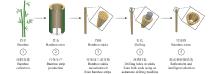
Fig.1
Production process of drilled bamboo drinking straws"
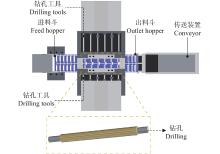
Fig.2
Schematic diagram of the high-speed automatic drilling device"
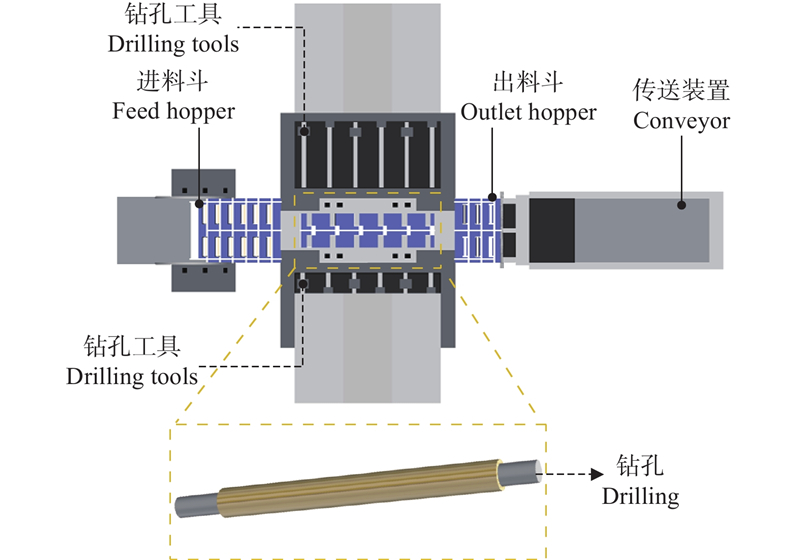
Fig.3
Method for splicing the length of bamboo strips"
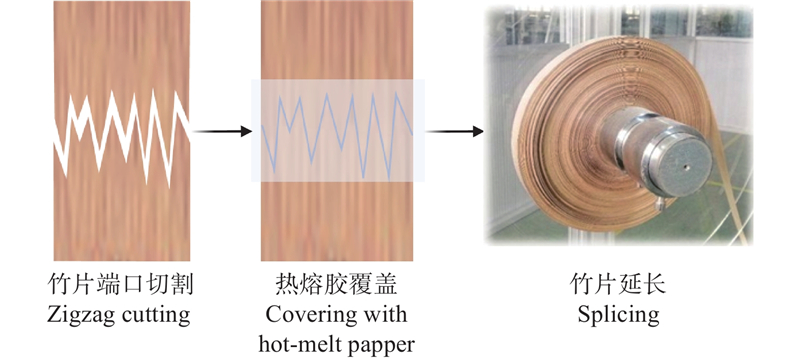
Fig.4
Microstructure of bamboo drinking straws"
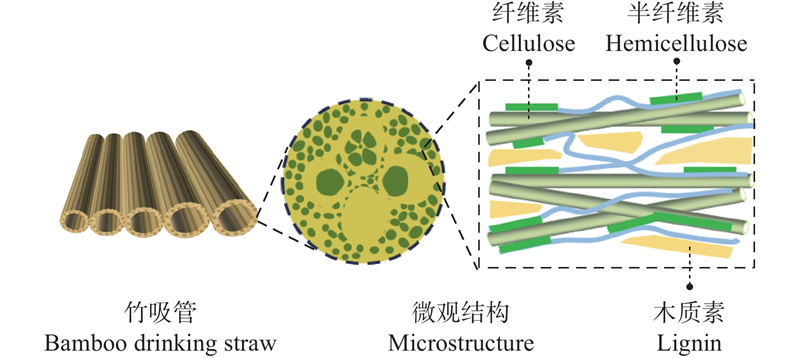
Table 2
Key requirements specified in the international standard for bamboo drinking straws"
| 内容 Scope | 具体条目和规定 Specifications and requirements | ||
| 术语和定义 Terms and definitions | 竹饮用吸管、钻孔式竹吸管、缠绕式竹吸管、天然竹吸管、尖头吸管、平头吸管、毛刺、霉变、开裂、污斑等 Bamboo drinking straw, drilled bamboo straw, coiled bamboo straw, natural bamboo straw, pointed straw, flat-end straw, splinter, decay, crack, strain, dust, etc. | ||
| 要求和测试方法 Requirements and test methods | 感观 Sensory requirements | 气味 Odour | 除竹子本身的天然气味外,无霉菌和其他异味 The smell should be free of mildew or any odour other than natural bamboo |
| 外观 Appearance | 对表面、毛刺、霉变、虫孔、裂纹、污斑、灰尘、斜口吸管尖端等内容 做出规范Specifications are established for surface, splinters, mildew, wormholes, cracks, stains, dust, and the tips of pointed straws | ||
| 尺寸和形状 Dimension and shape requirements | 对长度偏差、外径偏差、内径偏差、弯曲度、斜口吸管端部的斜角等内容做出规范 Specifications are established for length deviation, outer diameter deviation, inner diameter deviation, degree of curvature, and the bevel angle of the pointed straw | ||
| 物理和机械性能 Physical and mechanical requirements | 含水率Moisture content | ||
| 耐热性Heat endurance | |||
| 垂直于长度方向的最大压缩载荷 Maximum compressive load perpendicular to length direction | |||
| 检验规则 Inspection rules | 取样方法:采用ISO 2859-1中的正常检验二次抽样方案,根据不同的检验项目采用相应的抽样方案 Sampling: a double sampling plan for normal inspection in accordance with ISO 2859-1 shall be used | ||
| 检验判定规则Inspection and judgment rules | |||
| 包装和标识 Packaging and labelling | 包装 Packaging | 采用适当方式进行包装,可使用薄膜或纸张进行单独包装,材料应复合目标市场的食品接触材料要求Drinking straws should be properly packed to stay clean and protected from moisture and damage, and may be individually wrapped in food-safe film or paper | |
| 包装标识 Labelling on packaging | 制造商名称和地址、吸管的材料和尺寸、包内数量、生产日期、参考信息、买方要求的任何健康与安全相关信息The packaging should be labelled with the name and address of the manufacturer, the material and size of the straws, quantity per pack, production date, reference, any information regarding health and safety required by the buyer | ||
| 运输和存储 Transport and storage | 包装好的产品小心搬运、保持干燥、避免受潮、污染和损坏 Handle packages with care to keep them dry, clean, and undamaged | ||
| 存放于干燥、阴凉(常温)处,避免阳光直射、潮湿和接触易燃物 Store in a cool, dry place away from sunlight, moisture, and flammables | |||
|
栾 玉, 杨雨婷, 殷明亮, 等. 全天然竹制吸管的制备及其性能评价. 林产工业, 2025, 62 (2): 25- 30.
doi: 10.19531/j.issn1001-5299.202502005 |
|
|
Luan Y, Yang Y T, Yin M L, et al. The production and performance evaluation of all-natural bamboo straws. China Forest Products Industry, 2025, 62 (2): 25- 30.
doi: 10.19531/j.issn1001-5299.202502005 |
|
|
Bergström J S, Hayman D. An overview of mechanical properties and material modeling of polylactide (PLA) for medical applications. Annals of Biomedical Engineering, 2016, 44 (2): 330- 340.
doi: 10.1007/s10439-015-1455-8 |
|
|
Borowski P F, Patuk I, Bandala E R. Innovative industrial use of bamboo as key “green” material. Sustainability, 2022, 14 (4): 1955.
doi: 10.3390/su14041955 |
|
|
Chen C C, Wu Q J, Wan Z M, et al. Mildly processed chitin used in one-component drinking straws and single use materials: strength, biodegradability and recyclability. Chemical Engineering Journal, 2022, 442, 136173.
doi: 10.1016/j.cej.2022.136173 |
|
|
Chen H E, Xu L H, Yu K, et al. Release of microplastics from disposable cups in daily use. Science of the Total Environment, 2023, 854, 158606.
doi: 10.1016/j.scitotenv.2022.158606 |
|
|
Chen X G, Zhang X Q, Zhang Y P, et al. Changes of carbon stocks in bamboo stands in China during 100 years. Forest Ecology and Management, 2009, 258 (7): 1489- 1496.
doi: 10.1016/j.foreco.2009.06.051 |
|
|
Chitaka T Y, Russo V, von Blottnitz H. In pursuit of environmentally friendly straws: a comparative life cycle assessment of five straw material options in south Africa. The International Journal of Life Cycle Assessment, 2020, 25 (9): 1818- 1832.
doi: 10.1007/s11367-020-01786-w |
|
| Durst P, Ulrich W, Kashio M, et al. 1994. Non-wood forest products in Asia. FAO, Regional Office for Asia. | |
| Fao F. 2018. Food and agriculture organization of the United Nations. Rome, 403. | |
|
Lau W W Y, Shiran Y, Bailey R M, et al. Evaluating scenarios toward zero plastic pollution. Science, 2020, 369 (6510): 1455- 1461.
doi: 10.1126/science.aba9475 |
|
|
Liu S J, Liu X Y, Guo J L, et al. The association between microplastics and microbiota in placentas and meconium: the first evidence in humans. Environmental Science & Technology, 2022, 57 (46): 17774- 17785.
doi: 10.1021/acs.est.2c04706.s001 |
|
|
Luan Y, Huang B, Chen L, et al. High-performance, low-cost, chemical-free, and reusable bamboo drinking straw: an all-natural substitute for plastic straws. Industrial Crops and Products, 2023, 200, 116829.
doi: 10.1016/j.indcrop.2023.116829 |
|
|
Luan Y, Yang Y T, Su Q, et al. Eco‐friendly innovation: Industrial‐scale all‐natural bamboo drinking straw inspired by bamboo’s flexibility and toughness. Journal of Bioresources and Bioproducts, 2025, 10 (2): 239- 252.
doi: 10.1016/j.jobab.2025.03.002 |
|
|
Neto A M, Gomes T S, Pertel M, et al. An overview of plastic straw policies in the Americas. Marine Pollution Bulletin, 2021, 172, 112813.
doi: 10.1016/j.marpolbul.2021.112813 |
|
|
Ragusa A, Notarstefano V, Svelato A, et al. Raman microspectroscopy detection and characterisation of microplastics in human breastmilk. Polymers, 2022, 14 (13): 2700.
doi: 10.3390/polym14132700 |
|
|
Rai R, Ranjan R, Kant C, et al. Biodegradable, eco-friendly, and hydrophobic drinking straws based on delignified phosphorylated bamboo-gelatin composites. Chemical Engineering Journal, 2023, 471, 144047.
doi: 10.1016/j.cej.2023.144047 |
|
|
Roy P, Ashton L, Wang T, et al. Evolution of drinking straws and their environmental, economic and societal implications. Journal of Cleaner Production, 2021, 316, 128234.
doi: 10.1016/j.jclepro.2021.128234 |
|
|
Shaikh S, Yaqoob M, Aggarwal P. An overview of biodegradable packaging in food industry. Current Research in Food Science, 2021, 4, 503- 520.
doi: 10.1016/j.crfs.2021.07.005 |
|
|
Shankar S, Rhim J W. Effects of poly(butylene adipate-co-terephthalate) coating on the water resistant, mechanical, and antibacterial properties of kraft paper. Progress in Organic Coatings, 2018, 123, 153- 159.
doi: 10.1016/j.porgcoat.2018.07.002 |
|
|
Timshina A, Aristizabal-Henao J J, Da Silva B F, et al. The last straw: characterization of per- and polyfluoroalkyl substances in commercially-available plant-based drinking straws. Chemosphere, 2021, 277, 130238.
doi: 10.1016/j.chemosphere.2021.130238 |
|
|
Wang W H, Su F, Wang S C, et al. Bio-straw or not? Determinants of consumption intention under the plastic straw ban. Environmental Science and Pollution Research, 2023, 30 (30): 75002- 75014.
doi: 10.1007/s11356-023-27696-6 |
|
| Wang X Z, Pang Z Q, Chen C J, et al. All-natural, degradable, rolled-up straws based on cellulose micro- and nano-hybrid fibers. Advanced Functional Materials, 2020a, 30 (22): 1910417. | |
|
Wang X Z, Xia Q Q, Jing S S, et al. Strong, hydrostable, and degradable straws based on cellulose-lignin reinforced composites. Small, 2021, 17 (18): 2008011.
doi: 10.1002/smll.202008011 |
|
|
Wang Y L, Chen J, Wang D M, et al. A systematic review on the composition, storage, processing of bamboo shoots: focusing the nutritional and functional benefits. Journal of Functional Foods, 2020b, 71, 104015.
doi: 10.1016/j.jff.2020.104015 |
|
| Yang H B, Liu Z X, Yin C H, et al. Edible, ultra strong, and microplastic-free bacterial cellulose-based straws by biosynthesis. Advanced Functional Materials, 2022, 32 (15): 2111713. | |
|
Yi K, Fu S Y, Zhang H, et al. Cellulose nanofibrils/polydimethylsiloxane double-layer coating for fabrication of high barrier and excellent water- and oil-resistance paper. Progress in Organic Coatings, 2022, 172, 107123.
doi: 10.1016/j.porgcoat.2022.107123 |
|
|
Yin Y F, Berglund L, Salmén L. Effect of steam treatment on the properties of wood cell walls. Biomacromolecules, 2011, 12 (1): 194- 202.
doi: 10.1021/bm101144m |
|
|
Zanghelini G M, Cherubini E, Dias R, et al. Comparative life cycle assessment of drinking straws in Brazil. Journal of Cleaner Production, 2020, 276, 123070.
doi: 10.1016/j.jclepro.2020.123070 |
|
|
Zhao Q C, Fang Z S, Wang P C, et al. Polylactic acid micro/nanoplastic exposure induces male reproductive toxicity by disrupting spermatogenesis and mitochondrial dysfunction in mice. ACS Nano, 2025, 19 (5): 5589- 5603.
doi: 10.1021/acsnano.4c15112 |
|
|
Zhou B Z, Fu M Y, Xie J Z, et al. Ecological functions of bamboo forest: research and application. Journal of Forestry Research, 2005, 16 (2): 143- 147.
doi: 10.1007/BF02857909 |
| [1] | Quanjun Liu,Xiaoman Wang,Wenli Li,Xintong Yuan,Xiaofeng Hao,Xianjun Li,Xingong Li,Yiqiang Wu,Kang Xu. Prediction of the Influence of Drying Treatment of Phenolic Resin Impregnated Heat-Treated Bamboo Bundles on the Physical and Mechanical Properties of Bamboo Scrimber Based on the GWO-BPNN Model [J]. Scientia Silvae Sinicae, 2026, 62(5): 139-150. |
| [2] | Shaohui Fan,Shihui Zheng,Songpo Wei,Guanglu Liu. Key Environmental Factors Affecting Internode Length of Moso Bamboo [J]. Scientia Silvae Sinicae, 2026, 62(3): 100-110. |
| [3] | Hongli Chen,Guankai Wang,WenFu Zhang,Jian Zhang,Hongliang Huang,Zhenhua Yang,Yin Zhao,Xiaoqiang Du. Design and Testing of a Based on UAV Lifting System for Bamboo Product and Epidemic Tree Downhill [J]. Scientia Silvae Sinicae, 2026, 62(1): 177-187. |
| [4] | Jiaheng Hao,Yichao Guo,Hao Li,Aiqing Zhu,Lei Shi. Vegetation Cover Extraction of Bamboo Forest in China Based on Time-Series Remote Sensing Indices [J]. Scientia Silvae Sinicae, 2025, 61(9): 1-11. |
| [5] | Zhifeng Wang,Shuchang Tang,Xizhi Peng,Da Wang,Zhongfeng Zhang,Xianjun Li. Axial Compression Performance of Laminated Bamboo Grid Sandwich Panels [J]. Scientia Silvae Sinicae, 2025, 61(9): 173-183. |
| [6] | Xiaorong Wang,Miao Gong,Zhongchun Gu,Xingyi Hu,Lianghua Qi,Haishan Tan,Xue Dai,Qingping Liu,Shaodan Xia,Hu Zhao. Characteristics of Fine Root Decomposition and Nutrient Release during Phyllostachys edulis Expansion into Cunninghamia lanceolata Forest and Broad-Leaved Forest in Mufu Mountain Area [J]. Scientia Silvae Sinicae, 2025, 61(8): 46-57. |
| [7] | Xiaoman Wang,Jianxiong Lü,Xianjun Li,Yiqiang Wu,Xingong Li,Xiaofeng Hao,Jianzheng Qiao,Kang Xu. Prediction of Moisture Content during Drying of Phenolic Resin Impregnated Heat-Treated Bamboo Bundles Based on PSO-BP Neural Network Modeling [J]. Scientia Silvae Sinicae, 2025, 61(5): 187-198. |
| [8] | Kaiqiang Zhang,Shuangbao Zhang. Interface Properties of Bamboo Fiber Reinforced Polylactic Acid Composite Modified by Nano-SiO2 Biomimetic Mineralization [J]. Scientia Silvae Sinicae, 2025, 61(3): 189-198. |
| [9] | Bowen Shan,Yi Li,Jun Qin,Lei Shi. Spatiotemporal Change of the Extreme Climate in China’s Bamboo Forest during 1960—2050 [J]. Scientia Silvae Sinicae, 2025, 61(2): 50-61. |
| [10] | Haitao Li,Wenjing Zhou,Yiqiang Wu,Chen Chen,Wei Xu. Bending Mechanical Properties of Phyllostachys edulis at Different Temperatures [J]. Scientia Silvae Sinicae, 2025, 61(2): 163-171. |
| [11] | Xinxin Ma,You Wang,Jiajun Wang,Long Feng,Jianfeng Ma. Changes in Ash Composition of Bamboo during Pyrolysis and the Distribution Pattern of Silicon Transformation [J]. Scientia Silvae Sinicae, 2025, 61(2): 172-179. |
| [12] | Lemei Yang,Baogang Zhang,Youchao Chen,Yanjiang Cai. Leaf Functional Traits of Understory Plants in a Moso Bamboo Forests in Response to Simulated Nitrogen Deposition [J]. Scientia Silvae Sinicae, 2025, 61(12): 61-71. |
| [13] | Ye Sheng,Yuwen He,Renkun Guo,Chenggen He,Nan Guo. Bending Test and Determination of Characteristic Value of Bamboo Scrimber [J]. Scientia Silvae Sinicae, 2024, 60(7): 149-157. |
| [14] | Zhuo Lü,Wushuang Shi,Shuxin Kong,Shuyan Lin. Anatomical Structure and Three-Dimensional Construction of Leaves of Main Bamboo Species in Bambusa and Phyllostachys in Nanjing [J]. Scientia Silvae Sinicae, 2024, 60(5): 98-115. |
| [15] | Tengfei Ma,Yue Liu,Yawei Zhan,Meixin Wang,Zhiqiang Li. Pretreatment Technology on Bamboo for Monosaccharides Production under Enzymatic Hydrolysis: A Review [J]. Scientia Silvae Sinicae, 2024, 60(3): 150-159. |
| Viewed | ||||||
|
Full text |
|
|||||
|
Abstract |
|
|||||
