
Scientia Silvae Sinicae ›› 2026, Vol. 62 ›› Issue (4): 25-33.doi: 10.11707/j.1001-7488.LYKX20250519
• Frontiers and hot topics • Previous Articles Next Articles
Yuanhui Zhang1,2,Guibin Wang1,2,*( ),Yu Wang1,2,Jing Guo1,2,Yuhua Liu3,Pengfei Yu4
Received:2025-08-21
Online:2026-04-15
Published:2026-04-11
Contact:
Guibin Wang
E-mail:guibinwang99@163.com
CLC Number:
Yuanhui Zhang,Guibin Wang,Yu Wang,Jing Guo,Yuhua Liu,Pengfei Yu. Comprehensive Selection of Ginkgo biloba Clones for Leaf Production with High Medicinal Value and Low Acid Content[J]. Scientia Silvae Sinicae, 2026, 62(4): 25-33.
Table 1
Leaf phenotypic traits of Ginkgo biloba clones in this experiment"
| 无性系编号 Clone number | 单叶干质量 Single leaf dry mass/mg | 单叶面积 Single leaf area/cm2 | 比叶干质量 Specific leaf dry mass/(mg·cm?2) | 无性系编号 Clone number | 单叶干质量 Single leaf dry mass/mg | 单叶面积 Single leaf area/cm2 | 比叶干质量 Specific leaf dry mass/(mg·cm?2) | |
| 1 | 513.7±145.3abcdef | 37.42±9.48abcde | 13.69±0.88cdefghijk | 24 | 448.3±117.6bcdef | 34.11±5.24abcde | 13.01±1.34ghijk | |
| 2 | 419.22±81.4cdef | 31.82±6.32bcde | 13.18±0.13fghijk | 25 | 744.9±229.2a | 47.13±10.33a | 15.60±1.68abcdefg | |
| 3 | 462.11±77.5bcdef | 31.16±2.50bcde | 14.77±1.44abcdefghij | 26 | 542.2±383.3abcdef | 34.34±22.20abcde | 15.33±1.73abcdefgh | |
| 4 | 430.0±123.1cdef | 27.20±7.14de | 15.74±0.42abcdef | 27 | 409.3±139.4cdef | 27.54±8.99de | 14.83±1.25abcdefghij | |
| 5 | 506.4±10.4abcdef | 33.03±3.50abcde | 15.44±1.59abcdefgh | 28 | 489.8±80.9abcdef | 32.79±2.09abcde | 14.87±1.51abcdehghij | |
| 6 | 342.6±117.7def | 24.97±2.28e | 13.52±3.31efghijk | 29 | 334.5±64.7ef | 24.54±5.32e | 13.68±0.34defghijk | |
| 7 | 359.7±47.3cdef | 28.00±2.81cde | 12.82±0.51hijk | 30 | 552.9±57.5abcdef | 36.17±5.48abcde | 15.37±0.80abcdefgh | |
| 8 | 482.1±41.1bcdef | 34.26±2.94abcde | 14.10±1.13bcdefghijk | 31 | 610.1±162.0abc | 45.17±10.02ab | 13.43±1.14fghijk | |
| 9 | 539.3±74.6abcdef | 31.70±2.32bcde | 17.06±2.65a | 32 | 343.1±235.3def | 28.68±17.27cde | 11.68±1.21k | |
| 10 | 423.7±105.9cdef | 28.25±7.08cde | 15.00±0.65abcdefghi | 33 | 434.8±87.9cdef | 26.55±4.20e | 16.31±1.28abc | |
| 11 | 481.8±100.8bcdef | 33.26±6.86abcde | 14.48±0.42abcdefghij | 34 | 559.2±24.5abcdef | 36.06±1.40abcde | 15.54±1.28abcdefg | |
| 12 | 422.7±117.3cdef | 27.54±4.70de | 15.18±1.67abcdefgh | 35 | 520.7±155.1abcdef | 35.52±9.92abcde | 14.61±0.28abcdefghij | |
| 13 | 429.7±128.2cdef | 26.14±5.02e | 16.25±1.85abcd | 36 | 588.9±116.7abcde | 38.07±7.87abcde | 15.53±1.14abcdefg | |
| 14 | 434.4±145.8cdef | 25.30±8.18e | 17.10±1.29a | 37 | 435.6±54.6cdef | 33.96±4.91abcde | 12.89±1.07hijk | |
| 15 | 362.1±143.9cdef | 24.07±8.83e | 14.90±0.75abcdefghij | 38 | 581.9±68.8abcde | 42.16±3.70abcd | 13.78±0.51bcdefghijk | |
| 16 | 404.4±106.5cdef | 27.15±6.09de | 14.81±0.65abcdefghij | 39 | 533.9±37.2abcdef | 36.37±1.26abcde | 14.69±1.10abcdefghij | |
| 17 | 312.0±102.9f | 23.56±5.46e | 13.13±2.16fghijk | 40 | 418.6±87.9cdef | 25.99±4.34e | 16.09±1.63abcde | |
| 18 | 407.3±140.5cdef | 32.05±8.77abcde | 12.56±0.86ijk | 41 | 443.9±249.7bcdef | 34.44±13.08abcde | 12.39±2.25jk | |
| 19 | 413.9±173.4cdef | 28.53±10.41cde | 14.33±0.74bcdefghij | 42 | 527.0±102.3abcdef | 34.67±8.09abcde | 15.29±0.57abcdefgh | |
| 20 | 460.4±71.4bcdef | 32.09±4.36abcde | 14.34±1.16bcdefghij | 43 | 704.2±90.6ab | 43.04±3.55abc | 16.33±0.84ab | |
| 21 | 441.5±110.1cdef | 28.55±5.75cde | 15.39±1.34abcdefgh | 44 | 454.3±85.6bcdef | 32.00±5.77bcde | 14.18±0.14bcdefghijk | |
| 22 | 602.9±246.6abcd | 38.56±12.36abcde | 15.37±1.39abcdefgh | 45 | 522.3±108.8abcdef | 34.20±5.68abcde | 15.20±0.66abcdefgh | |
| 23 | 384.3±59.1cdef | 25.01±1.77e | 15.30±1.25abcdefgh | 46 | 527.9±32.7abcdef | 36.94±3.00abcde | 14.31±0.56bcdefghij |
Table 2
Content of medicinal components and ginkgolic acid in the leaves of Ginkgo biloba clones mg·g–1"
| 无性系编号 Clone number | 总黄酮 Total flavonoids | 萜内酯 Terpene lactones | 银杏酸 Ginkgolic acid | 无性系编号 Clone number | 总黄酮 Total flavonoids | 萜内酯 Terpene lactones | 银杏酸 Ginkgolic acid | |
| 1 | 16.11±1.26abcdefg | 7.16±0.45abcdefghij | 10.23±1.36ghijklmn | 24 | 18.10±1.76abcde | 7.36±0.51abcdefg | 16.21±3.77a | |
| 2 | 15.96±2.63abcdefg | 7.22±0.61abcdefgh | 8.61±1.32mn | 25 | 13.06±0.62defg | 6.43±0.32efghijk | 11.06±0.86efghijklm | |
| 3 | 17.32±1.32abcdef | 7.17±0.46abcdefghij | 9.10±0.27jklmn | 26 | 17.47±5.52abcdef | 6.97±0.89bcdefgk | 11.81±0.75bcdefghijklm | |
| 4 | 13.64±0.79cdefg | 6.29±0.22ghijk | 9.32±3.57ijklmn | 27 | 15.11±3.59abcdefg | 7.14±0.33abcdefghij | 14.43±1.14abcd | |
| 5 | 16.87±3.24abcdef | 6.92±0.23bcdefghijk | 9.43±1.67hijklmn | 28 | 17.49±3.88abcdef | 7.36±0.41abcde | 11.77±1.42bcdefghijklm | |
| 6 | 18.50±6.55abcd | 6.90±0.76bcdefghijk | 8.74±1.02lmn | 29 | 20.15±4.27a | 7.66±0.72abc | 13.95±0.83abcde | |
| 7 | 15.72±3.26abcdefg | 6.65±0.58defghijk | 11.57±0.40bcdefghijklm | 30 | 14.26±1.97bcdefg | 7.15±0.24abcdefghij | 12.47±1.05bcdefghi | |
| 8 | 11.06±0.87g | 6.50±0.42defghijk | 9.10±1.32jklmn | 31 | 16.88±3.86abcdef | 8.06±0.28a | 12.67±2.64bcdefgh | |
| 9 | 12.03±0.72 fg | 6.64±0.81defghijk | 9.72±3.17ghijklmn | 32 | 19.80±5.98ab | 7.48±0.77abcd | 14.81±3.73ab | |
| 10 | 12.84±0.96defg | 6.52±0.34defghijk | 10.79±1.19efghijklm | 33 | 12.26±0.73fg | 7.21±0.81abcdefghi | 13.68±2.14abcdef | |
| 11 | 15.21±0.54abcdefg | 7.28±0.13abcdefg | 11.32±0.26cdefghijklm | 34 | 17.24±2.48abcdef | 7.17±0.60abcdefghij | 11.08±1.09efghijklm | |
| 12 | 13.79±1.82cdefg | 6.51±0.61defghijk | 12.14±3.98bcdefghij | 35 | 18.29±1.79abcde | 7.67±0.04abc | 11.66±1.07bcdefghijklm | |
| 13 | 15.37±1.74abcdefg | 6.71±0.29cdefghijk | 11.74±0.81bcdefghijklm | 36 | 16.50±5.40abcdefg | 7.08±1.03bcdefghij | 12.87±1.87bcdefg | |
| 14 | 13.42±0.40cdefg | 7.12±0.55abcdefghij | 12.16±0.19bcdefghij | 37 | 17.43±1.92abcdef | 7.75±0.27ab | 13.60±1.60abcdef | |
| 15 | 15.11±1.55abcdefg | 6.96±0.24bcdefghijk | 14.45±2.45abc | 38 | 13.37±0.81cdefg | 6.78±0.30bcdefghijk | 12.05±0.46bcdefghijk | |
| 16 | 17.14±3.76abcdef | 6.75±0.47cdefghijk | 11.17±0.40defghijklm | 39 | 14.17±0.52bcdefg | 7.24±0.59abcdefgh | 11.54±0.04bcdefghijklm | |
| 17 | 16.44±2.37abcdefg | 6.42±0.57efghijk | 10.80±0.15efghijklm | 40 | 15.55±1.84abcdefg | 6.72±0.36cdefghijk | 7.54±0.61n | |
| 18 | 14.53±1.37abcdefg | 6.49±0.17efghijk | 10.86±1.51efghijklm | 41 | 13.76±2.31cdefg | 6.03±0.26k | 12.53±2.60bcdefghi | |
| 19 | 15.61±1.46abcdefg | 6.52±0.67defghijk | 11.92±1.47bcdefghijkl | 42 | 14.15±1.09bcdefg | 6.24±0.14ijk | 11.68±2.48bcdefghijklm | |
| 20 | 12.69±1.09efg | 6.29±0.56hijk | 11.92±0.89bcdefghijkl | 43 | 15.17±0.23abcdefg | 6.10±0.10k | 8.92±1.21jklmn | |
| 21 | 18.35±3.87abcde | 6.37±0.58fghijk | 11.65±0.13bcdefghijklm | 44 | 15.98±2.58abcdefg | 6.26±0.19hijk | 10.64±0.49fghijklmn | |
| 22 | 11.95±0.22fg | 6.22±0.15jk | 12.07±0.85bcdefghijk | 45 | 17.34±2.91abcdef | 6.58±0.21defghijk | 8.77±0.60klmn | |
| 23 | 18.79±6.38abc | 7.41±0.45abcde | 11.96±1.24bcdefghijkl | 46 | 16.02±1.77abcdefg | 6.01±0.34k | 9.91±0.95ghijklmn |
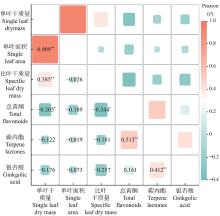
Fig.1
Correlation between leaf phenotypic traits of Ginkgo biloba clones and the contents of medicinal components and ginkgolic acid"
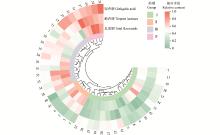
Fig.2
Clustering analysis results of Ginkgo biloba clones based on the contents of medicinal components and ginkgolic acid"
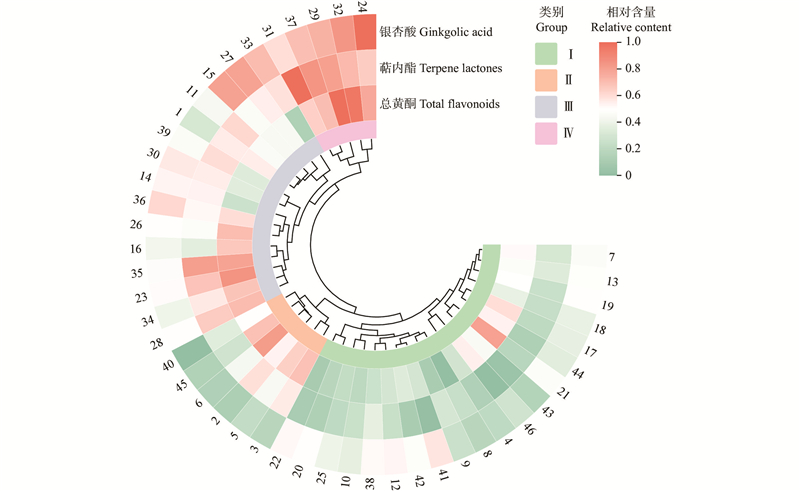
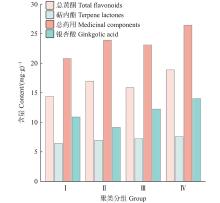
Fig.3
Content of functional ingredients and total medicinal components in leaves of different Ginkgo biloba clones"
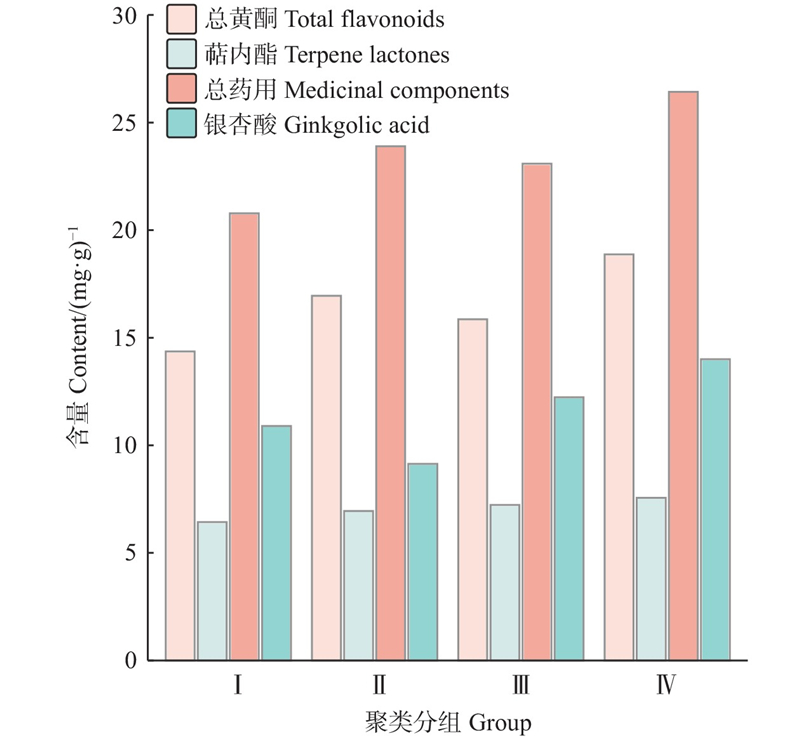
Table 3
Principal component analysis results of leaf indicators of Ginkgo biloba clones in this experiment"
| 叶片指标 Leaf index | 旋转后各主成分荷载 Loadings of each principal component after rotation | ||
| 主成分1 The first principal component | 主成分2 The second principal component | 主成分3 The third principal component | |
| 单叶干质量Single leaf dry mass | 0.941 | –0.118 | 0.294 |
| 单叶面积Single leaf area | 0.993 | –0.039 | –0.103 |
| 比叶干质量 Specific leaf dry weight | 0.066 | –0.16 | 0.969 |
| 总黄酮Total flavonoids | –0.209 | 0.619 | –0.356 |
| 萜内酯Terpene lactones | 0.014 | 0.907 | –0.009 |
| 银杏酸Ginkgolic acid | –0.047 | 0.677 | –0.094 |
| 方差贡献率 Variance contribution rate (%) | 39.804 | 25.612 | 14.603 |
| 累计贡献率 Cumulative contribution rate (%) | 39.804 | 65.416 | 80.019 |
Table 4
Comprehensive evaluation results and ranking of Ginkgo biloba clones in the test"
| 编号No. | C1 | C2 | C3 | T1 | T2 | T3 | D | 排名Rank |
| 1 | 0.953 | 0.503 | 0.263 | 0.508 | 0.767 | 0.400 | 0.571 | 7 |
| 2 | 0.501 | 0.699 | 0.121 | 0.287 | 0.931 | 0.294 | 0.494 | 19 |
| 3 | 0.557 | 0.669 | 0.388 | 0.314 | 0.906 | 0.494 | 0.536 | 15 |
| 4 | 0.412 | 0.003 | 0.708 | 0.243 | 0.349 | 0.733 | 0.367 | 35 |
| 5 | 0.750 | 0.470 | 0.553 | 0.409 | 0.740 | 0.617 | 0.553 | 11 |
| 6 | ?0.010 | 0.741 | 0.062 | 0.037 | 0.967 | 0.249 | 0.373 | 34 |
| 7 | 0.224 | 0.230 | 0.077 | 0.151 | 0.539 | 0.260 | 0.295 | 43 |
| 8 | 0.862 | ?0.039 | 0.517 | 0.464 | 0.314 | 0.590 | 0.439 | 23 |
| 9 | 0.896 | ?0.062 | 1.064 | 0.481 | 0.295 | 1.000 | 0.516 | 17 |
| 10 | 0.461 | ?0.043 | 0.612 | 0.268 | 0.311 | 0.662 | 0.353 | 37 |
| 11 | 0.746 | 0.403 | 0.448 | 0.407 | 0.684 | 0.539 | 0.520 | 16 |
| 12 | 0.416 | ?0.091 | 0.625 | 0.246 | 0.271 | 0.671 | 0.331 | 42 |
| 13 | 0.349 | 0.105 | 0.761 | 0.213 | 0.435 | 0.773 | 0.386 | 29 |
| 14 | 0.384 | 0.093 | 0.997 | 0.230 | 0.425 | 0.950 | 0.424 | 26 |
| 15 | 0.120 | 0.044 | 0.520 | 0.101 | 0.383 | 0.592 | 0.281 | 45 |
| 16 | 0.275 | 0.335 | 0.404 | 0.176 | 0.627 | 0.506 | 0.381 | 31 |
| 17 | ?0.085 | 0.252 | 0.083 | 0.000 | 0.558 | 0.265 | 0.227 | 46 |
| 18 | 0.517 | 0.123 | 0.084 | 0.295 | 0.450 | 0.266 | 0.339 | 40 |
| 19 | 0.386 | 0.078 | 0.389 | 0.231 | 0.412 | 0.495 | 0.337 | 41 |
| 20 | 0.703 | ?0.242 | 0.522 | 0.386 | 0.144 | 0.594 | 0.347 | 38 |
| 21 | 0.394 | 0.182 | 0.487 | 0.235 | 0.499 | 0.568 | 0.380 | 32 |
| 22 | 1.315 | ?0.414 | 0.806 | 0.685 | 0.000 | 0.806 | 0.488 | 20 |
| 23 | 0.118 | 0.671 | 0.430 | 0.100 | 0.908 | 0.525 | 0.436 | 24 |
| 24 | 0.651 | 0.302 | 0.097 | 0.361 | 0.600 | 0.276 | 0.422 | 27 |
| 25 | 1.958 | ?0.225 | 0.850 | 1.000 | 0.159 | 0.840 | 0.701 | 2 |
| 26 | 0.881 | 0.338 | 0.554 | 0.473 | 0.629 | 0.618 | 0.549 | 12 |
| 27 | 0.369 | 0.112 | 0.523 | 0.223 | 0.441 | 0.595 | 0.360 | 36 |
| 28 | 0.699 | 0.545 | 0.441 | 0.384 | 0.803 | 0.533 | 0.545 | 13 |
| 29 | ?0.048 | 0.781 | 0.075 | 0.018 | 1.000 | 0.259 | 0.376 | 33 |
| 30 | 1.061 | 0.141 | 0.691 | 0.561 | 0.465 | 0.721 | 0.559 | 9 |
| 31 | 1.487 | 0.734 | 0.240 | 0.770 | 0.961 | 0.383 | 0.760 | 1 |
| 32 | 0.132 | 0.660 | ?0.271 | 0.106 | 0.899 | 0.000 | 0.341 | 39 |
| 33 | 0.463 | ?0.042 | 0.913 | 0.268 | 0.311 | 0.887 | 0.395 | 28 |
| 34 | 0.996 | 0.457 | 0.595 | 0.529 | 0.729 | 0.649 | 0.615 | 5 |
| 35 | 0.860 | 0.740 | 0.368 | 0.463 | 0.966 | 0.479 | 0.627 | 4 |
| 36 | 1.171 | 0.216 | 0.654 | 0.615 | 0.528 | 0.692 | 0.601 | 6 |
| 37 | 0.620 | 0.641 | 0.065 | 0.345 | 0.883 | 0.252 | 0.500 | 18 |
| 38 | 1.372 | ?0.021 | 0.432 | 0.714 | 0.329 | 0.527 | 0.556 | 10 |
| 39 | 1.017 | 0.269 | 0.550 | 0.540 | 0.572 | 0.615 | 0.564 | 8 |
| 40 | 0.289 | 0.454 | 0.672 | 0.183 | 0.727 | 0.706 | 0.453 | 22 |
| 41 | 0.719 | ?0.271 | 0.117 | 0.394 | 0.120 | 0.291 | 0.287 | 44 |
| 42 | 0.932 | ?0.198 | 0.666 | 0.498 | 0.181 | 0.702 | 0.434 | 25 |
| 43 | 1.643 | ?0.065 | 0.866 | 0.846 | 0.293 | 0.852 | 0.670 | 3 |
| 44 | 0.601 | 0.080 | 0.348 | 0.336 | 0.413 | 0.463 | 0.384 | 30 |
| 45 | 0.814 | 0.401 | 0.492 | 0.440 | 0.683 | 0.571 | 0.542 | 14 |
| 46 | 0.964 | ?0.006 | 0.391 | 0.513 | 0.341 | 0.496 | 0.455 | 21 |
| Wi (%) | — | — | — | 49.743 | 32.007 | 18.249 | — | — |
| 曹福亮, 汪贵斌, 郁万文. 银杏叶用林定向培育技术体系的集成. 南京林业大学学报(自然科学版), 2014, 38 (6): 146- 152. | |
| Cao F L, Wang G B, Yu W W. Oriented cultivation techniques for leaf-harvest plantation of Ginkgo biloba L. Journal of Nanjing Forestry University (Natural Sciences Edition), 2014, 38 (6): 146- 152. | |
| 国家药典委员会. 2020. 中华人民共和国药典. 2020年版. 一部. 北京: 中国医药科技出版社. | |
| Chinese Pharmacopoeia Commission. 2020. Pharmacopoeia of the People’s Republic of China. Volume Ⅰ, 2020. Beijing: China Medical Science Press. [in Chinese] | |
|
戚 亚, 王改萍, 轩辕欣彤, 等. 文冠果药用优良无性系评价. 南京林业大学学报(自然科学版), 2025, 49 (2): 38- 44.
doi: 10.12302/j.issn.1000-2006.202312020 |
|
|
Qi Y, Wang G P, Xuanyuan X T, et al. Evaluation of medicinal asexual strains of Xanthoceras sorbifolium. Journal of Nanjing Forestry University (Natural Sciences Edition), 2025, 49 (2): 38- 44.
doi: 10.12302/j.issn.1000-2006.202312020 |
|
|
任婷婷, 张云程, 陈建华, 等. 69个东北杏(Prunus mandshurica)无性系果实表型多样性及优良无性系筛选. 中南林业科技大学学报, 2024, 44 (1): 1- 13.
doi: 10.14067/j.cnki.1673-923x.2024.01.001 |
|
|
Ren T T, Zhang Y C, Chen J H, et al. Phenotypic traits diversity analysis and selection of superior clones of 69 apricot (Prunus mandshurica) clones. Journal of Central South University of Forestry & Technology, 2024, 44 (1): 1- 13.
doi: 10.14067/j.cnki.1673-923x.2024.01.001 |
|
|
谢宝东, 王华田. 银杏不同家系和无性系叶片黄酮与内酯含量变异. 林业科技开发, 2008, 22 (2): 33- 37.
doi: 10.3969/j.issn.1000-8101.2008.02.009 |
|
|
Xie B D, Wang H T. Genetic variation of flavonoid and terpene content in Ginkgo biloba leaves and growth among various families and clones. China Forest Science and Technology, 2008, 22 (2): 33- 37.
doi: 10.3969/j.issn.1000-8101.2008.02.009 |
|
|
邢世岩, 郭彦彦, 王 利, 等. 银杏种质遗传多样性研究评述. 经济林研究, 2004, 22 (4): 65- 70.
doi: 10.3969/j.issn.1003-8981.2004.04.019 |
|
|
Xing S Y, Guo Y Y, Wang L, et al. A review on germplasm and genetic diversity research in Ginkgo biloba. Non-Wood Forest Research, 2004, 22 (4): 65- 70.
doi: 10.3969/j.issn.1003-8981.2004.04.019 |
|
|
许继业, 牟志刚, 刘国华, 等. 银杏半同胞家系叶主要功能性状及组分含量差异. 经济林研究, 2022, (3): 27- 35.
doi: 10.14067/j.cnki.1003-8981.2022.03.003 |
|
|
Xu J Y, Mou Z G, Liu G H, et al. Analysis of main functional traits and component content differences in leaves of half-sib families of Ginkgo biloba. Non-Wood Forest Research, 2022, (3): 27- 35.
doi: 10.14067/j.cnki.1003-8981.2022.03.003 |
|
|
仰榴青, 吴向阳, 陈 钧, 等. 银杏酸的分光光度法测定. 分析化学, 2004, 32 (5): 661- 664.
doi: 10.3321/j.issn:0253-3820.2004.05.027 |
|
|
Yang L Q, Wu X Y, Chen J, et al. Determination of ginkgolic acids by ultraviolet spectrophotometry. Chinese Journal of Analytical Chemistry, 2004, 32 (5): 661- 664.
doi: 10.3321/j.issn:0253-3820.2004.05.027 |
|
|
郁万文, 刘新亮, 曹福亮, 等. 不同银杏无性系叶药用成分差异及聚类分析. 植物学报, 2014, (3): 292- 305.
doi: 10.3724/SP.J.1259.2014.00292 |
|
|
Yu W W, Liu X L, Cao F L, et al. Cluster analysis on the main medicinal components in differential leaves of Ginkgo clones. Chinese Bulletin of Botany, 2014, (3): 292- 305.
doi: 10.3724/SP.J.1259.2014.00292 |
|
| 张心悦. 2024. 银杏无性系叶片表型差异及遗传多样性的SSR分析. 泰安: 山东农业大学. | |
| Zhang X Y. 2024. Leaf phenotypic differences of Ginkgo biloba L. clonesand SSR analysis of genetic.Tai’an: Shandong Agricultural University. [in Chinese] | |
|
张云跃, 林睦就, 马常耕. 银杏叶中化学成分的遗传变异. 林业科学, 2002, 38 (4): 72- 77.
doi: 10.3321/j.issn:1001-7488.2002.04.012 |
|
|
Zhang Y Y, Lin M J, Ma C G. Genetic variation of chemical constituent in Ginkgo biloba leaves. Scientia Silvae Sinicae, 2002, 38 (4): 72- 77.
doi: 10.3321/j.issn:1001-7488.2002.04.012 |
|
|
赵一懿, 郭洪祝. 银杏及其制剂药用发展及毒性评价研究述评. 上海中医药杂志, 2024, 58 (1): 16- 22.
doi: 10.16305/j.1007-1334.2024.2309046 |
|
|
Zhao Y Y, Guo H Z. A review and commentary on medicinal development and toxicity evaluation of Ginkgo and its preparations. Shanghai Journal of Traditional Chinese Medicine, 2024, 58 (1): 16- 22.
doi: 10.16305/j.1007-1334.2024.2309046 |
|
|
周 昊, 王成章. 银杏资源加工利用产业发展现状. 生物质化学工程, 2021, 55 (1): 10- 14.
doi: 10.3969/j.issn.1673-5854.2021.01.002 |
|
|
Zhou H, Wang C Z. Current status of processing and utilization of Ginkgo resources. Biomass Chemical Engineering, 2021, 55 (1): 10- 14.
doi: 10.3969/j.issn.1673-5854.2021.01.002 |
|
|
Biernacka P, Adamska I, Felisiak K. The potential of Ginkgo biloba as a source of biologically active compounds: a review of the recent literature and patents. Molecules, 2023, 28 (10): 3993.
doi: 10.3390/molecules28103993 |
|
|
Caretto S, Linsalata V, Colella G, et al. Carbon fluxes between primary metabolism and phenolic pathway in plant tissues under stress. International Journal of Molecular Sciences, 2015, 16 (11): 26378- 26394.
doi: 10.3390/ijms161125967 |
|
|
He B, Qian K, Han X, et al. Novel mechanisms for the synthesis of important secondary metabolites in Ginkgo biloba seed revealed by multi-omics data. Frontiers in Plant Science, 2023, 14, 1196609.
doi: 10.3389/fpls.2023.1196609 |
|
|
Huang L K, Kuan Y C, Lin H W, et al. Clinical trials of new drugs for Alzheimer’s disease: a 2020—2023 update. Journal of Biomedical Science, 2023, 30 (1): 83.
doi: 10.1186/s12929-023-00976-6 |
|
|
Li M, Li B, Xia Z M, et al. Anticancer effects of five biflavonoids from Ginkgo biloba L. male flowers in vitro. Molecules, 2019, 24 (8): 1496.
doi: 10.3390/molecules24081496 |
|
|
Liu L M, Wang Y T, Zhang J C, et al. Advances in the chemical constituents and chemical analysis of Ginkgo biloba leaf, extract, and phytopharmaceuticals. Journal of Pharmaceutical and Biomedical Analysis, 2021, 193, 113704.
doi: 10.1016/j.jpba.2020.113704 |
|
|
Lu Y, Bu Q, Chuan M L, et al. Metabolic regulation of the plant epigenome. The Plant Journal, 2023, 114 (5): 1001- 1013.
doi: 10.1111/tpj.16122 |
|
| Noor-E-Tabassum, Das R, Lami M S, et al. Ginkgo biloba: a treasure of functional phytochemicals with multimedicinal applications. Evidence-Based Complementary and Alternative Medicine, 2022, 2022, 8288818. | |
|
Snitz B E. Ginkgo biloba for preventing cognitive decline in older adults a randomized trial. Jurnal of the American Medical Association, 2009, 302 (24): 2663.
doi: 10.1016/s1090-798x(10)79304-8 |
|
| Xing S Y, Wu D J, Xing L F, et al. Quantitative genetic analysis and multiple trait selection of pharmaceutical composition on Ginkgo biloba L. leaves. Acta Genetica Sinica, 2002, 29 (10): 928- 935. | |
|
Ye W L, Wang J J, Little P J, et al. Anti-atherosclerotic effects and molecular targets of ginkgolide B from Ginkgo biloba. Acta Pharmaceutica Sinica B, 2024, 14 (1): 1- 19.
doi: 10.1016/j.apsb.2023.09.014 |
|
|
Zhan X R, Chen Z H, Chen R, et al. Environmental and genetic factors involved in plant protection-associated secondary metabolite biosynthesis pathways. Frontiers in Plant Science, 2022, 13, 877304.
doi: 10.3389/fpls.2022.877304 |
|
|
Zhao Y, Liu G Z, Yang F, et al. Multilayered regulation of secondary metabolism in medicinal plants. Molecular Horticulture, 2023, 3 (1): 11.
doi: 10.1186/s43897-023-00059-y |
|
|
Zhao Y P, Fan G Y, Yin P P, et al. Resequencing 545 Ginkgo genomes across the world reveals the evolutionary history of the living fossil. Nature Communications, 2019, 10, 4201.
doi: 10.1038/s41467-019-12133-5 |
|
|
Zhou Q, Mu K M, Xu M, et al. Variation in the concentrations of major secondary metabolites in Ginkgo Leaves from different geographical populations. Forests, 2017, 8 (8): 266.
doi: 10.3390/f8080266 |
| [1] | Caini Wang,Ying Li,Dongxue Su,Weiwei Geng,Jiabao Ye,Feng Xu,Weiwei Zhang,Yongling Liao. Research Progress in Metabolic Regulation of Terpene Trilactones in Ginkgo biloba [J]. Scientia Silvae Sinicae, 2026, 62(4): 217-230. |
| [2] | Yu Wang,Guibin Wang,Yuanhui Zhang,Yuxia Yang,Wei Tang,Jing Guo,Yuhua Liu,Pengfei Yu. Comprehensive Evaluation of Superior Ginkgo biloba Cultivars for Fruit Production Based on Phenotype and Functional Components [J]. Scientia Silvae Sinicae, 2026, 62(3): 161-170. |
| [3] | Meng Lanyang, Huang Yongli, Liang Junxia, Yan Yan, LI Yunjing, Feng Yuanheng, Yang Zhangqi, Tang Guoqiang. Effects of Pruning on the Form Quality of Artificial Young Forests of Michelia macclurei, Castanopsis hystrix and Castanopsis fissa [J]. Scientia Silvae Sinicae, 2023, 59(9): 106-116. |
| [4] | Gui Meng,Yefei Liu,Xufeng Zhang,Chengle Zhao,Shuirong Wu. Sequential Variation Analysis of Forest Pest Disasters in China from 1998 to 2018 [J]. Scientia Silvae Sinicae, 2022, 58(7): 134-143. |
| [5] | Wenzhen Liu,Yichao Yuan,Lianjin Zhang,Zhonghua Zhao. Stability Evaluation of Pinus tabulaeformis Forest Based on Its Internal Status and Neighborhood Environment [J]. Scientia Silvae Sinicae, 2021, 57(9): 76-86. |
| [6] | Ganggang Zhang,Gangying Hui. Comprehensive Evaluation Method of Forest Quality Based on the Accumulation and Homogeneity [J]. Scientia Silvae Sinicae, 2021, 57(1): 77-84. |
| [7] | Liqun Jiang,Zheng Zhao,Jun Shen,Juan Meng,Huajun Dong. Evaluation of Effects of VOCs Released by MDF on Indoor Air Quality [J]. Scientia Silvae Sinicae, 2020, 56(7): 135-141. |
| [8] | Nan Dong,Hong Zhang,Chunhui Zhang. Tourist Satisfaction of Shaanxi National Forest Park——A Case Study in Taibai, Taiping, and Wangshunshan [J]. Scientia Silvae Sinicae, 2020, 56(3): 156-163. |
| [9] | Tang Haixia, Du Shuhui, Xing Shiyan, Sang Yalin, Li Jihong, Liu Xiaojing, Sun Limin. Screening of Sex Determination Related Genes in Ginkgo biloba [J]. Scientia Silvae Sinicae, 2017, 53(2): 76-82. |
| [10] | Luo Qinghong, Ning Husen, He Miao, Ji Xiaomin, Lei Chunying. Ecophysiological Responses of Five Sandy Shrubs to Drought Stress [J]. Scientia Silvae Sinicae, 2017, 53(11): 29-42. |
| [11] | Lin Wenshu, Mu Dan, Wang Liping, Shao Lijun, Wu Jinzhuo. Correlation between the Growth of Dominant Trees and Surface Soil Physiochemical Properties of Conifer and Broad-Leaved Mixed Forest at Different Succession Stages [J]. Scientia Silvae Sinicae, 2016, 52(5): 17-25. |
| [12] | Liu Huanhuan, Cao Zhiguo, Jia Liming, Li Xiuzhong, Hao Lifeng, Liu Jinqiang, Wang Hua, Xi Benye. Analysis of the Role of Ultrasonic Cleaning in Quantitative Evaluation of the Retention of Tree Leaves to Atmospheric Particles: A Case Study with Ginkgo biloba [J]. Scientia Silvae Sinicae, 2016, 52(12): 133-140. |
| [13] | Chen Lei, Sun Bing, Wang Guibin, Cao Fuliang, Feng Chaonian. A Comprehensive Evaluation of Kernel Quality under Agroforestry Models of Ginkgo biloba Plantation for Nut Production [J]. Scientia Silvae Sinicae, 2016, 52(11): 63-70. |
| [14] | Guo Xuemin, Liu Jianzhen, Zhai Jiangtao, Xiao Xiao, Lü Yamei, Li Dandan, Pei Shimei, Zhang Libin. Relationship between Leaf Anatomical Structure and Trunk Cold Resistance of 16 Peach Cultivars [J]. Scientia Silvae Sinicae, 2015, 51(8): 33-43. |
| [15] | Mi Feng, Tan Zenghaodi, Gu Yanhong, Lu Shasha, Zhang Dahong. Difference Analysis and Evaluation of Chinese Forest Ecological Security [J]. Scientia Silvae Sinicae, 2015, 51(7): 107-115. |
| Viewed | ||||||
|
Full text |
|
|||||
|
Abstract |
|
|||||
