
Scientia Silvae Sinicae ›› 2026, Vol. 62 ›› Issue (4): 12-24.doi: 10.11707/j.1001-7488.LYKX20250487
• Frontiers and hot topics • Previous Articles Next Articles
Lang Bai1, Gesangwangdui2,Yonglin Zheng3,Runzhe Zhang4,Shibao Cheng5,Yunqi Wang3,*( )
)
Received:2025-08-01
Online:2026-04-15
Published:2026-04-11
Contact:
Yunqi Wang
E-mail:wangyunqi@bjfu.edu.cn
CLC Number:
Lang Bai, Gesangwangdui,Yonglin Zheng,Runzhe Zhang,Shibao Cheng,Yunqi Wang. Differences in Growth and Physiological Responses of Pinus massoniana and Castanopsis fargesii under Long-Term Acid Rain Stress[J]. Scientia Silvae Sinicae, 2026, 62(4): 12-24.
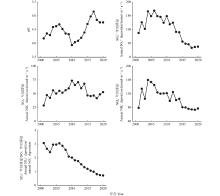
Fig.1
Acid rain factors in Jinyun Mountain from 2001 to 2020"
Table 1
Basic information on the sample trees of Pinus massoniana and Castanopsis fargesii"
| 树种 Tree species | 树龄 Tree age/a | 胸径 Diameter at breast height/cm | 树高 Tree height/m | 采样数量 Number of samples | 年表样芯数量 Number of cores per chronology |
| 马尾松 Pinus massoniana | 66.8±5.7 | 48.85±5.55 | 15.72±1.48 | 36 | 36 |
| 栲树 Castanopsis fargesii | 66.1±8.7 | 50.63±9.94 | 24.08±2.92 | 30 | 25 |
Table 2
Statistical characteristics of the standard chronology of Pinus massoniana and Castanopsis fargesii"
| 统计特征 Statistic characters | 马尾松 Pinus massoniana | 栲树 Castanopsis fargesii |
| 平均敏感度 Mean sensitivity | 0.157 | 0.119 |
| 标准差 Standard deviation | 0.207 | 0.192 |
| 信噪比 Signal-to-noise ration | 16.203 | 5.68 |
| 样本总体代表性 Express population signal | 0.942 | 0.852 |
| 一阶自相关系数 First order autocorrelation | 0.553 | 0.266 |
| 第一主成分方差解释量 Variance in first eigenvector(%) | 34.71 | 46.1 |
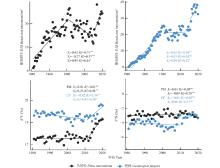
Fig.2
BAI and isotopic indicators for two tree species PM: Pinus massoniana; CF: Castanopsis fargesii. The subscripts 1–3 in R1–R3 and S1–S3 denote the three periods: pre 1980, 1981—2010, and 2011—2020; S represents the slope of the multiple linear regression fit. *, P < 0.05; **, P < 0.01; ***, P < 0.001; NS, not significant, P > 0.05."
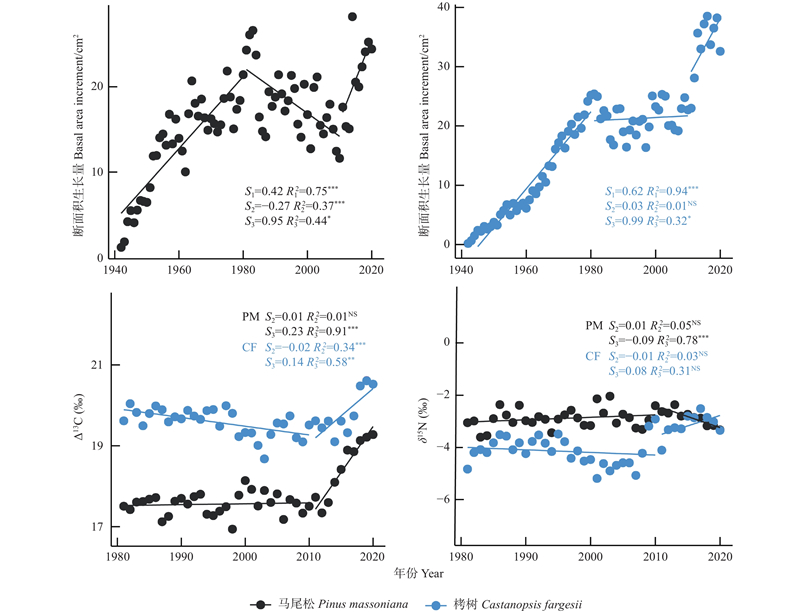
Fig.3
Trends in Ci and Ci/Ca, and intrinsic water-use efficiency of two tree species PM: Pinus massoniana; CF: Castanopsis fargesii. The subscripts 1, 2 in S1, S2 denote 1981—2010, and 2011—2020; S represents the slope of the multiple linear regression fit. *, P < 0.05; **, P < 0.01; ***, P < 0.001; NS, not significant, P > 0.05."
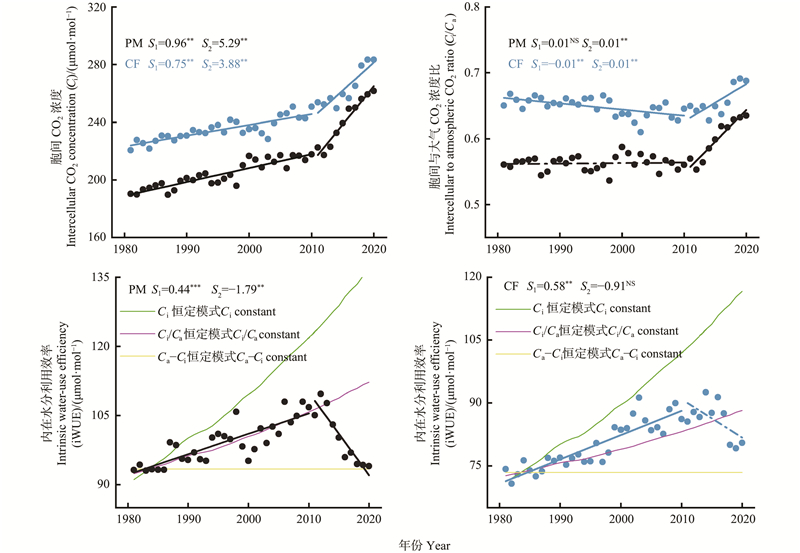
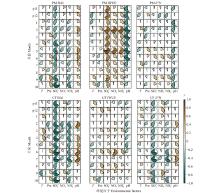
Fig.4
Correlations between tree BAI, intrinsic water-use efficiency and δ15N with acid rain factors on a monthly scale PM: Pinus massoniana; CF: Castanopsis fargesii. T represents mean monthly temperature, Pre represents mean monthly precipitation, SO42?, NO3?, NH4+, and pH represent the monthly deposition of sulfate, nitrate, ammonium, and precipitation pH, respectively. iWUE represents intrinsic water-use efficiency, BAI represents basal area increment, p11 and p12 represent November and December of the previous year, respectively. 1?10 represents January to October of the current year. The size of the sector area represents the absolute value of the correlation coefficient, and the color represents the sign of the correlation (brown for positive, green for negative). The color bar on the right represents the correlation coefficient r. *, P < 0.05; **, P < 0.01; ***, P < 0.001; NS, not significant, P > 0.05."
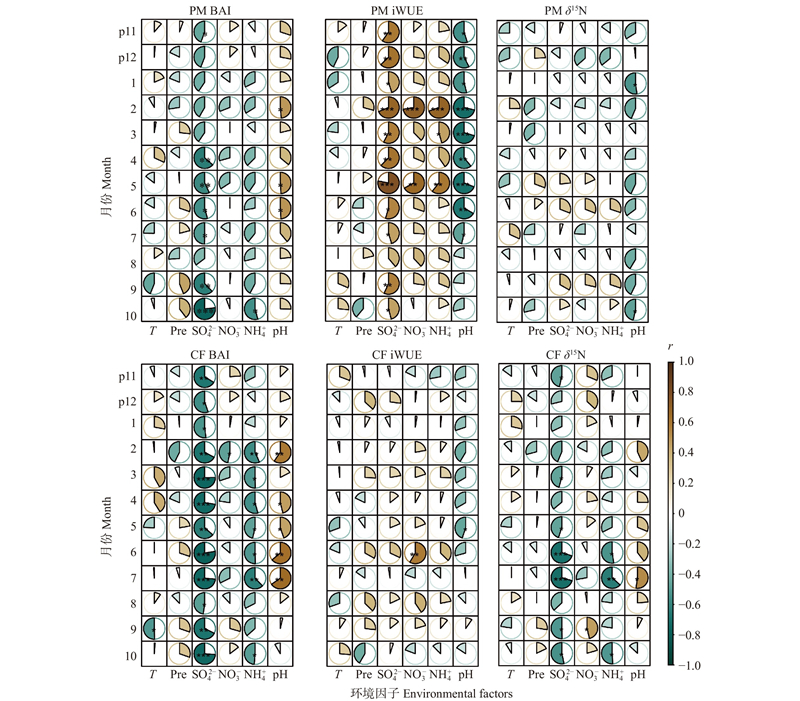
Fig.5
Correlations between tree BAI, intrinsic water-use efficiency, and δ15N with acid rain factors on an annual scale PM: Pinus massoniana; CF: Castanopsis fargesii. T represents mean annual temperature, Pre represents mean annual precipitation, SO42?, NO3?, NH4+, and pH represent the annual deposition of sulfate, nitrate, ammonium, and precipitation pH, respectively. iWUE represents intrinsic water-use efficiency, BAI represents basal area increment. the color represents the sign of the correlation (brown for positive, green for negative). The color bar on the right represents the correlation coefficient r. *, P < 0.05; **, P < 0.01; ***, P < 0.001; NS, not significant, P > 0.05."
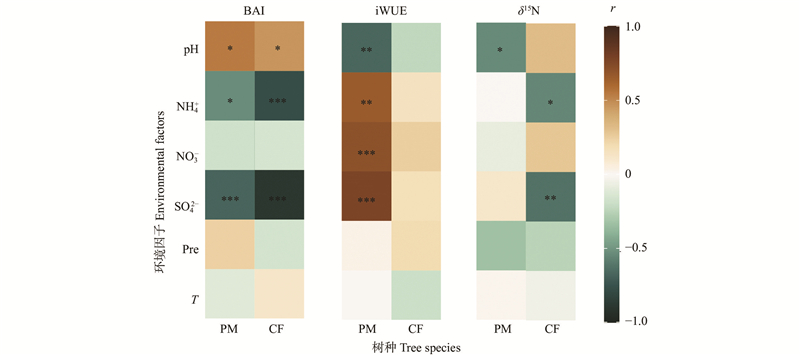
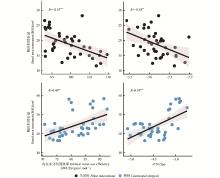
Fig.6
Correlations between tree basal area increment (BAI) and isotopic indicators R represents the Pearson correlation coefficient. *, P < 0.05; **, P < 0.01; ***, P < 0.001; NS, not significant, P > 0.05."
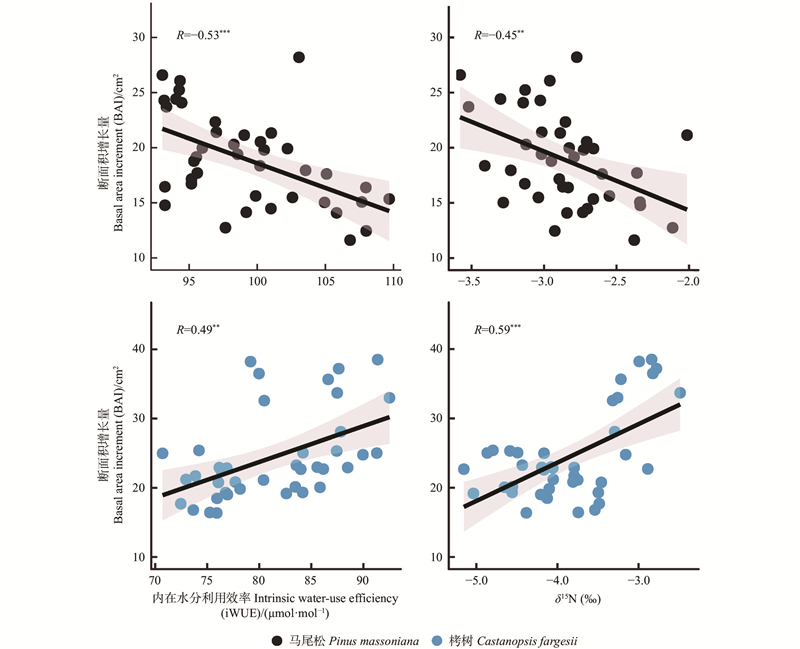
Table 3
Response of basal area increment (BAI) of two tree species to acid rain factors: multiple linear regression models (2001—2020)"
| 树种Tree species | 模型Model | R2 | P | F |
| 马尾松 Pinus massoniana | BAIPM = 25.607 ? 0.069 × SO42? | 0.46 | P<0.001 | 15.43 |
| 栲树 Castanopsis fargesii | BAICF =29.446 ? 0.206 × SO42??0.174 × NO3? + 0.096 × NH4+ | 0.88 | P<0.001 | 40.81 |
|
陈 峰, 袁玉江, 魏文寿, 等. 福建沙县马尾松树轮宽度与夏季亚洲-太平洋涛动指数的关系. 第四纪研究, 2011, 31 (1): 96- 103.
doi: 10.3969/j.issn.1001-7410.2011.01.13 |
|
|
Chen F, Yuan Y J, Wei W S, et al. Correlations between the summer Asian Pacific oscillation index and the tree-ring width of Pinus massiniana from Sha County, Fujian Province. Quaternary Sciences, 2011, 31 (1): 96- 103.
doi: 10.3969/j.issn.1001-7410.2011.01.13 |
|
| 刘可慧, 彭少麟, 莫江明, 等. 酸沉降对森林植物影响过程和机理. 生态环境, 2005, 14 (6): 953- 960. | |
| Liu K H, Peng S L, Mo J M, et al. The Process and mechanism of rain deposition upon forest plants. Ecology and Environmental Sciences, 2005, 14 (6): 953- 960. | |
| 裴承敏. 2019. 三峡库区三种植物对模拟酸雨的响应机制研究. 北京: 北京林业大学. | |
| Pei C M. 2019. Response mechanism of three plants to simulated acid rain in the Three Gorges Reservoir area. Beijing: Beijing Forestry University. [in Chinese] | |
| 王 娇, 关 欣, 黄 苛, 等. 酸沉降对森林生态系统碳循环关键过程的影响研究进展. 应用与环境生物学报, 2021, 27 (3): 776- 785. | |
| Wang J, Guan X, Huang K, et al. Effect of acid deposition on the key processes in the carbon cycle of forest ecosystems: a review. Chinese Journal of Applied and Environmental Biology, 2021, 27 (3): 776- 785. | |
| 许第发, 钟天祥, 徐冬梅, 等. 酸沉降对土壤地球化学过程的影响. 地质地球化学, 2002, 30 (4): 68- 74. | |
| Xu D F, Zhong T X, Xu D M, et al. Effects of acid deposition on soil geochemical cycles. Geology-Geochemistry, 2002, 30 (4): 68- 74. | |
| 杨 凤, 王云琦, 王玉杰, 等. 酸雨胁迫对缙云山马尾松幼苗光合生理特性的影响. 长江流域资源与环境, 2022, (1): 124- 134. | |
| Yang F, Wang Y Q, Wang Y J, et al. Effects of acid rain stress on photosynthetic physiological characteristics of Pinus massoniana seedlings in Jinyun Mountain. Resources and Environment in the Yangtze Basin, 2022, (1): 124- 134. | |
|
余 倩, 段 雷, 郝吉明. 中国酸沉降: 来源、影响与控制. 环境科学学报, 2021, 41 (3): 731- 746.
doi: 10.13671/j.hjkxxb.2020.0340 |
|
|
Yu Q, Duan L, Hao J M. Acid deposition in China: sources, effects and control. Acta Scientiae Circumstantiae, 2021, 41 (3): 731- 746.
doi: 10.13671/j.hjkxxb.2020.0340 |
|
| 张丽云, 邓湘雯, 雷相东, 等. 不同生长阶段马尾松生产力与气候因子的关系. 生态学杂志, 2013, 32 (5): 1104- 1110. | |
| Zhang L Y, Deng X W, Lei X D, et al. Pinus massoniana productivity at different age stages in relation to climatic factors. Chinese Journal of Ecology, 2013, 32 (5): 1104- 1110. | |
| 张新民, 柴发合, 王淑兰, 等. 中国酸雨研究现状. 环境科学研究, 2010, 23 (5): 527- 532. | |
| Zhang X M, Chai F H, Wang S L, et al. Research progress of acid precipitation in China. Research of Environmental Sciences, 2010, 23 (5): 527- 532. | |
|
Cecchini G, Andreetta A, Marchetto A, et al. Atmospheric deposition control of soil acidification in central Italy. Catena, 2019, 182, 104102.
doi: 10.1016/j.catena.2019.104102 |
|
|
Chen Z, Wang Y H, Chen R S, et al. Effects of forest type on nutrient fluxes in throughfall, stemflow, and litter leachate within acid-polluted locations in southwest China. International Journal of Environmental Research and Public Health, 2022, 19 (5): 2810.
doi: 10.3390/ijerph19052810 |
|
|
Dong D, Du E Z, Sun Z Z, et al. Non-linear direct effects of acid rain on leaf photosynthetic rate of terrestrial plants. Environmental Pollution, 2017, 231, 1442- 1445.
doi: 10.1016/j.envpol.2017.09.005 |
|
| Ehleringer J R, Hall A E, Farquhar G D. 1993. Stable isotopes and plant carbon-water relations. New York: Academic Press. | |
|
Farquhar G D, Ehleringer J R, Hubick K T. Carbon isotope discrimination and photosynthesis. Annual Review of Plant Physiology and Plant Molecular Biology, 1989, 40, 503- 537.
doi: 10.1146/annurev.pp.40.060189.002443 |
|
| Fauset S, Freitas H C, Galbraith D R, et al. 2018. Differences in leaf thermoregulation and water use strategies between three co-occurring Atlantic forest tree species. Plant, Cell & Environment, 41(7): 1618−1631. | |
|
Feng X H. Trends in intrinsic water-use efficiency of natural trees for the past 100–200 years: a response to atmospheric CO2 concentration. Geochimica et Cosmochimica Acta, 1999, 63 (13/14): 1891- 1903.
doi: 10.1016/s0016-7037(99)00088-5 |
|
|
Frank D C, Poulter B, Saurer M, et al. Water-use efficiency and transpiration across European forests during the Anthropocene. Nature Climate Change, 2015, 5 (6): 579- 583.
doi: 10.1038/nclimate2614 |
|
|
Gadermaier J, Vospernik S, Grabner M, et al. Soil water storage capacity and soil nutrients drive tree ring growth of six European tree species across a steep environmental gradient. Forest Ecology and Management, 2024, 554, 121599.
doi: 10.1016/j.foreco.2023.121599 |
|
|
Gentilesca T, Battipaglia G, Borghetti M, et al. Evaluating growth and intrinsic water-use efficiency in hardwood and conifer mixed plantations. Trees, 2021, 35 (4): 1329- 1340.
doi: 10.1007/s00468-021-02120-z |
|
|
Itahashi S, Ge B Z, Sato K, et al. MICS-Asia III: overview of model intercomparison and evaluation of acid deposition over Asia. Atmospheric Chemistry and Physics, 2020, 20 (5): 2667- 2693.
doi: 10.5194/acp-20-2667-2020 |
|
|
Kuang Y W, Sun F F, Wen D Z, et al. Tree-ring growth patterns of masson pine (Pinus massoniana L.) during the recent decades in the acidification Pearl River Delta of China. Forest Ecology and Management, 2008, 255 (8/9): 3534- 3540.
doi: 10.1016/j.foreco.2008.02.036 |
|
|
Li Y F, Wang Y Q, Wang Y J, et al. Effects of simulated acid rain on soil respiration and its component in a mixed coniferous-broadleaved forest of the Three Gorges Reservoir area in Southwest China. Forest Ecosystems, 2019, 6 (1): 32.
doi: 10.1186/s40663-019-0192-0 |
|
| Li Y Q, Xu C X, Huang Y M, et al., 2023,. Tree growth and intrinsic water use efficiency of Chinese pine plantations along a precipitation gradient in northern China. Forest Ecology and Management, 528: 120609. | |
|
Liu X, Ma S L, Jia Z H, et al. Complex effects of different types of acid rain on root growth of Quercus acutissima and Cunninghamia lanceolata saplings. Ecological Processes, 2022, 11 (1): 8.
doi: 10.1186/s13717-021-00351-z |
|
|
Liu Z Q, Chen J Y, Su Z J, et al. Acid rain reduces plant-photosynthesized carbon sequestration and soil microbial network complexity. Science of the Total Environment, 2023, 873, 162030.
doi: 10.1016/j.scitotenv.2023.162030 |
|
|
Mathias J M, Thomas R B. Disentangling the effects of acidic air pollution, atmospheric CO2, and climate change on recent growth of red spruce trees in the central Appalachian Mountains. Global Change Biology, 2018, 24 (9): 3938- 3953.
doi: 10.1111/gcb.14273 |
|
|
Medeiros J S, Tomeo N J, Hewins C R, et al. Fast-growing Acer rubrum differs from slow-growing Quercus alba in leaf, xylem and hydraulic trait coordination responses to simulated acid rain. Tree Physiology, 2016, 36 (8): 1032- 1044.
doi: 10.1093/treephys/tpw045 |
|
|
Merlin M, Hylen G, Vergarechea M, et al. Climate-growth relationships for Norway spruce and Scots pine remained relatively stable in Norway over the past 60 years despite significant warming trends. Forest Ecology and Management, 2024, 569, 122180.
doi: 10.1016/j.foreco.2024.122180 |
|
|
Norton D A, Palmer J G, Ogden J. Dendroecological studies in New Zealand 1. An evaluation of tree age estimates based on increment cores. New Zealand Journal of Botany, 1987, 25 (3): 373- 383.
doi: 10.1080/0028825X.1987.10413355 |
|
|
Oulehle F, Šamonil P, Urban O, et al. Growth and assemblage dynamics of temperate forest tree species match physiological resilience to changes in atmospheric chemistry. Global Change Biology, 2025, 31 (3): e70147.
doi: 10.1111/gcb.70147 |
|
|
Peñuelas J, Canadell J G, Ogaya R. Increased water-use efficiency during the 20th century did not translate into enhanced tree growth. Global Ecology and Biogeography, 2011, 20 (4): 597- 608.
doi: 10.1111/j.1466-8238.2010.00608.x |
|
|
Qi X, Cherubini P, Treydte K, et al. Growth responses to climate warming and their physiological mechanisms differ between mature and young larch trees in a boreal permafrost region. Agricultural and Forest Meteorology, 2023, 343, 109765.
doi: 10.1016/j.agrformet.2023.109765 |
|
|
Ren M, Liu Y, Li Q, et al. Responses of tree growth and intrinsic water use efficiency to environmental factors in central and northern China in the context of global warming. Forests, 2022, 13 (8): 1209.
doi: 10.3390/f13081209 |
|
| Rodríguez-Sánchez V M, Rosas U, Calva-Vásquez G, et al. 2020. Does acid rain alter the leaf anatomy and photosynthetic pigments in urban trees? Plants, 9(7): 862. | |
|
Saurer M, Siegwolf R T W, Schweingruber F H. Carbon isotope discrimination indicates improving water-use efficiency of trees in northern Eurasia over the last 100 years. Global Change Biology, 2004, 10 (12): 2109- 2120.
doi: 10.1111/j.1365-2486.2004.00869.x |
|
|
Shetti R, Boonen K, Smiljanić M, et al. Do trees respond to pollution? A network study of the impact of pollution on spruce growth from Europe. Environmental Pollution, 2024, 350, 124012.
doi: 10.1016/j.envpol.2024.124012 |
|
|
Shi Z J, Zhang J E, Xiao Z H, et al. Effects of acid rain on plant growth: a meta-analysis. Journal of Environmental Management, 2021, 297, 113213.
doi: 10.1016/j.jenvman.2021.113213 |
|
|
Succarie A, Xu Z H, Wang W J. The variation and trends of nitrogen cycling and nitrogen isotope composition in tree rings: the potential for fingerprinting climate extremes and bushfires. Journal of Soils and Sediments, 2022, 22 (9): 2343- 2353.
doi: 10.1007/s11368-022-03260-6 |
|
|
Thomas R B, Spal S E, Smith K R, et al. Evidence of recovery of Juniperus virginiana trees from sulfur pollution after the Clean Air Act. Proceedings of the National Academy of Sciences, 2013, 110 (38): 15319- 15324.
doi: 10.1073/pnas.1308115110 |
|
| Wang Z Y, Liu X H, Wang K Y, et al. 2022. Tree-ring δ15N of Qinghai spruce in the central Qilian Mountains of China: is pre-treatment of wood samples necessary? Journal of Arid Land, 14(6): 673-690. | |
|
Wason J W, Beier C M, Battles J J, et al. Acidic deposition and climate warming as drivers of tree growth in high-elevation spruce-fir forests of the northeastern US. Frontiers in Forests and Global Change, 2019, 2, 63.
doi: 10.3389/ffgc.2019.00063 |
|
|
Yang R Q, Fu P L, Fan Z X, et al. Growth-climate sensitivity of two pine species shows species-specific changes along temperature and moisture gradients in southwest China. Agricultural and Forest Meteorology, 2022, 318, 108907.
doi: 10.1016/j.agrformet.2022.108907 |
|
|
Zeng A Y, Zhou F F, Li W, et al. Tree-ring indicators of winter-spring temperature in central China over the past 200 years. Dendrochronologia, 2019, 58, 125634.
doi: 10.1016/j.dendro.2019.125634 |
|
|
Zhang Y, Li J H, Tan J Y, et al. An overview of the direct and indirect effects of acid rain on plants: relationships among acid rain, soil, microorganisms, and plants. Science of the Total Environment, 2023, 873, 162388.
doi: 10.1016/j.scitotenv.2023.162388 |
|
|
Zhang Y W, Guo Y P, Tang Z Y, et al. Patterns of nitrogen and phosphorus pools in terrestrial ecosystems in China. Earth System Science Data, 2021, 13 (11): 5337- 5351.
doi: 10.5194/essd-13-5337-2021 |
|
|
Zheng Y L, Wang Y Q, Wang W C, et al. Growth inhibition and recovery of Pinus massoniana in Chongqing since the 1980s. Ecological Indicators, 2024, 168, 112809.
doi: 10.1016/j.ecolind.2024.112809 |
|
|
Zhou S J, Zhang M, Chen S Z, et al. Acid resistance of masson pine (Pinus massoniana Lamb.) families and their root morphology and physiological response to simulated acid deposition. Scientific Reports, 2020, 10 (1): 22066.
doi: 10.1038/s41598-020-79043-1 |
| Viewed | ||||||
|
Full text |
|
|||||
|
Abstract |
|
|||||
