
Scientia Silvae Sinicae ›› 2026, Vol. 62 ›› Issue (1): 231-242.doi: 10.11707/j.1001-7488.LYKX20250022
• Scientific notes • Previous Articles
Chenglin Chi1,2,Jiannan Wang1,2,Rong Cui1,2,Qianxue Wang1,2,Jili Zhang1,2,*( )
)
Received:2025-01-17
Revised:2025-03-29
Online:2026-01-25
Published:2026-01-14
Contact:
Jili Zhang
E-mail:xtafktj@126.com
CLC Number:
Chenglin Chi,Jiannan Wang,Rong Cui,Qianxue Wang,Jili Zhang. Effects of Throughfall Reduction on Soil Macrofaunal Communities in Quercus mongolica Forest in Sanjiang Plain[J]. Scientia Silvae Sinicae, 2026, 62(1): 231-242.
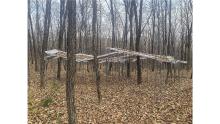
Fig.1
Status of natural forest in Q. mongolica with throughfall reduction"

Table 1
Revisions in soil physicochemical properties"
| 变量 Variable | 穿透雨减少 Throughfall reduction | 对照 Control | F | P |
| 土壤含水量 Soil water content (%) | 15.96±2.08 | 20.75±2.84 | 8.440 | 0.011* |
| pH | 6.10±0.09 | 6.21±0.15 | 7.781 | 0.025* |
| 土壤有机质含量 Soil organic matter (%) | 4.17±0.34 | 3.77±0.26 | 10.081 | 0.024* |
| 全氮含量 Total nitrogen / (g?kg?1) | 8.69±0.19 | 8.52±0.52 | 6.106 | 0.035* |
| 铵态氮含量 Ammonium nitrogen content / (mg?kg?1) | 35.70±8.93 | 27.64±8.36 | 480.140 | 0.000*** |
| 硝态氮含量 Nitrate nitrogen content / (mg?kg?1) | 733.01±143.83 | 1.996 | 0.225 | |
| 全磷含量 Total phosphorus content (%) | 0.23±0.03 | 0.21±0.02 | 38.878 | 0.001** |
| 速效磷含量 Available phosphorus content / (mg?kg?1) | 18.38±2.47 | 21.74±2.12 | 18.218 | 0.009** |
Table 2
Community composition and distribution characteristics of soil macrofauna"
| 类群 Group | 个体数 Individual | 百分比(个体数/ 总数) Percentage (individuals/total) (%) | 功能群 Guild | |||
| 穿透雨减少 Throughfall reduction | 对照 Control | |||||
| 昆虫纲 Insecta | 鞘翅目 Coleoptera | 步甲科 Carabidae | 539 | 8.07 | 肉食性 Carnivores | |
| 露尾甲科 Nitidulidae | 103 | 141 | 1.02 | 杂食性Omnivores | ||
| 隐翅虫科 Staphylinidae | 276 | 137 | 1.72 | 腐食性 Saprophages | ||
| 埋葬甲科 Silphidae | 43 | 5 | 0.20 | 腐食性 Saprophages | ||
| 象甲科 Curculionidae | 2 | 4 | 0.03 | 植食性 Herbivores | ||
| 金龟科 Scarabaeidae | 0 | 5 | 0.02 | 腐食性 Saprophages | ||
| 阎甲科 Histeridae | 5 | 1 | 0.03 | 肉食性 Carnivores | ||
| 叩甲科 Elateridae | 3 | 2 | 0.02 | 植食性 Herbivores | ||
| 金龟科幼虫 Scarabaeidae larvae | 2 | 0 | 0.01 | 植食性 Herbivores | ||
| 步甲科幼虫 Carabidae larvae | 5 | 2 | 0.03 | 肉食性 Carnivores | ||
| 埋葬甲科幼虫 Silphidae larvae | 1 | 0 | 0.00 | 腐食性 Saprophages | ||
| 直翅目 Orthoptera | 驼螽科 Rhaphidophoridae | 142 | 71 | 0.89 | 植食性 Herbivores | |
| 膜翅目 Hymenoptera | 蚁科 Formicidae | 77.77 | 杂食性 Omnivores | |||
| 姬蜂科 Ichneumonoidae | 75 | 51 | 0.53 | 植食性 Herbivores | ||
| 胡蜂科 Vespidae | 6 | 4 | 0.04 | 植食性 Herbivores | ||
| 泥蜂科 Sphecidae | 1 | 1 | 0.01 | 植食性 Herbivores | ||
| 革翅目 Dermaptera | 球螋科 Forficulidae | 194 | 315 | 2.12 | 杂食性 Omnivores | |
| 球螋科若虫 Forficulidae nymphs | 1 | 0 | 0.00 | 杂食性 Omnivores | ||
| 半翅目 Hemiptera | 姬蝽科 Nabidae | 64 | 27 | 0.38 | 肉食性 Carnivores | |
| 同蝽科 Acanthosomatidae | 0 | 1 | 0.00 | 植食性 Herbivores | ||
| 异蝽科 Urostylidae | 2 | 1 | 0.01 | 植食性 Herbivores | ||
| 双翅目 Diptera | 果蝇科 Drosophilidae | 75 | 95 | 0.71 | 腐食性 Saprophages | |
| 寄蝇科 Tachinidae | 163 | 162 | 1.36 | 植食性 Herbivores | ||
| 菌蚊科 Mycetophilidae | 13 | 40 | 0.22 | 植食性 Herbivores | ||
| 丽蝇科 Calliphoridae | 1 | 3 | 0.02 | 腐食性 Saprophages | ||
| 大蚊科幼虫 Tipulidae larvae | 13 | 9 | 0.09 | 腐食性 Saprophages | ||
| 鳞翅目 Lepidoptera | 夜蛾科 Noctuidae | 4 | 1 | 0.02 | 植食性 Herbivores | |
| 夜蛾科幼虫 Noctuidae larvae | 1 | 2 | 0.01 | 植食性 Herbivores | ||
| 蜻蜓目 Odonata | 蜓科稚虫 Aeshnidae naiads | 3 | 0 | 0.01 | 肉食性 Carnivores | |
| 唇足纲 Chilopoda | 蜈蚣目 Scolopendromorpha | 蜈蚣科 Scolopendridae | 97 | 109 | 0.86 | 肉食性 Carnivores |
| 地蜈蚣目 Geophilomorpha | 地蜈蚣科 Geophilidae | 29 | 70 | 0.41 | 肉食性 Carnivores | |
| 蛛形纲 Arachnida | 盲蛛目 Opiliones | 长奇盲蛛科 Phalangodidae | 452 | 258 | 2.96 | 杂食性 Omnivores |
| 蜘蛛目 Araneae | 平腹蛛科 Gnaphosidae | 71 | 26 | 0.40 | 肉食性 Carnivores | |
| 倍足纲 Diplopoda | 山蛩目 Spirobolida | 山蛩科幼虫 Spirobolidae larvae | 1 | 0 | 0.00 | 腐食性 Saprophages |
| 总计 Total | 100.00 | |||||
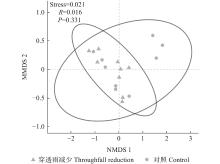
Fig.2
Non-metric multidimensional scaling of soil macrofaunal communities"
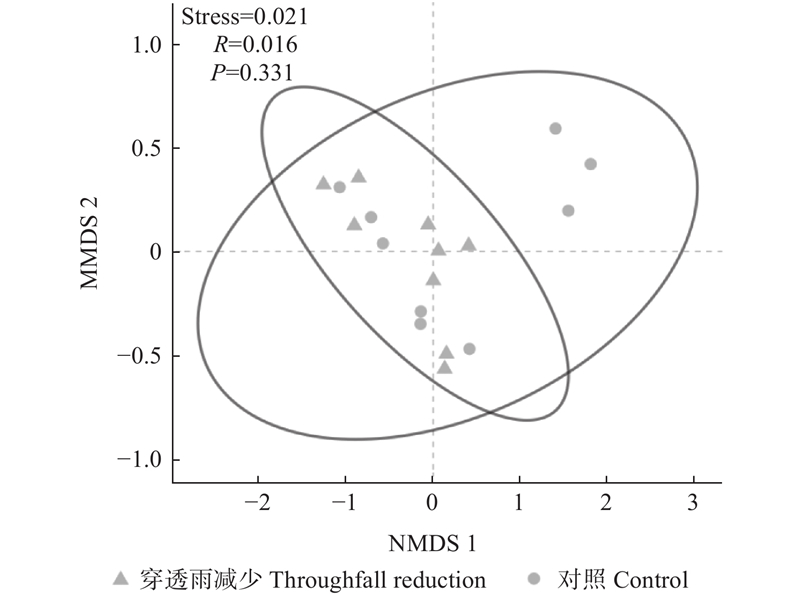
Table 3
Changes of community diversity parameters of soil macrofauna"
| 参数 Parameter | 穿透雨减少 Throughfall reduction | 对照 Control | F | P |
| 个体数 Individual numbers | 69.246 | 0.001** | ||
| 类群数 Group numbers | 15.78±2.59 | 14.44±3.47 | 2.818 | 0.155 |
| Simpson优势度指数 Simpson index | 0.50±0.22 | 0.48±0.30 | 134.058 | 0.000*** |
| Shannon-Wiener多样性指数 Shannon-Wiener index | 1.20±0.55 | 1.25±0.69 | 85.560 | 0.000*** |
| Pielou均匀度指数 Pielou index | 0.23±0.10 | 0.30±0.18 | 161.409 | 0.000*** |
Table 4
Changes in nutritional functional groups of soil macrofauna"
| 类群 Group | 参数 Parameter | 穿透雨减少 Throughfall reduction | 对照 Control | OR | P |
| 肉食性 Carnivores | 个体数 Individual numbers | 186.11±107.94 | 86.56±40.89 | 4.698×1072 | 0.001** |
| 类群数 Group numbers | 4.89±1.54 | 4.33±1.66 | 2.718 | 0.021* | |
| 杂食性Omnivores | 个体数 Individual numbers | 937.89±858.54 | 2.559×1034 | 0.008** | |
| 类群数 Group numbers | 3.44±0.88 | 3.00±1.00 | 1.948 | 0.064 | |
| 腐食性Saprophages | 个体数 Individual numbers | 45.56±38.15 | 28.22±20.05 | 3.089×10¹⁵ | 0.212 |
| 类群数 Group numbers | 3.22±0.67 | 3.33±1.00 | 0.717 | 0.540 | |
| 植食性Herbivores | 个体数 Individual numbers | 45.22±32.53 | 37.22±28.83 | 0.050 | 0.277 |
| 类群数 Group numbers | 4.22±1.09 | 3.78±1.20 | 1.396 | 0.140 |
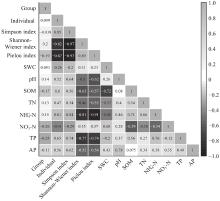
Fig.3
Correlation analysis of macrofaunal community characteristics and soil physicochemical properties"
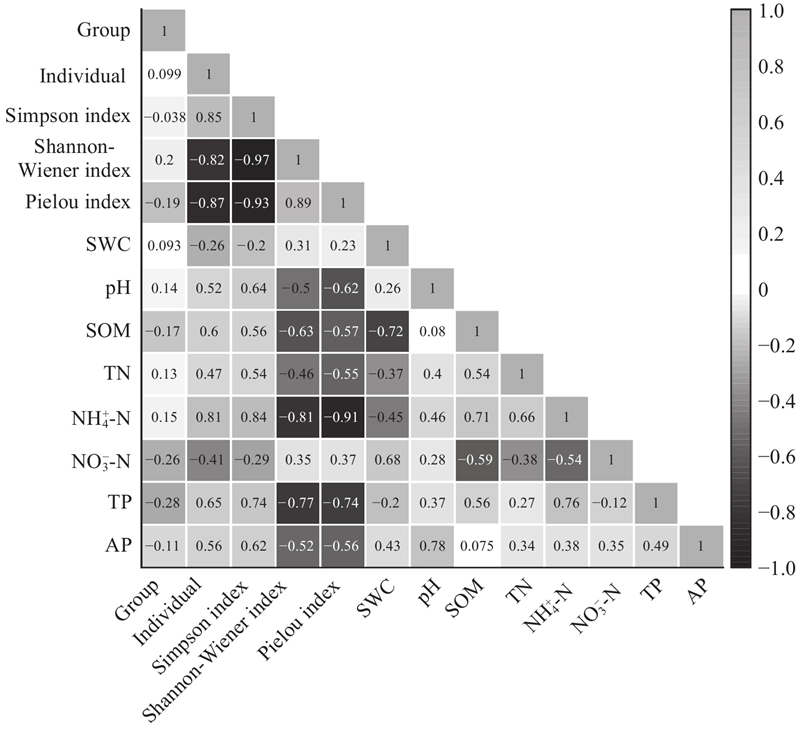
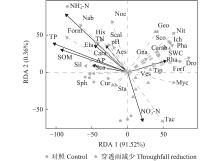
Fig.4
Redundancy analysis (RDA) of composition of soil macrofaunal community and soil physicochemical properties"
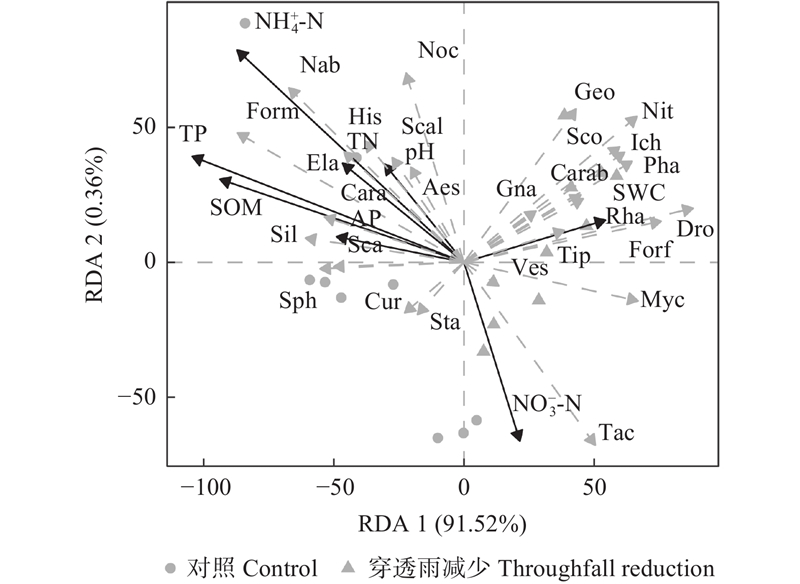
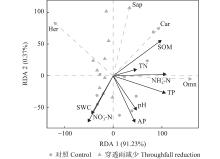
Fig.5
Redundancy analysis (RDA) of trophic structure of soil macrofaunal community and soil physicochemical properties"
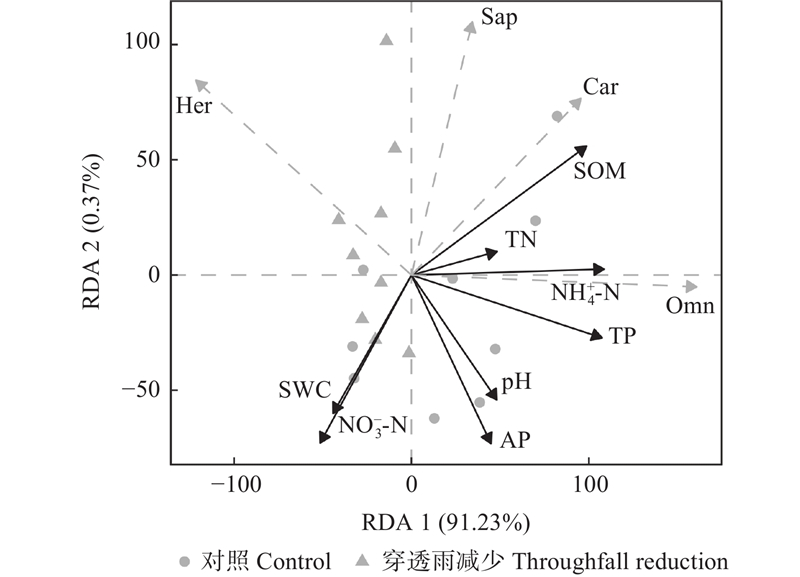
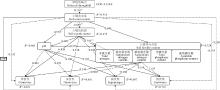
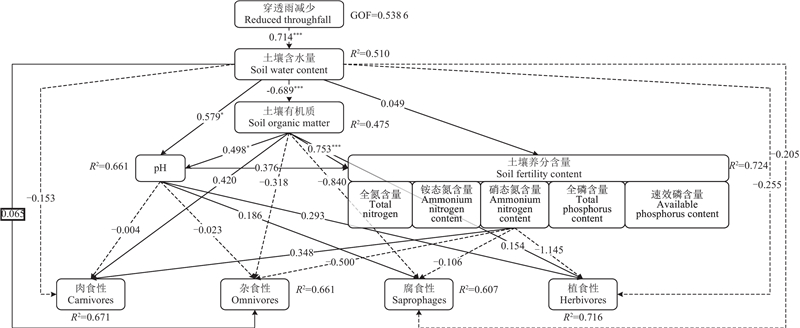
Fig.6
Effects of throughfall reduction on nutritional functional groups of soil macrofauna"
| 鲍士旦. 2000. 土壤农化分析. 3版. 北京: 中国农业出版社, 1–495. | |
| Bao S D. 2000. Soil and agricultural chemistry analysis. 3rd edition. Beijing: China Agriculture Press, 1–495. [in Chinese] | |
| 陈雅昕, 邓娇娇, 周永斌, 等. 2018. 蒙古栎天然次生林土壤微生物群落特征及其与土壤理化特性的关系. 沈阳农业大学学报, 49 (4): 409–416. | |
| Chen Y X, Deng J J, Zhou Y B, et al. 2018. Characteristics of soil microbial community and its relationship with soil physical and chemical properties in natural secondary forests of Quercus mongolica. Journal of Shenyang Agricultural University, 49 (4): 409–416. [in Chinese] | |
| 贾天朝, 胡西武. 1985—2020年中国“两屏三带”生态屏障区土地利用时空动态演化特征. 水土保持研究, 2024, 31 (4): 348- 363. | |
| Jia T C, Hu X W. Spatiotemporal dynamic evolution characteristics of land use in China’s ‘Two Screens and Thress Belts’ ecological barrier areas from 1985 to 2020. Research of Soil and Water Conservation, 2024, 31 (4): 348- 363. | |
| 林英华, 贾旭东, 徐演鹏, 等. 大兴安岭典型森林沼泽类型地表土壤动物群落与生态位分析. 林业科学, 2015, 51 (12): 53- 62. | |
| Lin Y H, Jia X D, Xu Y P, et al. Ground-dwelling soil animal community and niche analysis of a typical forest swamp in Daxing’anling Mountains. Scientia Silvae Sinicae, 2015, 51 (12): 53- 62. | |
| 刘 爽, 王传宽. 2010. 五种温带森林土壤微生物生物量碳氮的时空格局. 生态学报, 30 (12): 3135–3143. | |
| Liu S, Wang C K. 2010. Spatio-temporal patterns of soil microbial biomass carbon and nitrogen in five temperate forest ecosystems. Acta Ecologica Sinica, 30 (12): 3135–3143. [in Chinese] | |
| 李雪峰, 韩士杰, 张 岩. 2007. 降水量变化对蒙古栎落叶分解过程的间接影响. 应用生态学报, (2): 261–266. | |
| Li X F, Han S J, Zhang Y. 2007. Indirect effects of precipitation on litter decomposition of Quercus mongolica. Chinese Journal of Applied Ecology, (2): 261–266. [in Chinese] | |
| 孙 新, 谢致敬, 乔志宏, 等. 2024. 基于功能性状的土壤动物群落生态学研究进展. 应用生态学报, 35(4): 1150–1158. | |
| Sun X, Xie Z J, Qiao Z H, et al. 2024. Research advances in trait-based approaches in soil animal community ecology. Chinese Journal of Applied Ecology, 35 (4): 1150–1158. [in Chinese] | |
| 尹文英. 1998. 中国土壤动物检索图鉴. 北京: 科学出版社. | |
| Yin W Y. 1998. Chinese soil animal search illustration. Beijing: Science Press. [in Chinese] | |
| 尹礼唱, 王晓峰, 张 琨, 等. 国家屏障区生态系统服务权衡与协同. 地理研究, 2019, 38 (9): 2162- 2172. | |
| Yin L C, Wang X F, Zhang K, et al. Trade-offs and synergy between ecosystem services in National Barrier Zone. Geographical Research, 2019, 38 (9): 2162- 2172. | |
| 张巍巍, 李元胜. 2011. 中国昆虫生态大图鉴. 2版. 重庆: 重庆大学出版社. | |
| Zhang W W, Li Y S. 2011. Chinese insect illustration. 2nd edition. Chongqing: Chongqing University Press. [in Chinese] | |
| 张巍巍. 2022. 昆虫家谱: 世界昆虫410科野外鉴别指南(标准版). 重庆: 重庆大学出版社. | |
| Zhang W W. 2022. Insect genealogy: a field guide to 410 families of insects worldwide (standard edition). Chongqing: Chongqing University Press. [in Chinese] | |
| 张兴云, 李 维, 胡译元. 生态系统保护和修复的初步探讨. 林业勘查设计, 2024, 53 (2): 46- 49. | |
| Zhang X Y, Li W, Hu Y Y. Preliminary exploration of ecosystem protection and restoration. Forest Investigation Design, 2024, 53 (2): 46- 49. | |
|
Andriuzzi W S, Adams B J, Barrett J E, et al. Observed trends of soil fauna in the Antarctic dry valleys: early signs of shifts predicted under climate change. Ecology, 2018, 99 (2): 312- 321.
doi: 10.1002/ecy.2090 |
|
| Bardgett R D, Bowman W D, Kaufmann R, et al. A temporal approach to linking aboveground and belowground ecology. Trends in Ecology & Evolution, 2005, 20 (11): 634- 641. | |
|
Bardgett R D. Causes and consequences of biological diversity in soil 1. Zoology, 2002, 105 (4): 367- 375.
doi: 10.1078/0944-2006-00072 |
|
|
Beier C, Beierkuhnlein C, Wohlgemuth T, et al. Precipitation manipulation experiments–challenges and recommendations for the future. Ecology Letters, 2012, 15 (8): 899- 911.
doi: 10.1111/j.1461-0248.2012.01793.x |
|
|
Benton M J, Wilf P, Sauquet H. The angiosperm terrestrial revolution and the origins of modern biodiversity. New Phytologist, 2022, 233 (5): 2017- 2035.
doi: 10.1111/nph.17822 |
|
|
Blankinship J C, Niklaus P A, Hungate B A. A meta-analysis of responses of soil biota to global change. Oecologia, 2011, 165 (3): 553- 565.
doi: 10.1007/s00442-011-1909-0 |
|
| Brussaard L. Biodiversity and ecosystem functioning in soil. Ambio-A Journal of the Human Environment, 1997, 26 (8): 563- 570. | |
|
Cerda A, Schnabel S, Ceballos A, et al. Soil hydrological response under simulated rainfall in the Dehesa land system (Extremadura, SW Spain) under drought conditions. Earth Surface Processes and Landforms, 1998, 23 (3): 195- 209.
doi: 10.1002/(SICI)1096-9837(199803)23:3<195::AID-ESP830>3.0.CO;2-I |
|
| Coleman D C, Callaham M A J, Crossley D A J, et al. 2018. Fundamentals of soil ecology. 3rd ed. Cambridge: Academic Press. | |
|
Couper L I, Sanders N J, Heller N E, et al. Multiyear drought exacerbates long-term effects of climate on an invasive ant species. Ecology, 2021, 102 (10): e03476.
doi: 10.1002/ecy.3476 |
|
|
Coyle D R, Nagendra U J, Taylor M K, et al. Soil fauna responses to natural disturbances, invasive species, and global climate change: current state of the science and a call to action. Soil Biology and Biochemistry, 2017, 110, 116- 133.
doi: 10.1016/j.soilbio.2017.03.008 |
|
|
Dai A G. Increasing drought under global warming in observations and models. Nature Climate Change, 2013, 3 (1): 52- 58.
doi: 10.1038/nclimate1633 |
|
|
Deng L, Peng C H, Kim D G, et al. Drought effects on soil carbon and nitrogen dynamics in global natural ecosystems. Earth-Science Reviews, 2021, 214, 103501.
doi: 10.1016/j.earscirev.2020.103501 |
|
|
Dunne J A, Williams R J. Cascading extinctions and community collapse in model food webs. Philosophical Transactions of the Royal Society B: Biological Sciences, 2009, 364 (1524): 1711- 1723.
doi: 10.1098/rstb.2008.0219 |
|
|
Fekete I, Francioso O, Simpson M J, et al. Qualitative and quantitative changes in soil organic compounds in central European oak forests with different annual average precipitation. Environments, 2023, 10 (3): 48.
doi: 10.3390/environments10030048 |
|
|
Feng Y L, Wang Y Z, Lin Y Y, et al. Effects of ant nest microhabitats on the diversity of soil macrofauna in Gobi ecosystems. Biodiversity Science, 2022, 30 (12): 22282.
doi: 10.17520/biods.2022282 |
|
|
Fischer E M, Knutti R. Anthropogenic contribution to global occurrence of heavy-precipitation and high-temperature extremes. Nature Climate Change, 2015, 5 (6): 560- 564.
doi: 10.1038/nclimate2617 |
|
|
Goldman A E, Bonebrake T C, Tsang T P N, et al. Drought and presence of ants can influence Hemiptera in tropical leaf litter. Biotropica, 2020, 52 (2): 221- 229.
doi: 10.1111/btp.12762 |
|
|
Gongalsky K B. Soil macrofauna: study problems and perspectives. Soil Biology and Biochemistry, 2021, 159, 108281.
doi: 10.1016/j.soilbio.2021.108281 |
|
|
González G, Seastedt T R. Comparison of the abundance and composition of litter fauna in tropical and subalpine forests. Pedobiologia, 2000, 44 (5): 545- 555.
doi: 10.1078/S0031-4056(04)70070-0 |
|
|
Handa I T, Aerts R, Berendse F, et al. Consequences of biodiversity loss for litter decomposition across biomes. Nature, 2014, 509 (7499): 218- 221.
doi: 10.1038/nature13247 |
|
|
Henneron L, Aubert M, Bureau F, et al. Forest management adaptation to climate change: a Cornelian dilemma between drought resistance and soil macro-detritivore functional diversity. Journal of Applied Ecology, 2015, 52 (4): 913- 927.
doi: 10.1111/1365-2664.12440 |
|
|
Izadi M, Habashi H. Changes in diversity, biomass and abundance of soil macrofauna, Parrotio-Carpinetum forest at organic and semi-organic horizons. Eurasian Journal of Soil Science (Ejss), 2016, 5 (3): 166.
doi: 10.18393/ejss.2016.3.166-171 |
|
|
Jamieson M A, Trowbridge A M, Raffa K F, et al. Consequences of climate warming and altered precipitation patterns for plant-insect and multitrophic interactions. Plant Physiology, 2012, 160 (4): 1719- 1727.
doi: 10.1104/pp.112.206524 |
|
| Kajak A. The role of soil predators in decomposition processes. European Journal of Entomology, 1995, 92, 573- 580. | |
| Knapp M, Knappová J, Jakubec P, et al. 2020. Incomplete species lists produced by pitfall trapping: how many carabid species and which functional traits are missing? Biological Conservation, 245: 108545. | |
|
Koricheva J, Larsson S, Haukioja E. Insect performance on experimentally stressed woody plants: a meta-analysis. Annual Review of Entomology, 1998, 43, 195- 216.
doi: 10.1146/annurev.ento.43.1.195 |
|
|
Kosakivska I V, Voytenko L V, et al. Morphological, physiological, and molecular components of the adaptive response to drought in the genus Quercus (Fagaceae). Ukrainian Botanical Journal, 2023, 80 (3): 251- 266.
doi: 10.15407/ukrbotj80.03.251 |
|
|
Kudureti A, Zhao S, Zhakyp D, et al. Responses of soil fauna community under changing environmental conditions. Journal of Arid Land, 2023, 15 (5): 620- 636.
doi: 10.1007/s40333-023-0009-4 |
|
|
Lamarre G P A, Hérault B, Fine P V A, et al. Taxonomic and functional composition of arthropod assemblages across contrasting Amazonian forests. Journal of Animal Ecology, 2016, 85 (1): 227- 239.
doi: 10.1111/1365-2656.12445 |
|
|
Lavelle P, Blanchart E, Martin A, et al. A hierarchical model for decomposition in terrestrial ecosystems: application to soils of the humid tropics. Biotropica, 1993, 25 (2): 130- 150.
doi: 10.2307/2389178 |
|
|
Lindberg N, Engtsson J B, Persson T. Effects of experimental irrigation and drought on the composition and diversity of soil fauna in a coniferous stand. Journal of Applied Ecology, 2002, 39 (6): 924- 936.
doi: 10.1046/j.1365-2664.2002.00769.x |
|
|
Liu T, Chen X Y, Gong X, et al. Earthworms coordinate soil biota to improve multiple ecosystem functions. Current Biology, 2019, 29 (20): 3420- 3429.
doi: 10.1016/j.cub.2019.08.045 |
|
|
Martin P A, Fisher L, Pérez-Izquierdo L, et al. Meta-analysis reveals that the effects of precipitation change on soil and litter fauna in forests depend on body size. Global Change Biology, 2024, 30 (5): e17305.
doi: 10.1111/gcb.17305 |
|
|
Maute K, Hose G C, Story P, et al. Surviving drought: a framework for understanding animal responses to small rain events in the arid zone. Ecology, 2019, 100 (11): e02884.
doi: 10.1002/ecy.2884 |
|
|
Mody K, Eichenberger D, Dorn S. Stress magnitude matters: different intensities of pulsed water stress produce non-monotonic resistance responses of host plants to insect herbivores. Ecological Entomology, 2009, 34 (1): 133- 143.
doi: 10.1111/j.1365-2311.2008.01053.x |
|
|
Nielsen U N, Wall D H, Six J. Soil biodiversity and the environment. Annual Review of Environment and Resources, 2015a, 40, 63- 90.
doi: 10.1146/annurev-environ-102014-021257 |
|
|
Nielsen U N, Ball B A. Impacts of altered precipitation regimes on soil communities and biogeochemistry in arid and semi-arid ecosystems. Global change biology, 2015b, 21 (4): 1407- 1421.
doi: 10.1111/gcb.12789 |
|
|
Ouedraogo J, Ouedraogo E, Traore M, et al. Interaction between the management of soil fertility and macrofauna reduces runoff on a lixisol in the north-sudanian zone of Burkina Faso. Experimental Agriculture, 2017, 53 (1): 12- 26.
doi: 10.1017/S0014479716000016 |
|
|
Peng Y, Peñuelas J, Vesterdal L, et al. Responses of soil fauna communities to the individual and combined effects of multiple global change factors. Ecology Letters, 2022, 25 (9): 1961- 1973.
doi: 10.1111/ele.14068 |
|
|
Potapov A M, Beaulieu F, Birkhofer K, et al. Feeding habits and multifunctional classification of soil-associated consumers from protists to vertebrates. Biological Reviews, 2022, 97 (3): 1057- 1117.
doi: 10.1111/brv.12832 |
|
| Santonja M, Fernandez C, Gauquelin T, et al. Climate change effects on litter decomposition: intensive drought leads to a strong decrease of litter mixture interactions. Plant and Soil, 2015, 393 (1): 69- 82. | |
|
Sardans J, Peñuelas J. Drought changes phosphorus and potassium accumulation patterns in an evergreen Mediterranean forest. Functional Ecology, 2007, 21 (2): 191- 201.
doi: 10.1111/j.1365-2435.2007.01247.x |
|
|
Scheu S, Schaefer M. Bottom-up control of the soil macrofauna community in a beechwood on limestone: manipulation of food resources. Ecology, 1998, 79 (5): 1573.
doi: 10.1890/0012-9658(1998)079[1573:BUCOTS]2.0.CO;2 |
|
| Seager R, LIS N, Feldman J, et al. Whither the 100th meridian? the once and future physical and human geography of America’s arid–humid divide. part I: the story so far. Earth Interactions, 2018, 22 (5): 1- 22. | |
| Sun H Z, Dai E F, Li Y Y, et al. Climate change and sustainable forestry: A regional perspective from northeast China. The Forestry Chronicle, 2018, 94 (3): 201- 207. | |
| Sun Y, Solomon S, Dai A G, et al. 2007. How often will it rain? Journal of Climate, 20(19): 4801–4818. | |
|
Thakur M P, Phillips H R P, Brose U, et al. Towards an integrative understanding of soil biodiversity. Biological Reviews, 2020, 95 (2): 350- 364.
doi: 10.1111/brv.12567 |
|
|
Valim J O S, Teixeira N C, Santos N A, et al. Drought-induced acclimatization of a fast-growing plant decreases insect performance in leaf-chewing and sap-sucking guilds. Arthropod-Plant Interactions, 2016, 10 (4): 351- 363.
doi: 10.1007/s11829-016-9440-1 |
|
|
van Groenigen J W, Lubbers I M, Vos H M J, et al. Earthworms increase plant production: a meta-analysis. Scientific Reports, 2014, 4, 6365.
doi: 10.1038/srep06365 |
|
| Whalen J K. Managing soil biota-mediated decomposition and nutrient mineralization in sustainable agroecosystems. Advances in Agriculture, 2014, 2014, 384604. | |
|
Williams R S, Marbert B S, Fisk M C, et al. Ground-dwelling beetle responses to long-term precipitation alterations in a hardwood forest. Southeastern Naturalist, 2014, 13 (1): 138- 155.
doi: 10.1656/058.013.0114 |
|
| FAO, ITPS, GSBI, et al. 2020. State of knowledge of soil biodiversity: Status, challenges, and potentialities. Rome: FAO, 1–618. | |
|
Zhang H Z, Shi L L, Lu H B, et al. Drought promotes soil phosphorus transformation and reduces phosphorus bioavailability in a temperate forest. Science of the Total Environment, 2020, 732, 139295.
doi: 10.1016/j.scitotenv.2020.139295 |
| [1] | Yingjie Sun,Denan Zhang,Yuyi Shen,Guangping Xu,Yang Cao,Kechao Huang,Yunshuang Chen,Xinyue Mao,Qiumei Teng,Shihong Lü,Junzhi Chu. Effects of Simulated Nitrogen Deposition on Soil Microbial Community Structure and Enzyme Activities in Eucalyptus Plantations in Mid-subtropical Region [J]. Scientia Silvae Sinicae, 2025, 61(5): 46-60. |
| [2] | Zihan Cheng,Jinchi Zhang,Jiang Jiang,Miaojing Meng,Jiayin Li,Mei Luo,Xianghua Fang. Spatial Distribution Pattern and Correlation of Dominant Species at Different Vertical Levels in Baishanzu Mid-Mountain Evergreen Broad-Leaved Forest [J]. Scientia Silvae Sinicae, 2025, 61(3): 72-85. |
| [3] | Fengqing Li,Suzhen Liu,Guisheng Luo,Yuling Zou,Wei Huang,Mansheng Zeng. Analysis of Bacterial Community Structure and Diversity in Rhizosphere Soil of Monochasma savatieri in Different Habitats [J]. Scientia Silvae Sinicae, 2025, 61(1): 47-56. |
| [4] | Huan Xiao, Baiketuerhan Yeerjiang,Chunyu Zhang,Xiuhai Zhao. Relationship between Forest Layer Community Structure and Productivity of Broad-Leaved Korean Pine Forest in Changbai Mountain [J]. Scientia Silvae Sinicae, 2024, 60(3): 57-64. |
| [5] | Xiangrong Liu,Qiwu Sun,Lingyu Hou,Zhongyi Pang,Yanlin Zhang,Changjun Ding. The Differences in Soil Microbial Community Structure and Functional Diversity among Poplar Plantations at Different Ages in the Songliao Plain [J]. Scientia Silvae Sinicae, 2024, 60(11): 25-36. |
| [6] | Xian Xie,Xun Deng,Liwen Song,Jun Liang. Endophytic Fungal Diversity in the Needles and Shoots Infected with Dieback of Larix olgensis [J]. Scientia Silvae Sinicae, 2024, 60(10): 76-85. |
| [7] | Zhi Li,Xiaoyan Xue,Zhen Liu,Qifei Cai,Xiaodong Geng,Jian Feng,Huina Zhou,Tao Zhang,Mingwan Li,Yanmei Wang. Analysis of Bacterial Community Structure, Diversity and Functional Prediction in Different Organs of Healthy and Diseased Idesia polycarpa Plants [J]. Scientia Silvae Sinicae, 2022, 58(8): 136-148. |
| [8] | Bin Li,Hongxiang Shi,Lanlan Liu,Pu Yang,Xin Zhang,Hang Chen,Ying Feng,Xiaoming Chen. Characteristics of Community Structure and Functional Group of Fungi in Leaf, Stem, Root and Rhizosphere Soil of Ligustrum lucidum [J]. Scientia Silvae Sinicae, 2022, 58(5): 102-112. |
| [9] | Wei Cong,Jingjing Yu,Haimang Yu,Yi Ding,Yuguang Zhang. Diversity and Community Assembly of Forest Soil Microorganisms in Different Climatic Zones [J]. Scientia Silvae Sinicae, 2022, 58(2): 70-79. |
| [10] | Yongzhong Chen,Caixia Liu,Yanming Xu,Zhen Zhang,Yinghe Peng,Longsheng Chen,Yirong Su,Rui Wang,Wei Tang. Effects of Herbage Inter-Planting on Structure and Stability of Soil Microbial Community in Camellia oleifera Plantations [J]. Scientia Silvae Sinicae, 2022, 58(11): 61-70. |
| [11] | Pengyu Zhao,Xue Bai,Pingmei Yan,Xiaodong Zhao,Xiaoying Wu,Baofeng Chai. Responses of Soil Bacterial Community Structure and Phenotype to Soil Heterogeneity in Larix principis-rupprechtii Forest [J]. Scientia Silvae Sinicae, 2021, 57(7): 101-110. |
| [12] | Rongrong Pang,Jieying Peng,Yan Yan. Factors Influencing Aboveground Biomass in the Secondary Forest of Quercus aliena var. acutiserrata in Taibai Mountain [J]. Scientia Silvae Sinicae, 2021, 57(10): 157-165. |
| [13] | Xian Xie, Jun Liang, Yanpeng Zhu, Ruirui Hu, Yuan Cheng, Xingyao Zhang. Diversity and Community Structure of Endophytic Fungi in the Pure Forest of Pinus densiflora Infected by Different Incidences of Sphaeropsis sapinea [J]. Scientia Silvae Sinicae, 2020, 56(9): 51-57. |
| [14] | Changlin Liu,Guoying Zhou,Bai Xiao,Jun Liu. Diversity of Endophytic Fungi in Heartwood and Sapwood of Dalbergia odorifera [J]. Scientia Silvae Sinicae, 2020, 56(4): 109-120. |
| [15] | Cao Hongyu, Gao Guanglei, Ding Guodong, Zhang Ying, Zhao Yuanyuan, Ren Yue, Chen Yuxuan, Guo Mishan. Community Structure and Diversity of Soil Fungi in Four Habitats in Hulun Buir Sandy Land [J]. Scientia Silvae Sinicae, 2019, 55(8): 118-127. |
| Viewed | ||||||
|
Full text |
|
|||||
|
Abstract |
|
|||||
