
Scientia Silvae Sinicae ›› 2026, Vol. 62 ›› Issue (1): 156-163.doi: 10.11707/j.1001-7488.LYKX20250013
• Research papers • Previous Articles Next Articles
Xunya Zhang1,Huaqiang Yu2,Yafang Yin2,*( ),Xiaomei Jiang2
Received:2025-01-28
Revised:2025-06-23
Online:2026-01-25
Published:2026-01-14
Contact:
Yafang Yin
E-mail:yafang@caf.ac.cn
CLC Number:
Xunya Zhang,Huaqiang Yu,Yafang Yin,Xiaomei Jiang. Effect of Moisture Content and Temperature on Acousto-Ultrasonic Parameters of Larix gmelinii Wood[J]. Scientia Silvae Sinicae, 2026, 62(1): 156-163.
Table 1
Equilibrium moisture contents of Larix gmelinii wood under different temperature and relative humidity conditions"
| 平衡含水率 Equilibrium moisture contents(%) | 干球温度 Dry bulb temperature/℃ | 湿球温度 Wet bulb temperature/℃ | 相对湿度 Relative humidity(%) |
| 24 | 40 | 39.7 | 96.5 |
| 20 | 19.6 | 95.1 | |
| 12 | 40 | 34.0 | 69.1 |
| 20 | 16.5 | 65.0 | |
| 6 | 40 | 28.5 | 31.9 |
| 20 | 12.6 | 28.8 |
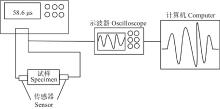
Fig.1
Schematic diagram of acousto-ultrasonic measurement system"
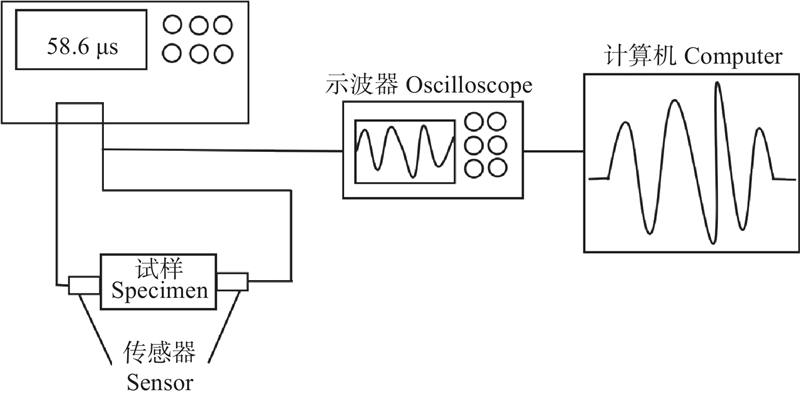
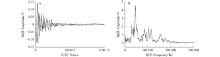
Fig.2
Ultrasonic time-domain signal (A) and frequency-domain signal (B)"

Table 2
Acousto-ultrasonic parameters of Larix gmelinii wood under different moisture content and temperature conditions"
| 含水率 Moisture content (%) | 温度 Temperature /℃ | 波速 Wave velocity/(m·s--1) | 峰值电压 Amplitude voltage/V | 均方根电压 Root mean square voltage/V | 频率形心 Frequency-centroid/kHz | |||||||
| 平均值 Mean | 标准偏差 Standard deviation | 平均值 Mean | 标准偏差 Standard deviation | 平均值 Mean | 标准偏差 Standard deviation | 平均值 Mean | 标准偏差 Standard deviation | |||||
| 6 | ?20 | 6 833 | 469 | 0.225 | 0.106 | 0.027 | 0.010 | 64.147 | 3.574 | |||
| 6 | 0 | 6 791 | 470 | 0.292 | 0.138 | 0.034 | 0.014 | 66.385 | 3.877 | |||
| 6 | 20 | 6 686 | 495 | 0.328 | 0.133 | 0.036 | 0.013 | 66.490 | 4.309 | |||
| 6 | 40 | 6 412 | 462 | 0.323 | 0.153 | 0.035 | 0.014 | 66.411 | 3.963 | |||
| 合计Total | 6 566 | 578 | 0.292 | 0.139 | 0.033 | 0.013 | 65.858 | 4.033 | ||||
| 12 | ?20 | 6 670 | 474 | 0.179 | 0.078 | 0.018 | 0.008 | 61.538 | 4.451 | |||
| 12 | 0 | 6 619 | 467 | 0.214 | 0.080 | 0.020 | 0.008 | 61.118 | 5.727 | |||
| 12 | 20 | 6 538 | 473 | 0.216 | 0.116 | 0.021 | 0.010 | 61.577 | 4.514 | |||
| 12 | 40 | 5 955 | 391 | 0.167 | 0.076 | 0.016 | 0.007 | 61.674 | 3.779 | |||
| 合计Total | 6 560 | 476 | 0.189 | 0.104 | 0.019 | 0.008 | 61.477 | 4.640 | ||||
| 24 | ?20 | 5 973 | 421 | 0.187 | 0.073 | 0.021 | 0.007 | 64.469 | 4.084 | |||
| 24 | 0 | 5 850 | 439 | 0.141 | 0.066 | 0.018 | 0.006 | 64.540 | 4.324 | |||
| 24 | 20 | 5 827 | 436 | 0.214 | 0.117 | 0.023 | 0.008 | 66.326 | 4.924 | |||
| 24 | 40 | 5 745 | 429 | 0.213 | 0.130 | 0.023 | 0.009 | 67.369 | 5.207 | |||
| 合计Total | 5 849 | 436 | 0.065 | 0.101 | 0.007 | 0.008 | 65.676 | 4.782 | ||||
| 85 | ?20 | 4 807 | 316 | 0.204 | 0.117 | 0.018 | 0.009 | 57.163 | 13.875 | |||
| 85 | 0 | 4 749 | 334 | 0.020 | 0.022 | 0.003 | 0.002 | 37.711 | 4.986 | |||
| 85 | 20 | 4 713 | 323 | 0.016 | 0.005 | 0.003 | 0.001 | 36.381 | 3.897 | |||
| 85 | 40 | 4 724 | 327 | 0.017 | 0.006 | 0.003 | 0.001 | 35.116 | 5.102 | |||
| 合计Total | 5 932 | 874 | 0.185 | 0.136 | 0.020 | 0.013 | 41.612 | 12.094 | ||||
Table 3
Variance analysis result of the influence of moisture content and temperature on acousto-ultrasonic parameters"
| 项目 Item | 独立变量 Dependent variable | 自由度 Degree of freedom | F值 F value | 显著性 Significance |
| 温度 Temperature | 波速 Wave velocity | 3 | 27.18 | <0.001 |
| 峰值电压Amplitude voltage | 3 | 4.28 | <0.001 | |
| 均方根电压Root mean square voltage | 3 | 2.91 | 0.03 | |
| 频率形心Frequency-centroid | 3 | 30.76 | <0.001 | |
| 含水率 Moisture content | 波速Wave velocity | 3 | 809.75 | <0.001 |
| 峰值电压Amplitude voltage | 3 | 174.62 | <0.001 | |
| 均方根电压Root mean square voltage | 3 | 302.76 | <0.001 | |
| 频率形心Frequency-centroid | 3 | 861.61 | <0.001 | |
| 温度×含水率 Temperature×moisture content | 波速Wave velocity | 9 | 8.72 | <0.001 |
| 峰值电压Amplitude voltage | 9 | 20.66 | <0.001 | |
| 均方根电压Root mean square voltage | 9 | 18.46 | <0.001 | |
| 频率形心Frequency-centroid | 9 | 52.68 | <0.001 |
Fig.3
Effect of temperature (A) and moisture content (B) on wave wave velocity Different letters represent significant differences (P<0.05)."
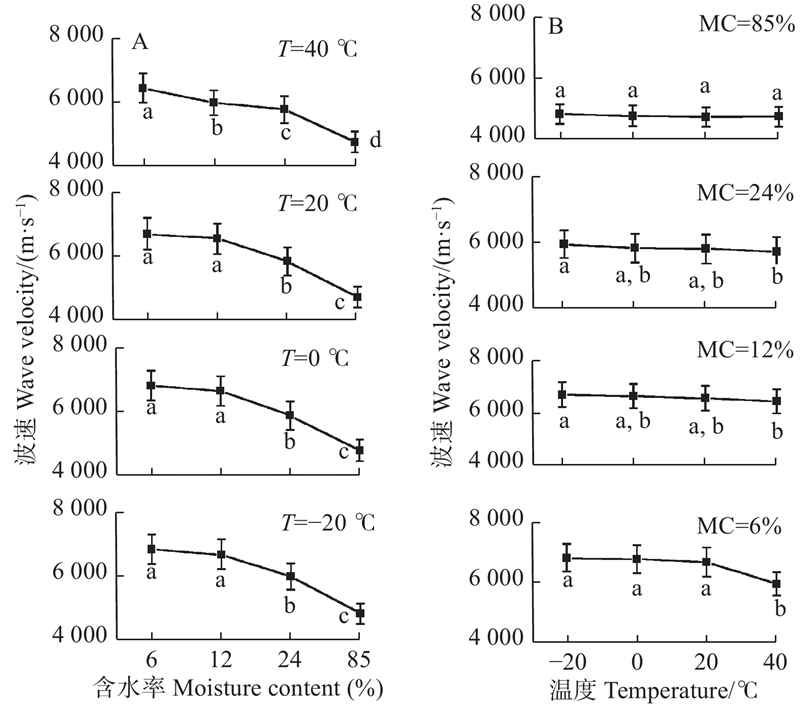
Fig.4
Effect of temperature (A) and moisture content (B) on amplitude voltage Different letters represent significant differences (P<0.05)."
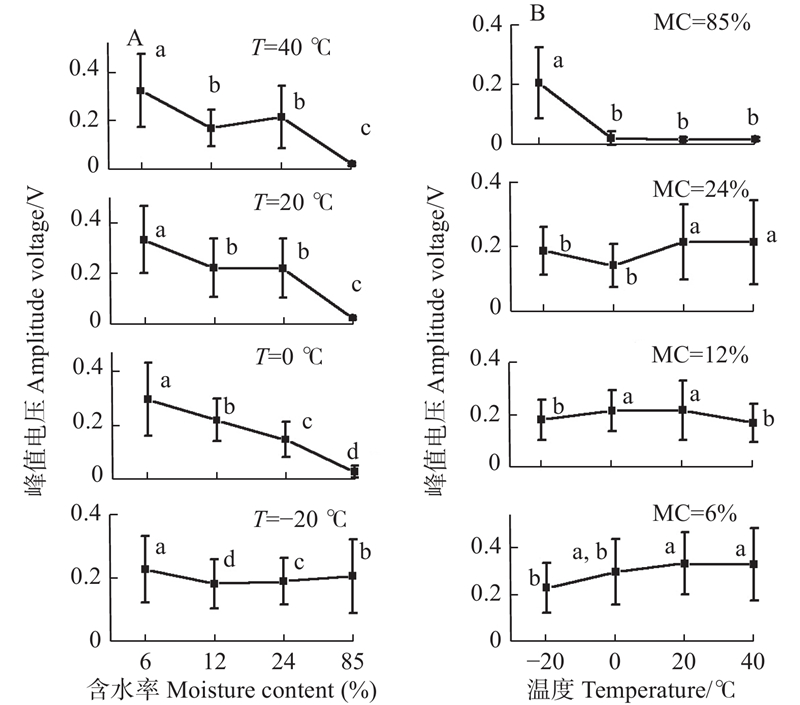
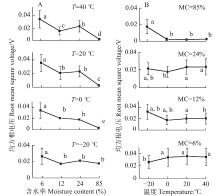
Fig.5
Effect of temperature (A) and moisture content (B) on root mean square voltage"
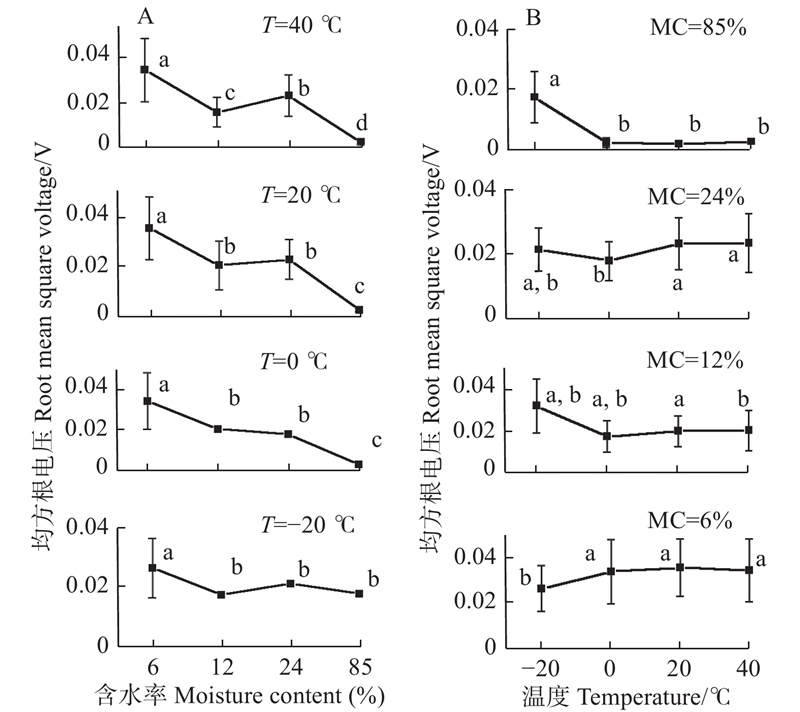
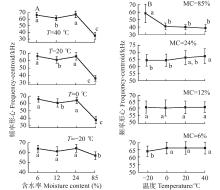
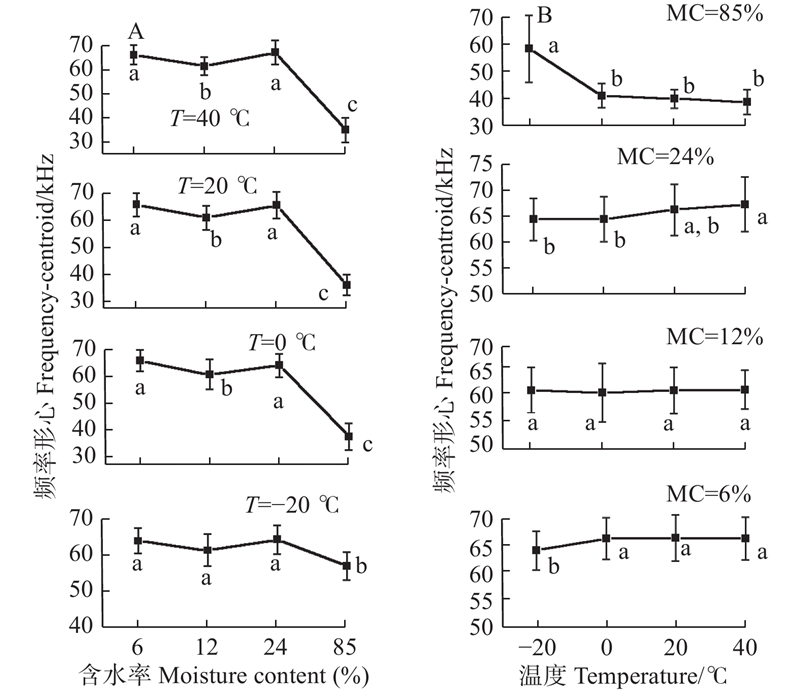
Fig.6
Effect of temperature (A) and moisture content (B) on frequency-centroid Different letters represent significant differences (P<0.05)."
| 成俊卿. 1985. 木材学. 北京: 中国林业出版社. | |
| Cheng J Q. 1985. Wood science. Beijing: China Forestry Publishing House. [in Chinese] | |
| 成俊卿, 杨家驹, 刘 鹏. 1992. 中国木材志. 北京: 中国林业出版社. | |
| Cheng J Q, Yang J J, Liu P. 1992. China woods. Beijing: China Forestry Publishing House. [in Chinese] | |
| 丁馨曾, 赵海龙, 申珂楠, 等. 声发射技术在木材干燥中的应用与发展. 西北林学院学报, 2015, 30 (3): 242- 244,292. | |
| Ding X Z, Zhao H L, Shen K N, et al. Application of acoustic emission technique in wood drying. Journal of Northwest Forestry University, 2015, 30 (3): 242- 244,292. | |
| 刘 昊, 高建民. 含水率和密度对木材应力波传播速度的影响. 北京林业大学学报, 2014, 36 (6): 154- 158. | |
| Liu H, Gao J M. Effects of moisture content and density on the stress wave velocity in wood. Journal of Beijing Forestry University, 2014, 36 (6): 154- 158. | |
| 彭 辉, 蒋佳荔, 詹天翼, 等. 木材密度和含水率对其轴向超声波传播速度的影响. 林业科学, 2016, 52 (10): 117- 124. | |
| Peng H, Jiang J L, Zhan T Y, et al. Influence of density and moisture content on ultrasound velocities along the longitudinal direction in wood. Scientia Silvae Sinicae, 2016, 52 (10): 117- 124. | |
| 申珂楠, 赵海龙, 丁馨曾, 等. 声发射技术在木材加工领域的应用. 世界林业研究, 2015, 28 (1): 56- 60. | |
| Shen K N, Zhao H L, Ding X Z, et al. Application of acoustic emission in wood processing. World Forestry Research, 2015, 28 (1): 56- 60. | |
| Sandoz J L, 殷亚方, Benoit Y, 等. 木材声学-超声波分等检测技术及工业应用. 木材工业, 2007, 21 (6): 27- 30. | |
| Sandoz J L, Yin Y F, Benoit Y, et al. An acousto-ultrasonic timber grading and inspection technology and industrial applications. China Wood Industry, 2007, 21 (6): 27- 30. | |
| 王千雪, 韩大校, 申方圆, 等. 大兴安岭兴安落叶松天然林结构特征. 温带林业研究, 2019, 2 (1): 47- 53. | |
| Wang Q X, Han D X, Shen F Y, et al. Structure characters of Larix gmelinii natural forest in Daxing’an Mountain. Journal of Temperate Forestry Research, 2019, 2 (1): 47- 53. | |
| 徐华东, 王立海. 温度和含水率对红松木材中应力波传播速度的影响. 林业科学, 2011, 47 (9): 123- 128. | |
| Xu H D, Wang L H. Effects of moisture content and temperature on propagation velocity of stress waves in Korean pine wood. Scientia Silvae Sinicae, 2011, 47 (9): 123- 128. | |
| 杨慧敏, 王立海. 木材缺陷与超声检测参数相关性及影响因素. 东北林业大学学报, 2015, 43 (8): 114- 116. | |
| Yang H M, Wang L H. Correlation and influencing factors between wood defect and ultrasonic propagation parameters. Journal of Northeast Forestry University, 2015, 43 (8): 114- 116. | |
| 叶克林, 吕建雄, 殷亚方. 我国高强度结构材加工利用技术的研究进展. 木材工业, 2009, 23 (1): 4- 6. | |
| Ye K L, Lü J X, Yin Y F. R & D of dimension lumber processing and application in China. China Wood Industry, 2009, 23 (1): 4- 6. | |
| 周 崟, 姜笑梅. 1990. 中国裸子植物材的木材解剖学及超微构造. 北京: 中国林业出版社. | |
| Zhou Y, Jiang X M. 1990. Wood anatomy and ultrastructure of gymnospermous woods in China. Beijing: China Forestry Publishing House. [in Chinese] | |
| 周 竹, 尹建新, 周素茵, 等. 基于近红外光谱技术的针叶材板材表面节子缺陷检测. 浙江农林大学学报, 2017, 34 (3): 520- 527. | |
| Zhou Z, Yin J X, Zhou S Y, et al. Knot detection on coniferous wood surfaces based on near infrared spectroscopy. Journal of Zhejiang A & F University, 2017, 34 (3): 520- 527. | |
| 张训亚, 姜笑梅, 吕 斌, 等. 声−超声技术评价兴安落叶松规格材的抗弯性质. 林业科学, 2014, 50 (10): 94- 98. | |
| Zhang X Y, Jiang X M, Lü B, et al. Evaluation of bending properties of larch dimension lumber with acousto-ultrasonic technique. Scientia Silvae Sinicae, 2014, 50 (10): 94- 98. | |
|
张训亚, 姜笑梅, 殷亚方. 不同方向落叶松木材声−超声参数特征及其与密度关系研究. 木材加工机械, 2017, 28 (4): 24- 28.
doi: 10.13594/j.cnki.mcjgjx.2017.04.006 |
|
|
Zhang X Y, Jiang X M, Yin Y F. Study on acousto-ultrasonic parameters of larch wood in different directions and its density relationship. Wood Processing Machinery, 2017, 28 (4): 24- 28.
doi: 10.13594/j.cnki.mcjgjx.2017.04.006 |
|
| Beall F C, Reis H, Senalik A, et al. Ultrasonic nondestructive evaluation of wood and wood products-past, present and future. Pro Ligno, 2013, 9 (4): 540- 546. | |
|
Beall F C. Overview of the use of ultrasonic technologies in research on wood properties. Wood Science and Technology, 2002, 36 (3): 197- 212.
doi: 10.1007/s00226-002-0138-4 |
|
| Brashaw B K, Bucur V, Divos F, et al. 2009. Nondestructive testing and evaluation of wood: a worldwide research update. Forest Product Journal, 59(3): 7−14. | |
|
Chan J M, Walker J C, Raymond C A. Effects of moisture content and temperature on acoustic velocity and dynamic MOE of radiata pine sapwood boards. Wood Science and Technology, 2011, 45 (4): 609- 626.
doi: 10.1007/s00226-010-0350-6 |
|
|
de Oliveira F G R, Candian M, Lucchette F F, et al. Moisture content effect on ultrasonic velocity in Goupia glabra. Materials Research, 2005, 8 (1): 11- 14.
doi: 10.1590/S1516-14392005000100004 |
|
|
El-Hadad A, Brodie G I, Ahmed B S. The effect of wood condition on sound wave propagation. Open Journal of Acoustics, 2018, 8 (3): 37- 51.
doi: 10.4236/oja.2018.83004 |
|
| Gao S, Wang X P, Wang L H, et al. 2012. Effect of temperature on acoustic evaluation of standing trees and logs: part 1-laboratory investigation. Wood and Fiber Science, 44(3): 286−297. | |
| Gao S, Wang X P, Wang L H, et al. 2013. Effect of temperature on acoustic evaluation of standing trees and logs: part 2-field investigation. Wood and Fiber Science, 45(1): 15−25. | |
| Gerhards C. Effect of moisture content and temperature on the mechanical properties of wood: an analysis of immediate effects. Wood and Fiber Science, 1982, 14 (1): 4- 36. | |
| Han C L. Bending strength and acousto-ultrasonic characterization of Japanese Cedar exposed to the outdoors. Turkish Journal of Agriculture and Forestry, 2004, 2 (1): 95- 109. | |
|
Kang H, Booker R E. Variation of stress wave velocity with MC and temperature. Wood Science and Technology, 2002, 36 (1): 41- 54.
doi: 10.1007/s00226-001-0129-x |
|
| Karsulovic J T, León L A, Gaete L. Ultrasonic detection of knots and annual ring orientation in Pinus radiata lumber. Wood and Fiber Science, 2000, 32 (3): 278- 286. | |
|
Llana D F, Íñiguez-González G, Martínez R D, et al. Influence of timber moisture content on wave time-of-flight and longitudinal natural frequency in coniferous species for different instruments. Holzforschung, 2018, 72 (5): 405- 411.
doi: 10.1515/hf-2017-0113 |
|
|
Pommier R, Breysse D, Dumail J F. Non-destructive grading of green Maritime pine using the vibration method. European Journal of Wood and Wood Products, 2013, 71 (5): 663- 673.
doi: 10.1007/s00107-013-0727-y |
|
| Quarles S L. The effect of moisture content and ring angle on the propagation of acoustic signals in wood. Journal of Acoustic Emission, 1990, 9 (3): 189- 195. | |
|
Sakai H, Minamisawa A, Takagi K. Effect of moisture content on ultrasonic velocity and attenuation in woods. Ultrasonics, 1990, 28 (6): 382- 385.
doi: 10.1016/0041-624X(90)90060-2 |
|
| Sandoz J L. Moisture content and temperature effect on ultrasound timber grading. Wood Science and Technology, 1993, 27 (5): 373- 380. | |
| Tejedor B, Lucchi E, Bienvenido-Huertas D, et al. Non-Destructive Techniques (NDT) for the diagnosis of heritage buildings: traditional procedures and futures perspectives. Energy & Buildings, 2022, 263 (5): 112029. | |
|
Watanabe K, Kobayashi I, Saito S, et al. Nondestructive evaluation of drying stress level on wood surface using near-infrared spectroscopy. Wood Science and Technology, 2013, 47 (2): 299- 315.
doi: 10.1007/s00226-012-0492-9 |
|
|
Yang H M, Yu L, Wang L H. Effect of moisture content on the ultrasonic acoustic properties of wood. Journal of Forestry Research, 2015, 26 (3): 753- 757.
doi: 10.1007/s11676-015-0079-z |
|
|
Yang T H, Wang S Y, Lin C J, et al. Evaluation of the mechanical properties of Douglas-fir and Japanese cedar lumber and its structural glulam by nondestructive techniques. Construction and Building Materials, 2008, 22 (4): 487- 493.
doi: 10.1016/j.conbuildmat.2006.11.012 |
|
| Zhou Z, Yin J X, Zhou S Y, et al. Detection of knot defects on coniferous wood surface using near infrared spectroscopy and chemometrics. BioResources, 2016, 11 (4): 9533- 9546. |
| [1] | Yang Jiao,Shen Wang,Zhixin Zeng,Jing Qiao,Haosen Yu,Qiqi Zhang,Mingxuan Qiu,Yining Pan,Wenbo Shu. Isolation, Identification and Sterilization Technology of 84K Poplar Tissue Culture Seedlings Infected with Bacteria [J]. Scientia Silvae Sinicae, 2025, 61(8): 106-115. |
| [2] | Shan Gao,Qing Wang,Lili Lu,Jie Shen,Jian Li. Pattern of Brittleness Transition in Impact Fracture of Wood at Subzero Temperature and the Relationship Models [J]. Scientia Silvae Sinicae, 2025, 61(7): 146-156. |
| [3] | Yaxin Yin,Siyi Chen,Junjian Li,Qiaobo Shan,Chunfang Zheng. Physiological Mechanisms of ZnO NPs in Enhancing Cold Resistance of Kandelia obovata Seedlings [J]. Scientia Silvae Sinicae, 2025, 61(5): 108-119. |
| [4] | Xiaoman Wang,Jianxiong Lü,Xianjun Li,Yiqiang Wu,Xingong Li,Xiaofeng Hao,Jianzheng Qiao,Kang Xu. Prediction of Moisture Content during Drying of Phenolic Resin Impregnated Heat-Treated Bamboo Bundles Based on PSO-BP Neural Network Modeling [J]. Scientia Silvae Sinicae, 2025, 61(5): 187-198. |
| [5] | Shiji Yang,Yanfang Wan,Yushi Bai,Dongmei Wang,Pengtao Yu,Yanhui Wang,Weiyue Wang,Yujia Chen. Transpiration of Larix gmelinii var. principis-rupprechtii Plantations on Different Slope Aspects in Liupan Mountains in Response of Environmental Factors [J]. Scientia Silvae Sinicae, 2025, 61(3): 108-120. |
| [6] | Bowen Shan,Yi Li,Jun Qin,Lei Shi. Spatiotemporal Change of the Extreme Climate in China’s Bamboo Forest during 1960—2050 [J]. Scientia Silvae Sinicae, 2025, 61(2): 50-61. |
| [7] | Haitao Li,Wenjing Zhou,Yiqiang Wu,Chen Chen,Wei Xu. Bending Mechanical Properties of Phyllostachys edulis at Different Temperatures [J]. Scientia Silvae Sinicae, 2025, 61(2): 163-171. |
| [8] | Xinxin Ma,You Wang,Jiajun Wang,Long Feng,Jianfeng Ma. Changes in Ash Composition of Bamboo during Pyrolysis and the Distribution Pattern of Silicon Transformation [J]. Scientia Silvae Sinicae, 2025, 61(2): 172-179. |
| [9] | Wanzhen Han,Lei Liu,Jie Cheng,Qiwu Sun,Yuhong Dong,Lingyu Hou,Runzhe Zhang. Response of Physicochemical Properties of Four Typical Forest Residue-based Biochars to Different Pyrolysis Temperatures [J]. Scientia Silvae Sinicae, 2025, 61(11): 138-149. |
| [10] | Luxiao Qian,Xin Gao,Jianxiong Lü,Youming Dong,Jingbo Shi. A New Approach for Conditioning Solid Wood Samples: Optimization of Water-Addition-Equilibrium Method [J]. Scientia Silvae Sinicae, 2025, 61(10): 38-48. |
| [11] | Bingnan Chen,Fengting Yang,Shengwang Meng,Xiaoqin Dai,Liang Kou,Yifan Chen,Huimin Wang,Xiaoli Fu. Temporal-Spatial Variation and Drivers of Phenology in Pinus massoniana and Pinus elliottii Forests in Hilly Regions with Red Soil [J]. Scientia Silvae Sinicae, 2024, 60(8): 67-78. |
| [12] | Shihao Zhu,Zhiwei Wu,Zhengjie Li,Shun Li. Moisture Dynamics and Modeling of Ground Surface Fine Dead Combustibles in Pinus massoniana Forest in Southern Jiangxi, China [J]. Scientia Silvae Sinicae, 2024, 60(5): 158-168. |
| [13] | Xinsheng Han,Hao Xu,Jinjun Cai,Liguo Dong,Yongzhong Guo,Yueling Wang,Haixia Wan,Yu An. Soil Moisture Dynamics and the Influencing Factors in the Sparse Strip-Planted Prunus sibirica Plantation in the Loess Region of Ningxia [J]. Scientia Silvae Sinicae, 2024, 60(4): 79-90. |
| [14] | Yaping Ma,Xuerui Feng,Handong Gao,Lihua Song,Bing Cao. Effects of Simulated Elevated CO2 Concentration and Atmospheric Temperature on Quality Formation of Lycium barbarum Fruits [J]. Scientia Silvae Sinicae, 2024, 60(3): 1-9. |
| [15] | Zhongqiu Sun,Xin Ye. Estimation of Near-Surface Air Temperature in Daxing’anling Mountains Forest Area based on Fengyun-4B Geostationary Meteorological Satellite Data [J]. Scientia Silvae Sinicae, 2024, 60(12): 27-34. |
| Viewed | ||||||
|
Full text |
|
|||||
|
Abstract |
|
|||||
