
Scientia Silvae Sinicae ›› 2026, Vol. 62 ›› Issue (1): 188-206.doi: 10.11707/j.1001-7488.LYKX20250284
• Reviews • Previous Articles Next Articles
Xuanxin Liu1,2,3,Xinwen Yu1,2,3( ),Xu Zhang1,2,3,Guang Deng1,2,3,Xuan Ouyang1,2,3,Dongpu Fan1,2,3,Yan Chen1,2,3,*()
Received:2025-05-08
Revised:2025-11-16
Online:2026-01-25
Published:2026-01-14
Contact:
Yan Chen
E-mail:Yuxinwen@ifrit.ac.cn;chenyan@ifrit.ac.cn
CLC Number:
Xuanxin Liu,Xinwen Yu,Xu Zhang,Guang Deng,Xuan Ouyang,Dongpu Fan,Yan Chen. Development Status and Prospects of Forestry Internet of Things[J]. Scientia Silvae Sinicae, 2026, 62(1): 188-206.
Fig.1
The general framework of forestry IoT"
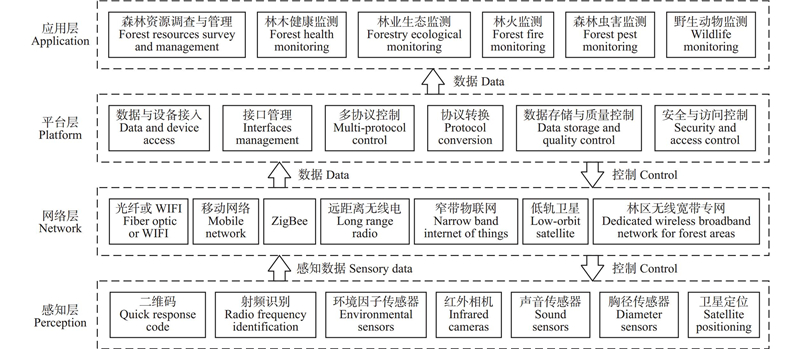

Table 1
Comparison of several low-power wireless communication technologies"
| 项目Items | ZigBee | Sigfox | LoRa | NB-IoT |
| 问世时间Established year | 2003 | 2009 | 2012 | 2015 |
| 组网方式Networking | ZigBee网关 ZigBee gateway | Sigfox基站 Sigfox base station | LoRa网关 LoRa gateway | 蜂窝组网 Cellular networks |
| 传输距离Transmission distance/km | 0.01~0.10 | 最远50 Up to 50 | 最远20 Up to 20 | 最远20 Up to 20 |
| 频段Frequency band | 非授权频段 Unlicensed band | 非授权频段 Unlicensed band | 非授权频段 Unlicensed band | 授权频段 License band |
| 传输速度Transmission speed/kbps | 20~250 | 0.1 | 0.3~50 | 20~250 |
Table 2
Comparison of typical forest ecological monitoring systems"
| 监测因子 Monitoring factors | 通信技术 Communications technology | 供电方式 Power supply | 监测地 Monitoring location | 相关文献 Related literature |
| 温度、湿度、光照强度 Temperature, humidity, illuminance | 433 MHz无线自组网 433 MHz wireless self-organizing network | 3.6 V锂电池 3.6 V lithium battery | 黑龙江省孟家岗林场 Mengjiagang Forest Farm, Heilongjiang Province | 李丹等( |
| 11种土壤、大气、光照参数 11 soil, atmospheric, and light parameters | GPRS/北斗卫星 GPRS/BeiDou satellite | 太阳能-蓄电池-市电互补供电 Complementary solar-battery-utility power supply | 北京鹫峰国家森林公园 Jiufeng National Forest Park, Beijing | 郑一力等( |
| 冠层图像 Canopy image | LoRa | 不间断电源模块 Uninterruptible power supply module | 南京中山植物园 Zhongshan Botanical Garden, Nanjing | Wang et al.( |
| 温度、湿度、气体 Temperature, humidity, gas | WIFI | 太阳能 Solar | 孟加拉国加济布尔森林 Gazipur forest, Bangladeshi | Mohammed et al.( |
| 温度、湿度、CO2浓度、水位 Temperature, humidity, CO2 concentration, water level | WIFI | 锂电池 Lithium battery | 泰国普吉岛东部海岸线的红树林 Mangrove forest along the eastern shoreline of Phuket, Thailand | Boonrat et al.( |
| 土壤温湿度、空气湿度、光照强度 Soil temperature and humidity, air humidity, illuminance | LoRa | — | 印度尼西亚布拉维雅大学森林 The forest in university of Brawijaya, Indonesia | Nurwarsito et al.( |
| 白铭悦, 郭建斌, 刘 铭, 等. 华北落叶松树干液流对不同降雨事件的响应. 农业工程学报, 2025, 41 (9): 227- 236. | |
| Bai M Y, Guo J B, Liu M, et al. Response of tree stem sap flow to different rainfall events in Larix principis-rupprechtii. Transactions of the Chinese Society of Agricultural Engineering, 2025, 41 (9): 227- 236. | |
| 崔雪晴, 侯 盟, 刘 璐, 等. 国家公园野生植物监测体系构建: 以祁连山国家公园为例. 林草政策研究, 2022, 2 (4): 43- 49. | |
| Cui X Q, Hou M, Liu L, et al. Establishment of wild plants monitoring system for National Parks: a case study of Qilian Mountain National Park. Journal of Forestry and Grassland Policy, 2022, 2 (4): 43- 49. | |
| 冯慧敏, 金 崑. 基于卷积神经网络的雄性海南长臂猿声纹识别. 林业科学, 2023, 59 (1): 119- 127. | |
| Feng H M, Jin K. Voiceprint recognition of male Nomascus hainanus based on convolutional neural network. Scientia Silvae Sinicae, 2023, 59 (1): 119- 127. | |
| 郭安琪, 刘昱坤, 于新文, 等. 2024. 海南长臂猿生境的声景观与声学活动评估. 生态学杂志, 43(3): 804-814. | |
| Guo A Q, Liu Y K, Yu X W, et al. 2024. Soundscape composition and acoustic activity assessment of Nomascus hainanus habitat. Chinese Journal of Ecology, 43(3): 804-814. [in Chinese] | |
| 国家林业局. 2013. 中国智慧林业发展指导意见. https://www.forestry.gov.cn/uploadfile/main/2013-8/file/2013-8-23-5eb225df08f4464089502e8e116b7899.pdf. [2013-08-23]. | |
| State Forestry Administration. 2013. Guidance on the development of intelligent forestry in China. https://www.forestry.gov.cn/uploadfile/main/2013-8/file/2013-8-23-5eb225df08f4464089502e8e116b7899.pdf. [2013-08-23]. [in Chinese] | |
| 胡樱馨, 梅安琪, 徐 晴, 等. 利用空间分布模式与样地设计提升森林资源抽样调查精度. 北京林业大学学报, 2024, 46 (2): 155- 165. | |
| Hu Y X, Mei A Q, Xu Q, et al. Using spatial distribution patterns and sample plot design to improve the accuracy of forest resource sampling survey. Journal of Beijing Forestry University, 2024, 46 (2): 155- 165. | |
| 黄友文. 基于RFID及物联网技术的茶叶溯源系统研究. 保鲜与加工, 2016, 16 (4): 112- 117. | |
| Huang Y W. Study on tea traceability system based on FRID and internet of things technology. Storage and Process, 2016, 16 (4): 112- 117. | |
| 季文旭, 冯仲科, 张瀚月, 等. 基于立木胸径生长率模型的乔木林碳汇潜力评估. 中国农业科技导报, 2024, 26 (1): 99- 109. | |
| Ji W X, Feng Z K, Zhang H Y, et al. Assessment of carbon sink potential of arbor forests based on DBH growth rate model for standing trees. Journal of Agricultural Science and Technology, 2024, 26 (1): 99- 109. | |
| 蒋 健, 董艳民, 郭艳美, 等. 2020. 以北京松山国家级自然保护区为例 基于综合信息管理平台的“智慧保护区”应用研究. 绿化与生活, (9): 48-52. | |
| Jiang J, Dong Y M, Guo Y M, et al. 2020. Taking Songshan National Nature Reserve in Beijing as an example, the application research of “Smart Reserve” based on comprehensive information management platform. Greening and Life, (9): 48-52. [in Chinese] | |
| 雷可欣, 张怀清, 邱汉清, 等. 2025. 智慧国家公园技术体系构建与应用. 林业科学, 61(10): 15-25. | |
| Lei K X, Zhang H Q, Qiu H Q, et al. 2025. Construction and application of smart national park technology system. Scientia Silvae Sinicae, 61(10): 15-25. [in Chinese] | |
| 李 丹, 孙利新, 戴 巍, 等. 2014. 森林生境因子无线传感器网络采集系统. 哈尔滨工业大学学报, 46(7): 123-128. | |
| Li D, Sun L X, Dai W, et al. 2014. Wireless sensor networks system of forest habitat factors collection. Journal of Harbin Institute of Technology, 46(7): 123-128. [in Chinese] | |
| 李 想. 2019. 基于物联网的虫情监测系统. 北京: 北京林业大学. | |
| Li X. 2019. The pest monitoring system based on the Internet of Things. Beijing: Beijing Forestry University. [in Chinese] | |
| 刘海洋, 于新文, 张 旭, 等. 无线信号在针叶林中的传播性质. 林业工程学报, 2016, 1 (3): 127- 132. | |
| Liu H Y, Yu X W, Zhang X, et al. Transmission properties of wireless signal in coniferous forest. Journal of Forestry Engineering, 2016, 1 (3): 127- 132. | |
| 刘 江, 赵 荣, 陈绍志. 区块链技术在林业中的应用. 世界林业研究, 2023, 36 (3): 16- 21. | |
| Liu J, Zhao R, Chen S Z. Application of blockchain technology in forestry. World Forestry Research, 2023, 36 (3): 16- 21. | |
| 刘鲁霞, 胡 波, 桑国庆, 等. 激光雷达森林结构指标在森林植物多样性评估中的研究进展. 林业科学, 2025, 61 (1): 176- 196. | |
| Liu L X, Hu B, Sang G Q, et al. Assessing forest vegetation diversity using forest structure indicators based on LiDAR remote sensing: a review. Scientia Silvae Sinicae, 2025, 61 (1): 176- 196. | |
| 刘金成, 王海明, 何亚琼, 等. 无人机技术在精准林业中的应用与挑战. 农业工程学报, 2024, 40 (5): 14- 24. | |
| Liu J C, Wang H M, He Y Q, et al. Application and challenges of UAV-based technology in precision forestry. Transactions of the Chinese Society of Agricultural Engineering, 2024, 40 (5): 14- 24. | |
| 刘一柏, 吴 寅, 刘文波, 等. 2022. 基于无线声发射传感器系统的活立木含水率诊断方法研究. 电子测量与仪器学报, 36(2): 160−168. | |
| Liu Y B, Wu Y, Liu W B, et al. 2022. Research on diagnosis method of standing wood moisture content based on wireless acoustic emission sensor system. Journal of Electronic Measurement and Instrumentation, 36(2): 160−168. [in Chinese] | |
| 刘云飞, 吴 寅, 李骏慧 2021. 林业物联网技术及应用. 北京: 中国林业出版社. | |
| Liu Y F, Wu Y, Li J H. 2021. Technology and application of internet of things in forestry. Beijing: China Forestry Publishing House. [in Chinese] | |
|
陆灯盛, 蒋先蝶, 李云鹤, 等. 基于激光雷达数据的森林生物量估测研究. 遥感学报, 2025, 29 (6): 2035- 2064.
doi: 10.11834/jrs.20255022 |
|
|
Lu D S, Jiang X D, Li Y H, et al. Forest biomass estimation with LiDAR data. National Remote Sensing Bulletin, 2025, 29 (6): 2035- 2064.
doi: 10.11834/jrs.20255022 |
|
| 穆卫谊, 韩 宁, 曲 植, 等. 基于非线性耦合的土壤电导率传感器标定方法. 农业机械学报, 2023, 54 (10): 356- 363. | |
| Mu W Y, Han N, Qu Z, et al. Coupling calibration method for multivariate nonlinear soil electrical conductivity sensor. Transactions of the Chinese Society for Agricultural Machinery, 2023, 54 (10): 356- 363. | |
| 牛晓栋, 陈志成, 闫崇宇, 等. 2015–2023年河南宝天曼森林生态系统国家野外科学观测研究站半小时尺度气象数据集. 中国科学数据, 2025, 10 (1): 294- 304. | |
| Niu X D, Chen Z C, Yan C Y, et al. A dataset of half-hour meteorological observations at Henan Baotianman Forest Ecosystem National Observation and Research Station (2015–2023). China Scientific Data, 2025, 10 (1): 294- 304. | |
| 乔慧捷, 杨秦敏, 李浩亮, 等. 2024. ZL202010428128.3. 野生动物监测方法及系统. 中国. 2024-03-08. | |
| Qiao H J, Yang Q M, Li H L, et al. 2024. ZL202010428128.3. Wildlife monitoring methods and systems. China. 2024-03-08. [in Chinese] | |
| 束祖飞, 何文通, 李 健, 等. 2021. 广东车八岭国家级自然保护区生物多样性综合监测信息服务平台. 数据与计算发展前沿, 3(6): 127-141. | |
| Shu Z F, He W T, Li J, et al. 2021. A comprehensive monitoring information service platform for biodiversity at Guangdong Chebaling National Nature Reserve. Frontiers of Data & Computing, 3(6): 127-141. [in Chinese] | |
| 苏枚芳. 2023. 野生动物保护远程监控技术研究. 成都: 电子科技大学. | |
| Su M F. 2023. Research on remote monitoring technology for wildlife conservation. Chengdu: University of Electronic Science and Technology of China. [in Chinese] | |
|
孙 浩, 郭笑怡, 张洪岩, 等. 基于无人机数据的森林冠层体密度和冠层基高估算. 遥感学报, 2024, 28 (12): 3107- 3122.
doi: 10.11834/jrs.20233094 |
|
|
Sun H, Guo X Y, Zhang H Y, et al. Estimating canopy bulk density and canopy base height using UAV LiDAR and multispectral images. National Remote Sensing Bulletin, 2024, 28 (12): 3107- 3122.
doi: 10.11834/jrs.20233094 |
|
| 覃先林, 李晓彤, 刘树超, 等. 中国林火卫星遥感预警监测技术研究进展. 遥感学报, 2020, 24 (5): 511- 520. | |
| Qin X L, Li X T, Liu S C, et al. Forest fire early warning and monitoring techniques using satellite remote sensing in China. Journal of Remote Sensing (Chinese), 2020, 24 (5): 511- 520. | |
|
谭晶维, 张怀清, 郭梦蕾, 等. 林草行业大模型构建思路与应用前景. 林业科学, 2025, 61 (7): 170- 181.
doi: 10.11707/j.1001?7488.LYKX20250188 |
|
|
Tan J W, Zhang H Q, Guo M L, et al. Construction ideas and application prospects of large models in forestry and grassand industry. Scientia Silvae Sinicae, 2025, 61 (7): 170- 181.
doi: 10.11707/j.1001?7488.LYKX20250188 |
|
| 谭 星, 冯鹏飞, 张 旭, 等. 2019. 物联网技术在我国智慧林业建设中的应用现状及发展策略. 世界林业研究, 32(5): 57−62. | |
| Tan X, Feng P F, Zhang X, et al. 2019. Application state and development strategy of Internet of Things technology in intelligent forestry in China. World Forestry Research, 32(5): 57−62. [in Chinese] | |
| 谭 星, 于新文, 张 旭, 等. 2020. 桉树人工林中433MHz信道LoRa信号的传播特性. 林业工程学报, 5(2): 137−143. | |
| Tan X, Yu X W, Zhang X, et al. 2020. Propagation characteristics of LoRa signal at 433 MHz channel in Eucalyptus plantation environment. Journal of Forestry Engineering, 5(2): 137−143. [in Chinese] | |
| 田惠玲, 朱建华, 何 潇, 等. 基于随机森林模型的东北三省乔木林生物质碳储量预测. 林业科学, 2022, 58 (4): 40- 50. | |
| Tian H L, Zhu J H, He X, et al. Projected biomass carbon stock of arbor forest of three provinces in northeastern China based on random forest model. Scientia Silvae Sinicae, 2022, 58 (4): 40- 50. | |
| 王 东, 王子涵, 李全邦, 等. 祁连山国家公园青海祁连县片区雪豹及其同域鸟兽分布监测. 生态学杂志, 2024, 43 (6): 1910- 1919. | |
| Wang D, Wang Z H, Li Q B, et al. Camera-trapping survey on the snow leopards and their sympatric mammals and birds in the Qilian County, Qilian Mountain National Park. Chinese Journal of Ecology, 2024, 43 (6): 1910- 1919. | |
| 王梦犀, 易小理. 云南香格里拉普达措国家公园综合管理信息化服务平台设计. 林业调查规划, 2021, 46 (5): 99- 105. | |
| Wang M X, Yi X L. Information service platform design for integrated management of Pudacuo National Park in Shangri-La of Yunnan. Forest Inventory and Planning, 2021, 46 (5): 99- 105. | |
| 王文霞, 胡延杰, 赵庆文, 等. 美国非木质林产品管理体系与启示. 世界林业研究, 2021, 34 (5): 110- 115. | |
| Wang W X, Hu Y J, Zhao Q W, et al. Non-timber forest products management system in the United States of America and its enlightenment. World Forestry Research, 2021, 34 (5): 110- 115. | |
| 王智超, 马天天, 邵亚奎, 等. 2024. 面向未来的中国智慧林业: 观测仪器体系的演进与发展趋势. 林业科学, 60(4): 1−15. | |
| Wang Z C, Ma T T, Shao Y K, et al. 2024. Future oriented smart forestry in China: evolution and development trends of observation instrument systems. Scientia Silvae Sinicae, 60(4): 1−15. [in Chinese] | |
| 吴 鑫, 张 贵, 文世熙. 基于物联网技术的森林资源数据更新系统研究. 中南林业科技大学学报, 2016, 36 (9): 78- 81. | |
| Wu X, Zhang G, Wen S X. Study on updating of forest resource data system based on IOT technology. Journal of Central South University of Forestry & Technology, 2016, 36 (9): 78- 81. | |
| 徐 梦, 田大栓, 王易恒, 等. 2022. 国家尺度自然保护地生态系统联网监测指标体系构建与应用研究. 植物生态学报, 46(10): 1219−1233. | |
| Xu M, Tian D S, Wang Y H, et al. 2022. Construction and application of the indicator system for ecosystem monitoring network in the protected areas on a national scale. Chinese Journal of Plant Ecology, 46(10): 1219−1233. [in Chinese] | |
| 杨晨辉, 程寿民, 高谢雨, 等. 基于干形拟合的TLS长白落叶松树干参数提取. 林业科学, 2025, 61 (8): 154- 163. | |
| Yang C H, Cheng S M, Gao X Y, et al. Stem parameter estimation method for Larix olgensis based on TLS data of stem shape fitting. Scientia Silvae Sinicae, 2025, 61 (8): 154- 163. | |
| 杨秦敏, 李浩亮, 乔慧捷, 等. 2021. ZL201911236489.1. 一种基于信息融合的野生动物监测系统及方法. 中国. 2021-04-27. | |
| Yang Q M, Li H L, Qiao H J, et al. 2021. ZL201911236489.1. A wildlife monitoring system and method based on information fusion. China. 2021-04-27. [in Chinese] | |
| 叶建新, 李颜娥, 武 斌, 等. 2023. 单针热脉冲法在树干液流监测中的应用. 传感器与微系统, 42(6): 164−168. | |
| Ye J X, Li Y E, Wu B, et al. 2023. Application of single-probe heat pulse method in monitoring of sap flow. Transducer and Microsystem Technologies, 42(6): 164−168. [in Chinese] | |
| 于新文, 张 旭, 范东璞, 等. 2022. ZL202010466202.0. 一种基于LoRa通信的低功耗野外声音采集系统. 中国. 2022-05-24. | |
| Yu X W, Zhang X, Fan D P, et al. 2022. ZL202010466202.0. A low-power outdoor sound acquisition system based on LoRa communication. China. 2022-05-24. [in Chinese] | |
| 余建平, 王江月, 肖慧芸, 等. 利用红外相机公里网格调查钱江源国家公园的兽类及鸟类多样性. 生物多样性, 2019, 27 (12): 1339- 1344. | |
| Yu J P, Wang J Y, Xiao H Y, et al. Camera-trapping survey of mammalian and avian biodiversity in Qianjiangyuan National Park, Zhejiang Province. Biodiversity Science, 2019, 27 (12): 1339- 1344. | |
| 袁方星. 2021. 立木胸径持续测量系统的研制. 杭州: 浙江农林大学. | |
| Yuan F X. 2021. Development of the continuous measurement system for the tree diameter at breast height. Hangzhou: Zhejiang Agriculture and Forestry University. [in Chinese] | |
| 袁明帅. 2021. 基于深度学习的钻蛀振动识别模型压缩与优化. 北京: 北京林业大学. | |
| Yuan M S. 2021. Compression and optimization of boring vibration recognition model based on deep learning. Beijing: Beijing Forestry University. [in Chinese] | |
| 张劲松, 孟 平, 刘 尉, 等. 热扩散式树木液流国产化传感器性能分析. 林业科学研究, 2007, 20 (3): 370- 374. | |
| Zhang J S, Meng P, Liu W, et al. Performance analysis for the domestic TDP sensor for measuring sap flow in trees. Forest Research, 2007, 20 (3): 370- 374. | |
| 张军国, 李文彬, 韩 宁, 等. 2007. 基于ZigBee无线传感器网络的森林火灾监测系统的研究. 北京林业大学学报, 29(4): 41−45. | |
| Zhang J G, Li W B, Han N, et al. 2007. Forest fire detection system based on ZigBee wireless sensor network. Journal of Beijing Forestry University, 29(4): 41−45. [in Chinese] | |
| 张长春, 李大方, 张军国. 基于Wasserstein距离和相关对齐迁移学习的野生动物图像识别方法. 林业科学, 2024, 60 (8): 25- 32. | |
| Zhang C C, Li D F, Zhang J G. Wildlife images recognition method based on Wasserstein distance and correlation alignment transfer learning. Scientia Silvae Sinicae, 2024, 60 (8): 25- 32. | |
| 赵国辉, 夏 辉, 孙晓阳, 等. 二维码在林木种子园信息化管理中的应用. 基因组学与应用生物学, 2017, 36 (4): 1629- 1633. | |
| Zhao G H, Xia H, Sun X Y, et al. The application of two-dimension code in informatization management of forest seed orchards. Genomics and Applied Biology, 2017, 36 (4): 1629- 1633. | |
| 赵燕东, 顾家华, 赵 玥, 等. 2022. 基于活立木介电特性的茎干蓄水量检测传感器研制. 农业工程学报, 38(3): 38-46. | |
| Zhao Y D, Gu J H, Zhao Y, et al. 2022. Development of a stem water storage detection sensor using the dielectric properties of living standing trees. Transactions of the Chinese Society of Agricultural Engineering, 38(3): 38-46. [in Chinese] | |
| 赵燕东, 黄红伦, 赵 玥, 等. 2023. 活立木茎干水分状况实时检测传感器研究. 农业机械学报, 54(7): 282-289, 359. | |
| Zhao Y D, Huang H L, Zhao Y, et al. 2023. Study of real-time detection sensor for stem moisture status of living tree. Transactions of the Chinese Society for Agricultural Machinery, 54(7): 282-289, 359. [in Chinese] | |
| 郑一力, 田 真, 关 鹏, 等. 草原植被盖度与物候智能监测系统研制. 农业工程学报, 2023, 39 (18): 162- 171. | |
| Zheng Y L, Tian Z, Guan P, et al. Development of an intelligent monitoring system for vegetation coverage and phenology in grassland. Transactions of the Chinese Society of Agricultural Engineering, 2023, 39 (18): 162- 171. | |
| 郑一力, 赵燕东, 刘卫平, 等. 2018. 基于北斗卫星通信的林区小气候监测系统研究. 农业机械学报, 49(2): 217−224. | |
| Zheng Y L, Zhao Y D, Liu W P, et al. 2018. Forest microclimate monitoring system based on Beidou satellite. Transactions of the Chinese Society for Agricultural Machinery, 49(2): 217−224. [in Chinese] | |
| 朱建军, 谢雁洲, 付海强, 等. 星载P波段SAR森林覆盖层穿透测绘——欧洲空间局BIOMASS卫星综述. 武汉大学学报(信息科学版), 2025, 50 (8): 1457- 1468. | |
| Zhu J J, Xie Y Z, Fu H Q, et al. Penetration mapping of forest cover using spaceborne P-band SAR: a review of the European space agency’s BIOMASS mission. Geomatics and Information Science of Wuhan University, 2025, 50 (8): 1457- 1468. | |
| 朱教君, 高 添, 张金鑫, 等. 2023. 以“塔群”为核心的“立体-全息”森林生态系统信息化观测研究方法体系. 生态学杂志, 42(12): 3050−3054. | |
| Zhu J J, Gao T, Zhang J X, et al. 2023. Methods of “Three-dimensional and Holographic” observation for forest ecosystems centered on “Multi-Tower”. Chinese Journal of Ecology, 42(12): 3050−3054. [in Chinese] | |
|
Alberti S, Stasolla G, Mazzola S, et al. Bioacoustic IoT sensors as next-generation tools for monitoring: counting flying insects through buzz. Insects, 2023, 14 (12): 924.
doi: 10.3390/insects14120924 |
|
|
Anderson C R, Volos H I, Buehrer R M. Characterization of low-antenna ultrawideband propagation in a forest environment. IEEE Transactions on Vehicular Technology, 2013, 62 (7): 2878- 2895.
doi: 10.1109/TVT.2013.2251027 |
|
|
Arnau Muñoz L, Berná Martínez J V, Maciá Pérez F, et al. Anomaly detection system for data quality assurance in IoT infrastructures based on machine learning. Internet of Things, 2024, 25, 101095.
doi: 10.1016/j.iot.2024.101095 |
|
| Aslan Y E, Korpeoglu I, Ulusoy Ö. 2012. A framework for use of wireless sensor networks in forest fire detection and monitoring. Computers, Environment and Urban Systems, 36(6): 614−625. | |
|
Azevedo J A R, Santos F E S. An empirical propagation model for forest environments at tree trunk level. IEEE Transactions on Antennas and Propagation, 2011, 59 (6): 2357- 2367.
doi: 10.1109/TAP.2011.2143664 |
|
|
Badescu A M, Cotofana L. A wireless sensor network to monitor and protect tigers in the wild. Ecological Indicators, 2015, 57, 447- 451.
doi: 10.1016/j.ecolind.2015.05.022 |
|
| Balbin J R, delos Reyes M J S. 2018. Development and implementation of low cost salinity and temperature monitoring system for mangrove forest. IEEE 9th International Conference on Humanoid, Nanotechnology, Information Technology, Communication and Control, Environment and Management (HNICEM). December 1-3, 2017, Manila, Philippines. IEEE: 1-6. | |
| Benzekri W, Moussati A E, Moussaoui O, et al. Early forest fire detection system using wireless sensor network and deep learning. International Journal of Advanced Computer Science and Applications, 2020, 11 (5): 469- 503. | |
| Bonilla-Ormachea K, Cuizaga H, Salcedo E, et al. 2025. ForestProtector: an IoT architecture integrating machine vision and deep reinforcement learning for efficient wildfire monitoring. 11th International Conference on Automation, Robotics, and Applications (ICARA). February 12-14, 2025, Zagreb, Croatia. IEEE: 70−75. | |
| Boonrat P, Boonrat P, Aharari A. 2024. Precision rehabilitation: IoT-based monitoring in mangrove ecosystems. IEEE 4th International Conference on Electronic Communications, Internet of Things and Big Data (ICEIB). April 19-21, 2024, Taipei, China. | |
|
Branding J, Von Hörsten D, Böckmann E, et al. InsectSound1000 An insect sound dataset for deep learning based acoustic insect recognition. Scientific Data, 2024, 11 (1): 475.
doi: 10.1038/s41597-024-03301-4 |
|
| Cai R, Su C C. 2024. Real-time climate monitoring and disaster early warning algorithm based on sensor network and cloud computing. International Conference on Telecommunications and Power Electronics (TELEPE). May 29-31, 2024, Frankfurt, Germany. IEEE: 921−926. | |
| Chen C J, Li Y S, Tai C Y, et al. 2022. Pest incidence forecasting based on Internet of Things and long short-term memory network. Applied Soft Computing, 124: 108895. | |
| Cho H M, Park J W, Lee J S, et al. Assessment of the GNSS-RTK for application in precision forest operations. Remote Sensing, 2024, 16 (1): 148. | |
|
Citroni R, Mangini F, Frezza F. Efficient integration of ultra-low power techniques and energy harvesting in self-sufficient devices: A comprehensive overview of current progress and future directions. Sensors, 2024, 24 (14): 4471.
doi: 10.3390/s24144471 |
|
| Dalai C, Singh M, Sunad Kumara A N, et al. 2024. Monitoring Water Levels in Rivers with optical fiber sensors. 5th International Conference on Innovative Trends in Information Technology (ICITIIT). March 15-16, 2024, Kottayam, India. IEEE: 1−6. | |
| Dalla Corte A P, Rex F E, de Almeida D R A, et al. 2020. Measuring individual tree diameter and height using GatorEye high-density UAV-lidar in an integrated crop-livestock-forest system. Remote Sensing, 12(5): 863. | |
| Dalvi A, Dautapure M. 2018. Undetected detective to protect the forest trees against poaching using WSN technology. National Conference on Quality Up-Gradation in Engineering, Science and Technology (NC-QUEST018). March 22, 2018, Dhanamgaon, India. | |
| Damaševičius R, Misra S, Maskeliūnas R, et al. Convergence of blockchain and Internet of Things: integration, security, and use cases. Frontiers of Information Technology & Electronic Engineering, 2024, 25 (10): 1295- 1321. | |
|
Dampage U, Bandaranayake L, Wanasinghe R, et al. Forest fire detection system using wireless sensor networks and machine learning. Scientific Reports, 2022, 12 (1): 46.
doi: 10.1038/s41598-021-03882-9 |
|
|
Decuyper M, Chávez R O, Lohbeck M, et al. Continuous monitoring of forest change dynamics with satellite time series. Remote Sensing of Environment, 2022, 269, 112829.
doi: 10.1016/j.rse.2021.112829 |
|
| Deepseek-AI. 2025. DeepSeek-V3 technical report. arXiv: 2412.19437v2. https://arxiv.org/abs/2412.19437. | |
|
Deppe T, Munday J N. Nighttime photovoltaic cells: electrical power generation by optically coupling with deep space. ACS Photonics, 2020, 7 (1): 1- 9.
doi: 10.1021/acsphotonics.9b00679 |
|
|
Duan Z G, Bi X X, Zou J, et al. A wireless triboelectric sensing system with polygonal synchronous driven by bipolar electromagnetic generators for wide wind speed monitoring. Sustainable Energy Technologies and Assessments, 2023, 60, 103553.
doi: 10.1016/j.seta.2023.103553 |
|
| Dyo V, Ellwood S A, MacDonald D W, et al. 2010. Evolution and sustainability of a wildlife monitoring sensor network. 8th ACM Conference on Embedded Networked Sensor Systems, Zürich, Switzerland. ACM, 127−140. | |
| Ecomatik. 2025. Dendrometer: Well-proven measuring instruments in ecological research. https://ecomatik.de/en/products/growth-and-plant-water-status-dendrometer/dendrometer-general-information. [2025-01-20]. | |
|
Ellwood S A, Newman C, Montgomery R A, et al. An active-radio-frequency-identification system capable of identifying co-locations and social-structure: validation with a wild free-ranging animal. Methods in Ecology and Evolution, 2017, 8 (12): 1822- 1831.
doi: 10.1111/2041-210X.12839 |
|
| EMS Brno. 2025. Dendrometer DRL26D. http://www.emsbrno.cz/p.axd/en/Dendrometer.DRL26D.html. [2025-01-20]. | |
|
Fei N Y, Lu Z W, Gao Y Z, et al. Towards artificial general intelligence via a multimodal foundation model. Nature Communications, 2022, 13 (1): 3094.
doi: 10.1038/s41467-022-30761-2 |
|
|
Fekry R, Yao W, Cao L, et al. Ground-based/UAV-LiDAR data fusion for quantitative structure modeling and tree parameter retrieval in subtropical planted forest. Forest Ecosystems, 2022, 9, 100065.
doi: 10.1016/j.fecs.2022.100065 |
|
| Gabrys J. 2020. Smart forests and data practices: From the Internet of Trees to planetary governance. Big Data & Society, 7(1): 205395172090487. | |
| Galkin N, Yang C W, Nordström L, et al. 2021. Prototyping Multi-Protocol Communication to enable semantic interoperability for Demand response Services. IEEE International Conference on Communications, Control, and Computing Technologies for Smart Grids (SmartGridComm). October 25-28, 2021, Aachen, Germany. IEEE, 15−20. | |
| Grinn-Gofroń A, Bogawski P, Bosiacka B, et al. Abundance of Ganoderma sp. in Europe and SW Asia: modelling the pathogen infection levels in local trees using the proxy of airborne fungal spore concentrations. Science of the Total Environment, 2021, 793 (1): 148509. | |
|
Guimarães N, Pádua L, Marques P, et al. Forestry remote sensing from unmanned aerial vehicles: a review focusing on the data, processing and potentialities. Remote Sensing, 2020, 12 (6): 1046.
doi: 10.3390/rs12061046 |
|
| Hamaza S, Farinha A, Nguyen H-N, et al. 2020. Sensor delivery in forests with aerial robots: A new paradigm for environmental monitoring. IEEE/RSJ International Conference on Intelligent Robots and Systems (IROS). November 1 2020, Las Vegas, Nevada, USA. | |
|
Hamaza S, Georgilas I, Fernandez M, et al. Sensor installation and retrieval operations using an unmanned aerial manipulator. IEEE Robotics and Automation Letters, 2019, 4 (3): 2793- 2800.
doi: 10.1109/LRA.2019.2918448 |
|
|
He Q, Feng Z, Fang H, et al. Blockchain-based edge computing service with dynamic entry and exit mechanism. IEEE Transactions on Mobile Computing, 2025, 24 (10): 10474- 10491.
doi: 10.1109/TMC.2025.3570646 |
|
|
Hill A P, Prince P, Piña Covarrubias E, et al. AudioMoth: Evaluation of a smart open acoustic device for monitoring biodiversity and the environment. Methods in Ecology and Evolution, 2018, 9 (5): 1199- 1211.
doi: 10.1111/2041-210X.12955 |
|
|
Hirst J M. An automatic volumetric spore trap. Annals of Applied Biology, 1952, 39 (2): 257- 265.
doi: 10.1111/j.1744-7348.1952.tb00904.x |
|
|
Huang Y S, Xu D C, Kan J M, et al. Study on field experiments of forest soil thermoelectric power generation devices. PLoS ONE, 2019, 14 (8): e0221019.
doi: 10.1371/journal.pone.0221019 |
|
| ICT International. 2025a. High resolution band dendrometers for trees and plants. https://ictinternational.com/product/band-dendrometers. [2025−01−20]. | |
| ICT International. 2025b. SFM1x sap flow meter with IoT connectivity. https://ictinternational.com/product/sfmx-sap-flow-meter/. [2025−01−20]. | |
|
Ims R A, Yoccoz N G. Ecosystem-based monitoring in the age of rapid climate change and new technologies. Current Opinion in Environmental Sustainability, 2017, 29, 170- 176.
doi: 10.1016/j.cosust.2018.01.003 |
|
|
Jiang L H, Xu L D, Cai H M, et al. An IoT-oriented data storage framework in cloud computing platform. IEEE Transactions on Industrial Informatics, 2014, 10 (2): 1443- 1451.
doi: 10.1109/TII.2014.2306384 |
|
|
Jiang X, Yang T D, Liu D P, et al. An automatic identification method of crested Ibis (Nipponia nippon) habitat based on spatiotemporal density detection. Animals, 2022, 12 (17): 2220.
doi: 10.3390/ani12172220 |
|
| Jiao D B, Wang Z H, Fan W, et al. 2024. A UAV-enabled time-sensitive data collection scheme for grassland monitoring edge networks. arXiv: 2407.20585. https://arxiv.org/abs/2407.20585. | |
| Kameswararao E V, Jaya Shankar M, Sai Lokesh T V, et al. 2023. IoT based anti poaching of trees and protection of forest. Intelligent cyber physical systems and internet of things, Coimbatore, India. Springer International Publishing: 45−55. | |
|
Karkouch A, Mousannif H, Al Moatassime H, et al. Data quality in Internet of Things: a state-of-the-art survey. Journal of Network and Computer Applications, 2016, 73, 57- 81.
doi: 10.1016/j.jnca.2016.08.002 |
|
| Kavitha M, Srinivasan R, Suganthy M, et al. 2023. IoT based forest fire detection and protection system. Second International Conference on Augmented Intelligence and Sustainable Systems (ICAISS). August 23-25, 2023, Trichy, India. IEEE: 1523−1527. | |
| Khallikkunaisa, Yathin A, Vignesh V, et al. 2024. Anti-poaching system for protecting forest and wildlife using IoT and ZigBee technology. International Conference on Distributed Computing and Optimization Techniques (ICDCOT). March 15-16, 2024, Bengaluru, India. IEEE: 1−7. | |
|
LeCun Y, Bengio Y, Hinton G. Deep learning. Nature, 2015, 521 (7553): 436- 444.
doi: 10.1038/nature14539 |
|
| Li A B, Li Q L, Yang Y H, et al. 2024. Stand structure and environment jointly determine negative air ion concentrations in forests: Evidence from concurrent on-site monitoring in four typical subtropical forests during the growing season. Environmental and Experimental Botany, 220: 105684. | |
| Li Q W, Li H Y, Huang Y Q, et al. 2025. PDENet: a high-precision forest fire detection network enabled by dual-stream hierarchical and elastic response. IEEE Transactions on Geoscience and Remote Sensing, 63: 4413719. | |
|
Lin C C, Liu W Y, Lu Y W. Three-dimensional Internet-of-things deployment with optimal management service benefits for smart tourism services in forest recreation parks. IEEE Access, 2019, 7, 182366- 182380.
doi: 10.1109/ACCESS.2019.2960212 |
|
| Liu X X, Chen Z B, Zhang H Y , et al. 2023. The interpretability of the activity signal detection model for wood-boring pests Semanotus bifasciatus in the larval stage. Pest Management Science, 79(10): 3830-3842. | |
| Lostanlen V, Cramer A, Salamon J, et al. 2024. BirdVoxDetect: large-scale detection and classification of flight calls for bird migration monitoring. IEEE/ACM Transactions on Audio, Speech, and Language Processing, 32: 4134-4145. | |
|
Lu J T, Li WL, Sun J K, et al. Secure and real-time traceable data sharing in cloud-assisted IoT. IEEE Internet of Things Journal, 2024, 11 (4): 6521- 6536.
doi: 10.1109/JIOT.2023.3314764 |
|
|
Maeda E E, Brede B, Calders K, et al. Expanding forest research with terrestrial LiDAR technology. Nature Communications, 2025, 16 (1): 8853.
doi: 10.1038/s41467-025-63946-6 |
|
|
Mankin R W, Al-Ayedh H Y, Aldryhim Y, et al. Acoustic detection of Rhynchophorus ferrugineus (Coleoptera: Dryophthoridae) and Oryctes elegans (Coleoptera: Scarabaeidae) in Phoenix dactylifera (Arecales: Arecacae) trees and offshoots in Saudi Arabian orchards. Journal of Economic Entomology, 2016, 109 (2): 622- 628.
doi: 10.1093/jee/tov398 |
|
| Marcu A E, Suciu G, Olteanu E, et al. 2019. IoT system for forest monitoring. 42nd International Conference on Telecommunications and Signal Processing (TSP). July 1-3, 2019, Budapest, Hungary. IEEE, 629−632. | |
|
Mason B M, Balaguera-Reina S A, Benjamin A, et al. When to target control efforts? Using novel GPS telemetry to quantify drivers of invasive Argentine black and white tegu (Salvator merianae) movement. Biological Invasions, 2024, 26 (6): 1769- 1785.
doi: 10.1007/s10530-024-03272-y |
|
|
Measey G J, Stevenson B C, Scott T, et al. Counting chirps: acoustic monitoring of cryptic frogs. Journal of Applied Ecology, 2017, 54 (3): 894- 902.
doi: 10.1111/1365-2664.12810 |
|
|
Menge J H, Magdon P, Wöllauer S, et al. Impacts of forest management on stand and landscape-level microclimate heterogeneity of European beech forests. Landscape Ecology, 2023, 38 (4): 903- 917.
doi: 10.1007/s10980-023-01596-z |
|
|
Miao Z Q, Liu Z W, Gaynor K M, et al. Iterative human and automated identification of wildlife images. Nature Machine Intelligence, 2021, 3 (10): 885- 895.
doi: 10.1038/s42256-021-00393-0 |
|
| Mohammed S K, Kamruzzaman S M, Ahmed A, et al. 2020. Design and implementation of an IoT based forest environment monitoring system. IEEE 5th International Conference on Computer and Communications (ICCC). December 6-9, 2019, Chengdu, China. IEEE: 2152−2156. | |
|
Morales G, Vargas V, Espejo D, et al. Method for passive acoustic monitoring of bird communities using UMAP and a deep neural network. Ecological Informatics, 2022, 72, 101909.
doi: 10.1016/j.ecoinf.2022.101909 |
|
|
Müller M, Graf P, Meyer J, et al. Integration and calibration of non-dispersive infrared (NDIR) CO2 low-cost sensors and their operation in a sensor network covering Switzerland. Atmospheric Measurement Techniques, 2020, 13 (7): 3815- 3834.
doi: 10.5194/amt-13-3815-2020 |
|
| Nair N, Akshaya A V, Joseph J. An in situ soil pH sensor with solid electrodes. IEEE Sensors Letters, 2022, 6 (8): 2000104. | |
|
Narayanan R, Murthy C S R. A routing framework with protocol conversions across multiradio IoT platforms. IEEE Internet of Things Journal, 2021, 8 (6): 4417- 4432.
doi: 10.1109/JIOT.2020.3028239 |
|
|
Niu K L, Wang C Y, Xu J H, et al. Early forest fire detection with UAV image fusion: a novel deep learning method using visible and infrared sensors. IEEE Journal of Selected Topics in Applied Earth Observations and Remote Sensing, 2025, 18, 6617- 6629.
doi: 10.1109/JSTARS.2025.3541205 |
|
|
Novkovic I, Markovic G B, Lukic D, et al. GIS-based forest fire susceptibility zonation with IoT sensor network support, case study—nature park golija, Serbia. Sensors, 2021, 21 (19): 6520.
doi: 10.3390/s21196520 |
|
| Nurwarsito H, Alkaf M. Development of LoRa multipoint network integrated with MQTT-SN protocol for microclimate data logging in UB forest. International Journal of Computing and Digital Systems, 2025, 17 (1): 1- 16. | |
|
Okafor N, Ingle R, Okwudili Matthew U, et al. Assessing and improving IoT sensor data quality in environmental monitoring networks: a focus on peatlands. IEEE Internet of Things Journal, 2024, 11 (24): 40727- 40742.
doi: 10.1109/JIOT.2024.3454241 |
|
|
Ouni S, Trabelsi Ayoub Z, Kamoun F. Auto-organization approach with adaptive frame periods for IEEE 802.15. 4/zigbee forest fire detection system. Wireless Networks, 2019, 25 (7): 4059- 4076.
doi: 10.1007/s11276-018-01936-x |
|
| Pareek S, Shrivastava S, Jhala S, et al. 2020. IoT and image processing based forest monitoring and counteracting system. 4th International Conference on Trends in Electronics and Informatics (ICOEI). June 15-17, 2020, Tirunelveli, India. IEEE, 1024−1027. | |
|
Pedrazzi L, Naik H, Sandbrook C, et al. Advancing animal behaviour research using drone technology. Animal Behaviour, 2025, 222, 123147.
doi: 10.1016/j.anbehav.2025.123147 |
|
|
Pesonen J, Raita-Hakola A M, Joutsalainen J, et al. Boreal forest fire: UAV-collected wildfire detection and smoke segmentation dataset. Scientific Data, 2025, 12 (1): 1419.
doi: 10.1038/s41597-025-05634-0 |
|
|
Pichler G, Poveda Lopez J A, Picchi G, et al. Comparison of remote sensing based RFID and standard tree marking for timber harvesting. Computers and Electronics in Agriculture, 2017, 140, 214- 226.
doi: 10.1016/j.compag.2017.05.030 |
|
| Plantsensors. 2025. Authentical granier sap flow sensors. http://plantsensors.com/ps-gp-granier-tdp-sap-flow-sensor/. [2025-01-20]. | |
|
Potamitis I, Rigakis I, Tatlas N A, et al. In-vivo vibroacoustic surveillance of trees in the context of the IoT. Sensors, 2019, 19 (6): 1366.
doi: 10.3390/s19061366 |
|
|
Ramadan M N A, Basmaji T, Gad A, et al. Towards early forest fire detection and prevention using AI-powered drones and the IoT. Internet of Things, 2024, 27, 101248.
doi: 10.1016/j.iot.2024.101248 |
|
|
Richardson E, Nimmo D G, Avitabile S, et al. Camera traps and pitfalls: an evaluation of two methods for surveying reptiles in a semiarid ecosystem. Wildlife Research, 2018, 44 (8): 637- 647.
doi: 10.1071/WR16048 |
|
|
Rigakis I, Potamitis I, Tatlas N A, et al. TreeVibes: modern tools for global monitoring of trees for borers. Smart Cities, 2021, 4 (1): 271- 285.
doi: 10.3390/smartcities4010017 |
|
|
Rodda S R, Fararoda R, Gopalakrishnan R, et al. LiDAR-based reference aboveground biomass maps for tropical forests of South Asia and Central Africa. Scientific Data, 2024, 11 (1): 334.
doi: 10.1038/s41597-024-03162-x |
|
|
Roy A M, Bhaduri J, Kumar T, et al. WilDect-YOLO: an efficient and robust computer vision-based accurate object localization model for automated endangered wildlife detection. Ecological Informatics, 2023, 75, 101919.
doi: 10.1016/j.ecoinf.2022.101919 |
|
|
Ruan W D, Wu K Y, Chen Q C, et al. ResNet-based bio-acoustics presence detection technology of Hainan gibbon calls. Applied Acoustics, 2022, 198, 108939.
doi: 10.1016/j.apacoust.2022.108939 |
|
|
Rustia D J A, Chiu L Y, Lu C Y, et al. Towards intelligent and integrated pest management through an AIoT-based monitoring system. Pest Management Science, 2022, 78 (10): 4288- 4302.
doi: 10.1002/ps.7048 |
|
| Sánchez I C G, Bacovich R A, López J G, et al. 2024. Development and application of an automated system for early detection of stress and damage in poplar clone plantations using eco-physiological sensors and IoT. IEEE International Workshop on Metrology for Agriculture and Forestry (MetroAgriFor). November 6-8, 2023, Pisa, Italy. IEEE: 624−628. | |
|
Saračević M H, Adamović S Z, Miškovic V A, et al. Data encryption for Internet of Things applications based on Catalan objects and two combinatorial structures. IEEE Transactions on Reliability, 2021, 70 (2): 819- 830.
doi: 10.1109/TR.2020.3010973 |
|
| Satryoko A, Runturambi A J S. 2020. Method using IoT low earth orbit satellite to monitor forest temperature in Indonesia. 7th International Conference on Electrical Engineering, Computer Sciences and Informatics (EECSI). October 1-2, 2020, Yogyakarta, Indonesia. IEEE: 240−243. | |
|
Shepard E L C, Wilson R P, Quintana F, et al. Identification of animal movement patterns using tri-axial accelerometry. Endangered Species Research, 2008, 10, 47- 60.
doi: 10.3354/esr00084 |
|
|
Shi H P, Chen Z B, Zhang H Y, et al. A waveform mapping-based approach for enhancement of trunk borers’ vibration signals using deep learning model. Insects, 2022, 13 (7): 596.
doi: 10.3390/insects13070596 |
|
| Shovon T A, Sprott A, Gagnon D, et al. Using imagery from unmanned aerial vehicles to investigate variation in snag frequency among forest stands. Forest Ecology and Management, 2022, 511 (1): 120138. | |
|
Silva-Neto H A, da Silva Sousa D, Duarte L C, et al. Recent developments on aerial lab-on-a-drone platforms for remote environmental monitoring: a review. Analytica Chimica Acta, 2025, 1337, 343544.
doi: 10.1016/j.aca.2024.343544 |
|
|
Silva H, Gomes R, Sousa C. Classifying forest supply chain traceability data with an ontological approach. Procedia Computer Science, 2025, 253, 3049- 3058.
doi: 10.1016/j.procs.2025.02.029 |
|
|
Singh R, Gehlot A, Akram Vaseem S, et al. Forest 4.0: digitalization of forest using the Internet of Things (IoT). Journal of King Saud University-Computer and Information Sciences, 2022, 34 (8): 5587- 5601.
doi: 10.1016/j.jksuci.2021.02.009 |
|
|
Singh V, Ray K C, Tripathy S. Real-time monitoring of illegal logging events using intelligent acoustic sensors nodes. IEEE Sensors Journal, 2024, 24 (17): 28276- 28286.
doi: 10.1109/JSEN.2024.3419897 |
|
|
Souza C P, Carvalho F B S, Silva F A N, et al. On harvesting energy from tree trunks for environmental monitoring. International Journal of Distributed Sensor Networks, 2016, 12 (6): 9383765.
doi: 10.1155/2016/9383765 |
|
| Susen C, Nenninger P, Fimmers C, et al. 2022. Comparison of frequency bands for wireless communication in forests using LoRa modulation. IEEE 46th Annual Computers, Software, and Applications Conference (COMPSAC). June 27 - July 1, 2022, Los Alamitos, CA, USA. IEEE: 1368−1374. | |
|
Swaminathan B, Jagadeesh M, Vairavasundaram S. Multi-label classification for acoustic bird species detection using transfer learning approach. Ecological Informatics, 2024, 80, 102471.
doi: 10.1016/j.ecoinf.2024.102471 |
|
| Tahsien S M, Karimipour H, Spachos P. Machine learning based solutions for security of Internet of Things (IoT): a survey. Journal of Network and Computer Applications, 2020, 161 (1): 102630. | |
|
Tian H, Zhao Y D, Gao C, et al. Assessing the vitality status of plants: using the correlation between stem water content and external environmental stress. Forests, 2022, 13 (8): 1198.
doi: 10.3390/f13081198 |
|
|
Tian Q, Lin Y, Guo X H, et al. New security mechanisms of high-reliability IoT communication based on radio frequency fingerprint. IEEE Internet of Things Journal, 2019, 6 (5): 7980- 7987.
doi: 10.1109/JIOT.2019.2913627 |
|
|
Tobler M W, Carrillo-Percastegui S E, Leite Pitman R, et al. An evaluation of camera traps for inventorying large- and medium-sized terrestrial rainforest mammals. Animal Conservation, 2008, 11 (3): 169- 178.
doi: 10.1111/j.1469-1795.2008.00169.x |
|
|
Torresan C, Benito Garzón M, O’Grady M, et al. A new generation of sensors and monitoring tools to support climate-smart forestry practices. Canadian Journal of Forest Research, 2021, 51 (12): 1751- 1765.
doi: 10.1139/cjfr-2020-0295 |
|
|
Tschörtner J, Lai B, Krömer J O. Biophotovoltaics: green power generation from sunlight and water. Frontiers in Microbiology, 2019, 10, 866.
doi: 10.3389/fmicb.2019.00866 |
|
|
Tuli S, Casale G, Jennings N R. SplitPlace: AI augmented splitting and placement of large-scale neural networks in mobile edge environments. IEEE Transactions on Mobile Computing, 2023, 22 (9): 5539- 5554.
doi: 10.1109/TMC.2022.3177569 |
|
| Umwelt-Geräte-Technik. 2025. Sap flow and water potential. https://ugt-online.de/en/topics/plants/sap-flow-and-water-potential/. | |
| Vanamala U M, Nidamarty L P. 2019. Galactic cosmic energy - a novel mode of energy harvesting. International Conference on Emerging Trends in Engineering (ICETE). March 22–23, 2019, Hyderabad, India. Springer International Publishing: 458−465. | |
| Vaswani A, Shazeer N, Parmar N, et al. 2017. Attention is all you need. 24th International Conference on Neural Information Processing Systems (NIPS). November 14–18, 2017, Long Beach, California, USA. | |
|
Velasco-Montero D, Fernández-Berni J, Carmona-Galán R, et al. Reliable and efficient integration of AI into camera traps for smart wildlife monitoring based on continual learning. Ecological Informatics, 2024, 83, 102815.
doi: 10.1016/j.ecoinf.2024.102815 |
|
| Voskov L, Rolich A, Bakanov G, et al. 2021. Gateway Data Encoding, Packaging and Compression method for heterogeneous IoT-satellite network. XVII International Symposium "Problems of Redundancy in Information and Control Systems" (REDUNDANCY). October 25−29, 2021. , Moscow, Russian Federation IEEE, 34−38. | |
|
Wang G B, Li H Y, Sheng V, et al. DPMNet: a remote sensing forest fire real-time detection network driven by dual pathways and multidimensional interactions of features. IEEE Transactions on Circuits and Systems for Video Technology, 2025, 35 (1): 783- 799.
doi: 10.1109/TCSVT.2024.3462432 |
|
| Wang H, Wei Y, Zhu H X, et al. 2019. NB-IoT based tree health monitoring system. IEEE International Conference on Industrial Technology (ICIT). February 13-15, 2019, Melbourne, Australia. IEEE, 1796−1799. | |
|
Wang H C, Wu Y, Ni Q, et al. A novel wireless leaf area index sensor based on a combined U-Net deep learning model. IEEE Sensors Journal, 2022, 22 (16): 16573- 16585.
doi: 10.1109/JSEN.2022.3188697 |
|
|
Wang T M, Feng L M, Yang H T, et al. A science-based approach to guide Amur leopard recovery in China. Biological Conservation, 2017, 210, 47- 55.
doi: 10.1016/j.biocon.2016.03.014 |
|
| Wang Y L, Dang G G. 2018. Forest fire monitoring system and energy saving algorithm. 14th International Conference on Computational Intelligence and Security (CIS). November 16-19, 2018, Hangzhou, China. IEEE: 273−276. | |
|
Wild T A, van Schalkwyk L, Viljoen P, et al. A multi-species evaluation of digital wildlife monitoring using the Sigfox IoT network. Animal Biotelemetry, 2023, 11 (1): 13.
doi: 10.1186/s40317-023-00326-1 |
|
| Wildlife Acoustics. 2025. Wildlife audio recorders and software. https://www.wildlifeacoustics.com. [2025−01−20]. | |
|
Wood J D, O’Connell-Rodwell C E, Klemperer S L. Methodological insights: Using seismic sensors to detect elephants and other large mammals: a potential census technique. Journal of Applied Ecology, 2005, 42 (3): 587- 594.
doi: 10.1111/j.1365-2664.2005.01044.x |
|
|
Yang S X, Huang Q Y, Yu M Z. Advancements in remote sensing for active fire detection: a review of datasets and methods. Science of the Total Environment, 2024, 943, 173273.
doi: 10.1016/j.scitotenv.2024.173273 |
|
|
Yang X F, Han L L, Wang Y, et al. Revealing the real-time diversity and abundance of small mammals by using an Intelligent Animal Monitoring System (IAMS). Intergrative Zoology, 2022, 17 (6): 1121- 1135.
doi: 10.1111/1749-4877.12664 |
|
|
Yin J L, Zhang H Y, Chen Z B, et al. Detecting emerald ash borer boring vibrations using an encoder-decoder and improved DenseNet model. Pest Management Science, 2025, 81 (1): 384- 401.
doi: 10.1002/ps.8442 |
|
|
Yoo S, Melde K L. VHF collar integrated antenna for ground link of GPS based location system. IEEE Transactions on Antennas and Propagation, 2013, 61 (1): 26- 32.
doi: 10.1109/TAP.2012.2214019 |
|
| Yu X W, Zhang X, Fan D P, et al. 2021. 20211104190. Method for measuring the diameter of signle tree based on angle change. Australia. 2021−08−11. | |
|
Zhang H X, Wu X P, Pan Y J, et al. A novel vibration energy harvester based on eccentric semicircular rotor for self-powered applications in wildlife monitoring. Energy Conversion and Management, 2021, 247, 114674.
doi: 10.1016/j.enconman.2021.114674 |
|
|
Zhang J Y, Huang J X, Jin S, et al. Vision-language models for vision tasks: a survey. IEEE Transactions on Pattern Analysis and Machine Intelligence, 2024a, 46 (8): 5625- 5644.
doi: 10.1109/TPAMI.2024.3369699 |
|
|
Zhang Q J, Sun Y J, Zheng X Y, et al. Development of a real-time continuous measurement system for tree radial direction. Forests, 2023, 14 (9): 1876.
doi: 10.3390/f14091876 |
|
|
Zhang S, Gao D M, Lin H F, et al. Wildfire detection using sound spectrum analysis based on the Internet of Things. Sensors, 2019, 19 (23): 5093.
doi: 10.3390/s19235093 |
|
|
Zhang Y, Deng B. Exploring the nexus of smart technologies and sustainable ecotourism: a systematic review. Heliyon, 2024b, 10 (11): e31996.
doi: 10.1016/j.heliyon.2024.e31996 |
|
|
Zhao K J, Li S Y, Wang J, et al. Development and application of tree radial measurement device. Forests, 2024, 15 (10): 1710.
doi: 10.3390/f15101710 |
|
|
Zhao M, Ye R J, Chen S T, et al. Realization of forest internet of things using wireless network communication technology of low-power wide-area network. Sensors, 2023, 23 (10): 4809.
doi: 10.3390/s23104809 |
| Viewed | ||||||
|
Full text |
|
|||||
|
Abstract |
|
|||||
