
Scientia Silvae Sinicae ›› 2025, Vol. 61 ›› Issue (11): 150-159.doi: 10.11707/j.1001-7488.LYKX20250012
• Research papers • Previous Articles Next Articles
Min Ji1,Rui Gao2,Xiaohuan Wang1,*( ),Xingliang Diao1,Jiakai Han1,Yang Zhao1,Guofu Wang1,Wei Zhang1,*()
Received:2025-01-07
Revised:2025-08-13
Online:2025-11-25
Published:2025-12-11
Contact:
Xiaohuan Wang,Wei Zhang
E-mail:wangxiaohuan@caf.ac.cn;wzhang@caf.ac.cn
CLC Number:
Min Ji,Rui Gao,Xiaohuan Wang,Xingliang Diao,Jiakai Han,Yang Zhao,Guofu Wang,Wei Zhang. Online Detecting Method of Structural Lumber Knot Based on Deep Learning[J]. Scientia Silvae Sinicae, 2025, 61(11): 150-159.
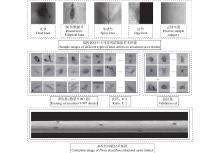
Fig.1
Image samples of different types of knot defects of Pinus densiflora structural lumber"
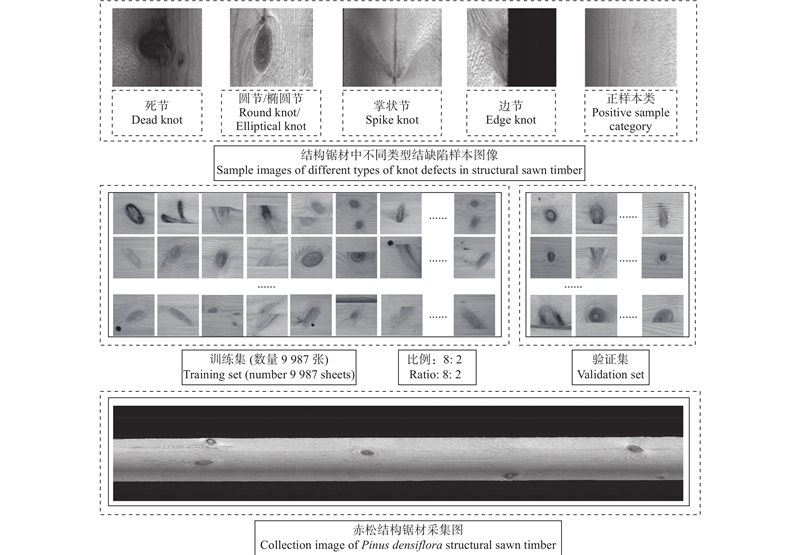

Fig.2
Lumber inspection platform based on machine vision technology"
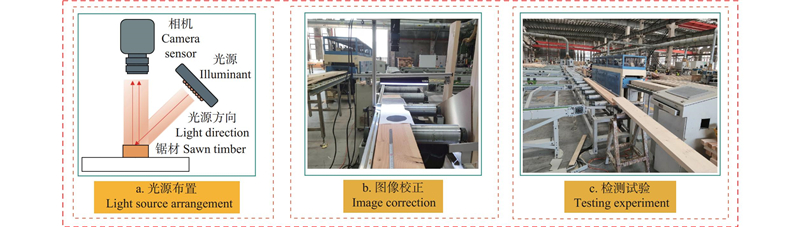
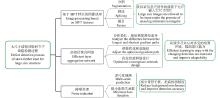
Fig.3
Detecting process of knot defects in large-sized structural lumber"
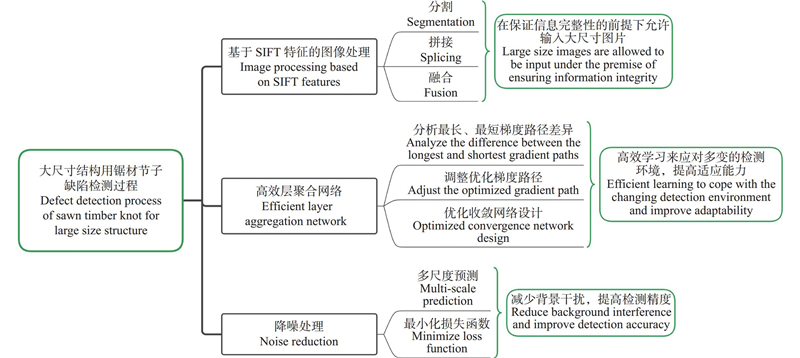
Fig.4
Deep learning YOLO network structure model"
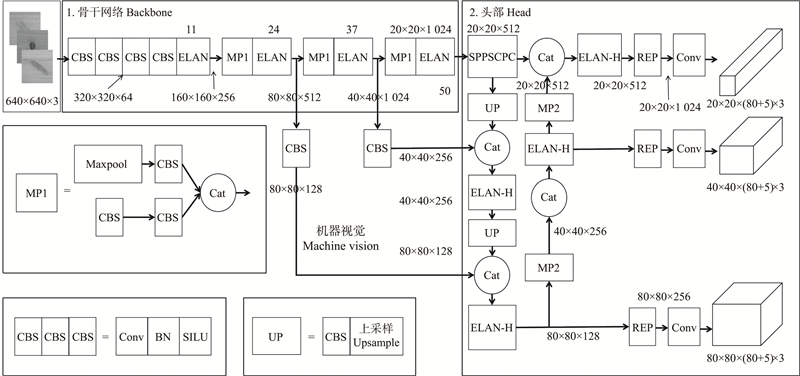
Fig.5
Efficient layer aggregation networks"
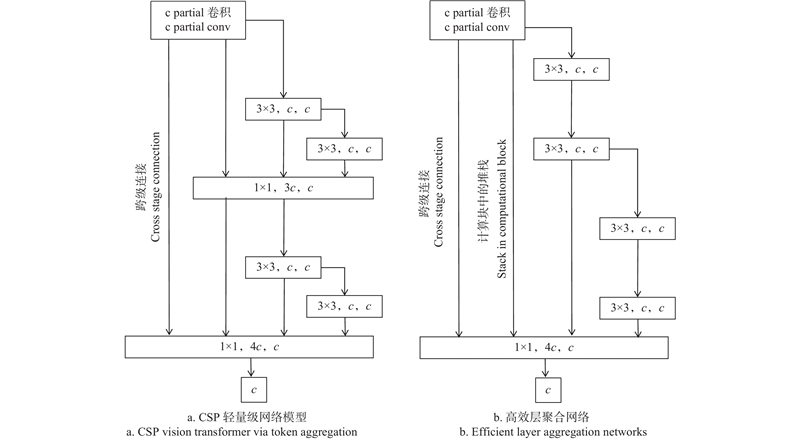
Fig.6
Deep learning training error"
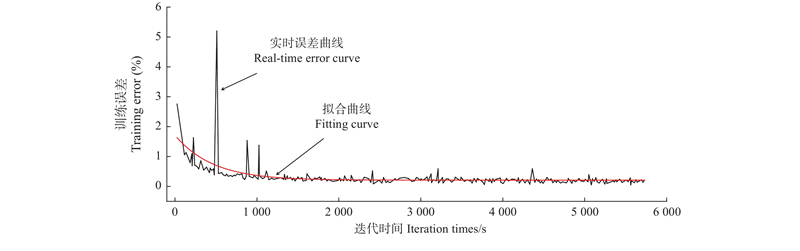

Fig.7
Comparison between machine vision detection method and manual measurement method"
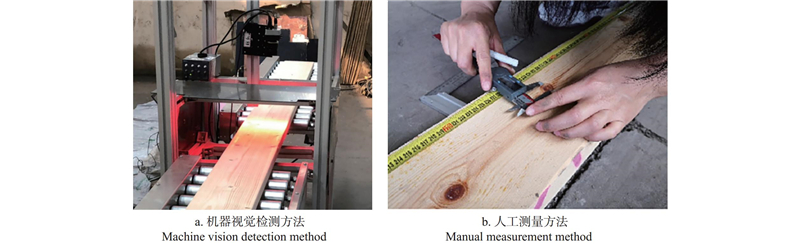
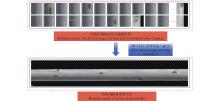
Fig.8
Inspection result of structural lumber knot defect"
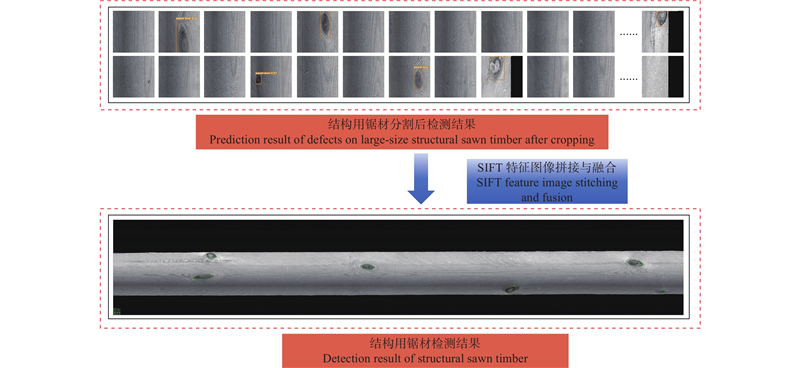
Table 1
Analysis of detection accuracy based on comparison between deep learning algorithm detection results and manual visual statistical results"
| 样品分组 Sample grouping | 2个宽面 Two wide face | 实际节子数量 The actual number of knots / piece | 检出节子数量 Number of detected knots / piece | 漏检率 Missed detection rate(%) | 非节子但被识别 为节子数量 Misjudged as a knot/ piece | 检测精度 Detection precision(%) |
| A | A | 12 | 11 | 8.33 | 1 | 91.67 |
| B | 14 | 14 | 0.00 | 0 | 100.00 | |
| B | A | 5 | 4 | 20.00 | 0 | 80.00 |
| B | 4 | 4 | 0.00 | 0 | 100.00 | |
| C | A | 15 | 13 | 13.33 | 0 | 86.67 |
| B | 16 | 13 | 18.75 | 1 | 81.25 | |
| D | A | 8 | 7 | 12.50 | 1 | 87.50 |
| B | 7 | 6 | 14.29 | 0 | 85.71 | |
| E | A | 13 | 12 | 7.69 | 2 | 92.31 |
| B | 14 | 12 | 14.29 | 1 | 85.71 | |
| F | A | 5 | 5 | 0.00 | 0 | 100.00 |
| B | 7 | 6 | 14.29 | 1 | 85.71 | |
| G | A | 10 | 10 | 0.00 | 0 | 100.00 |
| B | 13 | 11 | 15.38 | 0 | 84.62 | |
| H | A | 4 | 4 | 0.00 | 0 | 100.00 |
| B | 6 | 6 | 0.00 | 0 | 100.00 | |
| I | A | 15 | 13 | 13.33 | 1 | 86.67 |
| B | 12 | 11 | 8.33 | 1 | 91.67 | |
| J | A | 5 | 4 | 20.00 | 0 | 80.00 |
| B | 4 | 4 | 0.00 | 1 | 100.00 |
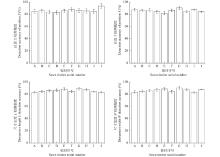
Fig.9
Analysis of measurement accuracy for the location and dimension of knot defects in sawn timber"
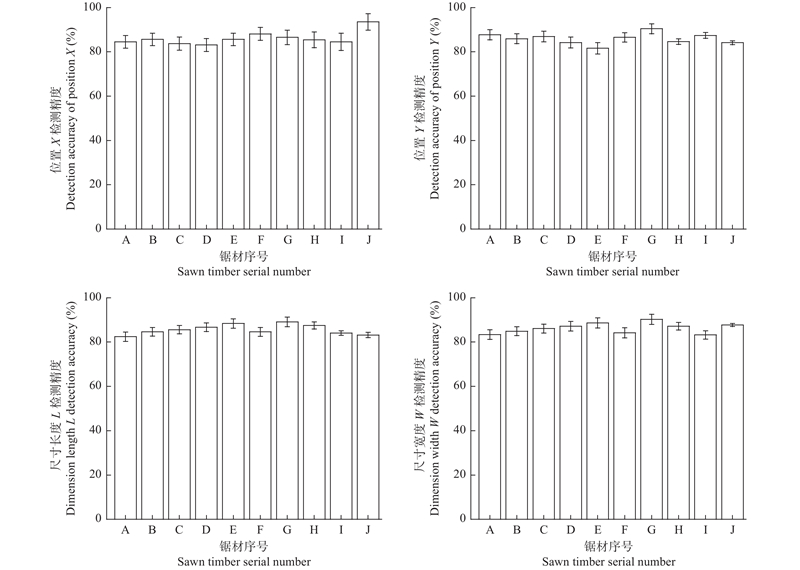
Table 2
Performance indicators of structural sawn lumber detection based based on the deep learning algorithm"
| 检测指标 Detection metrics | 精度Precision(%) |
| 识别与检测精度 Detection accuracy | 90.97 |
| 漏检率 Missed detection rate | 9.03 |
| 模型均值平均精度 Model mAP | 91.50 |
| 节子缺陷位置(X,Y)平均检测精度 Average detection accuracy of defect location (X, Y) | 86.29 |
| 节子缺陷尺寸(L,W)平均检测精度 Average detection accuracy of defect size (L, W) | 85.95 |
Table 3
Comparison of defect detection accuracy of different methods"
| 方法 Method | 均值平均精 度mAP(%) | 识别与检测精度 Detection accuracy(%) | 测量耗时 Measurement time/s |
| 图像预处理与 特征提取 Image preprocessing and feature extraction | — | 75.12 | 2.10 |
| 深度学习方法 Deep learning methods | 95 | 90.97 | 2.00 |
| 人工测量 Manual measurement | — | 91.56 | 22.80 |
|
陈龙现, 刘传泽, 杜光月, 等. 人造板在线同步图像采集系统设计与实现. 制造业自动化, 2019, 41 (1): 68- 71.
doi: 10.3969/j.issn.1009-0134.2019.01.016 |
|
|
Chen L X, Liu C Z, Du G Y, et al. Design and implementation of synchronous image acquisition system of wood-based panels. Manufacturing Automation, 2019, 41 (1): 68- 71.
doi: 10.3969/j.issn.1009-0134.2019.01.016 |
|
|
邓斌攸,池志强,潘云峰,等. 家具板件圆形孔位的机器视觉在线检测算法. 木材科学与技术, 2022, 36 (2): 60- 64.
doi: 10.12326/j.2096-9694.2021099 |
|
|
Deng B Y, Chi Z Q, Pan Y F, et al. Algorithm of machine vision system for detecting holes in furniture panel. Chinese Journal of Wood Science and Technolog, 2022, 36 (2): 60- 64.
doi: 10.12326/j.2096-9694.2021099 |
|
|
侯晓鹏, 吴智慧, 刘海波, 等. 基于OPC统一架构的木制品加工设备信息互联互通方法. 木材科学与技术, 2022, 36 (6): 95- 102.
doi: 10.12326/j.2096-9694.2022098 |
|
|
Hou X P, Wu Z H, Liu H B, et al. Information interconnection and intercommunication method for woodworking equipment based on open platform communications unified architecture(OPC UA). Chinese Journal of Wood Science and Technology, 2022, 36 (6): 95- 102.
doi: 10.12326/j.2096-9694.2022098 |
|
|
贾浩男, 徐华东, 王立海, 等. 基于改进YOLOv5木板材表面缺陷的定量识别. 北京林业大学学报, 2023, 45 (4): 147- 155.
doi: 10.12171/j.1000-1522.20220419 |
|
|
Jia H N, Xu H D, Wang L H, et al. Quantitative identification of surface defects in wood paneling based on improved YOLOv5. Journal of Beijing Forestry University, 2023, 45 (4): 147- 155.
doi: 10.12171/j.1000-1522.20220419 |
|
|
彭晓瑞, 吕 斌, 李伟光, 等. 我国板式家具先进制造技术研发与应用进展. 木材科学与技术, 2023, 37 (2): 1- 7, 15.
doi: 10.12326/j.2096-9694.2022085 |
|
|
Peng X R, Lyu B, Li W G, et al. Development and application progress of advanced manufacturing technology for China’s panel furniture. Chinese Journal of Wood Science and Technology, 2023, 37 (2): 1- 7, 15.
doi: 10.12326/j.2096-9694.2022085 |
|
| 田智康, 葛浙东, 郑焕祺, 等. 2024. 基于深度学习的75种阔叶材微观辨识方法. 林业科学, 60(10): 94−103. | |
| Tian Z K, Ge Z D, Zheng H Q, et al. 2024. Microscopic identification methods for 75 types of hardwood based on deep neural network. Scientia Silvae Sinicae, 60(10): 94−103. [in Chinese] | |
| 王 勇, 张 伟. 锯材表面缺陷识别方法对比分析研究. 世界林业研究, 2022, 35 (4): 47- 52. | |
| Wang Y, Zhang W. Comparative analysis of surface defect recognition methods for sawntimber. World Forestry Research, 2022, 35 (4): 47- 52. | |
|
王 晰, 简振雄, 任明俊. 基于深度学习的逆向反射模型. 光学学报, 2023, 43 (21)
doi: 10.3788/AOS230615 |
|
|
Wang X, Jian Z X, Ren M J. Inverse reflectance model based on deep learning. Acta Optica Sinica, 2023, 43 (21)
doi: 10.3788/AOS230615 |
|
| 王晓明, 邓 璐, 史一哲, 等. 基于Harris特征与NDT-ICP算法的钢箱拱预制件尺寸智检方法. 交通运输工程学报, 2024, 24 (1): 158- 170. | |
| Wang X M, Deng L, Shi Y Z, et al. Intelligent dimensional inspection method for steel box arch prefabricated components based on Harris features and NDT-ICP algorithm. Journal of Traffic and Transportation Engineering, 2024, 24 (1): 158- 170. | |
| 吴雨生, 张 伟, 候晓鹏, 等. 基于机器视觉的杉木规格材节子检测与分等. 林业和草原机械, 2020, 1 (2): 13- 16. | |
| Wu Y S, Zhang W, Hou X P, et al. Fir structural timber detecting and grading based on machine vision technology. Forestry and Grassland Machinery, 2020, 1 (2): 13- 16. | |
| 杨 凡, 杨博凯, 李荣荣. 基于图像分割和深度学习的人造板表面缺陷检测. 浙江农林大学学报, 2024, 41 (1): 176- 182. | |
| Yang F, Yang B K, Li R R. Surface defect detection technology of wood-based panel based on image segmentation and deep learning. Journal of Zhejiang A & F University, 2024, 41 (1): 176- 182. | |
| 喻 炜, 周海燕, 刘 英, 等. 人造板无损检测技术研究进展. 世界林业研究, 2023, 36 (3): 58- 62. | |
| Yu W, Zhou H Y, Liu Y, et al. Research progress in nondestructive testing technology for wood-based panels. World Forestry Research, 2023, 36 (3): 58- 62. | |
| 朱剑刚, 王 旭. 木质家具智能制造赋能技术及发展路径分析. 林业工程学报, 2021, 6 (6): 177- 183. | |
| Zhu J G, Wang X. Research on enabling technologies and development path of intelligent manufacturing of wooden furniture. Journal of Forestry Engineering, 2021, 6 (6): 177- 183. | |
|
张 赛, 王应彪, 杨 谭, 等. 基于改进LeNet-5模型的木材表面典型缺陷识别方法研究. 木材科学与技术, 2021, 35 (6): 31- 37.
doi: 10.12326/j.2096-9694.2021024 |
|
|
Zhang S, Wang Y B, Yang T, et al. Detecting method of the wood surface defects based on modified LeNet-5 model. Chinese Journal of Wood Science and Technology, 2021, 35 (6): 31- 37.
doi: 10.12326/j.2096-9694.2021024 |
|
|
Barmpoutis P, Dimitropoulos K, Barboutis I, et al. Wood species recognition through multidimensional texture analysis. Computers and Electronics in Agriculture, 2018, 144, 241- 248.
doi: 10.1016/j.compag.2017.12.011 |
|
|
Bengio Y, LeCun Y, Hinton G. Deep learning for AI. Communications of the ACM, 2021, 64 (7): 58- 65.
doi: 10.1145/3448250 |
|
|
Brunetti M, Burato P, Cremonini C, et al. Visual and machine grading of larch (Larix decidua Mill. ) structural timber from the Italian Alps. Materials and Structures, 2016, 49 (7): 2681- 2688.
doi: 10.1617/s11527-015-0676-5 |
|
|
Chung S, Abbott L F. Neural population geometry: an approach for understanding biological and artificial neural networks. Current Opinion in Neurobiology, 2021, 70, 137- 144.
doi: 10.1016/j.conb.2021.10.010 |
|
|
Gazo R, Wells L, Krs V, et al. Validation of automated hardwood lumber grading system. Computers and Electronics in Agriculture, 2018, 155, 496- 500.
doi: 10.1016/j.compag.2018.06.041 |
|
| Ishida T, Yamane I, Sakai T, et al. 2020. Do we need zero training loss after achieving zero training error? arXiv preprint arXiv: 2002.08709. | |
|
Ji M, Zhang W, Wang G F, et al. Machine vision for knot detection and location in Chinese fir lumber. Forest Products Journal, 2024, 74 (2): 185- 202.
doi: 10.13073/FPJ-D-23-00050 |
|
|
Ji M, Zhang W, Han J K, et al. A deep learning-based algorithm for online detection of small target defects in large-size sawn timber. Industrial Crops and Products, 2024, 222, 119671.
doi: 10.1016/j.indcrop.2024.119671 |
|
|
Kamal K, Qayyum R, Mathavan S, et al. Wood defects classification using laws texture energy measures and supervised learning approach. Advanced Engineering Informatics, 2017, 34, 125- 135.
doi: 10.1016/j.aei.2017.09.007 |
|
|
Li X Y, Chiong R, Hu Z Y, et al. A graph neural network model with local environment pooling for predicting adsorption energies. Computational and Theoretical Chemistry, 2023, 1226, 114161.
doi: 10.1016/j.comptc.2023.114161 |
|
| Lukacevic M, Kandler G, Hu M, et al. A 3D model for knots and related fiber deviations in sawn timber for prediction of mechanical properties of boards. Materials & Design, 2019, 166, 107617. | |
|
Pahlberg T, Hagman O, Thurley M. Recognition of boards using wood fingerprints based on a fusion of feature detection methods. Computers and Electronics in Agriculture, 2015, 111, 164- 173.
doi: 10.1016/j.compag.2014.12.014 |
|
| Pang G S, Shen C H, Cao L B, et al. Deep learning for anomaly detection. ACM Computing Surveys, 2022, 54 (2): 1- 38. | |
|
Ramos L T, Casas E, Romero C, et al. A study of YOLO architectures for wildfire and smoke detection in ground and aerial imagery. Results in Engineering, 2025, 26, 104869.
doi: 10.1016/j.rineng.2025.104869 |
|
| Tu Y X, Ling Z G, Guo S Y, et al. An accurate and real-time surface defects detection method for sawn lumber. IEEE Transactions on Instrumentation and Measurement, 2020, 70, 2501911. | |
| Wang B. 2022. A parallel implementation of computing mean average precision. arXiv preprint arXiv, 2206.09504. | |
|
Wang Y, Zhang W, Gao R, et al. Recent advances in the application of deep learning methods to forestry. Wood Science and Technology, 2021, 55 (5): 1171- 1202.
doi: 10.1007/s00226-021-01309-2 |
|
|
Wright L G, Onodera T, Stein M M, et al. Deep physical neural networks trained with backpropagation. Nature, 2022, 601, 549- 555.
doi: 10.1038/s41586-021-04223-6 |
|
|
Zhao J B, Meng Z X, Jin Z, et al. Bending properties of bamboo scrimber with holes in different sizes and positions. Construction and Building Materials, 2019, 200, 209- 217.
doi: 10.1016/j.conbuildmat.2018.12.076 |
| [1] | Xiaoning Ge,Xinqiao Xu,Huaiqing Zhang,Jing Zhang,Jie Yang,Zeyu Cui,Rurao Fu,Jinjie Liang,Tianhua Zou,Linlong Wang,Yang Liu. Progress and Reflection on Genotype-Environment Interaction Algorithms in Forest Tree Breeding [J]. Scientia Silvae Sinicae, 2025, 61(3): 1-15. |
| [2] | Wanying Xie,Wenping Liu,Han Wang. UAV Images of Pine Forests for Early Detection of Pine Wood Nematode Infestation [J]. Scientia Silvae Sinicae, 2024, 60(9): 124-133. |
| [3] | Jiandong Qi,Shangzi Zheng,Ziyi Chen,Zhongtian Ma. Wildlife Image Recognition of Infrared Cameras in Beijing Area Based on an Improvement ConvNeXt Model [J]. Scientia Silvae Sinicae, 2024, 60(8): 33-45. |
| [4] | Zhikang Tian,Zhedong Ge,Huanqi Zheng,Zhishuai Zheng,Yucheng Zhou. Microscopic Identification Methods for 75 Types of Hardwood Based on Deep Neural Network [J]. Scientia Silvae Sinicae, 2024, 60(10): 94-103. |
| [5] | Jiandong Qi,Zhongtian Ma,Dehuai Zhang,Yun Tian. Wildlife Image Recognition in Miyun District Based on BS-ResNeXt-50 [J]. Scientia Silvae Sinicae, 2023, 59(8): 112-122. |
| [6] | Jia Li,Lan Lan,Zuozhong Zhang,Wentao Yuan,Demin Gao,Shuqin Zong,Qiaolin Ye. Inversion Technology of Forest Fuel Moisture Content Based on Deep Learning [J]. Scientia Silvae Sinicae, 2022, 58(10): 47-58. |
| [7] | Yan Zhou,Wenping Liu,Youqing Luo,Shixiang Zong. Small Object Detection for Infected Trees Based on the Deep Learning Method [J]. Scientia Silvae Sinicae, 2021, 57(3): 98-107. |
| [8] | Ying Guo,Zengyuan Li,Erxue Chen,Xu Zhang,Lei Zhao,Yan Chen,Yahui Wang. A Deep Learning Method for Forest Fine Classification Based on High Resolution Remote Sensing Images: Two-Branch FCN-8s [J]. Scientia Silvae Sinicae, 2020, 56(3): 48-60. |
| [9] | Mingwei Shao,Junyu Dong. A New Algorithm for Automatic Optimizing Cross-Cut Saw Based on Deep Learning Algorithm [J]. Scientia Silvae Sinicae, 2020, 56(12): 123-129. |
| Viewed | ||||||
|
Full text |
|
|||||
|
Abstract |
|
|||||
