
Scientia Silvae Sinicae ›› 2026, Vol. 62 ›› Issue (1): 95-108.doi: 10.11707/j.1001-7488.LYKX20240532
• Research papers • Previous Articles Next Articles
Yafei Wang1,2,Yu Zou1,2,Xucun Zhu1,2,Shusen Zhang1,3,Shaoran Li4,Ye Wang5,Liming Jia1,2,*( )
)
Received:2024-09-13
Revised:2025-09-15
Online:2026-01-25
Published:2026-01-14
Contact:
Liming Jia
E-mail:jlm@bjfu.edu.cn
CLC Number:
Yafei Wang,Yu Zou,Xucun Zhu,Shusen Zhang,Shaoran Li,Ye Wang,Liming Jia. Plastic Response of Leaf-Fine Root Phenotype and Growth Rhythm of Populus tomentosa Plantation to Thinning Intensity[J]. Scientia Silvae Sinicae, 2026, 62(1): 95-108.

Table 1
Information on experimental forest stands in 2023"
| 间伐处理 Thinning treatment | 林木保留株树 Reserved forest trees | 2023年3月 March 2023 | 2023年11月 November 2023 | |||
| 胸径DBH/cm | 树高 Height/m | 胸径DBH/cm | 树高 Height/m | |||
| NT | 1 666 | 13.81±0.44 | 14.17±0.43 | 14.15±0.26 | 17.15±0.44 | |
| T50 | 833 | 14.56±1.12 | 15.21±0.39 | 15.83±1.07 | 17.36±0.68 | |
| T75 | 417 | 13.63±0.81 | 14.49±0.25 | 15.17±0.85 | 16.94±0.26 | |
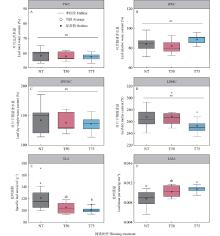
Fig.1
Effects of different thinning intensities on leaf traits of Populus tomentosa"
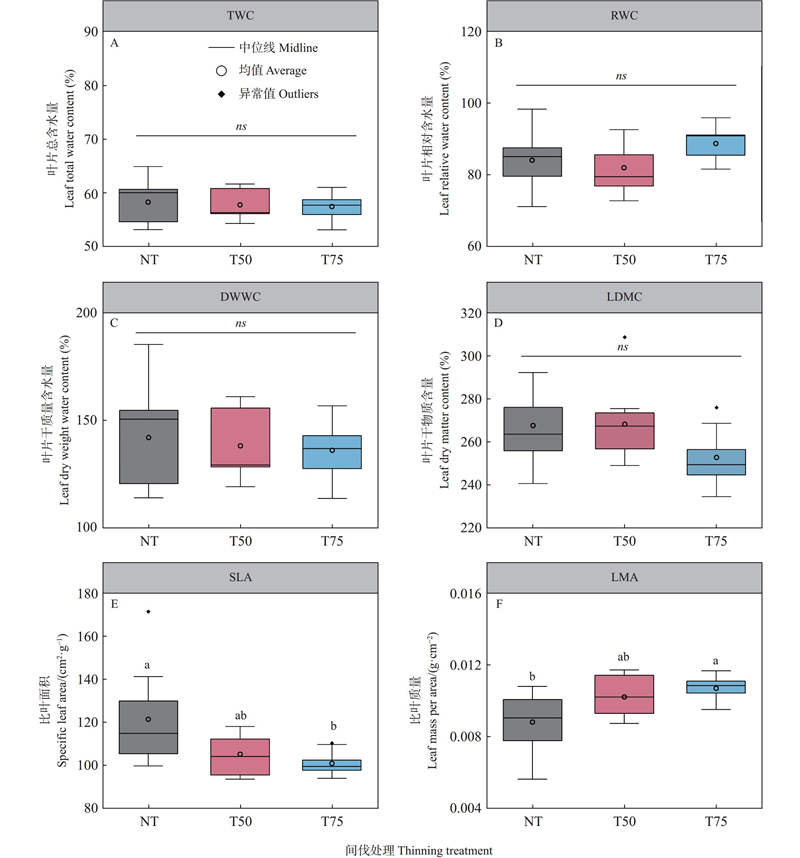
Table 2
Two-way ANOVA of the effects of thinning intensity, soil depth and their interaction on fine root traits (P value)"
| 根系功能性状 Root functional traits | 间伐强度 Thinning intensity (T) | 土层深度 Soil depth (S) | T×S |
| MRB | 0.108 | <0.001 | 0.889 |
| FRAD | 0.388 | <0.001 | 0.878 |
| FRBD | 0.108 | <0.001 | 0.677 |
| FRLD | 0.485 | 0.001 | 0.878 |
| FRVD | 0.377 | <0.001 | 0.637 |
| FRTD | 0.08 | <0.001 | 0.781 |
| SRA | 0.083 | 0.003 | 0.934 |
| SRL | 0.320 | 0.038 | 0.864 |
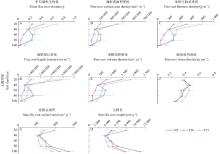
Fig.2
Effects of different thinning intensities on fine root traits of Populus tomentosa"
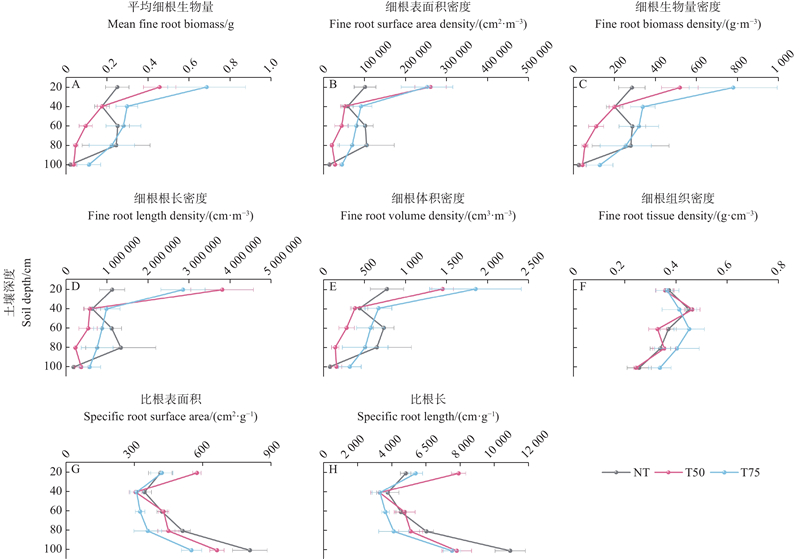

Fig.3
Dynamic changes in the DBH increment, cumulative DBH increment, RGR and LAI of Populus tomentosa under different thinning intensities"
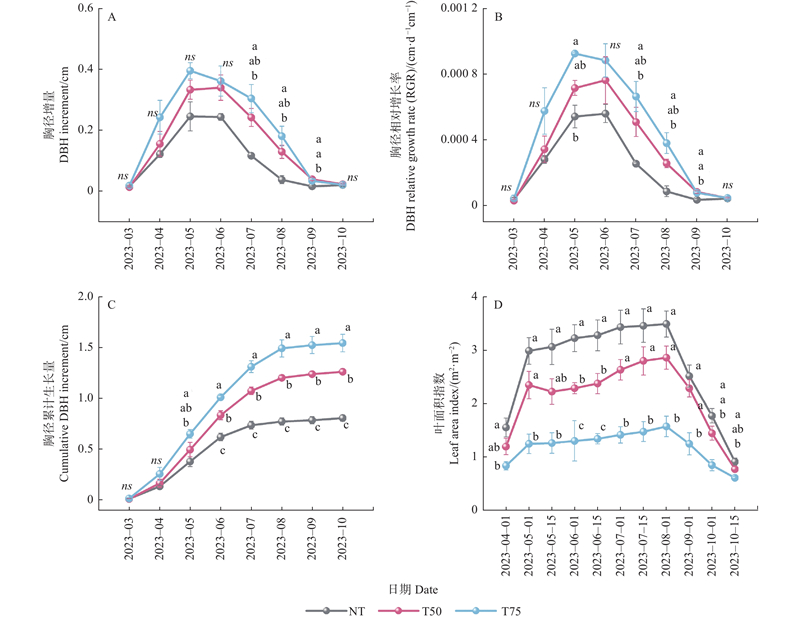
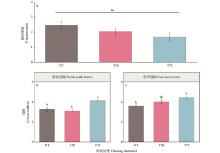
Fig.4
Effects of different thinning intensities on height increment and crown width of Populus tomentosa"

Table 3
Tree growth and productivity of Populus tomentosa under different thinning intensities at the end of the 2023 growing season"
| 间伐处理 Thinning treatment | 密度 Density/ hm?2 | 胸径 DBH/cm | 树高 Tree height/m | 单株材积 Volume per tree / (m3·a?1) | 保留木蓄积量 Reserved timber volume/(m3·hm?2) | 总蓄积量 Total forest stock volume /(m3·hm?2) | 年林地生产力 Annual forest productivity /(m3·hm?2a?1) |
| NT | 1 666 | 14.15±0.26 | 17.15±0.44 | 0.11±0.01 | 181.44±8.15a | 181.44±8.15 | 22.68±1.02 |
| T50 | 833 | 15.83±1.07 | 17.36±0.68 | 0.14±0.02 | 116.47±18.44b | 194.19±29.73 | 24.27±3.72 |
| T75 | 417 | 15.17±0.85 | 16.94±0.26 | 0.12±0.02 | 51.91±6.45c | 146.63±14.61 | 18.33±1.83 |
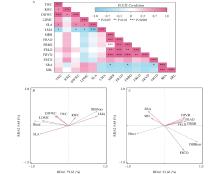
Fig.5
Correlation analysis between Populus tomentosa leaf traits, fine root traits and forest growth"
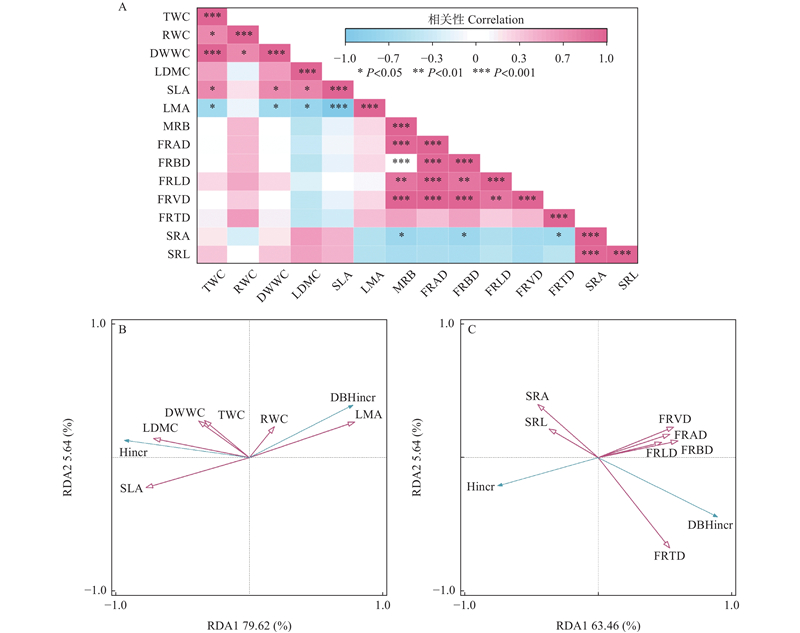
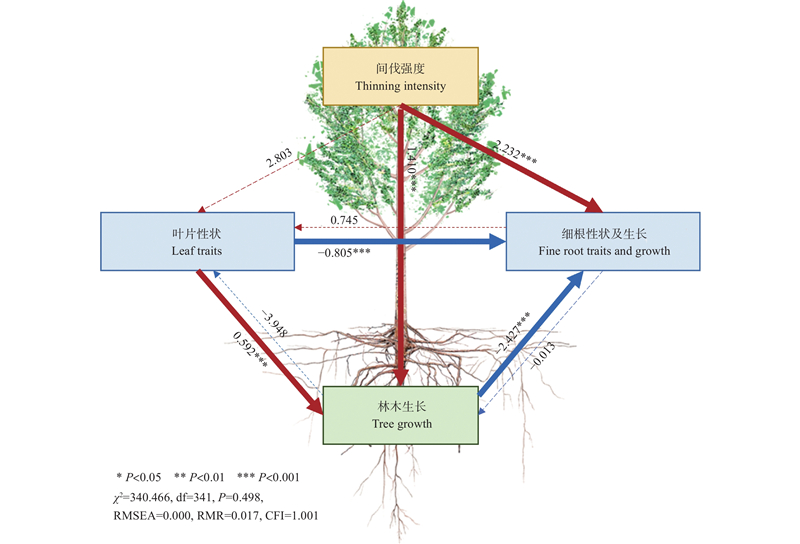
Fig.6
Structural equation model (SEM) of leaf traits, fine root traits and growth, forest growth of Populus tomentosa The red arrow indicates a positive effect, the blue arrow indicates a negative effect, the thickness of the solid line indicates the significance(P<0.05), and the dotted line indicates that the relationship is not significant(P>0.05)."
| 陈章水. 杨树二元立木材积表的编制. 林业科学研究, 1989, 2 (1): 78- 83. | |
| Chen Z S. Compilation of poplar two-dimensional standing wood volume table. Forestry Research, 1989, 2 (1): 78- 83. | |
| 何念鹏, 刘聪聪, 张佳慧, 等. 植物性状研究的机遇与挑战: 从器官到群落. 生态学报, 2018, 38 (19): 6787- 6796. | |
| He N P, Liu C C, Zhang J H, et al. Perspectives and challenges in plant traits: from organs to communities. Acta Ecologica Sinica, 2018, 38 (19): 6787- 6796. | |
| 贺曰林. 2021. 毛白杨S86人工林根区滴灌施肥及水氮调控机制研究. 北京: 北京林业大学. | |
| He Y L. 2021. Research on the drip irrigation-nitrogen fertigation and mechanism of water nitrogen regulation in root zone for Populus tomentosa S86 plantation. Beijing: Beijing Forestry University. [in Chinese] | |
|
何芸雨, 郭水良, 王 喆. 植物功能性状权衡关系的研究进展. 植物生态学报, 2019, 43 (12): 1021- 1035.
doi: 10.17521/cjpe.2019.0122 |
|
|
He Y Y, Guo S L, Wang Z. Research progress of trade-off relationships of plant functional traits. Chinese Journal of Plant Ecology, 2019, 43 (12): 1021- 1035.
doi: 10.17521/cjpe.2019.0122 |
|
|
刘明秀, 梁国鲁. 植物比叶质量研究进展. 植物生态学报, 2016, 40 (8): 847- 860.
doi: 10.17521/cjpe.2015.0428 |
|
|
Liu M X, Liang G L. Research progress on leaf mass per area. Chinese Journal of Plant Ecology, 2016, 40 (8): 847- 860.
doi: 10.17521/cjpe.2015.0428 |
|
| 王 烨, 李广德, 刘国彬, 等. 毛白杨人工林物候特征和生长对施肥的可塑性响应. 林业科学, 2023, 59 (5): 32- 40. | |
| Wang Y, Li G D, Liu G B, et al. Plasticity responses of phenological characteristics and tree growth of Populus tomentosa plantation to fertilization. Scientia Silvae Sinicae, 2023, 59 (5): 32- 40. | |
|
席本野, 邸 楠, 曹治国, 等. 树木吸收利用深层土壤水的特征与机制: 对人工林培育的启示. 植物生态学报, 2018, 42 (9): 885- 905.
doi: 10.17521/cjpe.2018.0083 |
|
|
Xi B Y, Di N, Cao Z G, et al. Characteristics and underlying mechanisms of plant deep soil water uptake and utilization: Implication for the cultivation of plantation trees. Chinese Journal of Plant Ecology, 2018, 42 (9): 885- 905.
doi: 10.17521/cjpe.2018.0083 |
|
| 邢鸿林, 赵彩鸿, 沈 忱, 等. 红皮云杉人工林树冠特征与生长形质的关系及间伐与修枝对其影响. 西北林学院学报, 2024, 39 (2): 91- 96. | |
| Xing H L, Zhao C H, Shen C, et al. Relationship between canopy morphological characteristics and growth characters of Picea koraiensis in plantations and the effect of thinning and pruning on them. Journal of Northwest Forestry University, 2024, 39 (2): 91- 96. | |
| 杨红青, 王亚飞, 贾黎明. 短轮伐期毛白杨S86纸浆林生长对沟灌水肥耦合的响应. 北京林业大学学报, 2023, 45 (3): 68- 78. | |
| Yang H Q, Wang Y F, Jia L M. Response of pulp plantation growth of Populus tomentosa S86 in short rotation period to coupling of water and fertilizer in furrow irrigation. Journal of Beijing Forestry University, 2023, 45 (3): 68- 78. | |
| 尤健健, 张文辉, 邓 磊, 等. 间伐对黄龙山油松中龄林细根空间分布和形态特征的影响. 生态学报, 2017, 37 (9): 3065- 3073. | |
| You J J, Zhang W H, Deng L, et al. Effects of thinning intensity on fine root biomass and morphological characteristics of middle-aged Pinus tabulaeformis plantations in the Huanglong Mountains. Acta Ecologica Sinica, 2017, 37 (9): 3065- 3073. | |
| 郑鸣鸣, 任正标, 王友良, 等. 间伐强度对杉木中龄林生长和结构的影响. 森林与环境学报, 2020, 40 (4): 369- 376. | |
| Zheng M M, Ren Z B, Wang Y L, et al. Effect of thinning intensity on the growth and structure of a middle-aged Chinese fir forest. Journal of Forest and Environment, 2020, 40 (4): 369- 376. | |
|
Adriano E, Laclau J P, Rodrigues J D. Deep rooting of rainfed and irrigated orange trees in Brazil. Trees, 2017, 31 (1): 285- 297.
doi: 10.1007/s00468-016-1483-5 |
|
| Asaye Z, Zewdie S. Fine root dynamics and soil carbon accretion under thinned and un-thinned Cupressus lusitanica stands in, Southern Ethiopia. Plant and Soil, 2013, 366 (1/2): 261- 271. | |
| Bakker M R, Augusto L, Achat D L. Fine root distribution of trees and understory in mature stands of maritime pine (Pinus pinaster) on dry and humid sites. Plant and Soil, 2006, 286 (1): 37- 51. | |
|
Baraloto C, Paine C E T, Poorter L, et al. Decoupled leaf and stem economics in rain forest trees. Ecology Letters, 2010, 13 (11): 1338- 1347.
doi: 10.1111/j.1461-0248.2010.01517.x |
|
|
Barber K R, Leeds-Harrison P B, Lawson C S. Soil aeration status in a lowland wet grassland. Hydrological Processes, 2004, 18 (2): 329- 341.
doi: 10.1002/hyp.1378 |
|
|
Benedetti-Ruiz S, Loewe-Muñoz V, Del Río R, et al. Effect of thinning on growth and shape of Castanea sativa adult tree plantations for timber production in Chile. Forest Ecology and Management, 2023, 530, 120762.
doi: 10.1016/j.foreco.2022.120762 |
|
|
Bhandari S K, Veneklaas E J, Mccaw L, et al. Effect of thinning and fertilizer on growth and allometry of Eucalyptus marginata. Forest Ecology and Management, 2021a, 479, 118594.
doi: 10.1016/j.foreco.2020.118594 |
|
|
Bhandari S K, Veneklaas E J, McCaw L, et al. Investigating the effect of neighbour competition on individual tree growth in thinned and unthinned eucalypt forests. Forest Ecology and Management, 2021b, 499, 119637.
doi: 10.1016/j.foreco.2021.119637 |
|
|
Cadotte M W, Cavender-Bares J, Tilman D, et al. Using phylogenetic, functional and trait diversity to understand patterns of plant community productivity. PLoS One, 2009, 4 (5): e5695.
doi: 10.1371/journal.pone.0005695 |
|
|
Coleman M D, Aubrey D P. Stand development and other intrinsic factors largely control fine-root dynamics with only subtle modifications from resource availability. Tree Physiology, 2018, 38 (12): 1805- 1819.
doi: 10.1093/treephys/tpy033 |
|
|
Coonen E J, Sillett S C. Separating effects of crown structure and competition for light on trunk growth of Sequoia sempervirens. Forest Ecology and Management, 2015, 358, 26- 40.
doi: 10.1016/j.foreco.2015.08.035 |
|
|
Cornwell W K, Ackerly D D. Community assembly and shifts in plant trait distributions across an environmental gradient in coastal California. Ecological Monographs, 2009, 79 (1): 109- 126.
doi: 10.1890/07-1134.1 |
|
| Coyle D R, Coleman M D. Forest production responses to irrigation and fertilization are not explained by shifts in allocation. Forest Ecology and Management, 2005, 208 (1/2/3): 137- 152. | |
|
Dang P, Gao Y, Liu J L, et al. Effects of thinning intensity on understory vegetation and soil microbial communities of a mature Chinese pine plantation in the Loess Plateau. Science of the Total Environment, 2018, 630, 171- 180.
doi: 10.1016/j.scitotenv.2018.02.197 |
|
|
Deng C, Zhang S G, Lu Y C, et al. Thinning effects on forest evolution in Masson pine (Pinus massoniana Lamb.) conversion from pure plantations into mixed forests. Forest Ecology and Management, 2020, 477, 118503.
doi: 10.1016/j.foreco.2020.118503 |
|
|
Di N, Liu Y, Mead D J, et al. Root-system characteristics of plantation-grown Populus tomentosa adapted to seasonal fluctuation in the groundwater table. Trees, 2018, 32 (1): 137- 149.
doi: 10.1007/s00468-017-1619-2 |
|
|
Dighton J, Helmisaari H S, Maghirang M, et al. Impacts of forest post thinning residues on soil chemistry, fauna and roots: Implications of residue removal in Finland. Applied Soil Ecology, 2012, 60, 16- 22.
doi: 10.1016/j.apsoil.2012.02.023 |
|
|
Ding J X, Wang Q T, Ge W J, et al. Coordination of leaf and root economic space in alpine coniferous forests on the Tibetan Plateau. Plant and Soil, 2024, 496, 555- 568.
doi: 10.1007/s11104-023-06381-0 |
|
|
Freschet G T, Roumet C, Comas L H, et al. Root traits as drivers of plant and ecosystem functioning: current understanding, pitfalls and future research needs. New Phytologist, 2021, 232 (3): 1123- 1158.
doi: 10.1111/nph.17072 |
|
|
Freschet G T, Violle C, Bourget M Y, et al. Allocation, morphology, physiology, architecture: the multiple facets of plant above- and below-ground responses to resource stress. New Phytologist, 2018, 219 (4): 1338- 1352.
doi: 10.1111/nph.15225 |
|
| Gratani L. Plant phenotypic plasticity in response to environmental factors. Advances in Botany, 2014, 2014, 208747. | |
|
Hamelin C, Gagnon D, Truax B. Aboveground biomass of glossy buckthorn is similar in open and understory environments but architectural strategy differs. Forests, 2015, 6 (4): 1083- 1093.
doi: 10.3390/f6041083 |
|
|
Han Q M. Height-related decreases in mesophyll conductance, leaf photosynthesis and compensating adjustments associated with leaf nitrogen concentrations in Pinus densiflora. Tree Physiology, 2011, 31 (9): 976- 984.
doi: 10.1093/treephys/tpr016 |
|
|
He M Z, Dijkstra F A. Drought effect on plant nitrogen and phosphorus: a meta-analysis. New Phytologist, 2014, 204 (4): 924- 931.
doi: 10.1111/nph.12952 |
|
|
He Y L, Xi B Y, Li G D, et al. Influence of drip irrigation, nitrogen fertigation, and precipitation on soil water and nitrogen distribution, tree seasonal growth and nitrogen uptake in young triploid poplar (Populus tomentosa) plantations. Agricultural Water Management, 2021, 243, 106460.
doi: 10.1016/j.agwat.2020.106460 |
|
|
Hikosaka K, Shigeno A. The role of Rubisco and cell walls in the interspecific variation in photosynthetic capacity. Oecologia, 2009, 160 (3): 443- 451.
doi: 10.1007/s00442-009-1315-z |
|
|
Kambach S, Sabatini F M, Attorre F, et al. Climate-trait relationships exhibit strong habitat specificity in plant communities across Europe. Nature Communications, 2023, 14, 712.
doi: 10.1038/s41467-023-36240-6 |
|
|
Kirfel K, Leuschner C, Hertel D, et al. Influence of root diameter and soil depth on the xylem anatomy of fine- to medium-sized roots of mature beech trees in the top- and subsoil. Frontiers in Plant Science, 2017, 8, 1194.
doi: 10.3389/fpls.2017.01194 |
|
|
Kong X, Zhang S S, Wang A Y, et al. Trees in cooler regions are more vulnerable to thermal stress: evidence from temperate poplar plantations in northern China during the 2022 heatwaves. Agricultural and Forest Meteorology, 2024, 356, 110181.
doi: 10.1016/j.agrformet.2024.110181 |
|
|
Li D D, Fernández J E, Li X, et al. Tree growth patterns and diagnosis of water status based on trunk diameter fluctuations in fast-growing Populus tomentosa plantations. Agricultural Water Management, 2020, 241, 106348.
doi: 10.1016/j.agwat.2020.106348 |
|
|
Liu J Q, Li D D, Fernández J E, et al. Variations in water-balance components and carbon stocks in poplar plantations with differing water inputs over a whole rotation: implications for sustainable forest management under climate change. Agricultural and Forest Meteorology, 2022, 320, 108958.
doi: 10.1016/j.agrformet.2022.108958 |
|
| Liu T R, Peng D L, Tan Z J, et al. 2023. Do stand density and month regulate soil enzymes and the stoichiometry of differently aged Larix principis-rupprechtii plantations? Catena, 220: 106683. | |
|
López B C, Sabate S, Gracia C A. Thinning effects on carbon allocation to fine roots in a Quercus ilex forest. Tree Physiology, 2003, 23 (17): 1217- 1224.
doi: 10.1093/treephys/23.17.1217 |
|
|
Ma Z Q, Guo D L, Xu X L, et al. Evolutionary history resolves global organization of root functional traits. Nature, 2018, 555 (7694): 94- 97.
doi: 10.1038/nature25783 |
|
|
Maurice J, Laclau J P, Re D S, et al. Fine root isotropy in Eucalyptus grandis plantations. Towards the prediction of root length densities from root counts on trench walls. Plant and Soil, 2010, 334, 261- 275.
doi: 10.1007/s11104-010-0380-8 |
|
|
McCormack M L, Dickie I A, Eissenstat D M, et al. Redefining fine roots improves understanding of below-ground contributions to terrestrial biosphere processes. New Phytologist, 2015, 207 (3): 505- 518.
doi: 10.1111/nph.13363 |
|
| McCormack M L, Guo D L. Impacts of environmental factors on fine root lifespan. Frontiers in Plant Science, 2014, 5, 205. | |
| Meng L C, Cui Z, Huang Z, et al. Thinning effects on forest production and rainfall redistribution: reduced soil water deficit and improved sustainability of semiarid plantation forestlands. Land Degradation & Development, 2022, 33 (16): 3163- 3173. | |
| Moreau G, Chagnon C, Achim A, et al. Opportunities and limitations of thinning to increase resistance and resilience of trees and forests to global change. Forestry, 2022, 95 (5): 595- 615. | |
| Mulia R, Dupraz C. 2006. Unusual fine root distributions of two deciduous tree species in southern France: what consequences for modelling of tree root dynamics? Plant and Soil, 281: 71–85. | |
| Niinemets Ü. 2007. Photosynthesis and resource distribution through plant canopies. Plant, Cell & Environment, 30(9): 1052–1071. | |
|
Noguchi K, Han Q M, Araki M G, et al. Fine-root dynamics in a young hinoki cypress (Chamaecyparis obtusa) stand for 3 years following thinning. Journal of Forest Research, 2011, 16 (4): 284- 291.
doi: 10.1007/s10310-010-0221-x |
|
|
Osnas J L D, Lichstein J W, Reich P B, et al. Global leaf trait relationships: mass, area, and the leaf economics spectrum. Science, 2013, 340 (6133): 741- 744.
doi: 10.1126/science.1231574 |
|
|
Park J, Kim T, Moon M, et al. Effects of thinning intensities on tree water use, growth, and resultant water use efficiency of 50-year-old Pinus koraiensis forest over four years. Forest Ecology and Management, 2018, 408, 121- 128.
doi: 10.1016/j.foreco.2017.09.031 |
|
|
Ruel J C, Larouche C, Achim A. Changes in root morphology after precommercial thinning in balsam fir stands. Canadian Journal of Forest Research, 2003, 33 (12): 2452- 2459.
doi: 10.1139/x03-178 |
|
|
Sankey T, Tatum J. Thinning increases forest resiliency during unprecedented drought. Scientific Reports, 2022, 12 (1): 9041.
doi: 10.1038/s41598-022-12982-z |
|
|
Santiago L S, Wright S J. Leaf functional traits of tropical forest plants in relation to growth form. Functional Ecology, 2007, 21 (1): 19- 27.
doi: 10.1111/j.1365-2435.2006.01218.x |
|
|
Sugiura D, Tateno M. Concentrative nitrogen allocation to sun-lit branches and the effects on whole-plant growth under heterogeneous light environments. Oecologia, 2013, 172 (4): 949- 960.
doi: 10.1007/s00442-012-2558-7 |
|
|
Sun K, Sun R J, Li Y B, et al. Plant economic strategies in two contrasting forests. BMC Plant Biology, 2023, 23, 366.
doi: 10.1186/s12870-023-04375-9 |
|
| Susana B R, Veronica L M, Rodrigo D R, et al. 2023. Effect of thinning on growth and shape of Castanea sativa adult tree plantations for timber production in Chile. Forest Ecology and Management, 530: 120762. | |
|
Toledo-Aceves T, Bonilla-Moheno M, Sosa V J, et al. Leaf functional traits predict shade tolerant tree performance in cloud forest restoration plantings. Journal of Applied Ecology, 2022, 59 (9): 2274- 2286.
doi: 10.1111/1365-2664.14128 |
|
|
Valladares F, Sanchez-Gomez D, Zavala M A. Quantitative estimation of phenotypic plasticity: bridging the gap between the evolutionary concept and its ecological applications. Journal of Ecology, 2006, 94 (6): 1103- 1116.
doi: 10.1111/j.1365-2745.2006.01176.x |
|
|
Vargas R, Allen E B, Allen M F. Effects of vegetation thinning on above- and belowground carbon in a seasonally dry tropical forest in Mexico. Biotropica, 2009, 41 (3): 302- 311.
doi: 10.1111/j.1744-7429.2009.00494.x |
|
| Westoby M, Wright I J. Land-plant ecology on the basis of functional traits. Trends in Ecology & Evolution, 2006, 21 (5): 261- 268. | |
|
Wright I J, Cannon K. Relationships between leaf lifespan and structural defences in a low-nutrient, sclerophyll flora. Functional Ecology, 2001, 15 (3): 351- 359.
doi: 10.1046/j.1365-2435.2001.00522.x |
|
|
Wright I J, Reich P B, Westoby M, et al. The world-wide leaf economics spectrum. Nature, 2004, 428 (6985): 821- 827.
doi: 10.1038/nature02403 |
|
|
Xi B Y, Wang Y, Jia L M, et al. Characteristics of fine root system and water uptake in a triploid Populus tomentosa plantation in the North China Plain: implications for irrigation water management. Agricultural Water Management, 2013, 117, 83- 92.
doi: 10.1016/j.agwat.2012.11.006 |
|
|
Xu T Y, Niu X, Wang B, et al. Variations in leaf functional traits and photosynthetic parameters of Cunninghamia lanceolata provenances. Forests, 2023, 14 (9): 1708.
doi: 10.3390/f14091708 |
|
|
Yücesan Z, Özçelik S, Oktan E. Effects of thinning on stand structure and tree stability in an afforested oriental beech (Fagus orientalis Lipsky) stand in northeast Turkey. Journal of Forestry Research, 2015, 26 (1): 123- 129.
doi: 10.1007/s11676-015-0028-x |
|
|
Zou S Y, Li D D, Di N, et al. Stand development modifies effects of soil water availability on poplar fine-root traits: evidence from a six-year experiment. Plant and Soil, 2022, 480, 165- 184.
doi: 10.1007/s11104-022-05568-1 |
| [1] | Qian Li,Fan Zhang,Xiangxue Meng,Xiaoyun Wu,Jianzhuang Pang,Hang Xu,Zhiqiang Zhang. Simulation of Net Carbon Exchange of Poplar Plantation in North China Plain Based on Decomposition-Reconstruction and Machine Learning [J]. Scientia Silvae Sinicae, 2025, 61(12): 72-82. |
| [2] | Lei Xu,Xiaoyun Wu,Jiang Lü,Yun Shi,Mengxun Zhu,Hang Xu,Zhiqiang Zhang. Impacts of Diffuse Radiation Fraction on Energy Partitioning in a Poplar Plantation in the North China Plain [J]. Scientia Silvae Sinicae, 2024, 60(3): 100-110. |
| [3] | Jiaming Wan,Jiang Lü,Yun Shi,Hang Xu,Zhiqiang Zhang. Effects of Diffuse Radiation on the Gross Primary Productivity of a Poplar Plantation [J]. Scientia Silvae Sinicae, 2023, 59(5): 1-10. |
| [4] | Ruirui Zhao,Yong Liu,Kai Wang. Effects of Biochar and Manure on Wood Decomposition and Soil Enzyme Activities Related Soil Nutrient Cycling in a triploid Populus tomentosa Plantation [J]. Scientia Silvae Sinicae, 2023, 59(11): 1-11. |
| [5] | Xu Xuelei, Sun Yujun, Zhou Hua, Zhang Peng, Hu Yang, Wang Xinjie. Effects of Thinning Intensity on Understory Growth and Soil Properties in Chinese fir Plantation [J]. Scientia Silvae Sinicae, 2019, 55(3): 1-12. |
| [6] | He Huaijiang, Zhang Zhonghui, Zhang Chunyu, Hao Minhui, Yao Jie, Xie Zhe, Gao Haitao, Zhao Xiuhai. Short-Term Effects of Thinning Intensity on Stand Growth and Species Diversity of Mixed Coniferous and Broad-Leaved Forest in Northeastern China [J]. Scientia Silvae Sinicae, 2019, 55(2): 1-12. |
| [7] | Zheng Jing, She Weiwei, Bai Yuxuan, Zhang Yuqing, Qin Shugao, Wu Bin. Effects of Nitrogen and Water Addition on Leaf Traits of Dominant Plant Species in Artemisia Ordosica Community of the Mu Us Desert [J]. Scientia Silvae Sinicae, 2018, 54(10): 164-171. |
| [8] | Liu Yuping, Liu Guifeng, Baiyila Dafu, Cheng Weiyan, Chen Zhijing, Jiang Lili. Effects of Topographic Factors on Leaf Traits of Dominant Species in Different Forest Communities in Daqinggou Nature Reserves [J]. Scientia Silvae Sinicae, 2017, 53(3): 154-162. |
| [9] | Wang Wenbo, Wang Yanping, Wang Huatian, Ma Xuesong, Yi Wenhui. Effects of Different Continuous Cropping and Rotation of Poplar Plantation on Soil Nitrogen Bacteria Community and Nitrogen Metabolism [J]. Scientia Silvae Sinicae, 2016, 52(5): 45-54. |
| [10] | Zhu Yujie, Dong Xibing. Evaluation of the Effects of Different Thinning Intensities on Larch Forest in Great Xing'an Mountains [J]. Scientia Silvae Sinicae, 2016, 52(12): 29-38. |
| [11] | Gong Gutang, Niu Mu, Mu Changlong, Chen Junhua, Li Yanqiong, Zhu Zhifang, Zheng Shaowei. Impacts of Different Thinning Intensities on Growth of Cupressus funebris Plantation and Understory Plants [J]. Scientia Silvae Sinicae, 2015, 51(4): 8-15. |
| [12] | Xu Tan, Wang Huatian, Zhu Wanrui, Wang Yanping, Li Chuanrong, Jiang Yuezhong. Morphological and Anatomical Traits of Poplar Fine Roots in Successive Rotation Plantations [J]. Scientia Silvae Sinicae, 2015, 51(1): 119-126. |
| [13] | Fu Jianping, Lan Zaiping, Sun Shangwei, Liu Junqin, Zhang Yong. Soil Water Movement in a Poplar Plantation under Drip Irrigation [J]. Scientia Silvae Sinicae, 2013, 49(6): 25-29. |
| [14] | Zhou Jianyun;Li Rong;Zhang Wenhui;He Jingfeng. Effects of Thinning Intensity on Structure Characteristics and Spatial Distribution of Quercus wutaishanica Populations [J]. Scientia Silvae Sinicae, 2012, 48(4): 149-155. |
| [15] | Li Rong;Zhang Wenhui;He Jingfeng;Zhou Jianyun. Regeneration and Development of Stump Sprouts of Quercus wutaishanica [J]. Scientia Silvae Sinicae, 2012, 48(3): 82-87. |
| Viewed | ||||||
|
Full text |
|
|||||
|
Abstract |
|
|||||
