
林业科学 ›› 2025, Vol. 61 ›› Issue (12): 72-82.doi: 10.11707/j.1001-7488.LYKX20240492
• 研究论文 • 上一篇
李倩1,张帆1,*( ),孟祥雪2,吴小云1,庞建壮1,许行1,张志强1
收稿日期:2024-08-19
修回日期:2025-03-07
出版日期:2025-12-25
发布日期:2026-01-08
通讯作者:
张帆
E-mail:Zhang_fan@bjfu.edu.cn
基金资助:
Qian Li1,Fan Zhang1,*(),Xiangxue Meng2,Xiaoyun Wu1,Jianzhuang Pang1,Hang Xu1,Zhiqiang Zhang1
Received:2024-08-19
Revised:2025-03-07
Online:2025-12-25
Published:2026-01-08
Contact:
Fan Zhang
E-mail:Zhang_fan@bjfu.edu.cn
摘要:
目的: 将分解重构思想与机器学习相结合,模拟人工林生态系统净碳交换量,为“三北”地区人工林生态系统固碳能力的高精度模拟预测提供有效工具。方法: 基于北京市顺义区共青林场杨树人工林通量观测系统与微气象观测系统2015—2018年生长季(4—10月)的逐日观测数据集,采用随机森林重要性排序法分析获得净生态系统碳交换量(NEE)的主要驱动要素。应用经验模态分解法(EMD)将NEE和主要驱动要素分解重构为波动项和趋势项,分别运用BP神经网络、支持向量机(SVM)、随机森林(RF)和极致梯度提升(XG-Boost)4种机器学习模型进行模拟,优选模型后进行NEE序列重构。结果: 1) 共青林场杨树人工林NEE受总辐射和温度影响显著,土壤体积含水量(5 cm)、饱和水汽压差和空气相对湿度对NEE的影响较弱,环境因子对NEE的影响重要性从大到小依次为总辐射、平均气温、最高气温、最低气温、土壤体积含水量(5 cm)、饱和水汽压差、空气相对湿度。2) NEE分解重构后,对波动项和趋势项模拟效果最好的模型分别为支持向量机和随机森林模型;3) 与直接运用机器学习模拟的方法相比,分解重构后的模拟测试集精度显著提升,R2由0.520提高至0.676,RMSE由1.998下降至1.646 μmol·m?2s?1,MAE由1.578下降至1.273 μmol·m?2s?1。结论: 总辐射、平均气温、最高气温和最低气温是影响杨树人工林生态系统NEE逐日变化的最关键因素。本研究提出的分解重构与机器学习相结合的方法可有效提升NEE的模拟准确度,为“三北”地区森林生态系统固碳能力模拟提供新思路。
中图分类号:
李倩,张帆,孟祥雪,吴小云,庞建壮,许行,张志强. 基于分解重构与机器学习的华北平原杨树人工林净碳交换模拟[J]. 林业科学, 2025, 61(12): 72-82.
Qian Li,Fan Zhang,Xiangxue Meng,Xiaoyun Wu,Jianzhuang Pang,Hang Xu,Zhiqiang Zhang. Simulation of Net Carbon Exchange of Poplar Plantation in North China Plain Based on Decomposition-Reconstruction and Machine Learning[J]. Scientia Silvae Sinicae, 2025, 61(12): 72-82.
图1
2015—2018年生长季(4—10月)NEE变化趋势"
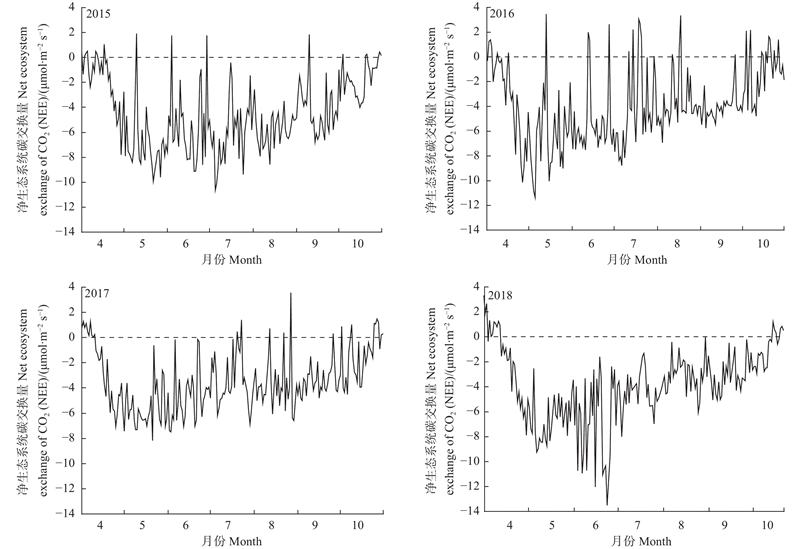
图2
环境因子重要性得分"
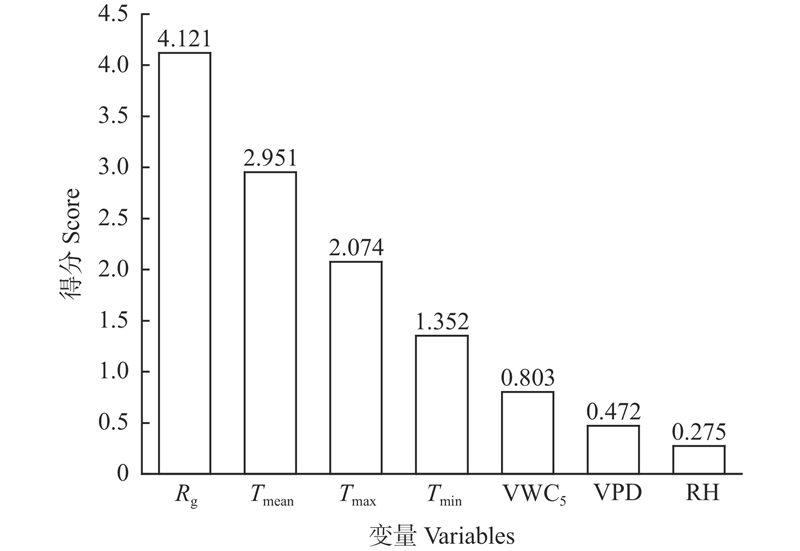
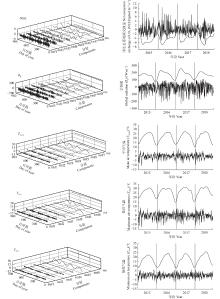
图3
NEE与主要环境因子分解重构"
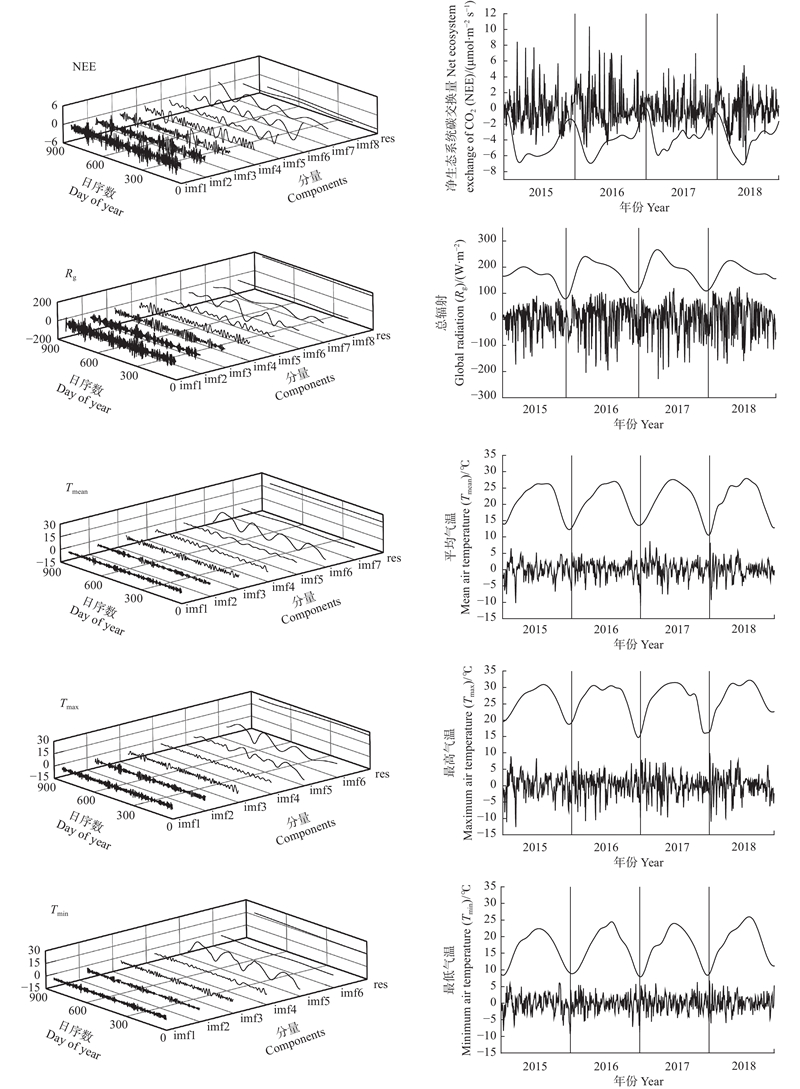

表1
机器学习算法对波动项与趋势项模拟使用的参数"
| 机器学习算法 Machine learning | 波动项最优参数 Optimal parameters of fluctuation term | 趋势项最优参数 Optimal parameters of trend term |
| 支持向量机 Support vector machines | sigma=0.1;C=1 | sigma=1;C=10 |
| BP神经网络 BP neural network | size=10 | size=10 |
| 随机森林 Random forest | mtry=2 | mtry=5 |
| 极致梯度提升 Extreme gradient boosting | nrounds=10;max-depth =5;eta=0.1;gamma=0; colsample-bytree=0.8;min-child-weight=1;subsample=0.6 | nrounds=50;max-depth =10;eta=0.1;gamma=0; colsample-bytree=0.8;min-child-weight=1;subsample=0.8 |
表2
不同机器学习模型在波动项与趋势项测试阶段的精度评价"
| 机器学习算法 Machine learning | 波动项 Fluctuation term | 趋势项 Trend term | |||||
| R2 | RMSE/ (μmol·m?2s?1) | MAE/ (μmol·m?2s?1) | R2 | RMSE/ (μmol·m?2s?1) | MAE/ (μmol·m?2s?1) | ||
| 支持向量机 Support vector machines | 0.384 | 1.664 | 1.291 | 0.960 | 0.384 | 0.238 | |
| BP神经网络 BP neural network | 0.366 | 1.664 | 1.267 | 0.943 | 0.422 | 0.301 | |
| 随机森林 Random forest | 0.323 | 1.74 | 1.346 | 0.973 | 0.323 | 0.219 | |
| 极致梯度提升 Extreme gradient boosting | 0.310 | 1.834 | 1.432 | 0.967 | 0.359 | 0.238 | |
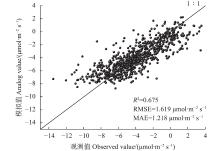
图4
经验模态分解法分解后整体数据观测值与模拟值的比较"
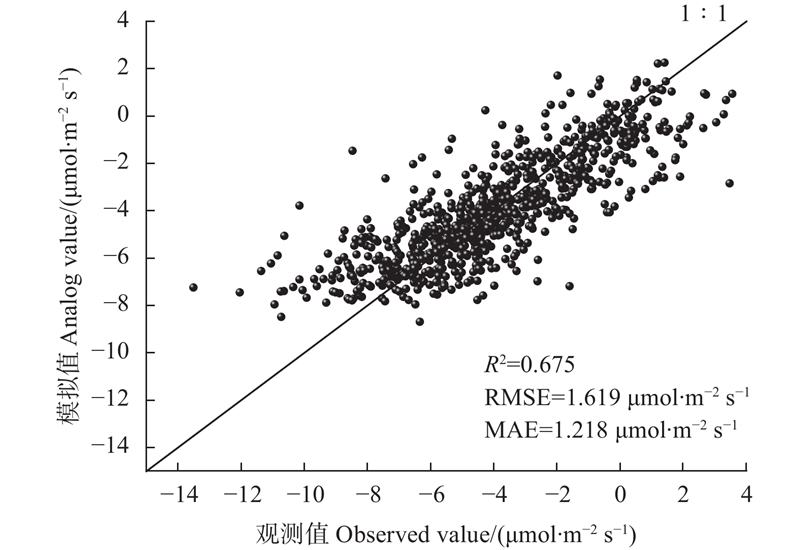
图5
分解重构前后最优模型测试集模拟结果比较"
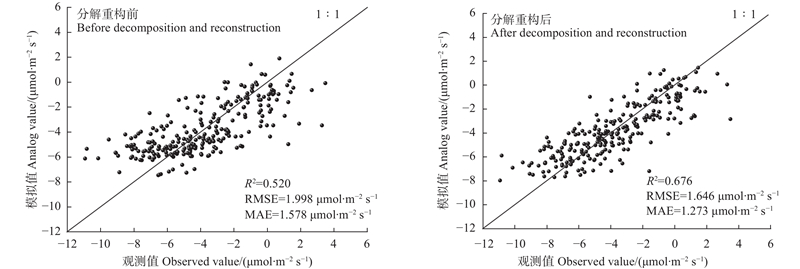
图6
波动项(a)与趋势项(b)沙普利分析结果"
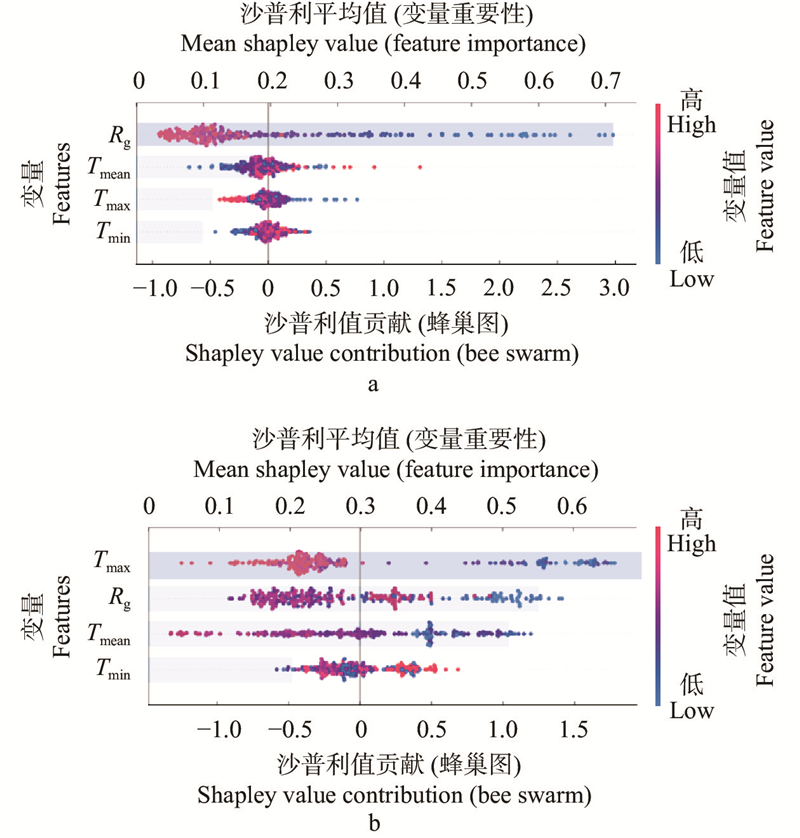
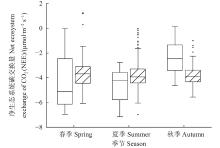
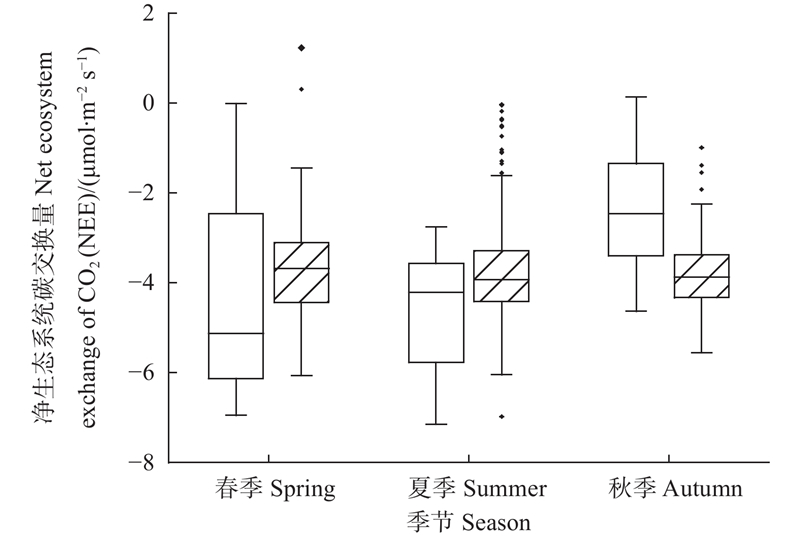
图7
波动项和趋势项季节变化 空白矩形盒表示趋势项,斜线填充矩形盒表示波动项,矩形盒中间黑线表示净碳交换量的中位数,上下边缘分别表示第3分位数 Q3和第1分位数Q1,二者的差值为四分位距 IQR,由矩形盒向上延伸的线端点为最大量(Q3+1.5IQR),向下延伸的线端点为最小量(Q3?1.5IQR),最大量与最小量以外的黑点为异常值。"
| 曹镓玺, 王 鑫, 雷光春. 基于遗传算法优化Bp神经网络的青藏高原海北高寒湿地CO2通量模拟及其影响因子. 山东大学学报(理学版), 2021, 56 (5): 33- 41. | |
| Cao J X, Wang X, Lei G C. Simulation of alpine wetlands CO2 flux and its influencing factors based on BP neural network optimized by genetic algorithm in Qinghai-Tibet Plateau. Journal of Shandong University (Natural Science), 2021, 56 (5): 33- 41. | |
| 曹 轲, 谭 冲, 刘 洪, 等. 基于改进灰狼算法优化Bp神经网络的无线传感器网络数据融合算法. 中国科学院大学学报, 2022, 39 (2): 232- 239. | |
| Cao K, Tan C, Liu H, et al. Data fusion algorithm of wireless sensor network based on BP neural network optimized by improved grey wolf optimizer. Journal of University of Chinese Academy of Sciences, 2022, 39 (2): 232- 239. | |
| 曹文康, 徐哈宁, 肖 慧, 等. 基于贝叶斯优化XGBoost的多元输入模型对滑坡位移预测效果研究. 测绘工程, 2024, 33 (2): 49- 55. | |
| Cao W K, Xu H N, Xiao H, et al. Study on the effect of Bayesian optimization XGBoost-based multi-input model on landslide displacement prediction. Engineering of Surveying and Mapping, 2024, 33 (2): 49- 55. | |
| 陈 凯, 朱 钰. 2007. 机器学习及其相关算法综述. 统计与信息论坛, (5): 105−112. | |
| Chen K, Zhu Y. 2007. A Summary of Machine Learning and Related Algorithms. Journal of Statistics and Information, (5): 105−112. [in Chinese] | |
| 陈 亮, 周国模, 杜华强, 等. 基于随机森林模型的毛竹林CO2通量模拟及其影响因子. 林业科学, 2018, 54 (8): 1- 12. | |
| Chen L, Zhou G M, Du H Q, et al. Simulation of CO2 flux and controlling factors in Moso bamboo forest using random forest algorithm. Scientia Silvae Sinicae, 2018, 54 (8): 1- 12. | |
|
方匡南, 吴见彬, 朱建平, 等. 随机森林方法研究综述. 统计与信息论坛, 2011, 26 (3): 32- 38.
doi: 10.3969/j.issn.1007-3116.2011.03.006 |
|
|
Fang K N, Wu J B, Zhu J P, et al. A review of technologies on random forests. Journal of Statistics and Information, 2011, 26 (3): 32- 38.
doi: 10.3969/j.issn.1007-3116.2011.03.006 |
|
| 冯新妍, 贾 昕, 黄金泽, 等. ANN-BiLSTM模型在温带荒漠灌丛碳通量数据缺失值插补中的应用. 北京林业大学学报, 2023, 45 (9): 62- 72. | |
| Feng X Y, Jia X, Huang J Z, et al. Application of ANN-BiLSTM model to long-term gap-filling of carbon flux data in temperate desert shrub. Journal of Beijing Forestry University, 2023, 45 (9): 62- 72. | |
| 冯鑫炜, 张志强, 许 行, 等. 欧美杨人工林生态系统净碳交换对环境因子响应的时滞. 林业科学, 2020, 56 (2): 12- 23. | |
| Feng X W, Zhang Z Q, Xu H, et al. Time-lag responses of net ecosystem carbon exchange to environmental factors in a Populus × euramericana plantation. Scientia Silvae Sinicae, 2020, 56 (2): 12- 23. | |
| 高怡凡, 宋长青, 王元慧, 等. 顾及土地利用强度和生态-经济权衡的四川省陆地生态系统碳储量预测与热点分析. 生态学报, 2024, 44 (9): 3958- 3969. | |
| Gao Y F, Song C Q, Wang Y H, et al. Carbon storage prediction of terrestrial ecosystems and hotspot analysis in Sichuan Province by considering land use intensity and eco-economic trade-offs. Acta Ecologica Sinica, 2024, 44 (9): 3958- 3969. | |
|
顾亚祥, 丁世飞. 支持向量机研究进展. 计算机科学, 2011, 38 (2): 14- 17.
doi: 10.3969/j.issn.1002-137X.2011.02.004 |
|
|
Gu Y X, Ding S F. Advances of support vector machines (SVM). Computer Science, 2011, 38 (2): 14- 17.
doi: 10.3969/j.issn.1002-137X.2011.02.004 |
|
| 金盛杰, 包腾飞, 陈迪辉, 等. 基于EMD分解法的大坝变形预测模型及应用. 水利水电技术, 2017, 48 (12): 41- 44. | |
| Jin S J, Bao T F, Chen D H, et al. EMD decomposition method-based dam deformation prediction model and its application. Water Resources and Hydropower Engineering, 2017, 48 (12): 41- 44. | |
| 康满春, 朱丽平, 许 行, 等. 基于Biome-BGC模型的北方杨树人工林碳水通量对气候变化的响应研究. 生态学报, 2019, 39 (7): 2378- 2390. | |
| Kang M C, Zhu L P, X H, et al. Modelling the responses of carbon and water fluxes with climate change for a poplar plantation in northern China based on the Biome-BGC model. Acta Ecologica Sinica, 2019, 39 (7): 2378- 2390. | |
| 刘 扬, 王立虎. 基于改进EMD-LSTM的洪水预测方法研究. 水利水电技术(中英文), 2022, 53 (1): 35- 44. | |
| Liu Y, Wang L H. Flood forecasting method based on an improved EMD-LSTM. Water Resources and Hydropower Engineering, 2022, 53 (1): 35- 44. | |
| 路 炜, 魏霖静. 基于EMD分解的黄河流域兰州水文站日径流预测. 水电能源科学, 2023, 41 (8): 19- 22. | |
| Lu W, Wei L J. Daily runoff prediction of lanzhou hydrological station in yellow river basin based on EMD decomposition. Water Resources and Power, 2023, 41 (8): 19- 22. | |
|
吕富成, 酒名扬, 韩立钦, 等. 中国北方针叶林碳通量动态变化及其影响因素分析. 气候与环境研究, 2024, 29 (3): 243- 252.
doi: 10.3878/j.issn.1006-9585.2024.24013 |
|
|
Lü F C, Jiu M Y, Han L Q, et al. Dynamic changes in carbon fluxes of the boreal coniferous forests of China and influencing factor analysis. Climatic and Environmental Research, 2024, 29 (3): 243- 252.
doi: 10.3878/j.issn.1006-9585.2024.24013 |
|
| 朴世龙, 何 悦, 王旭辉, 等. 中国陆地生态系统碳汇估算: 方法、进展、展望. 中国科学: 地球科学, 2022, 52 (6): 1010- 1020. | |
| Piao S L, He Y, Wang X H, et al. Estimation of carbon sequestration in Chinese terrestrial ecosystems: methods, progress, and prospects. Scientia Sinica(Terrae), 2022, 52 (6): 1010- 1020. | |
| 齐建东, 谭新新. 长白山红松阔叶林的净碳交换变化及基于时间卷积神经网络的模拟. 林业科学, 2022, 58 (2): 1- 12. | |
| Qi J D, Tan X X. Net carbon exchange of the forest of Korean pine and broad leaved forest trees in Changbai mountain and its simulation based on temporal convolutional network. Scientia Silvae Sinicae, 2022, 58 (2): 1- 12. | |
| 沙靖岚. 2017. 基于LightGBM与XGBoost算法的P2P网络借贷违约预测模型的比较研究. 大连: 东北财经大学. | |
| Sha J L. 2017. Comparative study of P2P online lending default prediction models based on LightGBM and XGBoost algorithms. Dalian: Dongbei University of Finance and Economics. [in Chinese] | |
| 苏文胜. 2010. 滚动轴承振动信号处理及特征提取方法研究. 大连: 大连理工大学. | |
| Su W S. 2010. Research on vibration signal processing and feature extraction of rolling bearings. Dalian: Dalian University of Technology. [in Chinese] | |
| 唐 欢, 叶 剑, 高振翔, 等. 我国典型生态系统净CO2交换量与蒸散量的多机器学习模型对比分析. 干旱区资源与环境, 2022, 36 (8): 92- 100. | |
| Tang H, Ye J, Gao Z X, et al. Comparative analysis of net CO2 exchange and evapotranspiration in typical ecosystems of China using multi-machine learning models. Journal of Arid Land Resources and Environment, 2022, 36 (8): 92- 100. | |
|
田惠玲, 朱建华, 何 潇, 等. 基于随机森林模型的东北三省乔木林生物质碳储量预测. 林业科学, 2022, 58 (4): 40- 50.
doi: 10.11707/j.1001-7488.20220405 |
|
|
Tian H L, Zhu J H, He X, et al. Projected biomass carbon stock of arbor forest of three provinces in northeastern China based on random forest model. Scientia Silvae Sinicae, 2022, 58 (4): 40- 50.
doi: 10.11707/j.1001-7488.20220405 |
|
|
王少影, 张 宇, 孟宪红, 等. 机器学习算法对涡动相关缺失通量数据的插补研究. 高原气象, 2020, 39 (6): 1348- 1360.
doi: 10.7522/j.issn.1000-0534.2019.00142 |
|
|
Wang S Y, Zhang Y, Meng X H, et al. Fill the gaps of eddy covariance fluxes using machine learning algorithms. Plateau Meteorology, 2020, 39 (6): 1348- 1360.
doi: 10.7522/j.issn.1000-0534.2019.00142 |
|
| 王 婷. 2010. EMD算法研究及其在信号去噪中的应用. 哈尔滨: 哈尔滨工程大学. | |
| Wang T. 2010. Research on the EMD algorithm and its application in signal denoising. Harbin: Harbin Engineering University. [in Chinese] | |
|
席本野. 杨树根系形态、分布、动态特征及其吸水特性. 北京林业大学学报, 2019, 41 (12): 37- 49.
doi: 10.12171/j.1000-1522.20190400 |
|
|
Xi B Y. Morphology, distribution, dynamic characteristics of poplar roots and its water uptake habits. Journal of Beijing Forestry University, 2019, 41 (12): 37- 49.
doi: 10.12171/j.1000-1522.20190400 |
|
| 许 行. 2021. 温带森林生态系统总初级生产力及其光能和水分利用效率的生物物理调控机制. 北京: 北京林业大学. | |
| Xu H. 2021. Biophysical regulation mechanisms of gross primary productivity and light and water use efficiency in temperate forest ecosystems. Beijing: Beijing Forestry University. [in Chinese] | |
|
闫东锋, 郭丹丹, 吴桂藏, 等. 间伐对杨树人工林表层根系分布及碳存储格局的影响. 西北林学院学报, 2017, 32 (2): 30- 36.
doi: 10.3969/j.issn.1001-7461.2017.02.05 |
|
|
Yan D F, Guo D D, Wu G Z, et al. Effects of thinning on the surface root system and carbon distribution pattern of Populus plantations. Journal of Northwest Forestry University, 2017, 32 (2): 30- 36.
doi: 10.3969/j.issn.1001-7461.2017.02.05 |
|
| 杨元合, 石 岳, 孙文娟, 等. 中国及全球陆地生态系统碳源汇特征及其对碳中和的贡献. 中国科学: 生命科学, 2022, 52 (4): 534- 574. | |
| Yang Y H, Shi Y, Sun W J, et al. Terrestrial carbon sinks in China and around the world and their contribution to carbon neutrality. Scientia Sinica(Vitae), 2022, 52 (4): 534- 574. | |
|
邹 宁, 金杨超, 郭 成, 等. 基于EMD的井中雷达信号预处理. 电子科技大学学报, 2022, 51 (6): 875- 883.
doi: 10.12178/1001-0548.2021379 |
|
|
Zou N, Jin Y C, Guo C, et al. EMD-Based borehole radar signal preprocessing method. Journal of University of Electronic Science and Technology of China, 2022, 51 (6): 875- 883.
doi: 10.12178/1001-0548.2021379 |
|
| Chen Y, Xu Y M, Chen T Y, et al. Exploring the spatiotemporal dynamics and driving factors of net ecosystem productivity in China from 1982 to 2020. Remote Sensing, 2024, 16 (1): 60. | |
|
Chu X, Zhan J Y, Li Z H, et al. Assessment on forest carbon sequestration in the Three-North Shelterbelt Program Region, China. Journal of Cleaner Production, 2019, 215, 382- 389.
doi: 10.1016/j.jclepro.2018.12.296 |
|
|
Du G S, Liu Z X, Lu H F. Application of innovative risk early warning mode under big data technology in internet credit financial risk assessment. Journal of Computational and Applied Mathematics, 2021, 386, 113260.
doi: 10.1016/j.cam.2020.113260 |
|
| Foken T. 2005. Angewandte meteorologie: mikrometeorologische methoden. Berlin: Springer Berlin Heidelberg. | |
|
Fu Z, Stoy P C, Poulter B, et al. Maximum carbon uptake rate dominates the interannual variability of global net ecosystem exchange. Global Change Biology, 2019, 25 (10): 3381- 3394.
doi: 10.1111/gcb.14731 |
|
| Gao D X, Yao J Y, Yu S T, et al. 2023. Eddy covariance CO2 flux gap filling for long data gaps: a novel framework based on machine learning and time series decomposition. Remote Sensing, 15(10): 2695. | |
|
Gasbarro F, Iraldo F, Daddi T. The drivers of multinational enterprises' climate change strategies: a quantitative study on climate-related risks and opportunities. Journal of Cleaner Production, 2017, 160, 8- 26.
doi: 10.1016/j.jclepro.2017.03.018 |
|
|
He L, Li J, Harahap M, et al. Scale-specific controller of carbon and water exchanges over wheat field identified by ensemble empirical mode decomposition. International Journal of Plant Production, 2018, 12 (1): 43- 52.
doi: 10.1007/s42106-017-0005-8 |
|
|
Huang I, Hsieh C. Gap-filling of surface fluxes using machine learning algorithms in various ecosystems. Water, 2020, 12 (12): 3415.
doi: 10.3390/w12123415 |
|
| Huang N E, Shen Z, Long S R. The empirical mode decomposition and the Hilbert spectrum for nonlinear and non-stationary time series anlysis. Proceedings of the Royal Society of London, 1998, 454, 903- 995. | |
| IPCC. 2021,. Climate change 2021: the physical science basis. Working group I contribution to the IPCC sixth assessment report of the intergovernmental panel on climate change.. Cambridge: Cambridge University Press, . | |
| Irvin J, Zhou S, Mcnicol G, et al. Gap-filling eddy covariance methane fluxes: comparison of machine learning model predictions and uncertainties at fluxnet-CH4 wetlands. Agricultural and Forest Meteorology, 2021, | |
|
Kormann R M F X. An analytical footprint model for non-neutral stratification. Boundary-Layer Meteorology, 2001, 99 (2): 207- 224.
doi: 10.1023/A:1018991015119 |
|
| Lorena A C, de Carvalho A C F. 2004. An hybrid GA/SVM approach for multiclass classification with directed acyclic graphs. Advances in Artificial Intelligence – SBIA 2004, 366−375. | |
|
Moffat A M, Papale D, Reichstein M, et al. Comprehensive comparison of gap-filling techniques for eddy covariance net carbon fluxes. Agricultural and Forest Meteorology, 2007, 147 (3/4): 209- 232.
doi: 10.1016/j.agrformet.2007.08.011 |
|
|
Schindler D E, Hilborn R. Prediction, precaution, and policy under global change. Science, 2015, 347 (6225): 953- 954.
doi: 10.1126/science.1261824 |
|
|
Xu H, Zhang Z Q, Chen J Q, et al. Regulations of cloudiness on energy partitioning and water use strategy in a riparian poplar plantation. Agricultural and Forest Meteorology, 2018, 262, 135- 146.
doi: 10.1016/j.agrformet.2018.07.008 |
|
|
Zhang D N, Zuo X X, Zang C F. Assessment of future potential carbon sequestration and water consumption in the construction area of the Three-North Shelterbelt Programme in China. Agricultural and Forest Meteorology, 2021, 303, 108377.
doi: 10.1016/j.agrformet.2021.108377 |
|
| Zhang W G, Li H R, Han L, et al. Slope stability prediction using ensemble learning techniques: a case study in Yunyang county, Chongqing, China. Journal of Rock Mechanics and Geotechnical Engineering, 2022, 14 (4): 1089- 1099. |
| [1] | 杨凯捷,丛巍巍,陆森,冯益明,王锋. 温带榆树稀树草原碳通量变化特征及环境因子的影响[J]. 林业科学, 2025, 61(9): 12-21. |
| [2] | 施正煌,侯方淼,张浩昆,黄国星. 新一轮集体林权制度改革对中国木质林产品出口边际增长的影响分析[J]. 林业科学, 2025, 61(9): 211-222. |
| [3] | 张宇娇,赵恒谦,付含聪,刘哿,皇甫霞丹,刘轩绮. 基于无人机遥感多特征的单木地上生物量反演模型[J]. 林业科学, 2025, 61(8): 129-141. |
| [4] | 袁泽雨,许行,任怡,许杨,庞建壮,吴小云,张翰遥,张志强. 2001—2021年“三北”工程区植被韧性分布特征及其驱动因素[J]. 林业科学, 2025, 61(7): 182-191. |
| [5] | 杨菲菲,张王菲,赵磊,赵含,姬永杰,王梦金. 基于GF-1数据的二阶段遥感特征优选与森林地上生物量反演模型[J]. 林业科学, 2025, 61(4): 9-19. |
| [6] | 葛晓宁,许新桥,张怀清,张京,杨杰,崔泽宇,傅汝饶,梁金洁,邹添华,王林龙,刘洋. 林木基因型-环境互作算法研究进展与思考[J]. 林业科学, 2025, 61(3): 1-15. |
| [7] | 潘丹,罗璐薏,季凯文,孔凡斌. 农村电子商务发展对林区内部收入差距与共同富裕的影响[J]. 林业科学, 2024, 60(5): 35-50. |
| [8] | 沈琛琛,肖文发,朱建华,曾立雄,陈吉臻,黄志霖. 基于机器学习算法的华中天然林土壤有机碳特征与关键影响因子[J]. 林业科学, 2024, 60(3): 65-77. |
| [9] | 徐磊,吴小云,律江,石云,朱梦洵,许行,张志强. 散射辐射比例对华北平原杨树人工林生态系统能量分配的影响[J]. 林业科学, 2024, 60(3): 100-110. |
| [10] | 焦强英,韩宗甫,王炜烨,刘迪,潘鹏旭,李博,张念慈,王萍,陶金花,范萌. 基于多源数据和机器学习方法的大兴安岭地区雷击火驱动因子及火险预测模型[J]. 林业科学, 2023, 59(6): 74-87. |
| [11] | 万家鸣,律江,石云,许行,张志强. 散射辐射对杨树人工林生态系统总初级生产力的影响[J]. 林业科学, 2023, 59(5): 1-10. |
| [12] | 赵蕊蕊,刘勇,王凯. 生物炭和有机肥对毛白杨人工林地木质分解及土壤养分循环相关酶活性的影响[J]. 林业科学, 2023, 59(11): 1-11. |
| [13] | 杨楠楠,白岩,姜苏译,杨春梅,徐凯宏. 基于AlexNet优化的板材材种识别方法[J]. 林业科学, 2022, 58(3): 149-158. |
| [14] | 王文波, 王延平, 王华田, 马雪松, 伊文慧. 杨树人工林连作与轮作对土壤氮素细菌类群和氮素代谢的影响[J]. 林业科学, 2016, 52(5): 45-54. |
| [15] | 许坛, 王华田, 朱婉芮, 王延平, 李传荣, 姜岳忠. 连作杨树细根根序形态及解剖结构[J]. 林业科学, 2015, 51(1): 119-126. |
| 阅读次数 | ||||||
|
全文 |
|
|||||
|
摘要 |
|
|||||

