
林业科学 ›› 2025, Vol. 61 ›› Issue (12): 61-71.doi: 10.11707/j.1001-7488.LYKX20250236
• 研究论文 • 上一篇
杨乐梅,张宝刚*( ),陈有超,蔡延江
收稿日期:2025-04-14
修回日期:2025-08-24
出版日期:2025-12-25
发布日期:2026-01-08
通讯作者:
张宝刚
E-mail:baogang@zafu.edu.cn
基金资助:
Lemei Yang,Baogang Zhang*(),Youchao Chen,Yanjiang Cai
Received:2025-04-14
Revised:2025-08-24
Online:2025-12-25
Published:2026-01-08
Contact:
Baogang Zhang
E-mail:baogang@zafu.edu.cn
摘要:
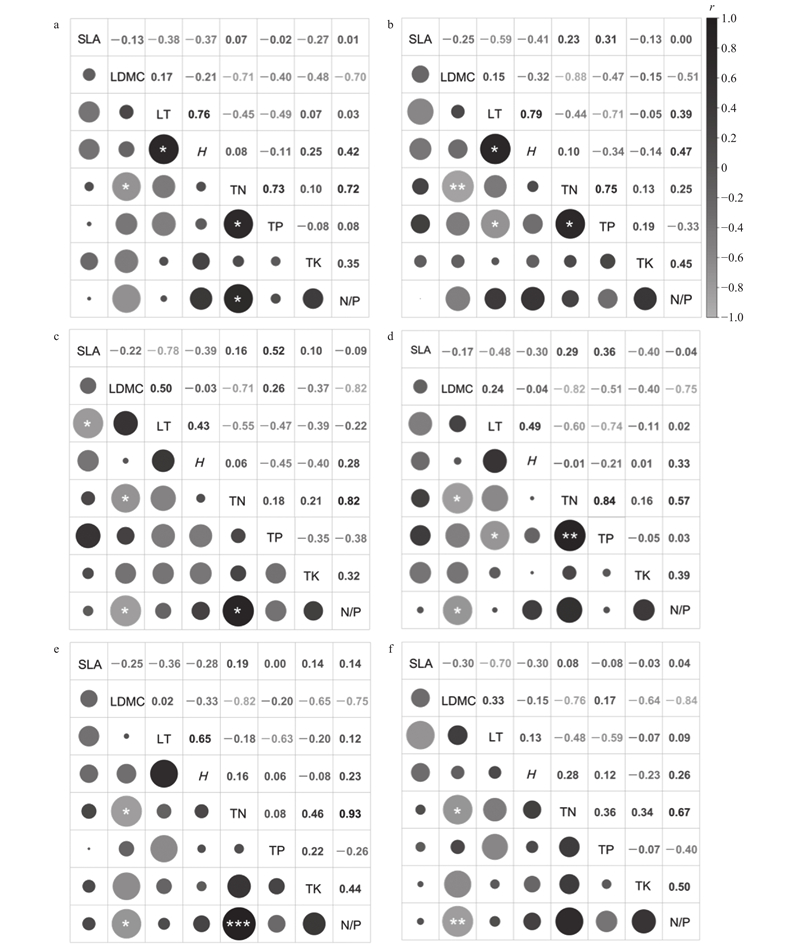
目的: 以亚热带毛竹林8种主要林下植物为对象,探究其叶片功能性状对模拟氮沉降的响应,明确林下不同植物对氮沉降的生态适应策略,为区域毛竹林生态系统的氮沉降管理提供科学依据。方法: 设置冠上与冠下2种模拟氮沉降方式以及有机氮(尿素与甘氨酸混合)和无机氮(硝酸铵)2种氮形态,共6个处理组:冠上无机氮添加、冠上有机氮添加、冠上对照(冠上清水添加)、冠下无机氮添加、冠下有机氮添加和冠下对照(冠下清水添加)。各处理组氮添加量统一为50 kg·hm?2a?1,对照组施以等量清水。试验3年后,测定4种灌木(寒莓、山莓、紫金牛和紫藤)和4种草本(绵穗苏、淡竹叶、金星蕨和苔草)的8项叶片功能性状(比叶面积、叶片干物质含量、叶片厚度、株高、全氮含量、全磷含量、全钾含量和氮磷比)。结果: 1) 除叶片干物质含量外,植物叶片功能性状对模拟氮沉降的响应未受氮沉降模拟方法(冠上/冠下)和沉降氮形态(有机/无机)的显著影响,但表现出显著的种间差异,主要体现在草本与灌木之间以及豆科与非豆科灌木之间。2) 模拟氮沉降使草本和灌木叶片氮含量均显著上升;草本叶片钾含量和氮磷比显著提高,而叶片干物质含量显著下降;灌木株高显著增加;豆科灌木株高显著增加但比叶面积显著降低;非豆科灌木叶片氮含量和氮磷比均显著提高。3) 叶片干物质含量与氮含量在所有处理下均呈显著负相关;叶片氮含量与磷含量仅在冠上对照、冠上无机氮添加和冠下对照处理下呈显著正相关;氮磷比与氮含量仅在冠上对照、冠上有机氮添加、冠下无机氮添加处理下呈显著正相关;比叶面积与叶片厚度仅在冠上有机氮添加处理下呈显著负相关;叶片厚度与株高在冠上对照、冠上无机氮添加处理下呈显著正相关。结论: 本研究揭示出毛竹林林下草本和灌木、豆科和非豆科灌木对氮沉降的适应策略差异。在氮沉降处理下,草本植物通过提高叶片氮含量、降低叶片干物质含量,在强化资源获取型策略的同时弱化资源保守型策略;非豆科灌木仅增加资源获取型功能性状如叶片氮含量,而未调整资源保守型功能性状;豆科灌木通过维持叶片氮磷计量平衡以适应氮富集环境。
中图分类号:
杨乐梅,张宝刚,陈有超,蔡延江. 毛竹林林下植物叶片功能性状的模拟氮沉降响应[J]. 林业科学, 2025, 61(12): 61-71.
Lemei Yang,Baogang Zhang,Youchao Chen,Yanjiang Cai. Leaf Functional Traits of Understory Plants in a Moso Bamboo Forests in Response to Simulated Nitrogen Deposition[J]. Scientia Silvae Sinicae, 2025, 61(12): 61-71.
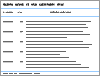
表1
不同氮沉降处理下林下植物功能性状(平均值±标准差)①"
| 植物种类 Plant species | 处理 Treatment | 比叶面积 Specific leaf area (SLA)/ (m2·kg?1) | 叶片干物质含量Leaf dry matter content (LDMC)/ (g·kg?1) | 叶片厚度 Leaf thickness (LT)/ mm | 株高 Plant height (H)/ cm | 全氮含量Total nitrogen content (TN)/ (g·kg?1) | 全磷含量Total phosphorus content (TP)/ (g·kg?1) | 全钾含量Total potassium content (TK)/ (g·kg?1) | 叶片氮磷比 Leaf N∶P ratio (N/P) |
| 寒莓 Rubus buergeri | CCK | 378.1±40.7bc | 287.2±18.4c | 0.43±0.03a | 90.4±41.2a | 19.7±1.0bc | 0.80±0.30a | 13.2±2.3a | 27.5±10.2a |
| CIN | 441.8±60.8ab | 249.9±44.3bc | 0.38±0.08a | 86.3±42.9a | 23.2±1.2a | 0.69±0.13a | 10.4±2.9ab | 34.5±6.2a | |
| CON | 347.5±39.9c | 241.9±40.1abc | 0.36±0.02a | 93.6±28.1a | 20.4±3.2abc | 0.60±0.18a | 9.4±2.2b | 35.0±5.7a | |
| UCK | 355.9±12.0bc | 290.7±17.3ab | 0.39±0.04a | 78.7±38.8a | 18.2±0.8c | 0.67±0.11a | 13.8±2.1a | 27.7±4.9a | |
| UIN | 508.2±107.9a | 268.4±15.5ab | 0.39±0.03a | 69.8±18.7a | 22.6±1.4ab | 0.82±0.11a | 12.4±1.7ab | 28.0±3.9a | |
| UON | 380.2±32.6bc | 305.2±7.7a | 0.37±0.06a | 47.6±25.2a | 23.4±2.9a | 0.70±0.11a | 11.0±2.1ab | 33.8±4.3a | |
| 山莓 Rubus corchorifolius | CCK | 566.4±28.4a | 366.2±66.3a | 0.29±0.04a | 58.8±17.5a | 20.6±0.7a | 0.68±0.05a | 13.7±2.4ab | 30.7±2.0a |
| CIN | 617.3±87.2a | 307.9±39.7a | 0.27±0.10a | 65.1±11.0a | 21.9±2.7a | 0.75±0.18a | 14.5±2.1ab | 30.0±6.0a | |
| CON | 475.8±89.6a | 347.2±144.0a | 0.29±0.05a | 79.5±20.0a | 24.6±5.0a | 0.74±0.13a | 14.9±4.1ab | 33.1±0.1a | |
| UCK | 574.4±49.9a | 299.0±74.8a | 0.25±0.05a | 60.5±14.5a | 22.4±3.5a | 0.73±0.06a | 17.3±1.7a | 30.9±3.7a | |
| UIN | 557.9±224.7a | 318.6±34.3a | 0.29±0.06a | 62.7±6.1a | 22.7±1.6a | 0.86±0.27a | 15.0±0.1ab | 28.2±8.0a | |
| UON | 635.7±31.7a | 280.9±11.9a | 0.29±0.10a | 70.3±13.5a | 25.2±3.0a | 0.74±0.10a | 12.0±0.1b | 34.3±3.0a | |
| 紫金牛 Ardisia japonica | CCK | 322.3±22.7a | 366.0±17.6a | 0.28±0.06a | 7.9±1.9a | 16.1±1.9c | 0.74±0.15a | 13.4±3.4a | 21.9±2.5a |
| CIN | 349.4±23.0a | 360.0±31.1a | 0.22±0.02a | 9.9±5.2a | 18.5±1.6abc | 0.77±0.03a | 15.6±1.6a | 24.3±1.3a | |
| CON | 327.2±27.2a | 375.4±23.0a | 0.35±0.09a | 10.2±4.3a | 18.8±1.2ab | 0.87±0.17a | 15.0±2.0a | 22.3±4.5a | |
| UCK | 305.4±23.7a | 333.9±64.3a | 0.27±0.07a | 9.8±1.7a | 18.3±1.9bc | 0.78±0.08a | 14.4±2.4a | 23.3±1.4a | |
| UIN | 339.0±52.3a | 362.0±8.3a | 0.25±0.02a | 9.5±1.5a | 19.8±1.1ab | 0.81±0.01a | 15.3±1.0a | 24.7±1.1a | |
| UON | 330.1±63.3a | 365.1±32.8a | 0.33±0.15a | 9.5±3.2a | 21.0±1.8a | 0.84±0.07a | 14.8±0.6a | 25.0±0.4a | |
| 紫藤 Wisteria sinensis | CCK | 604.8±20.6b | 296.4±36.7a | 0.21±0.01ab | 40.8±4.2a | 32.9±1.3a | 1.10±0.11ab | 9.2±6.6a | 30.2±1.7a |
| CIN | 693.3±148.9ab | 254.0±129.1a | 0.18±0.03b | 48.3±23.5a | 33.9±1.2a | 1.05±0.02bc | 8.3±3.1a | 19.4±15.6a | |
| CON | 537.7±65.3b | 329.8±55.2a | 0.28±0.11a | 72.4±15.4a | 30.9±3.7a | 1.05±0.05bc | 8.0±2.5a | 29.6±4.1a | |
| UCK | 939.6±379.5a | 273.4±62.5a | 0.20±0.02b | 54.4±31.1a | 33.5±0.5a | 1.24±0.13a | 8.6±0.4a | 27.2±3.3a | |
| UIN | 616.6±76.5b | 310.4±32.3a | 0.22±0.01ab | 52.5±17.2a | 28.3±7.0a | 0.92±0.14c | 7.4±1.2a | 30.5±4.0a | |
| UON | 624.8±26.6b | 317.7±30.1a | 0.19±0.04b | 65.9±10.5a | 32.9±2.6a | 1.12±0.10ab | 7.3±1.4a | 29.7±4.5a | |
| 绵穗苏 Chelonopsis chekiangensis | CCK | 572.5±124.4a | 253.9±21.0a | 0.37±0.14a | 78.6±26.3a | 26.8±6.9b | 0.80±0.36a | 24.1±6.7a | 38.3±16.8a |
| CIN | 558.0±33.8a | 239.9±17.8a | 0.29±0.10a | 68.9±21.2a | 31.7±5.6ab | 0.84±0.42a | 20.4±11.2a | 41.9±10.7a | |
| CON | 571.4±73.4a | 175.8±55.1b | 0.28±0.05a | 67.0±9.7a | 36.6±5.1a | 0.65±0.02a | 22.3±5.9a | 56.3±7.7a | |
| UCK | 544.8±40.9a | 241.5±26.0b | 0.29±0.11a | 57.4±24.9a | 29.5±0.8ab | 0.81±0.11a | 22.1±3.0a | 37.1±4.8a | |
| UIN | 637.5±78.3a | 212.5±35.4ab | 0.32±0.08a | 64.3±16.5a | 35.3±5.7ab | 0.83±0.18a | 25.0±1.9a | 44.1±11.3a | |
| UON | 622.1±96.0a | 211.5±32.0ab | 0.31±0.12a | 52.7±20.5a | 33.6±6.1ab | 0.73±0.31a | 24.0±5.4a | 52.5±22.3a | |
| 淡竹叶 Lophatherum gracile | CCK | 942.8±92.3a | 224.9±30.0a | 0.17±0.04a | 27.8±4.5a | 27.2±0.9b | 0.91±0.12ab | 23.4±4.8a | 30.2±3.6b |
| CIN | 215.7±35.9a | 0.18±0.07a | 28.8±9.3a | 32.0±1.5a | 1.03±0.17a | 23.8±2.9a | 31.7±4.8b | ||
| CON | 986.6±292.9a | 172.1±75.9a | 0.18±0.05a | 24.8±7.3a | 30.6±3.4ab | 0.81±0.08b | 22.1±2.7a | 38.1±3.1a | |
| UCK | 862.3±155.7a | 235.2±33.2a | 0.21±0.14a | 26.1±2.1a | 29.0±2.8ab | 1.03±0.21a | 26.7±5.5a | 28.6±3.5b | |
| UIN | 911.2±82.6a | 225.3±15.7a | 0.12±0.02a | 25.6±4.1a | 30.2±2.6ab | 0.99±0.10ab | 24.0±3.6a | 30.6±3.2b | |
| UON | 968.5±54.0a | 217.4±20.0a | 0.14±0.02a | 24.1±6.9a | 33.1±3.5a | 0.96±0.03ab | 23.7±1.6a | 34.6±4.6ab | |
| 金星蕨 Parathelypteris glanduligera | CCK | 336.8±53.6a | 0.27±0.09a | 26.3±1.6ab | 19.1±1.2a | 0.78±0.09a | 9.2±1.9bc | 24.6±1.3a | |
| CIN | 306.6±52.4a | 0.20±0.07a | 25.2±6.0ab | 22.3±2.6ab | 0.82±0.12a | 10.5±2.0abc | 27.9±7.1a | ||
| CON | 282.2±68.0a | 0.18±0.01a | 32.5±6.5a | 24.8±7.1a | 0.99±0.33a | 15.8±5.7a | 25.8±6.6a | ||
| UCK | 320.3±42.8a | 0.27±0.08a | 29.9±3.1ab | 19.0±0.8b | 0.74±0.03a | 7.7±2.1c | 25.7±1.9a | ||
| UIN | 315.8±15.7a | 0.25±0.12a | 27.2±8.2ab | 21.9±1.5ab | 0.80±0.07a | 14.2±5.3ab | 27.5±0.9a | ||
| UON | 310.2±25.0a | 0.20±0.08a | 23.0±4.1b | 21.2±1.1ab | 0.75±0.13a | 11.1±2.0abc | 28.7±5.1a | ||
| 苔草Carex spp. | CCK | 336.1±56.2b | 377.2±31.5ab | 0.33±0.03a | 58.6±4.6a | 16.2±1.3bc | 0.86±0.21a | 19.7±1.5a | 19.4±3.8a |
| CIN | 340.9±45.7b | 360.8±19.1ab | 0.34±0.08a | 58.4±4.9a | 17.4±1.1b | 0.82±0.33a | 18.2±0.6a | 24.2±10.0a | |
| CON | 315.0±79.5b | 385.6±51.8a | 0.34±0.09a | 63.00±24.3a | 15.5±1.3c | 0.68±0.07a | 20.2±0.7a | 18.2±11.1a | |
| UCK | 437.4±165.9ab | 357.4±42.2ab | 0.28±0.05a | 64.8±8.6a | 16.5±1.3bc | 0.72±0.16a | 20.3±1.4a | 23.6±4.9a | |
| UIN | 522.0±122.1a | 323.6±12.1b | 0.27±0.10a | 59.8±2.3a | 17.4±1.2bc | 0.98±0.27a | 17.9±5.1a | 18.8±5.0a | |
| UON | 399.7±82.7ab | 336.4±40.5ab | 0.30±0.06a | 55.7±16.6a | 20.5±0.7a | 0.95±0.36a | 18.9±1.9a | 24.2±9.5a |
表2
林下植物叶片性状的氮沉降响应在氮沉降方法、沉降氮形态和植物种类间的差异②"
| 叶片功能性状 Leaf functional traits | 氮沉降方法 N deposition approach | 沉降氮形态 Deposited N form | 植物种类 Plant species | 草本或灌木 Herbs or shrubs | 豆科或非豆科 Fabaceae or non-Fabaceae | |||||||||
| df | P | df | P | df | P | df | P | df | P | |||||
| 比叶面积Specific leaf area (SLA) | 1, 122 | 0.849 | 1, 122 | 0.593 | 7, 115 | 0.378 | 1, 121 | 0.178 | 1, 57 | 0.003 | ||||
| 叶片干物质含量Leaf dry matter content (LDMC) | 1, 125 | 0.010 | 1, 125 | 0.871 | 7, 118 | 0.038 | 1, 124 | 0.012 | 1, 57 | 0.104 | ||||
| 叶片厚度Leaf thickness (LT) | 1, 122 | 0.353 | 1, 122 | 0.283 | 7, 115 | 0.426 | 1, 121 | 0.130 | 1, 57 | 0.742 | ||||
| 株高Plant height (H) | 1, 125 | 0.785 | 1, 125 | 0.843 | 7, 118 | 0.017 | 1, 124 | 0.026 | 1, 60 | 0.009 | ||||
| 全氮含量Total nitrogen content (TN) | 1, 122 | 0.511 | 1, 122 | 0.278 | 7, 115 | <0.001 | 1, 124 | 0.007 | 1, 60 | <0.001 | ||||
| 全磷含量Total phosphorus content (TP) | 1, 122 | 0.408 | 1, 122 | 0.307 | 7, 115 | 0.157 | 1, 121 | 0.531 | 1, 57 | 0.010 | ||||
| 全钾含量Total potassium content (TK) | 1, 125 | 0.628 | 1, 125 | 0.813 | 7, 118 | <0.001 | 1, 124 | 0.016 | 1, 60 | 0.968 | ||||
| 叶片氮磷比 Leaf N∶P ratio (N/P) | 1, 122 | 0.496 | 1, 122 | 0.094 | 7, 115 | 0.026 | 1, 121 | 0.157 | 1, 57 | 0.096 | ||||
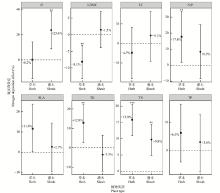
图1
模拟氮沉降对草本和灌木植物叶片功能性状的影响差异 H: 株高Plant height;LDMC: 叶片干物质含量Leaf dry matter content;LT: 叶片厚度Leaf thickness;N/P: 叶片氮磷比Leaf N∶P ratio;SLA: 比叶面积Specific leaf area;TK: 全钾含量Total potassium content;TN: 全氮含量Total nitrogen content;TP: Total phosphorus content."
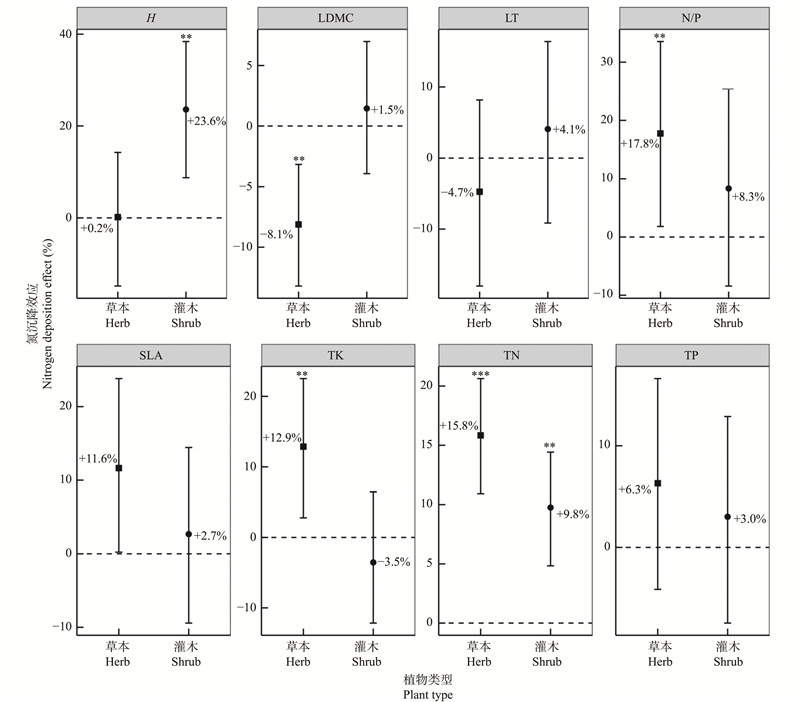
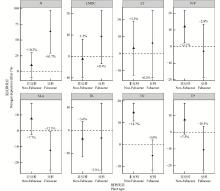
图2
模拟氮沉降对豆科和非豆科植物叶片功能性状的影响差异 H: 株高Plant height;LDMC: 叶片干物质含量Leaf dry matter content;LT: 叶片厚度Leaf thickness;N/P: 叶片氮磷比Leaf N∶P ratio;SLA: 比叶面积Specific leaf area;TK: 全钾含量Total potassium content;TN: 全氮含量Total nitrogen content;TP: Total phosphorus content."
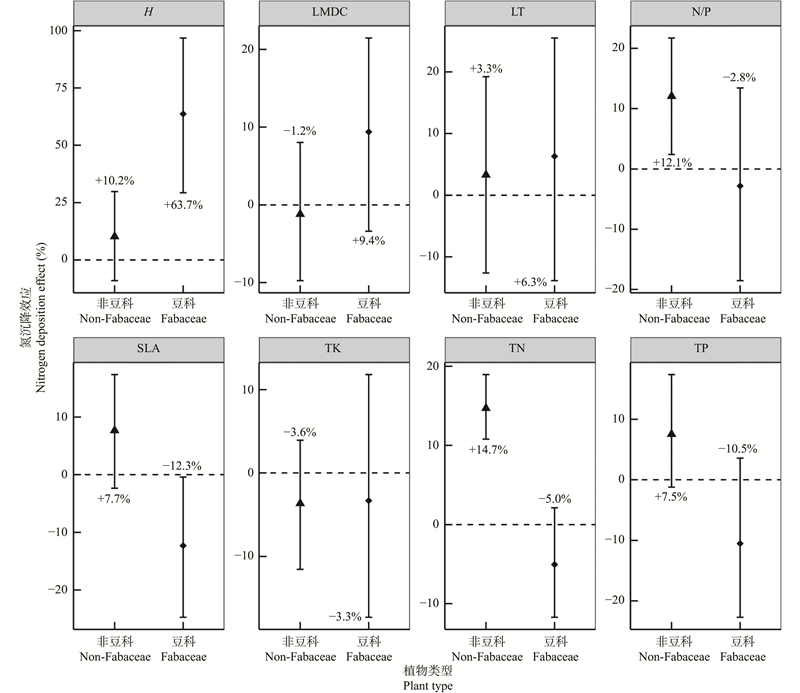
图3
不同氮沉降处理的林下植物叶片功能性状相关性 a: 冠上对照Canopy control;b: 冠上无机氮添加Canopy inorganic;c: 冠上有机氮添加Canopy organic;d: 冠下对照Understory control;e: 冠下无机氮添加Understory inorganic;f: 冠下有机氮添加Understory organic;SLA: 比叶面积Specific leaf area;LDMC: 叶片干物质含量Leaf dry matter content;LT: 叶片厚度Leaf thickness;H: 株高Plant height;TN: 全氮含量Total nitrogen content;TP: 全磷含量Total phosphorus content;TK: 全钾含量Total potassium content;N/P: 氮磷比Leaf N∶P ratio;*: P <0.05;**: P <0.01;***: P <0.001."
| 白 涵, 郝珉辉, 何怀江, 等. 2025. 东北主要树种幼树叶片功能性状对模拟氮沉降的响应. 林业科学, 2025, 61(5): 23–32. | |
| Bai H, Hao M H, He H J, et al. 2025. Response of leaf functional traits of saplings of main tree species in northeast China to simulated nitrogen deposition. Scientia Silvae Sinicae, 2025, 61(5): 23–32. [in Chinese] | |
| 段 娜, 李清河, 多普增, 等. 植物响应大气氮沉降研究进展. 世界林业研究, 2019, 32 (4): 6- 11. | |
| Duan N, Li Q H, Duo P Z, et al. Research progress on plant response to atmospheric nitrogen deposition. World Forestry Research, 2019, 32 (4): 6- 11. | |
| 冯鹏飞, 李玉敏. 2021年中国竹资源报告. 世界竹藤通讯, 2023, 21 (2): 100- 103. | |
| Feng P F, Li Y M. Report on bamboo resources in China 2021. World Bamboo and Rattan, 2023, 21 (2): 100- 103. | |
| 方运霆, 莫江明, 周国逸, 等. 鼎湖山主要森林类型植物胸径生长对氮沉降增加的初期响应. 热带亚热带植物学报, 2005, 13 (3): 198- 204. | |
| Fang Y T, Mo J M, Zhou G Y, et al. The initial response of DBH growth of main forest types to the increase of nitrogen deposition in Dinghu Mountain. Journal of Tropical and Subtropical Botany, 2005, 13 (3): 198- 204. | |
| 贺金生, 韩兴国. 生态化学计量学: 探索从个体到生态系统的统一化理论. 植物生态学报, 2010, 34 (1): 2- 6. | |
| He J S, Han X G. Ecological stoichiometry: Exploring the unified theory from individual to ecosystem. Journal of Plant Ecology, 2010, 34 (1): 2- 6. | |
| 蒋文婷, 田立斌, 朱高荻, 等. 不同形态氮添加对毛竹林土壤N2O排放的影响. 植物营养与肥料学报, 2022, 28 (5): 857- 868. | |
| Jiang W T, Yang X D, Zhu G D, et al. Effects of different forms of nitrogen addition on soil N2O emission in moso bamboo forest. Plant Nutrition and Fertilizer Science, 2022, 28 (5): 857- 868. | |
| 柯丹霞, 徐勤朕, 杨 娜, 等. 高氮抑制豆科植物结瘤固氮机制研究进展. 生物技术通报, 2019, 35 (10): 40- 45. | |
| Ke D X, Xu Q L, Yang N, et al. Research progress on mechanism of high nitrogen inhibiting nodulation and nitrogen fixation in leguminous plants. Biotechnology Bulletin, 2019, 35 (10): 40- 45. | |
|
李修鹏, 杨晓东, 余树全, 等. 基于功能性状的常绿阔叶植物防火性能评价. 生态学报, 2013, 33 (20): 6604- 6613.
doi: 10.5846/stxb201301030010 |
|
|
Li X P, Yang X D, Yu S Q, et al. Fire resistance evaluation of evergreen broad-leaved plants based on functional traits. Acta Ecologica Sinica, 2013, 33 (20): 6604- 6613.
doi: 10.5846/stxb201301030010 |
|
| 刘亚栋, 王晓霞, 和璐璐, 等. 北京地区油松人工林不同演替类型空间结构对林下植被及土壤的影响. 生态学报, 2023, 43 (5): 1959- 1970. | |
| Liu Y D, Wang X X, He L L, et al. Effects of spatial structure of different succession types of Pinus tabuliformis plantation on understory vegetation and soil in Beijing area. Acta Ecologica Sinica, 2023, 43 (5): 1959- 1970. | |
| 庞世龙, 欧芷阳, 凌福诚, 等. 桂西南岩溶区18种适生植物叶性状变异及其经济谱. 生态学杂志, 2021, 40 (10): 3041- 3049. | |
| Pang S L, Ou Z Y, Ling F C, et al. Leaf trait variation and economic spectrum of 18 species of suitable plants in karst area of southwest Guangxi. Ecological Frontiers, 2021, 40 (10): 3041- 3049. | |
| 邵雪蓉, 陈世仁, 陈应群, 等. 植物水分利用效率与植物功能性群落结构的关系研究综述. 世界林业研究, 2024, 37 (1): 37- 44. | |
| Shao X R, Chen S R, Chen Y Q, et al. The relationship between plant water use efficiency and plant functional community structure was reviewed. World Forestry Research, 2024, 37 (1): 37- 44. | |
| 王常顺, 汪诗平. 植物叶片性状对气候变化的响应研究进展. 植物生态学报, 2015, 39 (2): 206- 216. | |
| Wang C S, Wang S P. Research progress on the response of plant leaf traits to climate change. Journal of Plant Ecology, 2015, 39 (2): 206- 216. | |
| 王军强, 刘 彬, 常 凤, 等. 博斯腾湖湖滨带水盐梯度下植物功能性状及生态化学计量特征分析. 植物生态学报, 2022, 46 (8): 961- 970. | |
| Wang J Q, Liu B, Chang F, et al. Analysis of plant functional traits and ecological stoichiometric characteristics under water and salt gradients in the lakeside zone of Bosten Lake. Journal of Plant Ecology, 2022, 46 (8): 961- 970. | |
| 王乔姝怡, 郑成洋, 张歆阳, 等. 氮添加对武夷山亚热带常绿阔叶林植物叶片氮磷化学计量特征的影响. 植物生态学报, 2016, 40 (11): 1124- 1135. | |
| Wang-Qiao S Y, Zheng C Y, Zhang X Y, et al. Effects of nitrogen addition on stoichiometric characteristics of nitrogen and phosphorus in leaves of subtropical evergreen broad-leaved forest in Wuyi Mountain. Journal of Plant Ecology, 2016, 40 (11): 1124- 1135. | |
| 王秀荣, 严小龙, 卢仁骏. 磷素营养对菜豆叶片解剖结构的影响. 华南农业大学学报, 1999, 20 (1): 60- 65. | |
| Wang X R, Yan X L, Lu R J. Effect of phosphorus nutrition on anatomical structure of bean leaves. Journal of South China Agricultural University, 1999, 20 (1): 60- 65. | |
| 王毅焕, 靳一丹, 姜铭楷, 等. 短期氮沉降改变毛竹林凋落物和土壤有机质化学组成. 应用生态学报, 2023, 34 (10): 2593- 2600. | |
| Wang Y H, Jin Y D, Jiang M K, et al. Short-term nitrogen deposition changed the chemical composition of litter and soil organic matter in moso bamboo forest. Applied Ecology, 2023, 34 (10): 2593- 2600. | |
| 魏经纬, 肖向前, 卓寿佳, 等. 林冠氮沉降对毛竹林土壤磷组分的影响. 土壤学报, 2025, 62 (1): 233- 245. | |
| Wei J W, Xiao X Q, Zhuo S J, et al. Effects of canopy nitrogen deposition on soil phosphorus fractions in moso bamboo forest. Acta Pedologica Sinica, 2025, 62 (1): 233- 245. | |
| 肖春艳, 胡情情, 陈晓舒, 等. 基于文献计量的大气氮沉降研究进展. 生态学报, 2023, 43 (3): 1294- 1307. | |
| Xiao C Y, Hu Q Q, Chen X S, et al. Research progress of atmospheric nitrogen deposition based on bibliometrics. Acta Ecologica Sinica, 2023, 43 (3): 1294- 1307. | |
| 肖 迪, 王晓洁, 张 凯, 等. 氮添加对山西太岳山天然油松林主要植物叶片性状的影响. 植物生态学报, 2016, 40 (7): 686- 701. | |
| Xiao D, Wang X J, Zhang K, et al. Effects of nitrogen addition on leaf traits of main plants in natural Pinus tabuliformis forest in Taiyue Mountain of Shanxi Province. Journal of Plant Ecology, 2016, 40 (7): 686- 701. | |
| 夏霁晖, 冶佩霞, 杨 海, 等. 大别山北缘不同生活型木本植物叶功能性状及其耦合关系. 浙江农林大学学报, 2024, 41 (5): 970- 977. | |
| Xia J H, Ye P X, Yang H, et al. Leaf functional traits and their coupling relationships of woody plants with different life forms in the northern margin of Dabie Mountains. Journal of Zhejiang A& F University, 2024, 41 (5): 970- 977. | |
| 俞月凤, 韦建华, 胡钧铭, 等. 桂西北喀斯特地区退化群落灌草不同器官N、P生态化学计量内稳性特征. 生态学报, 2024, 44 (12): 5367- 5376. | |
| Yu Y F, Wei J H, Hu J M, et al. Characteristics of N and P ecological stoichiometry stability in different organs of shrub and grass in degraded communities in karst area of northwest Guangxi. Acta Ecologica Sinica, 2024, 44 (12): 5367- 5376. | |
| Clark D L, Wilson M, Roberts R, et al. 2012. Plant traits a tool for restoration? Applied Vegetation Science, 15(4): 449–458. | |
| Cornelissen C H J, Cerabolini B, Castro-Dí P, et al. 2003. Functional traits of woody plants: correspondence of species rankings between field adults and laboratory-grown seedlings? Journal of Vegetation Science, 14(3): 311–322. | |
|
Deng Q, Hui D F, Dennis S, et al. Responses of terrestrial ecosystem phosphorus cycling to nitrogen addition: a meta-analysis. Global Ecology and Biogeography, 2017, 26 (6): 713- 728.
doi: 10.1111/geb.12576 |
|
|
Elser James J, Bracken Matthew E S, Cleland Elsa E, et al. Global analysis of nitrogen and phosphorus limitation of primary producers in freshwater, marine and terrestrial ecosystems. Ecology letters, 2007, 10 (12): 1135- 42.
doi: 10.1111/j.1461-0248.2007.01113.x |
|
|
Garnier E, Vile D, Debain S, et al. Photosynthesis, water-use and nitrogen relate to both plant height and leaf structure in 60 species from the Mediterranean. Functional Ecology, 2025, 39 (2): 567- 582.
doi: 10.1111/1365-2435.14737 |
|
|
Gilliam F S. The ecological significance of the herbaceous layer in temperate forest ecosystems. Bioscience, 2007, 57 (10): 845- 858.
doi: 10.1641/B571007 |
|
| Gillam F S, May J D, Adams M B. Response of foliar nutrients of Rubus allegheniensis to nutrient amendments in a central Appalachian hardwood forest. Forest Ecology and Managent, 2018 (411): 101- 107. | |
|
He J S, Wang L, Flynn D F B, et al. Leaf nitrogen: phosphorus stoichiometry across Chinese grassland biomes. Oecologia, 2008, 155 (2): 301- 310.
doi: 10.1007/s00442-007-0912-y |
|
|
He J S, Wang Z, Wang X, et al. A test of the generality of leaf trait relationships on the Tibetan Plateau. New Phytologist, 2006, 170 (4): 835- 848.
doi: 10.1111/j.1469-8137.2006.01704.x |
|
| Jiang W T, Zhang H K, Fang Y Y, et al. Understory N application overestimates the effect of atmospheric N deposition on soil N2O emissions. Geoderma, 2023, 437, 116611. | |
|
Kerkhoof A J, Fagan W F, Elser J J, et al. Phylogenetic and growth form variation in the scaling of nitrogen and phosphorus in the seed plants. The American Naturalist, 2006, 168 (4): E103- E122.
doi: 10.1086/507879 |
|
| Li D J, Mo J M, Fang Y T, et al. Effects of simulated nitrogen deposition on biomass production and allocation in Schima superba and Cryptocarya concinna seedlings in subtropical China. Acta Phytoecologica Sinica, 2005, 29 (4): 543- 549. | |
|
Liu X J, Zhang Y, Han W X, et al. Enhanced nitrogen deposition over China. Nature, 2013, 494 (7438): 459- 462.
doi: 10.1038/nature11917 |
|
|
Lu X K, Mo J M, Dong S F. Effects of nitrogen deposition on forest biodiversity. Acta Ecologica Sinica, 2008, 28 (11): 5532- 5548.
doi: 10.1016/S1872-2032(09)60012-3 |
|
|
Meziane D, Shipley B. Interacting components of interspecific relative growth rate: constancy and change under differing conditions of light and nutrient supply. Functional Ecology, 1999, 13 (5): 611- 622.
doi: 10.1046/j.1365-2435.1999.00359.x |
|
|
Rivaie A A. The effects of understory vegetation on P availability in Pinus radiata forest stands: a review. Journal of Forestry Research, 2014, 25 (3): 489- 500.
doi: 10.1007/s11676-014-0488-4 |
|
|
Rose L, Rubarth M C, Hertel D, et al. Management alters interspecific leaf trait relationships and trait-based species rankings in permanent meadows. Journal of Vegetation Science, 2013, 24 (2): 239- 250.
doi: 10.1111/j.1654-1103.2012.01455.x |
|
|
Scoffoni C, Rawls M, McKown A, et al. Decline of leaf hydraulic conductance with dehydration: relationship to leaf size and venation architecture. Plant Physiology, 2011, 156 (2): 832- 843.
doi: 10.1104/pp.111.173856 |
|
|
Talhelm A F, Pregitzer K S, Burton A J. No evidence that chronic nitrogen additions photosynthesis in mature sugar maple forests. Ecological Applications, 2011, 21 (7): 2413- 2424.
doi: 10.1890/10-2076.1 |
|
| Tamm CO. 1990. Nitrogen in terrestrial ecosystems: Questions of productivity, vegetational change, and ecological stability (Vol. 81). Berlin: Springer-Verlag. | |
| Vitousek M P, Cassman K, Cleveland C, et al. 2002. Towards an ecological understanding of biological nitrogen fixation. Biogeochemistry, 57/58(1): 1–45. | |
|
Witte C. Urea metabolism in plants. Plant Science, 2011, 180 (3): 431- 438.
doi: 10.1016/j.plantsci.2010.11.010 |
|
|
Wright I J, Reich P B, Cornelissen J H C, et al. Modulation of leaf economic traits and trait relationships by climate. Global Ecology and Biogeography, 2005, 14 (5): 411- 421.
doi: 10.1111/j.1466-822x.2005.00172.x |
|
| Wright J I, Reich B P, Westoby M, et al. The worldwide leaf economics spectrum. Nature: International Weekly Journal of Science, 2004, 428 (6985): 821- 827. | |
| Zou Y, Li B, Penuelas J, et al. Response of functional traits in Machilus pauhoi to nitrogen addition is influenced by differences of provenances. Forest Ecology and Management, 2022, 513, 120- 207. |
| [1] | 谷瑞,范少辉,魏松坡,刘广路. 基于表型性状的毛竹核心种质构建[J]. 林业科学, 2025, 61(9): 101-112. |
| [2] | 王晓荣,龚苗,辜忠春,胡兴宜,漆良华,谭海山,戴薛,刘清平,夏少丹,赵虎. 幕阜山区毛竹向杉木林和阔叶林扩张的细根分解及养分释放特征[J]. 林业科学, 2025, 61(8): 46-57. |
| [3] | 王江飞,李慧,朱成磊,狄小琳,李英,王清楠,宛慧茹,孙化雨,高志民. 毛竹PeBAM3在叶片淀粉分解过程的功能[J]. 林业科学, 2025, 61(8): 231-240. |
| [4] | 白涵,郝珉辉,何怀江,张新娜,张春雨,赵秀海. 东北主要树种幼树叶片功能性状对模拟氮沉降的响应[J]. 林业科学, 2025, 61(5): 23-32. |
| [5] | 孙英杰,张德楠,沈育伊,徐广平,曹杨,黄科朝,陈运霜,毛馨月,滕秋梅,吕仕洪,褚俊智. 模拟氮沉降对中亚热带桉树人工林土壤微生物群落结构及酶活性的影响[J]. 林业科学, 2025, 61(5): 46-60. |
| [6] | 闫小玲,郝琴,申孜,张雨佳,郭小勤. 毛竹PheFT1基因的表达、蛋白互作及生物学功能分析[J]. 林业科学, 2025, 61(4): 140-152. |
| [7] | 马欣欣,王游,王佳军,冯龙,马建锋. 热解过程中竹材灰分组成变化及硅的转化分布规律[J]. 林业科学, 2025, 61(2): 172-179. |
| [8] | 李慧,王清楠,朱成磊,孙化雨,狄小琳,高志民. 3个竹种Rubisco活化酶基因鉴定及其功能[J]. 林业科学, 2025, 61(11): 35-44. |
| [9] | 臧艳,向宇轩,刘娟,姜培坤,吴家森,李永夫. 氮、磷添加对亚热带毛竹林土壤水稳性团聚体及有机碳分布的影响[J]. 林业科学, 2024, 60(7): 8-16. |
| [10] | 张翱,李文婷,王天祥,武耀星,雷刚,漆良华. 毛竹林土壤易氧化有机碳区域分异及影响因素[J]. 林业科学, 2024, 60(6): 1-12. |
| [11] | 李晓,贾淑娴,席颖青,杨柳明,刘小飞. 凋落物添加与去除对米槠天然林土壤微生物残体碳的影响[J]. 林业科学, 2024, 60(10): 12-20. |
| [12] | 赵洪贤,苏同,王瑞福,孙艳丽,高永龙,隗骥超,李鑫豪,田赟,贾昕,查天山. 北京密云油松林下灌木小叶鼠李叶片资源利用效率季节变异及环境调控[J]. 林业科学, 2023, 59(7): 1-11. |
| [13] | 王一,栾军伟,陈琛,刘世荣. 毛竹林土壤呼吸及组分对氮磷添加的非对等响应[J]. 林业科学, 2023, 59(7): 54-64. |
| [14] | 袁金玲,岳晋军,马婧瑕,于磊,刘蕾. 元宝毛竹的秆形特征[J]. 林业科学, 2023, 59(5): 71-80. |
| [15] | 蔡宗明,邓智文,李秉钧,李士坤,温伟庆,荣俊冬,郑郁善,陈礼光. 带状采伐宽度对毛竹林地下竹鞭结构特征的影响[J]. 林业科学, 2023, 59(4): 79-87. |
| 阅读次数 | ||||||
|
全文 |
|
|||||
|
摘要 |
|
|||||

