
林业科学 ›› 2025, Vol. 61 ›› Issue (12): 49-60.doi: 10.11707/j.1001-7488.LYKX20240402
• 研究论文 • 上一篇
王亚飞1,2,王凯1,2,刘洋1,2,丁晓菲1,2,续可心1,2,张国庆3,贾黎明1,2,*( ),席本野1,2
收稿日期:2024-06-27
修回日期:2025-02-28
出版日期:2025-12-25
发布日期:2026-01-08
通讯作者:
贾黎明
E-mail:jlm@bjfu.edu.cn
基金资助:
Yafei Wang1,2,Kai Wang1,2,Yang Liu1,2,Xiaofei Ding1,2,Kexin Xu1,2,Guoqing Zhang3,Liming Jia1,2,*(),Benye Xi1,2
Received:2024-06-27
Revised:2025-02-28
Online:2025-12-25
Published:2026-01-08
Contact:
Liming Jia
E-mail:jlm@bjfu.edu.cn
摘要:
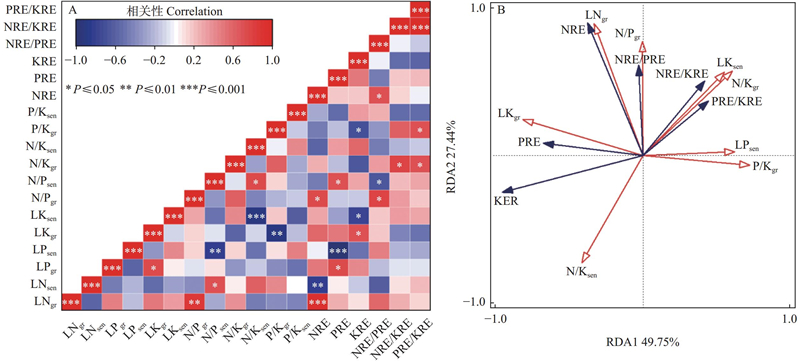
目的: 对抚育间伐后不同时期毛白杨各器官养分含量、化学计量特征和养分重吸收进行监测,解释林木器官尺度对不同间伐强度下光照、水、养分资源的响应状况,为毛白杨人工林培育管理提供理论支撑。方法: 以华北平原8年生三倍体毛白杨S86人工林为研究对象,设置不间伐(NT)、隔行间伐(间伐50%,T50)、隔行隔株间伐(间伐75%,T75)3种间伐强度。通过对林木叶、枝、干、根进行取样,分析毛白杨生长季内8月和11月各器官养分含量、化学计量比、叶片重吸收效率和相对重吸收率,探究不同时期叶片养分含量、化学计量特征和重吸收之间的耦联关系。结果: 1) 从8月和11月2个时期综合来看,间伐强度仅对叶片磷含量和树干碳含量存在显著影响;在11月,间伐能够显著提高钾在叶片中的积累,T50和T75相较于NT分别提高33.43%和35.74%。2) C/N、C/P、C/K反映在碳稳定作用下吸收氮、磷、钾养分的能力,可作为判断植物养分吸收速率和利用效率的指标,8月和11月2个时期叶片C/N、C/P、C/K、N/P差异显著;相比于枝、干、根,叶片的化学计量特征更易受时期、间伐及其交互作用的影响,其中间伐强度对毛白杨叶片的C/P和N/P影响显著。3) 不同间伐强度下,毛白杨叶片氮的重吸收效率(NRE)为14.64%~24.55%,磷的重吸收效率(PRE)为18.87%~34.97%,钾的重吸收效率(KRE)为7.00%~33.59%;随着间伐强度增加,叶片钾回流效率降低,T50和T75别使林木钾重吸收效率显著降低53.56%和79.16%。4) 养分含量与养分重吸收效率之间存在显著的相关关系,8月成熟叶片为正相关关系,11月凋落叶片多呈负相关关系;成熟叶片钾含量、凋落叶片N/K、凋落叶片磷含量对养分重吸收的贡献率排在前3,分别为35.2%、27.0%和19.9%。结论: 各器官养分化学计量特征和叶片氮、磷重吸收过程对间伐的短期响应不敏感,但生长季内不同时期的毛白杨各器官养分吸收和利用策略不同。基于“N/P阈值假说”,不同间伐强度下N/P范围为10.05~11.06,表明该区域毛白杨林木生长受到氮素限制,建议在抚育间伐后的林分管理中增施氮肥;NRE/PRE<1,基于“相对重吸收假说”,在增施氮肥中配以适量磷肥,能够促进林木生理代谢,提高林木的生长潜力。
中图分类号:
王亚飞,王凯,刘洋,丁晓菲,续可心,张国庆,贾黎明,席本野. 间伐强度对毛白杨S86人工林器官养分含量、化学计量特征和养分重吸收的影响[J]. 林业科学, 2025, 61(12): 49-60.
Yafei Wang,Kai Wang,Yang Liu,Xiaofei Ding,Kexin Xu,Guoqing Zhang,Liming Jia,Benye Xi. Effects of Thinning Intensity on Nutrient Content, Stoichiometric Characteristics and Nutrient Reabsorption of Various Organs of Populus tomentosa Plantations[J]. Scientia Silvae Sinicae, 2025, 61(12): 49-60.
表1
不同间伐强度下毛白杨林木生长情况①"
| 间伐强度 Thinning intensity | 2023年3月March 2023 | 2023年11月November 2023 | |||
| 胸径DBH/cm | 树高Height/m | 胸径DBH/cm | 树高Height/m | ||
| NT | 13.81±0.44 | 14.17±0.43 | 14.57±0.46 | 17.68±0.61 | |
| T50 | 14.56±1.12 | 15.21±0.39 | 15.83±1.07 | 17.36±0.68 | |
| T75 | 13.63±0.81 | 14.49±0.25 | 15.17±0.85 | 16.94±0.26 | |
表2
不同间伐强度下毛白杨各器官养分含量及化学计量特征参数方差分析(P值)①"
| 器官 Organ | 变异来源 Source of variation | 自由度 df | C | N | P | K | C/N | C/P | C/K | N/P | N/K | P/K |
| 叶Leaf | T | 2 | 0.815 | 0.127 | 0.010 | 0.554 | 0.105 | 0.027 | 0.271 | 0.005 | 0.065 | 0.958 |
| GP | 1 | 0.002 | 0.006 | <0.001 | <0.001 | 0.034 | 0.001 | <0.001 | 0.015 | 0.604 | 0.052 | |
| T×GP | 2 | 0.520 | 0.486 | 0.207 | 0.009 | 0.558 | 0.027 | <0.001 | 0.012 | 0.005 | 0.136 | |
| 枝Branch | T | 2 | 0.488 | 0.689 | 0.625 | 0.721 | 0.594 | 0.526 | 0.829 | 0.24 | 0.257 | 0.406 |
| GP | 1 | 0.064 | 0.003 | 0.163 | 0.010 | 0.002 | 0.395 | 0.004 | 0.421 | 0.159 | 0.013 | |
| T×GP | 2 | 0.512 | 0.040 | 0.389 | 0.755 | 0.003 | 0.232 | 0.404 | 0.562 | 0.219 | 0.402 | |
| 干Trunk | T | 2 | 0.044 | 0.806 | 0.254 | 0.681 | 0.377 | 0.367 | 0.957 | 0.431 | 0.606 | 0.858 |
| GP | 1 | 0.632 | 0.470 | 0.825 | 0.191 | 0.787 | 0.920 | 0.087 | 0.420 | 0.464 | 0.412 | |
| T×GP | 2 | 0.792 | 0.005 | 0.219 | 0.817 | 0.007 | 0.318 | 0.696 | 0.002 | 0.009 | 0.413 | |
| 根Root | T | 2 | 0.498 | 0.841 | 0.996 | 0.486 | 0.534 | 0.619 | 0.284 | 0.857 | 0.476 | 0.742 |
| GP | 1 | 0.360 | 0.011 | 0.412 | 0.267 | 0.027 | 0.211 | 0.067 | 0.965 | 0.353 | 0.913 | |
| T×GP | 2 | 0.767 | 0.961 | 0.505 | 0.225 | 0.893 | 0.800 | 0.090 | 0.616 | 0.185 | 0.243 |
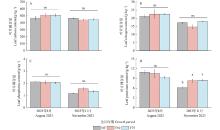
图1
不同间伐强度对2个时期毛白杨叶片养分含量的影响 NT:不间伐处理;T50:间伐50%林木(隔行间伐);T75:间伐75%林木(隔行隔株间伐)。不同小写字母表示不同处理间差异显著(P<0.05),ns表示差异不显著。NT: Non-thinning treatment; T50: 50% thinning of forest trees (alternating row thinning); T75: 75% thinning of forest trees (alternating row and tree thinning). Different lowercase letters indicate significant differences between different treatments (P<0.05), and ns indicates insignificant difference."
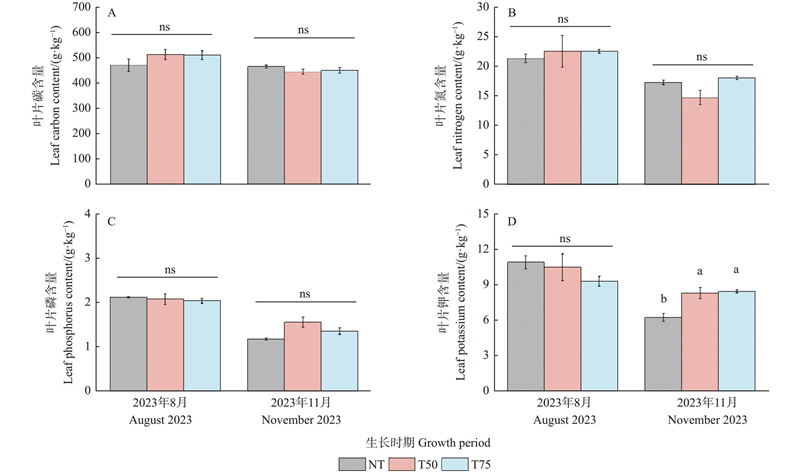
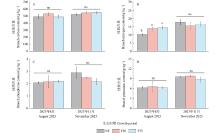
图2
不同间伐强度对2个时期毛白杨枝条养分含量的影响 NT:不间伐处理;T50:间伐50%林木(隔行间伐);T75:间伐75%林木(隔行隔株间伐)。不同小写字母表示不同处理间差异显著(P<0.05),ns 表示差异不显著。"
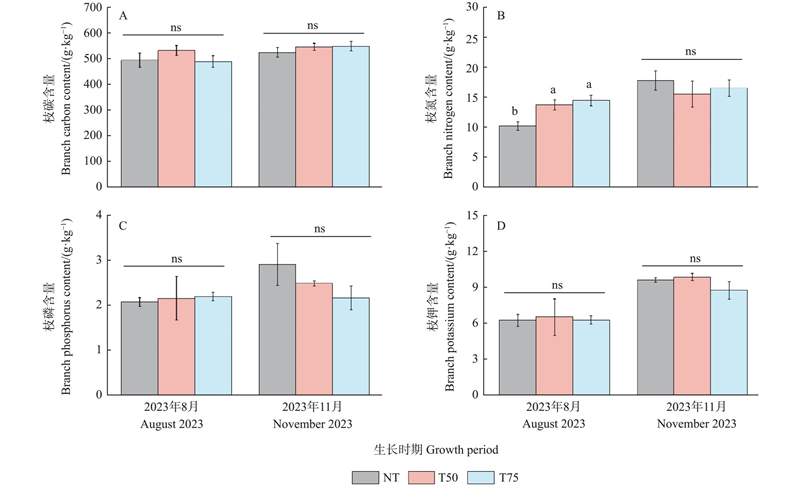
图3
不同间伐强度对2个时期毛白杨树干养分含量的影响 NT:不间伐处理;T50:间伐50%林木(隔行间伐);T75:间伐75%林木(隔行隔株间伐)。不同小写字母表示不同处理间差异显著(P<0.05),ns 表示差异不显著。NT: non-thinning treatment; T50: 50% thinning of forest trees (alternating row thinning); T75: 75% thinning of forest trees (alternating row and tree thinning). Different lowercase letters indicate significant differences between different treatments (P<0.05), and ns indicates insignificant difference."
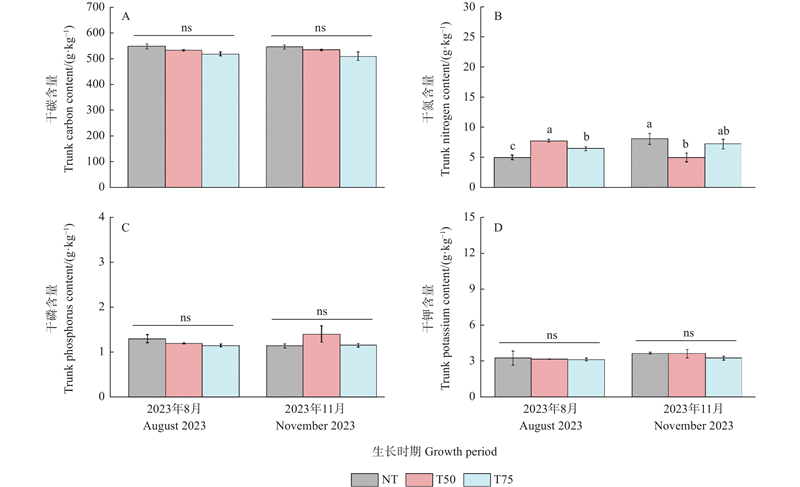
图4
不同间伐强度对2个时期毛白杨根养分含量的影响 NT:不间伐处理;T50:间伐50%林木(隔行间伐);T75:间伐75%林木(隔行隔株间伐)。ns表示差异不显著。NT: non-thinning treatment; T50: 50% thinning of forest trees (alternating row thinning); T75: 75% thinning of forest trees (alternating row and tree thinning). ns indicates insignificant difference."
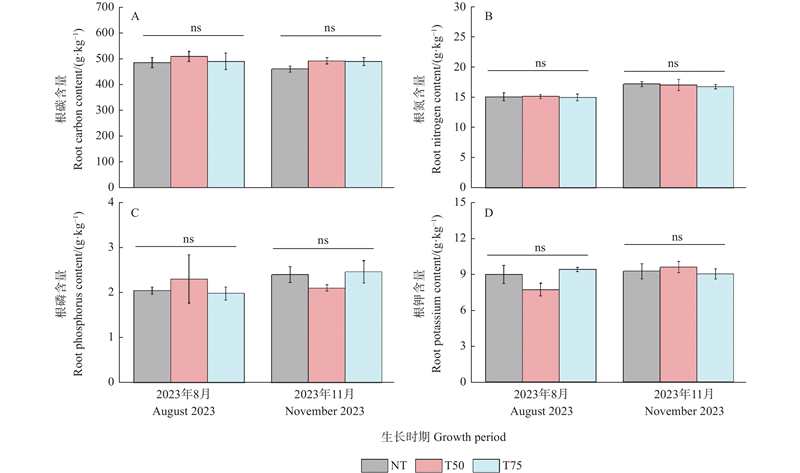
表3
不同间伐强度下2个时期毛白杨各器官化学计量特征①"
| 生长时期 Growth period | 器官 Organ | 间伐强度 Thinning intensity | C/N | C/P | C/K | N/P | N/K | P/K |
| 2023年8月 August 2023 | 叶 Leaf | NT | 22.04±0.50 | 221.74±10.72 | 43.44±3.30 | 10.05±0.30 | 1.97±0.11 | 0.20±0.01 |
| T50 | 23.41±3.07 | 247.66±7.45 | 49.80±4.66 | 10.84±1.02 | 2.15±0.11 | 0.20±0.01 | ||
| T75 | 22.64±1.05 | 250.20±13.21 | 54.93±1.44 | 11.06±0.38 | 2.44±0.14 | 0.22±0.01 | ||
| 枝 Branch | NT | 48.76±2.84a | 238.99±2.75 | 79.62±2.30 | 4.94±0.31 | 1.64±0.10 | 0.33±0.01 | |
| T50 | 39.29±3.91ab | 270.20±51.47 | 89.73±17.28 | 6.85±1.12 | 2.28±0.41 | 0.33±0.01 | ||
| T75 | 34.15±3.46b | 223.24±3.02 | 78.33±4.93 | 6.67±0.67 | 2.33±0.20 | 0.35±0.02 | ||
| 干 Trunk | NT | 111.90±8.32a | 427.67±33.84 | 179.13±25.29 | 3.88±0.47b | 1.64±0.32b | 0.43±0.09 | |
| T50 | 69.28±1.95b | 447.74±5.28 | 169.76±1.39 | 6.47±0.20a | 2.46±0.09a | 0.38±0.01 | ||
| T75 | 81.67±4.95b | 453.60±10.63 | 167.79±4.11 | 5.58±0.27a | 2.08±0.17ab | 0.37±0.02 | ||
| 根 Root | NT | 32.14±1.63 | 237.71±7.07 | 54.77±3.88 | 7.41±0.16 | 1.70±0.08 | 0.23±0.01 | |
| T50 | 33.48±1.02 | 244.84±51.85 | 66.89±6.40 | 7.29±1.51 | 1.99±0.13 | 0.30±0.07 | ||
| T75 | 32.82±3.19 | 250.07±27.03 | 52.35±3.92 | 7.63±0.36 | 1.60±0.04 | 0.21±0.01 | ||
| 2023年11月 November 2023 | 叶 Leaf | NT | 26.91±0.88 | 395.91±10.21a | 75.37±4.67a | 14.73±0.52a | 2.80±0.10a | 0.19±0.01 |
| T50 | 30.58±2.68 | 290.00±27.42b | 53.84±2.27b | 9.49±0.34b | 1.80±0.22b | 0.19±0.02 | ||
| T75 | 24.93±0.44 | 332.99±10.78b | 53.39±1.35b | 13.37±0.61a | 2.14±0.06b | 0.16±0.01 | ||
| 枝 Branch | NT | 30.14±3.80 | 188.45±25.87 | 54.63±2.74 | 6.58±1.39 | 1.85±0.18 | 0.30±0.05 | |
| T50 | 36.69±5.44 | 220.55±7.85 | 55.67±3.06 | 6.28±0.93 | 1.57±0.18 | 0.25±0.01 | ||
| T75 | 33.82±3.71 | 263.26±37.17 | 63.91±6.94 | 7.73±0.45 | 1.89±0.00 | 0.25±0.01 | ||
| 干 Trunk | NT | 69.28±6.21b | 480.29±12.05 | 150.31±2.63 | 7.03±0.57a | 2.21±0.25 | 0.31±0.01 | |
| T50 | 113.41±15.47a | 395.02±49.97 | 151.82±14.18 | 3.66±0.73b | 1.36±0.07 | 0.40±0.08 | ||
| T75 | 74.16±12.07ab | 445.63±25.62 | 158.57±6.22 | 6.23±0.74a | 2.25±0.35 | 0.36±0.02 | ||
| 根 Root | NT | 26.65±1.08 | 193.38±11.97 | 50.25±2.42 | 7.30±0.67 | 1.90±0.17 | 0.26±0.01 | |
| T50 | 28.96±2.04 | 234.27±6.89 | 51.65±2.08 | 8.13±0.34 | 1.81±0.18 | 0.22±0.01 | ||
| T75 | 29.16±0.50 | 204.08±24.47 | 54.48±1.06 | 6.98±0.72 | 1.87±0.05 | 0.27±0.03 |
表4
不同间伐强度下毛白杨叶片养分回流特征参数①"
| 间伐强度Thinning intensity | NRE (%) | PRE (%) | KRE (%) | NRE/PRE | NRE/KRE | PRE/KRE |
| NT | 14.64±3.06 | 34.97±0.89 | 33.59±2.48a | 0.42±0.10 | 0.43±0.07 | 1.06±0.10 |
| T50 | 24.55±11.31 | 18.87±7.37 | 15.60±4.55b | 1.35±0.69 | 1.31±0.46 | 1.31±0.36 |
| T75 | 15.57±1.58 | 26.18±3.57 | 7.00±2.74b | 0.60±0.04 | 4.95±3.51 | 8.49±6.13 |
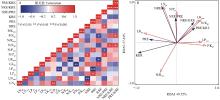
图5
毛白杨化学计量特征和养分重吸收的相关性分析 NRE:氮的重吸收效率;PRE:磷的重吸收效率;KRE:钾的重吸收效率。LNgr:表示8月成熟叶片氮含量;LNsen:表示11月凋落叶片氮含量;N/Pgr:表示8月叶片氮磷比;N/Psen:表示11月叶片氮磷比。其他元素表示以此类推。"
| 崔宁洁, 刘小兵, 张丹桔, 等. 不同林龄马尾松(Pinus massoniana)人工林碳氮磷分配格局及化学计量特征. 生态环境学报, 2014, 23 (2): 188- 195. | |
| Cui N J, Liu X B, Zhang D J, et al. The distribution pattern of carbon, nitrogen and phosphorus and the stoichiometry characteristics of Pinus massoniana plantation in different ages. Ecology and Environmental Sciences, 2014, 23 (2): 188- 195. | |
| 高宗宝, 王洪义, 吕晓涛, 等. 2017. 氮磷添加对呼伦贝尔草甸草原4种优势植物根系和叶片C: N: P化学计量特征的影响. 生态学杂志, 36(1): 80–88. | |
| Gao Z B, Wang H Y, Lü X T, et al. 2017. Effects of nitrogen and phosphorus addition on C: N: P stoichiometry in roots and leaves of four dominant plant species in a meadow steppe of Hulunbuir. Chinese Journal of Ecology, 2016, 36(1): 80–88. [in Chinese] | |
| 鞠 雯, 黄志群, 傅彦榕, 等. 亚热带幼林树木功能性状与叶片氮磷重吸收率的关系. 应用生态学报, 2022, 33 (12): 3229- 3236. | |
| Ju W, Huang Z Q, Fu Y R, et al. Relationships between tree functional traits and leaf nitrogen and phosphorus resorption efficiencies in subtropical young plantations. Chinese Journal of Applied Ecology, 2022, 33 (12): 3229- 3236. | |
| 李素新, 张芸香, 郭晋平. 氮添加对华北落叶松叶片化学计量与养分重吸收效率的影响. 水土保持学报, 2021, 35 (5): 249- 254, 263. | |
| Li S X, Zhang Y X, Guo J P. Effects of nitrogen addition on leaf stoichiometry and nutrients reabsorption efficiency of Larix principis-rupprechtii. Journal of Soil and Water Conservation, 2021, 35 (5): 249- 254, 263. | |
| 刘 莉, 蔡锰柯, 刘旭军, 等. 间伐对华北落叶松人工林叶、根及林下土壤C、N、P化学计量特征影响. 东北林业大学学报, 2019, 47 (8): 1- 7. | |
| Liu L, Cai M K, Liu X J, et al. Effects of thinning on ecological stoichiometry C, N and P in leaves, roots and soil of Larix principis-rupprechtii plantation. Journal of Northeast Forestry University, 2019, 47 (8): 1- 7. | |
| 陆姣云, 段兵红, 杨 梅, 等. 植物叶片氮磷养分重吸收规律及其调控机制研究进展. 草业学报, 2018, 27 (4): 178- 188. | |
| Lu J Y, Duan B H, Yang M, et al. Research progress in nitrogen and phosphorus resorption from senesced leaves and the influence of ontogenetic and environmental factors. Acta Prataculturae Sinica, 2018, 27 (4): 178- 188. | |
|
马玉珠, 钟全林, 靳冰洁, 等. 中国植物细根碳, 氮, 磷化学计量学的空间变化及其影响因子. 植物生态学报, 2015, 39 (2): 159- 166.
doi: 10.17521/cjpe.2015.0015 |
|
|
Ma Y Z, Zhong Q L, Jin B J, et al. Spatial changes and influencing factors of fine root carbon, nitrogen and phosphorus stoichiometry of plants in China. Chinese Journal of Plant Ecology, 2015, 39 (2): 159- 166.
doi: 10.17521/cjpe.2015.0015 |
|
| 任书杰, 于贵瑞, 陶 波, 等. 中国东部南北样带654种植物叶片氮和磷的化学计量学特征研究. 环境科学, 2007, 28 (12): 2665- 2673. | |
| Ren S J, Yu G R, Tao B, et al. Leaf nitrogen and phosphorus stoichiometry across 654 terrestrial plant species in NSTEC. Environmental Science, 2007, 28 (12): 2665- 2673. | |
|
田 地, 严正兵, 方精云. 植物生态化学计量特征及其主要假说. 植物生态学报, 2021, 45 (7): 682- 713.
doi: 10.17521/cjpe.2020.0331 |
|
|
Tian D, Yan Z B, Fang J Y. Review on characteristics and main hypotheses of plant ecological stoichiometry. Chinese Journal of Plant Ecology, 2021, 45 (7): 682- 713.
doi: 10.17521/cjpe.2020.0331 |
|
| 王丽娜, 吴俊文, 董 琼, 等. 抚育间伐对云南松非结构性碳和化学计量特征的影响. 北京林业大学学报, 2021, 43 (8): 70- 82. | |
| Wang L N, Wu J W, Dong Q, et al. Effects of tending and thinning on non-structural carbon and stoichiometric characteristics of Pinus yunnanensis. Journal of Beijing Forestry University, 2021, 43 (8): 70- 82. | |
| 王苗苗, 刘 勇, 李国雷, 等. 秋季施肥对毛白杨苗木质量、造林效果和养分回流的影响. 林业科学, 2021, 57 (7): 51- 60. | |
| Wang M M, Liu Y, Li G L, et al. Effects of autumn fertilization on quality, field performance and nutrient resorption of Populus tomentosa seedlings. Scientia Silvae Sinicae, 2021, 57 (7): 51- 60. | |
| 王亚飞, 杨红青, 周 欧, 等. 水氮耦合下高密度毛白杨纸浆林树木各器官化学计量特征. 北京林业大学学报, 2023, 45 (12): 68- 79. | |
| Wang Y F, Yang H Q, Zhou O, et al. Chemical stoichiometry characteristics of various organs of trees in high-density Populus tomentosa pulp forests under water-nitrogen coupling. Journal of Beijing Forestry University, 2023, 45 (12): 68- 79. | |
| 魏大平, 张 健, 张丹桔, 等. 不同林冠郁闭度马尾松(Pinus massoniana)叶片养分再吸收率及其化学计量特征. 应用与环境生物学报, 2017, 23 (3): 560- 569. | |
| Wei D P, Zhang J, Zhang D J, et al. Leaf carbon, nitrogen, and phosphorus resorption and the stoichiometry in Pinus massoniana plantations with various canopy densities. Chinese Journal of Applied and Environmental Biology, 2017, 23 (3): 560- 569. | |
| 闫媛媛, 郭 琪, 管俊泽, 等. 红松和水曲柳叶生态化学计量及养分重吸收特征的地理变异. 应用生态学报, 2023, 34 (4): 977- 984. | |
| Yan Y Y, Guo Q, Guan J Z, et al. Geographical variation of ecological stoichiometry and nutrient resorption in leaves of Pinus koraiensis and Fraxinus mandshurica. Journal of Applied Ecology, 2023, 34 (4): 977- 984. | |
| 张新洁, 陆天宇, 孙海龙, 等. 氮磷添加对水曲柳化学计量特征和养分再吸收的影响. 森林工程, 2019, 35 (5): 16- 21. | |
| Zhang X J, Lu T Y, Sun H L, et al. Effects of nitrogen and phosphorus addition on nutrient stoichiometry and resorption of Fraxinus mandshurica. Forest Engineering, 2019, 35 (5): 16- 21. | |
| 周丽丽, 钱瑞玲, 李树斌, 等. 滨海沙地主要造林树种叶片功能性状及养分重吸收特征. 应用生态学报, 2019, 30 (7): 2320- 2328. | |
| Zhou L L, Qian R L, Li S B, et al. Leaf functional traits and nutrient resorption among major silviculture tree species in coastal sandy site. Chinese Journal of Applied Ecology, 2019, 30 (7): 2320- 2328. | |
| Aerts R, Chapin III F S. The mineral nutrition of wild plants revisited: a re-evaluation of processes and patterns. Advances in Ecological Research, 1999, 30, 1- 67. | |
| Aerts R. 1996. Nutrient resorption from senescing leaves of perennials: are there general patterns? Journal of Ecology, 84: 597−608. | |
|
Ågren G I. The C: N: P stoichiometry of autotrophs–theory and observations. Ecology Letters, 2004, 7 (3): 185- 191.
doi: 10.1111/j.1461-0248.2004.00567.x |
|
|
Benedetti-Ruiz S, Loewe-Muñoz V, Del Río R, et al. Effect of thinning on growth and shape of Castanea sativa adult tree plantations for timber production in Chile. Forest Ecology and Management, 2023, 530, 120762.
doi: 10.1016/j.foreco.2022.120762 |
|
|
Bhandari S K, Veneklaas E J, McCaw L, et al. Effect of thinning and fertilizer on growth and allometry of Eucalyptus marginata. Forest Ecology and Management, 2021, 479, 118594.
doi: 10.1016/j.foreco.2020.118594 |
|
| Blanco J A, Imbert J B, Castillo F J. Influence of site characteristics and thinning intensity on litterfall production in two Pinus sylvestris L. forests in the western Pyrenees. Forest Ecology and Management, 2006, 237 (1/2/3): 342- 352. | |
|
Blanco J A, Imbert J B, Castillo F J. Thinning affects nutrient resorption and nutrient-use efficiency in two Pinus sylvestris stands in the Pyrenees. Ecological Applications, 2009, 19 (3): 682- 698.
doi: 10.1890/1051-0761-19.3.682 |
|
|
Bobbink R, Hicks K, Galloway J, et al. Global assessment of nitrogen deposition effects on terrestrial plant diversity: a synthesis. Ecological Applications, 2010, 20 (1): 30- 59.
doi: 10.1890/08-1140.1 |
|
|
Dang P, Gao Y, Liu J L, et al. Effects of thinning intensity on understory vegetation and soil microbial communities of a mature Chinese pine plantation in the Loess Plateau. Science of the Total Environment, 2018, 630, 171- 180.
doi: 10.1016/j.scitotenv.2018.02.197 |
|
|
Danger M, Gessner M O, Bärlocher F. Ecological stoichiometry of aquatic fungi: current knowledge and perspectives. Fungal Ecology, 2016, 19, 100- 111.
doi: 10.1016/j.funeco.2015.09.004 |
|
|
Drenovsky R E, Pietrasiak N, Short T H. Global temporal patterns in plant nutrient resorption plasticity. Global Ecology and Biogeography, 2019, 28 (6): 728- 743.
doi: 10.1111/geb.12885 |
|
|
Du E Z, Terrer C, Pellegrini A F A, et al. Global patterns of terrestrial nitrogen and phosphorus limitation. Nature Geoscience, 2020, 13 (3): 221- 226.
doi: 10.1038/s41561-019-0530-4 |
|
| Elser J J, Dobberfuhl D R, MacKay N A, et al. Organism size, life history, and N: P stoichiometry: toward a unified view of cellular and ecosystem processes. Bio Science, 1996, 46 (9): 674- 684. | |
|
Elser J J, Sterner R W, Gorokhova E, et al. Biological stoichiometry from genes to ecosystems. Ecology Letters, 2000a, 3 (6): 540- 550.
doi: 10.1111/j.1461-0248.2000.00185.x |
|
|
Elser J J, Fagan W F, Denno R F, et al. Nutritional constraints in terrestrial and freshwater food webs. Nature, 2000b, 408 (6812): 578- 580.
doi: 10.1038/35046058 |
|
|
Fang S Z, Lin D, Tian Y, et al. Thinning intensity affects soil-atmosphere fluxes of greenhouse gases and soil nitrogen mineralization in a lowland poplar plantation. Forests, 2016, 7 (7): 141.
doi: 10.3390/f7070141 |
|
|
Han W X, Fang J Y, Guo D L, et al. Leaf nitrogen and phosphorus stoichiometry across 753 terrestrial plant species in China. New Phytologist, 2005, 168 (2): 377- 385.
doi: 10.1111/j.1469-8137.2005.01530.x |
|
|
Han W X, Tang L Y, Chen Y H, et al. Relationship between the relative limitation and resorption efficiency of nitrogen vs phosphorus in woody plants. PLoS One, 2013, 8 (12): e83366.
doi: 10.1371/journal.pone.0083366 |
|
|
He M Z, Dijkstra F A. Drought effect on plant nitrogen and phosphorus: a meta-analysis. New Phytologist, 2014, 204 (4): 924- 931.
doi: 10.1111/nph.12952 |
|
| Huang J J, Wang X H, Yan E R. Leaf nutrient concentration, nutrient resorption and litter decomposition in an evergreen broad-leaved forest in eastern China. Forest Ecology and Management, 2007, 239 (1/2/3): 150- 158. | |
|
Kang H Z, Zhuang H L, Wu L L, et al. Variation in leaf nitrogen and phosphorus stoichiometry in Picea abies across Europe: an analysis based on local observations. Forest Ecology and Management, 2011, 261 (2): 195- 202.
doi: 10.1016/j.foreco.2010.10.004 |
|
|
Killingbeck K T. Nutrients in senesced leaves: keys to the search for potential resorption and resorption proficiency. Ecology, 1996, 77 (6): 1716- 1727.
doi: 10.2307/2265777 |
|
|
Li R S, Yang Q P, Zhang W D, et al. Thinning effect on photosynthesis depends on needle ages in a Chinese fir (Cunninghamia lanceolata) plantation. Science of the Total Environment, 2017, 580, 900- 906.
doi: 10.1016/j.scitotenv.2016.12.036 |
|
| Lu X K, Vitousek P M, Mao Q G, et al. Plant acclimation to long-term high nitrogen deposition in an N-rich tropical forest. Proceedings of the National Academy of Sciences of the United States of America, 2018, 115 (20): 5187- 5192. | |
|
Mo Q F, Zou B, Li Y W, et al. Response of plant nutrient stoichiometry to fertilization varied with plant tissues in a tropical forest. Scientific Reports, 2015, 5, 14605.
doi: 10.1038/srep14605 |
|
| Negishi Y, Eto Y, Hishita M, et al. Role of thinning intensity in creating mixed hardwood and conifer forests within a Cryptomeria japonica conifer plantation: a 14-year study. Forest Ecology and Management, 2020, 468 (3): 118184. | |
|
Park J, Kim T, Moon M, et al. Effects of thinning intensities on tree water use, growth, and resultant water use efficiency of 50-year-old Pinus koraiensis forest over four years. Forest Ecology and Management, 2018, 408, 121- 128.
doi: 10.1016/j.foreco.2017.09.031 |
|
|
Qiu X C, Wang H B, Peng D L, et al. Thinning drives C: N: P stoichiometry and nutrient resorption in Larix principis-rupprechtii plantations in North China. Forest Ecology and Management, 2020, 462, 117984.
doi: 10.1016/j.foreco.2020.117984 |
|
|
Reed S C, Townsend A R, Davidson E A, et al. Stoichiometric patterns in foliar nutrient resorption across multiple scales. New Phytologist, 2012, 196 (1): 173- 180.
doi: 10.1111/j.1469-8137.2012.04249.x |
|
|
Reich P B, Oleksyn J, Wright I J, et al. Evidence of a general 2/3-power law of scaling leaf nitrogen to phosphorus among major plant groups and biomes. Proceedings of the Royal Society B: Biological Sciences, 2010, 277, 877- 883.
doi: 10.1098/rspb.2009.1818 |
|
|
Schreeg L A, Santiago L S, Wright S J, et al. Stem, root, and older leaf N∶P ratios are more responsive indicators of soil nutrient availability than new foliage. Ecology, 2014, 95 (8): 2062- 2068.
doi: 10.1890/13-1671.1 |
|
|
Sistla S A, Appling A P, Lewandowska A M, et al. Stoichiometric flexibility in response to fertilization along gradients of environmental and organismal nutrient richness. Oikos, 2015, 124 (7): 949- 959.
doi: 10.1111/oik.02385 |
|
|
Tang L Y, Han W X, Chen Y H, et al. Resorption proficiency and efficiency of leaf nutrients in woody plants in eastern China. Journal of Plant Ecology, 2013, 6 (5): 408- 417.
doi: 10.1093/jpe/rtt013 |
|
| Tang Z Y, Xu W T, Zhou G Y, et al. Patterns of plant carbon, nitrogen, and phosphorus concentration in relation to productivity in China’s terrestrial ecosystems. Proceedings of the National Academy of Sciences of the United States of America, 2018, 115 (16): 4033- 4038. | |
|
Townsend A R, Cleveland C C, Asner G P, et al. Controls over foliar N: P ratios in tropical rain forests. Ecology, 2007, 88 (1): 107- 118.
doi: 10.1890/0012-9658(2007)88[107:COFNRI]2.0.CO;2 |
|
|
Vergutz L, Manzoni S, Porporato A, et al. Global resorption efficiencies and concentrations of carbon and nutrients in leaves of terrestrial plants. Ecological Monographs, 2012, 82 (2): 205- 220.
doi: 10.1890/11-0416.1 |
|
|
Yuan Z Y, Chen H Y H, Reich P B. Global-scale latitudinal patterns of plant fine-root nitrogen and phosphorus. Nature Communications, 2011, 2, 344.
doi: 10.1038/ncomms1346 |
|
|
Yuan Z Y, Chen H Y H. Global-scale patterns of nutrient resorption associated with latitude, temperature and precipitation. Global Ecology and Biogeography, 2009, 18 (1): 11- 18.
doi: 10.1111/j.1466-8238.2008.00425.x |
|
|
Yuan Z Y, Chen H Y H. Negative effects of fertilization on plant nutrient resorption. Ecology, 2015, 96 (2): 373- 380.
doi: 10.1890/14-0140.1 |
|
|
Zhao N, Yu G R, He N P, et al. Invariant allometric scaling of nitrogen and phosphorus in leaves, stems, and fine roots of woody plants along an altitudinal gradient. Journal of Plant Research, 2016, 129 (4): 647- 657.
doi: 10.1007/s10265-016-0805-4 |
|
|
Zhou L L, Addo-Danso S D, Wu P F, et al. Leaf resorption efficiency in relation to foliar and soil nutrient concentrations and stoichiometry of Cunninghamia lanceolata with stand development in southern China. Journal of Soils and Sediments, 2016, 16 (5): 1448- 1459.
doi: 10.1007/s11368-016-1352-2 |
| [1] | 张城伟,王兴,安可,吴子昊,张静宜,钟泽坤. 黄土丘陵区退耕植被叶片-土壤生态化学计量特征与植物内稳态差异[J]. 林业科学, 2025, 61(6): 61-74. |
| [2] | 王亚飞,刘洋,王凯,丁晓菲,续可心,贾黎明,席本野. 水氮耦合处理对毛白杨纸浆林生长及土壤水养特征影响[J]. 林业科学, 2025, 61(5): 85-97. |
| [3] | 王泽锦, 冉堃, 于淼, 张碧嘉, 冀莉, 李品. 北京市元宝槭和紫丁香叶片的功能性状和生态化学计量比及养分重吸收效率的城乡梯度差异[J]. 林业科学, 2024, 60(2): 42-54. |
| [4] | 刘美宏,闫琦铭,訾龙博,雷亚芳,闫丽. 糠醇-环氧植物油复合改性毛白杨木材的物理力学性能[J]. 林业科学, 2024, 60(11): 149-159. |
| [5] | 黄梦遥, 张润哲, 史策, 杨昊, 魏一凡, 张兆德, 祝琳, 宋连君, 聂立水, 王登芝. 不同施氮量和灌水水平下毛白杨林地土壤矿质氮动态[J]. 林业科学, 2023, 59(9): 45-54. |
| [6] | 李玲雅,邸楠,刘金强,赵小宁,邹松言,付海曼,席本野. 短轮伐毛白杨人工林耗水规律及作物系数曲线构建[J]. 林业科学, 2023, 59(10): 76-88. |
| [7] | 温文杰,王冬梅. 青海黄土高寒区4种典型人工林树木叶片碳氮磷含量及化学计量特征[J]. 林业科学, 2022, 58(1): 22-31. |
| [8] | 张亚雄,王烨,李广德,李豆豆,贺曰林,席本野,孙丽娟. 三倍体毛白杨分枝格局对不同土壤供水水平的响应[J]. 林业科学, 2021, 57(3): 145-151. |
| [9] | 孙明慧,刘勇,王长伟,李国雷,王苗苗,宋协海,常笑超,万芳芳,宋怀山. 密度和行距配置对毛白杨苗木质量的影响[J]. 林业科学, 2021, 57(3): 152-160. |
| [10] | 赵瑞,王传宽,全先奎,王兴昌. 黑龙江省帽儿山温带阔叶树种不同器官的生态化学计量特征[J]. 林业科学, 2021, 57(2): 1-11. |
| [11] | 乔栋,刘勇,田书勇,张锋,王亚晶,李晓丽,冯雪瑾,张亚男. 木质化期水分管理对毛白杨苗木形态、生理和造林效果的影响[J]. 林业科学, 2021, 57(11): 169-178. |
| [12] | 马煦,曹治国,岳晨,金楚晗,刘俊,刘洋,修桂芳,席本野. 降雨和灌溉影响下毛白杨叶片的颗粒物滞纳特征变化及其生理特性响应规律[J]. 林业科学, 2020, 56(8): 181-190. |
| [13] | 朱嘉磊, 薄慧娟, 李璇, 文春燕, 王江, 聂立水, 田菊, 宋莲君. 不同毛白杨无性系林分蓄积量的长期水氮耦合效应[J]. 林业科学, 2019, 55(5): 27-35. |
| [14] | 安胜男, 马晓军, 朱礼智. 木粉增强P34HB生物复合材料的制备及其结构性能表征[J]. 林业科学, 2019, 55(3): 125-133. |
| [15] | 邹松言,李豆豆,汪金松,邸楠,刘金强,王烨,李广德,段劼,贾黎明,席本野. 毛白杨幼林细根对梯度土壤水分的响应[J]. 林业科学, 2019, 55(10): 124-137. |
| 阅读次数 | ||||||
|
全文 |
|
|||||
|
摘要 |
|
|||||

