
林业科学 ›› 2026, Vol. 62 ›› Issue (6): 36-45.doi: 10.11707/j.1001-7488.LYKX20250653
李达海1,卜文圣1,杨风亭2,3,孟盛旺2,3,高德才2,3,寇亮2,3,王辉民2,3,付晓莉1,2,3,*( )
)
收稿日期:2025-10-30
修回日期:2025-12-28
出版日期:2026-06-10
发布日期:2026-06-13
通讯作者:
付晓莉
E-mail:fuxl@igsnrr.ac.cn
基金资助:
Dahai Li1,Wensheng Bu1,Fengting Yang2,3,Shengwang Meng2,3,Decai Gao2,3,Liang Kou2,3,Huimin Wang2,3,Xiaoli Fu1,2,3,*()
Received:2025-10-30
Revised:2025-12-28
Online:2026-06-10
Published:2026-06-13
Contact:
Xiaoli Fu
E-mail:fuxl@igsnrr.ac.cn
摘要:
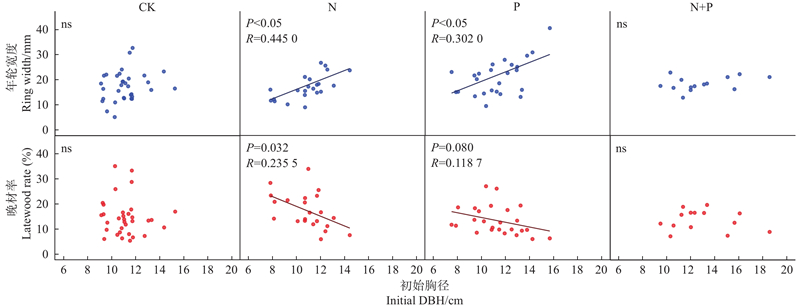
目的: 探究不同施肥措施对杉木生长和材性参数及其稳定性的影响,为杉木高品质大径材培育与可持续经营提供理论依据。方法: 依托杉木人工林长期施肥试验平台,设置对照、单施氮(100 kg·hm–2a–1)、单施磷(50 kg·hm–2a–1)和氮磷配施(100 kg·hm–2a–1氮+50 kg·hm–2a–1磷)4种处理,于2012年开始,每年分4次(3、6、9、12月,比例分别为30%、30%、20%、20%)进行施肥。氮肥和磷肥分别以硝酸铵和磷酸二氢钠的形式,与河沙混合均匀施入。采用树木年轮学方法测定2011—2023年逐年年轮宽度和晚材率,基于年轮宽度和晚材率的年际变异系数和施肥效应,分析杉木年轮宽度和晚材率对长期施肥的响应规律;利用分段线性回归和混合模型识别施肥年限和径级对年轮宽度和晚材率的影响。结果: 1) 与单施处理相比,氮磷配施可降低杉木生长对极端干旱的敏感性,表现为年轮宽度和晚材率的年际波动幅度减小,其变异系数与对照处理相当,表明该施肥策略有助于维持木材材质的均匀性;2) 氮磷配施处理下,连续施肥4年的累积促进效应最大,累积年轮宽度相比对照提高31.8%,同时累积晚材率的降幅较单施磷处理更为缓和,且与对照处理相当;3) 氮磷配施可缓解不同径级林木间的竞争,促进林分整体生长,有效抑制单一施肥导致的径级分化现象。结论: 建议在杉木中龄林施肥时实施以4年为周期的氮磷配施方案,可在提升杉木生长量的同时保障材质均匀性和硬度。
中图分类号:
李达海,卜文圣,杨风亭,孟盛旺,高德才,寇亮,王辉民,付晓莉. 氮磷配施促进杉木生长和材质稳定性:来自长期施肥试验的启示[J]. 林业科学, 2026, 62(6): 36-45.
Dahai Li,Wensheng Bu,Fengting Yang,Shengwang Meng,Decai Gao,Liang Kou,Huimin Wang,Xiaoli Fu. Combined Application of Nitrogen and Phosphorus Enhance the Growth and Wood Quality Stability of Chinese Fir: Insights from a Long-Term Fertilization Experiment[J]. Scientia Silvae Sinicae, 2026, 62(6): 36-45.

表1
样地2011年本底特征"
| 参数 Parameter | 平均值 ± 标准误 Mean ± SE | |
| 林分特征 Stand characteristic | 林龄 Stand age/a | 14 |
| 密度 Density /(tree·hm?2) | ||
| 平均胸径 Mean DBH/cm | 10.2 ± 0.2 | |
| 平均树高 Mean height/m | 8.93 ± 0.01 | |
| 林下植被生物量 Understory biomass/(g·m?2) | 22.70 ± 2.24 | |
| 土壤性质 (0~10 cm) Soil properties (0–10 cm) | 密度 Bulk density /(g·cm?3) | 1.25 ± 0.03 |
| pH (H2O) | 4.43 ± 0.10 | |
| 有机碳 Organic carbon/ (g·kg?1) | 20.56 ± 1.44 | |
| 全氮 Total nitrogen/(g·kg?1) | 1.20 ± 0.09 | |
| 全磷 Total phosphorus/(g·kg?1) | 0.31 ± 0.02 | |
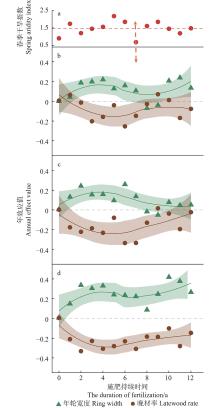
图1
不同施肥处理下年效应值随施肥持续时间的变化趋势 a为2011—2023年春季干旱指数的变化,其中双向箭头代表施肥后第7年发生严重春季干旱。b、c和d分别为氮添加、磷添加以及氮磷配施后,树木年轮宽度和晚材率的年效应值随施肥持续时间的动态变化。"
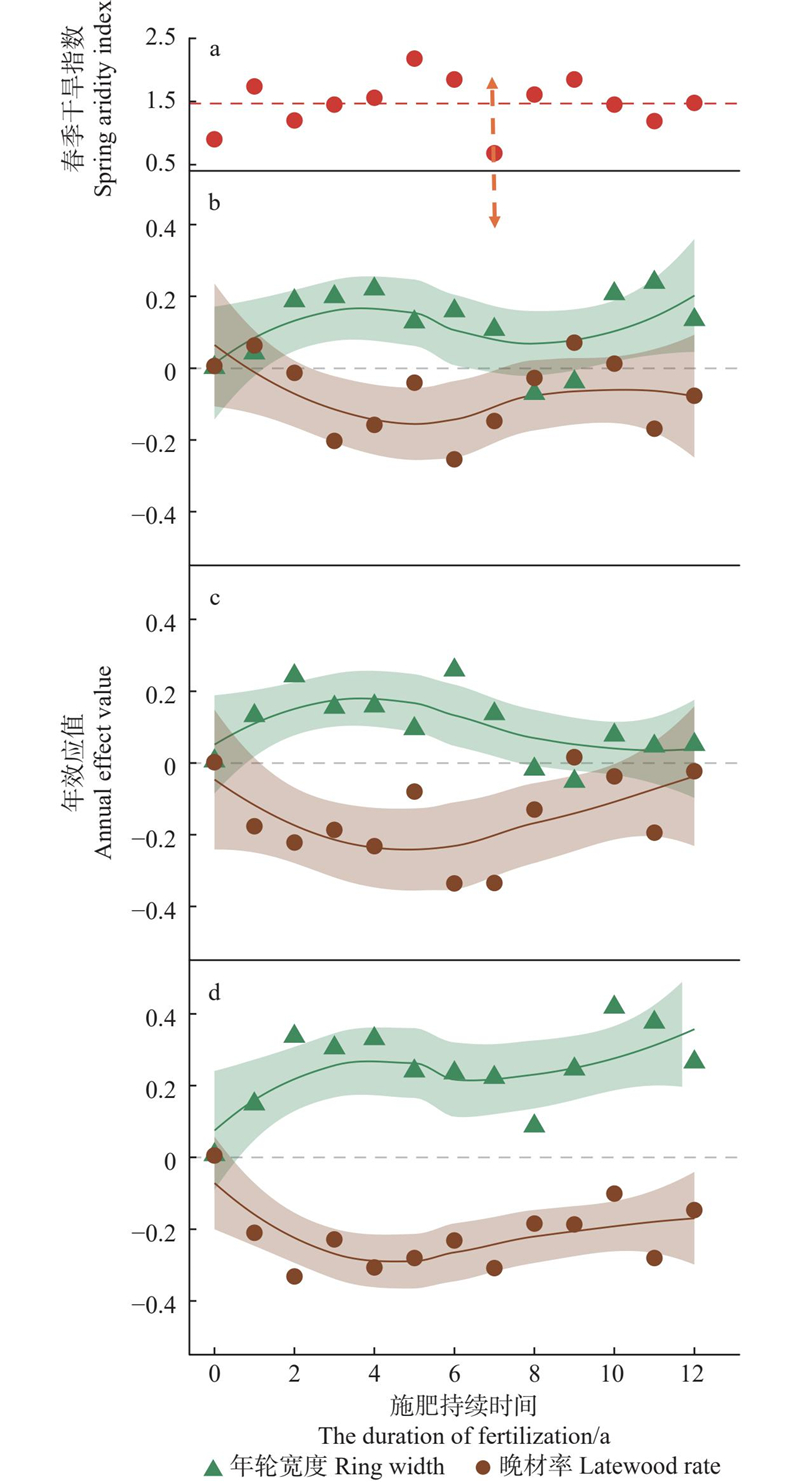
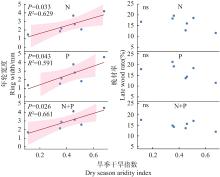
图2
旱季干旱指数与年轮宽度和晚材率滑动1年的关系分析 N:氮添加Nitrogen addition;P:磷添加Phosphorus addition;N+P:氮磷配施Combined nitrogen and phosphorus addition."
表2
不同施肥处理下年轮宽度与晚材率12年变异系数①"
| 处理Treatment | 变异系数Coefficient of variation | |
| 年轮宽度Ring with | 晚材率Latewood rate | |
| CK | 35.26 | 15.95 |
| N | 37.25 | 18.93 |
| P | 40.13 | 23.06 |
| N+P | 34.88 | 15.48 |
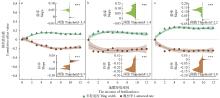
图3
不同施肥处理下累积效应值随施肥持续时间的变化趋势 a、b和c为氮添加(N)、磷添加(P)以及氮磷配施(N+P)后,树木年轮宽度和晚材率的累积效应值随施肥持续时间的动态变化,时间阈值指曲线斜率变化到达稳定时对应的施肥持续时间。时间阈值子图中***表示P < 0.001。a, b, and c depict the cumulative effect values of tree ring width and latewood rate in response to nitrogen (N), phosphorus (P), and combined nitrogen and phosphorus addition(N+P) over the treatment years, respectively. Temporal threshold indicates the time to stabilization of the curve slope, corresponding to the duration of fertilizer application. In the panel depicting temporal thresholds, three asterisks *** indicate statistical significance at the level of P < 0.001."
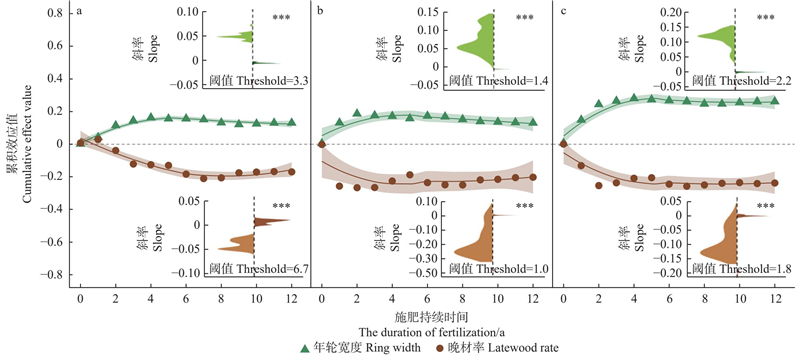
表3
施肥持续时间对累积年轮宽度和累积晚材率的影响①"
| 施肥持续时间 Duration of fertilization/a | 处理 Treatment | 累积年轮宽度 Cumulative ring with /mm | 效应值 Effect value | 提高比例 Percentage increase (%) | 累积晚材率 Cumulative latewood rate (%) | 效应值Effect value | 降低比例 Percentage decrease (%) |
| 1 | CK | 4.36±2.06 a | 16.6±9.9 a | ||||
| N | 4.52±1.56 a | 0.04 b | 3.8 | 15.3±6.2 a | –0.08 c | 7.6 | |
| P | 4.97±1.82 a | 0.13 a | 14.1 | 11.8±5.2 a | –0.34 a | 28.7 | |
| N+P | 5.00±1.90 a | 0.14 a | 14.8 | 13.4±6.0 a | –0.21 b | 19.3 | |
| 2 | CK | 8.41±2.99 b | 16.0±7.5 a | ||||
| N | 9.38±2.83 ab | 0.11c | 11.5 | 14.9±5.6 a | –0.07 b | 6.6 | |
| P | 10.14±2.27 a | 0.19 b | 20.5 | 11.5±4.0 b | –0.33 a | 28.1 | |
| N+P | 10.67±4.02 a | 0.24 a | 26.9 | 12.4±4.7 ab | –0.25 a | 22.5 | |
| 3 | CK | 12.67±3.80 b | 15.5±6.0 a | ||||
| N | 14.48±3.91 ab | 0.13 c | 14.3 | 13.8±5.0 ab | –0.11 b | 10.6 | |
| P | 15.11±3.26 a | 0.18 b | 19.3 | 11.7±4.0 b | –0.28 a | 24.4 | |
| N+P | 16.37±5.88 a | 0.26 a | 29.2 | 12.6±4.4 ab | –0.21 a | 18.8 | |
| 4 | CK | 16.59±4.84 b | 15.4±5.3 a | ||||
| N | 19.37±4.89 ab | 0.15 b | 16.7 | 13.7±4.8 ab | –0.12 b | 11.1 | |
| P | 19.71±3.95 a | 0.17 b | 18.8 | 11.9±3.5 b | –0.25 a | 22.4 | |
| N+P | 21.88±7.27 a | 0.28 a | 31.8 | 12.6±4.1 ab | –0.20 a | 18.0 |
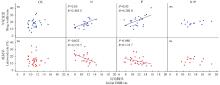
图4
施肥4年对不同径级累积年轮宽度和累积晚材率的影响 每个点都代表1个取样个体,ns表示无显著相关性。Each data point represents an individual sample; ns indicates no significant correlation. CK:对照组Control;N:氮添加Nitrogen addition;P:磷添加Phosphorus addition;N+P:氮磷配施Combined nitrogen and phosphorus addition."
|
陈智裕, 李 琦, 邹显花, 等. 邻株竞争对低磷环境杉木幼苗光合特性及生物量分配的影响. 植物生态学报, 2016, 40 (2): 177- 186.
doi: 10.17521/cjpe.2015.0182 |
|
|
Chen Z Y, Li Q, Zou X H, et al. Effect of neighboring competition on photosynthetic characteristics and biomass allocation of Chinese fir seedlings under low phosphorus stress. Chinese Journal of Plant Ecology, 2016, 40 (2): 177- 186.
doi: 10.17521/cjpe.2015.0182 |
|
| 陈楚莹, 廖利平, 汪思龙. 2000. 杉木人工林生态学. 北京: 科学出版社. | |
| Chen C Y, Liao L P, Wang S L.2000. Ecology of Chinese fir plantation. Beijing: Science Press. [in Chinese] | |
| 付志高, 李莲芳. 复合肥和磷肥混施对云南松幼林生长的短期效应分析. 林业资源管理, 2021 (1): 189- 196. | |
| Fu Z G, Li L F. Short term effects of compound and phosphate fertilizer on the growth of juvenile Pinus yunnanensis plantation. Forest Resources Management, 2021 (1): 189- 196. | |
| 黄敬文, 代 鑫, 张冬有. 树木年轮学新前沿和在中国的研究进展. 哈尔滨师范大学自然科学学报, 2022, 38 (6): 79- 86. | |
| Huang J W, Dai X, Zhang D Y. New frontiers in dendrochronology and research advances in China. Natural Science Journal of Harbin Normal University, 2022, 38 (6): 79- 86. | |
| 李思雨, 杨风亭, 王辉民, 等. 杉木和木荷木质部形成季节动态及其对环境因子的响应. 植物生态学报, 2025, 49 (2): 295- 307. | |
| Li S Y, Yang F T, Wang H M, et al. Seasonal dynamics of xylem formation in Cunninghamia lanceolata and Schima superba and its response to environmental factors. Chinese Journal of Plant Ecology, 2025, 49 (2): 295- 307. | |
|
李真子, 徐玉梅, 袁莲珍, 等. N、P、K对杉木幼苗生长量的影响. 四川林业科技, 2015, 36 (2): 95- 97.
doi: 10.3969/j.issn.1003-5508.2015.02.021 |
|
|
Li Z Z, Xu Y M, Yuan L Z, et al. Effect of N, P and K on the growth of Cunninghamia lanceolata seedlings. Journal of Sichuan Forestry Science and Technology, 2015, 36 (2): 95- 97.
doi: 10.3969/j.issn.1003-5508.2015.02.021 |
|
| 刘 欢, 王超琦, 吴家森, 等. 氮素指数施肥对杉木无性系苗生长及养分含量的影响. 应用生态学报, 2016, 27 (10): 3123- 3128. | |
| Liu H, Wang C Q, Wu J S, et al. Effects of exponential N fertilization on the growth and nutrient content in clonal Cunninghamia lanceolata seedlings. Chinese Journal of Applied Ecology, 2016, 27 (10): 3123- 3128. | |
|
刘跃钧, 马海泉, 陈天华, 等. 杉木大径材平衡施肥及土壤养分变化的研究. 江西林业科技, 2014, 42 (1): 18- 21.
doi: 10.3969/j.issn.1006-2505.2014.01.006 |
|
|
Liu Y J, Ma H Q, Chen T H, et al. Research on balanced fertilization and soil nutrient changes of Chinese fir large-diameter timber. Jiangxi Forestry Science and Technology, 2014, 42 (1): 18- 21.
doi: 10.3969/j.issn.1006-2505.2014.01.006 |
|
| 潘彦丽, 张零念, 巩合德. 氮磷钾不同配比对丽江云杉幼苗生理生长的影响. 西南林业大学学报, 2024, 44 (7): 27- 33. | |
| Pan Y L, Zhang L N, Gong H D. Effects of fertilization with different proportion of nitrogen, phosphorus and potassium on physiology growth of Picea likiangensis seedlings. Journal of Southwest Forestry University, 2024, 44 (7): 27- 33. | |
| 祁承经, 赵运林, 喻勋林, 等. 树木年轮学综论. 中南林业科技大学学报, 2017, 37 (3): 1- 8,16. | |
| Qi C J, Zhao Y L, Yu X L, et al. A comprehensive review on dendrochronology. Journal of Central South University of Forestry & Technology, 2017, 37 (3): 1- 8,16. | |
| 任鑫磊. 2024. 季节性干旱下杉木水力安全性状与水分利用模式的联合调控策略. 长沙: 中南林业科技大学. | |
| Ren X L. 2024. The joint regulatory strategies of hydraulic safety traits and water use patterns of Cunninghamia lanceolata under seasonal drought. Changsha: Central South University of Forestry and Technology. [in Chinese] | |
| 任衍敏, 陈敏健, 李惠通, 等. 配方施肥对杉木近熟林大径材材种结构的影响. 森林与环境学报, 2021, 41 (1): 18- 25. | |
| Ren Y M, Chen M J, Li H T, et al. Effects of formula fertilization on species structure of large diameter wood in near mature forest of Chinese fir. Journal of Forest and Environment, 2021, 41 (1): 18- 25. | |
|
吴立潮, 胡曰利, 吴晓芙, 等. 杉木中龄林施肥效应与效益研究. 中南林学院学报, 1997 (3): 1- 7.
doi: 10.14067/j.cnki.1673-923x.1997.03.001 |
|
|
Wu L C, Hu Y L, Wu X F, et al. Effect of fertilization on growth of middle-aged China-fir. Journal of Central South Forestry University, 1997 (3): 1- 7.
doi: 10.14067/j.cnki.1673-923x.1997.03.001 |
|
|
王玉鑫, 付晓莉, 王辉民, 等. 氮磷添加对杉木根叶分解残余物微生物群落结构及酶活性的影响. 生态学报, 2021, 41 (13): 5408- 5416.
doi: 10.5846/stxb202005111173 |
|
|
Wang Y X, Fu X L, Wang H M, et al. Effects of nitrogen and phosphorus additions on microbial community structure and enzyme activity in root and leaf debris of Cunninghamia lanceolata. Acta Ecologica Sinica, 2021, 41 (13): 5408- 5416.
doi: 10.5846/stxb202005111173 |
|
|
徐有明, 林 汉, 李贻铨, 等. 施肥对湿地松幼林生长和木材物理力学性质的影响. 林业科学, 2002, 38 (4): 125- 133.
doi: 10.3321/j.issn:1001-7488.2002.04.021 |
|
|
Xu Y M, Lin H, Li Y Q, et al. Effects of fertilization on growth increments and wood physical-mechanical properties of young slash pine. Scientia Silvae Sinicae, 2002, 38 (4): 125- 133.
doi: 10.3321/j.issn:1001-7488.2002.04.021 |
|
| 于姣妲, 李 莹, 殷丹阳, 等. 杉木对低磷胁迫的响应和生理适应机制. 林业科学研究, 2017, 30 (4): 566- 575. | |
| Yu J D, Li Y, Yin D Y, et al. Response and physiological mechanism of Chinese fir to low phosphorus stress. Forest Research, 2017, 30 (4): 566- 575. | |
|
俞有志, 王清奎, 于小军, 等. 施氮磷肥对杉木人工林土壤活性有机碳的影响. 生态学杂志, 2018, 37 (10): 3053- 3060.
doi: 10.13292/j.1000-4890.201810.014 |
|
|
Yu Y Z, Wang Q K, Yu X J, et al. Effects of N and P fertilization on soil labile organic carbon fractions in Cunninghamia lanceolata plantations in mid-subtropics. Chinese Journal of Ecology, 2018, 37 (10): 3053- 3060.
doi: 10.13292/j.1000-4890.201810.014 |
|
|
张 闯, 邹洪涛, 张心昱, 等. 氮添加对湿地松林土壤水解酶和氧化酶活性的影响. 应用生态学报, 2016, 27 (11): 3427- 3434.
doi: 10.13287/j.1001-9332.201611.016 |
|
|
Zhang C, Zou H T, Zhang X Y, et al. Effects of nitrogen additions on soil hydrolase and oxidase activities in Pinus elliottii plantations. Chinese Journal of Applied Ecology, 2016, 27 (11): 3427- 3434.
doi: 10.13287/j.1001-9332.201611.016 |
|
|
赵隽宇, 张泽尧, 覃祚玉, 等. 长期连作下广西杉木人工林主产区土壤肥力演变特征与评价. 中南林业科技大学学报, 2020, 40 (9): 124- 131.
doi: 10.14067/j.cnki.1673-923x.2020.09.014 |
|
|
Zhao J Y, Zhang Z Y, Qin Z Y, et al. Evolution characteristics and evaluation of soil fertility in main producing areas of Cunninghamia lanceolata plantation in Guangxi under long-term cropping. Journal of Central South University of Forestry & Technology, 2020, 40 (9): 124- 131.
doi: 10.14067/j.cnki.1673-923x.2020.09.014 |
|
|
钟鸿鹃, 张 洪, 谢 钊, 等. 配方施肥对杉木幼苗生长的影响研究. 安徽林业科技, 2021, 47 (6): 22- 23, 28.
doi: 10.3969/j.issn.2095-0152.2021.06.006 |
|
|
Zhong H J, Zhang H, Xie Z, et al. Study on the effects of formulated fertilizing on the growth of Cunninghamia lanceolata seedlings. Anhui Forestry Science and Technology, 2021, 47 (6): 22- 23, 28.
doi: 10.3969/j.issn.2095-0152.2021.06.006 |
|
|
周柏屹, 孙麟均, 吴鹏飞, 等. 杉木大径材培育研究进展. 世界林业研究, 2024, 37 (1): 54- 58.
doi: 10.13348/j.cnki.sjlyyj.2023.0105.y |
|
|
Zhou B Y, Sun L J, Wu P F, et al. Research progress in cultivation of large-diameter timber tree of Chinese fir. World Forestry Research, 2024, 37 (1): 54- 58.
doi: 10.13348/j.cnki.sjlyyj.2023.0105.y |
|
|
Ai C, Liang G Q, Sun J W, et al. Responses of extracellular enzyme activities and microbial community in both the rhizosphere and bulk soil to long-term fertilization practices in a fluvo-aquic soil. Geoderma, 2012, 173, 330- 338..
doi: 10.1016/j.geoderma.2011.07.020 |
|
|
Biber P, Pretzsch H. Tree growth at gap edges. Insights from long term research plots in mixed mountain forests. Forest Ecology and Management, 2022, 520, 120383.
doi: 10.1016/j.foreco.2022.120383 |
|
|
Chen F S, Niklas K J, Liu Y, et al. Nitrogen and phosphorus additions alter nutrient dynamics but not resorption efficiencies of Chinese fir leaves and twigs differing in age. Tree Physiology, 2015, 35 (10): 1106- 1117.
doi: 10.1093/treephys/tpv076 |
|
|
Etzold S, Sterck F, Bose A K, et al. Number of growth days and not length of the growth period determines radial stem growth of temperate trees. Ecology Letters, 2022, 25 (2): 427- 439.
doi: 10.1111/ele.13933 |
|
|
Franceschini T, Longuetaud F, Bontemps J D, et al. Effect of ring width, cambial age, and climatic variables on the within-ring wood density profile of Norway spruce Picea abies (L. ) Karst. Trees, 2013, 27 (4): 913- 925.
doi: 10.1007/s00468-013-0844-6 |
|
|
Fujii K. Soil acidification and adaptations of plants and microorganisms in Bornean tropical forests. Ecological Research, 2014, 29 (3): 371- 381.
doi: 10.1007/s11284-014-1144-3 |
|
|
Jiang L, Hättenschwiler S, Ma N, et al. Root mixing effects on belowground decomposition depend on mycorrhizal type. Nature Communications, 2025, 16, 10274.
doi: 10.1038/s41467-025-65163-7 |
|
|
Hedges L V, Gurevitch J, Curtis P S. The meta-analysis of response ratios in experimental ecology. Ecology, 1999, 80 (4): 1150- 1156.
doi: 10.1890/0012-9658(1999)080[1150:TMAORR]2.0.CO;2 |
|
|
Liu S, Zhang X Y, Wang H M, et al. Phosphorus-transforming microbes enhance phosphatase catalytic efficiency to alleviate phosphorus limitation under nitrogen and phosphorus additions in subtropical forest soil. Soil Biology and Biochemistry, 2025, 209, 109915.
doi: 10.1016/j.soilbio.2025.109915 |
|
|
Liu S, Zhang X Y, Wang H M, et al. Seven-year N and P inputs regulate soil microbial communities via bottom-up effects on carbon and nutrient supply and top-down effects on protist relative abundance. Forest Ecology and Management, 2024, 552, 121582.
doi: 10.1016/j.foreco.2023.121582 |
|
|
Pivovaroff A L, Santiago L S, Vourlitis G L, et al. Plant hydraulic responses to long-term dry season nitrogen deposition alter drought tolerance in a Mediterranean-type ecosystem. Oecologia, 2016, 181 (3): 721- 731.
doi: 10.1007/s00442-016-3609-2 |
|
|
Sanchez-Martinez P, Mencuccini M, García-Valdés R, et al. Increased hydraulic risk in assemblages of woody plant species predicts spatial patterns of drought-induced mortality. Nature Ecology & Evolution, 2023, 7 (10): 1620- 1632.
doi: 10.1038/s41559-023-02180-z |
|
|
Shao H, Wang H M, Delgado-Baquerizo M, et al. Nutrient enrichment shapes litter micro-food webs in a subtropical plantation. Forest Ecology and Management, 2025, 580, 122545.
doi: 10.1016/j.foreco.2025.122545 |
|
|
Song X W, Lyu S D, Wen X F. Limitation of soil moisture on the response of transpiration to vapor pressure deficit in a subtropical coniferous plantation subjected to seasonal drought. Journal of Hydrology, 2020, 591, 125301.
doi: 10.1016/j.jhydrol.2020.125301 |
|
| Sperry J S, Donnelly J R, Tyree M T. 1988. A method for measuring hydraulic conductivity and embolism in xylem. Plant, Cell & Environment, 11(1): 35−40. | |
|
Svensson C, Bader M K, Fransson A M, et al. Norway spruce productivity in southern Sweden is equally limited by nitrogen and phosphorous. Forest Ecology and Management, 2024, 572, 122192.
doi: 10.1016/j.foreco.2024.122192 |
|
|
Wallenstein M D, McNulty S, Fernandez I J, et al. Nitrogen fertilization decreases forest soil fungal and bacterial biomass in three long-term experiments. Forest Ecology and Management, 2006, 222 (1/2/3): 459- 468.
doi: 10.1016/j.foreco.2005.11.002 |
|
|
Wang F C, Fang X M, Wang G G, et al. Effects of nutrient addition on foliar phosphorus fractions and their resorption in different-aged leaves of Chinese fir in subtropical China. Plant and Soil, 2019, 443 (1): 41- 54.
doi: 10.1007/s11104-019-04221-8 |
|
|
Wang H, Zhu A M, Duan A G, et al. Responses to subtropical climate in radial growth and wood density of Chinese fir provenances, southern China. Forest Ecology and Management, 2022, 521, 120428.
doi: 10.1016/j.foreco.2022.120428 |
|
|
Wu P F, Ma X Q, Tigabu M, et al. Root morphological plasticity and biomass production of two Chinese fir clones with high phosphorus efficiency under low phosphorus stress. Canadian Journal of Forest Research, 2011, 41 (2): 228- 234.
doi: 10.1139/X10-198 |
|
|
Yang F T, Feng Z M, Wang H M, et al. Deep soil water extraction helps to drought avoidance but shallow soil water uptake during dry season controls the inter-annual variation in tree growth in four subtropical plantations. Agricultural and Forest Meteorology, 2017, 234, 106- 114.
doi: 10.1016/j.agrformet.2016.12.020 |
|
| You R, Deng X W, Thompson R A, et al. 2025. Impact of drought stress and fertilization on plant traits and nonstructural carbohydrates of Red-Heart Chinese fir. Trees, Forests and People, 21: 100946. | |
|
Zang H D, Blagodatskaya E, Wang J Y, et al. Nitrogen fertilization increases rhizodeposit incorporation into microbial biomass and reduces soil organic matter losses. Biology and Fertility of Soils, 2017, 53 (4): 419- 429.
doi: 10.1007/s00374-017-1194-0 |
|
|
Zhang L Q, Zhao Z H, Jiang B L, et al. Effects of long-term application of nitrogen fertilizer on soil acidification and biological properties in China: a meta-analysis. Microorganisms, 2024, 12 (8): 1683.
doi: 10.3390/microorganisms12081683 |
| [1] | 王新建,张向阳,邓坦,李文博,王傲宇,王凯,陈昊,赵小宁. 轻度间伐对栓皮栎林茎干液流与林分蒸腾短期响应的影响[J]. 林业科学, 2026, 62(6): 132-141. |
| [2] | 沈国舫. 关于现代林草业可持续发展的几点战略思考[J]. 林业科学, 2025, 61(7): 1-7. |
| [3] | 朱教君,宋立宁,王国晨. 沙地樟子松引种70年的历史、进展与展望[J]. 林业科学, 2025, 61(7): 23-34. |
| [4] | 龚金玉,马致远,胡琛,李田,雷静品. 原始森林的概念、生态功能及研究进展[J]. 林业科学, 2024, 60(4): 173-182. |
| [5] | 兰彦平, 陈晶晶, 黄荣凤, 郭飞. 板栗年轮结构对北京地区气候因子的响应分析[J]. 林业科学, 2014, 50(11): 23-29. |
| [6] | 刘青华;张蕊;金国庆;储德裕;周志春. 马尾松年轮宽度和木材基本密度的种源变异及早期选择[J]. 林业科学, 2010, 46(5): 49-54. |
| [7] | 周洲 李永丽. 毛白杨转录因子PtCBF5的表达模式分析[J]. 林业科学, 2010, 46(4): 58-63. |
| [8] | 雷静品;肖文发;刘建锋;白彦锋;刘昕. 森林退化及其评价研究[J]. 林业科学, 2010, 46(12): 153-157. |
| [9] | 蔡斌 周伯煌 刘刚. 可持续森林采伐初探[J]. 林业科学, 2009, 12(9): 138-141. |
| [10] | 张樟德. 桉树人工林的发展与可持续经营[J]. 林业科学, 2008, 44(7): 97-102. |
| [11] | 张会儒 唐守正. 森林生态采伐理论[J]. 林业科学, 2008, 44(10): 127-131. |
| [12] | 徐有明 徐姗姗 林汉 张水木 许建忠. 火炬松种源建筑材抗弯性质的变异及与树龄、晚材率、木材密度的关系[J]. 林业科学, 2007, 43(2): 77-83. |
| [13] | 李伟成;盛海燕 钟哲科. 竹林生态系统及其长期定位观测研究的重要性[J]. 林业科学, 2006, 42(8): 95-101. |
| [14] | 黄荣凤 赵有科 吕建雄 鲍甫成. 侧柏年轮宽度和年轮密度对气候变化的响应[J]. 林业科学, 2006, 42(7): 78-82. |
| [15] | 谢剑斌 查轩. 试论森林可持续经营单元的时空尺度[J]. 林业科学, 2005, 41(3): 164-170. |
| 阅读次数 | ||||||
|
全文 |
|
|||||
|
摘要 |
|
|||||

