
林业科学 ›› 2026, Vol. 62 ›› Issue (3): 61-73.doi: 10.11707/j.1001-7488.LYKX20250050
胡宇欣1,2,江怡航1,刘振华3,朱光玉4,张建国1,张雄清1,2,*( )
)
收稿日期:2025-02-02
修回日期:2025-10-28
出版日期:2026-03-15
发布日期:2026-03-12
通讯作者:
张雄清
E-mail:xqzhang85@caf.ac.cn
基金资助:
Yuxin Hu1,2,Yihang Jiang1,Zhenhua Liu3,Guangyu Zhu4,Jianguo Zhang1,Xiongqing Zhang1,2,*()
Received:2025-02-02
Revised:2025-10-28
Online:2026-03-15
Published:2026-03-12
Contact:
Xiongqing Zhang
E-mail:xqzhang85@caf.ac.cn
摘要:
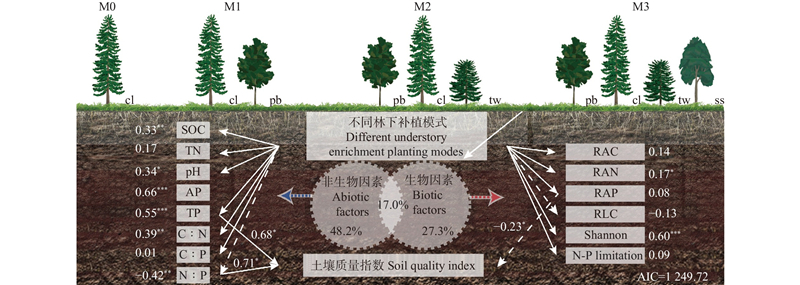
目的: 构建杉阔复层异龄混交林,评估不同林下补植模式的土壤质量变化,筛选适宜的林下补植模式,为杉木人工林土壤健康维护和可持续经营提供科学依据。方法: 在1998年营建的杉木人工林中,2014年进行第3次间伐(平均保留密度225株·hm–2),2015年设置杉木纯林对照(M0)、仅补植闽楠(M1)、补植闽楠和红豆杉(M2)、补植闽楠和红豆杉及木荷(M3)4种林下补植模式,杉木与补植树种的株数比例均为3∶7;在补植7年后的2022年,采集0~60 cm土层深度的土样,测定化学性质、胞外酶活性和细菌群落特征(16S rRNA)。选取最小数据集建立土壤质量指数(SQI)模型,采用方差分解量化生物因素(酶活性、微生物代谢限制和群落结构)和非生物因素(化学性质及其计量比)对土壤质量的贡献率,并通过结构方程模型解析“林下补植模式?土壤质量指数”之间的关系。结果: 与纯林M0相比,经林下补植形成的杉阔复层异龄混交林(M1、M2、M3)可显著改善土壤质量和微生物群落生态功能,0~20 cm土层的全氮、全磷、碱解氮、有效钾、土壤有机碳等关键养分含量提升29.87%~72.62%,其中M2的0~20 cm土层各指标增幅最大。林下补植通过优化土壤酶活性驱动碳氮磷循环,M1的土壤蔗糖酶活性、葡萄糖苷酶活性和M3的脲酶活性在0~20 cm土层达到峰值,而纯林的酸性磷酸酶活性、过氧化氢酶活性较高,反映出分解代谢路径的差异。M2的微生物磷限制平均值较纯林下降12.05%,并通过提升0~20 cm土层的氮水解酶相对活性和缓解40~60 cm土层的微生物碳限制优化养分利用策略。微生物群落分析显示,营建的复层异龄混交林可显著提高土壤微生物的Shannon多样性指数,改变酸杆菌门、变形菌门等功能菌群丰度。林下补植模式通过调控全磷(路径系数0.68)、氮磷比(0.71)及SOC(0.33)、pH值(0.34)、氮水解酶活性(0.17)和土壤微生物Shannon多样性(0.60)间接影响土壤质量。3种林下补植模式的土壤质量指数均优于纯林,其中M2的0~20 cm土层的土壤质量最高,纯林的40~60 cm土层的土壤质量最低。结论: 通过在杉木人工纯林林下补植乡土树种形成的杉阔复层异龄混交林,能够提升土壤养分水平、平衡化学计量限制、优化酶活性和微生物群落多样性,改善土壤质量,其中林下补植闽楠和红豆杉改造模式的土壤改良作用最为突出。
中图分类号:
胡宇欣,江怡航,刘振华,朱光玉,张建国,张雄清. 杉木纯林林下补植模式对土壤质量和微生物群落的影响[J]. 林业科学, 2026, 62(3): 61-73.
Yuxin Hu,Yihang Jiang,Zhenhua Liu,Guangyu Zhu,Jianguo Zhang,Xiongqing Zhang. Effects of Understory Enrichment Planting Modes in Pure Chinese fir Forests on Soil Quality and Microbial Communities[J]. Scientia Silvae Sinicae, 2026, 62(3): 61-73.

表1
浏阳湖林场样地概况①"
| 项目 Items | M1 | M2 | M3 | M0 | |||||||||||
| 样地编号 Plot No. | M1-1 | M1-2 | M1-3 | M2-1 | M2-2 | M2-3 | M3-1 | M3-2 | M3-3 | M0-1 | M0-2 | M0-3 | |||
| 树种比例 Tree species composition ratio | 3∶7∶ 0∶0 | 3∶7∶ 0∶0 | 3∶7∶ 0∶0 | 3∶5∶ 2∶0 | 3∶6∶ 1∶0 | 3∶6∶ 1∶0 | 3∶4∶ 1∶2 | 3∶2∶ 4∶1 | 3∶3∶ 3∶1 | 10∶0∶ 0∶0 | 10∶0∶ 0∶0 | 10∶0∶ 0∶0 | |||
| 坡位 Slope position | 中坡Mid-slope | 中坡Mid-slope | 中坡Mid-slope | 中坡Mid-slope | |||||||||||
| 坡向 Slope aspect | 西南Southwest | 西南Southwest | 西南Southwest | 西南Southwest | |||||||||||
| 海拔 Elevation/m | 216.11 | 160.68 | 176.61 | 163.94 | |||||||||||
| 杉木密度 Density of C. lanceolata/ (trees·hm–2) | 375 | 350 | 367 | ||||||||||||
| 杉木平均胸径 Mean DBH of C. lanceolata/cm | 23.16 | 25.20 | 22.07 | 18.46 | |||||||||||
| 杉木平均高 Mean tree height of C. lanceolata/m | 21.42 | 24.83 | 21.12 | 17.01 | |||||||||||
| 闽楠平均胸径 Mean DBH of P. bournei/cm | 4.36 | 5.82 | 5.25 | ||||||||||||
| 闽楠平均高 Mean tree height of P. bournei/m | 5.58 | 6.64 | 6.37 | ||||||||||||
| 红豆杉平均胸径 Mean DBH of T. wallichiana var. chinensis/cm | 5.99 | 5.88 | |||||||||||||
| 红豆杉平均高 Mean tree height of T. wallichiana var. chinensis/m | 5.08 | 4.82 | |||||||||||||
| 木荷平均胸径 Mean DBH of S. superba/cm | 4.49 | ||||||||||||||
| 木荷平均高 Mean tree height of S. superba/m | 5.86 | ||||||||||||||
表2
土壤化学指标与酶活性测定方法"
| 指标Index | 缩写 Abbreviation | 测定方法 Determination methods |
| 全氮 Total nitrogen | TN | 半微量凯氏定氮法Semi-micro Kjeldahl method |
| 全磷 Total phosphorus | TP | 消煮?钒钼酸铵比色法Digestion-ammonium vanadomolybdate colorimetry |
| 全钾 Total potassium | TK | 氢氧化钠熔解?火焰分光光度法Sodium hydroxide fusion-flame spectrophotometry |
| 碱解氮 Available nitrogen | AN | 碱解蒸馏法Alkali hydrolysis-distillation method |
| 有效磷 Available phosphorus | AP | 碳酸氢钠浸提?钼锑抗比色法Sodium bicarbonate extraction-molybdenum antimony anti colorimetry |
| 速效钾 Available potassium | AK | 乙酸铵浸提?火焰分光光度法Ammonium acetate extraction-flame spectrophotometry |
| pH值 pH value | pH | 水浸提电位法(水土比2.5∶1)Water extraction potentiometry (water-soil ratio 2.5∶1) |
| 有机质 Organic matter | SOM | 重铬酸钾氧化?外加热法Potassium dichromate oxidation-external heating method |
| 有效铁 Available iron | AFe | DTPA浸提?原子吸收分光光度法DTPA extraction-atomic absorption spectrophotometry |
| 土壤蔗糖酶 Soil sucrase | SUC | 3,5-二硝基水杨酸比色法3,5-dinitrosalicylic acid colorimetry |
| 葡萄糖苷酶 β-Glucosidase | GLU | 消煮?钒钼酸铵比色法Digestion-ammonium vanadomolybdate colorimetry |
| 纤维素酶 Cellulase | CEL | 3,5-二硝基水杨酸比色法3,5-dinitrosalicylic acid colorimetry |
| 酸性磷酸酶 Acid phosphatase | ACP | 磷酸苯二钠比色法Disodium phenyl phosphate colorimetry |
| 脲酶 Urease | URE | 苯酚?次氯酸钠比色法Phenol-sodium hypochlorite colorimetry |
| 过氧化氢酶 Catalase | CAT | 高锰酸钾滴定法Potassium permanganate titration |
表3
不同林下补植模式及土层的土壤化学性质与化学计量比①"
指标Index | M0 | M1 | M2 | M3 | |||||||||||
| 0~20 cm | 20~40 cm | 40~60 cm | 0~20 cm | 20~40 cm | 40~60 cm | 0~20 cm | 20~40 cm | 40~60 cm | 0~20 cm | 20~40 cm | 40~60 cm | ||||
| TN/(g·kg–1) | 0.94± 0.07bA | 1.00± 0.02abA | 0.72± 0.04bB | 1.14± 0.07aA | 1.04± 0.06aA | 0.91± 0.10aB | 1.18± 0.09aA | 0.92± 0.07bB | 0.76± 0.03bC | 1.22± 0.08aA | 0.97± 0.04abB | 0.79± 0.03bC | |||
| TP /(g·kg–1) | 0.26± 0.08bA | 0.24± 0.06bA | 0.22± 0.04bB | 0.28± 0.03bA | 0.31± 0.04abA | 0.31± 0.03bA | 0.44± 0.03aA | 0.42± 0.01aAB | 0.33± 0.05aB | 0.36± 0.07abA | 0.33± 0.10abA | 0.32± 0.08bA | |||
| TK/(g·kg–1) | 16.89± 2.04aA | 17.97± 1.37aA | 17.28± 0.72aA | 17.87± 2.23aA | 17.45± 3.68aA | 17.83± 2.52aA | 16.05± 0.85aA | 14.98± 1.25aA | 14.52± 0.29aA | 15.38± 1.66aA | 15.63± 1.82aA | 14.64± 2.50aA | |||
| AN/(mg·kg–1) | 91.85± 4.83cA | 80.11± 13.07bA | 55.18± 13.17bB | 126.46± 8.19bA | 109.24± 1.84aB | 92.64± 7.07aC | 153.08± 2.53aA | 124.67± 2.15aB | 95.17± 24.04aC | 122.83± 6.85bA | 91.94± 10.73bB | 75.47± 15.07abB | |||
| AP/(mg·kg–1) | 0.97± 0.30aA | 0.85± 0.04aA | 0.70± 0.21aA | 1.22± 0.14aA | 0.86± 0.35aA | 0.78± 0.27aA | 1.53± 0.38aA | 1.19± 0.33aAB | 0.66± 0.06aB | 1.02± 0.20aA | 0.77± 0.29aA | 0.80± 0.39aA | |||
| AK /(mg·kg–1) | 47.88± 6.23bA | 38.44± 1.51aB | 33.29± 2.62aB | 52.62± 2.99abA | 39.87± 8.30aA | 38.63± 9.24aA | 67.99± 5.62aA | 45.90± 4.92aB | 40.24± 3.52aB | 59.91± 12.52abA | 42.96± 9.78aAB | 35.53± 10.40aB | |||
| pH | 4.89± 0.09bA | 4.94± 0.13bA | 5.03± 0.09aA | 4.96± 0.08abA | 4.95± 0.04bA | 5.03± 0.01aA | 5.15± 0.12aA | 5.14± 0.05aA | 5.08± 0.12aA | 5.05± 0.04abA | 4.99± 0.06abA | 4.99± 0.03aA | |||
| AFe/(mg·kg–1) | 20.34± 3.9aA | 16.13± 5.57aA | 7.66± 2.41bB | 24.49± 3.70aA | 20.36± 3.48aA | 19.75± 4.69aA | 21.82± 1.76aB | 17.7± 1.63aB | 16.6± 1.06abA | 20.09± 4.44aA | 13.53± 3.58aAB | 10.28± 3.89bcB | |||
| SOC/(g·kg–1) | 9.5± 0.84bA | 7.07± 1.33bB | 4.36± 0.97cC | 15.19± 0.93aA | 11.58± 1.10aB | 10.29± 1.59aB | 16.4± 2.26aA | 11.98± 0.09abB | 9.18± 0.65bB | 14.53± 2.27aA | 10.27± 3.13abAB | 7.55± 1.30bB | |||
| C∶N | 10.05± 0.12bA | 7.09± 1.45bB | 6.08± 1.25bB | 13.32± 0.59abA | 11.15± 1.15aAB | 11.33± 1.13aB | 13.96± 2.52aA | 13.1± 0.91aA | 12.2± 0.60aA | 11.85± 1.09abA | 10.57± 2.74abA | 9.60± 2.02aA | |||
| N∶P | 3.73± 0.83aA | 4.38± 0.93aA | 3.36± 0.78aA | 4.08± 0.67aA | 3.46± 0.61abA | 2.96± 0.59aA | 2.68± 0.24aA | 2.34± 0.16bA | 2.31± 0.26aA | 3.52± 0.96aA | 3.15± 1.09abA | 2.59± 0.60aA | |||
| C∶P | 37.41± 7.93aA | 31.96± 12.14aA | 20.51± 6.26aA | 54.16± 7.44aA | 38.58± 7.91aB | 33.52± 7.60aB | 37.45± 8.11aA | 25.28± 0.88aB | 24.75± 3.83aB | 42.45± 15.73aA | 35.29± 21.46aA | 25.52± 11.19aA | |||
表4
不同林下补植模式及土层的土壤酶活性与土壤微生物代谢①"
| 指标 Index | M0 | M1 | M2 | M3 | |||||||||||
| 0~20 cm | 20~40 cm | 40~60 cm | 0~20 cm | 20~40 cm | 40~60 cm | 0~20 cm | 20~40 cm | 40~60 cm | 0~20 cm | 20~40 cm | 40~60 cm | ||||
| SUC | 3.11± 1.18bA | 1.25± 0.94cB | 0.58± 0.33bC | 3.31± 0.21aA | 2.40± 0.97aB | 1.61± 0.79aC | 2.59± 1.08cA | 1.25± 0.83cB | 0.97± 0.92aB | 2.17± 0.83dA | 1.53± 0.81bB | 1.19± 0.61abC | |||
| GLU | 0.74± 0.12cA | 0.37± 0.03cB | 0.21± 0.05cB | 1.02± 0.12aA | 0.84± 0.24aB | 0.78± 0.26aB | 0.95± 0.09abA | 0.56± 0.04bB | 0.46± 0.15bC | 0.88± 0.24bcA | 0.64± 0.14bB | 0.54± 0.08bB | |||
| CEL | 0.15± 0.15bB | 0.32± 0.33aA | 0.26± 0.17aAB | 0.33± 0.07aA | 0.15± 0.07bB | 0.13± 0.06bB | 0.28± 0.10aA | 0.13± 0.07bB | 0.07± 0.03bB | 0.28± 0.16aA | 0.17± 0.09bB | 0.11± 0.04bB | |||
| URE | 0.42± 0.14aA | 0.32± 0.04bA | 0.13± 0.02bB | 0.49± 0.04aA | 0.45± 0.05aA | 0.40± 0.11aA | 0.47± 0.05aA | 0.34± 0.06bB | 0.34± 0.10aB | 0.54± 0.00aA | 0.45± 0.02aAB | 0.36± 0.04aB | |||
| ACP | 1.85± 0.24aA | 1.84± 0.21aA | 1.22± 0.22cA | 1.56± 0.24cA | 1.68± 0.22bcAB | 1.67± 0.19aB | 1.66± 0.16bcA | 1.60± 0.26cA | 1.49± 0.11bB | 1.68± 0.20bA | 1.73± 0.11abAB | 1.60± 0.10aB | |||
| CAT | 2.58± 0.41aA | 1.87± 0.20bB | 1.53± 0.47cB | 2.18± 0.10bA | 1.96± 0.15bbA | 1.96± 0.33bA | 2.50± 0.38aA | 2.21± 0.68aB | 2.11± 0.63aB | 2.52± 0.45aA | 2.16± 0.56aB | 1.80± 0.70bC | |||
| RAC | 0.68± 0.19aA | 0.37± 0.34aA | –0.17± 0.61aA | 0.78± 0.02bA | 0.69± 0.12aA | 0.54± 0.20aA | 0.69± 0.17aA | 0.43± 0.23aA | 0.12± 0.47aA | 0.68± 0.12aA | 0.51± 0.23aA | 0.42± 0.17aA | |||
| RAN | 0.55± 0.35bA | –0.83± 0.22aA | –2.65± 0.92bB | –0.37± 0.05aA | –0.48± 0.11aA | –0.66± 0.29aA | –0.45± 0.13aA | –0.81± 0.20aA | –1.04± 0.47aA | –0.37± 0.13aA | –0.55± 0.11aA | –0.93± 0.22aB | |||
| RAP | 0.36± 0.12aA | 0.44± 0.14aA | 0.20± 0.21aA | 0.23± 0.08aA | 0.31± 0.10aA | 0.35± 0.10aA | 0.30± 0.09aA | 0.35± 0.14aA | 0.36± 0.12aA | 0.30± 0.06aA | 0.37± 0.09aA | 0.36± 0.02aA | |||
| EC∶EN | –1.65± 1.03aB | –0.53± 0.50aAB | 0.01± 0.26aA | –2.18± 0.22aA | –1.53± 0.67acA | –1.06± 0.89aA | –1.96± 0.97aA | –0.60± 0.46aA | –0.35± 0.82aA | –2.03± 0.94aA | –1.01± 0.30aAB | –0.50± 0.35aB | |||
| EC∶EP | 2.26± 1.55aA | 1.07± 1.16aA | 1.09± 1.26aA | 3.77± 1.19aA | 2.52± 1.3aA | 1.74± 1.10aA | 2.55± 1.30aA | 1.48± 1.13aA | 0.70± 1.85aA | 2.31± 0.72aA | 1.51± 0.93aA | 1.18± 0.52aA | |||
| EN∶EP | –1.54± 0.65aA | –1.92± 0.39abA | 3.75± 3.97aA | –1.77± 0.68aA | –1.60± 0.30aA | –1.92± 0.76aA | –1.55± 0.41aA | –2.41± 0.40bAB | –2.83± 0.85aB | –1.24± 0.35aA | –1.47± 0.06aA | –2.59± 0.55aB | |||
| RLC | 3.83± 0.78aA | 1.20± 1.26aA | 2.66± 1.38aA | 4.41± 0.89aA | 2.96± 1.47aB | 2.05± 1.39aB | 3.08± 1.59aA | 1.60± 1.23aB | 1.30± 1.58aB | 3.10± 1.07aA | 1.82± 1.11aB | 1.29± 0.61aB | |||
| N-P limitation | 127.35± 10.34aA | 118.05± 5.02aA | 135.35± 13.48aA | 121.52± 11.36aA | 122.47± 5.23aA | 119.24± 8.29aA | 113.70± 6.54bA | 112.89± 3.50bAB | 107.55± 9.64aB | 129.97± 8.98aA | 124.16± 1.02aA | 111.66± 4.62aB | |||
表5
不同林下补植模式和土层的细菌群落Alpha多样性①"
| 林下补植模式 Understory enrichment planting models | 土层深度 Soil layers/cm | Shannon | Simpson | Chao | Ace | Good’s_coverage |
| M0 | 0~20 | 8.47±0.11bA | 0.99±0.00aA | 2 732.87±129.22aA | 2 977.44±146.10aA | 0.98±0.00aA |
| 20~40 | 8.29±0.09bAB | 0.99±0.00aA | 2 582.40±56.97aA | 2 799.72±90.72aA | 0.98±0.00aA | |
| 40~60 | 8.15±0.16bB | 0.99±0.00aA | 2 554.00±145.01aA | 2 768.72±145.01aB | 0.99±0.00aA | |
| M1 | 0~20 | 8.58±0.13abA | 0.99±0.00aA | 2 598.92±149.10abA | 2 681.04±149.10bA | 0.99±0.00aA |
| 20~40 | 8.47±0.25bB | 0.99±0.00aA | 2 446.58±117.69abAB | 2 518.04±118.00bAB | 0.99±0.00aA | |
| 40~60 | 8.27±0.20bB | 0.99±0.00aA | 2 243.27±202.61bB | 2 308.59±212.31bB | 0.99±0.00aA | |
| M2 | 0~20 | 8.76±0.23aA | 0.99±0.00aA | 2 672.73±199.43abA | 2 776.64±206.03bA | 0.98±0.00aA |
| 20~40 | 8.61±0.12aA | 0.99±0.00aA | 2 552.18±118.48abA | 2 645.41±124.25abA | 0.98±0.00aA | |
| 40~60 | 8.64±0.16aA | 0.99±0.00aA | 2 578.67±111.65aA | 2 685.35±114.25aA | 0.98±0.00aA | |
| M3 | 0~20 | 8.49±0.14bA | 0.99±0.00aA | 2 607.91±198.17bA | 2 712.45±198.40bA | 0.98±0.00aA |
| 20~40 | 8.33±0.17bA | 0.99±0.00aA | 2 581.56±188.81bA | 2 688.11±193.05bA | 0.98±0.00aA | |
| 40~60 | 8.51±0.15bA | 0.99±0.00bA | 2 525.03±133.22abA | 2 623.19±138.30aA | 0.98±0.00aA |
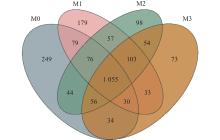
图1
不同林下补植模式的OTU水平物种分布韦恩图 M0:杉木纯林对照 Pure Chinese fir plantations;M1:仅补植闽楠 Enrichment planting with P. bournei only;M2:补植闽楠和红豆杉Enrichment planting with P. bournei and T. wallichiana var. chinensis;M3:补植闽楠、红豆杉和木荷Enrichment planting with P. bournei, T. wallichiana var. chinensis and S. superba."
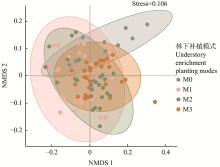
图2
细菌群落Beta多样性NMDS分析 M0:杉木纯林对照 Pure Chinese fir plantations;M1:仅补植闽楠 Enrichment planting with P. bournei only;M2:补植闽楠和红豆杉Enrichment planting with P. bournei and T. wallichiana var. chinensis;M3:补植闽楠、红豆杉和木荷Enrichment planting with P. bournei, T. wallichiana var. chinensis and S. superba."
图3
细菌群落门(a)和属(b)水平物种组成 M0:杉木纯林对照 Pure Chinese fir plantations;M1:仅补植闽楠 Enrichment planting with P. bournei only;M2:补植闽楠和红豆杉Enrichment planting with P. bournei and T. wallichiana var. chinensis;M3:补植闽楠、红豆杉和木荷Enrichment planting with P. bournei, T. wallichiana var. chinensis and S. superba."
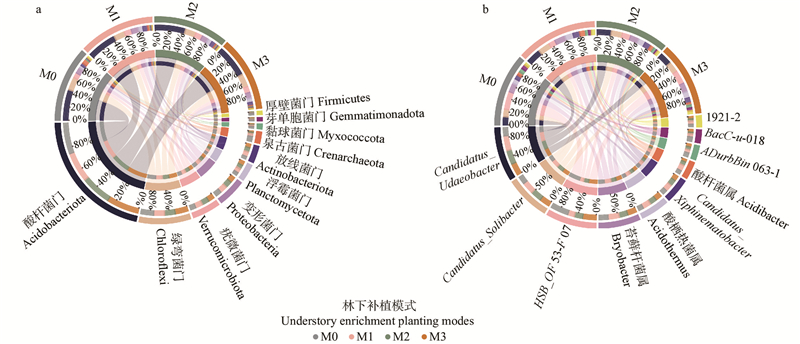
图4
不同林下补植模式的土壤质量指数 M0:杉木纯林对照 Pure Chinese fir plantations;M1:仅补植闽楠 Enrichment planting with P. bournei only;M2:补植闽楠和红豆杉Enrichment planting with P. bournei and T. wallichiana var. chinensis;M3:补植闽楠、红豆杉和木荷Enrichment planting with P. bournei, T. wallichiana var. chinensis and S. superba. 数字 1、2、3分别代表同一处理的3次生物学重复(3块样地) Numbers 1, 2, and 3 represent three biological replicates (three independent sample plots) of the same treatment. T、M、B分别表示0~20、20~40、40~60cm土层 T, M, and B represent the 0–20 cm soil layer, 20–40 cm soil layer, and 40–60 cm soil layer, respectively."
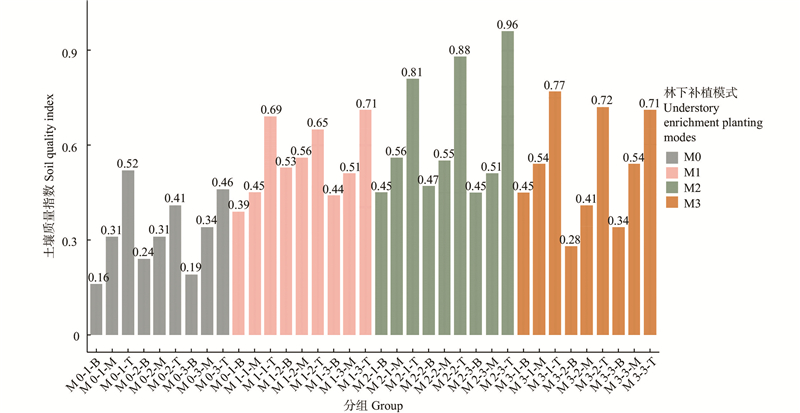
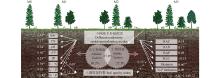
图5
不同林下补植模式–土壤质量指数的结构方程模型 cl:杉木C. lanceolata;pb:闽楠 P. bournei;tw:红豆杉: T. wallichiana var. chinensis;ss:木荷 S. superba; M0:杉木纯林对照 Pure Chinese fir plantations;M1:仅补植闽楠 Enrichment planting with P. bournei only;M2:补植闽楠和红豆杉Enrichment planting with P. bournei and T. wallichiana var. chinensis;M3:补植闽楠、红豆杉和木荷Enrichment planting with P. bournei, T. wallichiana var. chinensis and S. superba. TN:全氮Total nitrogen;TP:全磷Total phosphorus;AP:有效磷Available phosphorus;SOC:有机质Soil organic carbon;C∶N:土壤碳氮比Soil C∶N ratio;N∶P:土壤碳氮比Soil N∶P ratio;C∶P:土壤碳磷比soil C∶P ratio;RAC:碳元素水解酶相对活性Relative activity of carbon-hydrolyzing enzyme;RAN:氮元素水解酶相对活性Relative activity of nitrogen-hydrolyzing enzyme;RAP:磷元素水解酶相对活性Relative activity of phosphorus-hydrolyzing enzyme;RLC:微生物碳限制相对程度 Relative limitation of microbial carbon;N-P limitation:氮磷限制 Nitrogen-to-phosphorus limitation ratio. * P < 0.05, ** P < 0.01, *** P < 0.001."
|
艾 灵, 吴福忠, 樊雪波, 等. 米槠和杉木人工林土壤酶活性和酶化学计量特征对凋落物输入的短期响应. 应用生态学报, 2024, 35 (3): 631- 638.
doi: 10.13287/j.1001-9332.202403.014 |
|
|
Ai L, Wu F Z, Fan X B, et al. Short-term responses of soil enzyme activities and stoichiometry to litter input in Castanopsis carlesii and Cunninghamia lanceolata plantations. Chinese Journal of Applied Ecology, 2024, 35 (3): 631- 638.
doi: 10.13287/j.1001-9332.202403.014 |
|
| 鲍士旦. 2000. 土壤农化分析. 3版. 北京: 中国农业出版社. | |
| Bao S D. 2000. Soil and agricultural chemistry analysis. 3rd ed. Beijing: China Agriculture Press. [in Chinese] | |
|
陈利云, 王弋博, 李三相, 等. 甘肃省麦积山景区 3 种典型裸子植物土壤微生物群落结构分析. 微生物学通报, 2016, 43 (9): 1939- 1944.
doi: 10.13344/j.microbiol.china.150797 |
|
|
Chen L Y, Wang Y B, Li S X, et al. Microbial community structure of three typical gymnosperms soil in scenic area of Maijishan, Gansu Province.. Microbiology China, 2016, 43 (9): 1939- 1944.
doi: 10.13344/j.microbiol.china.150797 |
|
|
陈 蓉, 王韦韦, 曹丽荣, 等. 马尾松和杉木人工林细根碳氮磷化学计量特征随土层深度的变化. 生态学报, 2023, 43 (9): 3709- 3718.
doi: 10.5846/stxb202203250740 |
|
|
Chen R, Wang W W, Cao L R, et al. Variation of carbon, nitrogen and phosphorus stoichiometric characteristics of fine roots in Masson pine and Chinese fir plantations with soil depth. Acta Ecologica Sinica, 2023, 43 (9): 3709- 3718.
doi: 10.5846/stxb202203250740 |
|
|
杜 菁, 郑亚威, 杨孜奕, 等. 近自然改造模式下闽楠根际土壤微生物群落对杉木间伐保留密度的响应. 应用与环境生物学报, 2025, 31 (3): 441- 451.
doi: 10.19675/j.cnki.1006-687x.2024.02005 |
|
|
Du J, Zheng Y W, Yang Z Y, et al. Response of soil rhizosphere microbes in Phoebe bournei to the Cunninghamia lanceolata thinning retention density under close-to-natural transformation.. Chinese Journal of Applied and Environmental Biology, 2025, 31 (3): 441- 451.
doi: 10.19675/j.cnki.1006-687x.2024.02005 |
|
| 关松荫. 土壤酶活性影响因子的研究: I. 有机肥料对土壤中酶活性及氮磷转化的影响. 土壤学报, 1989, 26 (1): 72- 78. | |
| Guan S Y. Study on influencing factors of soil enzyme activity: I. Effects of organic fertilizer on soil enzyme activity and nitrogen and phosphorus conversion. Acta Pedologica Sinica, 1989, 26 (1): 72- 78. | |
|
厚凌宇, 徐道礼, 徐秀贤, 等. 盐胁迫对不同种类红豆杉生长的影响及其应对方案. 林业科技通讯, 2024 (9): 83- 88.
doi: 10.13456/j.cnki.lykt.2024.05.27.0002 |
|
|
Hou L Y, Xu D L, Xu X X, et al. Effects of salt stress on growth of different Taxus species and coping schemes. Forest Science and Technology, 2024 (9): 83- 88.
doi: 10.13456/j.cnki.lykt.2024.05.27.0002 |
|
| 焦泽南. 2025,. 抚育间伐对杉木人工林林分生长与土壤肥力的影响.. 长沙: 中南林业科技大学. | |
| Jiao Z N. 2025,. Effects of tending thinning on stand growth and soil fertility of Chinese fir plantations.. Changsha: Central South University of Forestry and Technology. [in Chinese] | |
|
姜 俊, 刘宪钊, 贾宏炎, 等. 杉木人工林近自然化改造对林下植被多样性和土壤理化性质的影响. 北京林业大学学报, 2019, 41 (5): 170- 177.
doi: 10.13332/j.1000-1522.20190022 |
|
|
Jiang J, Liu X Z, Jia H Y et al. Effects of stand density on understory species diversity and soil physicochemical properties after close–to–nature transformation management of Chinese fir plantation. Journal of Beijing Forestry University, 2019, 41 (5): 170- 177.
doi: 10.13332/j.1000-1522.20190022 |
|
| 梅俊卿. 2025,. 间伐对杉木根际土壤微生物和代谢物的影响.. 长沙: 中南林业科技大学. | |
| Mei J Q. 2025,. The impact of thinning on soil microorganisms and metabolites in the rhizosphere of Chinese fir plantations. .Changsha: Central South University of Forestry and Technology.[in Chinese] | |
|
屈彦成, 江怡航, 陈涵玥, 等. 杉木人工林林分叶面积动态变化规律. 生态学报, 2024, 44 (13): 5609- 5620.
doi: 10.20103/j.stxb.202304280901 |
|
|
Qu Y C, Jiang Y H, Chen H Y, et al. Dynamic change of stand leaf area for Chinese fir plantation. Acta Ecologica Sinica, 2024, 44 (13): 5609- 5620.
doi: 10.20103/j.stxb.202304280901 |
|
|
盛炜彤. 关于我国人工林长期生产力的保持. 林业科学研究, 2018, 31 (1): 1- 14.
doi: 10.13275/j.cnki.lykxyj.2018.01.001 |
|
|
Sheng W T. On the maintenance of long-term productivity of plantation in China. Forest Research, 2018, 31 (1): 1- 14.
doi: 10.13275/j.cnki.lykxyj.2018.01.001 |
|
| 苏志才. 树种间相互关系分析与混交造林树种选择. 林业科学, 1990, 368- 373. | |
| Su Z C. Analysis on the correlation and selection of tree species for mixed forest. Scientia Silvae Sinicae, 1990, 368- 373. | |
| 王旦媚. 2022,. 金洞林场闽楠人工林近自然改造最适密度研究.. 长沙: 中南林业科技大学. | |
| Wang D M. 2022,. Study on the optimal density of close-to-nature transformation of Phoebe bournei plantations in Jindong forest farm. Changsha: Central South University of Forestry and Technology. [in Chinese] | |
|
魏书蒙, 陈详腾, 赵光宇, 等. 杉木人工林近自然改造对土壤化学性质及酶活性的影响. 生态学报, 2024, 44 (10): 4277- 4287.
doi: 10.20103/j.stxb.202309111951 |
|
|
Wei S M, Chen X T, Zhao G Y, et al. Effects of close-to-nature transformation of Chinese fir plantation on soil chemical properties and enzyme activities. Acta Ecologica Sinica, 2024, 44 (10): 4277- 4287.
doi: 10.20103/j.stxb.202309111951 |
|
|
谢阳生, 孟京辉, 曾 冀, 等. 马尾松人工纯林近自然化改造效果分析. 林业科学研究, 2023, 36 (2): 31- 38.
doi: 10.12403/j.1001-1498.20220459 |
|
|
Xie Y S, Meng J H, Zeng J, et al. Analysis on the effect of close-to-nature transformation of Pinus massoniana pure forest plantation. Forest Research, 2023, 36 (2): 31- 38.
doi: 10.12403/j.1001-1498.20220459 |
|
|
Andrews S S, Karlen D L, Cambardella C A. The soil management assessment framework. Soil Science Society of America Journal, 2004, 68, 1945- 1962.
doi: 10.2136/sssaj2004.1945 |
|
|
Blattert C, Mutterer S, Thrippleton T, et al. Managing European Alpine forests with close-to-nature forestry to improve climate change mitigation and multifunctionality. Ecological Indicators, 2024, 165, 112154.
doi: 10.1016/j.ecolind.2024.112154 |
|
|
Bogati K, Walczak M. The impact of drought stress on soil microbial community, enzyme activities and plants. Agronomy, 2022, 12 (1): 189.
doi: 10.3390/agronomy12010189 |
|
|
Brown H C A, Appiah M, Berninger F A. Old timber plantations and secondary forests attain levels of plant diversity and structure similar to primary forests in the West African humid tropics. Forest Ecology and Management, 2022, 518, 120271.
doi: 10.1016/j.foreco.2022.120271 |
|
|
Bu W S, Gu H J, Zhang C C, et al. Mixed broadleaved tree species increases soil phosphorus availability but decreases the coniferous tree nutrient concentration in subtropical China. Forests, 2020, 11 (4): 461.
doi: 10.3390/f11040461 |
|
|
Caporaso J G, Kuczynski J, Stombaugh J, et al. QIIME allows analysis of high-throughput community sequencing data. Nature Methods, 2010, 7 (5): 335- 336.
doi: 10.1038/nmeth.f.303 |
|
|
Chen S F, Zhou Y Q, Chen Y R, et al. Fastp: an ultra-fast all-in-one FASTQ preprocessorOpen access. Bioinformatics, 2018, 34 (17): i884- i890.
doi: 10.1093/bioinformatics/bty560 |
|
|
Chen X T, Zhao G Y, Li Y L, et al. Close-to-nature management shifts soil phosphorus availability and P-cycling genes in Chinese fir systems. Plant and Soil, 2024, 504 (1): 333- 346.
doi: 10.1007/s11104-024-06629-3 |
|
|
Dengiz O. Soil quality index for paddy fields based on standard scoring functions and weight allocation method. Archives of Agronomy and Soil Science, 2020, 66 (3): 301- 315.
doi: 10.1080/03650340.2019.1610880 |
|
|
Ding K, Zhang Y T, Wang L, et al. Forest conversion from pure to mixed Cunninghamia lanceolata plantations enhances soil multifunctionality, stochastic processes, and stability of bacterial networks in subtropical southern China. Plant and Soil, 2023, 488 (1): 411- 429.
doi: 10.1007/s11104-023-05983-y |
|
|
Ding K, Zhang Y T, Yrjälä K, et al. The introduction of Phoebe bournei into Cunninghamia lanceolata monoculture plantations increased microbial network complexity and shifted keystone taxa. Forest Ecology and Management, 2022, 509, 120072.
doi: 10.1016/j.foreco.2022.120072 |
|
|
Dong W Y, Zhang X Y, Liu X Y, et al. Responses of soil microbial communities and enzyme activities to nitrogen and phosphorus additions in Chinese fir plantations of subtropical China. Biogeosciences, 2015, 12 (18): 5537- 5546.
doi: 10.5194/bg-12-5537-2015 |
|
|
Edgar R C. UPARSE: highly accurate OTU sequences from microbial amplicon reads. Nature Methods, 2013, 10 (10): 996- 998.
doi: 10.1038/nmeth.2604 |
|
|
Frossard E, Condron L M, Oberson A, et al. Processes governing phosphorus availability in temperate soils. Journal of Environmental Quality, 2000, 29 (1): 15- 23.
doi: 10.2134/jeq2000.00472425002900010003x |
|
|
Gao Y, He N P, Yu G R, et al. Long-term effects of different land use types on C, N, and P stoichiometry and storage in subtropical ecosystems: a case study in China. Ecological Engineering, 2014, 67, 171- 181.
doi: 10.1016/j.ecoleng.2014.03.013 |
|
|
Guo J H, Feng H L, McNie P, et al. Species mixing improves soil properties and enzymatic activities in Chinese fir plantations: a meta-analysis. Catena, 2023, 220, 106723.
doi: 10.1016/j.catena.2022.106723 |
|
|
Hu W T, Chen J R, Liu M Y, et al. Mixing with Schima superba enhanced soil fertility and simplified soil microbial community of Eucalyptus urophylla forests. Journal of Soil Science and Plant Nutrition, 2024, 24 (3): 5972- 5987.
doi: 10.1007/s42729-024-01954-z |
|
|
Lei J, Wu H B, Li X Y, et al. Response of rhizosphere bacterial communities to near-natural forest management and tree species within Chinese fir plantations. Microbiology Spectrum, 2023, 11, e02328- 22.
doi: 10.1128/spectrum.02328-22 |
|
|
Li Q, Xu M, Liu G, et al. Cumulative effects of a 17‐year chemical fertilization on the soil quality of cropping system in the Loess Hilly Region, China. Journal of Plant Nutrition and Soil Science, 2013, 176 (2): 249- 259.
doi: 10.1002/jpln.201100395 |
|
|
Li W Y, Sun H M, Cao M M, et al. Diversity and structure of soil microbial communities in Chinese fir plantations and Cunninghamia lanceolata–Phoebe bournei mixed forests at different successional stages. Forests, 2023, 14 (10): 1977.
doi: 10.3390/f14101977 |
|
|
Li X, Zhang Y, Song S M, et al. Bacterial diversity patterns differ in different patch types of mixed forests in the upstream area of the Yangtze River Basin. Applied Soil Ecology, 2021, 161, 103868.
doi: 10.1016/j.apsoil.2020.103868 |
|
|
Li Y Q, Ma J W, Li Y J, et al. Microbial community and enzyme activity respond differently to seasonal and edaphic factors in forest and grassland ecosystems. Applied Soil Ecology, 2024, 194, 105167.
doi: 10.1016/j.apsoil.2023.105167 |
|
|
Lladó S, López-Mondéjar R, Baldrian P. Forest soil bacteria: diversity, involvement in ecosystem processes, and response to global change. Microbiology and Molecular Biology Reviews, 2017, 81 (2): e00063- 16.
doi: 10.1128/mmbr.00063-16 |
|
|
Lu D, Zhu J, Wu D, et al. Detecting dynamics and variations of crown asymmetry induced by natural gaps in a temperate secondary forest using terrestrial laser scanning. Forest Ecology and Management, 2020, 473, 118289.
doi: 10.1016/j.foreco.2020.118289 |
|
|
Ma S H, Chen G P, Tang W G, et al. Inconsistent responses of soil microbial community structure and enzyme activity to nitrogen and phosphorus additions in two tropical forests. Plant and Soil, 2021, 460 (1): 453- 468.
doi: 10.1007/s11104-020-04805-9 |
|
|
Magoč T, Salzberg S L. FLASH: fast length adjustment of short reads to improve genome assembliesFree. Bioinformatics, 2011, 27 (21): 2957- 2963.
doi: 10.1093/bioinformatics/btr507 |
|
|
Ming A G, Yang Y J, Liu S R, et al. A decade of close-to-nature transformation alters species composition and increases plant community diversity in two coniferous plantations. Frontiers in Plant Science, 2020, 11, 1141.
doi: 10.3389/fpls.2020.01141 |
|
|
Moorhead D L, Sinsabaugh R L, Hill B H, et al. Vector analysis of ecoenzyme activities reveal constraints on coupled C, N and P dynamics. Soil Biology and Biochemistry, 2016, 93, 1- 7.
doi: 10.1016/j.soilbio.2015.10.019 |
|
|
Pan C, Sun C C, Qu X J, et al. Microbial community interactions determine the mineralization of soil organic phosphorus in subtropical forest ecosystems. Microbiology Spectrum, 2024, 12 (3): e01355- 23.
doi: 10.1128/spectrum.01355-23 |
|
|
Pribyl D W. A critical review of the conventional SOC to SOM conversion factor. Geoderma, 2010, 156 (3/4): 75- 83.
doi: 10.1016/j.geoderma.2010.02.003 |
|
|
Segata N, Izard J, Waldron L, et al. Metagenomic biomarker discovery and explanation. Genome Biology, 2011, 12 (6): R60.
doi: 10.1186/gb-2011-12-6-r60 |
|
|
Shang Q Y, Ling N, Feng X M, et al. Soil fertility and its significance to crop productivity and sustainability in typical agroecosystem: a summary of long-term fertilizer experiments in China. Plant and Soil, 2014, 381 (1): 13- 23.
doi: 10.1007/s11104-014-2089-6 |
|
|
Shen F F, Wu J P, Fan H B, et al. Soil N/P and C/P ratio regulate the responses of soil microbial community composition and enzyme activities in a long-term nitrogen loaded Chinese fir forest. Plant and Soil, 2019, 436 (1): 91- 107.
doi: 10.1007/s11104-018-03912-y |
|
|
Sinsabaugh R L, Hill B H, Follstad Shah J J. Ecoenzymatic stoichiometry of microbial organic nutrient acquisition in soil and sediment. Nature, 2009, 462 (7274): 795- 798.
doi: 10.1038/nature08632 |
|
|
Spiecker H. Silvicultural management in maintaining biodiversity and resistance of forests in Europe: temperate zone. Journal of Environmental Management, 2003, 67 (1): 55- 65.
doi: 10.1016/S0301-4797(02)00188-3 |
|
|
Wang Q K, Wang S L. Soil microbial properties and nutrients in pure and mixed Chinese fir plantations. Journal of Forestry Research, 2008, 19 (2): 131- 135.
doi: 10.1007/s11676-008-0022-7 |
|
|
Wang Q, Garrity G M, Tiedje J M, et al. Naïve Bayesian classifier for rapid assignment of rRNA sequences into the new bacterial taxonomy. Applied and Environmental Microbiology, 2007, 73 (16): 5261- 5267.
doi: 10.1128/AEM.00062-07 |
|
|
Wu H L, Xiang W H, Chen L, et al. Soil phosphorus bioavailability and recycling increased with stand age in Chinese fir plantations. Ecosystems, 2020, 23 (5): 973- 988.
doi: 10.1007/s10021-019-00450-1 |
|
|
Xiao W, Chen X, Jing X, et al. A meta-analysis of soil extracellular enzyme activities in response to global change. Soil Biology and Biochemistry, 2018, 123, 21- 32.
doi: 10.1016/j.soilbio.2018.05.001 |
|
|
Xu C Y, Du C, Jian J S, et al. The interplay of labile organic carbon, enzyme activities and microbial communities of two forest soils across seasons. Scientific Reports, 2021, 11, 5002.
doi: 10.1038/s41598-021-84217-6 |
|
|
Yang Z J, Chen S D, Liu X, et al. Loss of soil organic carbon following natural forest conversion to Chinese fir plantation. Forest Ecology and Management, 2019, 449, 117476.
doi: 10.1016/j.foreco.2019.117476 |
|
|
Yemefack M, Jetten V G, Rossiter D G. Developing a minimum data set for characterizing soil dynamics in shifting cultivation systems. Soil and Tillage Research, 2006, 86 (1): 84- 98.
doi: 10.1016/j.still.2005.02.017 |
| [1] | 郭江涛,彭晶晶,马鑫,刘帆,夏永秀. 北方沙地杨树人工林对常规与滴灌施肥的响应[J]. 林业科学, 2025, 61(10): 135-145. |
| [2] | 吕梓晴, 段爱国. 不同产区杉木生物量与碳储量模型[J]. 林业科学, 2024, 60(2): 1-11. |
| [3] | 刘相荣,孙启武,厚凌宇,庞忠义,张琰琳,丁昌俊. 松辽平原杨树人工林土壤微生物群落结构及其功能多样性的林龄差异[J]. 林业科学, 2024, 60(11): 25-36. |
| [4] | 盖旭,张健,吕衡,黄志远,李巧玲,钟哲科,卞方圆,张小平. 雷竹林下养鸡对土壤活性有机碳及碳库管理指数的影响[J]. 林业科学, 2023, 59(12): 78-86. |
| [5] | 杨承栋. 发展有群落结构混交林是维护、恢复和提高森林土壤功能实现人工林可持续经营的关键技术[J]. 林业科学, 2022, 58(8): 26-40. |
| [6] | 陈嘉琪,赵光宇,李仰龙,董玉红,厚凌宇,焦如珍. 杉木人工林土壤磷素形态及含量的林龄变化[J]. 林业科学, 2022, 58(5): 10-17. |
| [7] | 王淑真,梁晶晶,包明琢,潘菲,周垂帆. 不同林龄杉木林土壤磷形态与解磷菌变化[J]. 林业科学, 2022, 58(2): 58-69. |
| [8] | 曹俐,王阳,杨蕴力,郑雨,王伟,刘桂丰,姜静. 转BpGLK裂叶桦生长变异、根际土壤酶活性及微生物群落组成[J]. 林业科学, 2022, 58(12): 21-31. |
| [9] | 谢云,郭芳芸,陈丽华,曹兵. 大气CO2浓度升高对宁夏枸杞根区土壤微生物功能多样性及碳源利用特征的影响[J]. 林业科学, 2021, 57(4): 163-172. |
| [10] | 李益,冯秀秀,赵发珠,郭垚鑫,王俊,任成杰. 秦岭太白山不同海拔锐齿栎林土壤微生物群落的变化特征[J]. 林业科学, 2021, 57(12): 22-31. |
| [11] | 任玉连,陆梅,曹乾斌,李聪,冯峻,王志胜. 南滚河自然保护区森林土壤酶活性对海拔升高的响应[J]. 林业科学, 2020, 56(4): 22-34. |
| [12] | 胡华英, 张虹, 曹升, 殷丹阳, 周垂帆, 何宗明. 杉木人工林土壤施用生物炭对细菌群落结构及多样性的影响[J]. 林业科学, 2019, 55(8): 184-193. |
| [13] | 王超群, 焦如珍, 董玉红, 厚凌宇, 赵京京, 赵世荣. 不同林龄杉木人工林土壤微生物群落代谢功能差异[J]. 林业科学, 2019, 55(5): 36-45. |
| [14] | 刘辉, 吴小芹, 任嘉红, 陈丹. 荧光假单胞菌与红绒盖牛肝菌共接种对杨树根际土壤酶活性及微生物多样性的影响[J]. 林业科学, 2019, 55(1): 22-30. |
| [15] | 杨安娜, 陆云峰, 张俊红, 吴家森, 徐金良, 童再康. 杉木人工林土壤养分及酸杆菌群落结构变化[J]. 林业科学, 2019, 55(1): 119-127. |
| 阅读次数 | ||||||
|
全文 |
|
|||||
|
摘要 |
|
|||||

