
林业科学 ›› 2026, Vol. 62 ›› Issue (7): 240-252.doi: 10.11707/j.1001-7488.LYKX20250728
• 综合评述 • 上一篇
吴小婷1,2,焦洁洁3,4,许崇华1,2,赫凤彩1,2,徐侠1,2,*( )
)
收稿日期:2025-12-04
出版日期:2026-07-10
发布日期:2026-07-16
通讯作者:
徐侠
E-mail:xuxia.1982@outlook.com
基金资助:
Xiaoting Wu1,2,Jiejie Jiao3,4,Chonghua Xu1,2,Fengcai He1,2,Xia Xu1,2,*()
Received:2025-12-04
Online:2026-07-10
Published:2026-07-16
Contact:
Xia Xu
E-mail:xuxia.1982@outlook.com
摘要:
森林土壤有机碳是陆地生态系统碳库的重要组成部分,其变化关系到生态系统碳平衡和气候变化应对能力。抚育间伐作为重要的森林经营措施,可通过调节林分结构、微环境条件和植物?微生物互作过程,影响土壤有机碳的输入、转化与稳定。近年来,国内外学者围绕抚育间伐对森林土壤有机碳的影响开展大量研究,但相关认识仍较分散。本研究系统梳理不同间伐强度、恢复阶段和森林类型下土壤有机碳的响应特征及其调控机制。轻度间伐对土壤有机碳含量和碳储量的影响通常不显著,中度间伐总体上有利于土壤有机碳含量和碳储量的积累,重度间伐则可能导致土壤有机碳含量和碳储量增加或减少。间伐后短期内土壤有机碳含量和碳储量多呈下降趋势,中长期则表现为持续增加或逐渐趋于新的稳态。针叶林和针阔混交林土壤有机碳含量和碳储量对间伐的响应多表现为增加或无显著变化,而阔叶林则可能表现为增加、减少或无显著变化。这些差异主要与间伐对森林土壤碳输入和碳输出过程的综合调节有关。未来,应加强长期定位观测与模型研究的结合,优化不同立地和经营条件下的间伐措施设计,并深化土壤碳汇功能与生态系统多功能性的耦合研究,以进一步揭示间伐影响森林土壤有机碳的作用机制。
中图分类号:
吴小婷,焦洁洁,许崇华,赫凤彩,徐侠. 抚育间伐影响森林土壤有机碳的研究进展[J]. 林业科学, 2026, 62(7): 240-252.
Xiaoting Wu,Jiejie Jiao,Chonghua Xu,Fengcai He,Xia Xu. Research Progress on the Effects of Thinning on Forest Soil Organic Carbon[J]. Scientia Silvae Sinicae, 2026, 62(7): 240-252.
图1
轻度(a)、中度(b)和重度(c)抚育间伐对土壤有机碳的影响机制 箭头向上、向下分别表示显著上升、下降,没标注表示无显著影响。Arrows pointing up and down denote significant increase and significant decrease, respectively; unmarked items indicate no significant effect."
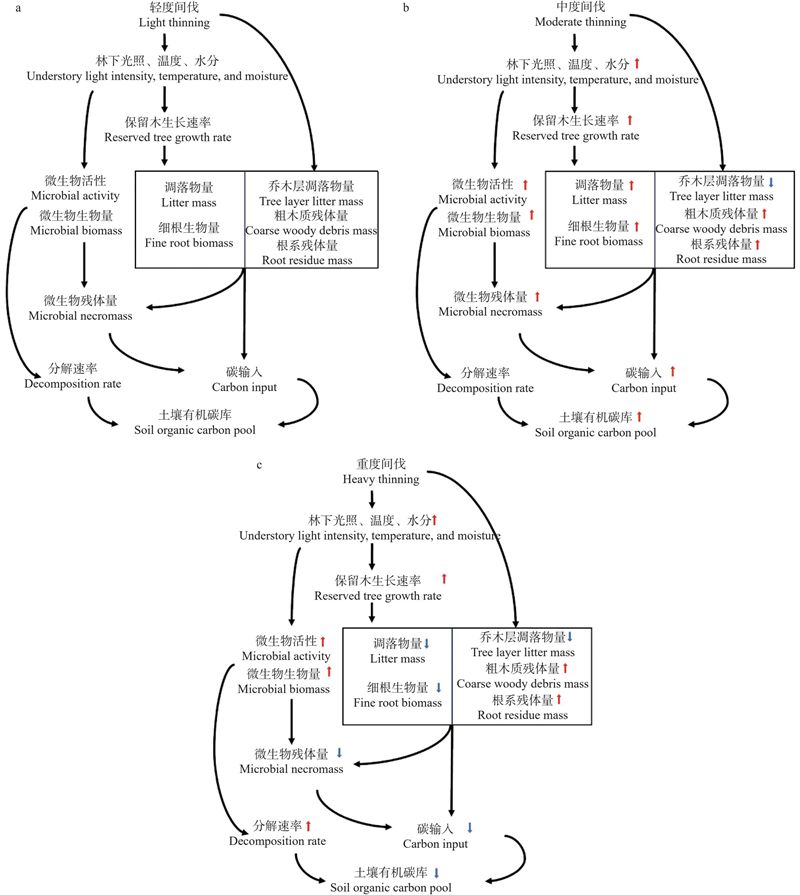
图2
抚育间伐后短期(a)、中长期恢复(b)对土壤有机碳的影响机制 箭头向上、向下分别表示显著上升、下降,未标注表示无显著影响Arrows pointing up and down denote significant increase and significant decrease, respectively; unmarked items indicate no significant effect."
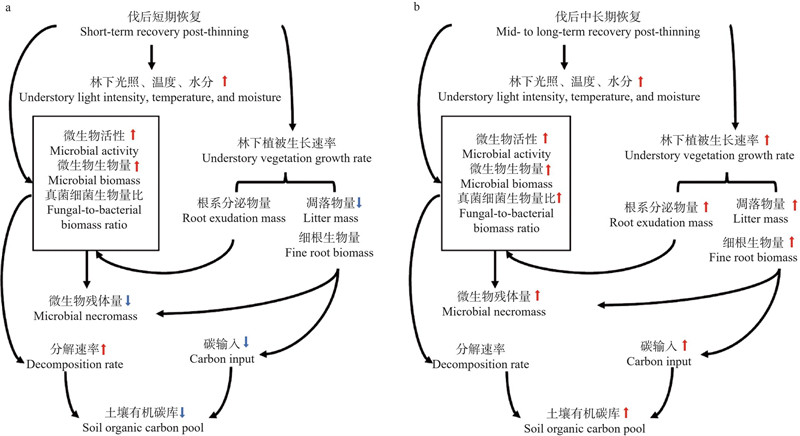
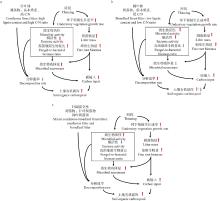
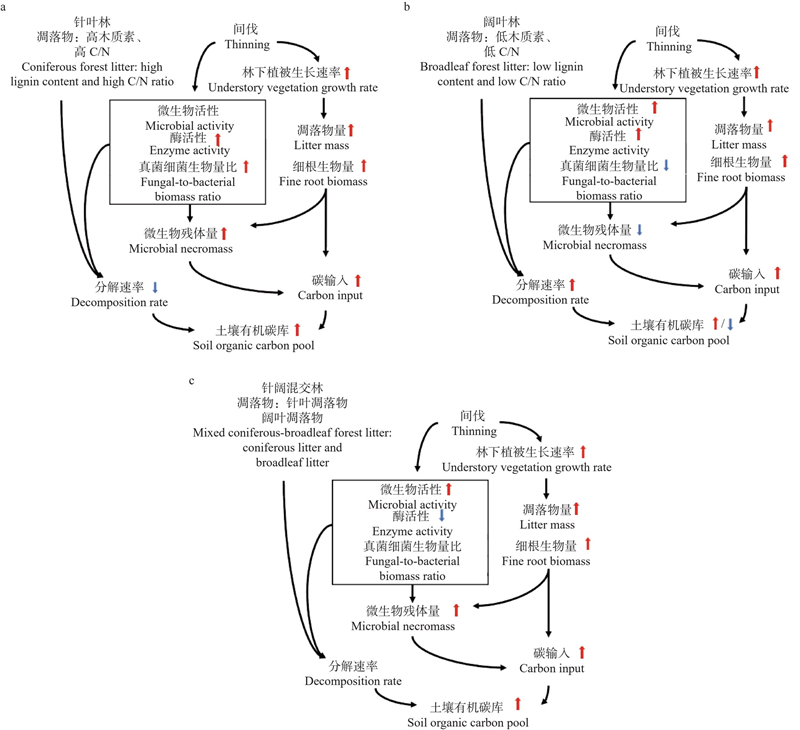
图3
抚育间伐对针叶林(a)、阔叶林(b)和针阔混交林(c)土壤有机碳的影响机制 箭头向上、向下表示显著上升、下降,无显著影响没有进行标注Arrows pointing up and down denote significant increase and significant decrease, respectively; unmarked items indicate no significant effect."
|
曹 立, 王维枫, 马雪红, 等. 间伐对秦岭松栎混交林土壤异养呼吸的影响. 浙江农林大学学报, 2024, 41 (1): 22- 29.
doi: 10.11833/j.issn.2095-0756.20230193 |
|
|
Cao L, Wang W F, Ma X H, et al. Effects of thinning on soil heterotrophic respiration of oak-pine mixed forests in Qinling Mountains. Journal of Zhejiang A& F University, 2024, 41 (1): 22- 29.
doi: 10.11833/j.issn.2095-0756.20230193 |
|
| 曹 正, 苏宝玲, 张岩松, 等. 抚育间伐对辽东山区日本落叶松人工林碳储量及其组成的影响. 应用生态学报, 2025, 36 (7): 1991- 1999. | |
| Cao Z, Su B L, Zhang Y S, et al. Effects of thinning on carbon stocks and fractions of Larix kaempferi plantation in eastern area of Liaoning Province, China. Chinese Journal of Applied Ecology, 2025, 36 (7): 1991- 1999. | |
|
陈炎根, 胡艳静, 黄 莎, 等. 不同间伐强度对杉木人工林土壤呼吸速率的短期影响. 浙江农林大学学报, 2023, 40 (5): 1054- 1062.
doi: 10.11833/j.issn.2095-0756.20220704 |
|
|
Chen Y G, Hu Y J, Huang S, et al. Short-term effects of different thinning intensities on soil respiration rate in the Cunninghamia lanceolata plantation. Journal of Zhejiang A& F University, 2023, 40 (5): 1054- 1062.
doi: 10.11833/j.issn.2095-0756.20220704 |
|
|
成向荣, 虞木奎, 葛 乐, 等. 不同间伐强度下麻栎人工林碳密度及其空间分布. 应用生态学报, 2012, 23 (5): 1175- 1180.
doi: 10.13287/j.1001-9332.2012.0162 |
|
|
Cheng X R, Yu M K, Ge L, et al. Carbon density and its spatial distribution in Quercus acutissima plantations under different thinning intensities. Chinese Journal of Applied Ecology, 2012, 23 (5): 1175- 1180.
doi: 10.13287/j.1001-9332.2012.0162 |
|
|
邓送求, 闫家锋, 王 宇, 等. 间伐强度对不同林分类型下层物种多样性的短期影响. 东北林业大学学报, 2010, 38 (3): 31- 33, 46.
doi: 10.3969/j.issn.1000-5382.2010.03.010 |
|
|
Deng S Q, Yan J F, Wang Y, et al. Short-term effects of thinning intensity on species diversity of undergrowth layer in different stands. Journal of Northeast Forestry University, 2010, 38 (3): 31- 33, 46.
doi: 10.3969/j.issn.1000-5382.2010.03.010 |
|
| 刁娇娇, 肖文娅, 费 菲, 等. 间伐对杉木人工林生长及生态系统碳储量的短期影响. 西南林业大学学报, 2017, 37 (3): 134- 139. | |
| Diao J J, Xiao W Y, Fei F, et al. Short effect of thinning on the growth and carbon storage of Cunninghamia lanceolata plantation. Journal of Southwest Forestry University, 2017, 37 (3): 134- 139. | |
|
丁 波, 丁贵杰, 李先周, 等. 短期间伐对杉木人工林生态系碳储量的影响. 中南林业科技大学学报, 2016, 36 (8): 66- 71.
doi: 10.12302/j.issn.1000-2006.202106021 |
|
|
Ding B, Ding G J, Li X Z, et al. Effects of short-term thinning on the carbon storage in Cunninghamia lanceolata plantation ecosystem. Journal of Central South University of Forestry & Technology, 2016, 36 (8): 66- 71.
doi: 10.12302/j.issn.1000-2006.202106021 |
|
|
董莉莉, 刘红民, 汪成成, 等. 间伐对蒙古栎次生林生态系统碳储量的短期和长期影响. 沈阳农业大学学报, 2019, 50 (5): 614- 620.
doi: 10.3969/j.issn.1000-1700.2019.05.014 |
|
|
Dong L L, Liu H M, Wang C C, et al. Short-term and long-term effects of thinning on carbon storage of Quercus mongolica secondary forests. Journal of Shenyang Agricultural University, 2019, 50 (5): 614- 620.
doi: 10.3969/j.issn.1000-1700.2019.05.014 |
|
| 杜 雪, 王海燕, 邹佳何, 等. 长白山北坡云冷杉阔叶混交林土壤有机碳分布特征及其影响因素. 生态环境学报, 2022, 31 (4): 663- 669. | |
| Du X, Wang H Y, Zou J H, et al. Distribution characteristics and influencing factors of soil organic carbon in spruce-fir broad-leaved mixed forest on north slope of Changbai Mountains. Ecology and Environment Sciences, 2022, 31 (4): 663- 669. | |
|
段梦成, 王国梁, 史君怡, 等. 间伐对油松人工林碳储量的长期影响. 水土保持学报, 2018, 32 (5): 190- 196.
doi: 10.13870/j.cnki.stbcxb.2018.05.031 |
|
|
Duan M C, Wang G L, Shi J Y, et al. Long-term effects of thinning on carbon storage in Pinus tabulae formis plantations. Journal of Soil and Water Conservation, 2018, 32 (5): 190- 196.
doi: 10.13870/j.cnki.stbcxb.2018.05.031 |
|
| 龚映匀, 王瑞辉, 张 斌, 等. 2020. 抚育间伐对川西柳杉人工林生长和土壤有机碳的影响. 林业资源管理, (6): 96−104. | |
| Gong Y Y, Wang R H, Zhang B, et al. 2020. Effects of thinning on growth and soil organic carbon of Cryptomeria fortunei plantation in Western Sichuan. Forest Resources Management, (6): 96−104. [in Chinese] | |
| 郝 磊. 2019. 不同经营措施下的华北落叶松人工林土壤有机碳及养分特征. 北京: 北京林业大学. | |
| Hao L. 2019. Characteristics of soil organic carbon and nutrients in Larix principis-rupprechtii plantations under different management measures. Beijing: Beijing Forestry University. [in Chinese] | |
| 何传龙. 2014. 不同间伐强度对柏木低效人工林土壤有机碳的初期影响. 雅安: 四川农业大学. | |
| He C L. 2014. Initial effects of different thinning intensities on soil organic carbon in low-efficiency Cupressus funebris plantations. Yaan: Sichuan Agricultural University. [in Chinese] | |
| 何 姗, 刘 娟, 姜培坤, 等. 经营管理对森林土壤有机碳库影响的研究进展. 浙江农林大学学报, 2019, 36 (4): 818- 827. | |
| He S, Liu J, Jiang P K, et al. Effects of forest management on soil organic carbon pool: a review. Journal of Zhejiang A& F University, 2019, 36 (4): 818- 827. | |
|
胡 澳, 赵毅辉, 吴继来, 等. 采伐后植被自然恢复对马尾松次生林土壤有机碳及其活性组分的影响. 浙江农林大学学报, 2024, 41 (6): 1189- 1200.
doi: 10.11833/j.issn.2095-0756.20240264 |
|
|
Hu A, Zhao Y H, Wu J L, et al. Effects of natural vegetation restoration after logging on soil organic carbon and its active components in Pinus massoniana secondary forests. Journal of Zhejiang A& F University, 2024, 41 (6): 1189- 1200.
doi: 10.11833/j.issn.2095-0756.20240264 |
|
| 黄香兰, 杨振意, 薛 立. 2013. 抚育间伐对人工林影响的研究进展. 林业资源管理, (1): 62-67, 75. | |
| Huang X L, Yang Z Y, Xue L. 2013. Research advances in effects of thinning on artificial forest. Forest Resources Management, (1): 62-67, 75. [in Chinese] | |
|
井艳丽, 李旭华, 张 袁, 等. 间伐对川西亚高山云杉人工林土壤微生物残体碳积累的影响. 应用生态学报, 2024, 35 (1): 169- 176.
doi: 10.13287/j.1001-9332.202401.040 |
|
|
Jing Y L, Li X H, Zhang Y, et al. Effects of thinning on accumulation of soil microbial residue carbon of Picea asperata plantations in sub-alpine region of western Sichuan, China. Chinese Journal of Applied Ecology, 2024, 35 (1): 169- 176.
doi: 10.13287/j.1001-9332.202401.040 |
|
|
李光敏, 陈伏生, 徐志文, 等. 间伐和林下植被剔除对毛竹林土壤活性有机碳的影响. 江西农业大学学报, 2019, 41 (4): 733- 740.
doi: 10.13836/j.jjau.2019085 |
|
|
Li G M, Chen F S, Xu Z W, et al. Effects of thinning and understory removal on soil labile organic carbon in moso plantation. Acta Agriculturae Universitatis Jiangxiensis, 2019, 41 (4): 733- 740.
doi: 10.13836/j.jjau.2019085 |
|
| 李 玉. 2023. 间伐对秦岭松栎混交林土壤有机碳和活性组分的影响. 南京: 南京林业大学. | |
| Li Y. 2023. Effects of thinning on soil organic carbon and its labile fractions in a pine-oak mixed forest in the Qinling Mountains. Nanjing: Nanjing Forestry University. [in Chinese] | |
| 李云红, 张彦东, 孙海龙. 采伐干扰对东北温带次生林土壤碳矿化和活性有机碳的影响. 水土保持学报, 2009, 23 (6): 139- 143. | |
| Li Y H, Zhang Y D, Sun H L. Effect of harvest disturbance oil soil carbon mineralization and soil labile organic carbon in the temperate second growth of Northeast China. Journal of Soil and Water Conservation, 2009, 23 (6): 139- 143. | |
|
梁 晶, 王庆成, 许丽娟, 等. 抚育对长白山两种林分凋落物分解及土壤的影响. 植物研究, 2015, 35 (2): 297- 303.
doi: 10.7525/j.issn.1673-5102.2015.02.018 |
|
|
Liang J, Wang Q C, Xu L J, et al. Effect of thinning on litter decomposition and soil of two stands in Changbai Mountain. Bulletin of Botanical Research, 2015, 35 (2): 297- 303.
doi: 10.7525/j.issn.1673-5102.2015.02.018 |
|
|
梁 晶, 王庆成, 许丽娟, 等. 抚育对长白山西坡杨桦幼龄林土壤呼吸及碳储量密度的影响. 植物研究, 2015b, 35 (1): 110- 116.
doi: 10.7525/j.issn.1673-5102.2015.01.017 |
|
|
Liang J, Wang Q C, Xu L J, et al. Effect of thinning on respiration rate and soil carbon density of young-age poplar-birch stands in western Changbai Mountains. Bulletin of Botanical Research, 2015b, 35 (1): 110- 116.
doi: 10.7525/j.issn.1673-5102.2015.01.017 |
|
|
蔺佳玮, 张全智, 王传宽. 帽儿山干扰系列次生林碳密度恢复. 生态学报, 2023, 43 (21): 8793- 8802.
doi: 10.20103/j.stxb.202209132610 |
|
|
Lin J W, Zhang Q Z, Wang C K. Carbon density recovery of disturbance sequence secondary forests in Maoershan. Acta Ecologica Sinica, 2023, 43 (21): 8793- 8802.
doi: 10.20103/j.stxb.202209132610 |
|
| 刘林馨, 王 健, 杨晓杰, 等. 大兴安岭不同森林群落植被多样性对土壤有机碳密度的影响. 生态环境学报, 2018, 27 (9): 1610- 1616. | |
| Liu L X, Wang J, Yang X J, et al. Forest plant community and soil organic carbon density in da Xing’an Mountains. Ecology and Environment Sciences, 2018, 27 (9): 1610- 1616. | |
|
刘运科, 范 川, 李贤伟, 等. 间伐对川西亚高山粗枝云杉人工林细根生物量及碳储量的影响. 植物生态学报, 2012, 36 (7): 645- 654.
doi: 10.3724/SP.J.1258.2012.00645 |
|
|
Liu Y K, Fan C, Li X W, et al. Effects of thinning on fine root biomass and carbon storage of subalpine Picea asperata plantation in Western Sichuan Province, China. Chinese Journal of Plant Ecology, 2012, 36 (7): 645- 654.
doi: 10.3724/SP.J.1258.2012.00645 |
|
| 骆土寿, 陈步峰, 陈永富, 等. 海南岛霸王岭热带山地雨林采伐经营初期土壤碳氮储量. 林业科学研究, 2000, 13 (2): 123- 128. | |
| (Luo T S, Chen B F, Chen Y F, et al. Variation of the soil carbon and nitrogen for initial stage after the felling in tropical montane rainforest of Bawangling, Hainan Island. Forest Research, 2000, 13 (2): 123- 128. | |
|
毛亮亮, 董希斌, 曲杭峰, 等. 抚育间伐对小兴安岭天然针阔混交林土壤微生物酶活性的影响. 森林工程, 2023, 39 (6): 36- 45.
doi: 10.3969/j.issn.1006-8023.2023.06.004 |
|
|
Mao L L, Dong X B, Qu H F, et al. Effects of thinning on soil microbial enzyme activity in natural conifer and broadleaved mixed forest in xiaoxing’an mountains. Forest Engineering, 2023, 39 (6): 36- 45.
doi: 10.3969/j.issn.1006-8023.2023.06.004 |
|
|
彭信浩, 韩海荣, 徐小芳, 等. 间伐和改变凋落物输入对华北落叶松人工林土壤呼吸的影响. 生态学报, 2018, 38 (15): 5351- 5361.
doi: 10.5846/stxb201703160449 |
|
|
Peng X H, Han H R, Xu X F, et al. Thinning treatment and litterfall changes influence soil respiration in a Larix principis-rupprechtii plantation. Acta Ecologica Sinica, 2018, 38 (15): 5351- 5361.
doi: 10.5846/stxb201703160449 |
|
|
齐梦娟, 石朔蓉, 姜春前, 等. 青冈栎次生林土壤活性有机碳对间伐强度的响应. 林业科学研究, 2021, 34 (6): 122- 129.
doi: 10.13275/j.cnki.lykxyj.2021.06.015 |
|
|
Qi M J, Shi S R, Jiang C Q, et al. Response of soil labile organic carbon to thinning intensity in secondary forest of Cyclobalanopsis glauca. Forest Research, 2021, 34 (6): 122- 129.
doi: 10.13275/j.cnki.lykxyj.2021.06.015 |
|
| 秦立厚, 刘琪璟, 孙 震, 等. 长白山阔叶红松林主要树种凋落叶分解速率及其与叶性状的关系. 生态学报, 2022, 42 (14): 5894- 5905. | |
| Qin L H, Liu Q J, Sun Z, et al. Litter decomposition rates of main tree species and their relationships with leaf traits in a broadleaved Korean pine forest of Changbai Mountain. Acta Ecologica Sinica, 2022, 42 (14): 5894- 5905. | |
| 戎建涛, 张晓红, 郜爱玲, 等. 不同间伐强度经营对柳杉人工林土壤理化性质的影响. 西北林学院学报, 2019, 34 (4): 206- 211. | |
| Rong J T, Zhang X H, Gao A L, et al. Effects of different thinning intensity managements on soil physicochemical properties of Cryptomeria fortunei plantations. Journal of Northwest Forestry University, 2019, 34 (4): 206- 211. | |
| 孙志虎, 王秀琴, 陈祥伟. 不同抚育间伐强度对落叶松人工林生态系统碳储量影响. 北京林业大学学报, 2016, 38 (12): 1- 13. | |
| Sun Z H, Wang X Q, Chen X W. Effects of thinning intensity on carbon storage of Larix olgensis plantation ecosystem. Journal of Beijing Forestry University, 2016, 38 (12): 1- 13. | |
|
王佳佳, 贺 涛, 张 沂, 等. 间伐强度对阿尔泰山天然林下植被的影响. 生态学报, 2022, 42 (23): 9761- 9768.
doi: 10.5846/stxb202111153201 |
|
|
Wang J J, He T, Zhang Y, et al. Effects of thinning intensity on understory plant of natural forest in Altai Mountains, Xinjiang, China. Acta Ecologica Sinica, 2022, 42 (23): 9761- 9768.
doi: 10.5846/stxb202111153201 |
|
|
王晓荣, 雷 蕾, 曾立雄, 等. 抚育间伐对马尾松林土壤活性有机碳的短期影响. 生态学杂志, 2021, 40 (4): 1049- 1061.
doi: 10.13292/j.1000-4890.202104.008 |
|
|
Wang X R, Lei L, Zeng L X, et al. Short-term effects of tending thinning on soil labile organic carbon in Pinus massoniana stands. Chinese Journal of Ecology, 2021, 40 (4): 1049- 1061.
doi: 10.13292/j.1000-4890.202104.008 |
|
|
王有良, 宋重升, 彭丽鸿, 等. 间伐对杉木人工林土壤碳氮及其组分特征的影响. 水土保持学报, 2021, 35 (5): 204- 212.
doi: 10.13870/j.cnki.stbcxb.2021.05.028 |
|
|
Wang Y L, Song C S, Peng L H, et al. Effects of thinning on soil carbon and nitrogen fractions in a Cunninghamia lanceolata plantation. Journal of Soil and Water Conservation, 2021, 35 (5): 204- 212.
doi: 10.13870/j.cnki.stbcxb.2021.05.028 |
|
|
王祖华, 李瑞霞, 王晓杰, 等. 间伐对杉木人工林林下植被多样性及生物量的影响. 生态环境学报, 2010, 19 (12): 2778- 2782.
doi: 10.3969/j.issn.1674-5906.2010.12.002 |
|
|
Wang Z H, Li R X, Wang X J, et al. Effects of thinning on biomass and species diversity of understory in Chinese fir plantations. Ecology and Environmental Sciences, 2010, 19 (12): 2778- 2782.
doi: 10.3969/j.issn.1674-5906.2010.12.002 |
|
|
闫美芳, 张新时, 江 源, 等. 主要管理措施对人工林土壤碳的影响. 生态学杂志, 2010, 29 (11): 2265- 2271.
doi: 10.13292/j.1000-4890.2010.0353 |
|
|
Yan M F, Zhang X S, Jiang Y, et al. Effects of management practices on forest plantation soil carbon: a review. Chinese Journal of Ecology, 2010, 29 (11): 2265- 2271.
doi: 10.13292/j.1000-4890.2010.0353 |
|
| 殷鸣放, 周立君, 殷炜达. 长白落叶松人工林带状间伐方式对土壤有机碳含量的影响. 林业科学, 2012, 48 (7): 170- 173. | |
| Yin M F, Zhou L J, Yin W D. Effects of different thinning manners on the soil organic carbon content of Larix olgensis plantations. Scientia Silvae Sinicae, 2012, 48 (7): 170- 173. | |
|
曾念念, 何传龙, 黄从德, 等. 不同间伐强度对柏木低效人工林土壤有机碳的影响. 四川林业科技, 2015, 36 (3): 25- 30.
doi: 10.3969/j.issn.1003-5508.2015.03.006 |
|
|
Zeng N N, He C L, Huang C D, et al. Effect of thinning intensity on soil organic carbon of low-efficiency Cupressus funebris plantation. Journal of Sichuan Forestry Science and Technology, 2015, 36 (3): 25- 30.
doi: 10.3969/j.issn.1003-5508.2015.03.006 |
|
| 翟凯燕, 马婷瑶, 金雪梅, 等. 间伐对马尾松人工林土壤活性有机碳的影响. 生态学杂志, 2017, 36 (3): 609- 615. | |
| Zhai K Y, Ma T Y, Jin X M, et al. Effects of thinning intensity on soil active organic carbon in Pinus massoniana plantation. Chinese Journal of Ecology, 2017, 36 (3): 609- 615. | |
| 张宝山. 2024. 抚育间伐对森林土壤碳循环及微生物多样性影响研究. 哈尔滨: 东北林业大学. | |
| Zhang B S. 2024. Effects of tending and thinning on forest soil carbon cycle and microbial diversity. Harbin: Northeast Forestry University. [in Chinese] | |
|
张文雯, 韩海荣, 程小琴, 等. 间伐对华北落叶松人工林土壤活性有机碳含量及酶活性的影响. 应用生态学报, 2019, 30 (10): 3347- 3355.
doi: 10.13287/j.1001-9332.201910.007 |
|
|
Zhang W W, Han H R, Cheng X Q, et al. Effects of thinning on soil active organic carbon contents and enzyme activities in Larix principis-rupprechtii plantation. Chinese Journal of Applied Ecology, 2019, 30 (10): 3347- 3355.
doi: 10.13287/j.1001-9332.201910.007 |
|
| 张子胥, 胡丁猛, 卢昱存, 等. 抚育间伐条件下凋落物分解对海岸带防护林土壤有机碳稳定性的影响. 水土保持学报, 2024, 38 (6): 293- 301. | |
| Zhang Z X, Hu D M, Lu Y C, et al. The impact of litter decomposition on soil organic carbon stability in coastal shelter forests under thinning. Journal of Soil and Water Conservation, 2024, 38 (6): 293- 301. | |
| 郑丽凤, 周新年, 巫志龙, 等. 天然林不同强度采伐10 a后林地土壤理化性质分析. 林业科学研究, 2008, 21 (1): 106- 109. | |
| Zheng L F, Zhou X N, Wu Z L, et al. Analysis on soil physic-chemical properties of natural forest 10 years after high intensity cutting. Forest Research, 2008, 21 (1): 106- 109. | |
|
郑子潇, 王丹阳, 胡保安, 等. 华北落叶松人工林土壤有机碳和团聚体稳定性对间伐的响应. 生态学杂志, 2023, 42 (4): 780- 787.
doi: 10.13292/j.1000-4890.202304.010 |
|
|
Zheng Z X, Wang D Y, Hu B A, et al. Responses of soil organic carbon and aggregate stability to thinning in Larix principis-rupprechtii plantation. Chinese Journal of Ecology, 2023, 42 (4): 780- 787.
doi: 10.13292/j.1000-4890.202304.010 |
|
| 周 焘, 王传宽, 周正虎, 等. 2019. 抚育间伐对长白落叶松人工林土壤碳、氮及其组分的影响. 应用生态学报, 30(5): 1651-1658. | |
| Zhou T, Wang C K, Zhou Z H, et al. 2019. Effects of thinning on soil carbon and nitrogen fractions in a Larix olgensis plantation. Chinese Journal of Applied Ecology, 30(5): 1651-1658. [in Chinese] | |
|
周运红, 李建亮, 王利东, 等. 间伐对华北落叶松林凋落物分解的影响. 北京林业大学学报, 2021, 43 (12): 29- 37.
doi: 10.12171/j.1000?1522.20210114 |
|
|
Zhou Y H, Li J L, Wang L D, et al. Effects of thinning on litter decomposition of Larix principis-rupprechtii plantation. Journal of Beijing Forestry University, 2021, 43 (12): 29- 37.
doi: 10.12171/j.1000?1522.20210114 |
|
|
朱浩宇, 陆 畅, 高 明, 等. 缙云山4种林分土壤植硅体碳分布特征. 土壤学报, 2020, 57 (2): 359- 369.
doi: 10.11766/trxb201904150631 |
|
|
Zhu H Y, Lu C, Gao M, et al. Distribution of PhytoOC in soils under four different types of forest in Jinyun Mountain. Acta Pedologica Sinica, 2020, 57 (2): 359- 369.
doi: 10.11766/trxb201904150631 |
|
|
Alam A, Kilpeläinen A, Kellomäki S. Impacts of initial stand density and thinning regimes on energy wood production and management-related CO2 emissions in boreal ecosystems. European Journal of Forest Research, 2012, 131 (3): 655- 667.
doi: 10.1007/s10342-011-0539-8 |
|
|
Bai S H, Dempsey R, Reverchon F, et al. Effects of forest thinning on soil-plant carbon and nitrogen dynamics. Plant and Soil, 2017, 411 (1): 437- 449.
doi: 10.1007/s11104-016-3052-5 |
|
|
Chen X L, Chen H Y H, Chen X, et al. Soil labile organic carbon and carbon-cycle enzyme activities under different thinning intensities in Chinese fir plantations. Applied Soil Ecology, 2016, 107, 162- 169.
doi: 10.1016/j.apsoil.2016.05.016 |
|
|
Cheng X Q, Kang F F, Han H R, et al. Effect of thinning on partitioned soil respiration in a young Pinus tabulae formis plantation during growing season. Agricultural and Forest Meteorology, 2015, 214, 473- 482.
doi: 10.1016/j.agrformet.2015.09.016 |
|
|
Cheng X R, Yu M K, Wang G G. Effects of thinning on soil organic carbon fractions and soil properties in Cunninghamia lanceolata stands in Eastern China. Forests, 2017, 8 (6): 198.
doi: 10.3390/f8060198 |
|
|
Clarke N, Gundersen P, Jönsson-Belyazid U, et al. Influence of different tree-harvesting intensities on forest soil carbon stocks in boreal and northern temperate forest ecosystems. Forest Ecology and Management, 2015, 351, 9- 19.
doi: 10.1016/j.foreco.2015.04.034 |
|
|
Dang P, Gao Y, Liu J L, et al. Effects of thinning intensity on understory vegetation and soil microbial communities of a mature Chinese pine plantation in the Loess Plateau. Science of the Total Environment, 2018, 630, 171- 180.
doi: 10.1016/j.scitotenv.2018.02.197 |
|
|
Gong C, Tan Q Y, Liu G B, et al. Forest thinning increases soil carbon stocks in China. Forest Ecology and Management, 2021, 482, 118812.
doi: 10.1016/j.foreco.2020.118812 |
|
|
He T, Lei J J, Peng Y Y, et al. Thinning intensity enhances soil multifunctionality and microbial residue contributions to organic carbon sequestration in Chinese fir plantations. Plants, 2025, 14 (4): 579.
doi: 10.3390/plants14040579 |
|
|
Hou G L, Delang C O, Lu X X, et al. A meta-analysis of changes in soil organic carbon stocks after afforestation with deciduous broadleaved, sempervirent broadleaved, andconifer tree species. Annals of Forest Science, 2020, 77 (4): 92.
doi: 10.1007/s13595-020-00997-3 |
|
|
Houghton R A. Balancing the global carbon budget. Annual Review of Earth and Planetary Sciences, 2007, 35, 313- 347.
doi: 10.1146/annurev.earth.35.031306.140057 |
|
|
Johnson D W, Curtis P S. Effects of forest management on soil C and N storage: meta analysis. Forest Ecology and Management, 2001, 140 (2/3): 227- 238.
doi: 10.1016/s0378-1127(00)00282-6 |
|
|
Knoepp J D, Swank W T. Forest management effects on surface soil carbon and nitrogen. Soil Science Society of America Journal, 1997, 61 (3): 928- 935.
doi: 10.2136/sssaj1997.03615995006100030031x |
|
|
Kurth V J, D’Amato A W, Palik B J, et al. Fifteen-year patterns of soil carbon and nitrogen following biomass harvesting. Soil Science Society of America Journal, 2014, 78 (2): 624- 633.
doi: 10.2136/sssaj2013.08.0360 |
|
|
Lal R. Soil carbon sequestration impacts on global climate change and food security. Science, 2004, 304 (5677): 1623- 1627.
doi: 10.1126/science.1097396 |
|
|
Lin N, Feng M C, Huang H Q, et al. Effects of thinning on carbon storage in a mixed broadleaved plantation in a subtropical area of China. Forests, 2024, 15 (4): 638.
doi: 10.3390/f15040638 |
|
|
Ma N, Li S G, McCormack M L, et al. Substantial forest soil carbon accrual from absorptive fine roots over decadal timescales. Nature Geoscience, 2025, 18 (10): 1020- 1026.
doi: 10.1038/s41561-025-01790-5 |
|
|
Ma Y, Cheng X Q, Kang F F, et al. Effects of thinning on soil aggregation, organic carbon and labile carbon component distribution in Larix principis-rupprechtii plantations in North China. Ecological Indicators, 2022, 139, 108873.
doi: 10.1016/j.ecolind.2022.108873 |
|
|
Menyailo O V. Forest soil carbon and climate changes. Forests, 2022, 13 (3): 398.
doi: 10.3390/f13030398 |
|
|
Nave L E, Vance E D, Swanston C W, et al. Harvest impacts on soil carbon storage in temperate forests. Forest Ecology and Management, 2010, 259 (5): 857- 866.
doi: 10.1016/j.foreco.2009.12.009 |
|
|
Nilsen P, Strand L T. Thinning intensity effects on carbon and nitrogen stores and fluxes in a Norway spruce (Picea abies (L. ) Karst. ) stand after 33 years. Forest Ecology and Management, 2008, 256 (3): 201- 208.
doi: 10.1016/j.foreco.2008.04.001 |
|
|
Nunery J S, Keeton W S. Forest carbon storage in the northeastern United States: Net effects of harvesting frequency, post-harvest retention, and wood products. Forest Ecology and Management, 2010, 259 (8): 1363- 1375.
doi: 10.1016/j.foreco.2009.12.029 |
|
|
Pang X Y, Bao W K, Zhu B, et al. Responses of soil respiration and its temperature sensitivity to thinning in a pine plantation. Agricultural and Forest Meteorology, 2013, 171, 57- 64.
doi: 10.1016/j.agrformet.2012.12.001 |
|
|
Post W M, Emanuel W R, Zinke P J, et al. Soil carbon pools and world life zones. Nature, 1982, 298 (5870): 156- 159.
doi: 10.1038/298156a0 |
|
|
Powers M, Kolka R, Palik B, et al. Long-term management impacts on carbon storage in Lake States forests. Forest Ecology and Management, 2011, 262 (3): 424- 431.
doi: 10.1016/j.foreco.2011.04.008 |
|
|
Qu Q, Xu H W, Xu L, et al. Forest thinning effects on soil carbon stocks and dynamics: Perspective of soil organic carbon sequestration rates. Catena, 2025, 250, 108759.
doi: 10.1016/j.catena.2025.108759 |
|
| Ruiz-Peinado R, Bravo-Oviedo A, López-Senespleda E, et al. 2013. Do thinnings influence biomass and soil carbon stocks in Mediterranean maritime pinewoods? European Journal of Forest Research, 132(2): 253-262. | |
|
Settineri G, Mallamaci C, Mitrović M, et al. Effects of different thinning intensities on soil carbon storage in Pinus laricio forest of Apennine South Italy. European Journal of Forest Research, 2018, 137 (2): 131- 141.
doi: 10.1007/s10342-017-1077-9 |
|
|
Shen Y F, Cheng R M, Xiao W F, et al. Effects of understory removal and thinning on soil aggregation, and organic carbon distribution in Pinus massoniana plantations in the three Gorges Reservoir area. Ecological Indicators, 2021, 123, 107323.
doi: 10.1016/j.ecolind.2020.107323 |
|
|
Thiffault E, Hannam K D, Paré D, et al. Effects of forest biomass harvesting on soil productivity in boreal and temperate forests: a review. Environmental Reviews, 2011, 19 (2011): 278- 309.
doi: 10.1139/a11-009 |
|
|
Tian H X, Cheng X Q, Han H R. Effects of post-thinning precipitation on soil acid phosphomonoesterase activity in Larix principis-rupprechtii Mayr. plantations. Forests, 2019, 10 (9): 734.
doi: 10.3390/f10090734 |
|
|
Tveite B, Hanssen K H. Whole-tree thinnings in stands of Scots pine (Pinus sylvestris) and Norway spruce (Picea abies): Short- and long-term growth results. Forest Ecology and Management, 2013, 298, 52- 61.
doi: 10.1016/j.foreco.2013.02.029 |
|
|
Wang D, Chen X L, Chen H Y H, et al. Contrasting effects of thinning on soil CO2 emission and above- and belowground carbon regime under a subtropical Chinese fir plantation. Science of the Total Environment, 2019, 690, 361- 369.
doi: 10.1016/j.scitotenv.2019.06.417 |
|
|
Wang X H, Wu Y T, Zhao W Q, et al. The rhizosphere and hyphosphere differentially regulate microbiomes and nutrient cycling within soil aggregates in an ectomycorrhiza-dominated forest. Geoderma, 2025, 463, 117570.
doi: 10.1016/j.geoderma.2025.117570 |
|
|
Wic Baena C, Andrés-Abellán M, Lucas-Borja M E, et al. Thinning and recovery effects on soil properties in two sites of a Mediterranean forest, in Cuenca Mountain (South-eastern of Spain). Forest Ecology and Management, 2013, 308, 223- 230.
doi: 10.1016/j.foreco.2013.06.065 |
|
|
Xu M P, Liu H Y, Zhang Q, et al. Effect of forest thinning on soil organic carbon stocks from the perspective of carbon-degrading enzymes. Catena, 2022, 218, 106560.
doi: 10.1016/j.catena.2022.106560 |
|
|
Yang A R, Son Y, Noh N J, et al. Effect of thinning on carbon storage in soil, forest floor and coarse woody debris of Pinus densiflorastands with different stand ages in Gangwon-do, central Korea. Forest Science and Technology, 2011, 7 (1): 30- 37.
doi: 10.1080/21580103.2011.559936 |
|
|
Yang H L, Li Y L, Zhan J, et al. Effects of litter chemical traits and species richness on soil carbon cycling changed over time. Frontiers in Environmental Science, 2022a, 10, 1023831.
doi: 10.3389/fenvs.2022.1023831 |
|
|
Yang L, Wang J S, Geng Y, et al. Heavy thinning reduces soil organic carbon: Evidence from a 9-year thinning experiment in a pine plantation. Catena, 2022b, 211, 106013.
doi: 10.1016/j.catena.2021.106013 |
|
|
Zhang H L, Liu S R, Yu J Y, et al. Thinning increases forest ecosystem carbon stocks. Forest Ecology and Management, 2024, 555, 121702.
doi: 10.1016/j.foreco.2024.121702 |
|
|
Zhang X Z, Guan D X, Li W B, et al. The effects of forest thinning on soil carbon stocks and dynamics: a meta-analysis. Forest Ecology and Management, 2018, 429, 36- 43.
doi: 10.1016/j.foreco.2018.06.027 |
|
|
Zhang Z X, Hao M, Yu Q H, et al. The effect of thinning intensity on the soil carbon pool mediated by soil microbial communities and necromass carbon in coastal zone protected forests. Science of the Total Environment, 2023, 881, 163492.
doi: 10.1016/j.scitotenv.2023.163492 |
|
|
Zheng D L, Heath L S, Ducey M J, et al. Carbon changes in conterminous US forests associated with growth and major disturbances: 1992–2001. Environmental Research Letters, 2011, 6 (1): 019502.
doi: 10.3410/f.10450956.11283054 |
|
|
Zhou D, Zhao S Q, Liu S, et al. A meta-analysis on the impacts of partial cutting on forest structure and carbon storage. Biogeosciences, 2013, 10 (6): 3691- 3703.
doi: 10.5194/bg-10-3691-2013 |
|
|
Zhou T, Wang C K, Zhou Z H. Impacts of forest thinning on soil microbial community structure and extracellular enzyme activities: a global meta-analysis. Soil Biology and Biochemistry, 2020, 149, 107915.
doi: 10.1016/j.soilbio.2020.107915 |
| [1] | 左壮,金星姬,Pukkala Timo,李凤日. 抚育间伐强度对樟子松人工林成熟龄的影响[J]. 林业科学, 2026, 62(2): 1-14. |
| [2] | 胡建文,刘常富,勾蒙蒙,雷蕾,陈会玲,张佳佳,朱粟锋,斛如媛,肖文发. 马尾松人工林土壤有机碳及其组分对林龄的响应及驱动因素[J]. 林业科学, 2025, 61(6): 75-84. |
| [3] | 张佳佳,肖文发,雷蕾,杨鑫,胡建文,杨洪炳,廖倚凌,曾立雄. 柑橘园覆盖光叶苕子促进土壤颗粒有机碳净积累[J]. 林业科学, 2025, 61(2): 74-84. |
| [4] | 朱教君,王高峰,张怀清,高添. 关于“气候智慧林业”研究的思考[J]. 林业科学, 2024, 60(7): 1-7. |
| [5] | 杨阳,王宝荣,孙慧,周媛媛,乔江波,宋怡,张萍萍,李自民,王云强,安韶山. 地球关键带土壤微生物介导有机碳转化研究进展[J]. 林业科学, 2024, 60(7): 165-174. |
| [6] | 白雪娟,翟国庆,刘敬泽. 13C稳定同位素在陆地生态系统植物-微生物-土壤碳循环中的应用[J]. 林业科学, 2024, 60(7): 175-190. |
| [7] | 沈琛琛,肖文发,朱建华,曾立雄,陈吉臻,黄志霖. 基于机器学习算法的华中天然林土壤有机碳特征与关键影响因子[J]. 林业科学, 2024, 60(3): 65-77. |
| [8] | 李晓,贾淑娴,席颖青,杨柳明,刘小飞. 凋落物添加与去除对米槠天然林土壤微生物残体碳的影响[J]. 林业科学, 2024, 60(10): 12-20. |
| [9] | 韩新生,刘广全,许浩,董立国,郭永忠,安钰,万海霞,王月玲. 宁夏黄土区典型坡面表层土壤有机碳含量的空间变化特征及尺度效应[J]. 林业科学, 2024, 60(1): 19-31. |
| [10] | 游巍斌,李颖,周艳,何东进. 武夷山国家公园马尾松林改为茶园后影响表层土壤碳含量的林缘效应[J]. 林业科学, 2023, 59(10): 41-49. |
| [11] | 刘晨,张春雨,赵秀海. 采伐干扰对吉林蛟河针阔混交林生产力稳定性的影响[J]. 林业科学, 2022, 58(3): 1-9. |
| [12] | 胡海清,罗碧珍,罗斯生,魏书精,王振师,李小川,刘菲. 林火干扰对森林生态系统碳库的影响研究进展[J]. 林业科学, 2020, 56(4): 160-169. |
| [13] | 胡宗达,刘世荣,刘兴良,罗明霞,胡璟,李亚非,余昊,欧定华,吴德勇. 川西亚高山3种天然次生林土壤有机碳氮组分特征[J]. 林业科学, 2020, 56(11): 1-11. |
| [14] | 张晓红,张会儒,卢军,雷相东. 目标树抚育间伐对蒙古栎天然次生林生长的初期影响[J]. 林业科学, 2020, 56(10): 83-92. |
| [15] | 王志康, 许晨阳, 耿增超, 刘莉丽, 侯琳, 杜璨, 王强, 吕东唯. 基于扣除根系体积新方法的秦岭辛家山2种林分土壤有机碳密度特征[J]. 林业科学, 2019, 55(6): 133-141. |
| 阅读次数 | ||||||
|
全文 |
|
|||||
|
摘要 |
|
|||||

