
林业科学 ›› 2026, Vol. 62 ›› Issue (7): 140-151.doi: 10.11707/j.1001-7488.LYKX20250753
孙可心1,张晨洁1,牛童非1,马慧丽2,张祖奇1,郭丽丽1,侯小改1,*( )
)
收稿日期:2025-12-16
出版日期:2026-07-10
发布日期:2026-07-14
通讯作者:
侯小改
E-mail:hxg382@126.com
基金资助:
Kexin Sun1,Chenjie Zhang1,Tongfei Niu1,Huili Ma2,Zuqi Zhang1,Lili Guo1,Xiaogai Hou1,*()
Received:2025-12-16
Online:2026-07-10
Published:2026-07-14
Contact:
Xiaogai Hou
E-mail:hxg382@126.com
摘要:
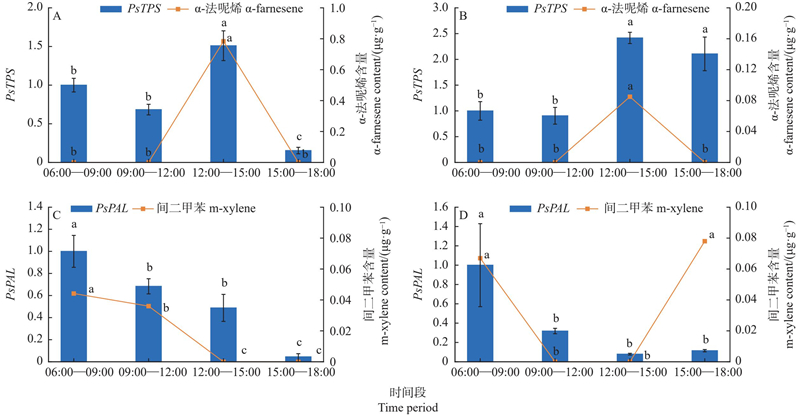
目的: 系统解析‘洛阳红’牡丹挥发性香气成分在不同花发育时期和日变化中的释放规律,探究花香相关基因的表达水平,为提升‘洛阳红’年宵花的观赏品质和产业应用提供理论支撑。方法: 以催花盆栽和田间地栽‘洛阳红’牡丹为研究材料,采用动态顶空吸附结合气相色谱?质谱联用技术(GC-MS),分别分析7个不同花发育时期(露色期、破绽期、初开期、半开期、盛开期、始衰期和衰败期)的香气成分和盛开期日变化规律(06:00—18:00)。结果: 1) 在‘洛阳红’牡丹中分别鉴定出挥发性成分43种(盆栽)和30种(地栽),包括8种苯环类、5种醇类、1种酚类、3种醛类、2种萜烯类、6种酯类和27种烃类化合物。2) 香气释放总量在开花进程中均呈先升后降的单峰模式,盆栽于半开期达到最高,地栽于盛开期达到最高。在一天不同时间段中,盆栽释放量随时间逐渐上升,在15:00—18:00达到最高;地栽则呈先增后降趋势,在09:00—12:00达到最高。3) 利用qRT-PCR技术检测花香合成通路中PsTPS和PsPAL基因的表达模式发现,不同开花时期PsTPS在盆栽中的表达量与橙花醇含量趋势相似,在地栽中的表达量则与α-法呢烯趋势相似;PsPAL的表达量在盆栽和地栽中分别与间二甲苯和苯乙醇的含量变化趋势相似。而1天内不同时间段中,PsTPS和PsPAL的表达量分别与α-法呢烯和间二甲苯的含量变化趋势相似。结论: 本研究从花香成分与基因表达2个角度揭示出‘洛阳红’花香的释放规律,对‘洛阳红’催花产业发展具有重要应用价值。
中图分类号:
孙可心,张晨洁,牛童非,马慧丽,张祖奇,郭丽丽,侯小改. 两种栽培方式对‘洛阳红’牡丹挥发性香气成分释放及其相关基因表达的影响[J]. 林业科学, 2026, 62(7): 140-151.
Kexin Sun,Chenjie Zhang,Tongfei Niu,Huili Ma,Zuqi Zhang,Lili Guo,Xiaogai Hou. Effects of Two Cultivation Methods on Volatile Aroma Components Release and Related Genes Expression in Paeonia suffruticosa ‘Luoyang Hong’[J]. Scientia Silvae Sinicae, 2026, 62(7): 140-151.
图1
‘洛阳红’不同花发育时期开花形态 CE:露色期Color exposure stage;BS:破绽期Blooming stage;IF:初开期Initial flowering stage;HO:半开期Half opening stage;FB:盛开期Full blooming stage;ID:始衰期Initial decay stage;DE:衰败期Decay stage."
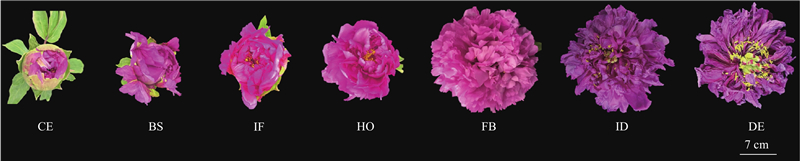
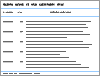
表1
实时荧光定量PCR引物序列"
| 基因名称Gene name | 正向引物序列Forward-primer sequence | 反向引物序列Reverse-primer sequence |
| PsTPS | ATGGCATTGCGTTTTTCTTTG | TGGCTGATCGCCTGTTTGTAG |
| PsPAL | TGCCTCGCTACTTACCCTTT | GGCTCTCGTATTCGCTTCTA |
| EF1-α | CCGCCAGAGAGGCTGCTAAT | GCAATGTGGGAAGTGTGGCA |
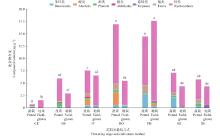
图2
2种栽培方式下‘洛阳红’不同花发育时期挥发性化合物的总含量及分类分布 CE:露色期Color exposure stage;BS:破绽期Blooming stage;IF:初开期Initial flowering stage;HO:半开期Half opening stage;FB:盛开期Full blooming stage;ID:始衰期Initial decay stage;DE:衰败期Decay stage. 不同小写字母表示盆栽和地栽不同花发育时期共14组的挥发性化合物总量在0.05水平上差异显著。"
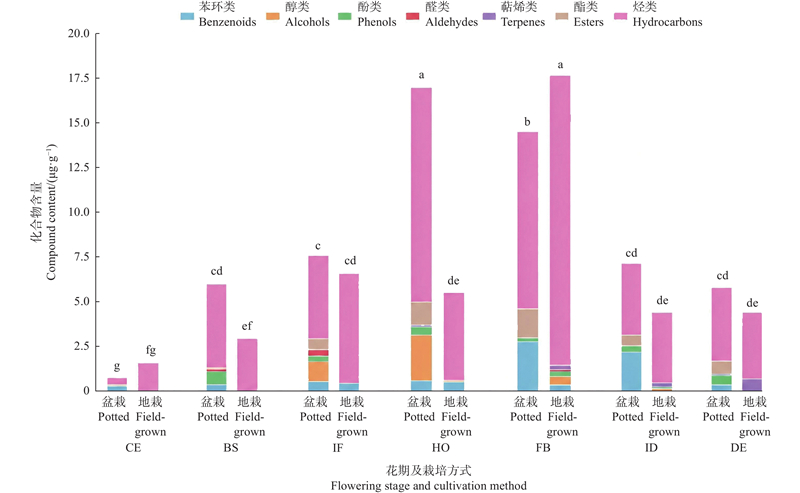
表2
‘洛阳红’不同花发育时期挥发性成分种类及含量①"
| 分类 Classification | 化合物Compounds | 盆栽Potted | 地栽Field-grown | |||||||||||||
| CE | BS | IF | HO | FB | ID | DE | CE | BS | IF | HO | FB | ID | DE | |||
| 苯环类 Benzenes | 1,3,5-三甲氧基苯 1,3,5-trimethoxy-benzene | — | — | — | — | — | 1.721 | 0.096 | — | — | — | — | — | — | — | |
| 7-甲基腺嘌呤 6-amino-7-methylpurine | — | — | — | — | — | 0.145 | — | — | — | — | — | — | — | — | ||
| 对苯二甲醚 1,4-dimethoxybenzene | — | 0.073 | 0.202 | 0.318 | 2.521 | — | — | — | — | 0.121 | 0.261 | 0.328 | — | — | ||
| 对二甲苯 m-xylene | 0.149 | 0.145 | 0.111 | 0.120 | 0.116 | 0.131 | 0.114 | — | — | — | — | — | — | — | ||
| 间二甲苯 1,3-dimethylbenzene | 0.062 | 0.051 | 0.110 | 0.059 | 0.036 | 0.072 | 0.048 | — | — | — | 0.079 | — | — | — | ||
| 乙苯ethylbenzene | 0.053 | 0.045 | 0.067 | 0.040 | 0.049 | 0.060 | 0.049 | — | — | — | — | — | — | — | ||
| 吲哚Indole | — | — | — | — | — | — | — | — | — | 0.270 | 0.126 | — | — | — | ||
| 邻二甲苯 o-xylene | — | — | — | — | — | — | — | — | — | — | — | — | — | 0.083 | ||
| 合计Total | 0.264cd | 0.314cd | 0.491c | 0.537c | 2.722a | 2.130b | 0.307cd | — | — | 0.392cd | 0.467c | 0.328cd | — | 0.083d | ||
| 醇类 Alcohols | 2-乙基己醇2-ethylhexanol | — | — | 0.080 | — | — | — | — | — | — | — | — | — | — | — | |
| 橙花醇Nerol | — | — | 1.003 | 2.546 | — | — | — | — | — | — | — | — | — | — | ||
| 苯乙醇Phenethyl alcohol | — | — | — | — | — | — | — | — | — | — | 0.075 | 0.424 | 0.138 | — | ||
| 合计Total | — | — | 1.083b | 2.546a | — | — | — | — | — | — | 0.075c | 0.424c | 0.138c | — | ||
| 酚类 Phenols | 2,4-二叔丁基苯酚 2,4-di-tert-butylphenol | — | 0.709 | 0.317 | 0.469 | 0.205 | 0.342 | 0.526 | — | — | — | — | 0.281 | 0.093 | — | |
| 合计Total | — | 0.709a | 0.317bc | 0.469ab | 0.205cd | 0.342bc | 0.526ab | — | — | — | — | 0.281bc | 0.093cd | — | ||
| 醛类 Aldehydes | 苯甲醛Benzaldehyde | — | — | 0.112 | — | — | — | — | — | — | — | — | — | — | — | |
| 癸醛Decanal | — | — | 0.035 | — | — | — | — | — | — | — | — | — | — | — | ||
| 壬醛Nonanal | — | 0.148 | 0.220 | — | — | — | — | — | — | — | — | 0.116 | — | — | ||
| 合计Total | — | 0.148b | 0.367a | — | — | — | — | — | — | — | — | 0.116b | — | — | ||
| 萜烯类 Terpenes | α-法呢烯α-farnesene | — | — | — | 0.104 | — | — | — | — | — | — | — | 0.223 | 0.191 | 0.537 | |
| β-罗勒烯β-ocimene | — | — | — | — | — | — | 0.072 | — | — | — | — | — | — | — | ||
| 合计Total | — | — | — | 0.104cd | — | — | 0.072d | — | — | — | — | 0.223b | 0.191bc | 0.537a | ||
| 酯类 Esters | 茉莉酸甲酯 Methyl jasmonate | — | — | — | — | 0.484 | 0.356 | 0.526 | — | — | — | — | — | — | — | |
| 肉豆蔻酸异丙酯 Isopropyl myristate | — | 0.081 | — | 0.171 | — | — | — | — | — | — | — | — | — | — | ||
| 顺-7-十四碳乙酸酯 (Z)-7-tetradecen-1-yl acetate | — | — | 0.464 | 1.167 | 1.191 | 0.241 | 0.171 | — | — | — | — | — | — | — | ||
| 乙酸十八酯 Acetic acid n-octadecyl ester | — | — | 0.166 | — | — | — | — | — | — | — | — | — | — | — | ||
| 正戊酸己酯Hexyl n-valerate | 0.067 | — | — | — | — | — | — | — | — | — | — | — | — | — | ||
| 合计Total | 0.067c | 0.081c | 0.630bc | 1.338a | 1.675a | 0.597bc | 0.727b | — | — | — | — | — | — | — | ||
| 烃类 Hydrocarbons | 奥苷菊环Azulene | — | — | 0.039 | — | — | — | — | — | — | — | — | — | — | — | |
| (E)-5-十四碳烯 (E)-5-Tetradecen-1-ol | — | — | — | 0.217 | — | — | — | — | — | — | — | — | — | — | ||
| 1-十八烷烯1-Octadecene | — | — | — | 0.187 | — | 0.186 | — | — | — | — | — | — | 0.055 | — | ||
| 1-十九碳烯1-Nonadecene | — | — | — | — | — | 0.459 | 0.150 | — | — | — | — | — | — | — | ||
| 2-甲基十六烷 2-Methylhexadecane | — | 0.169 | 0.152 | 0.366 | 0.322 | — | — | — | — | 0.182 | - | 2.287 | — | — | ||
| 3-甲基十七烷 3-Methylheptadecane | — | 0.219 | 0.102 | 0.196 | 0.160 | — | 0.113 | — | — | — | — | — | — | — | ||
| 8-十七烷烯8-Heptadecene | — | — | — | 0.411 | 0.479 | 0.196 | 0.117 | — | — | — | — | — | — | — | ||
| 癸烷Decane | — | — | 0.060 | — | — | — | — | — | — | — | — | — | — | — | ||
| 角鲨烷Squalane | — | — | 0.164 | 0.319 | — | 0.184 | — | — | — | — | — | — | — | — | ||
| 姥鲛烷Pristane | — | — | — | — | — | — | 0.199 | — | — | — | — | — | — | — | ||
| 十二烷Dodecane | 0.126 | 0.196 | 0.202 | 0.385 | 0.168 | 0.082 | 0.110 | 0.096 | — | 0.312 | 0.132 | 0.347 | — | — | ||
| 十六烷Hexadecane | — | 1.143 | 0.804 | 1.221 | 0.615 | 0.632 | 0.878 | 0.417 | 0.858 | 0.361 | 0.512 | 0.277 | 0.882 | 0.827 | ||
| 十七烷Heptadecane | — | 0.927 | 0.849 | 2.364 | 3.639 | 0.783 | 0.732 | 0.191 | 0.529 | 1.731 | 0.657 | 3.055 | 0.633 | 0.694 | ||
| 十三烷Tridecane | 0.074 | 0.232 | 0.171 | 0.379 | 0.339 | 0.275 | 0.327 | 0.075 | — | 0.424 | 0.388 | 1.855 | 0.091 | 0.061 | ||
| 十四烷Tetradecane | 0.085 | 0.350 | 0.331 | 0.556 | 0.419 | 0.247 | 0.312 | 0.264 | 0.433 | 0.377 | 0.483 | 1.047 | 0.545 | 0.535 | ||
| 十五烷Pentadecane | — | 0.853 | 1.470 | 3.916 | 3.223 | 0.713 | 0.638 | 0.292 | 0.582 | 1.511 | 1.337 | 3.550 | 1.488 | 1.320 | ||
| 十一烷Hendecane | 0.090 | 0.178 | 0.153 | 0.592 | 0.316 | 0.125 | 0.062 | — | — | 0.170 | 0.216 | 1.489 | 0.065 | — | ||
| 十八烷Octadecane | — | 0.530 | 0.268 | 0.489 | 0.213 | 0.259 | 0.440 | 0.199 | — | — | 0.239 | — | — | 0.148 | ||
| 植烷Phytane | — | — | — | 0.262 | — | — | 0.150 | — | — | — | — | — | — | — | ||
| 二十烷Eicosane | — | — | — | — | — | — | — | — | 0.503 | 0.185 | 0.128 | — | 0.202 | 0.198 | ||
| 6,9-十七碳二烯 6,9-Heptadecadiene | — | — | — | — | — | — | — | — | — | 0.985 | — | — | — | — | ||
| 2,2,4,6,6-五甲基庚烷 2,2,4,6,6-Pentamethylheptane | — | — | — | — | — | — | — | — | — | — | — | 0.230 | — | — | ||
| 3,3-二甲基己烷 3,3-Dimethylhexane | — | — | — | — | — | — | — | — | — | — | — | 0.129 | — | — | ||
| 二十一烷Heneicosane | — | — | — | — | — | — | — | — | — | — | — | 1.924 | — | — | ||
| 合计Total | 0.375f | 4.797cd | 4.766cd | 11.861b | 9.895b | 4.142cd | 4.228cd | 1.533ef | 2.905de | 6.238c | 4.091cd | 16.189a | 3.963cd | 3.784cd | ||
图3
2种栽培方式下‘洛阳红’1天内不同时间段挥发性化合物的总含量及分类分布 不同小写字母表示盆栽和地栽1天内不同时间段共8组挥发性化合物总量在0.05水平上差异显著。"
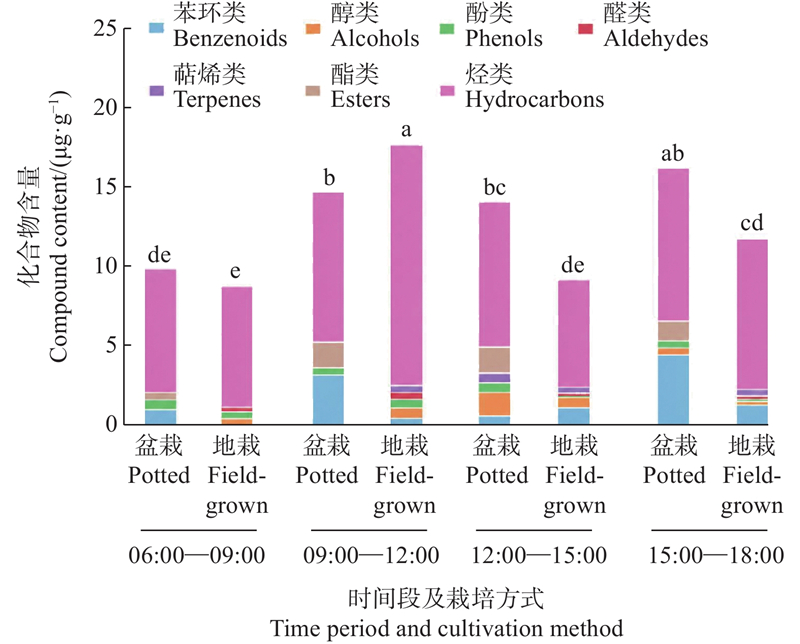
表3
‘洛阳红’1天内不同时间段挥发性成分种类及含量"
| 分类 Classification | 化合物 Compounds | 盆栽Potted | 地栽Field-grown | |||||||
| 06:00—09:00 | 09:00—12:00 | 12:00—15:00 | 15:00—18:00 | 06:00—09:00 | 09:00—12:00 | 12:00—15:00 | 15:00—18:00 | |||
| 苯环类 Benzenes | 乙苯Ethylbenzene | 0.048 | 0.049 | 0.050 | — | — | — | — | — | |
| 对二甲苯p-Xylene | 0.103 | 0.116 | 0.096 | 0.148 | — | — | 0.046 | — | ||
| 间二甲苯m-Xylene | 0.044 | 0.036 | — | — | 0.067 | — | — | 0.078 | ||
| 对苯二甲醚1,4-Dimethoxybenzene | 0.612 | 2.521 | 0.195 | 4.096 | — | 0.328 | 0.972 | 1.015 | ||
| 吲哚Indole | — | — | — | — | — | — | — | 0.154 | ||
| 合计Total | 0.807c | 2.722b | 0.341d | 4.244a | 0.067d | 0.328d | 1.019c | 1.247c | ||
| 醇类 Alcohols | 叶醇Cis-3-hexen-1-ol | — | — | 0.106 | 0.176 | — | — | — | — | |
| 苯乙醇Phenylethyl alcohol | — | — | 0.784 | — | — | 0.424 | 0.459 | 0.153 | ||
| 2-己基-1-癸醇2-Hexyl-1-decanol | — | — | — | — | 0.164 | — | — | — | ||
| 合计Total | — | — | 0.890a | 0.176c | 0.164c | 0.424b | 0.459b | 0.153c | ||
| 酚类 Phenols | 2,4-二叔丁基苯酚2,4-Di-tert-butylphenol | 0.375 | 0.205 | 0.265 | 0.256 | 0.257 | 0.281 | 0.072 | — | |
| 合计Total | 0.375a | 0.205b | 0.265b | 0.256b | 0.257b | 0.281ab | 0.072c | — | ||
| 醛类 Aldehydes | 壬醛Nonanal | — | — | — | — | 0.077 | 0.116 | — | 0.025 | |
| 癸醛Decanal | — | — | — | — | 0.085 | — | — | 0.088 | ||
| 合计Total | — | — | — | — | 0.162a | 0.116b | — | 0.114b | ||
| 萜烯类 Terpenes | α-法呢烯α-Farnesene | — | — | 0.432 | — | — | 0.223 | 0.272 | 0.220 | |
| 合计Total | — | — | 0.432a | — | — | 0.223b | 0.272b | 0.220b | ||
| 酯类 Esters | 顺-7-十四碳乙酸酯(Z)-7-Tetradecen-1-yl acetate | 0.504 | 1.191 | 0.991 | 1.027 | — | — | — | — | |
| 茉莉酸甲酯Methyl jasmonate | — | 0.484 | 0.492 | 0.434 | — | — | — | — | ||
| 乙酸叶醇酯Cis-3-hexenyl-1-acetate | — | — | 0.054 | — | — | — | — | — | ||
| 合计Total | 0.504b | 1.675a | 1.537a | 1.460a | — | — | — | — | ||
| 烃类 Hydrocarbons | 十一烷Hendecane | 0.277 | 0.316 | 0.378 | 0.200 | 0.326 | 1.489 | 0.298 | 1.374 | |
| 十二烷Dodecane | 0.200 | 0.168 | 0.133 | 0.243 | 0.203 | 0.347 | 0.031 | 0.434 | ||
| 十三烷Tridecane | 0.268 | 0.339 | 0.281 | 0.252 | 0.436 | 1.855 | 0.072 | 0.124 | ||
| 十四烷Tetradecane | 0.540 | 0.419 | 0.636 | 0.476 | 0.381 | 1.047 | 0.436 | 0.275 | ||
| 十五烷Pentadecane | 2.609 | 3.223 | 4.857 | 2.643 | 2.985 | 3.550 | 3.837 | 3.087 | ||
| 十六烷Hexadecane | 1.181 | 0.615 | 0.686 | 0.999 | 0.260 | 0.277 | 0.732 | 0.362 | ||
| 2-甲基十六烷 2-Methylhexadecane | 0.231 | 0.322 | — | — | 0.254 | 2.287 | — | 0.350 | ||
| 十七烷Heptadecane | 1.672 | 3.639 | 2.917 | 3.280 | 1.968 | 3.055 | 1.628 | 1.428 | ||
| 角鲨烷Squalane | 0.290 | — | — | 0.213 | — | — | — | — | ||
| 3-甲基十七烷3-Methylheptadecan | 0.146 | 0.160 | 0.136 | 0.244 | 0.160 | — | — | — | ||
| 1-十八烷烯1-Octadecene | 0.142 | — | — | — | 0.318 | — | — | — | ||
| 十八烷Octadecane | 0.392 | 0.213 | 0.202 | 0.435 | 0.378 | — | 0.153 | 0.200 | ||
| 植烷Phytane | 0.111 | — | — | — | — | — | — | — | ||
| 1-十九碳烯1-Nonadecene | — | 0.322 | 0.321 | 0.346 | — | — | — | — | ||
| (E)-2-十四烯(2E)-Tetradec-2-ene | — | — | 0.128 | — | — | — | — | — | ||
| 8-十七烷烯8-Heptadecene | — | — | — | 0.146 | 0.294 | — | — | 0.568 | ||
| 2,2,4,6,6-五甲基庚烷 2,2,4,6,6-Pentamethylheptane | — | 0.479 | — | 0.294 | 0.154 | 0.230 | — | 0.209 | ||
| 3,3-二甲基己烷 3,3-Dimethylhexane | — | — | — | — | — | 0.129 | — | — | ||
| 二十一烷Heneicosane | — | — | — | — | — | 1.924 | — | — | ||
| 1,7-十六烷二烯 1,7-Hexadecadiene | — | — | — | — | — | — | 0.450 | — | ||
| 3-甲基十五烷 3-Methylpentadecane, | — | — | — | — | — | — | — | 0.113 | ||
| 6,9-十七碳二烯 6,9-Heptadecadiene | — | — | — | — | — | — | — | 1.498 | ||
| 合计Total | 8.059c | 10.217bc | 10.676b | 9.771bc | 8.116c | 16.189a | 7.637c | 10.022bc | ||
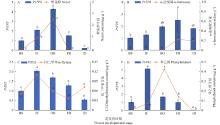
图4
不同花发育时期花香相关基因表达量与花香物质的含量 A:盆栽‘洛阳红’中PsTPS表达量与橙花醇含量变化 Changes in PsTPS expression level and neroal content in potted Paeonia suffruticosa‘Luoyang Hong’ ;B:地栽‘洛阳红’中PsTPS表达量与α-法呢烯含量变化 Changes in PsTPS expression level and farnesene content in field-grown P. suffruticosa ‘Luoyang Hong’;C:盆栽‘洛阳红’中PsPAL表达量与间二甲苯含量变化 Changes in PsPAL expression level and m-xylene content in potted P. suffruticosa ‘Luoyang Hong’;D:地栽‘洛阳红’中PsPAL表达量与苯乙醇含量变化 Changes in PsPAL expression level and phenethyl alcohol content in field-grown P. suffruticosa ‘Luoyang Hong’.BS:破绽期Blooming stage;IF:初开期Initial flowering stage;HO:半开期Half opening stage;FB:盛开期Fullblooming stage;ID:始衰期Initial decay stage.不同小写字母表示在0.05水平上差异显著。Different lowercase letters indicate significant differences at the level of 0.05."
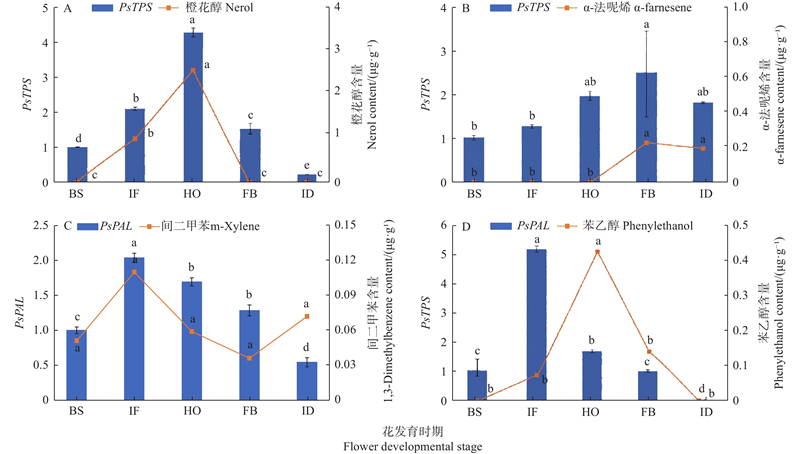
图5
1天内不同时间段花香相关基因表达量与花香物质的含量Fig.5 Gene expression levels of flower fragrance related genes and contents of flower fragrance substances at different time periods within a day A:盆栽‘洛阳红’中PsTPS表达量与α-法呢烯含量变化 Changes in PsTPS expression level and content of farnesene in potted Paeonia suffruticosa ‘Luoyang Hong’;B:地栽‘洛阳红’中PsTPS表达量与α-法呢烯含量变化 Changes in PsTPS expression level and relative content of farnesene in field-grown P. suffruticosa ‘Luoyang Hong’;C:盆栽‘洛阳红’中PsPAL表达量与间二甲苯含量变化 Changes in PsPAL expression level and relative content of m-xylene in potted P. suffruticosa ‘Luoyang Hong’;D:地栽‘洛阳红’中PsPAL表达量与间二甲苯含量变化 Changes in PsPAL expression level and relative content of m-xylene in field-grown P. suffruticosa ‘Luoyang Hong’.不同小写字母表示在0.05水平上差异显著。Different lowercase letters indicate significant differences at the level of 0.05."
|
陈 晨, 袁 刚. 植物花香合成与调控机制研究进展. 江苏农业科学, 2025, 53 (22): 31- 38.
doi: 10.15889/j.issn.1002-1302.2025.22.004 |
|
|
Chen C, Yuan G. Research progress on synthesis and regulation mechanism of plant floral scent. Jiangsu Agricultural Sciences, 2025, 53 (22): 31- 38.
doi: 10.15889/j.issn.1002-1302.2025.22.004 |
|
|
丁星文, 王珍珍, 王其刚, 等. 不同花色滇牡丹花香成分分析. 南方园艺, 2022, 33 (3): 25- 30.
doi: 10.3969/j.issn.1674-5868.2022.03.005 |
|
|
Ding X W, Wang Z Z, Wang Q G, et al. Analysis of floral volatile components of in Paeonia delavayi with differrent colors. Southern Horticulture, 2022, 33 (3): 25- 30.
doi: 10.3969/j.issn.1674-5868.2022.03.005 |
|
| 窦雅君, 翟 娟, 侯芳梅, 等. 不同光照强度对‘金盏银台’水仙花香释放的影响. 西北农业学报, 2014, (4): 85- 91. | |
| Dou Y J, Zhai J, Hou F M, et al. Effect of different light intensities on the floral aroma emitted from Chinese daffodil (Narcissus tazetta L. var. chinensis Roem). Acta Agriculturae Boreali-occidentalis Sinica, 2014, (4): 85- 91. | |
| 黄昕蕾, 郑宝强, 王 雁. 鼓槌石斛不同花期香气成分及盛花期香气日变化规律研究. 林业科学研究, 2018, 31 (4): 142- 149. | |
| Huang X L, Zheng B Q, Wang Y. Study of aroma compounds in flowers of Dendrobium chrysotoxum in different florescence stages and diurnal variation of full blooming stage. Forest Research, 2018, 31 (4): 142- 149. | |
|
李瑞雅, 宋程威, 牛童非, 等. ‘海黄’牡丹花挥发性物质释放规律及PsGDS的克隆与表达分析. 园艺学报, 2023, 50 (2): 331- 344.
doi: 10.16420/j.issn.0513-353x.2021-0870 |
|
|
Li R Y, Song C W, Niu T F, et al. The emitted pattern analysis of flower volatiles and cloning of PsGDS gene in tree peony cultivar ‘High Noon’. Acta Horticulturae Sinica, 2023, 50 (2): 331- 344.
doi: 10.16420/j.issn.0513-353x.2021-0870 |
|
| 牛童非, 薛 娴, 郭丽丽, 等. 外源茉莉酸甲酯对温室牡丹‘洛阳红’挥发性成分及含量的影响. 林业科学, 2023, 59 (5): 53- 60. | |
| Niu T F, Xue X, Guo L L, et al. Effects of exogenous methyl jasmonate on volatile components and content of Paeonia suffruticosa ‘Luoyanghong’ in greenhouse. Scientia Silvae Sinicae, 2023, 59 (5): 53- 60. | |
| 牛童非, 杨 迪, 马慧丽, 等. 牡丹花香的生物合成及调控研究进展. 园艺学报, 2026, 53 (2): 447- 466. | |
| Niu T F, Yang D, Ma H L, et al. Advances in floral aroma biosynthesis and regulation in tree peony. Acta Horticulturae Sinica, 2026, 53 (2): 447- 466. | |
| 吴 静, 邹吉睿, 汪进萱, 等. 紫丁香花香成分鉴定及关键TPS基因的功能分析. 植物遗传资源学报, 2024, 25 (5): 824- 833. | |
| Wu J, Zou J R, Wang J X, et al. Identification of floral components and functional analysis of key TPS genes in Syringa oblata. Journal of Plant Genetic Resources, 2024, 25 (5): 824- 833. | |
|
肖文芳, 李 佐, 陈和明, 等. 大叶蝴蝶兰花朵挥发性成分测定. 热带农业科学, 2020, 40 (4): 82- 87.
doi: 10.12008/j.issn.1009-2196.2020.04.014 |
|
|
Xiao W F, Li Z, Chen H M, et al. Determination of volatile components in flowers of Phalaenopsis violacea. Chinese Journal of Tropical Agriculture, 2020, 40 (4): 82- 87.
doi: 10.12008/j.issn.1009-2196.2020.04.014 |
|
| 许弘朋, 陆锦萍, 蒋晓楠, 等. 植物激素与环境因子调控园艺作物香气合成的研究进展. 园艺学报, 2026, 53 (2): 331- 358. | |
| Xu H P, Lu J P, Jiang X N, et al. Research advances in the regulation of aroma biosynthesis in horticultural crops by plant hormones and environmental factors. Acta Horticulturae Sinica, 2026, 53 (2): 331- 358. | |
| 颜沛沛, 叶 炜, 江金兰, 等. 金钗石斛花香气日变化规律. 亚热带农业研究, 2021, 17 (3): 179- 183. | |
| Yan P P, Ye W, Jiang J L, et al. Diurnal variation of floral scents emitted from Dendrobium nobile Lindl. Subtropical Agriculture Research, 2021, 17 (3): 179- 183. | |
| 张红磊. 2011. 牡丹花期、花色及花香的变异研究. 泰安: 山东农业大学. | |
| Zhang H L. 2011. The researches on variation of florescence、color and aromatic components in Paeonia suffruticosa. Tai’an: Shandong Agricultural University. [in Chinese] | |
|
张辉秀, 冷平生, 胡增辉, 等. ‘西伯利亚’百合花香随开花进程变化及日变化规律. 园艺学报, 2013, 40 (4): 693- 702.
doi: 10.16420/j.issn.0513-353x.2013.04.012 |
|
|
Zhang H X, Leng P S, Hu Z H, et al. The floral scent emitted from Lilium ‘Siberia’ at different flowering stages and diurnal variation. Acta Horticulturae Sinica, 2013, 40 (4): 693- 702.
doi: 10.16420/j.issn.0513-353x.2013.04.012 |
|
|
张 颖. 春季催花牡丹观赏价值综合评价. 现代园艺, 2023, 46 (13): 78- 81,85.
doi: 10.14051/j.cnki.xdyy.2023.13.041 |
|
|
Zhang Y. Comprehensive evaluation of the ornamental value of forced-flowering tree peonies in spring. Contemporary Horticulture, 2023, 46 (13): 78- 81,85.
doi: 10.14051/j.cnki.xdyy.2023.13.041 |
|
| 张宇航, 谷梦雅, 洪雅萍, 等. 茉莉花PAL基因家族的多基因组鉴定与表达分析. 江苏农业学报, 2024, 40 (3): 403- 414. | |
| Zhang Y H, Gu M Y, Hong Y P, et al. Multi-genomic identification and expressional analysis of PAL gene family in Jasminum sambac. Jiangsu Journal of Agricultural Sciences, 2024, 40 (3): 403- 414. | |
|
Barman M, Mitra A. Floral maturation and changing air temperatures influence scent volatiles biosynthesis and emission in Jasminum auriculatum Vahl. Environmental and Experimental Botany, 2021, 181, 104296.
doi: 10.1016/j.envexpbot.2020.104296 |
|
|
Delle-Vedove R, Schatz B, Dufay M. Understanding intraspecific variation of floral scent in light of evolutionary ecology. Annals of Botany, 2017, 120 (1): 1- 20.
doi: 10.1093/aob/mcx055 |
|
|
Farré-Armengol G, Fernández-Martínez M, Filella I, et al. Deciphering the biotic and climatic factors that influence floral scents: a systematic review of floral volatile emissions. Frontiers in Plant Science, 2020, 11, 1154.
doi: 10.3389/fpls.2020.01154 |
|
|
Hermann G, Bek R, Steeb S. Aroma evolution during flower opening in Rosa damascena Mill. Zeitschrift Für Naturforschung C, 1999, 54 (11): 889- 895.
doi: 10.1515/znc-1999-1106 |
|
|
Kong J Q. Phenylalanine ammonia-lyase, a key component used for phenylpropanoids production by metabolic engineering. Cheminform, 2015, 5 (77): 62587- 62603.
doi: 10.1039/c5ra08196c |
|
|
Li S S, Chen L G, Xu Y J, et al. Identification of floral fragrances in tree peony cultivars by gas chromatography–mass spectrometry. Scientia Horticulturae, 2012, 142, 158- 165.
doi: 10.1016/j.scienta.2012.05.015 |
|
|
Li S S, Zhang L, Sun M, et al. Biogenesis of flavor-related linalool is diverged and genetically conserved in tree peony (Paeonia × suffruticosa). Horticulture Research, 2022, 10 (2): uhac253.
doi: 10.1093/hr/uhac253 |
|
|
Luo J, Zhong W T, Xiong Y Y, et al. Analysis of non-polar low-molecular metabolites in Citron (Citrus medica L. ) peel essential oil at different developmental stages and a combined study of transcriptomics revealed genes related to the synthesis regulation of the monoterpenoid compound nerol. International Journal of Molecular Sciences, 2025, 26 (18): 9034.
doi: 10.3390/ijms26189034 |
|
|
Lü M W, Zhang L, Wang Y Z, et al. Floral volatile benzenoids/phenylpropanoids: biosynthetic pathway, regulation and ecological value. Horticulture Research, 2024, 11 (10): uhae220.
doi: 10.1093/hr/uhae220 |
|
|
Ma H L, Zhang C J, Niu T F, et al. Identification of floral volatile components and expression analysis of controlling gene in Paeonia ostii ‘Fengdan’ under different cultivation conditions. Plants, 2023, 12 (13): 2453.
doi: 10.3390/plants12132453 |
|
|
Magnard J L, Bony A R, Bettini F, et al. Linalool and linalool nerolidol synthases in roses, several genes for little scent. Plant Physiology and Biochemistry, 2018, 127, 74- 87.
doi: 10.1016/j.plaphy.2018.03.009 |
|
|
Sagae M, Oyama-Okubo N, Ando T, et al. Effect of temperature on the floral scent emission and endogenous volatile profile of Petunia axillaris. Bioscience Biotechnology & Biochemistry, 2008, 72 (1): 110- 115.
doi: 10.1271/bbb.70490 |
|
|
Shalit M, Guterman I, Volpin H, et al. Volatile ester formation in roses. identification of an acetyl-coenzyme A. geraniol/citronellol acetyltransferase in developing rose petals. Plant Physiology, 2003, 131 (4): 1868- 1876.
doi: 10.1104/pp.102.018572 |
|
|
Weng Y Y, Wang S T, Niu T F, et al. Effect of spermidine on the quality of vase-inserted Paeonia suffruticosa ‘Luoyang Hong’. Postharvest Biology and Technology, 2025, 223, 113445.
doi: 10.1016/j.postharvbio.2025.113445 |
|
|
Yin H N, Wang L, Su H M, et al. Effects of ultraviolet and infrared radiation absence or presence on the aroma volatile compounds in winegrape during veraison. Food Research International, 2023, 167, 112662.
doi: 10.1016/j.foodres.2023.112662 |
|
|
Yu Y, Lü S H, Chen D, et al. Volatiles emitted at different flowering stages of Jasminum sambac and expression of genes related to α-farnesene biosynthesis. Molecules, 2017, 22 (4): 546.
doi: 10.3390/molecules22040546 |
|
|
Zhang T, Yuan Y C, Zhan Y, et al. Metabolomics analysis reveals Embden Meyerhof Parnas pathway activation and flavonoids accumulation during dormancy transition in tree peony. BMC Plant Biology, 2020, 20 (1): 484.
doi: 10.1186/s12870-020-02692-x |
|
|
Zhao Q, Gu L N, Li Y Q, et al. Volatile composition and classification of Paeonia lactiflora flower aroma types and identification of the fragrance-related genes. International Journal of Molecular Sciences, 2023, 24 (11): 9410.
doi: 10.3390/ijms24119410 |
| [1] | 周艳萍,李涵宇,黄政强,王楠,李青粉. 欧洲云杉胚性愈伤组织长期继代培养的内源激素含量及基因表达变化[J]. 林业科学, 2026, 62(7): 113-125. |
| [2] | 石广振,赵正楠,冯慧,杨娟,史恭发,阿尔达克·库万太,王磊,孙炜伦,王玲. “花眼”月季品种染色体倍性及其表型多样性分析[J]. 林业科学, 2025, 61(9): 123-137. |
| [3] | 黄锦,张俊红,童再康,杨琪. 人工脱水对闽楠种子萌发特性的影响[J]. 林业科学, 2025, 61(4): 249-256. |
| [4] | 宗自豪,刘瑞玲,吴伟杰,陈慧芝,童川,韩树人,靳政时,叶先明,郜海燕. 模拟运输下减振包装对猕猴桃货架品质和苹果酸代谢的影响[J]. 林业科学, 2025, 61(2): 122-130. |
| [5] | 吴翠萍,金曹亮,应建平,索金伟,吴家胜,胡渊渊. 近成熟期定额灌水对香榧假种皮开裂的解剖学变化及基因表达的影响[J]. 林业科学, 2025, 61(1): 115-125. |
| [6] | 牛童非,薛娴,郭丽丽,郁敏,张晨洁,徐鑫傲,李瑞雅,侯小改. 外源茉莉酸甲酯对温室牡丹‘洛阳红’挥发性成分及含量的影响[J]. 林业科学, 2023, 59(5): 53-60. |
| [7] | 张苗,周生财,吴梦洁,童再康,韩潇,张俊红,程龙军. 闽楠中WRKY家族成员鉴定及缺磷胁迫下表达分析[J]. 林业科学, 2022, 58(2): 133-147. |
| [8] | 郑刘辉,侯宇,张新凤,喻卫武,曾燕如,戴文圣. 香榧种子生长发育过程中假种皮挥发油的变化[J]. 林业科学, 2022, 58(11): 127-136. |
| [9] | 唐芳,赵树堂,王丽娟,宋学勤,卢孟柱. 毛白杨次生维管系统再生过程的基因表达[J]. 林业科学, 2021, 57(9): 52-65. |
| [10] | 李真,袁婷婷,朱成磊,杨克彬,宋新章,高志民. 毛竹铵态氮转运蛋白的分子特征及基因表达模式[J]. 林业科学, 2021, 57(7): 70-79. |
| [11] | 康晓彤,陈辉. 华山松alpha-pinene synthase基因和(-)-limonene synthase基因的克隆及表达[J]. 林业科学, 2021, 57(6): 180-188. |
| [12] | 苗雅慧,鞠丹,梁珂豪,王爱斌,刘峻玲,张凌云. 青杄转录因子基因PwNF-YB8的克隆与功能分析[J]. 林业科学, 2021, 57(5): 77-92. |
| [13] | 周心怡,闫丽琼,吕云彤,孙丽丽,朱靖闻,曹传旺. 舞毒蛾取食诱导小黑杨苯丙烷代谢酶活性及其相关基因的表达[J]. 林业科学, 2021, 57(3): 108-116. |
| [14] | 刘闵豪,李龙,叶靖,周轩辕,李周岐,范睿深,徐郡儡. 杜仲ARF基因家族全基因组鉴定和表达分析[J]. 林业科学, 2021, 57(3): 170-180. |
| [15] | 韩昆瑾,郭娟娟,吕梓晴,李玉言,王世杰,杨敏生,王进茂. 转多基因107杨对目标害虫的抗性检测[J]. 林业科学, 2021, 57(11): 85-93. |
| 阅读次数 | ||||||
|
全文 |
|
|||||
|
摘要 |
|
|||||

