|
陈 枫, 孙传恒, 邢 斌, 等. 农业元宇宙: 关键技术、应用情景、挑战与展望. 智慧农业(中英文), 2022, 4 (4): 126- 137.
|
|
Chen F, Sun C H, Xing B, et al. Agricultural metaverse: key technologies, application scenarios, challenges and prospects. Smart Agriculture, 2022, 4 (4): 126- 137.
|
|
崔泽宇, 张怀清, 刘 洋, 等. 树木三维建模与可视化模拟技术进展与应用. 林业科学, 2025, 61 (6): 1- 12.
|
|
Cui Z Y, Zhang H Q, Liu Y, et al. Progress and applications of 3D modeling and visualization simulation technology for trees. Scientia Silvae Sinicae, 2025, 61 (6): 1- 12.
|
|
葛晓宁, 许新桥, 张怀清, 等. 林木基因型−环境互作算法研究进展与思考. 林业科学, 2025, 61 (3): 1- 15.
|
|
Ge X N, Xu X Q, Zhang H Q, et al. Progress and reflection on genotype-environment interaction algorithms in forest tree breeding. Scientia Silvae Sinicae, 2025, 61 (3): 1- 15.
|
|
龚建华, 林 珲, 徐丙立, 等. 虚拟地理环境视角下地理元宇宙初探. 遥感学报, 2024, 28 (5): 1145- 1160.
doi: 10.11834/jrs.20233004
|
|
Gong J H, Lin H, Xu B L, et al. Primary exploration of geographic metaverse from the perspective of virtual geographic environment. National Remote Sensing Bulletin, 2024, 28 (5): 1145- 1160.
doi: 10.11834/jrs.20233004
|
|
郝天象, 王 兵, 牛 香, 等. 全面提升我国森林生态系统质量和稳定性的实践与思考. 陆地生态系统与保护学报, 2022 (5): 13- 31.
|
|
Hao T X, Wang B, Niu X, et al. Practice and thinking of comprehensively improving the quality and stability of forest ecosystem in China. Terrestrial Ecosystem and Conservation, 2022 (5): 13- 31.
|
|
郝育军. 新阶段我国林草科技工作形势、任务和对策. 林草政策研究, 2021, 1 (1): 1- 7.
|
|
Hao Y J. The situations, main tasks and countermeasures of China’s scientific and technological work on forestry and grasslands in the new stage. Journal of Porestry and Grassland Policy, 2021, 1 (1): 1- 7.
|
|
李世东. 2017. 智慧林业概论. 北京: 中国林业出版社.
|
|
Li S D. 2017. Introduction to smart forestry. Beijing: China Forestry Publishing House. [in Chinese]
|
|
李天满, 张旭晨, 郑 重, 等. 稳步推进大熊猫国家公园高质量发展. 国家公园(中英文), 2023, 1 (2): 126- 134.
|
|
Li T M, Zhang X C, Zheng Z, et al. Steadily promote the high-quality development of the Giant Panda National Park. National Park, 2023, 1 (2): 126- 134.
|
|
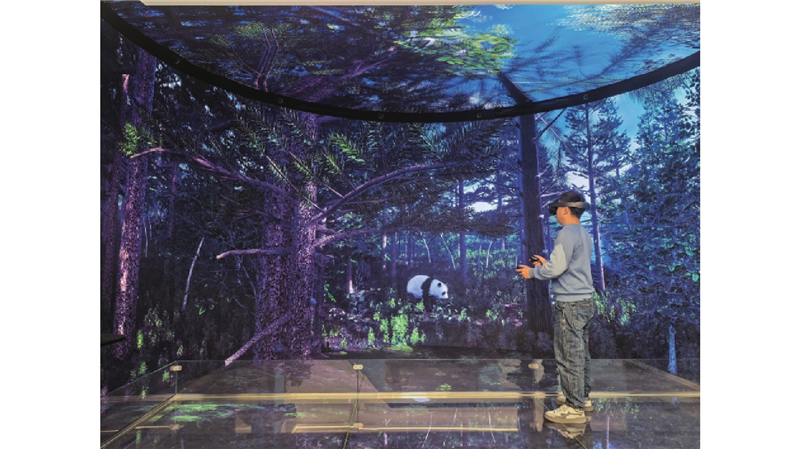
李永亮, 沈 康, 张怀清, 等. 基于CAVE2的森林虚拟仿真系统应用研究. 林业资源管理, 2019 (2): 123- 131,136.
|
|
Li Y L, Shen K, Zhang H Q, et al. Forest virtual simulation system based on CAVE2. Forest Resources Management, 2019 (2): 123- 131,136.
|
|
谭晶维, 张怀清, 郭梦蕾, 等. 林草行业大模型构建思路与应用前景. 林业科学, 2025, 61 (7): 170- 181.
|
|
Tan J W, Zhang H Q, Guo M L, et al. Construction ideas and application prospects of large models in forestry and grassand industry. Scientia Silvae Sinicae, 2025, 61 (7): 170- 181.
|
|
王 桥, 刘绍民, 王国强, 等. 我国生态环境监测网络体系发展研究. 中国工程科学, 2024, 26 (5): 212- 222.
|
|
Wang Q, Liu S M, Wang G Q, et al. Development of ecological environment monitoring network system in China. Strategic Study of Chinese Academy of Engineerng, 2024, 26 (5): 212- 222.
|
|
王天宇, 周建波, 雷永杰, 等. 林草装备发展现状探析. 林业机械与木工设备, 2024, 52 (4): 8- 13.
|
|
Wang T Y, Zhou J B, Lei Y J, et al. Analysis on the development status of forest and grass equipment. Forestry Machinery & Woodworking Equipment, 2024, 52 (4): 8- 13.
|
|
于贵瑞, 郭珂歆, 郝天象. 新时期林业生态经济体系构建的初步探索. 林业科学, 2025, 61 (7): 8- 22.
|
|
Yu G R, Guo K X, Hao T X. Preliminary exploration on the construction of forestry ecological economic system in the new era. Scientia Silvae Sinicae, 2025, 61 (7): 8- 22.
|
|
朱 庆, 张利国, 丁雨淋, 等. 从实景三维建模到数字孪生建模. 测绘学报, 2022, 51 (6): 1040- 1049.
|
|
Zhu Q, Zhang L G, Ding Y L, et al. From real 3D modeling to digital twin modeling. Acta Geodaetica et Cartographica Sinica, 2022, 51 (6): 1040- 1049.
|
|
Adil M, Song H B, Khan M K, et al. 5G/6G-enabled metaverse technologies: taxonomy, applications, and open security challenges with future research directions. Journal of Network and Computer Applications, 2024, 223, 103828.
doi: 10.1016/j.jnca.2024.103828
|
|
Anthwal A, Uniyal A, Gairolla J, et al. Industry 4.0 technologies adoption for digital transition in drug discovery and development: a review. Journal of Industrial Information Integration, 2024, 38, 100562.
doi: 10.1016/j.jii.2024.100562
|
|
Banaeian Far S, Imani Rad A, Rajabzadeh Asaar M. Blockchain and its derived technologies shape the future generation of digital businesses: a focus on decentralized finance and the metaverse. Data Science and Management, 2023, 6 (3): 183- 197.
doi: 10.1016/j.dsm.2023.06.002
|
|
Bernardes A, Gardim L, Araújo A A C, et al. Exploring the metaverse in the education of healthcare students: a scoping review. Revista Latino-Americana de Enfermagem, 2024, 32, e4347.
|
|
Chang H, Han H S, Anderson N, et al. The cost of forest thinning operations in the Western United States: a systematic literature review and new thinning cost model. Journal of Forestry, 2023, 121 (2): 193- 206.
doi: 10.1093/jofore/fvac037
|
|
Duan J F, Yu S S, Tan H L, et al. A survey of embodied AI: from simulators to research tasks. IEEE Transactions On Emerging Topics in Computational Intelligence, 2022, 6 (2): 230- 244.
doi: 10.1109/TETCI.2022.3141105
|
|
Dubey V, Mokashi A, Pradhan S R, et al. Metaverse and banking industry–2023 the year of metaverse adoption. Technium: Romanian Journal of Applied Sciences and Technology, 2022, 4 (10): 62- 73.
doi: 10.47577/technium.v4i10.7774
|
|
Feng Y, Audy J F. Forestry 4.0: a framework for the forest supply chain toward Industry 4.0. Gestão & Produção, 2020, 27, e5677.
|
|
Giang Barrera K, Shah D. Marketing in the metaverse: conceptual understanding, framework, and research agenda. Journal of Business Research, 2023, 155, 113420.
doi: 10.1016/j.jbusres.2022.113420
|
|
Holzinger A, Schweier J, Gollob C, et al. From industry 5.0 to forestry 5.0: bridging the gap with human-centered artificial intelligence. Current Forestry Reports, 2024, 10 (6): 442- 455.
doi: 10.1007/s40725-024-00231-7
|
|
Hoppen M, Chen J, Kemmerer J, et al. Smart forestry–a forestry 4.0 approach to intelligent and fully integrated timber harvesting. International Journal of Forest Engineering, 2024, 35 (2): 137- 152.
doi: 10.1080/14942119.2024.2323238
|
|
Hu X T, Zhang H Q, Yang G B, et al. Visual simulation research on growth polymorphism of Chinese fir stand based on different comprehensive grade models of spatial structure parameters. Forests, 2023, 14 (3): 617.
doi: 10.3390/f14030617
|
|
Ioannidis S, Kontis A P. Metaverse for tourists and tourism destinations. Information Technology & Tourism, 2023, 25 (4): 483- 506.
|
|
Jing W P, Kuang Z F, Scherer R, et al. Editorial: big data and artificial intelligence technologies for smart forestry. Frontiers in Plant Science, 2023, 14, 1149740.
doi: 10.3389/fpls.2023.1149740
|
|
Kalyani Y, Collier R. A systematic survey on the role of cloud, fog, and edge computing combination in smart agriculture. Sensors, 2021, 21 (17): 5922.
doi: 10.3390/s21175922
|
|
Kourtesis P. 2024. A comprehensive review of multimodal XR applications, risks, and ethical challenges in the metaverse. Multimodal Technologies and Interaction, 8(11): 98.
|
|
Kuru K. MetaOmniCity: toward immersive urban metaverse cyberspaces using smart city digital twins. IEEE Access, 2023, 11, 43844- 43868.
doi: 10.1109/ACCESS.2023.3272890
|
|
Lei K X, Zhang H Q, Qiu H Q, et al. A novel strategy for constructing large-scale forest scene: integrating forest hierarchical models and tree growth models to improve the efficiency and stability of forest polymorphism simulation. Forests, 2023, 14 (8): 1595.
doi: 10.3390/f14081595
|
|
Lian G J, Zhang H Q, Lei K X, et al. A novel collaborative planning framework for artificial forest harvesting and replanting. Biosystems Engineering, 2025, 256, 104156.
doi: 10.1016/j.biosystemseng.2025.104156
|
|
Liu Y, Chen W X, Bai Y J, et al. 2025. Aligning cyber space with physical world: a comprehensive survey on embodied AI. IEEE/ASME Transactions on Mechatronics, 1−22.
|
|
Maslej N, Fattorini L, Perrault R, et al. 2025. Artificial intelligence index report 2025. arXiv: 2504.07139. https://arxiv.org/abs/2504.07139.
|
|
Mngadi M, Germishuizen I, Mutanga O, et al. A systematic review of the application of remote sensing technologies in mapping forest insect pests and diseases at a tree-level. Remote Sensing Applications: Society and Environment, 2024, 36, 101341.
doi: 10.1016/j.rsase.2024.101341
|
|
Qiu H Q, Zhang H Q, Lei K X, et al. Forest digital twin: a new tool for forest management practices based on spatio-temporal data, 3D simulation engine, and intelligent interactive environment. Computers and Electronics in Agriculture, 2023, 215, 108416.
doi: 10.1016/j.compag.2023.108416
|
|
Qiu H Q, Zhang H Q, Lei K X, et al. A novel method for forest spatial structure heterogeneity evaluation of plantation utilizing point-wise vector network and neighborhood index. Computers and Electronics in Agriculture, 2025, 229, 109774.
doi: 10.1016/j.compag.2024.109774
|
|
Raad H, Rashid F K M. The metaverse: applications, concerns, technical challenges, future directions and recommendations. IEEE Access, 2023, 11, 110850- 110861.
doi: 10.1109/ACCESS.2023.3321650
|
|
Ramadhan A, Suryodiningrat S P, Mahendra I. The fundamentals of metaverse: a review on types, components and opportunities. Journal of Information and Organizational Sciences, 2023, 47 (1): 153- 165.
doi: 10.31341/jios.47.1.8
|
|
Tian M H, Li L C, Wan L, et al. Forest product trade, wood consumption, and forest conservation-the case of 61 countries. Journal of Sustainable Forestry, 2017, 36 (7): 717- 728.
doi: 10.1080/10549811.2017.1356736
|
|
Wang G G, Lu D L, Gao T, et al. Climate-smart forestry: an AI-enabled sustainable forest management solution for climate change adaptation and mitigation. Journal of Forestry Research, 2024, 36 (1): 7.
doi: 10.1007/s11676-024-01802-x
|
|
Wang H, Ning H S, Lin Y J, et al. A survey on the metaverse: the state-of-the-art, technologies, applications, and challenges. IEEE Internet of Things Journal, 2023, 10 (16): 14671- 14688.
doi: 10.1109/JIOT.2023.3278329
|
|
Wang X J, Kang M Z, Sun H Q, et al. DeCASA in AgriVerse: parallel agriculture for smart villages in metaverses. IEEE/CAA Journal of Automatica Sinica, 2022, 9 (12): 2055- 2062.
doi: 10.1109/JAS.2022.106103
|
|
Yu G, Liu C, Fang T, et al. A survey of real-time rendering on Web3D application. Virtual Reality & Intelligent Hardware, 2023, 5 (5): 379- 394.
|
|
Yun T, Li J, Ma L F, et al. Status, advancements and prospects of deep learning methods applied in forest studies. International Journal of Applied Earth Observation and Geoinformation, 2024, 131, 103938.
doi: 10.1016/j.jag.2024.103938
|
|
Zhang X L, Chen Y C, Hu L L, et al. The metaverse in education: definition, framework, features, potential applications, challenges, and future research topics. Frontiers in Psychology, 2022, 13, 1016300.
doi: 10.3389/fpsyg.2022.1016300
|
|
Zhu S Q, Yu T, Xu T, et al. Intelligent computing: the latest advances, challenges, and future. Intelligent Computing, 2023, 2, 6.
doi: 10.34133/icomputing.0006
|

 ),杨廷栋1,张京1,蒋娴1