
林业科学 ›› 2025, Vol. 61 ›› Issue (11): 215-225.doi: 10.11707/j.1001-7488.LYKX20240608
汪斯妍1,张真1,孔祥波1,方加兴1,韩福祥2,雷有久2,刘福1,*( ),张苏芳1,*()
收稿日期:2024-10-19
修回日期:2024-11-16
出版日期:2025-11-25
发布日期:2025-12-11
通讯作者:
刘福,张苏芳
E-mail:liufu2006@163.com;zhangsf@caf.ac.cn
基金资助:
Siyan Wang1,Zhen Zhang1,Xiangbo Kong1,Jiaxing Fang1,Fuxiang Han2,Youjiu Lei2,Fu Liu1,*(),Sufang Zhang1,*()
Received:2024-10-19
Revised:2024-11-16
Online:2025-11-25
Published:2025-12-11
Contact:
Fu Liu,Sufang Zhang
E-mail:liufu2006@163.com;zhangsf@caf.ac.cn
摘要:
毒蛾亚科昆虫危害性大、分布广泛、繁殖力强、食性复杂,常常给农林业生产造成巨大损失。昆虫性信息素具有特异性强、灵敏度高、对天敌无害、对环境友好等特点,是害虫综合防治的重要手段。在全球范围内,目前已测定并分析了42种毒蛾亚科昆虫的性腺提取物,共鉴定出55种性信息素组分,以TypeⅡ、TypeⅢ型信息素为主,仅有黄毒蛾属昆虫性信息素结构类型为TypeⅠ。毒蛾亚科昆虫性信息素组分结构复杂,具有不饱和双键、环氧基团、甲基侧链等,存在多种异构体,在鉴定上难度很大。毒蛾亚科昆虫依赖性信息素的特异性维持种间的生殖隔离,各组分之间比例的细微差异和异构现象均会改变其生物活性。对已鉴定出的毒蛾亚科昆虫性信息素组分进行比较和分析发现,同属昆虫中性信息素组分的重叠率很高,甚至一些种的性信息素组分完全相同,只是比例不同;有些组分还可出现在多属昆虫中。我国对毒蛾亚科昆虫性信息素的研究虽然取得一些成果,但与国外相比仍存在一定差距。本研究对已鉴定出的毒蛾亚科昆虫性信息素进行系统比较、分析,旨在为今后性信息素组分的鉴定、化学合成及其防治应用提供参考,促进我国毒蛾亚科害虫绿色防控技术发展。
中图分类号:
汪斯妍,张真,孔祥波,方加兴,韩福祥,雷有久,刘福,张苏芳. 毒蛾亚科昆虫性信息素研究进展[J]. 林业科学, 2025, 61(11): 215-225.
Siyan Wang,Zhen Zhang,Xiangbo Kong,Jiaxing Fang,Fuxiang Han,Youjiu Lei,Fu Liu,Sufang Zhang. Research Progress on the Sex Pheromones of Lymantriinae Species (Lepidoptera: Erebidae)[J]. Scientia Silvae Sinicae, 2025, 61(11): 215-225.
表1
已鉴定的毒蛾亚科昆虫性信息素组分①"
| 属 Genus | 种 Species | 组分 Components | 类型 Type | 参考文献 Reference |
| 茸毒蛾属 Dasychira | D. grisefactaella | Z6-21-11Kt | TypeⅢ | |
| D. vagansgrisea | ||||
| D. plagiata | Z6-21-11Kt E6-21-11Kt | TypeⅢ | ||
| 茶黑毒蛾 D. baibarana | Z3,Z6-cis-9,10-epo-21Hy Z3,Z6,E11-cis-9,10-epo-21Hy Z3,Z6-21-11Kt | TypeⅡ+ TypeⅢ | ||
| 古毒蛾属 Orgyia | O. cana | Z6-21-11Kt | TypeⅢ | |
| 古毒蛾 O. antiqua | ||||
| 角斑古毒蛾 O. gonostigma | ||||
| 黄杉毒蛾 O. pseudotsugata | Z6,E8-21-11Kt Z6,E9-21-11Kt | TypeⅢ | ||
| 旋古毒蛾 O. thyellina | Z6-21-9Kt Z6-21-11Kt | TypeⅢ | ||
| O. detrita | Z6,Z9,11S-henicosadien-11-ol Z6,Z9,11R-henicosadien-11-ol | TypeⅢ | ||
| 棉古毒蛾 O. postica | Z6,Z9-trans-11,12-epo-21Hy Z6,Z9-21Hy Z6-21-11Kt | TypeⅡ+ TypeⅢ | ||
| O. vetusta | Z6,Z9-henicosadien-11-ol Z6,Z9-eicosadien-11-ol Z6-henicosen-11-ol | TypeⅢ | ||
| O. leucostigma | Z6,Z9-21-11Kt Z6-21-11Kt | TypeⅢ | ||
| 灰斑古毒蛾 O. ericae | Z6,Z9-23Hy Z6,Z9-21Hy Z6-21-11Kt | TypeⅡ+ TypeⅢ | ||
| 毒蛾属 Lymantria | 亚洲型舞毒蛾 L. dispar asiatica | 7R,8S-epo-2-methyloctadecane (+)-Disparlure | TypeⅢ | |
| 舞毒蛾日本亚种 L. dispar japonica | ||||
| L. beatrix | ||||
| L. narindra | ||||
| 新加坡毒蛾 L. singapura | ||||
| 络毒蛾 L. concolor | cis-7,8-epo-2-methyloctadecane (±)-Disparlure | TypeⅢ | ||
| 烟毒蛾 L. fumida | 7R,8S-epo-2-methyloctadecane Z7-2-me-18Hy | TypeⅢ | ||
| L. obfuscata | ||||
| 栎毒蛾 L. mathura | Z3,Z6-9R,10S-epo-19Hy Z3,Z6-9S,10R-epo-19Hy Z3,Z6,Z9-19Hy | TypeⅡ | ||
| 木毒蛾 L. xylina | 7R,8S-epo-2-methyleicosane ((+)-Xylinalure) 7S,8R-epo-2-methyleicosane ((-)-Xylinalure) | TypeⅢ | ||
| 模毒蛾 L. monacha | 7R,8S-epo-2-methyloctadecane 7S,8R-epo-2-methyloctadecane (-)-Disparlure 7R,8S-epo-octadecane (+)-Monachalure Z7-2-me-18Hy Z7-18Hy | TypeⅡ+ TypeⅢ | ||
| L. lucescens | Z7-2-me-18Hy | TypeⅢ | ||
| 虹毒蛾 L. serva | ||||
| 舞毒蛾 L. dispar | 7R,8S-epo-2-me-17-ene-18Hy 7R,8S-epo-2-methyloctadecane | TypeⅢ | ||
| 肘纹毒蛾 L. bantaizana | Z7,E9-2-me-18Hy | TypeⅢ | ||
| L. schaeferi | 7R,8S-epo-2-methyleicosane ((+)-Xylinalure) | TypeⅢ | ||
| 黄毒蛾属 Euproctis | 桑毛虫 E. similis xanthocampa | Z6-18:nBu Z6-18:iVa Z7-18:iVa Z9-18:iVa | TypeⅠ | |
| 茶黄毒蛾 E. pseudoconspersa | 10-me-14-me-15:nBu 10R-me-14-me-15:iBu 14-me-15:iBu | TypeⅠ | ||
| 盗毒蛾 E. similis | Z7-18:2-mB Z7-18:iBu Z7-18:iVa Z7-18:nBu Z9-18:2-mB Z9-18:iVa | TypeⅠ | ||
| 台湾黄毒蛾 E. taiwana | Z9-16-me-17:iBu 16-me-17:iBu | TypeⅠ | ||
| 黄毒蛾 E. chrysorrhoea | Z7,Z13,Z16,Z19-22:iBu | TypeⅠ | ||
| E. terminalis | ||||
| 戟盗毒蛾 E. pulverea | Z11,Z14,Z17-20:4-mv Z11,Z14,Z17-20:iBu | TypeⅠ | ||
| E. subflava | 10R-me-14-me-15:iBu 14-me-15:iBu | TypeⅠ | ||
| 草原毛虫属 Gynaephora | 青海草原毛虫 G. qinghainensis | Z3,Z6,Z9-21Hy Z3,Z6,Z9-20Hy | TypeⅡ | |
| 透翅毒蛾属 Perina | 榕透翅毒蛾 P. nuda | Z9-3R,4S-6S,7R-diepo-21Hy Z9-3S,4R-6S,7R-diepo-21Hy Z3,Z9-6S,7R-epo-21Hy Z3,Z9-cis-6,7-epo-21Hy | TypeⅡ | |
| 雪毒蛾属 Leucoma | 柳毒蛾 L. salicis | Z3-6R,7S-9R,10S-diepo-21Hy | TypeⅡ | |
| 台毒蛾属 Teia | T. anartoides | Z6,E8-21-11Kt Z6-9R,10S-epo-20Hy Z6-9R,10S-epo-21Hy Z6,Z9-henicosadien-11-ol Z6,Z9-21Hy Z6,Z9-21-11Kt Z6-21-11Kt | TypeⅡ+ TypeⅢ |
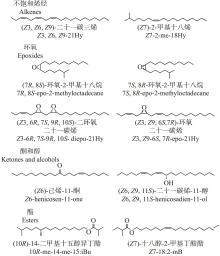
图1
不同类型的毒蛾亚科昆虫性信息素举例"
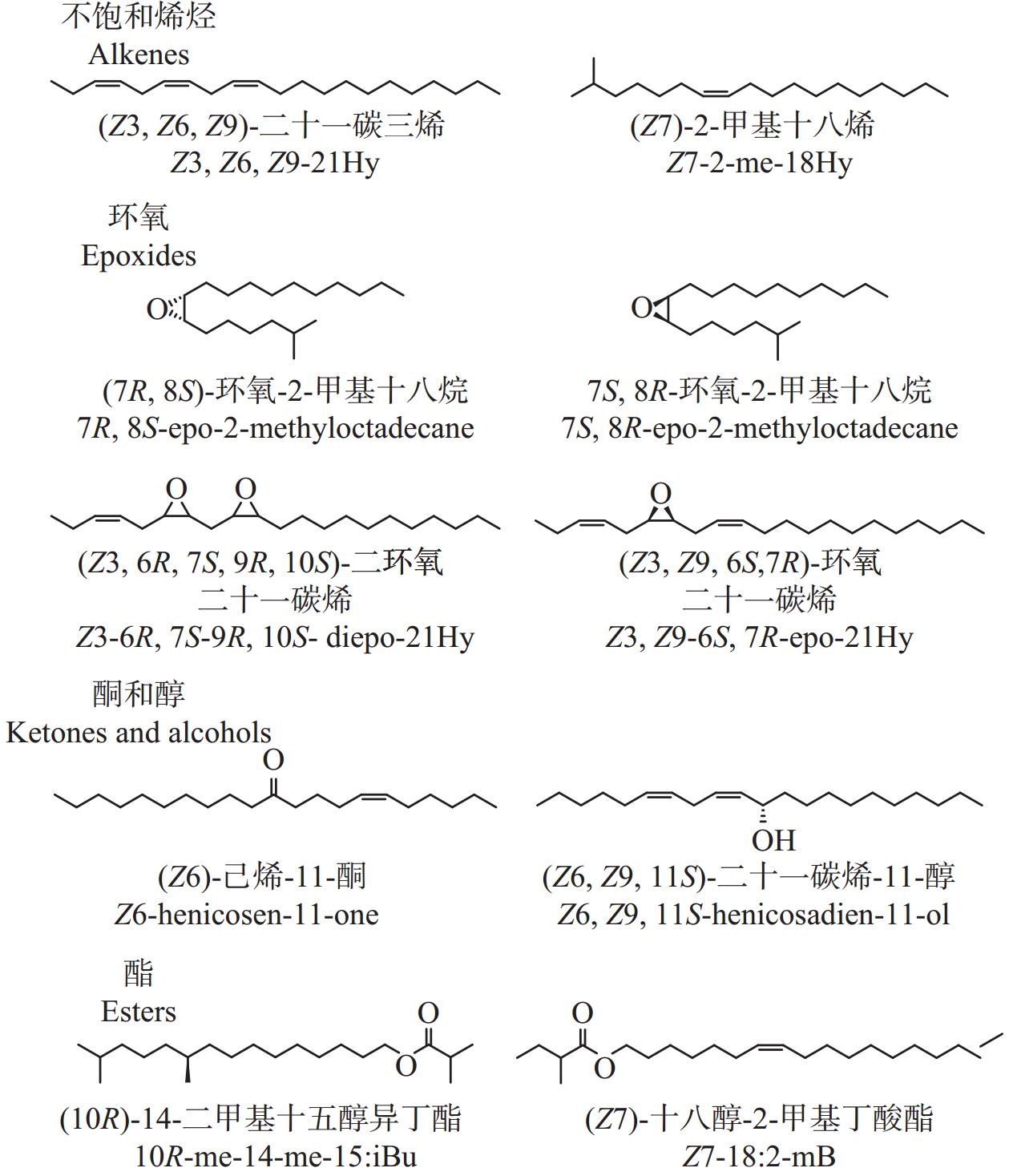
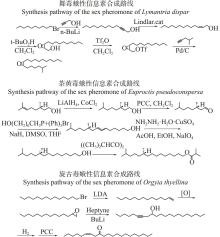
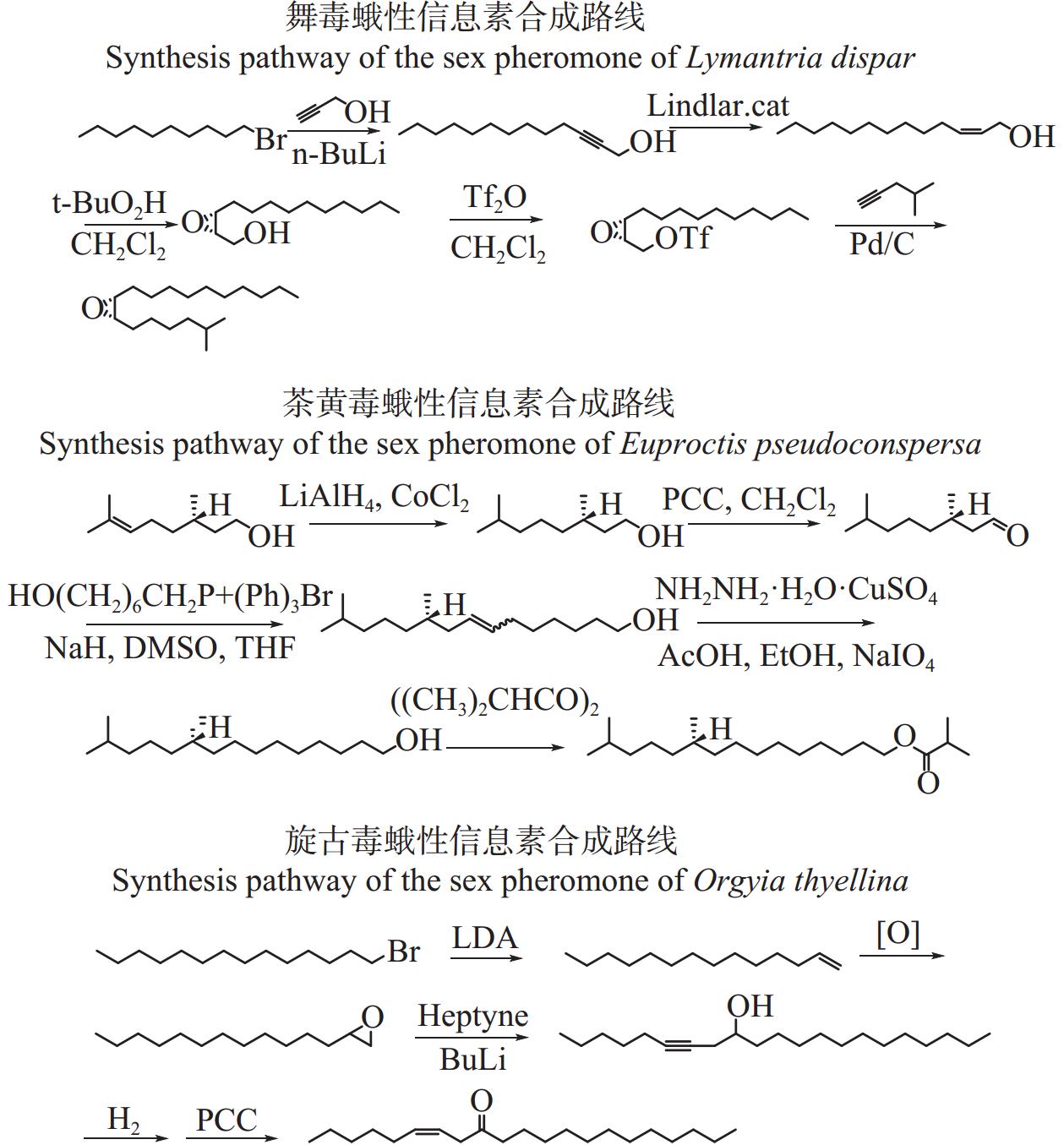
图2
不同类型的毒蛾亚科昆虫性信息素合成路线"
| 高泽芬, 陈国发, 王 鹏, 等. 模毒蛾性信息素应用技术研究. 中国森林病虫, 2020, 39 (2): 43- 46. | |
| Gao Z F, Chen G F, Wang P, et al. Research on the application technology of sex pheromone of the nun moth, Lymantria monacha (Lepidoptera: Lymantriidae). Forest Pest and Disease, 2020, 39 (2): 43- 46. | |
| 华湘翰, 王新珍. 鳞翅目性信息素性诱剂名录. 化学生态物质, 1989 (1): 132- 134. | |
| Hua X H, Wang X Z. Catalogue of lepidopteran sex pheromone lures. Chemical Ecological Substances, 1989 (1): 132- 134. | |
| 孔祥波, 赵成华, 张 真, 等. 松毛虫性信息素共轭双键定位方法的研究. 色谱, 2004, 22 (2): 97- 100. | |
| Kong X B, Zhao C H, Zhang Z, et al. Determination of double bond position in conjugated dienes in sex pheromones of Dendrolimus spp. Chinese Journal of Chromatography, 2004, 22 (2): 97- 100. | |
| 孔祥波, 赵莉蔺, 张 真, 等. 一种用于昆虫性信息素成分单不饱和双键定位的简便方法. 昆虫学报, 2010, 53 (6): 634- 639. | |
| Kong X B, Zhao L L, Zhang Z, et al. A simple method to determine the double bond position in monounsaturated insect pheromone compounds. Acta Entomologica Sinica, 2010, 53 (6): 634- 639. | |
| 刘 福, 张苏芳, 孔祥波, 等. (2S,3R,7R/S)-3,7-二甲基-2-十三碳醇丙酸酯的全合成研究进展. 合成化学, 2018, 26 (7): 520- 529. | |
| Liu F, Zhang S F, Kong X B, et al. Progress in total synthesis of (2S,3R,7R/S)-3,7-dimethyl-2-tridecanyl acetate. Chinese Journal of Synthetic Chemistry, 2018, 26 (7): 520- 529. | |
| 刘 福, 郭 丽, 李青春, 等. 杨小舟蛾雌蛾性信息素活性成分的鉴定. 昆虫学报, 2019, 62 (7): 814- 822. | |
| Liu F, Guo L, Li Q C, et al. Identification of the active components of sex pheromone of female moths of Micromelalopha sieversi (Lepidoptera: Notodontidae). Acta Entomologica Sinica, 2019, 62 (7): 814- 822. | |
| 刘 福, 袁中伟, 孔祥波, 等. 2020. 6种松毛虫性信息素前体化合物全合成研究进展, 林业科学, 56(4): 170–180. | |
| Liu F, Yuan Z W, Kong X B, et al. 2019. Research progress on total synthesis of active components of sex pheromones of six species of pine caterpillars. Scientia Silvae Sinicae, 56(4): 173–183. [in Chinese] | |
| 刘万才, 刘振东, 朱晓明, 等. 我国昆虫性信息素技术的研发与应用进展. 中国生物防治学报, 2022, 38 (4): 803- 811. | |
| Liu W C, Liu Z D, Zhu X M, et al. Development and application of insect sex pheromone technology in China. Chinese Journal of Biological Control, 2022, 38 (4): 803- 811. | |
| 刘用垄, 孙 悦, 陈佳宁, 等. 木毒蛾核型多角体病毒的PCR快速检测技术. 生物安全学报, 2023, 32 (1): 80- 84. | |
| Liu Y L, Sun Y, Chen J N, et al. Establishment of PCR detection for Lymantria xylina multiple nucleopolyhedrovirus. Journal of Biosafety, 2023, 32 (1): 80- 84. | |
| 马 涛, 温秀军, 李兴文. 昆虫性信息素人工合成技术研究进展. 世界林业研究, 2012, 25 (6): 46- 50. | |
| Ma T, Wen X J, Li X W. Research advance in artificial synthesis of insect sex pheromone. World Forestry Research, 2012, 25 (6): 46- 50. | |
| 马 涛, 黄志嘉, 朱 映, 等. 尺蛾科昆虫性信息素组分特征及应用进展. 林业科学, 2019, 55 (5): 152- 162. | |
| Ma T, Huang Z J, Zhu Y, et al. Progress in sex pheromone components in geometrid species (Lepidoptera: Geometridae) and their applications. Scientia Silvae Sinicae, 2019, 55 (5): 152- 162. | |
| 苗建才, 王振华, 高文韬. 舞毒蛾性信息素应用技术的研究. 东北林业大学学报, 1988, 16 (1): 14- 20. | |
| Miao J C, Wang Z H, Gao W T. Research on the application technology of gypsy moth sex pheromone. Journal of Northeast Forestry University, 1988, 16 (1): 14- 20. | |
| 浦冠勤, 堵鹤鸣, 毛建萍, 等. 桑毛虫性信息素研究: Ⅳ. 桑毛虫性诱测报的应用. 江苏蚕业, 1988, 10 (3): 6- 10. | |
| Pu G Q, Du H M, Mao J P, et al. Research on the sex pheromone of Euproctis similis xanthocampa: Ⅳ. The application of sex pheromone trapping and forecasting in Euproctis similis xanthocampa. Jiangsu Sericulture, 1988, 10 (3): 6- 10. | |
| 沈南英, 曾 璐, 张显耻, 等. 草原毛虫性信息素的研究. 中国草地学报, 1983, 1 (1): 43- 49. | |
| Shen N Y, Zeng L, Zhang X C, et al. Study on the sex pheromone of the Gynaephora qinghainensis. Chinese Journal of Grassland, 1983, 1 (1): 43- 49. | |
| 谈忠兴, 吴元伟, 林国强, 等. 昆虫信息素结构和合成的研究ⅩⅦ. 桑毛虫性信息素的结构鉴定. 化学学报, 1984, 42 (11): 1178- 1182. | |
| Tan Z X, Wu Y W, Lin GQ, et al. Study on identification and synthesis of insect pheromone XVII. The sex pheromone of Euproctis similis xanthocampa. Acta Chimica Sinica, 1984, 42 (11): 1178- 1182. | |
| 汪永俊. 1979. 侧柏毒蛾性信息素研究初报. 林业科技资料, (4): 23–25. | |
| Wang Y J, 1979. Preliminary report on the study of the sex pheromone of Parocneria furva. Forestry Science and Technology Information, (4): 23–25. [in Chinese] | |
| 王留洋, 杨超霞, 郭兵博, 等. 昆虫性信息素研究进展与应用前景. 农药学学报, 2022, 24 (5): 997- 1016. | |
| Wang L Y, Yang C X, Guo B B, et al. Research progress and application prospects on insect sex pheromone. Chinese Journal of Pesticide Science, 2022, 24 (5): 997- 1016. | |
| 王晓伟, 姬兰柱, 张庆贺, 等. 美国的舞毒蛾管理及其启示(Ⅱ). 中国森林病虫, 2013, 32 (3): 31- 35. | |
| Wang X W, Ji L Z, Zhang Q H, et al. Management of the gypsy moth in the United States and its implications (II). Forest Pest and Disease, 2013, 32 (3): 31- 35. | |
| 魏初奖, 谢大洋, 庄晨辉, 等. 福建省木麻黄毒蛾灾区区划及其应用研究. 江西农业大学学报, 2004, 26 (5): 774- 777. | |
| Wei C J, Xie D Y, Zhuang C H, et al. Plague division of Lymantria xylina and its application in Fujian Province. Acta Agriculturae Universitatis Jiangxiensis, 2004, 26 (5): 774- 777. | |
| 张军生, 王 鹏, 王 茜. 飞机超低量喷洒木烟碱防治模毒蛾的研究. 中国森林病虫, 2014, 33 (5): 37- 40. | |
| Zhang J S, Wang P, Wang Q. Effect of anabasine microcapsule SC against Lymantria monacha (Linnaeus) in the ultra-low volume aerial control. Forest Pest and Disease, 2014, 33 (5): 37- 40. | |
| 赵仲苓. 1994. 中国经济昆虫志. 鳞翅目. 毒蛾科. Ⅱ. 科学出版社, 1–13. | |
| Zhao Z L. 1994. Economic insect fauna of China. Lepidoptera. Lymantriidae. Ⅱ. Science Press, 1–13. [in Chinese] | |
| 赵仲苓. 2003. 中国动物志. 昆虫纲. 第三十卷. 鳞翅目. 毒蛾科. 北京: 科学出版社, 1–45. | |
| Zhao Z L. 2003. Fauna Sinica. Insecta. Volume 30. Lepidoptera. Lymantriidae. Beijing: Science Press, 1–45. [in Chinese] | |
| 周建华, 韦 卫, 赵莉蔺, 等. 蜀柏毒蛾性信息素及其林间诱集效果初步研究. 四川林业科技, 2017, 38 (6): 9- 12. | |
| Zhao J H, Wei W, Zhao L L, et al. A preliminary study on the identification of components of sex pheromone from Parocneria orienta Chao and its trapping effects in the field. Journal of Sichuan Forestry Science and Technology, 2017, 38 (6): 9- 12. | |
| 张 真, 王鸿斌, 陈国发, 等. 信息化学物质在害虫监测中的应用. 昆虫学报, 2022, 65 (3): 351- 363. | |
| Zhang Z, Wang H B, Chen G F, et al. Application of semiochemicals in insect pest monitoring. Acta Entomologica Sinica, 2022, 65 (3): 351- 363. | |
|
Ando T, Ohtani K, Yamamoto M, et al. Sex pheromone of Japanese giant looper, Ascotis selenaria cretacea: identification and field tests. Journal of Chemical Ecology, 1997, 23 (10): 2413- 2423.
doi: 10.1023/B:JOEC.0000006683.58028.1e |
|
| Ando T, Inomata S I, Yamamoto M. Lepidopteran sex pheromones. Topics in Current Chemistry, 2004, 239, 51- 96. | |
|
Ando T, Yamakawa R. Chiral methyl-branched pheromones. Natural Product Reports, 2015, 32 (7): 1007- 1041.
doi: 10.1039/C4NP00138A |
|
|
Ando T, Yamamoto M. Semiochemicals containing lepidopteran sex pheromones: wonderland for a natural product chemist. Journal of Pesticide Science, 2020, 45 (4): 191- 205.
doi: 10.1584/jpestics.D20-046 |
|
| Arn H, Tóth M, Priesner E. 1997. List of sex pheromones of Lepidoptera and related attractants, supplement 1992—1996. Technology Transaction Mating Disruption. 20: 257–293. | |
|
Beroza M, Katagiri K, Iwata Z, et al. Disparlure and analogues as attractants for two Japanese lymantriid moths. Environmental Entomology, 1973, 2 (5): 966.
doi: 10.1093/ee/2.5.966 |
|
| Bhardwaj S P. Investigations on the response of lepidopteran sex pheromones of temperate fruit pests in Himachal Pradesh, India. Agriculture Ecosystems & Environment, 1987, 19 (1): 87- 91. | |
| Bouwer M C, Scheepers L M, Slippers B, et al. The sex pheromone of the pine brown-tail moth. Euproctis terminalis (Lepidoptera: Erebidae). Journal of Chemical Ecology, 2021, 47 (8/9): 732- 739. | |
| Butenandt A, Beckmann R, Stamm D, et al. Über den sexuallockstoff den seidenspinner Bombyx mori. Reindarstellung und Konstitution. Zeitschrift für Naturforschung, 1959, 14 (4): 283- 284. | |
| Cardé R T, Doane C C, Baker T C, et al. Attractancy of optically active pheromone for male gypsy moths. Environmental Entomology, 1977, 6 (6): 768- 772. | |
|
Carlson D A, Roan C S, Yost R A, et al. Dimethyl disulfide derivatives of long chain alkenes, alkadienes, and alkatrienes for gas chromatography/mass spectrometry. Analytical Chemistry, 1989, 61 (14): 1564- 1571.
doi: 10.1021/ac00189a019 |
|
|
Chen G F, Sheng M L, Li T, et al. Synergistic sex pheromone components of the greyspotted tussock moth. Orgyia ericae. Entomologia Experimentalis Et Applicata, 2010, 136 (3): 227- 234.
doi: 10.1111/j.1570-7458.2010.01011.x |
|
| Coleman T W, Foelker C J, Perkins T. 2023. A 20-year synthesis of the Lymantria dispar slow the spread program. Forest Service, U. S. Department of Agriculture, 45–69. | |
|
Daterman G E, Peterson L J, Robbins R G, et al. Laboratory and field bioassay of the Douglas-fir tussock moth pheromone, (Z)-6-heneicosen-11-one. Environmental Entomology, 1976, 5 (6): 1187- 1190.
doi: 10.1093/ee/5.6.1187 |
|
|
El–Sayed A M, Gibb A R, Suckling D M, et al. Identification of sex pheromone components of the painted apple moth: a tussock moth with a thermally labile pheromone component. Journal of Chemical Ecology, 2005, 31 (3): 621- 646.
doi: 10.1007/s10886-005-2050-5 |
|
|
Grant G G. Interspecific pheromone responses of tussock moths 1 and some isolating mechanisms of eastern species 2. Environmental Entomology, 1977, 6 (5): 739- 742.
doi: 10.1093/ee/6.5.739 |
|
|
Grant G G, Liu W, Slessor K N, et al. Sustained production of the labile pheromone component, (Z, Z)-6, 9-heneicosadien-11-one, from a stable precursor for monitoring the whitemarked tussock moth. Journal of Chemical Ecology, 2006, 32 (8): 1731- 1741.
doi: 10.1007/s10886-006-9105-0 |
|
|
Gries G, Schaefer P W, Yoo H J S, et al. Specificity of nun and gypsy moth sexual communication through multiple-component pheromone blends. Naturwissenschaften, 1996, 83 (8): 382- 385.
doi: 10.1007/BF01142006 |
|
|
Gries G, Slessor K N, Gries R, et al. (Z)-6(E)-8-heneicosadien-11-one: synergistic sex pheromone component of douglas-fir tussock moth, Orgyia pseudotsugata (McDunnough) (Lepidoptera: Lymantriidae). Journal of Chemical Ecology, 1997, 23 (1): 19- 34.
doi: 10.1023/B:JOEC.0000006343.38471.c7 |
|
|
Gries G, Gries R, Schaefer P W, et al. Sex pheromone components of pink gypsy moth, Lymantria mathura. Naturwissenschaften, 1999a, 86, 235- 238.
doi: 10.1007/s001140050606 |
|
|
Gries G, Clearwater J, Gries R, et al. Synergistic sex pheromone components of white-spotted tussock moth, Orgyia thyellina. Journal of Chemical Ecology, 1999b, 25 (5): 1091- 1104.
doi: 10.1023/A:1020833909739 |
|
|
Gries G, Schaefer P W, Khaskin G, et al. Sex pheromone components of Casuarina moth, Lymantria xylina. Journal of Chemical Ecology, 1999c, 25 (11): 2535- 2545.
doi: 10.1023/A:1020830309624 |
|
| Gries G, Schaefer P W, Gries R, et al. 2001. Reproductive character displacement in Lymantria monacha from northern Japan? Journal of Chemical Ecology, 27(6): 1163–1176. | |
|
Gries G, Schaefer P W, Gries R, et al. 2-methyl-(Z)-7-octadecene: sex pheromone of allopatric Lymantria lucescens and L. serva. Journal of Chemical Ecology, 2002, 28 (3): 469- 478.
doi: 10.1023/A:1014579725967 |
|
|
Gries R, Khaskin G, Khaskin E, et al. Enantiomers of (Z, Z)-6, 9-heneicosadien-11-ol: sex pheromone components of Orgyia detrita. Journal of Chemical Ecology, 2003, 29 (10): 2201- 2212.
doi: 10.1023/A:1026262028172 |
|
|
Gries R, Gries G, Schäfer P W, et al. (Z, E)-6, 8-heneicosadien-11-one: major sex-pheromone component of Orgyia vetusta (Lepidoptera: Lymantriidae). Canadian Entomologist, 2005a, 137 (4): 471- 475.
doi: 10.4039/n04-078 |
|
|
Gries R, Khaskin G, Gries G, et al. (7R, 8S)-cis-7, 8-epoxy-2-methyloctadec-17-ene: A novel trace component from the sex pheromone gland of gypsy moth, Lymantria dispar. Journal of Chemical Ecology, 2005b, 31 (1): 49- 62.
doi: 10.1007/s10886-005-0973-5 |
|
|
Gries R, Khaskin G, Gotoh T, et al. (7Z,9E)-2-methyl-7,9-octadecadiene: a sex pheromone component of Lymantria bantaizana. Journal of Chemical Ecology, 2005c, 31 (4): 879- 891.
doi: 10.1007/s10886-005-3550-z |
|
|
Gries R, Schaefer P W, Hahn R, et al. Sex Pheromone components of Indian gypsy moth, Lymantria obfuscata. Journal of Chemical Ecology, 2007, 33 (9): 1774- 1786.
doi: 10.1007/s10886-007-9328-8 |
|
|
Ichikawa A, Yasuda T, Wakamura S. Absolute configuration of sex pheromone for tea tussock moth, Euproctis pseudoconspersa (Strand) via synthesis of (R)- and (S)-10, 14-dimethyl-1-pentadecyl isobytyrates. Journal of Chemical Ecology, 1995, 21 (5): 627- 634.
doi: 10.1007/BF02033705 |
|
| Kamata N, Nakamura K. Schaefer P W, 2001. Three tropical Lymantria spp. attracted by (+)-disparlure, the synthetic sex pheromone of the gypsy moth: moth abundance, seasonality, and trap lure effectiveness. Tropics, 10(3): 473–480. | |
|
Kovalev B G, Vrkoc Y, Fedoseev N Z, et al. Isolation and identification of a component of the sex pheromone of Orgyia gonostigma. Chemistry of Natural Compounds, 1985, 21 (2): 264- 265.
doi: 10.1007/BF00714937 |
|
|
Kozlov M V, Zhu J, Philipp P, et al. Pheromone specificity in Eriocrania semipurpurella (Stephens) and E. sangii (Wood) (Lepidoptera: Eriocraniidae) based on chirality of semiochemicals. Journal of Chemical Ecology, 1996, 22 (3): 431- 454.
doi: 10.1007/BF02033647 |
|
| Lance D. 2006. Guidelines for detection trapping of exotic Lymantriid and Lasiocampid moths. USDA-APHIS-PPQ, 1–9. | |
|
Leonhardt B A, Mastro V C, Schwarz M, et al. Identification of sex pheromone of browntail moth, Euproctis chrysorrhoea (L) (Lepidoptera: Lymantriidae). Journal of Chemical Ecology, 1991, 17 (5): 897- 910.
doi: 10.1007/BF01395598 |
|
|
Liu F, Kong X B, Zhang S F, et al. Facile and efficient syntheses of (11Z, 13Z)-hexadecadienal and its derivatives: key sex pheromone and attractant components of Notodontidae. Molecules, 2019, 24 (9): 1781.
doi: 10.3390/molecules24091781 |
|
|
Liu F, Guo L, Zhang S F, et al. Synthesis and bioactivity of (13Z, 15E)-octadecadienal: A sex pheromone component from Micromelalopha sieversi Staudinger (Lepidoptera: Notodontidae). Pest Management Science, 2021, 77 (1): 264- 272.
doi: 10.1002/ps.6015 |
|
|
Löfstedt C, Hansson B S, Petersson E, et al. Pheromonal secretions from glands on the 5th abdominal sternite of hydropsychid and rhyacophilid caddisflies (Trichoptera). Journal of Chemical Ecology, 1994, 20 (1): 153- 170.
doi: 10.1007/BF02065998 |
|
| Löfstedt C, Kozlov M. 1997. A phylogenetic analysis of pheromone communication in primitive moths//Cardé R T, Minks A K. Insect pheromone research-new directions. New York: Chapman & Hall, 473–489. | |
| Löfstedt C, Wahlberg N, Millar J M. 2016. Evolutionary patterns of pheromone diversity in Lepidoptera/Allison J D, Cardé R T. Pheromone communication in moths: evolution, behavior and application. Berkeley: University of California Press, 43–78. | |
|
Magsi F H, Li Z Q, Cai X M, et al. Identification of a unique three-component sex pheromone produced by the tea black tussock moth, Dasychira baibarana (Lepidoptera: Erebidae: Lymantriinae). Pest Management Science, 2022, 78 (6): 2607- 2617.
doi: 10.1002/ps.6892 |
|
|
Millar J G, Giblin M, Barton D, et al. Synthesis and field testing of enantiomers of 6Z, 9Z-cis-epoxydienes as sex attractants for geometrid moths: Interaction of enantiomers and regioisomers. Journal of Chemical Ecology, 1990, 16 (7): 2317- 2339.
doi: 10.1007/BF01026941 |
|
|
Millar J G, Giblin M, Barton D, et al. Chiral lepidopteran sex attractants: blends of optically active C20 and C21 diene epoxides as sex attractants for geometrid and noctuid moths (Lepidoptera). Environmental Entomology, 1991, 20 (2): 450- 457.
doi: 10.1093/ee/20.2.450 |
|
|
Millar J G. Polyene hydrocarbons and epoxides: a second major class of lepidopteran sex attractant pheromones. Annual Review of Entomology, 2000, 45, 575- 604.
doi: 10.1146/annurev.ento.45.1.575 |
|
|
McDonough L M, Bailey J B, Hoffmann M P, et al. Sabulodes caberata Guenée (Lepidoptera: Geometridae) components of its sex pheromone gland. Journal of Chemical Ecology, 1986, 12 (12): 2107- 2116.
doi: 10.1007/BF01020313 |
|
| Molet T. 2013. CPHST Pest Datasheet for Lymantria xylina. USDA-APHIS-PPQ, 1–7. | |
|
Ohmasa Y, Wakamura S, Kozai S, et al. Sex pheromone of the fruit–piercing moth, Oraesia excavata (Butler) (Lepidoptera: Noctuidae): isolation and identification. Applied Entomology and Zoology, 1991, 26 (1): 55- 62.
doi: 10.1303/aez.26.55 |
|
| Park I K, Lee H R, Jung C S, et al. Synergic effect of sex pheromone (7R, 8S)-cis-7, 8-epoxy-2-methyloctadec-17-ene on (+)-disparlure of the Asian gypsy moth, Lymantria dispar, in Korea. Journal of Forestry Research, 2018, 30 (3): 1119- 1122. | |
| Sharov A A, Leonard D, Liebhold A M, et al. “Slow The Spread”: a national program to contain the gypsy moth. Journal of Forestry, 2002, 100 (5): 30- 36. | |
|
Schaefer P W, Gries G, Gries R, et al. Pheromone components and diel periodicity of pheromonal communication in Lymantria fumida. Journal of Chemical Ecology, 1999, 25 (10): 2305- 2312.
doi: 10.1023/A:1020873807864 |
|
|
Schaefer P W, Jiang M, Gries R, et al. Attraction of male Lymantria schaeferi Schintlmeister (Lepidoptera: Erebidae: Lymantriinae) to traps baited with (+)-xylinalure in Jiangxi Province, China. Life: The Excitement of Biology, 2013, 1 (2): 95- 99.
doi: 10.9784/LEB1(2)Schaefer.01 |
|
|
Szöcs G, Tóth M, Mori K, et al. Absolute configuration of the major sex pheromone component of the satin moth, Leucoma salicis, verified by field trapping test in Hungary. Chemoecology, 2005, 15 (2): 127- 128.
doi: 10.1007/s00049-005-0293-9 |
|
| Tcheslavskaia K S, Thorpe K W, Brewster C C, et al. Optimization of pheromone dosage for gypsy moth mating disruption. Entomologia Experimentalis Et Applicata, 2010, 115 (3): 355- 361. | |
|
Wakamura S, Yasuda T, Ichikawa A, et al. Sex attractant pheromone of the tea tussock moth, Euproctis pseudoconspersa (Strand) (Lepidoptera: Lymantriidae): identification and field attraction. Applied Entomology and Zoology, 1994, 29 (3): 403- 411.
doi: 10.1303/aez.29.403 |
|
|
Wakamura S, Ichikawa A, Yasuda T, et al. EAG and field responses of the male tea tussock moth, Euproctis pseudoconspersa(Strand) (Lepidoptera: Lymantriidae) to (R)-and (S)-enantiomers and racemic mixture of 10, 14-dimethylpentadecyl isobutyrate. Applied Entomology and Zoology, 1996, 31 (4): 623- 625.
doi: 10.1303/aez.31.623 |
|
|
Wakamura S, Arakaki N, Ono H, et al. Identification of novel sex pheromone components from a tussock moth, Euproctis pulverea. Entomologia Experimentalis Et Applicata, 2001b, 100 (1): 109- 117.
doi: 10.1046/j.1570-7458.2001.00853.x |
|
|
Wakamura S, Arakaki N, Yamamoto M, et al. Posticlure: a novel trans-epoxide as a sex pheromone component of the tussock moth, Orgyia postica (Walker). Tetrahedron Letters, 2001a, 42 (4): 687- 689.
doi: 10.1016/S0040-4039(00)02038-4 |
|
|
Wakamura S, Arakaki N, Yamazawa H, et al. Identification of epoxyhenicosadiene and novel diepoxy derivatives as sex pheromone components of the clear-winged tussock moth Perina nuda. Journal of Chemical Ecology, 2002, 28 (3): 449- 467.
doi: 10.1023/A:1014545309128 |
|
| Wakamura S, Arakaki N, Yamamoto M, et al. 2005. Sex pheromone and related compounds in the Ishigaki and Okinawa strains of the tussock moth, Orgyia postica (Walker) (Lepidoptera: Lymantriidae). Bioscience, Biotechnology, and Biochemistry, 69(5): 957–965. | |
|
Wakamura S, Yasuda T, Hirai Y, et al. Sex pheromone of the oriental tussock moth Artaxa subflava (Bremer) (Lepidoptera: Lymantriidae): identification and field attraction. Applied Entomology and Zoology, 2007, 42 (3): 375- 382.
doi: 10.1303/aez.2007.375 |
|
|
Wang Z G, Zheng J F, Huang P Q. Asymmetric synthesis of both enantiomers of disparlure. Chinese Journal of Chemistry, 2012, 30 (1): 23- 28.
doi: 10.1002/cjoc.201100482 |
|
| Wang R, Zhang ZH, Hu X, et al. Molecular detection and genetic diversity of casuarina moth, Lymantria xylina (Lepidoptera: Erebidae). Journal of Insect Science, 2018, 18 (3): 21. | |
|
Yasuda T, Yoshii S, Wakamura S. Identification of the sex attractant pheromone of the browntail moth, Euproctissimilis (Fuessly) (Lepidoptera: Lymantriidae). Applied Entomology and Zoology, 1994, 29 (1): 21- 30.
doi: 10.1303/aez.29.21 |
|
|
Yasuda T, Wakamura S, Arakaki N. Identification of sex attractant pheromone components of the tussock moth, Euproctistaiwana (Shiraki) (Lepidoptera: Lymantriidae). Journal of Chemical Ecology, 1995, 21 (11): 1813- 1822.
doi: 10.1007/BF02033678 |
|
|
Zhao C H, Millar J G, Pan K H, et al. Responses of tea tussock moth, Euproctis pseudoconspersa, to its pheromone, (R)-10, 14-dimethylpentadecyl isobutyrate, and to the S-enantiomer of its pheromone. Journal of Chemical Ecology, 1998, 24 (8): 1347- 1353.
doi: 10.1023/A:1021226800132 |
| [1] | 韦柳明,李庆乐,蓝阳,卢梦婷,马若克,韦鹏练,符韵林. 大花序桉叶片黄酮类物质提纯及其活性分析[J]. 林业科学, 2025, 61(8): 80-95. |
| [2] | 焦阳,王深,曾智新,乔静,余浩森,张琦琦,邱明萱,潘怡宁,舒文波. 84K杨组培苗染菌分离鉴定及脱菌技术[J]. 林业科学, 2025, 61(8): 106-115. |
| [3] | 张君瑶,李晨亮,刘慧,段春明,曾海聪,王嘉楠. 合肥市城市绿色廊道中传粉昆虫多样性及其影响因素[J]. 林业科学, 2025, 61(6): 147-158. |
| [4] | 刘程林,应玥,王瑞珍,刘云朋,王青华,孔德治,曲良建. 绿僵菌系统发育及防治松褐天牛成虫的菌株筛选[J]. 林业科学, 2025, 61(2): 152-162. |
| [5] | 崔罗敏,王芝权,孙晓威,於朝广,喻方圆,殷云龙. 台湾含笑的育种潜力[J]. 林业科学, 2025, 61(10): 121-134. |
| [6] | 刘彩霞,王慧敏,张美丽,梁玲瑜,蔡泱莲,汪杨,王正,吕全. 钝翅细小蠹对樟子松的危害及其传播松枯梢病的潜在作用[J]. 林业科学, 2025, 61(1): 17-25. |
| [7] | 刘艾涛,叶碧欢,陈友吾,宋其岩,李海波,沈建军,张昕. 香榧藻斑病病原的分离鉴定及防治药剂筛选[J]. 林业科学, 2024, 60(1): 111-119. |
| [8] | 杨忠岐,曹亮明,王小艺,刘慧慧,吴耀军,蒋学建,罗缉. 一种重要的桉树外来入侵害虫——桉树叶瘿球角姬小蜂(膜翅目:姬小蜂科)[J]. 林业科学, 2023, 59(8): 85-89. |
| [9] | 唐汉尧,郑吉阳,王敦. 摩泽蒲螨携带杀虫真菌靶向防治光肩星天牛[J]. 林业科学, 2022, 58(8): 157-164. |
| [10] | 马星霞,李嘉欣,王麟,王艳华. 危害我国古建筑木构件的天牛类害虫[J]. 林业科学, 2022, 58(12): 130-140. |
| [11] | 彭欣,王瀚棠,郭春晖,杨振德,周静,王雪,丁芷柔. 入侵性致瘿害虫桉树枝瘿姬小蜂(膜翅目: 姬小蜂科)EST-SSR开发及隐种鉴定[J]. 林业科学, 2021, 57(9): 140-151. |
| [12] | 程静,王海香,薛婉怡,邓彩萍. 异质生境下访花昆虫对枣花生物学特性的适应性[J]. 林业科学, 2021, 57(8): 121-132. |
| [13] | 陈越渠,刘庆珍,李立梅,张杨,韩姣,张永安. 杨树溃疡病拮抗链霉菌的筛选及鉴定[J]. 林业科学, 2021, 57(7): 92-100. |
| [14] | 任利利,陶静,武海卫,宗世祥,王传珍,华德,石娟,刘漪舟,骆有庆. 重大害虫长林小蠹入侵我国的首次发现与侵染特征[J]. 林业科学, 2021, 57(5): 140-150. |
| [15] | 万琼莲,王连春,王泉,许杏萍,苏帆,赵静,蔡红. 羽脉山黄麻丛枝植原体的分子鉴定及病害调查[J]. 林业科学, 2021, 57(5): 195-201. |
| 阅读次数 | ||||||
|
全文 |
|
|||||
|
摘要 |
|
|||||

