
Scientia Silvae Sinicae ›› 2025, Vol. 61 ›› Issue (11): 80-91.doi: 10.11707/j.1001-7488.LYKX20240439
• Research papers • Previous Articles Next Articles
Guangpu Wei1,Wenjun Zhang1,2,3,Zhiheng Zhu1,Yaxian Gao1,2,3,Xiaoyan Yu1,2,3,*( )
)
Received:2024-07-15
Revised:2025-09-09
Online:2025-11-25
Published:2025-12-11
Contact:
Xiaoyan Yu
E-mail:Yu_xiaoyan@imust.edu.cn
CLC Number:
Guangpu Wei,Wenjun Zhang,Zhiheng Zhu,Yaxian Gao,Xiaoyan Yu. Spatiotemporal Variation of Vegetation Coverage and Climate Driving Factors in Inner Mongolia from 2004 to 2023 Based on kNDVI[J]. Scientia Silvae Sinicae, 2025, 61(11): 80-91.
Table 1
Classification criteria of climate driving factors for dynamic changes in kNDVI"
| 驱动因子类型Type of driving factor | 分类依据Classification criteria | ||
| RT?kNDVI-P | RP?kNDVI-T | kNDVI-T-P | |
| 降水驱动Driven by precipitation | |t|>0.05 | F>F0.05 | |
| 温度驱动Driven by temperature | |t|>0.05 | F>F0.05 | |
| 降水和温度驱动Driven by both temperature and precipitation | |t|<0.05 | |t|<0.05 | F>F0.05 |
| 非气候因子驱动Driven by non-climate factors | F<F0.05 | ||
Table 2
Average kNDVI and its area proportion in different regions of Inner Mongolia (2004—2023)"
| 区域 Region | kNDVI平均 值Average kNDVI | 植被覆盖水平 Vegetation coverage level | 面积占比Area proportion (%) |
| 西部地区 Western region | 0.01 | 低植被覆盖度 Low coverage | 36.62 |
| 中部地区 Central region | 0.05 | 中等植被覆盖度 Moderate coverage | 25.71 |
| 东北部地区 Northeastern region | 0.26 | 高–极高覆盖度 High-very high coverage | 37.67 |
| 全区平均 Regional average | 0.109 | — | 100.00 |
Table 3
Classification of kNDVI median distribution and major regions (2004—2023)"
| 植被覆盖水平 Vegetation coverage level | kNDVI中值范围 kNDVI median range | 主要分布区域 Main distribution regions | 面积占比 Area proportion (%) |
| 低植被覆盖度 Low coverage | 0~0.03 | 阿拉善高原、鄂尔多斯高原、河套平原、内蒙古高原生态脆弱区 Alxa Plateau, Ordos Plateau, Hetao Plain, Inner Mongolia Plateau ecologically fragile zone | 36.62 |
| 中等植被覆盖度 Moderate coverage | 0.03~0.07 | 乌兰察布南部、赤峰东部、通辽全境、呼伦贝尔西部 Southern Ulanqab, eastern Chifeng, whole Tongliao, western Hulunbuir | 25.71 |
| 植被覆盖度 High coverage | 0.07~0.17 | 呼伦贝尔大部、乌兰察布中部、兴安盟、赤峰、通辽部分地区 Majority of Hulunbuir, central Ulanqab, Hinggan League, Chifeng, part of Tongliao | 17.22 |
| 极高植被覆盖度 Very high coverage | >0.17 | 呼伦贝尔部分优势生态区 Some superior ecological areas of Hulunbuir | 20.45 |
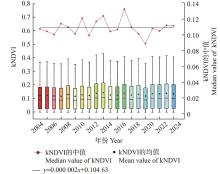
Fig.1
Time variation characteristics of vegetation coverage in Inner Mongolia kNDVI from 2004 to 2023"
Table 4
Trend of vegetation coverage changes in Inner Mongolia kNDVI (2004—2023)"
| SkNDVI | ZS | KNDVI 趋势 KNDVI trend | 面积占比 Area ratio (%) |
| ≥ | ≥1.96 | 显著提升 Significant improvement | 18.90 |
| ≥ | ?1.96~1.96 | 轻微提升 Slight improvement | 16.46 |
| ? | ?1.96~1.96 | 稳定 Stabilize | 49.95 |
| ≤? | ?1.96~1.96 | 轻微减少 Slight reduction | 11.38 |
| ≤? | ≤?1.96 | 严重减少 Serious reduction | 3.31 |
Table 5
Classification of vegetation coverage changes in Inner Mongolia (2004—2023)"
| 主要分布区域 Main distribution regions | 变化趋势描述 Trend description | 变化类型 Change type |
| 主要分布在呼伦贝尔东西部、兴安盟、通辽、赤峰、锡林郭勒东部、乌兰察布南部、鄂尔多斯东南部、巴彦淖尔南部以及呼和浩特和包头部分地区 Mainly distributed in eastern and western Hulunbuir, Hinggan League, Tongliao, Chifeng, eastern Xilingol, southern Ulanqab, southeastern Ordos, southern Bayannur, and parts of Hohhot and Baotou | 2004—2023年植被覆盖度显著下降 Significant decrease in vegetation coverage during 2004—2023 | 严重减少 Significant decrease |
| 与严重减少区相邻或过渡区域 Adjacent or transitional zones to significantly decreased areas | 2004—2023年植被覆盖度略有下降 Slight decrease in vegetation coverage during 2004—2023 | 轻微减少 Slight decrease |
| 主要分布在阿拉善、巴彦淖尔北部、包头和乌兰察布北部、锡林郭勒西部、呼伦贝尔西部 Mainly distributed in Alxa, northern Bayannur, northern Baotou and Ulanqab, western Xilingol, and western Hulunbuir | 2004—2023年植被覆盖度无明显变化 No significant change in vegetation coverage during 2004—2023 | 稳定 Stable |
| 零星分布于呼伦贝尔中北部、乌兰察布、赤峰、锡林郭勒、巴彦淖尔部分地区 Sporadically distributed in central-northern Hulunbuir, Ulanqab, Chifeng, Xilingol, and parts of Bayannur | 2004—2023年植被覆盖度略有提升 Slight increase in vegetation coverage during 2004—2023 | 轻微提升 Slight increase |
| 集中于部分生态恢复区和林草工程重点区域 Concentrated in some ecological restoration zones and key afforestation/grassland programs | 2004—2023年植被覆盖度显著提升 Significant increase in vegetation coverage during 2004—2023 | 显著提升 Significant increase |
Table 6
Hurst index classification of kNDVI in Inner Mongolia (2004—2023)"
| 可持续性描述 Sustainability description | H范围 H value range | 面积占比 Area proportion (%) |
| 不可持续性 Unsustainability | 0~0.50 | 75.7 |
| 非常轻微可持续性 Very slight sustainability | 0.50~0.55 | — |
| 轻微可持续性 Slight sustainability | 0.55~0.65 | — |
| 强可持续性 Strong sustainability | 0.65~0.75 | — |
| 非常强可持续性 Very strong sustainability | 0.75~0.80 | — |
| 极强可持续性 Extremely strong sustainability | 0.80~1 | 24.3 |
Table 7
Coupling classification of kNDVI trends and Hurst index (2004—2023)"
| 变化情景 Change scenario | 描述 Description | 面积占比 Area proportion (%) | 主要分布区域 Main distribution regions |
| 可持续性与显著改善 Sustainability and significant improvement | 具有正的长期记忆特性,未来持续改善 Positive long-term memory with future improvement trend | 1.28 | 呼伦贝尔中部及北部、兴安盟少部分地区 Central and northern Hulunbuir, and parts of Hinggan League |
| 可持续性与轻微改善 Sustainability and slight improvement | 具有持续性,kNDVI略有改善 Sustainability with slight improvement | 5.13 | 呼伦贝尔中部、乌兰察布、赤峰、锡林郭勒、巴彦淖尔部分地区 Central Hulunbuir, Ulanqab, Chifeng, Xilingol, parts of Bayannur |
| 可持续性与轻微退化 Sustainability and slight degradation | 具有持续性,kNDVI略有退化 Sustainability with slight degradation | 22.63 | 东北平原、大兴安岭南部、内蒙古高原东部、河套平原、鄂尔多斯高原、阿拉善高原 Northeast Plain, southern Greater Khingan Mountains, eastern Inner Mongolia Plateau, Hetao Plain, Ordos and Alxa Plateau |
| 可持续性与稳定性 Sustainability and stability | H与趋势均无显著变化 No significant change in Hurst index or trend | 0.00 | — |
| 可持续性与严重退化 Sustainability and severe degradation | 趋势为持续下降,H较小 Sustained decline trend with low Hurst index | 0.00 | — |
| 未来变化趋势不确定 Undetermined future variation trend | H低或趋势不显著,未来变化趋势不明确 Uncertain trend due to low Hurst index or insignificant persistence | 70.96 | 呼伦贝尔西部和东部、锡林郭勒、巴彦淖尔和阿拉善大部分地区 Western and eastern Hulunbuir, Xilingol, most of Bayannur and Alxa |
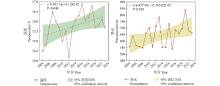
Fig.2
Trends of temperature and precipitation in Inner Mongolia from 2004 to 2023"
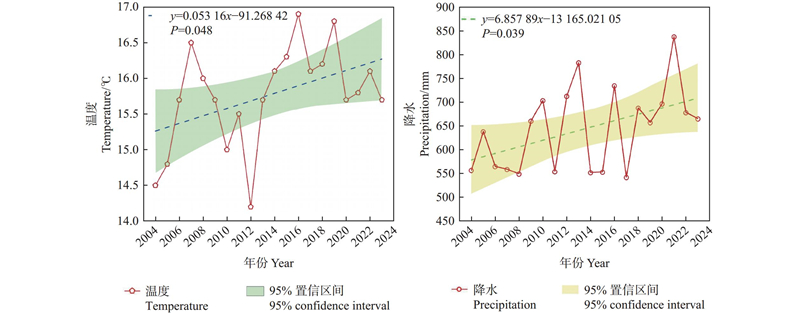
Table 8
Classification and spatial distribution of average annual temperature and total precipitation in Inner Mongolia (2004—2023)"
| 气温分级范围 Temperature class/℃ | 空间分布描述 Spatial distribution description | 空间分布描述 Spatial distribution description | 降水量分级范围 Precipitation class/mm | |
| ?3.10~0.08 | 主要分布在呼伦贝尔东北部高纬度地区 Mainly in the northeastern high-latitude areas of Hulunbuir | 阿拉善西部极干旱区 Extremely arid region of western Alxa | 27~73 | |
| 0.08~4.70 | 东北部高原丘陵区域 Northeastern hilly plateau regions | 阿拉善右旗及左旗西部 Right Banner and western Left Banner of Alxa | 73~118 | |
| 4.70~8.60 | 兴安岭及锡林郭勒北部 Greater Khingan Mountains and northern Xilingol | 巴彦淖尔西南部及鄂尔多斯西部 Southwest Bayannur and western Ordos | 118~163 | |
| 8.60~12.50 | 通辽、赤峰及中部部分区域 Tongliao, Chifeng, and parts of central region | 鄂尔多斯中部及呼和浩特以西区域 Central Ordos and areas west of Hohhot | 163~208 | |
| 12.50~16.40 | 包头、呼和浩特、鄂尔多斯北部 Baotou, Hohhot, and northern Ordos | 乌兰察布、呼和浩特、包头 Ulanqab, Hohhot, Baotou | 208~253 | |
| 16.40~20.30 | 鄂尔多斯大部、巴彦淖尔北部 Most of Ordos, northern Bayannur | 赤峰及通辽西部 Western Chifeng and Tongliao | 253~298 | |
| 20.30~24.28 | 巴彦淖尔西南部及阿拉善北部 Southwest Bayannur and northern Alxa | 锡林郭勒及通辽中东部 Xilingol and eastern-central Tongliao | 298~343 | |
| 24.28~28.32 | 阿拉善左旗、阿右旗北部 Left Banner and northern Right Banner of Alxa | 呼伦贝尔中南部与兴安盟部分区域 Central-southern Hulunbuir and parts of Hinggan League | 343~389 | |
| 28.32~32.10 | 阿右旗南部边缘地带 Southern border of Alxa Right Banner | 呼伦贝尔东部森林区 Eastern Hulunbuir forest area | 389~479 | |
| 32.10~36.44 | 阿拉善高原西南干旱区 Southwestern arid zone of Alxa Plateau | 呼伦贝尔东北部湿润地带 Northeastern moist zones of Hulunbuir | 479~548 |
Table 9
Statistics of partial correlation coefficients between kNDVI and climate factors (2004—2023)"
| 统计指标 Statistical index | kNDVI 温度 kNDVI temperature | kNDVI 降水 kNDVI precipitation |
| PCC范围 PCC range | ?1~1 | ?1~1 |
| 平均值 Mean value | ?0.13 | 0.07 |
| 正相关像素占比 Proportion of positively correlated pixels (%) | 67.87 | 58.50 |
| 负相关像素占比 Proportion of negatively correlated pixels (%) | 32.13 | 41.50 |
| 显著正相关占比 Proportion of significant positive correlation (%) | 47.26 | 34.50 |
| 显著负相关占比 Proportion of significant negative correlation (%) | 16.72 | 21.50 |
| 显著性空间分布说明 Significance spatial descriptions | 显著正相关: 呼伦贝尔东部/西部、兴安盟西部、锡林郭勒、赤峰中部、通辽南部、乌兰察布北部、包头、鄂尔多斯北部、阿拉善东部 Significant positive correlation: eastern/western Hulunbuir, western Hinggan, Xilingol, central Chifeng, southern Tongliao, northern Ulanqab, Baotou, northern Ordos, eastern Alxa 温度–显著负相关: 呼伦贝尔东北部/南部、兴安盟大部、通辽北部、乌兰察布、呼和浩特南部、巴彦淖尔大部、鄂尔多斯南部、阿拉善西部/南部 Temperature-significant negative correlation: northeastern/southern Hulunbuir, most Hinggan, northern Tongliao, Ulanqab, southern Hohhot, most Bayannur, southern Ordos, western/southern Alxa | 显著正相关: 呼伦贝尔、锡林郭勒、乌兰察布、鄂尔多斯西南部、阿拉善东部 Significant positive correlation: Hulunbuir, Xilingol, Ulanqab, southwestern Ordos, eastern Alxa 降水–显著负相关: 呼伦贝尔东部、兴安盟、赤峰、通辽、锡林郭勒中部、乌兰察布北部、包头、呼和浩特、鄂尔多斯大部、巴彦淖尔北部、阿拉善西部/北部Precipitation-significant negative correlation: eastern Hulunbuir, Hinggan, Chifeng, Tongliao, central Xilingol, northern Ulanqab, Baotou, Hohhot, most Ordos, northern Bayannur, western/northern Alxa |
Table 10
Statistics of complex correlation coefficient between kNDVI and climate factors and spatial characteristics (2004—2023)"
| 统计指标 Statistical index | 结果特征 Result characteristics |
| 值域范围 Value range | 0~1 |
| 平均值 Mean value | 0.25 |
| 显著相关像素占比 (P≤0.05) Proportion of significantly correlated pixels (%) | 34.91 |
| 非显著像素占比 Proportion of non-significant pixels (%) | 65.09 |
| 显著相关区域空间分布 Spatial distribution of significant correlation | 斑块状分布:呼伦贝尔高原、锡林郭勒草原带、阴山南麓、鄂尔多斯-阿拉善过渡带 Patchy distribution: Hulunbuir Plateau, Xilingol belt, southern Yinshan, Ordos-Alxa ecotone |
| 非显著区域空间分布 Spatial distribution of non-significant correlation | 广泛分布:河套灌区、乌兰察布丘陵、大兴安岭西麓、巴彦淖尔荒漠区 Widespread: Hetao irrigation, Ulanqab hills, western Greater Khingan, Bayannur desert |
Table 11
Types and spatial distribution of vegetation coverage drivers (2004—2023)"
| 驱动类型 Driver type | 地理分布特征 Geographical distribution |
| 降水 Precipitation (7.78%) | 呼伦贝尔、锡林郭勒西部、乌兰察布南部、 鄂尔多斯西南部、阿拉善南部 Hulunbuir, western Xilingol, southern Ulanqab, southwestern Ordos, southern Alxa |
| 温度 Temperature (17.01%) | 阿拉善东部、鄂尔多斯北部、包头、乌兰察布、 锡林郭勒、赤峰、通辽南部、兴安盟、呼伦贝尔东西部 Eastern Alxa, northern Ordos, Baotou, Ulanqab, Xilingol, Chifeng, southern Tongliao, Hinggan, eastern/western Hulunbuir |
| 共同 Combined (10.12%) | 呼伦贝尔西部、锡林郭勒中部、 乌兰察布局部区域 Western Hulunbuir, central Xilingol, partial Ulanqab |
| 非气候 Non-climate (65.09%) | 全域性分布,重点区域: 河套平原、阴山北麓、科尔沁沙地、 乌兰布和沙漠、腾格里沙漠边缘带 Pan-regional distribution, key areas: Hetao Plain, northern Yinshan, Horqin sandy land, Ulan buh desert, Tengger desert fringe |
| 安 妮, 宁小莉, 海全胜, 等. 基于MODIS数据的近15年浑善达克沙地植被净初级生产力时空分布研究. 干旱区资源与环境, 2020, 34 (4): 168- 175. | |
| An N, Ning X L, Hai Q S, et al. Optical model for estimating the spatial and temporal distribution of vegetation net primary productivity in Hunshandake Sandyland in recent 15 years. Journal of Arid Land Resources and Environment, 2020, 34 (4): 168- 175. | |
| 陈小龙, 张浩东, 赵元凤. 草原保险高质量发展路径研究: 基于内蒙古的实地调研. 草地学报, 2024, 32 (3): 907- 917. | |
| Chen X L, Zhang H D, Zhao Y F. Research on the path of high-quality development of grassland insurance-based on field research in Inner Mongolia. Acta Agrestia Sinica, 2024, 32 (3): 907- 917. | |
|
郝家田, 胡云云, 杜一尘, 等. 基于NDVI的2009—2018年黄河流域林草植被覆盖变化. 林业科学, 2022, 58 (3): 10- 19.
doi: 10.11707/j.1001-7488.20220302 |
|
|
Hao J T, Hu Y Y, Du Y C, et al. NDVI-based coverage changes of forest and grass vegetation in Yellow River Basin during 2009 to 2018. Scientia Silvae Sinicae, 2022, 58 (3): 10- 19.
doi: 10.11707/j.1001-7488.20220302 |
|
| 关伟涛, 吕世海, 刁兆岩, 等. 不同利用方式下呼伦贝尔草甸草原土壤呼吸动态特征及影响因素. 干旱区资源与环境, 2023, 37 (7): 117- 126. | |
| Guan W T, Lv S H, Diao Z Y, et al. Dynamics characteristics of soil respiration under different grazing modes in Hulunbuir meadow steppe. Journal of Arid Land Resources and Environment, 2023, 37 (7): 117- 126. | |
| 靳三玲, 刁兆岩, 吕世海, 等. 呼伦贝尔草原植物功能群对围封及放牧的响应特征. 干旱区资源与环境, 2022, 36 (1): 151- 158. | |
| Jin S L, Diao Z Y, Lü S H, et al. Response characteristics of plant functional groups to enclosure and grazing in Hulunbuir grassland. Journal of Arid Land Resources and Environment, 2022, 36 (1): 151- 158. | |
|
金佳莉, 王 成, 贾宝全. 我国4个典型城市近30年绿色空间时空演变规律. 林业科学, 2020, 56 (3): 61- 72.
doi: 10.11707/j.1001-7488.20200307 |
|
|
Jin J L, Wang C, Jia B Q. Spatio-temporal patterns of evolution urban greenspace during the last three decades in four typical cities of China. Scientia Silvae Sinicae, 2020, 56 (3): 61- 72.
doi: 10.11707/j.1001-7488.20200307 |
|
| 李德重, 姚 娜, 薛永军, 等. 内蒙古自治区自然资源调查监测高精度实景三维建设方法与实践. 测绘通报, 2023 (11): 158- 162. | |
| Li D Z, Yao N, Xue Y J, et al. High-precision 3D real scene construction method and practice for natural resources survey and monitoring system in Inner Mongolia Autonomous Region. Bulletin of Surveying and Mapping, 2023 (11): 158- 162. | |
|
李润东, 田文东, 于海群, 等. 基于数字影像的北京松山森林物候模拟及其与气象因子的关系. 林业科学, 2022, 58 (1): 89- 97.
doi: 10.11707/j.1001-7488.20220110 |
|
|
Li R D, Tian W D, Yu H Q, et al. Forest phenology estimation and its relationships with corresponding meteorological factors based on digital images in Songshan, Beijing, China. Scientia Silvae Sinicae, 2022, 58 (1): 89- 97.
doi: 10.11707/j.1001-7488.20220110 |
|
|
马小茗, 李瑞平, 李鑫磊, 等. 河套灌区地下水埋深与土壤盐分对增强型植被指数的联合影响. 干旱地区农业研究, 2023, 41 (3): 134- 141,165.
doi: 10.7606/j.issn.1000-7601.2023.03.18 |
|
|
Ma X M, Li R P, Li X L, et al. Combined effects of groundwater depth and soil salinization on enhanced vegetation index in Hetao irrigation area. Agricultural Research in the Arid Areas, 2023, 41 (3): 134- 141,165.
doi: 10.7606/j.issn.1000-7601.2023.03.18 |
|
| 马慧榕, 肖锋军, 董治宝, 等. 2000—2020年青海省共和县土地沙漠化动态及其驱动因素. 干旱区资源与环境, 2022, 36 (6): 139- 148. | |
| Ma H R, Xiao F J, Dong Z B, et al. Change of sandy desertification land and its driving factors in Gonghe county, Qinghai province from 2000 to 2020. Journal of Arid Land Resources and Environment, 2022, 36 (6): 139- 148. | |
| 曲学斌, 金林雪, 红 梅, 等. 基于VCI的内蒙古生长季干旱变化及对气候响应. 排灌机械工程学报, 2023, 41 (10): 1058- 1064. | |
| Qu X B, Jin L X, Hong M, et al. Drought change in growing season of Inner Mongolia and its response to based on VCI. Journal of Drainage and Irrigation Machinery, 2023, 41 (10): 1058- 1064. | |
| 秦豪君, 杨晓军, 马 莉, 等. 2000—2020年中国西北地区区域性沙尘暴特征及成因. 中国沙漠, 2022, 42 (6): 53- 64. | |
| Qin H J, Yang X J, Ma L, et al. Characteristics and causes of regional sandstorms in northwest of China from 2000 to 2020. Journal of Desert Research, 2022, 42 (6): 53- 64. | |
| 唐祎欣, 张 伟, 吴汉卿, 等. 植被恢复对西南喀斯特地区土壤气候韧性的提升作用. 生态学报, 2023, 43 (20): 8430- 8441. | |
| Tang Y X, Zhang W, Wu H Q, et al. Vegetation restoration enhances the resilience of soil quality to climate change in the southwest karst region. Acta Ecologica Sinica, 2023, 43 (20): 8430- 8441. | |
|
王晓雅, 凌子燕, 陈 研, 等. 秦岭中部自然保护区植被生长状况遥感监测. 自然保护地, 2022 (2): 48- 59.
doi: 10.12335/2096-8981.2021121602 |
|
|
Wang X Y, Ling Z Y, Chen Y, et al. Remote sensing monitoring of vegetation growth status about nature reserves in the middle of Qinling Mountains. Natural Protected Areas, 2022 (2): 48- 59.
doi: 10.12335/2096-8981.2021121602 |
|
| 王希义, 彭淑贞, 徐海量, 等. 塔里木河下游植被生物量的动态模拟及其宏观价值评估. 干旱区资源与环境, 2020, 34 (3): 166- 172. | |
| Wang X Y, Peng S Z, Xu H L, et al. Dynamic simulation and macro-value evaluation vegetation biomass in the lower reaches of Tarim river. Journal of Arid Land Resources and Environment, 2020, 34 (3): 166- 172. | |
| 吴佳芯, 张育涵, 李邵宇, 等. 长期放牧对内蒙古荒漠草原土壤不同组分有机磷含量的影响. 草地学报, 2024, 32 (5): 1479- 1488. | |
| Wu J X, Zhang Y H, Li S Y, et al. Effects of Long-term grazing on different fractions of organic phosphorus content in desert grassland in Inner Mongolia. Acta Agrestia Sinica, 2024, 32 (5): 1479- 1488. | |
|
吴运力, 张 钰, 田佳榕. 气候变化和人类活动对内蒙古高原不同植被类型NDVI的影响. 中国农业气象, 2023, 44 (12): 1155- 1168.
doi: 10.3969/j.issn.1000-6362.2023.12.008 |
|
|
Wu Y L, Zhang Y, Tian J R, et al. Impacts by climate change and human activities on NDVI in different vegetation types across the Inner Mongolia plateau. Chinese Jourmal of Agrometeorology, 2023, 44 (12): 1155- 1168.
doi: 10.3969/j.issn.1000-6362.2023.12.008 |
|
| 徐红枫, 王 妍, 苏 倩, 等. 基于Google Earth Engine的云南省典型岩溶地区30年石漠化演变与驱动因子分析. 干旱区资源与环境, 2022, 36 (5): 94- 101. | |
| Xu H F, Wang Y, Su Q, et al. Evolution of rock desertification and driving factors in typical karst areas of Yunnan Province. Journal of Arid Land Resources and Environment, 2022, 36 (5): 94- 101. | |
| 叶生星, 丁国栋, 刁兆岩, 等. 不同利用程度对典型草原植被空间异质性的影响. 干旱区资源与环境, 2019, 33 (3): 158- 164. | |
| Ye S X, Ding G D, Diao Z Y, et al. Effects of grazing levels on the spatial heterogeneity of vegetation in typical steppe. Journal of Arid Land Resources and Environment, 2019, 33 (3): 158- 164. | |
| 赵家培, 郭恩亮, 王永芳, 等. 2023. 基于核温度植被干旱指数的内蒙古植被生长季生态干旱监测. 应用生态学报, 34(11): 2929−2937. | |
| Zhao J P, Guo E L, Wang Y F, et al. 2023. Ecological drought monitoring of Inner Mongolia vegetation growing season based on kernel temperature vegetation drought index (kTVDI), Chinese Journal of Applied Ecology, 34(11): 2929−2937. [in Chinese] | |
| 张 恒, 诺 敏, 班擎宇, 等. 不同草原防火政策下内蒙古草原火灾发生风险及其驱动因素的研究. 中国草地学报, 2024, 46 (4): 100- 111. | |
| Zhang H, Nuo M, Ban Q Y, et al. Study on grassland fire and its driving factors under different grassland fire prevention policies in Inner Mongolia. Chinese Journal of Grassland, 2024, 46 (4): 100- 111. | |
| 庄义琳, 周金星, 吴秀芹, 等. 2001—2016年喀斯特断陷盆地植被变化及其驱动因素. 林业科学, 2019, 55 (9): 177- 184. | |
| Zhuang Y L, Zhou J X, Wu X Q, et al. Vegetation change and it's driving forces in karst faulted basins between 2001 and 2016. Scientia Silvae Sinicae, 2019, 55 (9): 177- 184. | |
|
郑婷婷, 杨 莉, 贾卓霏, 等. 基于生态系统“受损−恢复力−修复潜力”评价的内蒙古生态空间分区及保护修复策略. 环境工程技术学报, 2023, 13 (5): 1901- 1909.
doi: 10.12153/j.issn.1674-991X.20221162 |
|
|
Zheng T T, Yang L, Jia Z F, et al. Ecological space zoning and conservation and restoration strategies based on the evaluation of ecosystem “damage-resilience-restoration potential” in Inner Mongolia autonomous region. Journal of Environmental Engineering Technology, 2023, 13 (5): 1901- 1909.
doi: 10.12153/j.issn.1674-991X.20221162 |
|
|
Alencar A, Shimbo J Z, Lenti F, et al. Mapping three decades of changes in the Brazilian savanna native vegetation using landsat data processed in the google earth engine platform. Remote Sensing, 2020, 12 (6): 924.
doi: 10.3390/rs12060924 |
|
| Bellini E, Moriondo M, Dibari C, et al. Impacts of climate change on European grassland phenology: a 20-year analysis of MODIS satellite data. Remote Sensing, 2023, 15 (1): 218. | |
|
Dastour H, Hassan Q K. Quantifying the influence of climate variables on vegetation through remote sensing and multi-dimensional data analysis. Earth Systems and Environment, 2024, 8 (2): 165- 180.
doi: 10.1007/s41748-024-00384-2 |
|
| Dawood M, Rahman A U, Rahman G, et al. Geo-statistical analysis of climatic variability and trend detection in the Hindu Kush region, north Pakistan. Environmental Monitoring and Assessment, 2023, 196 (1): 4. | |
|
Di Sciorio F, Mattera R, Segovia J E T. Measuring conditional correlation between financial markets' inefficiency. Quantitative Finance and Economics, 2023, 7 (3): 491- 507.
doi: 10.3934/QFE.2023025 |
|
|
Du H J, Liu Q H, Li J, et al. Retrieving crop leaf area index by combining optical and microwave vegetation indices: a feasibility analysis. National Remote Sensing Bulletin, 2013, 17 (6): 1587- 1611.
doi: 10.11834/jrs.20133035 |
|
|
Drissia T K, Jothiprakash V, Sivakumar B. Regional flood frequency analysis using complex networks. Stochastic Environmental Research and Risk Assessment, 2022, 36 (1): 115- 135.
doi: 10.1007/s00477-021-02074-1 |
|
|
Feng X J, Tian J, Wang Y X, et al. Spatio-temporal variation and climatic driving factors of vegetation coverage in the Yellow River Basin from 2001 to 2020 based on kNDVI. Forests, 2023, 14 (3): 620.
doi: 10.3390/f14030620 |
|
|
Forzieri G, Dakos V, McDowell N G, et al. Emerging signals of declining forest resilience under climate change. Nature, 2022, 608 (7923): 534- 539.
doi: 10.1038/s41586-022-04959-9 |
|
|
Gholampour A, Ho V D, Ozbakkaloglu T. Ambient-cured geopolymer mortars prepared with waste-based sands: mechanical and durability-related properties and microstructure. Composites Part B: Engineering, 2019, 160, 519- 534.
doi: 10.1016/j.compositesb.2018.12.057 |
|
|
Guo B, Zhang R, Lu M, et al. A new large-scale monitoring index of desertification based on kernel normalized difference vegetation index and feature space model. Remote Sensing, 2024, 16 (10): 1771.
doi: 10.3390/rs16101771 |
|
|
He Q Y, Yang Q H, Jiang S Z, et al. A comprehensive analysis of vegetation dynamics and their response to climate change in the Loess Plateau: insight from long-term kernel normalized difference vegetation index data. Forests, 2024, 15 (3): 471.
doi: 10.3390/f15030471 |
|
|
Huang X, Wang L. Spatial heterogeneity and factors Influencing Ecosystem services in the Yimeng Mountainous area. Polish Journal of Environmental Studies, 2023, 32 (3): 2637- 2655.
doi: 10.15244/pjoes/161329 |
|
|
Jasim B, Jasim O Z, AL-Hameedawi A N. Monitoring change detection of vegetation vulnerability using hotspots analysis. IIUM Engineering Journal, 2024, 25 (2): 116- 129.
doi: 10.31436/iiumej.v25i2.3030 |
|
|
Jin K, Jin Y S, Wang F, et al. Impacts of anthropogenic activities on vegetation cover changes in the Circum-Bohai-Sea region, China. Geocarto International, 2022, 37 (25): 9339- 9354.
doi: 10.1080/10106049.2021.2017016 |
|
|
Li J Z, Claude N, Tassi P, et al. River restoration works design based on the study of early-stage vegetation development and alternate bar dynamics. River Research and Applications, 2023, 39 (9): 1682- 1695.
doi: 10.1002/rra.4188 |
|
|
Liu T X, Zhang Q, Li T T, et al. Dynamic vegetation responses to climate and land use changes over the Inner Mongolia reach of the Yellow River Basin, China. Remote Sensing, 2023a, 15 (14): 3531.
doi: 10.3390/rs15143531 |
|
| Liu Y, Liu H, Chen Y, et al. Spatio-temporal dynamics of vegetation optical depth and its driving forces in China from 2000 to 2018. Acta Geographica Sinica, 2023b, 78 (3): 729- 745. | |
|
Liu Z Z, Wang H, Li N, et al. Spatial and temporal characteristics and driving forces of vegetation changes in the Huaihe river basin from 2003 to 2018. Sustainability, 2020, 12 (6): 2198.
doi: 10.3390/su12062198 |
|
| Li S, Liang W, Fu B J, et al. Vegetation changes in recent large-scale ecological restoration projects and subsequent impact on water resources in China’s Loess Plateau. Science of the Total Environment, 2016, 569, 1032- 1039. | |
| Li Y, Chen Q, Fang H, et al. Vegetation evolution and its influencing factors in the Yangtze River Basin based on multi-scale geographical weighted regression. China Environmental Science, 2024, 44 (1): 352- 362. | |
|
Moorman M C, Augspurger T, Stanton J D, et al. Where’s the grass? Disappearing submerged aquatic vegetation and declining water quality in lake mattamuskeet. Journal of Fish and Wildlife Management, 2017, 8 (2): 401- 417.
doi: 10.3996/082016-JFWM-068 |
|
|
Neuenschwander A, Pitts K. The ATL08 land and vegetation product for the ICESat-2 Mission. Remote Sensing of Environment, 2019, 221, 247- 259.
doi: 10.1016/j.rse.2018.11.005 |
|
|
Qin S F, Ding J L, Ge X Y, et al. Spatio-temporal changes in water use efficiency and its driving factors in central Asia (2001—2021). Remote Sensing, 2023, 15 (3): 767.
doi: 10.3390/rs15030767 |
|
|
Su Y H, Gong Z T, Qin N. Complex interval-value intuitionistic fuzzy sets: Quaternion number representation, correlation coefficient and applications. AIMS Mathematics, 2024, 9 (8): 19943- 19966.
doi: 10.3934/math.2024973 |
|
|
Venson G G, Tsuruta K M, Finzi R M, et al. The use of Hurst exponent in impedance-based structural health monitoring. Journal of the Brazilian Society of Mechanical Sciences and Engineering, 2022, 44 (11): 536.
doi: 10.1007/s40430-022-03838-8 |
|
|
Wang Q, Moreno-Martínez Á, Muñoz-Marí J, et al. Estimation of vegetation traits with kernel NDVI. ISPRS Journal of Photogrammetry and Remote Sensing, 2023, 195, 408- 417.
doi: 10.1016/j.isprsjprs.2022.12.019 |
|
| Wang S Y, Gao M L, Li Z H, et al. 2024. How do driving factors affect vegetation coverage change in the Shaanxi region of the Qinling Mountains? Remote Sensing, 16(1): 160. | |
| Wang Z, Wu J, Bai S, et al. Spatiotemporal changes of sloping farmland resources and its soil erosion effects in Yan’an city. Research of Soil and Water Conservation, 2022, 29 (3): 1- 11. | |
|
Wu J, Cai L J, Hu K, et al. Design and evaluation of an efficient mosquito trap. Pest Management Science, 2024, 80 (10): 5200- 5211.
doi: 10.1002/ps.8247 |
|
|
Ye J H, Wang N, Sun M, et al. A new method for the rapid determination of fire disturbance events using GEE and the VCT algorithm: a case study in southwestern and northeastern China. Remote Sensing, 2023, 15 (2): 413.
doi: 10.3390/rs15020413 |
|
|
Yue X Q, Feng D, Sun D S, et al. AirPollutionViz: visual analytics for understanding the spatio-temporal evolution of air pollution. Journal of Visualization, 2024, 27 (2): 215- 233.
doi: 10.1007/s12650-024-00958-2 |
|
| Zhang Y, Sa C, Meng F, et al. Response characteristics of vegetation reforestation period to climate, snow cover and soil water in mongolian plateau. Remote Sensing Technology and Application, 2024a, 38 (6): 1338- 1349. | |
| Zhang G, Wang H, Su X, et al. Assessing the vegetation vulnerability of Loess Plateau under compound dry and hot climates. Transactions of the Chinese Society of Agricultural Engineering, 2024b, 40 (6): 339- 346. | |
| Zhu H. Sclerophyllous evergreen broad-leaved forest in Yunnan A remnant vegetation related to Tethys. Guihaia, 2023, 43 (2): 234- 241. |
| [1] | Xiaoyan Yu,Yaxian Gao,Guangpu Wei,Shuyu Zhang,Wenjun Zhang. Spatio-temporal Pattern of Vegetation Resilience and Its Response to Extreme Climate in Inner Mongolia Autonomous Region [J]. Scientia Silvae Sinicae, 2025, 61(9): 48-58. |
| [2] | Gentana Ge,Lianggaoke Yue,Xiaosong Li,Cuicui Ji,Jianhe Wang,Tong Shen,Tiancan Wang. Estimation of Tree Height in the Grain for Green Program Stands of Inner Mongolia Based on GEDI and Sentinel-2 [J]. Scientia Silvae Sinicae, 2025, 61(3): 16-26. |
| [3] | Yi Li,Bowen Shan,Li Yang,Jun Qin,Lei Shi. Spatio-Temporal Change of Forest Lands of Feicheng City and Its Driving Factorsin the Past 20 Years [J]. Scientia Silvae Sinicae, 2024, 60(7): 40-46. |
| [4] | Jiatian Hao,Yunyun Hu,Yichen Du,Xiaowei Hou,Anmin Xiang. NDVI-Based Coverage Changes of Forest and Grass Vegetation in Yellow River Basin during 2009 to 2018 [J]. Scientia Silvae Sinicae, 2022, 58(3): 10-19. |
| [5] | Li Jie, Zhang Jun, Liu Chenli, Yang Xuchao. Spatiotemporal Variation of Vegetation Coverage in Recent 16 Years in the Border Region of China, Laos, and Myanmar Based on MODIS-NDVI [J]. Scientia Silvae Sinicae, 2019, 55(8): 9-18. |
| [6] | Cheng Ruimei, Wang Na, Xiao Wenfa, Shen Yafei, Liu Zebin. Advances in Studies of Ecological Stoichiometry of Terrestrial Ecosystems [J]. Scientia Silvae Sinicae, 2018, 54(7): 130-136. |
| [7] | Ou Zhaorong, Zhu Qingke, Sun Yongyu. Temporal and Spatial Heterogeneity of the Vegetation Coverage in the Dry Season in Yuanmou Dry-Hot Valley [J]. Scientia Silvae Sinicae, 2017, 53(11): 20-28. |
| [8] | Liu Lin, Liu Tienan, Liu Meishuang, Liu Junchuang. Analysis of Forest Land Area Change and Driving Factors in the Forest Industry Region of Heilongjiang Province [J]. Scientia Silvae Sinicae, 2016, 52(5): 160-169. |
| [9] | Jia Baoquan;Qiu Erfa;Zhang Hongqi. Xi'an Vegetation Dynamics Based on NDVI [J]. Scientia Silvae Sinicae, 2012, 48(10): 6-12. |
| [10] | Zhang Fei;Tashpolat·Tiyip;Ding Jianli;;He Qisheng;Tian Yuan;Mamat·Sawut;Wang Hong;Gui Dongwei;. Dynamically Monitoring Vegetation Cover by Remote Sensing in the Typical Salinization Region of Xinjiang: A Case Study in Delta Oasis of Weigan and Kuqa Rivers [J]. Scientia Silvae Sinicae, 2011, 47(7): 27-35. |
| [11] | Hou Jianhua;Gao Baojia;Dong Jianxin;Gao Lijie;Liu Yinghua;Li Lanhui. Community Diversity of Arthropod in Forest-Steppe Ecotone in Southeast Edge of Inner Mongolia Tableland [J]. Scientia Silvae Sinicae, 2008, 44(3): 94-101. |
| [12] | Wang Yukui;Yan Yanxia;Wang Baoping;Xiao Caihong;Yang Chaowei. Weather Condition Analysis on Dust Events of Ulanbuh Desert [J]. , 2007, 43(zk): 22-27. |
| [13] | Xu Wenke;Cai Tijiu;Ju Cunyong. Quantitative Estimation of Desertification Degree Based on RS and GIS in Mu Us Sandland,Inner Mongolia [J]. Scientia Silvae Sinicae, 2007, 43(5): 48-53. |
| [14] | Bi Huaxing;Li Xiaoyin;Li Jun;Guo Mengxia;Liu Xin. Study on Suitable Vegetation Cover on Loess Area Based on Soil Water Balance [J]. Scientia Silvae Sinicae, 2007, 43(4): 17-23. |
| [15] | Wang Hua;Liang Shouhua;Wang Hui;Jia Guixia. Rare and Precious Wild Flower Resources in Inner Mongolia Derset Region and Their Utilization Prospect in Landscape Gardening [J]. Scientia Silvae Sinicae, 2007, 43(3): 59-65. |
| Viewed | ||||||
|
Full text |
|
|||||
|
Abstract |
|
|||||
