
Scientia Silvae Sinicae ›› 2025, Vol. 61 ›› Issue (11): 70-79.doi: 10.11707/j.1001-7488.LYKX20240686
• Research papers • Previous Articles Next Articles
Liu Yang1,Feng Yan1,*( ),Yanjiao Wang2
Received:2024-11-14
Revised:2025-09-08
Online:2025-11-25
Published:2025-12-11
Contact:
Feng Yan
E-mail:fyan@caf.ac.cn
CLC Number:
Liu Yang,Feng Yan,Yanjiao Wang. Spatiotemporal Variations Characteristics and Driving Forces of Vegetation Coverage in the Horqin and Otindag Sandy Lands[J]. Scientia Silvae Sinicae, 2025, 61(11): 70-79.
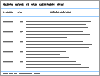
Table 1
Criteria of determining interaction"
| 判断依据 Criterion | 交互作用 Interaction |
| q(x1∩x2)<Min[q(x1),q(x2)] | 非线性减弱 Non-linear reduction |
| q(x1∩x2)= q(x1)+ q(x2) | 独立Independent |
| Min[q(x1),q(x2)]<q(x1∩x2)<Max[q(x1),q(x2)] | 单因子非线性减弱Single factor non-linear reduction |
| q(x1∩x2)>q(x1)+ q(x2) | 非线性增强Non-linear enhancement |
| q(x1∩x2)>Max(q(x1),q(x2)) | 双因子增强Bi-factor enhancement |
Table 2
Future trend in FVC"
| 取值范围 Value range | 未来趋势变化 Future trend changes | |
| Theil-Sen | Hurst | |
| >0 | >0.5 | 持续改善Continuous improvement |
| <0 | >0.5 | 持续退化Continuous degradation |
| >0 | <0.5 | 由改善到退化From improvement to degradation |
| <0 | <0.5 | 由退化到改善From degradation to improvement |
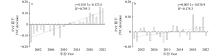
Fig.1
Variations of FVC deviation in Horqin sandy land (a)and Otindag sandy land (b) in 2000—2022"
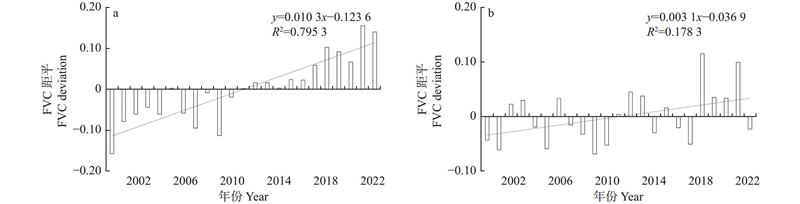
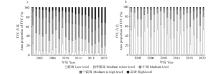
Fig.2
Area proportion of FVC with different levels in Horqin sandy land (a) and Otindag sandy land (b) in 2000—2022"
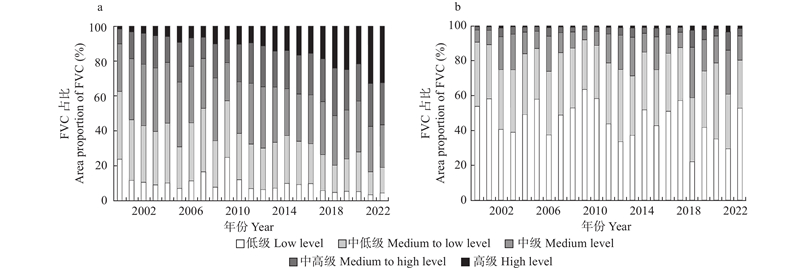
Table 3
Area proportion of FVC with significant change in Horqin and Otindag sandy lands"
| 沙地Sandy land | 面积占比Area proportion (%) | ||||||
| 极显著增加 Very significantly increased | 显著增加 Significantly increased | 不显著增加 No significantly increased | 无变化 Unchange | 不显著减少 No significantly reduced | 显著减少 Significantly reduced | 极显著减少 Very significantly reduced | |
| 科尔沁沙地 Horqin sandy land | 54.56 | 13.54 | 24.39 | 0.63 | 5.89 | 0.51 | 0.48 |
| 浑善达克沙地 Otindag sandy land | 11.89 | 8.43 | 50.38 | 10.77 | 17.37 | 0.71 | 0.44 |
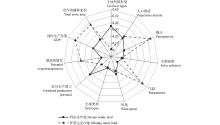
Fig.3
Results of single factor detection(q-value)"
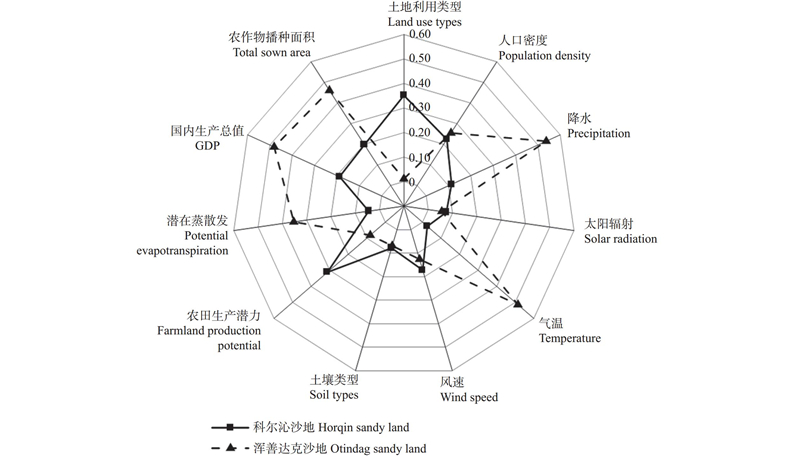
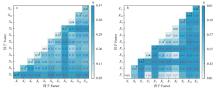
Fig.4
Interaction detection results of driving factors in Horqin sandy land (a)and Otindag sandy land (b) X1: Land use type;X2: Population density;X3: Precipitation;X4: Solar radiation;X5: Temperature;X6: Wind speed; X7: Soil type; X8: Farmland production potential; X9: Potential evapotranspiration;X10: Gross domestic product (GDP);X11: Total sowing area. * for P<0.01, and the red font and blue font indicate bi-factor enhancement and non-linear enhancement respectively, the purple font indicates single factor non-linear reduction,and the yellow font indicates independent function."
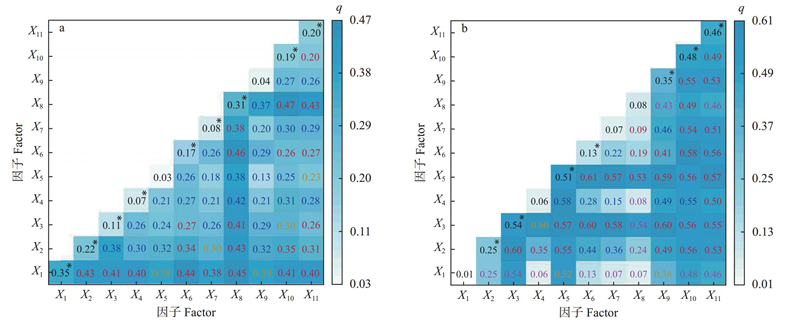
Table 4
Projected areal proportion of FVC change trends in Horqin and Otindag sandy lands"
| 沙地Sandy land | 面积占比Area proportion (%) | |||
| 持续改善 Continuous improvement | 由改善到退化 From improvement to degradation | 持续退化 Continuous degradation | 由退化到改善 From degradation to improvement | |
| 科尔沁沙地Horqin sandy land | 22.96 | 70.34 | 1.88 | 4.82 |
| 浑善达克沙地Otindag sandy land | 12.09 | 68.89 | 2.64 | 16.38 |
|
陈雪萍, 赵学勇, 张 晶, 等. 基于地理探测器的科尔沁沙地植被NDVI时空变化特征及其驱动因素. 植物生态学报, 2023, 47 (8): 1082- 1093.
doi: 10.17521/cjpe.2022.0020 |
|
|
Chen X P, Zhao X Y, Zhang J, et al. Variation of NDVI spatio-temporal characteristics and its driving factors based on geodetector model in Horqin sandy land, China. Chinese Journal of Plant Ecology, 2023, 47 (8): 1082- 1093.
doi: 10.17521/cjpe.2022.0020 |
|
|
何晨阳, 闫 峰, 卢 琦, 等. 2001—2020年埃及植被生长状况时空变化特征. 林业科学, 2023, 59 (3): 65- 72.
doi: 10.11707/j.1001-7488.LYKX20210566 |
|
|
He C Y, Yan F, Lu Q, et al. Characterization of spatiotemporal variations in vegetation growth in Egypt in 2001—2020. Scientia Silvae Sinicae, 2023, 59 (3): 65- 72.
doi: 10.11707/j.1001-7488.LYKX20210566 |
|
| 韩 磊, 曹鑫鑫, 朱会利, 等. 基于特征分区的陕北黄土高原植被覆盖变化及其驱动因素. 生态学报, 2023, 43 (20): 8564- 8577. | |
| Han L, Cao X X, Zhu H L, et al. Change of vegetation coverage and driving factor in the north Shanxi Loess Plateau based on characteristic zoning. Acta Ecologica Sinica, 2023, 43 (20): 8564- 8577. | |
| 郝家田, 胡云云, 杜一尘, 等. 基于NDVI的2009—2018年黄河流域林草植被覆盖变化. 林业科学, 2022, 58 (3): 10- 19. | |
| Hao J T, Hu Y Y, Du Y C, et al. NDVI-based coverage changes of forest and grass vegetation in Yellow River Basin during 2009 to 2018. Scientia Silvae Sinicae, 2022, 58 (3): 10- 19. | |
| 雷 茜, 胡忠文, 王敬哲, 等. 1985—2015年中国不同生态系统NDVI时空变化及其对气候因子的响应. 生态学报, 2023, 43 (15): 6378- 6391. | |
| Lei Q, Hu Z W, Wang J Z, et al. Spatiotemporal dynamics of NDVI in China from 1985 to 2015: ecosystem variation, regional differences, and response to climatic factors. Acta Ecologica Sinica, 2023, 43 (15): 6378- 6391. | |
| 刘慧丽, 陈 浩, 董廷旭, 等. 川渝地区NDVI动态特征及其对气候变化的响应. 生态学报, 2023, 43 (16): 6743- 6757. | |
| Liu H L, Chen H, Dong T X, et al. Variation characteristic of NDVI and its response to climate change in the Sichuan-Chongqing region. Acta Ecologica Sinica, 2023, 43 (16): 6743- 6757. | |
| 谭炳香, 沈明潭, 郄光发, 等. 冬奥会崇礼生态核心区植被覆盖时空变化遥感监测. 林业科学, 2022, 58 (4): 141- 151. | |
| Tan B X, Shen M T, Qie G F, et al. Temporal and spatial changes monitoring of vegetation coverage for the ecological core area of Chongli Winter Olympic Games. Scientia Silvae Sinicae, 2022, 58 (4): 141- 151. | |
| 马永桃, 任孝宗, 胡慧芳, 等. 基于地理探测器的浑善达克沙地植被变化定量归因. 中国沙漠, 2021, 41 (4): 195- 204. | |
| Ma Y T, Ren X Z, Hu H F, et al. Vegetation dynamics and its driving force in Otindag sandy land based on geodetector. Journal of Desert Research, 2021, 41 (4): 195- 204. | |
| 王劲峰, 徐成东. 地理探测器: 原理与展望. 地理学报, 2017, 72 (1): 116- 134. | |
| Wang J F, Xu C D. Geodetector: principle and prospective. Acta Geographica Sinica, 2017, 72 (1): 116- 134. | |
| 王瑞杰, 闫 峰. 2000—2018年西北砒砂岩区植被覆盖度与地形效应. 应用生态学报, 2020, 31 (4): 1194- 1202. | |
| Wang R J, Yan F. Fractional vegetation cover and topographic effects in pisha sandstone area of northwest China in 2000—2018. Chinese Journal of Applied Ecology, 2020, 31 (4): 1194- 1202. | |
| 王 超, 侯 鹏, 刘晓曼, 等. 中国重要生态系统保护和修复工程区域植被覆盖时空变化研究. 生态学报, 2023, 43 (21): 8903- 8916. | |
| Wang C, Hou P, Liu X M, et al. Spatiotemporal changes in vegetation cover of the national key ecosystem protection and restoration project areas, China. Acta Ecologica Sinica, 2023, 43 (21): 8903- 8916. | |
| 闫 峰, 吴 波, 王艳姣. 2000—2011年毛乌素沙地植被生长状况时空变化特征. 地理科学, 2013, 33 (5): 602- 608. | |
| Yan F, Wu B, Wang Y J. Spatial and temporal variations of vegetation growth status in Mu Us sandy land in 2000—2011. Scientia Geographica Sinica, 2013, 33 (5): 602- 608. | |
| 闫 峰, 王艳姣, 武建军, 等. 2009. 基于 Ts-EVI 时间序列谱的冬小麦面积提取. 农业工程学报, 25(4): 135−140. | |
| Yan F, Wang Y J, Wu J J, et al. 2009. Extracting winter wheat area using temporal sequence of Ts-EVI. Transactions of the Chinese Society of Agricultural Engineering, 25(4): 135−140. [in Chinese] | |
| 赵媛媛, 武海岩, 丁国栋, 等. 浑善达克沙地土地沙漠化研究进展. 中国沙漠, 2020, 40 (5): 101- 111. | |
| Zhao Y Y, Wu H Y, Ding G D, et al. A review on the aeolian desertification in the Otindag sandy land. Journal of Desert Research, 2020, 40 (5): 101- 111. | |
| 张思源, 聂 莹, 张海燕, 等. 基于地理探测器的内蒙古植被NDVI时空变化与驱动力分析. 草地学报, 2020, 28 (5): 1460- 1472. | |
| Zhang S Y, Nie Y, Zhang H Y, et al. Spatiotemporal variation of vegetation NDVI and its driving forces in Inner Mongolia based on geodetector. Acta Agrestia Sinica, 2020, 28 (5): 1460- 1472. | |
| 张 钤, 张方敏, 卢 琦, 等. 生态工程对科尔沁沙地主要生态服务功能的影响. 水土保持通报, 2021, 41 (5): 154- 159, 165, 373. | |
| Zhang Q, Zhang F M, Lu Q, et al. Effects of ecological construction projects on primary ecosystem services in Horqin sandy land. Bulletin of Soil and Water Conservation, 2021, 41 (5): 154- 159, 165, 373. | |
|
Ali R, Kuriqi A, Abubaker S, et al. Long-term trends and seasonality detection of the observed flow in Yangtze River using mann-kendall and sen’s innovative trend method. Water, 2019, 11 (9): 1855.
doi: 10.3390/w11091855 |
|
|
Du H. Spatiotemporal evolution of fractional vegetation cover and its response to climate change based on MODIS data in the subtropical region of China. Remote Sensing, 2021, 13 (5): 913.
doi: 10.3390/rs13050913 |
|
|
Feng X, Tian J, Wang Y, et al. Spatio-temporal variation and climatic driving factors of vegetation coverage in the Yellow River Basin from 2001 to 2020 Based on Kndvi. Forests, 2023, 14 (3): 620.
doi: 10.3390/f14030620 |
|
|
Han Z, Song W. Interannual trends of vegetation and responses to climate change and human activities in the Great Mekong Subregion. Global Ecology and Conservation, 2022, 38, e02215.
doi: 10.1016/j.gecco.2022.e02215 |
|
|
He C Y, Yan F, Wang Y J, et al. Spatiotemporal variation in vegetation growth status and its response to climate in the Three-River headwaters region, China. Remote Sensing, 2022, 14 (19): 5041.
doi: 10.3390/rs14195041 |
|
|
Liu L, Xu X L, Chen X. Assessing the impact of urban expansion on potential crop yield in China during 1990–2010. Food Security, 2015, 7 (1): 33- 43.
doi: 10.1007/s12571-014-0411-z |
|
|
Mo K, Chen Q, Chen C, et al. Spatiotemporal variation of correlation between vegetation cover and precipitation in an arid mountain-oasis river basin in northwest China. Journal of Hydrology, 2019, 574, 138- 147.
doi: 10.1016/j.jhydrol.2019.04.044 |
|
|
Peng S Z, Ding Y X, Wen Z M, et al. Spatiotemporal change and trend analysis of potential evapotranspiration over the Loess Plateau of China during 2011—2100. Agricultural and Forest Meteorology, 2017, 233, 183- 194.
doi: 10.1016/j.agrformet.2016.11.129 |
|
|
Peng L, Wang J, Liu M M, et al. Spatio-temporal variation characteristics of NDVI and its response to climate on the Loess Plateau from 1985 to 2015. CATENA, 2021, 203, 105331.
doi: 10.1016/j.catena.2021.105331 |
|
|
Wang H, Yao F, Zhu H, et al. Spatiotemporal variation of vegetation coverage and its response to climate factors and human activities in arid and semi-arid areas: case study of the Otindag sandy land in China. Sustainability, 2020, 12 (12): 5214.
doi: 10.3390/su12125214 |
|
|
Wang X, Song J L, Xiao Z Q, et al. Desertification in the Mu Us sandy land in China: response to climate change and human activity from 2000 to 2020. Geography and Sustainability, 2022, 3 (2): 177- 189.
doi: 10.1016/j.geosus.2022.06.001 |
|
|
Zhang X C, Jin X M. Vegetation dynamics and responses to climate change and anthropogenic activities in the Three-River headwaters region, China. Ecological Indicators, 2021, 131, 108223.
doi: 10.1016/j.ecolind.2021.108223 |
|
|
Zhang Q, Gu L, Liu Y, et al. Spatio-temporal dynamics of normalized difference vegetation index and its response to climate change in Xinjiang, 2000–2022. Forests, 2024, 15 (2): 370.
doi: 10.3390/f15020370 |
|
|
Zhong X Z, Li J, Wang J L, et al. Linear and nonlinear characteristics of long-term NDVI using trend analysis: a case study of Lancang-Mekong River Basin. Remote Sense, 2022, 14, 6271.
doi: 10.3390/rs14246271 |
| Viewed | ||||||
|
Full text |
|
|||||
|
Abstract |
|
|||||
