
Scientia Silvae Sinicae ›› 2026, Vol. 62 ›› Issue (7): 186-196.doi: 10.11707/j.1001-7488.LYKX20250554
• Research papers • Previous Articles Next Articles
Zeyu Xu,Rongrong Li*( )
)
Received:2025-09-09
Online:2026-07-10
Published:2026-07-14
Contact:
Rongrong Li
E-mail:rongrong.li@njfu.edu.cn
CLC Number:
Zeyu Xu,Rongrong Li. A Surface Defect Detection Algorithm for Bamboo Strips Based on Lightweight Feature Fusion and Spatial Reconstruction[J]. Scientia Silvae Sinicae, 2026, 62(7): 186-196.
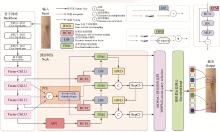
Fig.1
FCHM-DETR network structure"
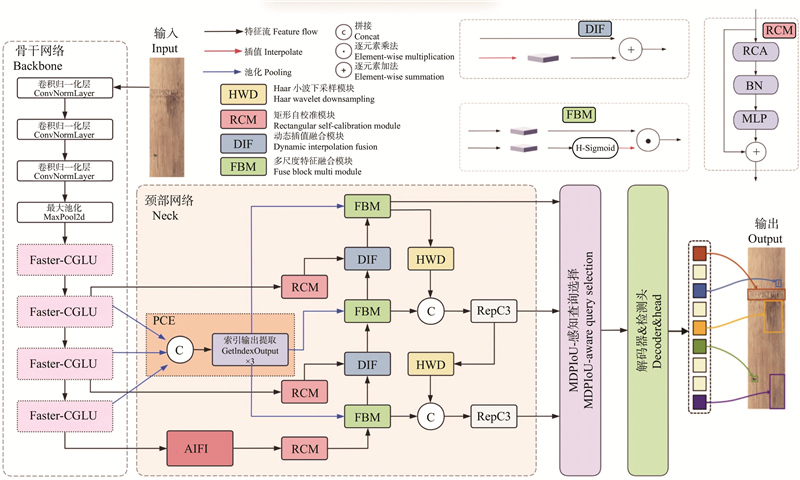
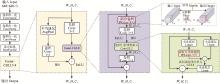
Fig.2
Structure diagram of Faster-CGLU network"
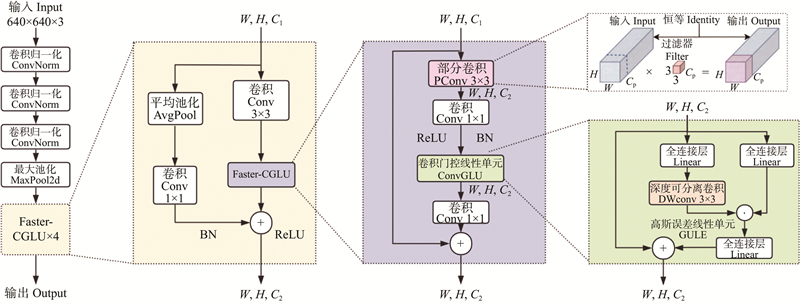
Fig.3
Schematic diagram of the CGLU mechanism"
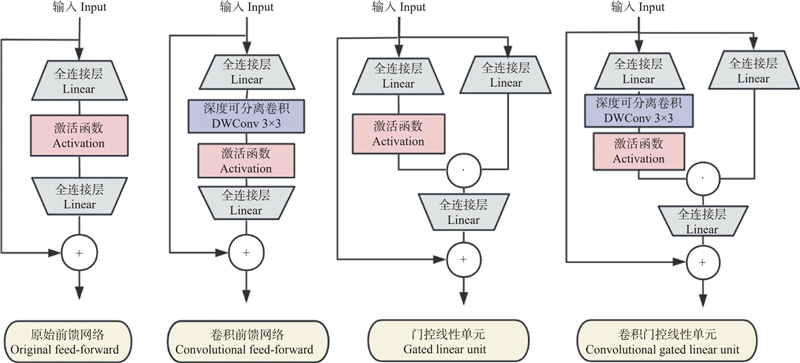
Fig.4
CGRFPN network structure"
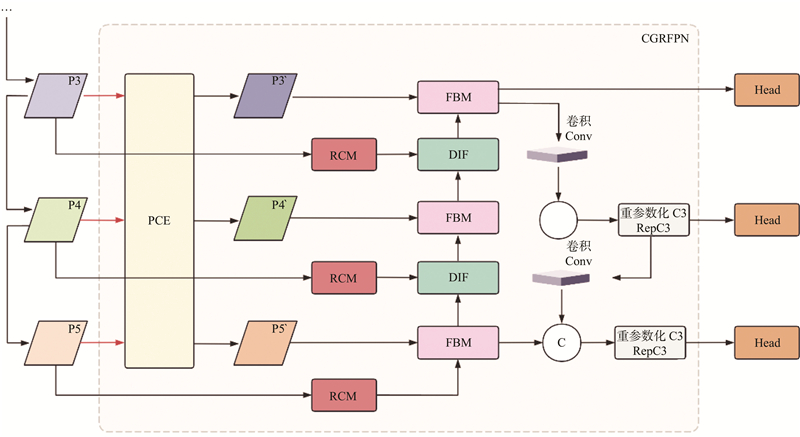
Fig.5
Structure of the modules in CGRFPN"
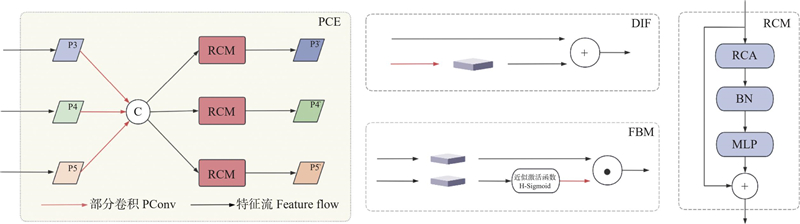
Fig.6
Schematic diagram of haar wavelet downsampling structure"
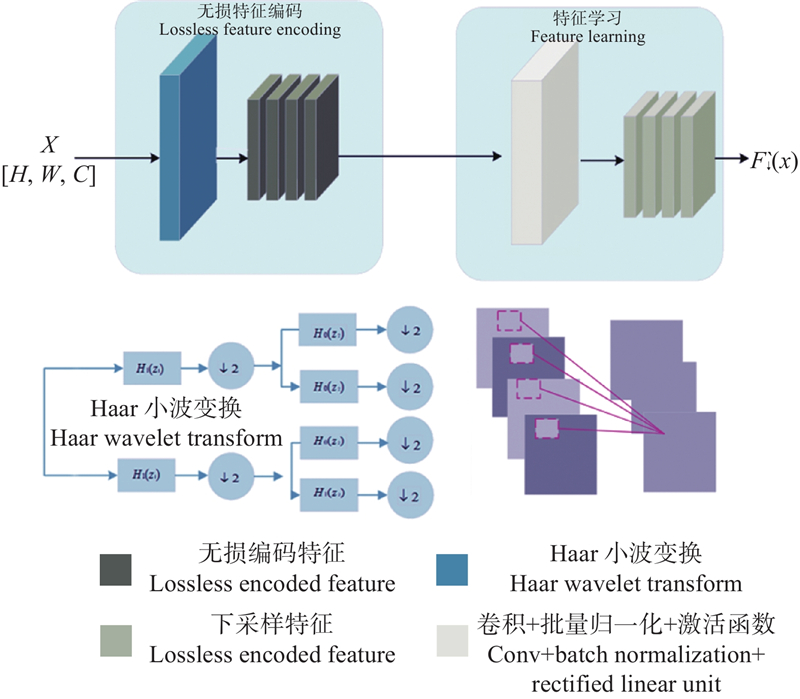
Table 1
Comparison of parameters and computational quantities of different downsampling methods"
| 模块 Module | 参数量 Parameter quantity/ M | 计算量 FLOPs/ G |
| Haar小波下采样 Haar wavelet downsampling | ||
| 3×3卷积下采样 3 × 3 convolutional downsampling |
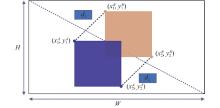
Fig.7
Schematic diagram of the bounding box geometric relationship of MPDIoU"
Table 2
Defect types and characteristics covered by the bamboo strip surface defect dataset"
| 缺陷类型Defect types | 缺陷特征Defect characteristics |
| 黑节 Black node | 竹节部位因代谢异常、病虫侵害生成深色块状缺陷 Dark block defects formed at bamboo nodes due to abnormal metabolism, pests and diseases |
| 虫孔 Wormhole | 蛀蚀作用形成边界清晰的圆状、长条状孔洞,内腔呈黑色 Round or strip holes with distinct boundaries and black interiors caused by insect erosion |
| 霉变 Mildew | 霉菌侵染形成灰绿色不规则班区,灰度不均、边缘弥散 Irregular gray-green mold spots with uneven grayscale and blurred edges induced by mildew |
| 裂缝 Crack | 加工或干燥失误产生沿竹材纹理延展的线状损伤 Linear defects extending along bamboo grain caused by improper processing and drying |
| 留黄 Residual bamboo yellow | 竹条内壁残留未剔除的淡黄色疏松薄壁组织 Residual pale yellow loose parenchyma on inner wall of bamboo strips |
| 留青 Residual bamboo green | 竹条外壁留存青绿色光滑蜡质表层 Retained smooth cyan wax layer on outer surface of bamboo strips |
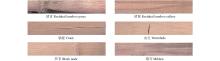
Fig.8
Six types of defect samples on the bamboo strips"
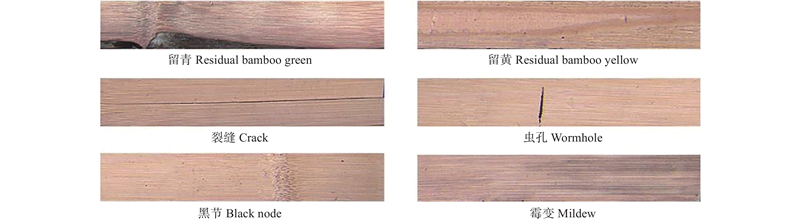
Fig.9
Defect distribution across datasets"
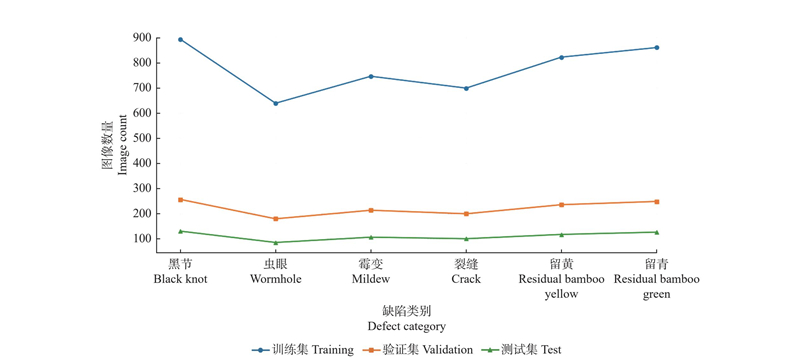
Table 3
Test environment configuration"
| 配置类型Configuration type | 具体参数Specific parameters |
| 操作系统Operating system | Linux Ubuntu 22.04 LTS (version 6.11.0-24) |
| 中央处理器Central processing unit (CPU) | Intel(R) Core (TM) i9-14900K |
| 图形处理器Graphics processing unit (GPU) | NVIDIA GeForce GTX4090 24 GB |
| 内存Random access memory (RAM) | 128 GB DDR5 5 600 MHz |
| 深度学习框架Deep learning framework | PyTorch 2.4.1, TorchVision 0.19.1 |
| 加速库Acceleration library | CUDA 12.6, cuDNN 8.9.2 |
| 其他库Other libraries | OpenCV 4.8.0、NumPy 1.24.3、PyTorch-OpCounter 0.6.0 |
Table 4
Ablation experiment"
| 试验 Test | Faster-CGLU | CGRFPN | HWD | MPDIoU | 准确率 Precision(% ) | 召回率 Recall(% ) | 平均精度均值 mAP50(% ) | 参数量 Parameter/ M | 计算量 FLOPs/ G | 帧率 FPS |
| 1 | ? | ? | ? | ? | 91.8 | 86.6 | 91.0 | 38.6 | 57.0 | 405 |
| 2 | √ | ? | ? | ? | 90.9 | 87.5 | 91.6 | 30.1 | 46.2 | 373 |
| 3 | ? | √ | ? | ? | 91.5 | 90.3 | 92.8 | 36.2 | 48.2 | 387 |
| 4 | ? | ? | √ | ? | 89.1 | 86.7 | 91.3 | 38.7 | 55.6 | 402 |
| 5 | ? | ? | ? | √ | 91.0 | 89.2 | 92.4 | 38.6 | 57.0 | 415 |
| 6 | √ | √ | ? | ? | 92.9 | 90.3 | 93.8 | 26.7 | 36.0 | 348 |
| 7 | √ | √ | √ | ? | 93.5 | 90.6 | 94.3 | 26.8 | 36.7 | 347 |
| 8 | √ | √ | √ | √ | 93.6 | 91.3 | 94.7 | 26.8 | 36.7 | 355 |
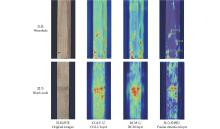
Fig.10
Grad-CAM gradient-weighted class activation map"
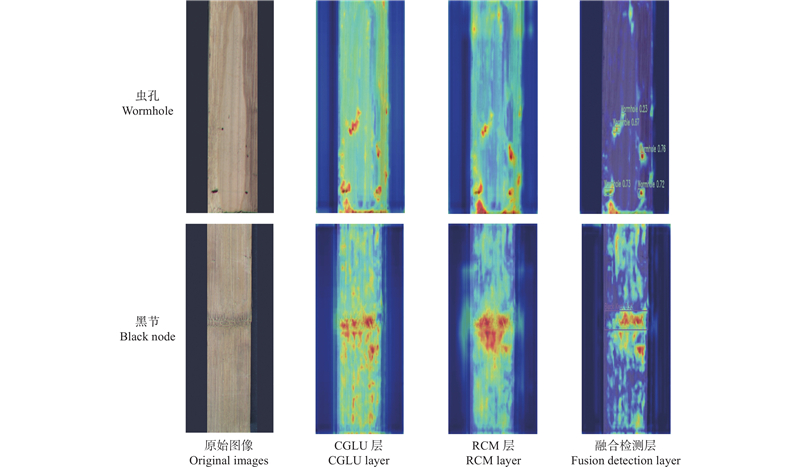
Table 5
Detection performance of various defects %"
| 缺陷类型 Defect type | 准确率 Precision | 召回率 Recall | 平均精度 均值@0.5 mAP50 | 平均精度 均值 @0.5:0.95 mAP50-95 |
| 黑节Black knot | 95.1 | 96.7 | 98.3 | 75.1 |
| 虫孔Wormhole | 89.9 | 78.3 | 86.0 | 48.4 |
| 霉变Mildew | 91.6 | 91.0 | 95.3 | 78.2 |
| 裂缝Crack | 93.8 | 92.9 | 95.3 | 70.4 |
| 留黄Residual bamboo yellow | 94.6 | 90.5 | 94.0 | 81.1 |
| 留青Residual bamboo green | 96.5 | 98.3 | 99.4 | 83.6 |
| 平均Average | 93.6 | 91.3 | 94.7 | 72.8 |
Fig.11
Comparison of detection results of surface defect models for bamboo strips"
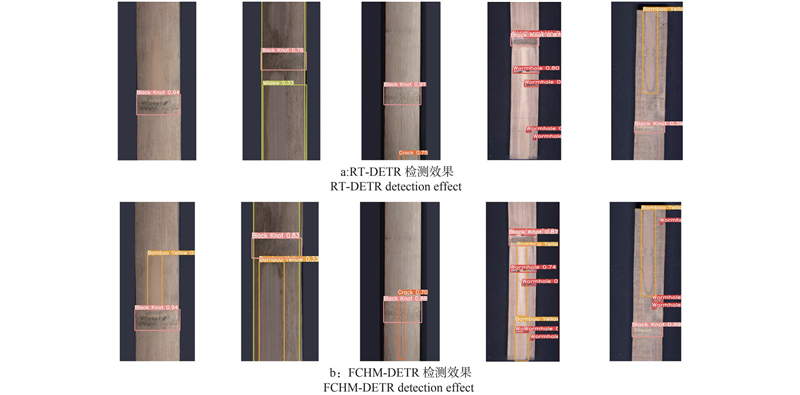
Table 6
Comparison of surface defect detection results of bamboo strips with different models"
| 模型Model | 参数量 Parameter/ M | 计算量 FLOPs/ G | 平均精度 均值 mAP50(% ) | 帧率 Frame rate/ FPS |
| Faster R-CNN ( | 138 | 180.2 | 87.8 | 32 |
| CenterNe ( | 31.4 | 47.7 | 90.5 | 206 |
| YOLOv8n ( | 4.9 | 5.2 | 83.5 | 393 |
| SSD | 28.6 | 32.4 | 78.6 | 174 |
| YOLOv5m | 20.9 | 48.4 | 86.8 | 313 |
| YOLOv8m | 25.9 | 78.7 | 88.5 | 287 |
| YOLOv10m | 25.9 | 77.0 | 89.7 | 326 |
| RT-DETR-r18 | 38.6 | 57.0 | 91.0 | 405 |
| FCHM-DETR | 26.8 | 36.7 | 94.7 | 355 |
| 陈力能. 2018. 基于机器视觉的竹块缺陷检测系统研究与设计. 桂林: 广西师范大学. | |
| Chen L N. 2018. A machine vision system for detection of bamboo block. Guilin: Guangxi Normal University. [in Chinese] | |
|
高钦泉, 黄炳城, 刘文哲, 等. 基于改进CenterNet的竹条表面缺陷检测方法. 计算机应用, 2021, 41 (7): 1933- 1938.
doi: 10.11772/j.issn.1001-9081.2020081167 |
|
|
Gao Q Q, Huang B C, Liu W Z, et al. Bamboo strip surface defect detection method based on improved CenterNet. Journal of Computer Applications, 2021, 41 (7): 1933- 1938.
doi: 10.11772/j.issn.1001-9081.2020081167 |
|
|
李延军, 许 斌, 张齐生, 等. 我国竹材加工产业现状与对策分析. 林业工程学报, 2016, 1 (1): 2- 7.
doi: 10.13360/j.issn.2096-1359.2016.01.001 |
|
|
Li Y J, Xu B, Zhang Q S, et al. Present situation and the countermeasure analysis of bamboo timber processing industry in China. Journal of Forestry Engineering, 2016, 1 (1): 2- 7.
doi: 10.13360/j.issn.2096-1359.2016.01.001 |
|
| 石烨炜, 鲍光海. 融合改进ASPP和CBAM的竹材端面分割与竹梢位置检测方法. 林业工程学报, 2023, 8 (5): 138- 145. | |
| Shi Y W, Bao G H. Bamboo end face segmentation and branch position detection method fused with improved ASPP and CBAM. Journal of Forestry Engineering, 2023, 8 (5): 138- 145. | |
| 解晨辉, 杨博凯, 李荣荣. 基于双循环生成对抗网络和Dense-Net的木材缺陷检测方法. 林业工程学报, 2023, 8 (4): 129- 136. | |
| Xie C H, Yang B K, Li R R. Wood defect detection method based on double least generative adversarial networks and Dense-Net. Journal of Forestry Engineering, 2023, 8 (4): 129- 136. | |
| 颜志强. 2014. 毛竹竹片弦切面图像纹理特征分析与应用. 福州: 福建农林大学. | |
| Yan Z Q. 2014. Application and analysis of texture features on tangential section image of moso bamboo strip. Fuzhou: Fujian Agriculture and Forestry University. [in Chinese] | |
|
杨 松, 张 锐, 朱良宽. 多尺度卷积神经网络融合Transformer的竹材缺陷识别方法. 林业工程学报, 2024, 9 (5): 126- 133.
doi: 10.13360/j.issn.2096-1359.202310028 |
|
|
Yang S, Zhang R, Zhu L K. Bamboo defect recognition method based on multi-scale convolutional neural network fusion Transformer. Journal of Forestry Engineering, 2024, 9 (5): 126- 133.
doi: 10.13360/j.issn.2096-1359.202310028 |
|
| 叶翰舟, 傅金和, 程海涛, 等. 以竹代塑加工技术与产品现状及其市场发展潜力. 林业科学, 2024, 60 (1): 129- 141. | |
| Ye H Z, Fu J H, Cheng H T, et al. The current status and market development potential of processing technology and products using bamboo as a substitute for plastic. Scientia Silvae Sinicae, 2024, 60 (1): 129- 141. | |
| 张建辉, 陈 磊, 王 滔, 等. “以竹代塑”产业规划编制要点浅析. 林产工业, 2024, 61 (8): 76- 81, 92. | |
| Zhang J H, Chen L, Wang T, et al. Brief analysis on the main contents for industry plan organizing of Replacing Plastic with Bamboo. China Forest Products Industry, 2024, 61 (8): 76- 81, 92. | |
| 张亚慧, 姜伯言, 周昌平, 等. “以竹代塑”发展理念、面临挑战与发展模式研究. 林业工程学报, 2025, 10 (4): 10- 18. | |
| Zhang Y H, Jiang B Y, Zhou C P, et al. Research on the development concept, models and challenges of “bamboo as a substitute for plastic”. Journal of Forestry Engineering, 2025, 10 (4): 10- 18. | |
| Carion N, Massa F, Synnaeve G, et al. 2020. End-to-end object detection with transformers. Computer Vision – ECCV 2020. Cham: Springer International Publishing, 213−229. | |
| Gehring J, Auli M, Grangier D, et al. 2017. Convolutional sequence to sequence learning. Proceedings of the 34th International Conference on Machine Learning. Sydney, Australia: Journal Machine Learning Research, 1243–1252. | |
|
He Y, Song K C, Meng Q G, et al. An end-to-end steel surface defect detection approach via fusing multiple hierarchical features. IEEE Transactions on Instrumentation and Measurement, 2020, 69 (4): 1493- 1504.
doi: 10.1109/TIM.2019.2915404 |
|
|
Hu J F, Yu X, Zhao Y F. Bamboo defect classification based on improved transformer network. Wood Research, 2022, 67 (3): 501- 510.
doi: 10.37763/wr.1336-4561/67.3.501510 |
|
| Kuang H L, Ding Y R, Li R F, et al. 2018. Defect detection of bamboo strips based on LBP and GLCM features by using SVM classifier. 2018 Chinese Control and Decision Conference (CCDC). June 9−11, 2018, Shenyang, China. IEEE, 3341−3345. | |
|
LeCun Y, Bengio Y, Hinton G. Deep learning. Nature, 2015, 521 (7553): 436- 444.
doi: 10.1038/nature14539 |
|
|
Li R R, Xu Z Y, Yang F, et al. Defect detection for melamine-impregnated paper decorative particleboard surface based on deep learning. Wood Material Science & Engineering, 2026, 21 (1): 379- 392.
doi: 10.1080/17480272.2024.2428963 |
|
|
Schmidhuber J. Deep learning in neural networks: an overview. Neural Networks, 2015, 61, 85- 117.
doi: 10.1016/j.neunet.2014.09.003 |
|
| Shi D. 2024. TransNeXt: robust foveal visual perception for vision transformers. 2024 IEEE/CVF Conference on Computer Vision and Pattern Recognition (CVPR). June 16−22, 2024, Seattle, WA, USA. IEEE, 17773−17783. | |
| Vaswani A, Shazeer N, Parmar N, et al. 2017. Attention is all you need//Proceedings of the 31st International Conference on Neural Information Processing Systems (NIPS). Long Beach, CA, USA: Curran Associates Inc, 6000−6010. | |
|
Wang X Y, Liang D T, Deng W Y. Surface grading of bamboo strips using multi-scale color texture features in eigenspace. Computers and Electronics in Agriculture, 2010, 73 (1): 91- 98.
doi: 10.1016/j.compag.2010.04.008 |
|
|
Yang R X, Lee Y R, Lee F S, et al. Improvement of YOLO detection strategy for detailed defects in bamboo strips. Forests, 2025, 16 (4): 595.
doi: 10.3390/f16040595 |
|
|
Zeng Q Z, Lu Q F, Yu X Y, et al. Identification of defects on bamboo strip surfaces based on comprehensive features. European Journal of Wood and Wood Products, 2023, 81 (2): 315- 328.
doi: 10.1007/s00107-022-01891-7 |
|
|
Zhao W D, Chen F, Huang H C, et al. A new steel defect detection algorithm based on deep learning. Computational Intelligence and Neuroscience, 2021, 2021, 5592878.
doi: 10.1155/2021/5592878 |
|
| Zhao Y A, Lü W Y, Xu S L, et al. 2024. DETRs beat YOLOs on real-time object detection. 2024 IEEE/CVF Conference on Computer Vision and Pattern Recognition (CVPR). June 16−22, 2024, Seattle, WA, USA. IEEE, 16965−16974. |
| [1] | Zongqi Yao,Lingting Lei,Guoqi Chai,Langning Huo,Xin Tian,Xiaoli Zhang. Collaborative Detection Method with Spaceborne Multispectral and SAR Data for Land Cover and Forest Type Changes [J]. Scientia Silvae Sinicae, 2026, 62(2): 160-172. |
| [2] | Yaodi Li,Ye Tian,Changchun Zhang,Jiangjian Xie,Haitao Zhao,Junguo Zhang. Wildlife Image Recognition Methods and Challenges Based on Deep Learning [J]. Scientia Silvae Sinicae, 2026, 62(1): 207-222. |
| [3] | Chenxu Wu,Dongyan Zhang,Lanxiang Zhang,Nuo Chen,Siyu Mao. Detection Method of Pinecones in the Forest Based on RT-DETR [J]. Scientia Silvae Sinicae, 2025, 61(6): 25-37. |
| [4] | Xiaoning Ge,Xinqiao Xu,Huaiqing Zhang,Jing Zhang,Jie Yang,Zeyu Cui,Rurao Fu,Jinjie Liang,Tianhua Zou,Linlong Wang,Yang Liu. Progress and Reflection on Genotype-Environment Interaction Algorithms in Forest Tree Breeding [J]. Scientia Silvae Sinicae, 2025, 61(3): 1-15. |
| [5] | Yanling Tang,Qiaoling Han,Yue Zhao,Weiping Liu,Yili Zheng,Yandong Zhao,Shanshan Xu. A Forest Pest Detection Algorithm Based on Multi-scale Sequence Feature Fusion [J]. Scientia Silvae Sinicae, 2025, 61(2): 21-30. |
| [6] | Min Ji,Rui Gao,Xiaohuan Wang,Xingliang Diao,Jiakai Han,Yang Zhao,Guofu Wang,Wei Zhang. Online Detecting Method of Structural Lumber Knot Based on Deep Learning [J]. Scientia Silvae Sinicae, 2025, 61(11): 150-159. |
| [7] | Wanying Xie,Wenping Liu,Han Wang. UAV Images of Pine Forests for Early Detection of Pine Wood Nematode Infestation [J]. Scientia Silvae Sinicae, 2024, 60(9): 124-133. |
| [8] | Jiandong Qi,Shangzi Zheng,Ziyi Chen,Zhongtian Ma. Wildlife Image Recognition of Infrared Cameras in Beijing Area Based on an Improvement ConvNeXt Model [J]. Scientia Silvae Sinicae, 2024, 60(8): 33-45. |
| [9] | Zhikang Tian,Zhedong Ge,Huanqi Zheng,Zhishuai Zheng,Yucheng Zhou. Microscopic Identification Methods for 75 Types of Hardwood Based on Deep Neural Network [J]. Scientia Silvae Sinicae, 2024, 60(10): 94-103. |
| [10] | Jiandong Qi,Zhongtian Ma,Dehuai Zhang,Yun Tian. Wildlife Image Recognition in Miyun District Based on BS-ResNeXt-50 [J]. Scientia Silvae Sinicae, 2023, 59(8): 112-122. |
| [11] | Jia Li,Lan Lan,Zuozhong Zhang,Wentao Yuan,Demin Gao,Shuqin Zong,Qiaolin Ye. Inversion Technology of Forest Fuel Moisture Content Based on Deep Learning [J]. Scientia Silvae Sinicae, 2022, 58(10): 47-58. |
| [12] | Yan Zhou,Wenping Liu,Youqing Luo,Shixiang Zong. Small Object Detection for Infected Trees Based on the Deep Learning Method [J]. Scientia Silvae Sinicae, 2021, 57(3): 98-107. |
| [13] | Ying Guo,Zengyuan Li,Erxue Chen,Xu Zhang,Lei Zhao,Yan Chen,Yahui Wang. A Deep Learning Method for Forest Fine Classification Based on High Resolution Remote Sensing Images: Two-Branch FCN-8s [J]. Scientia Silvae Sinicae, 2020, 56(3): 48-60. |
| [14] | Mingwei Shao,Junyu Dong. A New Algorithm for Automatic Optimizing Cross-Cut Saw Based on Deep Learning Algorithm [J]. Scientia Silvae Sinicae, 2020, 56(12): 123-129. |
| [15] | Guo Hui, Wang Xiao, Liu Chuanze, Zhou Yucheng. Research on Defect Extraction of Particleboard Surface Images Based on Gray Level Co-Occurrence Matrix and Hierarchical Clustering [J]. Scientia Silvae Sinicae, 2018, 54(11): 111-120. |
| Viewed | ||||||
|
Full text |
|
|||||
|
Abstract |
|
|||||
