
Scientia Silvae Sinicae ›› 2026, Vol. 62 ›› Issue (4): 206-216.doi: 10.11707/j.1001-7488.LYKX20250280
• Research papers • Previous Articles Next Articles
Lichun Xiong1,2,3,Minxin Shang2,Zhe Hou2,Fengting Wang1,2,3,*( )
)
Received:2025-05-08
Online:2026-04-15
Published:2026-04-11
Contact:
Fengting Wang
E-mail:fengtingwang@zafu.edu.cn
CLC Number:
Lichun Xiong,Minxin Shang,Zhe Hou,Fengting Wang. Booster or Drag? The Export Embodied Carbon Effect of Position Upgrading in the Global Value Chain of China’s Wood Industry[J]. Scientia Silvae Sinicae, 2026, 62(4): 206-216.
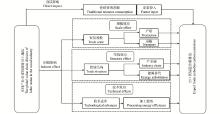
Fig.1
Impact mechanism of the rising position of global value chain division of labor on the embodied carbon in export trade"
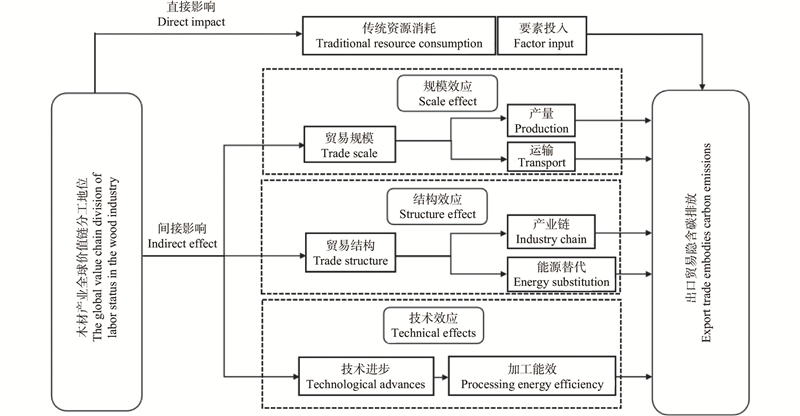
Table 1
Relevant variables and their data sources"
| 项目Item | 变量Variable | 符号Symbol | 数据来源Data sources |
| 被解释变量 Dependent variable | 贸易隐含碳排放 Embodied carbon emissions from trade/ [(t·(106$)?1] | CIE | EORA数据库EORA database |
| 解释变量 Explanatory variable | 相对全球价值链分工地位 Relative position in the global value chain | 亚洲开发银行数据库 Asian Development Bank database | |
| 控制变量 Control variable | 出口规模Export scale/$ | ln export | 亚洲开发银行数据库 Asian Development Bank database |
| 人口规模Population size | pop | 世界银行World Bank | |
| 人均国内生产总值 Per capita gross domestic product/$ | pgdp | 世界银行World Bank | |
| 研发支出R&D expenditure (%) | rd | 世界银行World Bank | |
| 外商直接投资Foreign direct investment/104$ | fdi | 世界银行World Bank | |
| 森林租金Forest rent (%) | rent | 世界银行World Bank | |
| 地理距离Geographic distance/km | dist | CEPII数据库CEPII database | |
| 政策虚拟变量Policy dummy variable | im | 各国政策文件Policy documents of various countries | |
| 机制变量 Mechanism variable | 规模效应Scale effect | gm | 世界银行World Bank |
| 技术效应Technical effects | js | CEPII数据库CEPII database | |
| 结构效应Structure effect | jg | 亚洲开发银行数据库Asian Development Bank database |
Table 2
Descriptive statistical analysis results of main variables"
| 变量 Variable | 符号 Symbol | 样本量 Sample size | 均值 Mean | 标准差 Standard deviation | 最小值 Min. | 最大值 Max. |
| 贸易隐含碳强度Trade embodied carbon intensity | CIE | 450 | 908.3 | 1 725 | 25.61 | 16 391 |
| 相对全球价值链分工地位 Relative position in the global value chain | 450 | 3.917 | 11.88 | ?49.61 | 36.76 | |
| 出口规模Export scale | ln export | 450 | 7.650 | 1.528 | 3.802 | 11.45 |
| 人均国内生产总值Per capita gross domestic product | pgdp | 450 | 1.396e+06 | 5.712e+06 | 8 415 | 4.020e+07 |
| 外商直接投资Foreign direct investment | fdi | 450 | 2.815e+10 | 6.348e+10 | ?8.334e+10 | 5.114e+11 |
| 研发支出R&D expenditure | rd | 450 | 1.609 | 0.997 | 0.284 | 4.930 |
| 人口规模Population size | pop | 450 | 8.801e+10 | 2.374e+11 | 4.067e+08 | 1.408e+12 |
| 森林租金Forest rent | rent | 450 | 0.195 | 0.251 | 0 | 1.294 |
| 地理距离Geographic distance | dist | 450 | 552 807 | 270 181 | 39 913 | 1.781e+06 |
| 政策虚拟变量Policy dummy variable | im | 450 | 0.207 | 0.405 | 0 | 1 |
| 规模效应Scale effect | gm | 450 | 2.362e+12 | 3.089e+13 | ?1.815e+14 | 1.645e+14 |
| 结构效应Structure effect | jg | 450 | 1.185 | 0.172 | 1.004 | 2.522 |
| 技术效应Technical effects | js | 450 | 86 293 | 238 132 | 158.0 | 2.121e+06 |
Table 3
Multiple collinearity test and Hausman test"
| 检验Test | 变量Variable | VIF | 1/VIF |
| 共线性检验 Collinearity test | 相对全球价值链分工地位Relative position in the global value chain (GVCPsdid) | 1.72 | 0.579 942 |
| 出口规模Export scale (ln export) | 2.56 | 0.390 522 | |
| 贸易伙伴国人均GDP Per capita GDP of trading partner countries (pgdp) | 1.54 | 0.650 966 | |
| 外商直接投资Foreign direct investment (fdi) | 1.46 | 0.684 574 | |
| 研发支出R&D expenditure (rd) | 2.55 | 0.391 664 | |
| 人口规模Population size (pop) | 1.39 | 0.720 773 | |
| 森林租金Forest rent (rent) | 1.15 | 0.873 174 | |
| 地理距离Geographic distance (dist) | 1.47 | 0.681 528 | |
| 政策虚拟变量Policy dummy variable (im) | 1.22 | 0.817 742 | |
| Mean VIF | 1.67 | ||
| F检验 F test | F(9, 440) | 358.62 | |
| Prob > F | 0.000 0 | ||
| Breusch-Pagan检验 Breusch-Pagan test | chi2 (1) | 1 514.78 | |
| Prob > chi2 | 0.000 0 | ||
| Hausman检验 Hausman test | chi2 (5) | 46.57 | |
| Prob > chi2 | 0.000 | ||
Table 4
Benchmark regression results of global value chain position on trade embodied carbon"
| 变量 Variable | 被解释变量:贸易隐含碳强度 Dependent variable: trade embodied carbon intensity |
| 相对全球价值链分工地位 Relative position in the global value chain (GVCPsdid) | ?11.276* (6.066) |
| 出口规模Export scale (ln export) | ?1 089.505*** (396.950) |
| 贸易伙伴国人均GDP Per capita GDP of trading partner countries (pgdp) | ?0.000** (0.000) |
| 外商直接投资 Foreign direct investment (fdi) | 0.000 (0.000) |
| 研发支出R&D expenditure (rd) | 248.757** (114.818) |
| 人口规模Population size (pop) | 0.000*** (0.000) |
| 森林租金Forest rent (rent) | 92.037 (352.490) |
| 地理距离 Geographic distance (dist) | 0.001 (0.001) |
| 政策虚拟变量 Policy dummy variable (im) | ?172.860 (391.428) |
| 个体固定效应Individual fixed effects | 是Yes |
| 时间固定效应Time fixed effect | 是Yes |
| 常数项 Constant | 8 552.683*** (3 016.985) |
| 观测值 Observations | 450 |
| R2 | 0.945 9 |
Table 5
Results of robustness test"
| 变量 Variable | (1) 缩尾处理 Winsorize | (2) 更换时间 区间 Change time interval |
| 相对全球价值链分工地位Relative position in the global value chain (GVCPsdid) | ?11.276* (6.066) | ?12.100* (6.809) |
| 出口规模Export scale (ln export) | ?1 089.505*** (396.950) | ?1 166.394*** (441.171) |
| 贸易伙伴国人均GDP Per capita GDP of trading partner countries (pgdp) | ?0.000** (0.000) | ?0.000* (0.000) |
| 外商直接投资Foreign direct investment (fdi) | 0.000 (0.000) | 0.000 (0.000) |
| 研发支出R&D expenditure (rd) | 248.757** (114.818) | 257.904** (119.321) |
| 人口规模Population size (pop) | 0.000*** (0.000) | 0.000*** (0.000) |
| 森林租金Forest rent (rent) | 92.037 (352.490) | 56.516 (396.041) |
| 地理距离Geographic distance (dist) | 0.001 (0.001) | 0.001 (0.001) |
| 政策虚拟变量Policy dummy variable (im) | ?172.860 (391.428) | ?277.536 (486.446) |
| 个体固定效应Individual fixed effects | 是Yes | 是Yes |
| 时间固定效应Time fixed effect | 是Yes | 是Yes |
| 常数项 Constant | 8 552.683*** (3 016.985) | 9 177.551*** (3 373.902) |
| 观测值 Observations | 450 | 420 |
| R2 | 0.945 9 | 0.943 6 |
Table 6
Results of endogeneity test"
| 变量 Variable | 贸易隐含 碳强度 Trade embodied carbon intensity (CIE) | |
| 相对全球价值链分工地位 Relative position in the global value chain (GVCPsdid) | ?0.000* (?1.758) | |
| 不可识别检验 Unrecognized test | Kleibergen-Paap rk LM statistic | 5.427 |
| Chi-sq (2) P-val | 0.019 8 | |
| 弱工具变量检验 Weak instrumental variable test | Cragg-Donald Wald F statistic | 180.975 |
| Kleibergen-Paap rk Wald F statistic | 28.773 | |
Table 7
Heterogeneity test results"
| 变量 Variable | 被解释变量:贸易隐含碳强度Dependent variable: trade embodied carbon intensity | |||
| (1) 发达国家 Developed country | (2) 发展中国家 Developing country | (3) 贸易大国 Trading power | (4) 贸易小国 Trading small country | |
| 相对全球价值链分工地位 Relative position in the global value chain (GVCPsdid) | ?9.702*** (1.930) | ?9.352 (20.486) | ?8.125 (11.137) | ?11.023* (6.690) |
| 出口规模Export scale (ln export) | ?625.579*** (94.983) | ?1 963.220* (1 094.961) | ?557.588* (313.528) | ?1 178.579*** (430.267) |
| 贸易伙伴国人均GDP Per capita GDP of trading partner countries (pgdp) | ?0.000 (0.000) | ?0.000 (0.000) | ?0.000 (0.000) | ?0.000 (0.000) |
| 外商直接投资Foreign direct investment (fdi) | 0.000 (0.000) | 0.000 (0.000) | 0.000 (0.000) | 0.000 (0.000) |
| 研发支出R&D expenditure (rd) | 79.699 (56.736) | 441.227 (400.827) | 286.036* (165.074) | 75.658 (136.308) |
| 人口规模Population size (pop) | 0.000*** (0.000) | 0.000*** (0.000) | 0.000 (0.000) | 0.000*** (0.000) |
| 森林租金Forest rent (rent) | 82.749 (238.274) | 61.559 (1 049.417) | 998.569*** (296.254) | 483.835 (470.705) |
| 地理距离Geographic distance (dist) | ?0.000 (0.000) | 0.002 (0.001) | 0.000 (0.000) | 0.003 (0.003) |
| 政策虚拟变量Policy dummy variable (im) | 240.833 (213.239) | ?626.045 (641.473) | 332.031 (213.778) | ?542.388 (690.897) |
| 个体固定效应Individual fixed effects | 是Yes | 是Yes | 是Yes | 是Yes |
| 时间固定效应Time fixed effect | 是Yes | 是Yes | 是Yes | 是Yes |
| 常数项 Constant | 5 482.018*** (889.920) | 11 658.408* (5 990.830) | 4 080.832 (2 703.707) | 8 237.956*** (2 798.745) |
| 观测值 Observations | 270 | 180 | 180 | 270 |
| R2 | 0.904 2 | 0.955 6 | 0.891 1 | 0.952 4 |
Table 8
Mechanism inspection results"
| 变量 Variable | 规模效应 Scale effect | 结构效应 Structural effect | 技术效应 Technical effect |
| 相对全球价值链分工地位 Relative position in the global value chain (GVCPsdid) | ?0.004*** (0.001) | 0.004*** (0.001) | 0.007*** (0.001) |
| 出口规模Export scale (ln export) | 0.157*** (0.025) | 0.021 (0.025) | 1.260*** (0.027) |
| 贸易伙伴国人均GDP Per capita GDP of trading partner countries (pgdp) | 0.000*** (0.000) | 0.000 (0.000) | ?0.000*** (0.000) |
| 外商直接投资 Foreign direct investment (fdi) | 0.000** (0.000) | ?0.000 (0.000) | 0.000 (0.000) |
| 研发支出R&D expenditure (rd) | ?0.094*** (0.023) | 0.016 (0.023) | ?0.028 (0.025) |
| 人口规模Population size (pop) | 0.000*** (0.000) | 0.000 (0.000) | 0.000*** (0.000) |
| 森林租金Forest rent (rent) | ?0.355*** (0.077) | 0.032 (0.076) | ?0.060 (0.084) |
| 地理距离 Geographic distance (dist) | 0.000 (0.000) | 0.000 (0.000) | 0.000** (0.000) |
| 政策虚拟变量 Policy dummy variable (im) | 0.159*** (0.025) | ?0.029 (0.025) | ?0.012 (0.027) |
| 个体固定效应 Individual fixed effects | 是Yes | 是Yes | 是Yes |
| 时间固定效应 Time fixed effect | 是Yes | 是Yes | 是Yes |
| 常数项 Constant | 25.526*** (0.216) | 0.831*** (0.215) | 0.595** (0.236) |
| 观测值 Observations | 450 | 450 | 450 |
| R2 | 0.997 9 | 0.774 3 | 0.997 3 |
| 党玉婷, 盛 丹. 2018. 全球价值链下中国对外贸易内涵污染研究. 经济问题探索, (7): 113−122. | |
| Dang Y T, Sheng D. 2018. The embodied pollution of China’s foreign trade under global value chain? Inquiry into Economic Issues, (7): 113−122. [in Chinese] | |
| 巩爱凌. 中国制造业在全球价值链分工中的地位与出口隐含碳研究. 经济与管理, 2013, 27 (8): 72- 76. | |
| Gong A L. Research on position of China’s manufacturing industry in global value chain division system & carbon emission embodied in export. Economy and Management, 2013, 27 (8): 72- 76. | |
| 郭 玲, 林凝芬, 王文烂, 等. 全球价值链分工对林产品出口隐含碳的影响. 林业经济, 2022, 44 (9): 76- 96. | |
| Guo L, Lin N F, Wang W L, et al. The impact of global value chain division on carbon embodied in forest product exports. Forestry Economics, 2022, 44 (9): 76- 96. | |
|
侯方淼, 裴润田, 刘 璨, 等. 中国林产工业嵌入全球价值链对贸易隐含碳排放的影响. 中南林业科技大学学报, 2022, 42 (10): 177- 188.
doi: 10.14067/j.cnki.1673-923x.2022.10.020 |
|
|
Hou F M, Pei R T, Liu C, et al. Influences of China’s forest product industry embedding in the global value chain on the embodied carbon emissions in trade. Journal of Central South University of Forestry & Technology, 2022, 42 (10): 177- 188.
doi: 10.14067/j.cnki.1673-923x.2022.10.020 |
|
| 侯方淼, 王宏飞, 刘 璨, 等. 产业集聚对中国木材企业全球价值链地位的作用机制及其实现路径. 林业科学, 2023, 59 (12): 137- 151. | |
| Hou F M, Wang H F, Liu C, et al. Mechanism of industrial agglomeration on Chinese wood enterprises’ GVC (global value chain) position and its realization path. Scientia Silvae Sinicae, 2023, 59 (12): 137- 151. | |
| 户华玉, 佘群芝. 制造业数字化转型能否降低出口隐含碳强度. 国际贸易问题, 2022, (7): 36- 52. | |
| Hu H Y, She Q Z. Does digital transformation of manufacturing reduce the embodied carbon intensity on exports. Journal of International Trade, 2022, (7): 36- 52. | |
| 江 涛, 覃琼霞. 自贸区升级协定的贸易效应研究: 来自中国−东盟的证据. 国际商务(对外经济贸易大学学报), 2022, (1): 1- 17. | |
| Jiang T, Qin Q X. The trade effect of regional free trade upgrading agreement: evidence from China-ASEAN. International Business, 2022, (1): 1- 17. | |
| 蒋殿春, 张庆昌. 美国在华直接投资的引力模型分析. 世界经济, 2011, 34 (5): 26- 41. | |
| Jiang D C, Zhang Q C. Gravity model analysis of US direct investment in China. The Journal of World Economy, 2011, 34 (5): 26- 41. | |
| 阚大学, 吕连菊. 进出口贸易对环境污染的非线性影响: 基于面板平滑转换回归模型. 国际商务(对外经济贸易大学学报), 2016, (2): 5- 17. | |
| Kan D X, Lü L J. Nonlinear effects of the import and export trades on environmental pollution: an analysis using the panel smooth transition regression model. International Business, 2016, (2): 5- 17. | |
|
李 斌, 彭 星. 中国对外贸易影响环境的碳排放效应研究: 引入全球价值链视角的实证分析. 经济与管理研究, 2011, (7): 40- 48.
doi: 10.3969/j.issn.1000-7636.2011.07.006 |
|
|
Li B, Peng X. The study of carbon emission effect of China’s foreign trade impacting the environment: an empirical analysis by the introduction of global value chain perspective. Research on Economics and Management, 2011, (7): 40- 48.
doi: 10.3969/j.issn.1000-7636.2011.07.006 |
|
| 李小平. 国际贸易中隐含的CO2测算: 基于垂直专业化分工的环境投入产出模型分析. 财贸经济, 2010, (5): 66- 70. | |
| Li X P. Measuring embedded CO2 in international trade: an analysis using input-output method based on vertical specialization. Finance & Trade Economics, 2010, (5): 66- 70. | |
| 刘和旺, 李修玉, 郑世林. 智能制造政策对企业新质生产力的影响研究. 广东财经大学学报, 2025, 40 (4): 50- 65. | |
| Liu H W, Li X Y, Zheng S L. The impact of intelligent manufacturing policies on the new quality productive forces in enterprises. Journal of Guangdong University of Finance & Economics, 2025, 40 (4): 50- 65. | |
| 吕 越, 吕云龙. 2019. 中国参与全球价值链的环境效应分析. 中国人口·资源与环境, 29(7): 91−100. | |
| Lü Y, Lü Y L. 2019. The environmental effect of China’s participation in global value chain. China Population, Resources and Environment, 29(7): 91−100. [in Chinese] | |
| 潘 安. 全球价值链分工对中国对外贸易隐含碳排放的影响. 国际经贸探索, 2017, 33 (3): 14- 26. | |
| Pan A. The effect of GVC division on carbon emission embodied in China’s foreign trade. International Economics and Trade Research, 2017, 33 (3): 14- 26. | |
| 彭 星, 李 斌. 全球价值链视角下中国嵌入制造环节的经济碳排放效应研究. 财贸研究, 2013, 24 (6): 18- 26. | |
| Peng X, Li B. The study on economic carbon emissions effect of China’s embedding in the manufacturing sector under global value chain perspective. Finance and Trade Research, 2013, 24 (6): 18- 26. | |
| 彭水军, 张文城, 卫 瑞. 碳排放的国家责任核算方案. 经济研究, 2016, 51 (3): 137- 150. | |
| Peng S J, Zhang W C, Wei R. National carbon emission responsibility. Economic Research Journal, 2016, 51 (3): 137- 150. | |
|
屈 韬, 罗 曼, 屈 焰. 中国自由贸易试验区的外资引致效应及其影响路径研究. 国际经贸探索, 2018, 34 (9): 17- 30.
doi: 10.13687/j.cnki.gjjmts.2018.09.002 |
|
|
Qu T, Luo M, Qu Y. Research on the FDI induction effect and influence path of China pilot free trade zone. International Economics and Trade Research, 2018, 34 (9): 17- 30.
doi: 10.13687/j.cnki.gjjmts.2018.09.002 |
|
| 陶长琪, 徐志琴. 2019. 融入全球价值链有利于实现贸易隐含碳减排吗? 数量经济研究, 10(1): 16−31. | |
| Tao C Q, Xu Z Q. 2019. Is integrating global value chains conducive to achieving CO2 mitigation in foreign trade? The Journal of Quantitative Economics, 10(1): 16−31. [in Chinese] | |
|
田建国, 庄贵阳, 陈 楠. 全球价值链分工对中日制造业贸易隐含碳的影响. 中国地质大学学报(社会科学版), 2019, 19 (2): 71- 84.
doi: 10.16493/j.cnki.42-1627/c.2019.02.007 |
|
|
Tian J G, Zhuang G Y, Chen N. Influence of global value chain division on the implied carbon of manufacturing trade between China and Japan. Journal of China University of Geosciences (Social Sciences Edition), 2019, 19 (2): 71- 84.
doi: 10.16493/j.cnki.42-1627/c.2019.02.007 |
|
| 吴天博, 田 刚. “丝绸之路经济带”视域下中国与沿线国家木质林产品贸易: 基于引力模型的实证研究. 国际贸易问题, 2019, (11): 77- 87. | |
| Wu T B, Tian G. The trade of woody forest products between China and the countries along the silk road economic belt: an empirical study based on gravity model. Journal of International Trade, 2019, (11): 77- 87. | |
|
熊立春, 程宝栋. 中国林产品贸易成本测算及其影响因素研究. 国际贸易问题, 2017, (11): 25- 35.
doi: 10.13510/j.cnki.jit.2017.11.003 |
|
|
Xiong L C, Cheng B D. Study on trade cost of forest products in China and its influencing factors. Journal of International Trade, 2017, (11): 25- 35.
doi: 10.13510/j.cnki.jit.2017.11.003 |
|
| 熊立春, 程宝栋, 万 璐. 全球价值链视角下中美贸易摩擦对林产品出口贸易的影响与启示. 林业经济, 2019, 41 (12): 3- 9, 78. | |
| Xiong L C, Cheng B D, Wan L. The influence of Sino-US trade friction on the export trade of forest products from the perspective of global value chain and its enlightenment. Forestry Economics, 2019, 41 (12): 3- 9, 78. | |
| 熊立春, 赵宏宇, 程宝栋. 逆全球化背景下贸易便利化对木材产业全球价值链地位的影响. 农业技术经济, 2024, (7): 129- 144. | |
| Xiong L C, Zhao H Y, Cheng B D. The impact of trade facilitation on the global value chain position of timber industry under the background of anti-globalization thoughts. Journal of Agrotechnical Economics, 2024, (7): 129- 144. | |
|
徐 博, 杨来科, 钱志权. 全球价值链分工地位对于碳排放水平的影响. 资源科学, 2020, 42 (3): 527- 535.
doi: 10.18402/resci.2020.03.11 |
|
|
Xu B, Yang L K, Qian Z Q. The impact of global value chain position on carbon emissions. Resources Science, 2020, 42 (3): 527- 535.
doi: 10.18402/resci.2020.03.11 |
|
| 许福志. 社会资本、人力资本与资源诅咒对经济增长作用. 首都经济贸易大学学报, 2018, 20 (2): 13- 22. | |
| Xu F Z. The influence of social capital, human capital and resource curse on economic development. Journal of Capital University of Economics and Business, 2018, 20 (2): 13- 22. | |
|
闫 珂, 杨来科. 数字全球价值链对出口贸易隐含碳排放强度的影响研究. 国际贸易问题, 2025, (2): 123- 139.
doi: 10.13510/j.cnki.jit.2025.02.003 |
|
|
Yan K, Yang L K. Research on the impact of digital global value chains on the intensity of export-embodied carbon emissions. Journal of International Trade, 2025, (2): 123- 139.
doi: 10.13510/j.cnki.jit.2025.02.003 |
|
| 闫云凤, 黄 灿. 全球价值链下我国碳排放的追踪与溯源: 基于增加值贸易的研究. 大连理工大学学报(社会科学版), 2015, 36 (3): 21- 27. | |
| Yan Y F, Huang C. Tracing China’s CO2 emissions in global value chain based on added value of trade. Journal of Dalian University of Technology (Social Sciences), 2015, 36 (3): 21- 27. | |
| 余 振, 周冰惠, 谢旭斌, 等. 参与全球价值链重构与中美贸易摩擦. 中国工业经济, 2018, (7): 24- 42. | |
| Yu Z, Zhou B H, Xie X B, et al. Participation in the reconstruction of the GVCs and Sino-U. S. trade frictions. China Industrial Economics, 2018, (7): 24- 42. | |
|
张连众, 朱 坦, 李慕菡, 等. 贸易自由化对我国环境污染的影响分析. 南开经济研究, 2003, (3): 3- 5, 30.
doi: 10.14116/j.nkes.2003.03.001 |
|
|
Zhang L Z, Zhu T, Li M H, et al. An analysis of the impact of free trade on the environmental pollution in China. Nankai Economic Studies, 2003, (3): 3- 5, 30.
doi: 10.14116/j.nkes.2003.03.001 |
|
| 赵玉焕, 史巧玲, 伍思健. 参与全球价值链对中国出口贸易碳强度的影响. 北京理工大学学报(社会科学版), 2020, 22 (4): 17- 27. | |
| Zhao Y H, Shi Q L, Wu S J. Impact of China’s participation in global value chains on carbon intensity of export. Journal of Beijing Institute of Technology (Social Sciences Edition), 2020, 22 (4): 17- 27. | |
|
赵玉焕, 郑 璐, 刘似臣. 全球价值链嵌入对中国出口贸易隐含碳的影响研究. 国际贸易问题, 2021, (3): 142- 157.
doi: 10.13510/j.cnki.jit.2021.03.010 |
|
|
Zhao Y H, Zheng L, Liu S C. Impact of participating in global value chains on carbon emissions embodied in China’s exports. Journal of International Trade, 2021, (3): 142- 157.
doi: 10.13510/j.cnki.jit.2021.03.010 |
|
| Copeland B R, Taylor M S. North-south trade and the environment. The Quarterly Journal of Economics, 1994, 109 (3): 755- 787. | |
|
Du H B, Guo J H, Mao G Z, et al. CO2 emissions embodied in China-US trade: input-output analysis based on the emergy/dollar ratio. Energy Policy, 2011, 39 (10): 5980- 5987.
doi: 10.1016/j.enpol.2011.06.060 |
|
|
Grossman G M, Krueger A B. Environmental impacts of a north American free trade agreement. CEPR Discussion Papers, 1992, 8 (2): 223- 250.
doi: 10.3386/w3914 |
|
| Kaplinsky R, Farooki M. 2010. What are the implications for global value chains when the market shifts from the north to the south? Policy Research Working Paper Series, 4(1/3): 13−38. | |
| Lemieux T. 2006. Increasing residual wage inequality: composition effects, noisy data, or rising demand for skill? The American Economic Review, 96(3): 461−498. | |
|
Li Y, Wang Y H, Li J W, et al. Global value chain embedding mode and carbon emission efficiency: evidence from China’s manufacturing industry. Technological Forecasting and Social Change, 2023, 194, 122661.
doi: 10.1016/j.techfore.2023.122661 |
|
|
Liu Y Z, Mao J. How do tax incentives affect investment and productivity? Firm-level evidence from China. American Economic Journal: Economic Policy, 2019, 11 (3): 261- 291.
doi: 10.1257/pol.20170478 |
|
|
Porter M E, van der Linde C. Toward a new conception of the environment-competitiveness relationship. Journal of Economic Perspectives, 1995, 9 (4): 97- 118.
doi: 10.1257/jep.9.4.97 |
|
| Wang Z, Wei S J, Yu X D, et al. 2017. Measures of participation in global value chains and global business cycles. National Bureau of Economic Research Working Paper No. 23222. | |
|
Weitzel M, Ma T. Emissions embodied in Chinese exports taking into account the special export structure of China. Energy Economics, 2014, 45, 45- 52.
doi: 10.1016/j.eneco.2014.06.012 |
|
|
Zhao Y H, Zhang Z H, Wang S, et al. CO2 emissions embodied in China’s foreign trade: an investigation from the perspective of global vertical specialization. China & World Economy, 2014, 22 (4): 102- 120.
doi: 10.1111/j.1749-124x.2014.12077.x |
| No related articles found! |
| Viewed | ||||||
|
Full text |
|
|||||
|
Abstract |
|
|||||
