
Scientia Silvae Sinicae ›› 2026, Vol. 62 ›› Issue (2): 230-240.doi: 10.11707/j.1001-7488.LYKX20250386
• Scientific notes • Previous Articles
Jingru Ge1,Rongxia Zhang2,Jinfeng Zhang2,3,*( ),Jiping Yang1
Received:2025-06-12
Revised:2025-08-03
Online:2026-02-25
Published:2026-03-04
Contact:
Jinfeng Zhang
E-mail:20231034@qhnu.edu.cn
CLC Number:
Jingru Ge,Rongxia Zhang,Jinfeng Zhang,Jiping Yang. Altitudinal Gradient Variation of Plant Diversity in Broadleaved Species–Pinus koraiensis Forests in Changbai Mountain[J]. Scientia Silvae Sinicae, 2026, 62(2): 230-240.
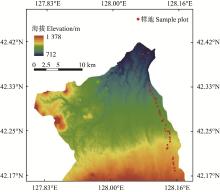
Fig.1
Location and design of sample plots"
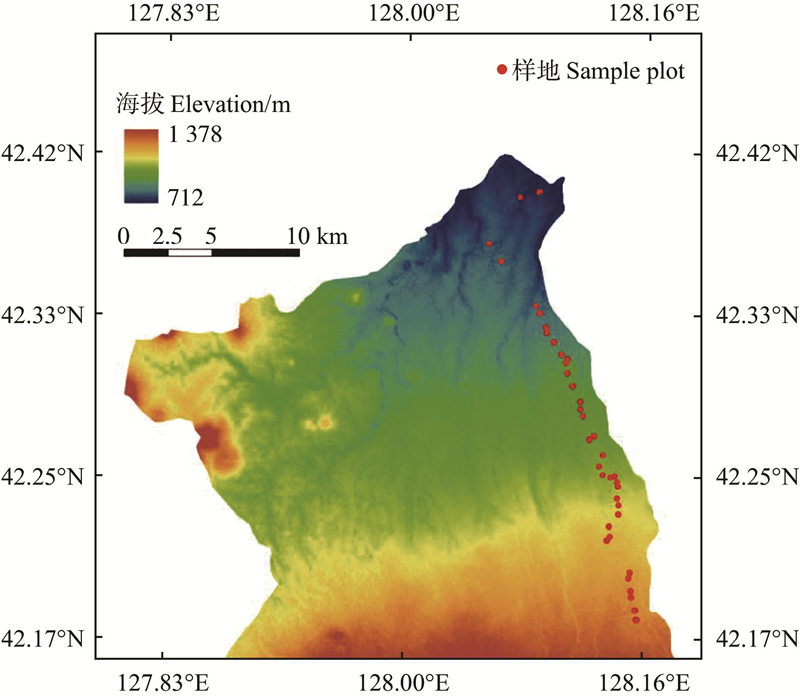
Table 1
Variation of community structural characteristics along elevation gradients in the broadleaved species–Pinus koraiensisforests of Changbai Mountain"
| 海拔 Elevation/m | 郁闭度Canopy density | 密度Density | 平均 胸径 Mean DBH / cm | 最大 胸径 Max. DBH/ cm | 平均 树高 Mean height/ m | 最大 树高 Max. height/ m | 胸高断 面积 Basal area/ (m2·hm–2) | 针叶树 株数比例Conifer proportion (%) | ||
| (1≤DBH< 5 cm)/ (ind.·hm–2) | (5≤DBH< 20 cm)/ (ind.·hm–2) | (DBH≥ 20 cm)/ (ind.·hm–2) | ||||||||
| 700~750 | 0.60 | 5 822 | 2 233 | 1 056 | 11.3 | 113.3 | 10.1 | 30.5 | 141.1 | 5.1 |
| 750~800 | 0.65 | 9 189 | 3 489 | 922 | 12.6 | 90.2 | 12.3 | 38.0 | 180.7 | 8.0 |
| 800~850 | 0.72 | 9 711 | 3 467 | 1 244 | 12.1 | 100.3 | 17.8 | 40.2 | 213.2 | 14.1 |
| 850~900 | 0.73 | 7 144 | 4 278 | 1 344 | 10.2 | 115.2 | 16.8 | 45.6 | 187.7 | 20.7 |
| 900~950 | 0.70 | 7 167 | 2 900 | 1 133 | 11.4 | 127.4 | 16.0 | 39.6 | 163.8 | 6.4 |
| 950~1 000 | 0.60 | 11 611 | 5 289 | 1 189 | 8.3 | 132.1 | 16.1 | 39.5 | 192.7 | 24.7 |
| 1 000~1 050 | 0.72 | 5 756 | 2 800 | 1 044 | 12.9 | 112.0 | 16.3 | 38.0 | 151.1 | 12.8 |
| 1 050~1 100 | 0.75 | 6 933 | 3 300 | 1 356 | 11.4 | 118.4 | 15.7 | 38.3 | 183.9 | 24.7 |
| 1 100~1 150 | 0.75 | 9 078 | 4 078 | 1 356 | 11.9 | 156.0 | 15.7 | 42.3 | 220.7 | 59.5 |
Table 2
Composition of dominant tree species across elevation gradients"
| 海拔 Elevation/m | 树种组成 Species composition (DBH≥1 cm) | ||
| 株数百分比 Percentage of stem number(%) | 胸高断面积百分比 Percentage of basal area(%) | 重要值 Importance value | |
| 700~750 | 20.33簇毛槭 Acer barbinerve+19.97 假色槭 A. pseudosieboldianum+16.12色木槭 A. mono+7.69暴马丁香 Syringa reticulata subsp. amurensis+6.59白牛槭 A. mandshuricum+ 其他 Others | 14.14红松 P. koraiensis+13.05水曲柳 F. mandschurica+12.52色木槭 A. mono+11.75假色槭A. pseudosieboldianum +11.60色木槭 A. mono+其他 Others | 33.07簇毛槭 A. barbinerve+17.33假色槭 A. pseudosieboldianum+10.58色木槭 A. mono+9.13红松 P. koraiensis+6.74紫椴 T. amurensis+其他 Others |
| 750~800 | 16.88色木槭 A. mono+11.10水曲柳 Fraxinus mandschurica+9.80暴马丁香 S. reticulata subsp. amurensis+7.20假色槭 A. pseudosieboldianum +6.61青楷槭 A. tegmentosum+其他 Others | 13.16紫椴 T. amurensis+12.92红松 P. koraiensis+11.04水曲柳 F. mandschurica+9.58春榆 Ulmus davidiana var. japonica+9.58色木槭 A. mono+其他 Others | 10.76色木槭 A. mono+ |
| 800~850 | 29.99假色槭 A. pseudosieboldianum+9.22簇毛槭 A. barbinerve+5.78色木槭 A. mono+4.95红松 Pinus koraiensis+4.67蒙古栎 Quercus mongolica+其他 Others | 12.26红松 P. koraiensis+11.00假色槭 A. pseudosieboldianum+9.07紫椴 T. amurensis+8.13色木槭 A. mono+6.46蒙古栎 Q. mongolica+其他 Others | 18.70假色槭 A. pseudosieboldianum+8.90红松 P. koraiensis+6.00簇毛槭 A. barbinerve+5.82紫椴 T. amurensis+5.41蒙古栎 Q. mongolica+其他 Others |
| 850~900 | 31.80假色槭 A. pseudosieboldianum+16.55簇毛槭 A. barbinerve+9.46色木槭 A. mono+6.38紫椴 Tilia amurensis+4.73红松 P. koraiensis+ 其他 Others | 13.76紫椴 T. amurensis+12.20色木槭 A. mono+10.80水曲柳 F. mandschurica+8.16红松 P. koraiensis+5.33蒙古栎 Q. mongolica+其他 Others | 18.81假色槭 A. pseudosieboldianum+10.99色木槭 A. mono+ |
| 900~950 | 25.90簇毛槭 A. barbinerve+16.54色木槭 A. mono+14.23白牛槭 A. mandshuricum+6.28青楷槭 A. tegmentosum+5.89紫椴 T. amurensis+其他 Others | 16.75紫椴 T. amurensis+15.19色木槭 A. mono+10.38白牛槭 A. mandshuricum+9.25 水曲柳 F. mandschurica+8.64臭冷杉 A. nephrolepis+其他 Others | 16.64色木槭 A. mono+15.38簇毛槭 A. barbinerve+10.96紫椴 T. amurensis+9.75白牛槭 A. mandshuricum+6.60臭冷杉 A. nephrolepis+其他 Others |
| 950~1 000 | 30.81簇毛槭 A. barbinerve+13.05色木槭 A. mono+10.27臭冷杉 Abies nephrolepis+9.67青楷槭 A. tegmentosum+7.20紫椴 T. amurensis+其他 Others | 12.00臭冷杉 A. nephrolepis+10.86紫椴 T. amurensis+10.45色木槭 A. mono+8.37红松 P. koraiensis+7.61簇毛槭 A. barbinerve+ 其他 Others | 16.44色木槭 A. mono+15.38簇毛槭 A. barbinerve+10.96紫椴 T. amurensis+9.75白牛槭 A. mandshuricum+6.6臭冷杉 A. nephrolepis+其他 Others |
| 1 000~1 050 | 37.79簇毛槭 A. barbinerve+14.06假色槭 A. pseudosieboldianum+9.67色木槭 A. mono+7.73白牛槭 A. mandshuricum+6.15花楷槭 A. ukurunduense+其他 Others | 15.00色木槭 A. mono+11.43紫椴 T. amurensis+11.03臭冷杉 A. nephrolepis+9.08黑桦 Betula dahurica+8.81簇毛槭 A. barbinerve+其他 Others | 18.48簇毛槭 A. barbinerve+12.95色木槭 A. mono+9.66臭冷杉 A. nephrolepis+9.35假色槭 A. pseudosieboldianum +8.44紫椴 T. amurensis+其他 Others |
| 1 050~1 100 | 16.20臭冷杉 A. nephrolepis+14.49簇毛槭 A. barbinerve+10.90花楷槭 A. ukurunduense+10.59色木槭 A. mono+9.19青楷槭 A. tegmentosum+其他 Others | 15.47红松 P. koraiensis+12.76臭冷杉 A. nephrolepis+10.27紫椴 T. amurensis+8.90色木槭 A. mono+6.23鱼鳞云杉 P. jezoensis+ 其他 Others | 11.67簇毛槭 A. barbinerve+10.94臭冷杉 A. nephrolepis+10.82色木槭 A. mono+9.13红松 P. koraiensis+7.76花楷槭 A. ukurunduense+其他 Others |
| 1 100~1 150 | 27.61臭冷杉 A. nephrolepis+13.37鱼鳞云杉 Picea jezoensis+13.13花楷槭 A. ukurunduense+9.08紫椴 T. amurensis+6.50长白落叶松 Larix olgensis+其他 Others | 21.78长白落叶松 L. olgensis+18.26臭冷杉 A. nephrolepis+13.60红松 P. koraiensis+10.53紫椴 T. amurensis+9.08鱼鳞云杉 P. jezoensis+其他 Others | 119.32臭冷杉 A. nephrolepis+10.03红松 P. koraiensis+9.96鱼鳞云杉 P. jezoensis+9.61花楷槭 A. ukurunduense+9.53长白落叶松 L. olgensis+其他 Others |
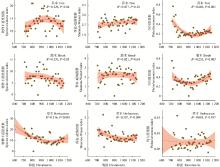
Fig.2
Variation patterns of diversity for different plant life-forms along the elevation gradient in a broadleaved species–Pinus koraiensis forest The regression relationship is shown with a solid line when it reaches the level of statistical significance (P<0.05), and with a dashed line otherwise (P>0.05)."
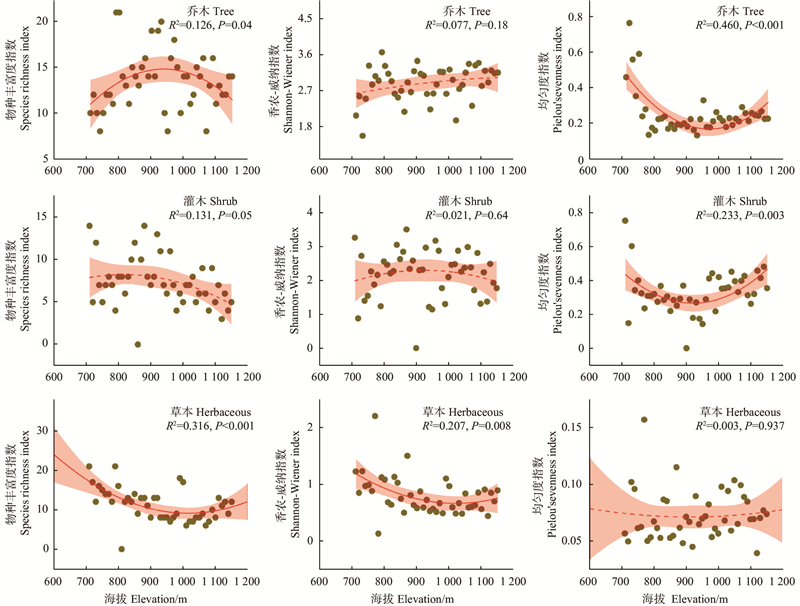
Fig.3
Correlations between species diversity indices of different life-forms and environmental factors in the broadleaved species–Pinus koraiensis forest"
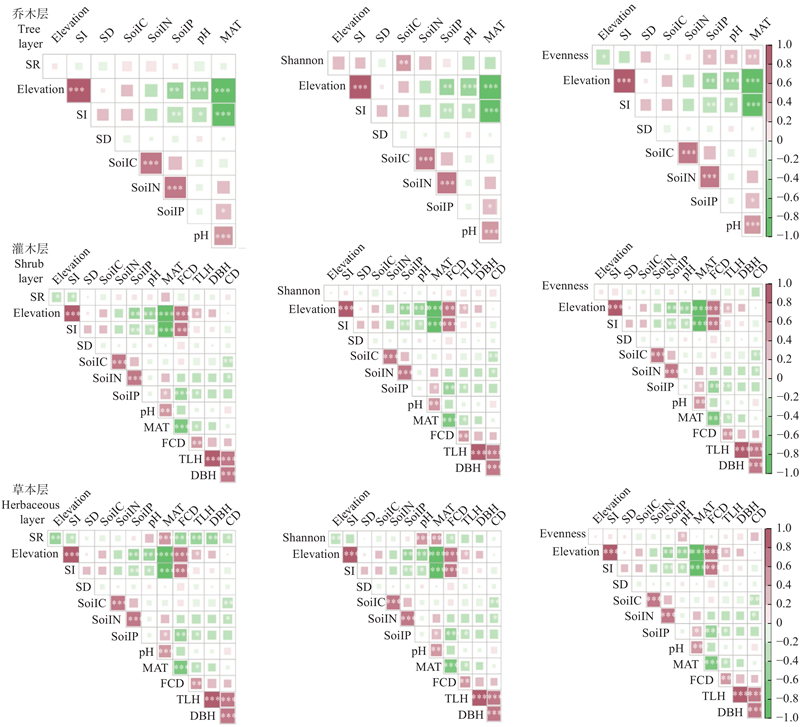
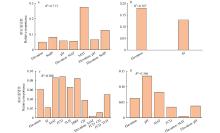
Fig.4
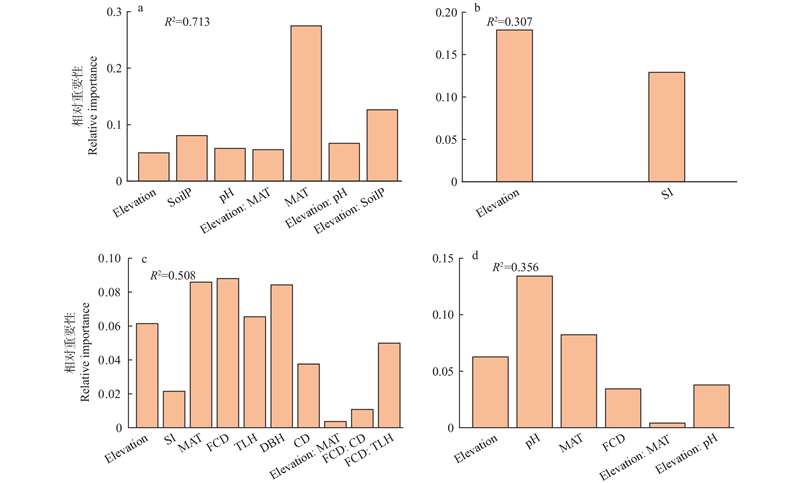
Variance partitioning of influencing variables on (a) arbor evenness, (b) shrub richness, (c) herb richness, and (d) herb Shannon-Wiener index"
| 白雪娇, 李步杭, 张 健, 等. 长白山阔叶红松林灌木物种组成、结构和空间分布. 应用生态学报, 2010, 21 (8): 1899- 1906. | |
| Bai X J, Li B H, Zhang J, et al. Species composition, structure, and spatial distribution of shrubs in broad-leaved korean pine (Pinus koraiensis) mixed forest in Changbai Mountains. Chinese Journal of Applied Ecology, 2010, 21 (8): 1899- 1906. | |
| 鲍士旦. 2000. 土壤农化分析. 3版. 北京: 中国农业出版社. | |
| Bao S D. 2000. Soil and agricultural chemistry analysis. 3rd ed. Beijing: China Agriculture Press. [in Chinese] | |
| 程根伟, 余新晓, 赵玉涛. 2004. 山地森林生态系统水文循环与数学模拟. 北京: 科学出版社. | |
| Cheng G W, Yu X X, Zhao Y T. 2004. The hydrological cycle and its mathematical models of forest ecosystem in mountains. Beijing: Science Press. [in Chinese] | |
|
方精云, 王襄平, 沈泽昊, 等. 植物群落清查的主要内容、方法和技术规范. 生物多样性, 2009, 17 (6): 533- 548.
doi: 10.3724/SP.J.1003.2009.09253 |
|
|
Fang J Y, Wang X P, Shen Z H, et al. Methods and protocols for plant community inventory. Biodiversity Science, 2009, 17 (6): 533- 548.
doi: 10.3724/SP.J.1003.2009.09253 |
|
| 郝占庆, 李步杭, 张 健, 等. 长白山阔叶红松林样地(CBS), 群落组成与结构. 植物生态学报, 2008, 32 (2): 238- 250. | |
| Hao Z Q, Li B H, Zhang J, et al. Broad-leaved korean pine (Pinus Koraiensis) mixed forest plot in Changbaishan (CBS) of China: community composition and structure. Journal of Plant Ecology, 2008, 32 (2): 238- 250. | |
| 郝占庆, 于德永, 杨晓明, 等. 2002. 长白山北坡植物群落α多样性及其随海拔梯度的变化. 应用生态学报, 13(7): 785−789. | |
| Hao Z Q, Yu D Y, Yang X M, et al. 2002. α diversity of communities and their variety along altitude gradient on northern slope of Changbai Mountain. Chinese Journal of Applied Ecology, 13(7): 785−789. [in Chinese] | |
| 姜 萍, 赵 光, 叶 吉, 等. 长白山北坡森林群落结构组成及其海拔变化. 生态学杂志, 2003, 22 (6): 28- 32. | |
| Jiang P, Zhao G, Ye J, et al. Structure of forest communities on the northern slope of Changbai Mountain and its variation along elevation gradients. Chinese Journal of Ecology, 2003, 22 (6): 28- 32. | |
| 秦 浩, 张殷波, 董 刚, 等. 2019. 山西关帝山森林群落物种、谱系和功能多样性海拔格局. 植物生态学报, 43(9): 762−773. | |
| Qin H, Zhang Y B, Dong G, et al. 2019. Altitudinal patterns of taxonomic, phylogenetic and functional diversity of forest communities in Mount Guandi, Shanxi, China. Chinese Journal of Plant Ecology, 43(9): 762−773. [in Chinese] | |
|
王国宏. 祁连山北坡中段植物群落多样性的垂直分布格局. 生物多样性, 2002, 10 (1): 7- 14.
doi: 10.17520/biods.2002002 |
|
|
Wang G H. Species diversity of plant communities along an altitudinal gradient in the middle section of northern slopes of Qilian Mountains, Zhangye, Gansu, China. Biodiversity Science, 2002, 10 (1): 7- 14.
doi: 10.17520/biods.2002002 |
|
|
王芸芸, 师 帅, 蔺 菲, 等. 长白山阔叶红松林木本植物繁殖特征及其关联性. 科学通报, 2014, 59 (24): 2407- 2415.
doi: 10.1360/N972014-00278 |
|
|
Wang Y Y, Shi S, Lin F, et al. Reproductive traits and their correlation among woody plants in a broadleaf-Korean pine (Pinus koraiensis) mixed forest in northeast China. Chinese Science Bulletin, 2014, 59 (24): 2407- 2415.
doi: 10.1360/N972014-00278 |
|
|
吴晓莆, 朱 彪, 赵淑清, 等. 东北地区阔叶红松林的群落结构及其物种多样性比较. 生物多样性, 2004, 12 (1): 174- 181.
doi: 10.17520/biods.2004021 |
|
|
Wu X P, Zhu B, Zhao S Q, et al. Comparison of community structure and species diversity of mixed forests of deciduous broad-leaved tree and Korean pine in Northeast China. Biodiversity Science, 2004, 12 (1): 174- 181.
doi: 10.17520/biods.2004021 |
|
| 吴晓煜, 赵秀海. 长白山阔叶红松林物种多样性格局及其尺度效应. 林业科学, 2025, 61 (2): 40- 49. | |
| Wu X Y, Zhao X H. Patterns of Species diversity and itʼs scale effects in the broad-leaved korean pine forests of Changbai Mountain. Scientia Silvae Sinicae, 2025, 61 (2): 40- 49. | |
| 肖 欢, 叶尔江·拜克吐尔汗, 张春雨, 等. 长白山阔叶红松林林层群落结构与生产力的关系. 林业科学, 2024, 60 (3): 57- 64. | |
| Xiao H, Baiketuerhan Y E J, Zhang C Y, et al. Relationship between forest layer community structure and productivity of broad-leaved korean pine forest in Changbai Mountain. Scientia Silvae Sinicae, 2024, 60 (3): 57- 64. | |
| 徐文铎, 何兴元, 陈 玮, 等. 2004. 长白山植被类型特征与演替规律的研究. 生态学杂志, 23(5): 162−174. | |
| Xu W D, He X Y, Chen W, et al. 2004 Characteristics and succession rules of vegetation types in Changbai Mountain. Chinese Journal of Ecology, 23(5): 162−174. [in Chinese] | |
| 张金峰, 葛树森, 梁金花, 等. 长白山阔叶红松林红松种群年龄结构与数量动态特征. 植物生态学报, 2022a, 46 (6): 667- 677. | |
| Zhang J F, Ge S F, Liang J H, et al. Age structure and quantitative dynamics of Pinus koraiensis population in broad-leaved Korean pine forest in Changbai Mountain. Journal of Plant Ecology, 2022a, 46 (6): 667- 677. | |
| 张金峰, 葛树森, 梁金花, 等. 长白山阔叶红松林紫椴种群结构与动态特征. 生态学报, 2022b, 42 (13): 5381- 5390. | |
| Zhang J F, Ge S F, Liang J H, et al. Population structure and dynamic characteristics of Tilia amurensis in broad-leaved Korean pine mixed forest in Changbai Mountain. Acta Ecologica Sinica, 2022b, 42 (13): 5381- 5390. | |
| 张殷波, 秦 浩, 孟庆欣, 等. 太行山森林群落物种多样性空间格局及其影响因素. 应用与环境生物学报, 2022, 28 (2): 331- 338. | |
| Zhang Y B, Qin H, Meng Q X, et al. Spatial patterns of and factors influencing species diversity in the forest communities of China’s Taihang Mountains. Chinese Journal of Apply and Environmental Biology, 2022, 28 (2): 331- 338. | |
| 赵家豪, 叶钰倩, 陈 斌, 等. 江西武夷山南方铁杉针阔混交林主要植物生态位特征. 林业科学, 2021, 57 (1): 191- 199. | |
| Zhao J H, Ye Y Q, Chen B, et al. Niche characteristics of dominant plants of coniferous (Tsuga chinensis var. tchekiangensis) and broad-leaf mixed forest in Jiangxi Wuyishan, China. Scientia Silvae Sinicae, 2021, 57 (1): 191- 199. | |
|
赵淑清, 方精云, 宗占江, 等. 长白山北坡植物群落组成、结构及物种多样性的垂直分布. 生物多样性, 2004, 12 (1): 164- 173.
doi: 10.17520/biods.2004020 |
|
|
Zhao S Q, Fang J Y, Zong Z J, et al. Composition, structure and species diversity of plant communities along an altitudinal gradient on the northern slope of Mt. Changbai, Northeast China. Biodiversity Science, 2004, 12 (1): 164- 173.
doi: 10.17520/biods.2004020 |
|
|
Carvalho J C, Cardoso P, Gomes P. Determining the relative roles of species replacement and species richness differences in generating beta-diversity patterns. Global Ecology and Biogeography, 2012, 21 (7): 760- 771.
doi: 10.1111/j.1466-8238.2011.00694.x |
|
| Chase J M. 2003. Community assembly: when should history matter? Oecologia, 136(4): 489-498. | |
|
Cheng C J, He N P, Li M X, et al. Plant species richness on the Tibetan Plateau: patterns and determinants. Ecography, 2023, 2023, e06265.
doi: 10.1111/ecog.06265 |
|
|
Chun J H, Lee C B. Diversity patterns and phylogenetic structure of vascular plants along elevational gradients in a mountain ecosystem, South Korea. Journal of Mountain Science, 2018, 15 (2): 280- 295.
doi: 10.1007/s11629-017-4477-x |
|
|
Diniz-Filho J A F, Bini L M, Hawkins B A. Spatial autocorrelation and red herrings in geographical ecology. Global Ecology and Biogeography, 2003, 12 (1): 53- 64.
doi: 10.1046/j.1466-822X.2003.00322.x |
|
|
Harms K E, Condit R, Hubbell S P, et al. Habitat associations of trees and shrubs in a 50-ha neotropical forest plot. Journal of Ecology, 2001, 89 (6): 947- 959.
doi: 10.1111/j.1365-2745.2001.00615.x |
|
|
Hao M H, Zhang C Y, Zhao X H, et al. Functional and phylogenetic diversity determine woody productivity in a temperate forest. Ecology and Evolution, 2018, 8 (5): 2395- 2406.
doi: 10.1002/ece3.3857 |
|
|
He D N, Peng D L, Yang H, et al. The response of seedlings and saplings to canopy structure and light in different gaps in a spruce-fir mixed stand in Changbai Mountains, China. Forest Ecology and Management, 2023, 546, 121365.
doi: 10.1016/j.foreco.2023.121365 |
|
|
Jost L. Partitioning diversity into independent alpha and beta components. Ecology, 2007, 88 (10): 2427- 2439.
doi: 10.1890/06-1736.1 |
|
|
Legendre P, Mi X C, Ren H B, et al. Partitioning beta diversity in a subtropical broad-leaved forest of China. Ecology, 2009, 90 (3): 663- 674.
doi: 10.1890/07-1880.1 |
|
|
McCain C M. Area and mammalian elevational diversity. Ecology, 2007, 88 (1): 76- 86.
doi: 10.1890/0012-9658(2007)88[76:AAMED]2.0.CO;2 |
|
|
Pashirzad M, Ejtehadi H, Vaezi J, et al. Plant–plant interactions influence phylogenetic diversity at multiple spatial scales in a semi-arid mountain rangeland. Oecologia, 2019, 189 (3): 745- 755.
doi: 10.1007/s00442-019-04345-9 |
|
|
Qian H, Ricklefs R E. A latitudinal gradient in large-scale beta diversity for vascular plants in North America. Ecology Letters, 2007, 10 (8): 737- 744.
doi: 10.1111/j.1461-0248.2007.01066.x |
|
| Rowe R J, Lidgard S. 2009. Elevational gradients and species richness: do methods change pattern perception? Global Ecology and Biogeography, 18(2): 163−177. | |
| Shi B K, Gao W F, Cai H Y, et al. Spatial variation of soil respiration is linked to the forest structure and soil parameters in an old-growth mixed broadleaved-Korean pine forest in northeastern China. Plant and Soil, 2016, 400 (1): 263- 274. | |
|
Vetaas O R, Grytnes J A. Distribution of vascular plant species richness and endemic richness along the Himalayan elevation gradient in Nepal. Global Ecology and Biogeography, 2002, 11 (4): 291- 301.
doi: 10.1046/j.1466-822X.2002.00297.x |
|
|
Wang G H, Zhou G S, Yang L M, et al. Distribution, species diversity and life-form spectra of plant communities along an altitudinal gradient in the northern slopes of Qilianshan Mountains, Gansu, China. Plant Ecology, 2003, 165 (2): 169- 181.
doi: 10.1023/A:1022236115186 |
|
|
Wang G R, Sun Y, Zhou M, et al. Effect of thinning intensity on understory herbaceous diversity and biomass in mixed coniferous and broad-leaved forests of Changbai Mountain. Forest Ecosystems, 2021, 8 (1): 53.
doi: 10.1186/s40663-021-00331-x |
|
|
Yue Q M, Hao M H, Li X Y, et al. Assessing biotic and abiotic effects on forest productivity in three temperate forests. Ecology and Evolution, 2020, 10 (14): 7887- 7900.
doi: 10.1002/ece3.6516 |
|
|
Zhang W X, Huang D Z, Wang R Q, et al. Altitudinal patterns of species diversity and phylogenetic diversity across temperate mountain forests of northern China. PLoS One, 2016, 11 (7): e0159995.
doi: 10.1371/journal.pone.0159995 |
|
|
Zhao F Q, Yang J, Liu Z H, et al. Balancing multiple objectives using a classification-based forest management system in Changbai Mountains, China. Environmental Management, 2011, 48 (6): 1136- 1147.
doi: 10.1007/s00267-011-9669-5 |
| [1] | Hui Mao,Feifei Zhao,Jie Li,Chunyu Zhang. Impacts of Tree Species Diversity and Environmental Factors on Soil Multifunctionality in the Middle Temperate Forests of Northeast China [J]. Scientia Silvae Sinicae, 2026, 62(2): 40-52. |
| [2] | Haifeng Yin,Size Liu,Jie Zeng,Yu Su,Anwei Yu,Xianwei Li. Mutual Feedback between Root Decomposition of Pinus massoniana and Soil Nematode Trophic Groups under Forest Gap Transformation [J]. Scientia Silvae Sinicae, 2026, 62(2): 85-96. |
| [3] | Xinyi Lin,Xinglu Zhou,Lei Zhang,Lijuan Wang,Xinmin An,Jianjun Hu. Biosafety Assessment of Transgenic Poplar Expressing the BtCry1Ac Gene [J]. Scientia Silvae Sinicae, 2026, 62(2): 134-146. |
| [4] | Shirong Liu,Yuanqi Chen,Xiuqing Nie,Angang Ming,Hui Wang. Effects of Tree Species Diversity on Multifunctionality and Resilience of Forest Ecosystems [J]. Scientia Silvae Sinicae, 2026, 62(1): 1-18. |
| [5] | Wankuan Zhu,Zhichao Wang,Yuxing Xu,Runxia Huang,Yi Tao,Yuanyuan Zhong,Apeng Du. Simulation of Soil Respiration in a Stratified Mixed Stand of Eucalyptus spp. and Manglietia glauca in Leizhou Peninsula Based on Machine Learning Algorithms [J]. Scientia Silvae Sinicae, 2026, 62(1): 67-82. |
| [6] | Chenglin Chi,Jiannan Wang,Rong Cui,Qianxue Wang,Jili Zhang. Effects of Throughfall Reduction on Soil Macrofaunal Communities in Quercus mongolica Forest in Sanjiang Plain [J]. Scientia Silvae Sinicae, 2026, 62(1): 231-242. |
| [7] | Tao Yu,Liang He,Wenbin Yang,Yiben Cheng,Wei Feng,Ronglian Qi,Guohua Liu,Yanyan Ning,Yuanyuan Yu,Wei Li. Characteristics of Deep Percolation and Soil Water Replenishment of Typical Arboreal and Shrub Vegetation in Horqin Sandy Land [J]. Scientia Silvae Sinicae, 2026, 62(1): 83-94. |
| [8] | Xiaoyan Yu,Yaxian Gao,Guangpu Wei,Shuyu Zhang,Wenjun Zhang. Spatio-temporal Pattern of Vegetation Resilience and Its Response to Extreme Climate in Inner Mongolia Autonomous Region [J]. Scientia Silvae Sinicae, 2025, 61(9): 48-58. |
| [9] | Minmin Kang,Pingping Li,Yanfang Wan,Wenbiao Duan,Pengtao Yu,Yanhui Wang,Xiaoquan Zhang,Weilai Li,Yuan Gao. Response of Sap Flow Density to Extreme Soil Drought in Platycladus orientalis Plantation in Mountainous Area of Beijing [J]. Scientia Silvae Sinicae, 2025, 61(9): 59-69. |
| [10] | Zhihui Yang,Liuduan Wei,Miao Yu,Tianxin Dong,Xingyu Zhang,Xinna Zhang,Bingqian Ma,Chengyang Xu. Drought Effect on the Seedling Growth of Four Species Depends on the Lower Order Root Traits [J]. Scientia Silvae Sinicae, 2025, 61(9): 81-89. |
| [11] | Yuqi Jiang,Jianzhi Niu,Di Wang,Tao Yang,Zhengyu Dai,Jiayu Zheng. Characteristics of Soil Preferential Flow in the Natural Secondary Forest of Laotudingzi in Liaoning Province Based on Dye Tracing and Ground Penetrating Radar [J]. Scientia Silvae Sinicae, 2025, 61(8): 32-45. |
| [12] | Zihan Huang,Qiaoling Han,Yue Zhao,Yandong Zhao,Meihui Song. Multi-Scale Fusion Method of Soil CT/SEM Images Based on CycleGAN [J]. Scientia Silvae Sinicae, 2025, 61(8): 116-128. |
| [13] | Rumiao Wang,Jing Li,Weiwei Liu,Lijuan Cui. Regulating Mechanisms of Microbial Metabolic Plasticity on Carbon Sequestration in Degraded Wetlands and Its Implications for Ecological Restoration [J]. Scientia Silvae Sinicae, 2025, 61(7): 52-58. |
| [14] | Zhong Zhao. Problems and Challenges Faced by the Health Management of Old Trees [J]. Scientia Silvae Sinicae, 2025, 61(7): 94-99. |
| [15] | Can Wang, Masoudi Abolfazl,Min Wang,Ze Zhang,Jingkun Cao,Yuhao Xu,Zhijun Yu,Jingze Liu. Characteristics of Soil Pathogenic Bacteria and Their Response to Microplastics under Typical Land-use Conversion Patterns in Xiong’an New Area [J]. Scientia Silvae Sinicae, 2025, 61(7): 231-240. |
| Viewed | ||||||
|
Full text |
|
|||||
|
Abstract |
|
|||||
