
Scientia Silvae Sinicae ›› 2026, Vol. 62 ›› Issue (1): 133-143.doi: 10.11707/j.1001-7488.LYKX20240521
• Research papers • Previous Articles Next Articles
Hongwei Zhou1( ),Yongzheng Li1,Wenhui Guo2,*(),Yifan Chen2,Haochang Hu1,Siyan Zhang1,Di Cui3,Yumo Chen4
Received:2024-09-04
Revised:2025-07-04
Online:2026-01-25
Published:2026-01-14
Contact:
Wenhui Guo
E-mail:easyid@163.com;guowh1666@163.com
CLC Number:
Hongwei Zhou,Yongzheng Li,Wenhui Guo,Yifan Chen,Haochang Hu,Siyan Zhang,Di Cui,Yumo Chen. Prediction of Subcompartment-Scale Spread of Pine Wilt Disease Based on Cellular Automata Model[J]. Scientia Silvae Sinicae, 2026, 62(1): 133-143.
Table 1
Impact factor database"
| 影响因子类型 Environmental factor type | 影响因子 Environmental factor | 缩写 Abbreviation | 数据来源 Data source |
| 生物气候因子 Bioclimatic factor | 19项生物气候因子 19 Bioclimatic factors | Bio1-Bio19 | |
| 地理环境因子 Geography factor | 海拔 Elevation | Ele | |
| 人为影响因子 Human influence | 人口 Population | Pop | |
| 地区生产总值 Gross domestic product | GDP | ||
| 道路密度 Road density | R.dens | ||
| 木材运输量 Pine wood transportation | PWT | 国家林业和草原局 生物灾害防控中心 Center for Biological Disaster Prevention and Control, National Forestry and Grassland Administration | |
| 疫区木材运输量 Infected pine wood transportation | IPWT |
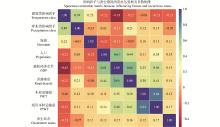
Fig.1
Spearman correlation coefficient matrix"
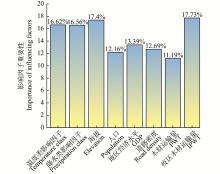
Fig.2
Importance analysis of influencing factors"
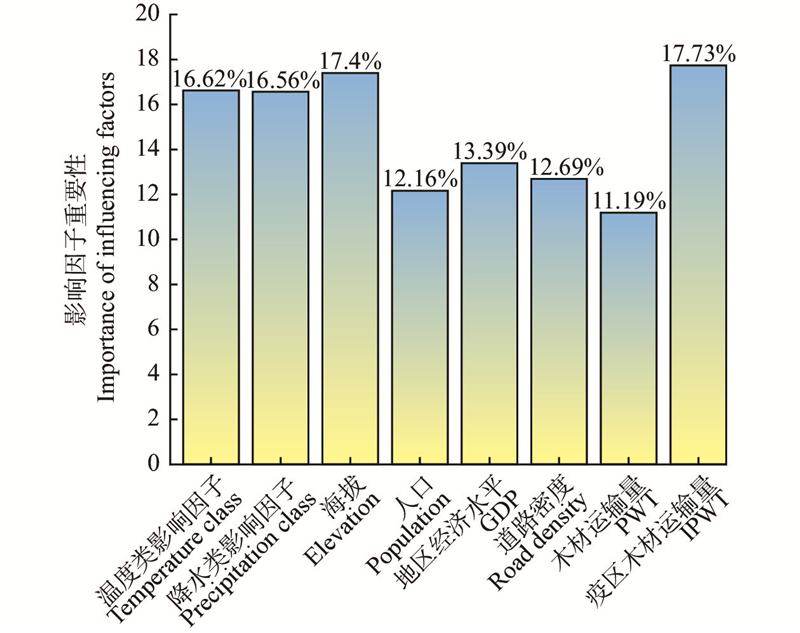
Table 2
Top ten frequent itemsets in terms of support"
| 项集长度 Length | 频繁项集 Frequent items | 支持度 Support | 频率 Occurrences |
| 1 | 疫区木材运输量 Infected pine wood transportation: 中 Middle(3.11~8.52) | 0.546 | 1 601 |
| 1 | 木材运输量 Pine wood transportation: 较高 Relatively high(349.15~2 951.08) | 0.454 | 1 329 |
| 1 | 木材运输量 Pine wood transportation: 中 Middle(200.00~349.15) | 0.423 | 1 238 |
| 1 | 疫区木材运输量 Infected pine wood transportation: 较高 Relatively high(8.52~167.83) | 0.311 | 913 |
| 1 | 木材运输量 Pine wood transportation: 高 High(6 386.88 ~ 8 478.69) | 0.208 | 610 |
| 2 | 降水类影响因子 Synthetic precipitation class: 低 Low(?1.94~?1.62), 疫区木材运输量 Infected pine wood transportation: 中 Middle(3.11~8.52) | 0.394 | 1 155 |
| 2 | 疫区木材运输量 Infected pine wood transportation: 较高 Relatively high(8.52~167.83), 木材运输量 Pine wood transportation: 高 High(6 386.88~8 478.69) | 0.312 | 913 |
| 2 | 降水类影响因子 Synthetic precipitation class: 低 Low(?1.94~?1.62), 木材运输量 Pine wood transportation: 中 Middle(200.00~349.15) | 0.188 | 551 |
| 2 | 温度类影响因子 Synthetic temperature class: 较低 Relatively low(?1.75~?1.43), 疫区木材运输量Infected pine wood transportation: 中 Middle(3.11~8.52) | 0.168 | 492 |
| 2 | 木材运输量 Pine wood transportation: 中 Middle(200.00~349.15), 温度类影响因子 Synthetic temperature class: 较低 Relatively low(?1.75~?1.43) | 0.156 | 455 |
Table 3
Top five natural factor frequent itemsets in terms of support"
| 项集长度 Length | 频繁项集 Frequent items | 支持度 Support | 频率 Frequency |
| 1 | Bio5: 较高Relatively high(54.32~54.42) | 0.337 | 423 |
| 1 | Bio6: 高High(0.20~1.02) | 0.327 | 410 |
| 1 | Bio11: 中Middle(14.65~14.82) | 0.316 | 396 |
| 1 | Bio11: 较高Relatively high(14.99~20.75) | 0.274 | 343 |
| 1 | Bio6: 中 (0.16~0.20) | 0.271 | 340 |
| 2 | Bio16: 较高Relatively high(809.40~834.40), Bio18: 较高Relatively high(809.40~834.40) | 0.229 | 287 |
| 2 | Bio16: 高High(801.20~809.40),Bio18: 高High(801.20~809.40) | 0.226 | 283 |
| 2 | Bio1: 较高Relatively high(26.39~49.54), Bio10: 较高Relatively high(37.53~119.48) | 0.226 | 283 |
| 2 | Bio1: 较高Relatively high(26.39~49.54),Bio11: 较高Relatively high(14.99~20.75) | 0.217 | 272 |
| 2 | Bio5: 较高Relatively high(54.32~54.42),Bio8: 较高Relatively high(37.84~38.24) | 0.213 | 267 |
Fig.3
Structure and workflow of CA model"
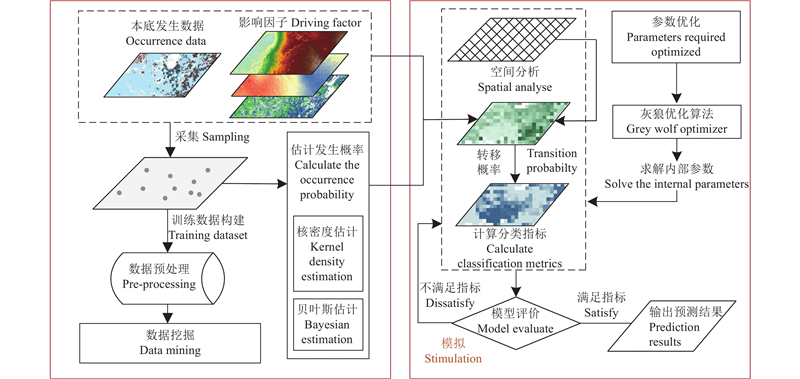
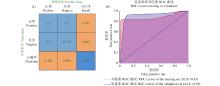
Fig.4
Prediction performance of CA model a: The confusion matrix of the prediction results by the model on the 2023 validation set and various evaluation indicators are presented. b: ROC curves and AUC indicators for the training, validation, and external validation sets of prediction models."
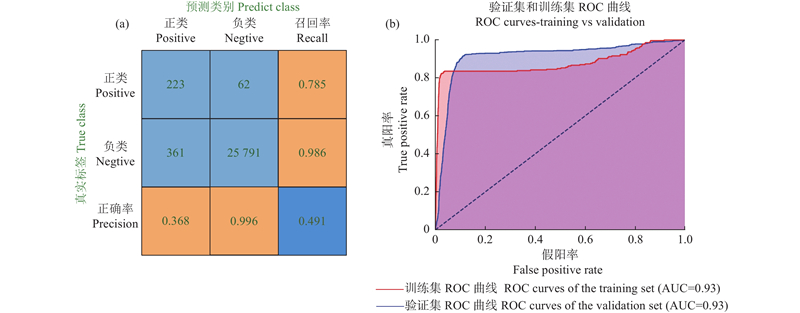
Table 4
Comparison of performance metrics between models"
| 预测模型 Predict model | 准确率 Accuracy | 召回率 Recall | 精确率 Precision | F1分数 F1 score | 曲线下面积 AUC |
| CA | 0.979 | 0.785 | 0.382 | 0.491 | 0.890 |
| SVM | 0.967 | 0.147 | 0.062 | 0.088 | 0.781 |
| RF | 0.989 | 0.270 | 0.517 | 0.355 | 0.699 |
| CART | 0.987 | 0.298 | 0.360 | 0.326 | 0.988 |
| GLM | 0.991 | 0.273 | 0.736 | 0.398 | 0.986 |
| ANN | 0.991 | 0.288 | 0.701 | 0.408 | 0.988 |
| 陈崇成, 李建微, 唐丽玉, 等. 林火蔓延的计算机模拟与可视化研究进展. 林业科学, 2005, 41 (5): 155- 162. | |
| Chen C C, Li J W, Tang L Y, et al. Research advance in simulation and visualization of forest fire spreading via computer. Scientia Silvae Sinicae, 2005, 41 (5): 155- 162. | |
| 程 功, 吕 全, 冯益明, 等. 气候变化背景下松材线虫在中国分布的时空变化预测. 林业科学, 2015, 51 (6): 119- 126. | |
| Cheng G, Lv Q, Feng Y M, et al. Temporal and spatial dynamic pattern of pine wilt disease distribution in China predicted under climate change scenario. Scientia Silvae Sinicae, 2015, 51 (6): 119- 126. | |
| 丁晓磊, 汪青桐, 林司曦, 等. 广东省与江苏省松材线虫种群遗传结构差异分析. 林业科学, 2022, 58 (8): 1- 9. | |
| Ding Y L, Wang Q T, Lin S X, et al. Analysis of genetic variations of Bursaphelenchus xylophilus populations between Guangdong and Jiangsu provinces with SNP marker. Scientia Silvae Sinicae, 2022, 58 (8): 1- 9. | |
| 郭彦龙, 赵泽芳, 乔慧捷, 等. 物种分布模型面临的挑战与发展趋势. 地球科学进展, 2020, 35 (12): 1292- 1305. | |
| Guo Y L, Zhao Z F, Qiao H J, et al. Challenges and development trend of species distribution model. Advances in Earth Science, 2020, 35 (12): 1292- 1305. | |
| 韩阳阳, 王 焱, 项 杨, 等. 基于Maxent生态位模型的松材线虫在中国的适生区预测分析. 南京林业大学学报(自然科学版), 2015, 39 (01): 6- 10. | |
| Han Y Y, Wang Y, Xiang Y, et al. Prediction of potential distribution of Bursaphelenchus xylophilus in China based on Maxent ecological niche model. Journal of Nanjing Forestry University (Natural Science Edition), 2015, 39 (01): 6- 10. | |
| 洪承昊, 陈京元, 赵 勇, 等. 三峡库区松材线虫病扩张速度对人为活动的响应. 生态学报, 2017, 37 (20): 6800- 6808. | |
| Hong C H, Chen J Y, Zhao Y, et al. A correlation of pine wood nematode dispersal rate with human activities-a case study in the Three Gorges Reservoir Area. Acta Ecologica Sinica, 2017, 37 (20): 6800- 6808. | |
| 巨云为, 李明阳, 吴文浩. 江苏省松材线虫发生的预测方法. 林业科学, 2010, 46 (12): 91- 96. | |
| Ju Y W, Li M Y, Wu W H. Predictive methods of pine wilt disease in Jiangsu Province. Scientia Silvae Sinicae, 2010, 46 (12): 91- 96. | |
| 焦强英, 韩宗甫, 王炜烨, 等. 基于多源数据和机器学习方法的大兴安岭地区雷击火驱动因子及火险预测模型. 林业科学, 2023, 59 (6): 74- 87. | |
| Jiao Q Y, Han Z P, Wang W Y, et al. Driving factors and forecasting model of lightning-caused forest fires in daxing’ anling mountains based on multi-sources data and machine learning method. Scientia Silvae Sinicae, 2023, 59 (6): 74- 87. | |
| 刘婷婷, 杨晋帆, 周汝良, 等. 基于地理栅格变量与机器学习的松材线虫病扩散风险分析. 浙江农林大学学报, 2023, 40 (3): 617- 626. | |
| Liu T T, Yang J F, Zhou R L, et al. Prediction of spread risk of pine wilt disease based on geographic raster variables and machine learning models. Journal of Zhejiang A& F University, 2023, 40 (3): 617- 626. | |
| 刘晓梅, 蒲永兰, 李宏群, 等. 基于MaxEnt模型的重庆松材线虫病潜在生境分析. 三峡生态环境监测, 2017, 2 (3): 75- 80. | |
| Liu X M, Pu Y L, Li H Q, et al. Potential habitat analysis of pine wilt disease in Chongqing based on the MaxEnt model. Ecology and Environmental Monitoring of Three Gorges, 2017, 2 (3): 75- 80. | |
| 田 静, 邢艳秋, 姚松涛, 等. 基于元胞自动机和BP神经网络算法的Landsat-TM遥感影像森林类型分类比较. 林业科学, 2017, 53 (2): 26- 34. | |
| Tian J, Xing Y Q, Yao S T, et al. Comparison of Landsat-TM image forest type classification based on cellular automata and BP neural network algorithm. Scientia Silvae Sinicae, 2017, 53 (2): 26- 34. | |
| 田相林, 廖梓延, 孙帅超, 等. 多源数据对林分动态预测的影响及不确定性分析. 林业科学, 2021, 57 (3): 51- 66. | |
| Tian X L, Liao Z Y, Sun S C, et al. Impacts of multiple source data on forest forecasting and uncertainty propagatio. Scientia Silvae Sinicae, 2021, 57 (3): 51- 66. | |
| 王冬至, 张冬燕, 李永宁, 等. 基于贝叶斯法的针阔混交林树高与胸径混合效应模型. 林业科学, 2019, 55 (11): 85- 94. | |
| Wang D Z, Zhang D Y, Li Y N, et al. Height-diameter relationship for conifer mixed forest based on bayesian nonlinear mixed-effects model. Scientia Silvae Sinicae, 2019, 55 (11): 85- 94. | |
| 王曦茁, 曹业凡, 汪来发, 等. 松材线虫病发生及防控现状. 环境昆虫学报, 2018, 40 (2): 256- 267. | |
| Wang Z X, Cao Y F, Wang L F, et al. Current status of pine wilt disease and its control status. Journal of Environmental Entomology, 2018, 40 (2): 256- 267. | |
| 项移娟, 管剑锋, 李 健, 等. 浙江省松材线虫病发生程度预测预报模型. 浙江农林大学学报, 2011, 28 (5): 775- 778. | |
| Xiang Y J, Guan J F, Li J, et al. A pine wilt disease forecasting model for Zhejiang Province. Journal of Zhejiang A & F University, 2011, 28 (5): 775- 778. | |
| 许格希, 余荣兵, 杨昌旭, 等. 基于GIS空间技术和MaxEnt模型预测川西松材线虫病入侵风险. 北京林业大学学报, 2023, 45 (09): 104- 115. | |
| Xu G X, Yu R B, Yang C X, et al. Prediction of invasion risk of pine wilt disease based on GIS spatial technology and MaxEnt model in western Sichuan province of southwestern China. Journal of Beijing Forestry University, 2023, 45 (09): 104- 115. | |
| 应晨希, 吴小芹, 温彤玥, 等. 不同致病力松材线虫和拟松材线虫种群繁殖对温度的响应. 环境昆虫学报, 2023, 45 (2): 433- 441. | |
| Ying C X, Wu X Q, Wen T Y, et al. Population reproduction of Bursaphelenchus xylophilus and Bursaphelenchus mucronatus with different virulence response to temperature. Journal of Environmental Entomology, 2023, 45 (2): 433- 441. | |
| 叶建仁. 松材线虫病在中国的流行现状、防治技术与对策分析. 林业科学, 2019, 55 (9): 1- 10. | |
| Ye J R. The current situation, control techniques, and countermeasures of pine wilt disease in China. Scientia Silvae Sinicae, 2019, 55 (9): 1- 10. | |
| 张晓芳, 郭旭展, 洪 亮, 等. 冬奥核心区华北落叶松和白桦单木冠幅预测模型——组级贝叶斯模型、加性模型和混合效应模型比较. 林业科学, 2022, 58 (10): 89- 100. | |
| Zhang X F, Guo X Z, Hong L, et al. Comparison of single tree crown prediction models of Larix principis-rupprechtii and Betula platyphylla in the core area of the Winter Olympics in China. Scientia Silvae Sinicae, 2022, 58 (10): 89- 100. | |
| 张志诚, 刘 鹏, 孙江华, 等. 松树萎蔫病在安徽的侵染及其发生的气候分布研究. 宁夏大学学报(自然科学版), 2006, 27 (1): 89- 92. | |
| Zhang Z C, Liu P, Shun J H, et al. GIS method on the spatial-climate distributed characteristic of pine wilt disease in Anhui Province. Journal of Ningxia University(Natural Science Edition), 2006, 27 (1): 89- 92. | |
| 郑雅楠, 刘佩旋, 时 勇, 等. 辽宁松材线虫病与中国其他疫区的差异性分析. 北京林业大学学报, 2021, 43 (5): 155- 160. | |
| Zheng Y N, Liu P X, Shi Y, et al. Difference analysis on pine wilt disease between Liaoning province of northeastern China and other epidemic areas in China. Journal of Beijing Forestry University, 2021, 43 (5): 155- 160. | |
| 赵 理. 2024. 从典型案件谈松材线虫病疫木管理. 中国森林病虫, 43(3):42−45. | |
| Zhao L. 2024. Discussing the management of pine wood nematode-infected wood through typical case studies. Forest Pest and Disease, 43(3):42−45.[in Chinese] | |
|
Aburas M M, Ho Y M, Ramli M F, et al. The simulation and prediction of spatio-temporal urban growth trends using cellular automata models: A review. International Journal of Applied Earth Observation and Geoinformation, 2016, 52, 380- 389.
doi: 10.1016/j.jag.2016.07.007 |
|
| Barik M, Hafidi I, Rochd Y. 2023. Review of heuristic algorithms for frequent itemsets mining problem. Computing and Informatics, 42(6): 1360–1377-1360–1377. | |
| Choi W I, Song H J, Kim D S, et al. 2017. Dispersal patterns of pine wilt disease in the early stage of its invasion in South Korea. Forests, 8(11): 411. | |
| Gan W, Lin J C W, Fournier-Viger P, et al. A survey of utility-oriented pattern mining. IEEE Transactions on Knowledge and Data Engineering, 2019, 33 (4): 1306- 1327. | |
|
Hirata A, Nakamura K, Nakao K, et al. Potential distribution of pine wilt disease under future climate change scenarios. PLoS One, 2017, 12 (8): e0182837.
doi: 10.1371/journal.pone.0182837 |
|
| Huang J, Zhao X, Mo X, et al. 2024. Host vegetation connectivity is decisive for the natural spread of pine wilt disease. Pest Management Science, 80(10):5141-5156 | |
|
Jin Z, He D, Wei Z. Intelligent fault diagnosis of train axle box bearing based on parameter optimization VMD and improved DBN. Engineering Applications of Artificial Intelligence, 2022, 110, 104713.
doi: 10.1016/j.engappai.2022.104713 |
|
| Jolliffe I T, Cadima J. 2016. Principal component analysis: a review and recent developments. Philosophical Transactions of the Royal Society A: Mathematical, Physical and Engineering Sciences, 374(2065): 20150202. | |
|
Lee D S, Choi W I, Nam Y, et al. Predicting potential occurrence of pine wilt disease based on environmental factors in South Korea using machine learning algorithms. Ecological informatics, 2021, 64, 101378.
doi: 10.1016/j.ecoinf.2021.101378 |
|
|
Lin J, Li X, Wen Y, et al. Modeling urban land-use changes using a landscape-driven patch-based cellular automaton (LP-CA). Cities, 2023, 132, 103906.
doi: 10.1016/j.cities.2022.103906 |
|
|
Liu C, Newell G, White M. On the selection of thresholds for predicting species occurrence with presence‐only data. Ecology and evolution, 2016, 6 (1): 337- 348.
doi: 10.1002/ece3.1878 |
|
|
Liu D, Zhang X. Occurrence prediction of pine wilt disease based on CA-Markov model. Forests, 2022, 13 (10): 1736.
doi: 10.3390/f13101736 |
|
|
Liu Y, Huang J, Yang T. Natural factors play a dominant role in the short-distance transmission of pine wilt disease. Forests, 2023, 14 (5): 1059.
doi: 10.3390/f14051059 |
|
|
Lu X, Huang J, Li X, et al. The interaction of environmental factors increases the risk of spatiotemporal transmission of pine wilt disease. Ecological Indicators, 2021, 133, 108394.
doi: 10.1016/j.ecolind.2021.108394 |
|
| Lundberg S, Lee S I. 2017. A unified approach to interpreting model predictions. Advances in neural information processing systems, 30. | |
|
Medrek M, Pastuszak Z. Numerical simulation of the novel coronavirus spreading. Expert Systems with applications, 2021, 166, 114109.
doi: 10.1016/j.eswa.2020.114109 |
|
|
Mirjalili S, Mirjalili S M, Lewis A. Grey wolf optimizer. Advances in Engineering Software, 2014, 69, 46- 61.
doi: 10.1016/j.advengsoft.2013.12.007 |
|
|
Mohd Pozi M S, Sulaiman M N, Mustapha N, et al. A new classification model for a class imbalanced data set using genetic programming and support vector machines: case study for wilt disease classification. Remote Sensing Letters, 2015, 6 (7): 568- 577.
doi: 10.1080/2150704X.2015.1062159 |
|
|
Tang X, Yuan Y, Li X, et al. Maximum entropy modeling to predict the impact of climate change on pine wilt disease in China. Frontiers in plant science, 2021, 12, 652500.
doi: 10.3389/fpls.2021.652500 |
|
|
Wang W, Zhu Q, He G, et al. Impacts of climate change on pine wilt disease outbreaks and associated carbon stock losses. Agricultural and Forest Meteorology, 2023, 334, 109426.
doi: 10.1016/j.agrformet.2023.109426 |
|
|
Xiao Y, Guo Q, Xie N, et al. Predicting the global potential distribution of Bursaphelenchus xylophilus using an ecological niche model: expansion trend and the main driving factors. BMC Ecology and Evolution, 2024, 24 (1): 48.
doi: 10.1186/s12862-024-02234-1 |
|
| Yu B, Yin H, Zhu Z. 2017. Spatio-temporal graph convolutional networks: A deep learning framework for traffic forecasting. arXiv preprint arXiv: 1709.04875. | |
| Zhou H, Zhang S, Chen Y, et al. Research on pine wilt disease spread prediction based on an improved LGBM model. Phytopathology®, 2025, 115 (4): 410- 421. | |
| Zhou H W, Xie M, Koski T M, et al. Epidemiological model including spatial connection features improves prediction of the spread of pine wilt disease. Ecological Indicators, 2024, 63, 112103. | |
|
Zhou J, Qiu Y, Zhu S, et al. Optimization of support vector machine through the use of metaheuristic algorithms in forecasting TBM advance rate. Engineering Applications of Artificial Intelligence, 2021, 97, 104015.
doi: 10.1016/j.engappai.2020.104015 |
|
|
Zhang Y, Dian Y, Zhou J, et al. Characterizing spatial patterns of pine wood nematode outbreaks in subtropical zone in China. Remote Sensing, 2021, 13 (22): 4682.
doi: 10.3390/rs13224682 |
| [1] | Tingting Chen,Hao Cheng,Jianren Ye,Ying Li,Anshun Ni,Jiao Zhang. Dynamics of Bursaphelenchus xylophilus Movement with Early Diagnosis and Treatment Efficacy [J]. Scientia Silvae Sinicae, 2025, 61(7): 241-250. |
| [2] | Wanying Xie,Wenping Liu,Han Wang. UAV Images of Pine Forests for Early Detection of Pine Wood Nematode Infestation [J]. Scientia Silvae Sinicae, 2024, 60(9): 124-133. |
| [3] | Anshun Ni,yongchun Wang,Dan Yang,Xueshu Sun,Jianren Ye. Toxicity of a New Compound Medicament 2% Avermectin · 6% Fluopyram on Bursaphelenchus xylophilus [J]. Scientia Silvae Sinicae, 2022, 58(8): 18-25. |
| [4] | Minjia Wang,Jianren Ye,Yusheng Tu,Fangping Du. Screening of Wood Rot Fungi for Treating the Infected Wood by Bursaphelenchus xylophilus [J]. Scientia Silvae Sinicae, 2021, 57(6): 93-102. |
| [5] | Ye Jianren. Epidemic Status of Pine Wilt Disease in China and Its Prevention and Control Techniques and Counter Measures [J]. Scientia Silvae Sinicae, 2019, 55(9): 1-10. |
| [6] | Sun Tingyu, Wang Yanli, Shen Liyuan, Wu Xiaoqin, Zhu Lihua, Ye Jianren. Impact of Medium Components on Somatic Embryo Maturation in Pinus thunbergii [J]. Scientia Silvae Sinicae, 2019, 55(4): 178-186. |
| [7] | Lin Li, Zhou Lei, Pan Jun, Kang Lipeng, Ye Jianren, Zhu Lihua. Pathogenicity of Aseptic and Germ-Carrying Bursaphelenchus xylophilus on Pinus densiflora [J]. Scientia Silvae Sinicae, 2017, 53(5): 82-87. |
| [8] | Tian Jing, Xing Yanqiu, Yao Songtao, Zeng Xujing, Jiao Yitao. Comparison of Landsat-TM Image Forest Type Classification Based on Cellular Automata and BP Neural Network Algorithm [J]. Scientia Silvae Sinicae, 2017, 53(2): 26-34. |
| [9] | Zhan Maokui, Yang Zhongqi, Wang Xiaoyi, Lai Yanxue, Zhang Yifeng. Capacity of Transmitting Bursaphelenchus xylophilus by the Vector Monochamus alternatus Adults [J]. Scientia Silvae Sinicae, 2014, 50(7): 74-81. |
| [10] | Xu Fuyuan;Zheng Huaying;Liu Yunpeng;Xie Chunxia;Xu Ming;Zhao Zhendong. Resistance Analysis of Pinus massoniana Provenances to Maturation Feedings by the Adult of Monochamus alternatus and Bursaphelenchus xylophilus [J]. Scientia Silvae Sinicae, 2011, 47(1): 101-106. |
| [11] | Xu Huachao;Xu Jinhua;Zhang Liqin;Lin Haiping;Yang Ping;Cheng Jianming. Virulence of Bacillus thuringiensis to Monochamus alternatus and Its biological Characteristics [J]. Scientia Silvae Sinicae, 2010, 46(4): 151-155. |
| [12] | Chen Yao.;Wang Laifa;Piao Chungen;Zhu Tianhui;Shin Sangchul;Chung Yeongjin. Effects of Wood Rotting Fungi on Stumps of Dead Wood Caused by PWN(Bursaphelenchus xylophilus) [J]. Scientia Silvae Sinicae, 2008, 44(8): 78-81. |
| [13] | Li Yan;Ye Jianren. Death Manner of Host Parenchymatous Cells in Infecting Early Stage of Pine Wilt Disease [J]. Scientia Silvae Sinicae, 2008, 44(4): 95-98. |
| [14] | Cao Yue;Han Zhengmin;Li Chuandao. STUDIES ON WILTING TOXIC SUBSTANCES PRODUCED IN PINES INFECTED BY PINE WOOD NEMATODES [J]. Scientia Silvae Sinicae, 2001, 37(4): 75-79. |
| [15] | Wang Yuyan Shu Chaoran Li Haiyan Guo Zhihong. A STUDY ON THE TECHNIQUES OF THE RAPID QUARANTINE DETECTION FOR DISEASED WOOD CAUSED BY PINE WOOD NEMATODE [J]. Scientia Silvae Sinicae, 2000, 36(5): 59-62. |
| Viewed | ||||||
|
Full text |
|
|||||
|
Abstract |
|
|||||
