
Scientia Silvae Sinicae ›› 2025, Vol. 61 ›› Issue (11): 242-254.doi: 10.11707/j.1001-7488.LYKX20240653
• Scientific notes • Previous Articles
Yan Liang1,Yinhua Wang1,*( ),Liping Yan1,Yuguang Kong2,Qinghua Li1,Weiguo Zhong1,Zexin Tian1,Yuanfu Dong3,Yuanshuai Zhang3
Received:2024-11-03
Revised:2025-02-18
Online:2025-11-25
Published:2025-12-11
Contact:
Yinhua Wang
E-mail:415474942@qq.com
CLC Number:
Yan Liang,Yinhua Wang,Liping Yan,Yuguang Kong,Qinghua Li,Weiguo Zhong,Zexin Tian,Yuanfu Dong,Yuanshuai Zhang. Analysis of Genetic Diversity in Robinia pseudoacacia Populations and Preliminary Screening of the Core Germplasm[J]. Scientia Silvae Sinicae, 2025, 61(11): 242-254.
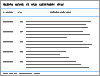
Table 1
Information of SSR primers"
| 引物 Primer | 重复单元 Repeat motifs | 引物序列 Primer sequence | 荧光类型 Fluorescence type | |
| MQ7 | (AAT)11 | F: | AACACGAGTCGAGGCTATCAAT | TARMRA |
| R: | ACGGCTAGAGTCATTGGTTCAA | |||
| MQ12 | (AT)8 | F: | AGAAAAGCGTCCATTGTCTAAT | FAM |
| R: | AGAGGGACAAGACAGAAAATG | |||
| MQ32 | (TG)10 | F: | TCCCTCTCTTTCCGTTGATGAT | FAM |
| R: | AATCCTGGACGTGAAGAATAAA | |||
| MQ37 | (TGT)10 | F: | ACGAATTCTTTCTTCCGCAAAA | HEX |
| R: | TCGCCCTCTATTTCTTGTTCTT | |||
| MQ39 | (A)12 | F: | CTTCGTGGTGGTGTCCTTTATA | TARMRA |
| R: | CGAAAGAATCCACTGCCAATTT | |||
| MQ47 | (TCA)10 | F: | TGGTTCCGTTGCTTTCTTATTC | ROX |
| R: | AGACTATGCCTACGCCATATAA | |||
| MQ49 | (T)10 | F: | ACTGCCGCCACTTATCTTTATT | FAM |
| R: | GAACCGCTGGATCATCACTTAT | |||
| MQ54 | (ACC)10 | F: | CAGTCCAAGGGTTGAAGTAAAA | HEX |
| R: | GTCGTTAAACCCGGCAAAATA | |||
| MQ59 | (T)10 | F: | AAATCGTCGAGAACCCTTTAAA | ROX |
| R: | TTCTGGGCCGAGAGAATTATTT | |||
| MQ64 | (T)14 | F: | GGATAGAGATATCGCCCGTTAT | TARMRA |
| R: | TCGTGTGGATCAAAAGAAAGAT | |||
| CC2-48 | (AGA)11 | F: | GACACTGAAATAGGCTCCTGAT | TARMRA |
| R: | ATTTTGGCAGGAGGGGAAATTA | |||
| CC2-54 | (AAT)10 | F: | TCAGTCCAAGGGTTGAAGTAAA | HEX |
| R: | GTCGTTAAACCCGGCAAAATA | |||
| CC2-61 | (A)10 | F: | TGAGGCCCCATATTGACTATCA | FAM |
| R: | TCGGGAGTCACAAATTCGTTAA | |||
| MQ16 | (T)12c(A)10 | F: | ACCCTTACGCTTTGCAGATATA | FAM |
| R: | TCAACGTCCAATTTTCGGTAGA | |||
| RPly02 | (CCA)6 | F: | TGTGAATGGTTGGTGGACAT | FAM |
| R: | CGTTGCTTGGAGGAGAATAA | |||
| RPly22 | (ACCTGA)3 | F: | ATCACATCTGTTCCTCCAC | TARMRA |
| R: | TTCTCCTCAGCCACTTCTTT | |||
| RPly109 | (AG)17 | F: | GAGGAATCACAAAACCGTTTGG | HEX |
| R: | TGGGATTTGAGAGAGTGGTGGTG | |||
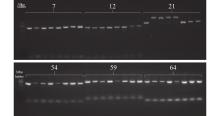
Fig.1
Partial SSR primer amplification"

Table 2
Genetic diversity of R. pseudoacacia germplasm resources"
| 位点Locus | Na | Ne | I | Ho | He | H | PIC | Fst |
| MQ49 | 6.000 | 4.261 | 1.588 | 0.016 | 0.765 | 0.767 | 0.730 | 0.041 |
| MQ54 | 5.000 | 2.576 | 1.158 | 0.356 | 0.612 | 0.613 | 0.566 | 0.035 |
| MQ7 | 7.000 | 2.832 | 1.263 | 0.133 | 0.647 | 0.648 | 0.592 | 0.028 |
| CC2-61 | 3.000 | 2.093 | 0.855 | 0.015 | 0.522 | 0.523 | 0.441 | 0.038 |
| CC2-54 | 5.000 | 2.762 | 1.209 | 0.378 | 0.638 | 0.639 | 0.591 | 0.028 |
| CC2-48 | 7.000 | 3.348 | 1.301 | 0.526 | 0.701 | 0.702 | 0.646 | 0.023 |
| MQ59 | 7.000 | 2.752 | 1.294 | 0.016 | 0.637 | 0.638 | 0.590 | 0.034 |
| MQ32 | 9.000 | 2.753 | 1.286 | 0.019 | 0.637 | 0.638 | 0.588 | 0.055 |
| MQ37 | 7.000 | 1.391 | 0.556 | 0.099 | 0.281 | 0.282 | 0.257 | 0.051 |
| MQ39 | 9.000 | 2.856 | 1.359 | 0.019 | 0.650 | 0.651 | 0.609 | 0.050 |
| MQ47 | 7.000 | 2.107 | 0.953 | 0.012 | 0.525 | 0.526 | 0.451 | 0.033 |
| MQ12 | 8.000 | 2.977 | 1.361 | 0.028 | 0.664 | 0.665 | 0.621 | 0.052 |
| MQ64 | 6.000 | 2.379 | 1.016 | 0.016 | 0.580 | 0.581 | 0.500 | 0.035 |
| MQ16 | 7.000 | 1.372 | 0.606 | 0.015 | 0.271 | 0.272 | 0.258 | 0.050 |
| RPly02 | 10.000 | 3.062 | 1.468 | 0.557 | 0.673 | 0.674 | 0.642 | 0.026 |
| RPly22 | 9.000 | 1.538 | 0.797 | 0.347 | 0.350 | 0.350 | 0.334 | 0.018 |
| RPly109 | 23.000 | 6.675 | 2.334 | 0.690 | 0.850 | 0.852 | 0.838 | 0.055 |
| 平均值Mean | 7.941 | 2.808 | 1.200 | 0.191 | 0.588 | 0.589 | 0.544 | 0.038 |
Table 3
Genetic diversity of 6 R. pseudoacacia populations"
| 群体 Population | Na | Ne | I | Ho | He | H |
| 北京 Beijing | 3.412 | 2.072 | 0.845 | 0.136 | 0.481 | 0.497 |
| 山西 Shanxi | 4.765 | 2.772 | 1.136 | 0.164 | 0.582 | 0.595 |
| 山东 Shandong | 6.412 | 2.897 | 1.175 | 0.194 | 0.588 | 0.590 |
| 美国阿巴拉契亚 Appalachia of USA | 6.353 | 2.501 | 1.113 | 0.207 | 0.523 | 0.530 |
| 辽宁 Liaoning | 4.882 | 2.865 | 1.177 | 0.208 | 0.609 | 0.621 |
| 河南 Henan | 4.118 | 2.586 | 1.058 | 0.183 | 0.578 | 0.588 |
| 平均值Mean | 4.990 | 2.616 | 1.084 | 0.182 | 0.560 | 0.570 |
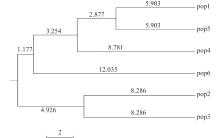
Fig.2
UPGMA dendrogram of R. pseudoacacia populations based on Nei’s genetic distance"
Table 4
Analysis of molecular variance (AMOVA) among R. pseudoacacia populations"
| 变异来源 Source variation | 方差总和 Sum of squares | 平均方差 Mean of squares | 变异分量 Estimated variance component | 变异百分比 Percentage of variation (%) |
| 群体间Among populations | 71.360 | 14.272 | 0.077 | 2 |
| 个体间Among individuals | 2 560.360 | 8.077 | 3.233 | 66 |
| 个体内Within individuals | 520.500 | 1.611 | 1.611 | 32 |
| 总和Total | 3 152.220 | 4.921 | 100 |
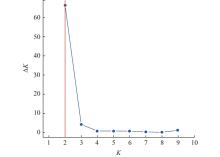
Fig.3
K-ΔK map of R. pseudoacacia germplasm population based on genetic distance"
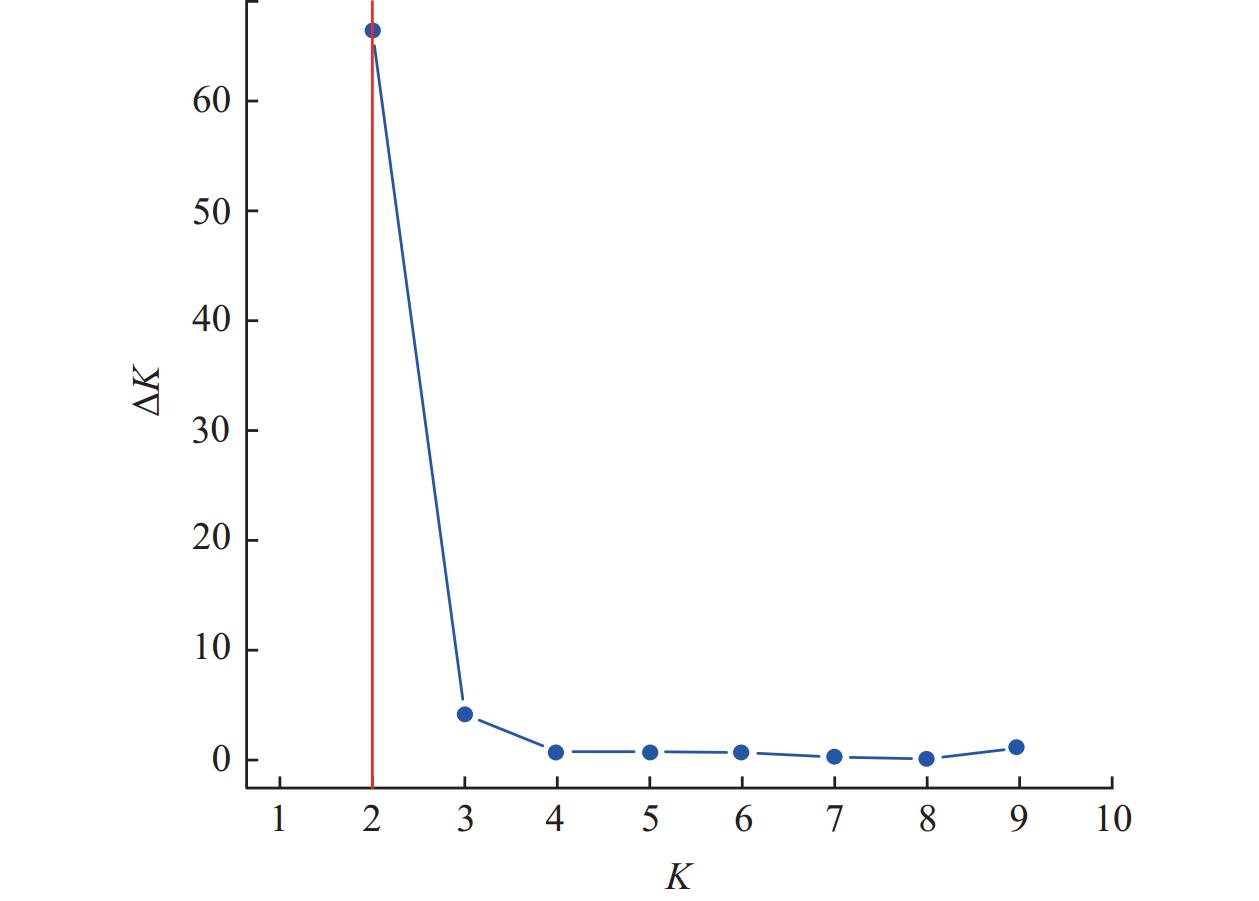

Fig.4
Genetic origin of R. pseudoacacia based on 6 geographical sources"
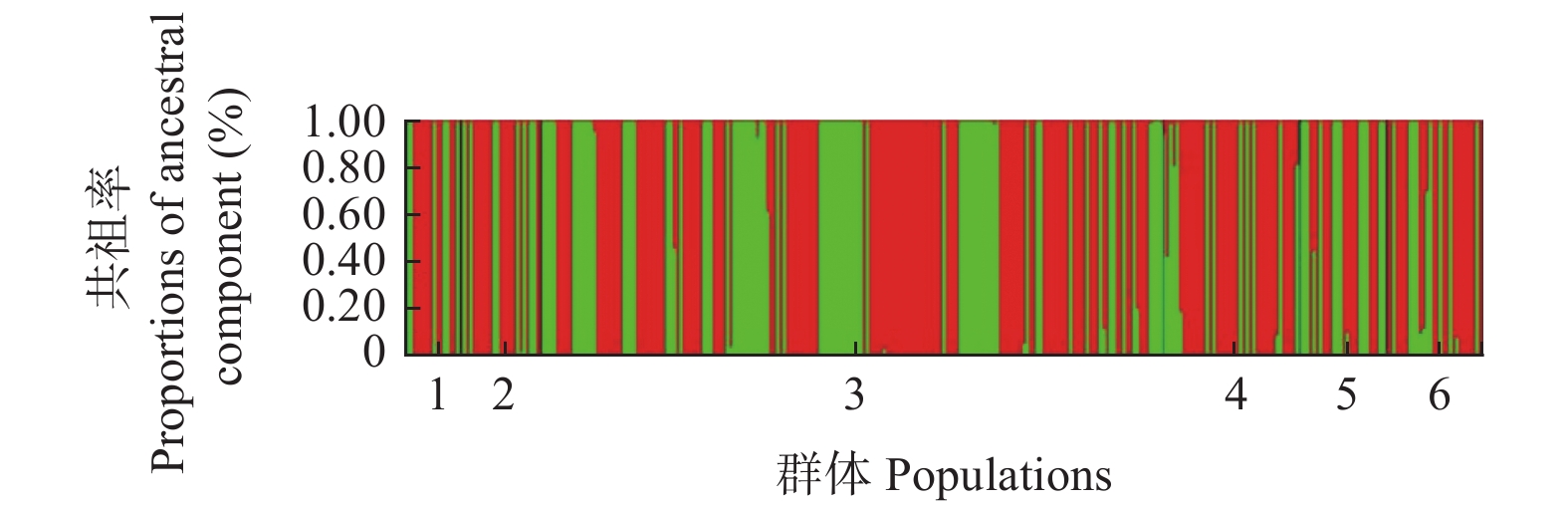

Fig.5
Dengrograms of 323 R. pseudoacacia germplasm based on Nei’s genetic distance"
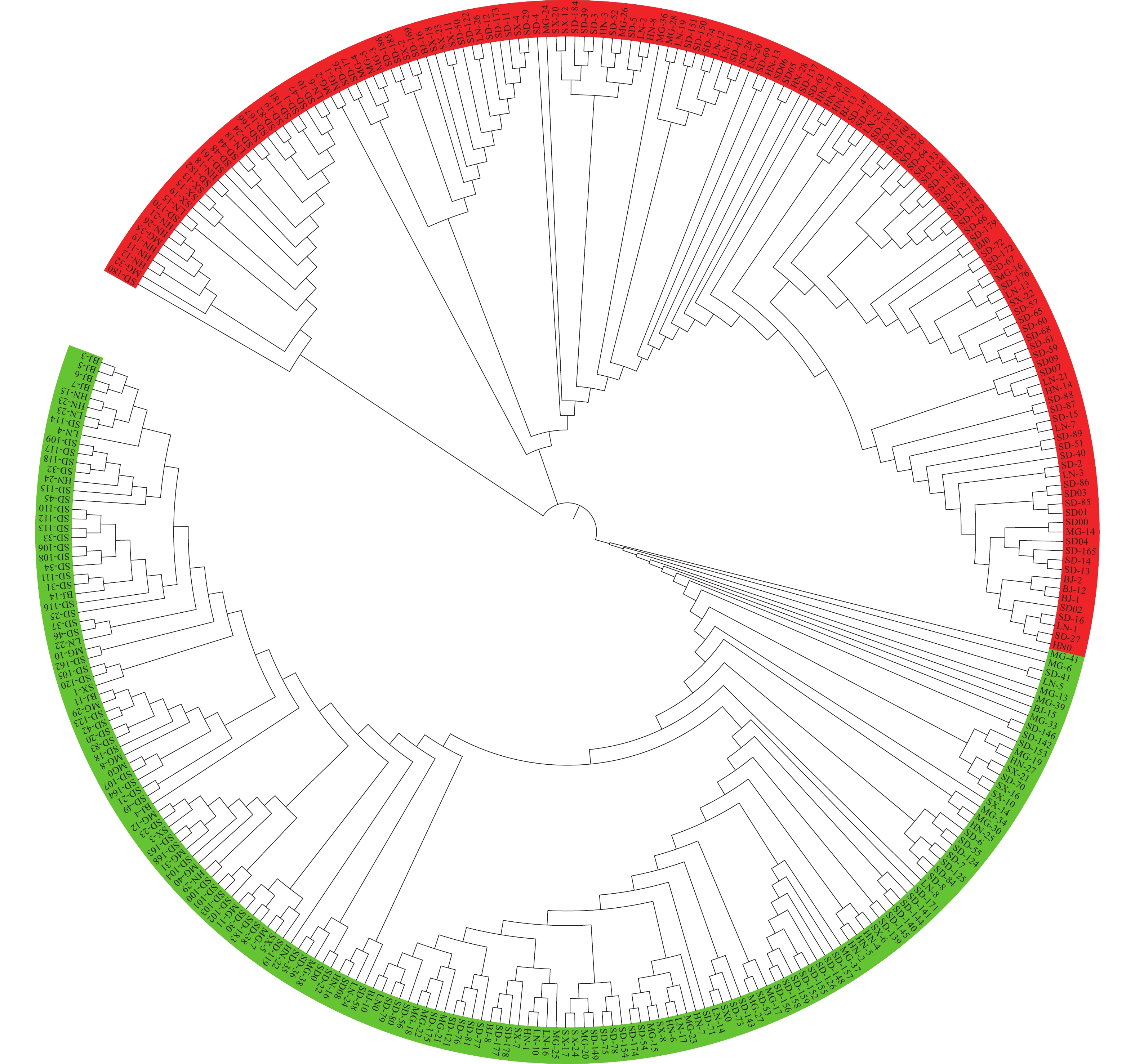
Table 5
Comparison of genetic diversity of R. pseudoacacia population under different sampling ratios"
| 取样比例 Sampling ratio (%) | Na | Ne | I | Ho | He | H | 等位基因总数 Total allele |
| 100 | 7.941 | 2.808 | 1.200 | 0.191 | 0.588 | 0.589 | 135 |
| 60 | 7.824 | 3.491 | 1.363 | 0.214 | 0.658 | 0.660 | 133 |
| 55 | 7.824 | 3.613 | 1.390 | 0.221 | 0.670 | 0.672 | 133 |
| 50 | 7.765 | 3.668 | 1.405 | 0.222 | 0.676 | 0.679 | 132 |
| 45 | 7.647 | 3.720 | 1.415 | 0.225 | 0.679 | 0.682 | 130 |
| 40 | 7.412 | 3.807 | 1.433 | 0.227 | 0.689 | 0.691 | 126 |
| 35 | 7.412 | 3.918 | 1.464 | 0.226 | 0.701 | 0.704 | 126 |
| 30 | 7.588 | 3.829 | 1.461 | 0.234 | 0.694 | 0.698 | 129 |
| 25 | 7.412 | 3.938 | 1.473 | 0.238 | 0.698 | 0.702 | 126 |
| 20 | 7.235 | 4.060 | 1.501 | 0.254 | 0.708 | 0.714 | 123 |
| 15 | 7.059 | 3.944 | 1.486 | 0.260 | 0.703 | 0.710 | 120 |
| 10 | 6.529 | 3.542 | 1.408 | 0.281 | 0.669 | 0.680 | 111 |
| 5 | 5.941 | 3.467 | 1.392 | 0.213 | 0.667 | 0.689 | 101 |
Table 6
Geographical origin of R. pseudoacacia germplasm under different sampling ratio"
| 取样比例 Sampling ratio (%) | 北京 Beijing | 山西 Shanxi | 山东 Shandong | 美国阿巴拉契亚 Appalachia of USA | 辽宁 Liaoning | 河南 Henan | 种质总数 Germplasm total |
| 100 | 16 | 24 | 187 | 41 | 26 | 29 | 323 |
| 60 | 9 | 11 | 98 | 29 | 17 | 23 | 187 |
| 55 | 9 | 10 | 87 | 26 | 16 | 21 | 169 |
| 50 | 9 | 10 | 79 | 24 | 15 | 21 | 158 |
| 45 | 8 | 10 | 71 | 22 | 15 | 19 | 145 |
| 40 | 7 | 10 | 64 | 18 | 13 | 17 | 129 |
| 35 | 7 | 9 | 49 | 18 | 13 | 14 | 110 |
| 30 | 7 | 10 | 37 | 18 | 13 | 14 | 99 |
| 25 | 6 | 7 | 33 | 16 | 10 | 12 | 84 |
| 20 | 5 | 5 | 23 | 15 | 7 | 8 | 63 |
| 15 | 5 | 5 | 15 | 13 | 6 | 7 | 51 |
| 10 | 3 | 2 | 8 | 8 | 5 | 5 | 31 |
| 5 | 3 | 0 | 3 | 6 | 2 | 2 | 16 |
Table 7
The t test of genetic diversity parameters in the core germplasm collection of R. pseudoacacia"
| 群体 Population | 种质总数 Germplasm total | N | Na | Ne | I | Ho | He | H |
| 原始种质 Original germplasms | 323 | 135.000 | 7.941 | 2.808 | 1.200 | 0.191 | 0.588 | 0.589 |
| 初始核心种质库 Initial core germplasm collection | 63 | 123.000 | 7.235 | 4.060 | 1.501 | 0.254 | 0.708 | 0.714 |
| t=1.047 | P=0.330 | |||||||
| 原始种质 Original germplasms | 323 | 135.000 | 7.941 | 2.808 | 1.200 | 0.191 | 0.588 | 0.589 |
| 优化核心种质库 Optimize core germplasm collection | 75 | 135.000 | 7.941 | 3.996 | 1.495 | 0.242 | 0.701 | 0.705 |
| t=0.992 | P=0.354 | |||||||
| 初始核心种质库 Initial core germplasm collection | 63 | 123.000 | 7.235 | 4.060 | 1.501 | 0.254 | 0.708 | 0.714 |
| 优化核心种质库 Optimize core germplasm collection | 75 | 135.000 | 7.941 | 3.996 | 1.495 | 0.242 | 0.701 | 0.705 |
| t=?1.578 | P=0.159 | |||||||

Fig.6
PCoA analysis of retained germplasm, core germplasm and supplementary germplasm"
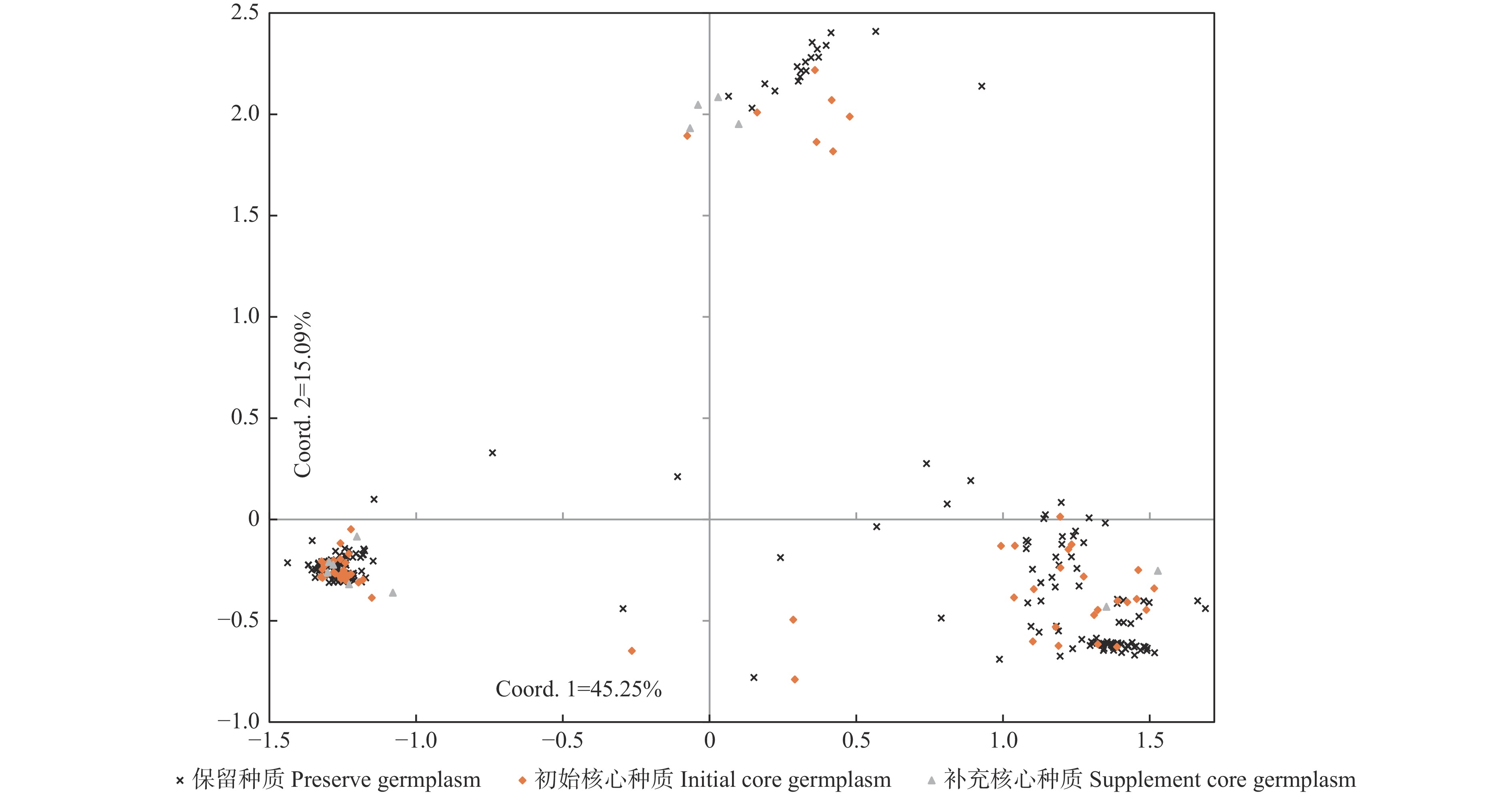
Table 8
Geographic origin of the original and optimized core germplasm collections"
| 群体 Population | 北京 Beijing | 山西 Shanxi | 山东 Shandong | 美国阿巴拉契亚 Appalachia of USA | 辽宁 Liaoning | 河南 Henan | 种质总数 Germplasm total |
| 原始种质 Original germplasms | 16 | 24 | 187 | 41 | 26 | 29 | 323 |
| 初始核心种质库 Initial core germplasm collection | 5 | 5 | 23 | 15 | 7 | 8 | 63 |
| 优化核心种质库 Optimize core germplasm collection | 6 | 8 | 29 | 17 | 7 | 8 | 75 |
|
陈 存, 丁昌俊, 张 静, 等. 美洲黑杨群体结构分析及核心种质库构建. 林业科学, 2020, 56 (9): 67- 76.
doi: 10.11707/j.1001-7488.20200908 |
|
|
Chen C, Ding J C, Zhang J, et al. Population structure analysis and core collection construction of Populus deltoids. Scientia Silvae Sinicae, 2020, 56 (9): 67- 76.
doi: 10.11707/j.1001-7488.20200908 |
|
| 崔文娟, 罗俊杰, 陈 军, 等. 甘肃紫苏资源遗传多样性分析及核心种质构建. 中国油料作物学报, 2025, 47 (2): 380- 392. | |
| Cui W J, Luo J J, Chen J, et al. Genetic diversity analysis and core collections construction of perilla landraces in Gansu. Chinese Journal of Oil Crop Sciences, 2025, 47 (2): 380- 392. | |
| 代 涵. 2024. 油茶主要农艺性状与SSR分子标记的关联比较分析. 贵阳: 贵州师范大学. | |
| Dai H. 2024. Comparative analysis of the association between major agronomic traits and SSR molecular markers in Camellia oleifera. Guiyang: Guizhou Normal University. [in Chinese] | |
| 冯夏莲, 荷承忠, 张志毅, 等. 植物遗传多样性研究方法概述. 西南林学院学报(自然科学版), 2006, 26 (1): 69- 79. | |
| Feng X L, He C Z, Zhang Z Y, et al. Summarization on research methods of plant genetic diversity. Journal of Southwest Forestry University (Natural Sciences), 2006, 26 (1): 69- 79. | |
| 顾保阳. 2022. 山东省费县大青山刺槐种质资源分析及评价. 泰安: 山东农业大学. | |
| Gu B Y. 2022. Analysis and evaluation of Robinia pseudoacacia germplasm resources in Daqing Mountain of Fei County, Shandong. Tai’an: Shandong Agricultural University. [in Chinese] | |
| 顾万春. 中国林木遗传(种质)资源保存与研究现状. 世界林业研究, 1999, 12 (2): 50- 57. | |
| Gu W C. The present situation of forest tree genetic germplasm resource conservation and research of in China. World Forestry Research, 1999, 12 (2): 50- 57. | |
| 管崇帆, 郑京生, 李雅婧, 等. 气候和密度对刺槐径向生长和干旱脆弱性的影响. 生态学报, 2023, 43 (8): 3261- 3272. | |
| Guan C F, Zheng J S, Li Y J, et al. Effects of climate and density on the radial growth and drought vulnerability of Robinia pseudoacacia. Acta Ecologica Sinica, 2023, 43 (8): 3261- 3272. | |
| 郭 慧. 2022. 刺槐半同胞家系多性状综合评价及优树遗传多样性分析. 泰安: 山东农业大学. | |
| Guo H. 2022. Comprehensive evaluation of multiple traits in Robinia pseudoacacia L. half sibling families and analysis of genetic diversity of elite trees. Tai’an: Shandong Agricultural University. [in Chinese] | |
|
郭 琪, 孙宇涵, 张元帅, 等. 山东大青山刺槐无性系叶性状的表型变异分析与饲用优良无性系选择. 北京林业大学学报, 2021, 43 (11): 62- 70.
doi: 10.12171/j.1000-1522.20200305 |
|
|
Guo Q, Sun Y H, Zhang Y S, et al. Phenotypic variation analysis on leaf traits and selection of optimal forage clones of Robinia pseudoacacia clones in Shandong Province of eastern China. Journal of Beijing Forestry University, 2021, 43 (11): 62- 70.
doi: 10.12171/j.1000-1522.20200305 |
|
| 胡守荣, 夏 铭, 郭长英, 等. 2001. 林木遗传多样性研究方法概况. 东北林业大学学报, 29(3): 72−75. | |
| Hu S R, Xia M, Guo C Y, et al. 2001. Methods of genetic diversity for forest tree. Journal of Northeast Forestry University, 29(3): 72−75. [in Chinese] | |
| 黄伟业, 李润泽, 唐 芳, 等. 基于表型性状的花苜蓿核心种质构建. 草地学报, 2025, 33 (3): 1- 23. | |
| Huang W Y, Li R Z, Tang F, et al. Construction of Medicago ruthenica L. core germplasm based on phenotypic traits. Acta Agrestia Sinica, 2025, 33 (3): 1- 23. | |
| 李魁鹏, 陈仕昌, 程 琳, 等. 基于SSR标记构建广西杉木核心种质. 广西科学, 2021, 28 (5): 511- 519. | |
| Li K P, Chen S C, Cheng L, et al. Construction of core germplasm of Cunninghamia lanceolate in Guangxi based on SSR markers. Guangxi Sciences, 2021, 28 (5): 511- 519. | |
| 刘 松, 聂兴华, 李伊然, 等. 基于SSR荧光标记构建板栗品种(系)核心种质群. 果树学报, 2023, 40 (2): 230- 241. | |
| Liu S. Nie X H, Li Y R, et al. Construction of core collection of Chinese chestnut cultivars (lines) based on SSR fluorescence markers. Journal of Fruit Science, 2023, 40 (2): 230- 241. | |
| 毛秀红. 2017. 刺槐不同来源无性系种质的表型变异与遗传多样性分析. 北京: 中国林业科学研究院. | |
| Mao X H. 2017. Analysis of phenotypic variation and genetic diversity for Robinia pseudoacacia clonal germplasms from different Sources. Beijing: Chinese Academy of Forestry. [in Chinese] | |
|
毛秀红, 朱士利, 李善文, 等. 基于荧光SSR标记的毛白杨核心种质构建. 北京林业大学学报, 2020, 42 (7): 40- 47.
doi: 10.12171/j.1000-1522.20190413 |
|
|
Mao X H, Zhu S L, Li S W, et al. Core germplasm construction of Populus tomentosa based on the fluorescent SSR markers. Journal of Beijing Forestry University, 2020, 42 (7): 40- 47.
doi: 10.12171/j.1000-1522.20190413 |
|
|
毛秀红, 闫少波, 葛 磊, 等. 毛白杨微核心种质构建方法的探讨. 北京林业大学学报, 2023, 45 (2): 58- 67.
doi: 10.12171/j.1000-1522.20210150 |
|
|
Mao X H, Yan S B, Ge L, et al. Study on construction method of microcore germplasm of Populus tomentosa. Journal of Beijing Forestry University, 2023, 45 (2): 58- 67.
doi: 10.12171/j.1000-1522.20210150 |
|
| 莫长明, 谢文娟, 郭文锋, 等. 罗汉果遗传多样性与群体结构及核心种质研究. 中草药, 2023, 54 (18): 6040- 6054. | |
| Mo C M, Xie W J, Guo W F, et al. Study on genetic diversity and population structure and core collection of Siraitia grosvenorii. Chinese Traditional and Herbal Drugs, 2023, 54 (18): 6040- 6054. | |
| 秦子璐, 徐正康, 戴晓港, 等. 2024. 望春玉兰种质资源遗传多样性分析与核心种质构建. 园艺学报, 51(8): 1823−1832. | |
| Qing Z L, Xu Z K, Dai X G, et al. Genetic diversity dnalysis and core collection construction of Magnolia biondii germplasm. Acta Horticulturae Sinica, 51(8): 1823−1832. [in Chinese] | |
|
沈 浩, 刘登义. 遗传多样性概述. 生物学杂志, 2001, 18 (3): 5- 9.
doi: 10.3969/j.issn.2095-1736.2001.03.002 |
|
|
Shen H, Liu D Y. Summary of genetic diversity. Journal of Biology, 2001, 18 (3): 5- 9.
doi: 10.3969/j.issn.2095-1736.2001.03.002 |
|
|
孙海龙, 鲁晓峰, 刘 硕, 等. ‘矮甜李’在辽宁兴城引种表现及栽培技术. 北方园艺, 2024, 47 (24): 155- 158.
doi: 10.11937/bfyy.20242708 |
|
|
Sun H L, Lu X F, Liu S, et al. Performance and cultivation techniques of ‘Aitian Plum’ in Xingcheng of Liaoning Province. Northern Horticulture, 2024, 47 (24): 155- 158.
doi: 10.11937/bfyy.20242708 |
|
| 汪 萍. 2017. 刺槐优良品种选择及优株分子标记. 合肥: 安徽农业大学. | |
| Wang P. 2017. Selection on fine variety Robinia pseudoacacia L and its molecular markers. Hefei: Anhui Agricultural University. [in Chinese] | |
| 王中仁. 植物遗传多样性和系统学研究中的等位酶分析. 生物多样性, 1994, 2 (1): 3843. | |
| Wang Z R. Allozyme analysis in studies of plant genetic diversity and systematice. Biodiversity Science, 1994, 2 (1): 3843. | |
| 文亚峰, 韩文军, 吴 顺. 2010. 植物遗传多样性及其影响因素. 中南林业科技大学学报, 30(12): 80−87. | |
| Wen Y F, Han W J, Wu S. 2010. Plant genetic diversity and its influencing factors. Journal of Central South University of Forestry & Technology, 30(12): 80−87. [in Chinese] | |
| 吴桂容. 2004. 细胞分类学研究进展. 贺州学院学报. 20(2): 75−79. | |
| Wu G R. 2004. Advances in cytotaxonomy. Journal of Hezhou University, 20(2): 75−79. [in Chinese] | |
| 吴 涛, 陈少瑜, 肖良俊, 等. 基于 SSR 标记的云南省核桃种质资源遗传多样性及核心种质构建. 植物遗传资源学报, 2020, 21 (3): 767- 774. | |
| Wu T, Chen S Y, Xiao L J, et al. Genetic diversity analysis and core collection construction of walnut germplasm in Yunnan Province. Journal of Plant Genetic Resources, 2020, 21 (3): 767- 774. | |
|
荀守华, 乔玉玲, 张江涛, 等. 我国刺槐遗传育种现状及发展对策. 山东林业科技, 2009, 39 (1): 92- 96.
doi: 10.3969/j.issn.1002-2724.2009.01.038 |
|
|
Xun S H, Qiao Y L, Zhang J T, et al. Research progress and development tactics on genetics breeding of Robinia pseudoacacia L. in China. Journal of Shandong Forestry Science and Technology, 2009, 39 (1): 92- 96.
doi: 10.3969/j.issn.1002-2724.2009.01.038 |
|
| 闫平玉, 张 磊, 王佳兴, 等. 红松天然种群遗传多样性分析及核心种质构建. 南京林业大学学报(自然科学版), 2024, 48 (5): 1- 17. | |
| Yan Y P, Zhang L, Wang J X, et al. Analysis of genetic diversity and construction of core collections of Korean pine natural population. Journal of Nanjing Forestry University (Natural Sciences Edition), 2024, 48 (5): 1- 17. | |
|
杨海平, 李继生, 于国强, 等. 分子标记技术在林木育种中的应用. 山东林业科技, 2017, 47 (3): 111- 114.
doi: 10.3969/j.issn.1002-2724.2017.03.030 |
|
|
Yang H P, Li J S, Yu G Q, et al. Application of molecular marker technology in tree breeding. Journal of Shandong Forestry Science and Technology, 2017, 47 (3): 111- 114.
doi: 10.3969/j.issn.1002-2724.2017.03.030 |
|
| 杨欣超, 张凯权, 王 静, 等. 基于SSR分子标记的刺槐遗传多样性分析及核心种质的构建. 分子植物育种, 2020, 18 (9): 3086- 3097. | |
| Yang X C, Zhang K Q, Wang J, et al. Analysis of genetic diversity and construction of core collections of black locust based on SSR markers. Molecular Plant Breeding, 2020, 18 (9): 3086- 3097. | |
|
张俊红, 王 洋, 周生财, 等. 闽楠群体遗传结构分析与核心种质库构建. 林业科学, 2024, 60 (1): 68- 79.
doi: 10.11707/j.1001-7488.LYKX20230138 |
|
|
Zhang J H, Wang Y, Zhou S C, et al. Genetic structure analysis and core germplasm collection construction of Phoebe bournei Populations. Scientia Silvae Sinicae, 2024, 60 (1): 68- 79.
doi: 10.11707/j.1001-7488.LYKX20230138 |
|
| 张咏琦, 王 超, 许林林, 等. 野生二倍体草莓的SSR分子标记开发及核心种质的构建. 园艺学报, 2023, 50 (11): 2365- 2375. | |
| Zhang Y Q, Wang C, Xu L L, et al. Development of SSR molecular markers and construction of core collection of wild diploid strawberry. Acta Horticulturae Sinica, 2023, 50 (11): 2365- 2375. | |
| 郑鹏飞. 2022. 北京山区典型森林生态系统碳氮循环及其与水文过程的耦合关系. 北京: 北京林业大学. | |
| Zheng P F. 2022. Coupling of carbon-nitrogen cycles and hydrological process of typical forest ecosystems in Beijing mountainous area. Beijing: Beijing Forestry University. [in Chinese] | |
| 邹春静, 盛晓峰, 韩文卿, 等. 2003. 同工酶分析技术及其在植物研究中的应用. 生态学杂志, 22(6): 63−69. | |
| Zou C J, Sheng X F, Han W Q, et al. Isozyme analysis technology and its application in plant research. Chinese Journal of Ecology, 22(6): 63−69. [in Chinese] | |
|
Balakrishnan R, Nair N V, Sreenivasan T V. A method for establishing a core collection of Saccharum officinarum L. germplasm based on quantitative-morphological data. Genetic Resource and Crop Evolution, 2000, 47 (1): 1- 9.
doi: 10.1023/A:1008780526154 |
|
|
Castelán P M, Cortés-Cruz M, Mendoza-Castillo M D C, et al. Diversity and genetic structure inferred with microsatellites in natural populations of Pseudotsuga menziesii (Mirb.) Franco (Pinaceae) in the central region of Mexico. Forests, 2019, 10 (2): 101.
doi: 10.3390/f10020101 |
|
|
Charmet G, Balfourier F, Ravel C, et al. Genotype Ⅹ environment interactions in a core collection of French perennial ryegrass populations. Theoretical and Applied Genetics, 1993, 86 (6): 731- 736.
doi: 10.1007/BF00222663 |
|
| Doyle J J, Doyle J L. A rapid DNA isolation procedure for small quantities of fresh leaf tissue. Phytochemical Bulletin, 1987, 3 (19): 11- 15. | |
|
Ferguson M E, Hearne S J, Close T J, et al. Identification, validation and high-throughput genotyping of transcribed gene SNPs in cassava. Theoretical and Applied Genetics, 2012, 124 (4): 685- 695.
doi: 10.1007/s00122-011-1739-9 |
|
| Frankel O H, Brown A H D. l984. Current plant genetic resources a critical appraisal. New Delhi: Oxford & IBH Publishing Co. | |
|
Gepts P. Plant genetic resources conservation and utilization: the accomplishments and future of a societal insurance policy. Crop Science, 2006, 46 (5): 2278- 2292.
doi: 10.2135/cropsci2006.03.0169gas |
|
| Distefano G, La Malfa S, Gentile A, et al. EST-SNP genotyping of Citrus species using high-resolution melting curve analysis. Tree Genetics & Genomes, 2013, 9 (5): 1271- 1281. | |
|
Hamrick J L, Blanton H M, Hamrick K J. Genetic structure of geographically marginal populations of ponderosa pine. American Journal of Botany, 1989, 76 (11): 1559- 1568.
doi: 10.1002/j.1537-2197.1989.tb15141.x |
|
| Hamrick J L, Godt M J W, Sherman-Broyles S L. Factors influencing levels of genetic diversity in woody plant species. New Forests, 1992, 6 (1): 95- 124. | |
|
Jin Y Q, Ma Y P, Wang S, et al. Genetic evaluation of the breeding population of a valuable reforestation conifer Platycladus orientalis (Cupressaceae). Scientific Reports, 2016, 6, 34821.
doi: 10.1038/srep34821 |
|
|
Li Z C, Zhang H L, Zeng Y W, et al. Studies on sampling schemes for the establishment of core collection of rice landraces in Yunnan, China. Genetic Resources and Crop Evolution, 2002, 49 (1): 67- 74.
doi: 10.1023/A:1013855216410 |
|
|
Rubio-Moraga A, Candel-Perez D, Lucas-Borja M E, et al. Genetic diversity of Pinus nigra Arn. populations in southern Spain and northern Morocco revealed by inter-simple sequence repeat profiles. International Journal of Molecular Sciences, 2012, 13 (5): 5645- 5658.
doi: 10.3390/ijms13055645 |
|
| Schaal B A, O’Kane S L Jr, Rogstad S H. DNA variation in plant populations. Trends in Ecology & Evolution, 1991, 6 (10): 329- 333. | |
| Van Hintum T J L. 1999. The general methodology for creating a core collection//Johnson R C, Hodgkin T. eds. Core collections for today and tomorrow. Italy: IPGRI, 10−17. | |
|
Wang Z F, Zhang X, Lei W X, et al. Chromosome-level genome assembly and population genomics of Robinia pseudoacacia reveal the genetic basis for its wide cultivation. Communications Biology, 2023, 6 (1): 797.
doi: 10.1038/s42003-023-05158-6 |
|
|
Wilson E O. The biological diversity crisis. BioScience, 1985, 35 (11): 700- 706.
doi: 10.2307/1310051 |
| [1] | Pingping Li,Yanhui Wang,Pengtao Yu,Yirui Wang,Wenbiao Duan,Yanfang Wan,Xiaocha Wei,Zaijun Shi. Growth Response of Black Locust Plantations to Site Quality and Stand Density on the Loess Plateau of China [J]. Scientia Silvae Sinicae, 2025, 61(7): 192-207. |
| [2] | Wanting Gao,Xiaochuang Hu,Shoujia Sun,Jinsong Zhang,Ping Meng,Jinfeng Cai. Prediction of the Distribution of Robinia pseudoacacia in China under Future Climate Change Using an Optimized MaxEnt Model [J]. Scientia Silvae Sinicae, 2025, 61(4): 104-116. |
| [3] | Xiaoqing Yin,Lan Ma,Fengjiao Niu. Soil Water Transport Characteristics of Robinia pseudoacacia Plantations in the Loess Plateau of Western Shanxi Province under Simulated Drought Conditions [J]. Scientia Silvae Sinicae, 2025, 61(10): 49-59. |
| [4] | Junhong Zhang,Yang Wang,Shengcai Zhou,Xiaolin Wu,Renchao Wu,Qi Yang,Yuting Zhang,Zaikang Tong. Genetic Structure Analysis and Core Germplasm Collection Construction of Phoebe bournei Populations [J]. Scientia Silvae Sinicae, 2024, 60(1): 68-79. |
| [5] | Tianrun Cai,Jia Guo,Ziyi Wang,Yaxin Song,Shumin Zhang,Minsheng Yang,Jun Zhang. Spatial Pattern Analysis of Clonal Growth of Robinia pseudoacacia in Mountainous Areas Based on SSR Molecular Markers [J]. Scientia Silvae Sinicae, 2023, 59(6): 19-27. |
| [6] | Juan Han,Yapeng Li,Yanting Tian,Qi Guo,Yun Li,Yuhan Sun,Yongping Deng,Dongsheng Niu,Lizhuo Su,Xiuyu Li,Zuodeng Peng. Optimization of Efficient Regeneration System of Robinia pseudoacacia Leavesin vitro [J]. Scientia Silvae Sinicae, 2023, 59(4): 68-78. |
| [7] | Xiaolei Ding,Qingtong Wang,Sixi Lin,Ruiwen Zhao,Yue Zhang,Jianren Ye. Analysis of Genetic Variations of Bursaphelenchus xylophilus Populations between Guangdong and Jiangsu Provinces with SNP Marker [J]. Scientia Silvae Sinicae, 2022, 58(8): 1-9. |
| [8] | Fei Yang,Yiyan Lin,Lixin Chen,Lu Han,Yingming Wu,Yajie Yu. Soil Water Use and Niche Characteristics of Dominant Tree Species in Arbor Layer and Shrub Layer in Two Plantations of Pinus tabulaeformis and Robinia pseudoacacia in Loess Region of Western Shanxi Province [J]. Scientia Silvae Sinicae, 2022, 58(6): 1-12. |
| [9] | Xinyu Li,Minqiu Wang,Meiling Yuan,Ueno Saneyoshi,Xingtong Wu,Mengying Cai,Tsumura Yoshihiko,Yafeng Wen. Genetic Differentiation and Demographic History of Cryptomeria, A Relict Plant, in East Asia [J]. Scientia Silvae Sinicae, 2022, 58(6): 66-78. |
| [10] | Wenting Pan,Jianjun Sun,Qinqin Yuan,Lili Zhang,Kangqiao Deng,Yueqiao Li. Analysis of Genetic Diversity and Structure in Different Provenances of Liriodendron by RAD-seq Technique [J]. Scientia Silvae Sinicae, 2022, 58(4): 74-81. |
| [11] | Qingzhi Lin,Xiangyuan Zhu,Peili Mao,Lin Zhu,Longmei Guo,Zexiu Li,Banghua Cao,Yingdong Hao,Haitao Tan,Pizheng Hong,Xiaojun Lu. Effects of NaCl and PEG Stresses on Germination and Seedling Growth of Robinia pseudoacacia Seeds with Different Sizes [J]. Scientia Silvae Sinicae, 2022, 58(2): 100-112. |
| [12] | Lin Qi,Longmei Guo,Youde Liu,Banghua Cao,Peili Mao,Zexiu Li. Dynamic Responses of Non-Structural Carbohydrates in Robinia pseudoacacia Seedlings to NaCl Stress [J]. Scientia Silvae Sinicae, 2022, 58(1): 32-42. |
| [13] | Chaoqun Du,Xiaomei Sun,Yunhui Xie,Yimei Hou. Genetic Diversity of Larix kaempferi Populations with Different Levels of Improvement in Northern Subtropical Region [J]. Scientia Silvae Sinicae, 2021, 57(5): 68-76. |
| [14] | Huanhuan Chen,Gexi Xu,Fanqiang Ma,Shun Liu,Miaomiao Zhang,Xiangwen Cao,Jian Chen,Guangdong Zhao,Hongguo Yang,Zuomin Shi. Phylogenetic Structure of Undergrowth Layers across Subalpine Dark Coniferous Forests and Their Post-Harvesting Secondary Forests in Western Sichuan [J]. Scientia Silvae Sinicae, 2020, 56(7): 1-11. |
| [15] | Yihong Meng,Gangbiao Xu,Mengzhu Lu,Xiaolong Jiang,Feilong Guo. Population Genetic Structure and Demographic History of Disanthus cercidifolius var. longipes [J]. Scientia Silvae Sinicae, 2020, 56(7): 55-62. |
| Viewed | ||||||
|
Full text |
|
|||||
|
Abstract |
|
|||||
