
林业科学 ›› 2026, Vol. 62 ›› Issue (4): 130-141.doi: 10.11707/j.1001-7488.LYKX20250614
周星鲁1,2,张磊1,2,李清河1,*( ),胡建军1,2,*()
收稿日期:2025-10-13
出版日期:2026-04-15
发布日期:2026-04-11
通讯作者:
李清河,胡建军
E-mail:tsinghel@caf.ac.cn;hujj@caf.ac.cn
基金资助:
Xinglu Zhou1,2,Lei Zhang1,2,Qinghe Li1,*(),Jianjun Hu1,2,*()
Received:2025-10-13
Online:2026-04-15
Published:2026-04-11
Contact:
Qinghe Li,Jianjun Hu
E-mail:tsinghel@caf.ac.cn;hujj@caf.ac.cn
摘要:
目的: 揭示美洲黑杨生长及材性性状变异规律,选育优质高产优良无性系,为美洲黑杨遗传改良及其高效利用提供科学依据。方法: 以北京大兴林场10年生美洲黑杨4个全同胞家系和品种对比试验林为材料,基于树高、胸径等生长性状开展优良无性系选育。筛选27个优良无性系和新品种,测定不同年轮下材性数据,包括年轮宽度、基本密度、微纤丝角、纤维长度和纤维宽度等。采用主成分分析法进行综合评价,筛选综合性能优异的无性系。在此基础上,基于年轮材性数据解析美洲黑杨材性径向变异;结合相关性分析、逐步回归分析和通径分析等多元统计方法,揭示美洲黑杨生长及材性性状变异规律。结果: 对242个杂交子代生长性状的统计分析表明,不同全同胞家系间生长性状差异不显著,但各家系优良子代间差异显著,其中,丹红杨×北杨家系表现出最高的遗传增益,树高和胸径增益分别达15.27%和43.61%。基于生长和材性数据聚类分析将27个无性系划分为3个类群,不同类群在纤维长度、纤维长宽比、基本密度和生长表现上差异显著。主成分分析结果表明,前3个主成分能够解释材性性状大部分表型变异,综合评价筛选出中怀1号、中成4号、中成2号、中菏1号和K25共5个材性优异的无性系。从年轮数据看,不同无性系间的遗传变异更丰富,其中年轮宽度、微纤丝角和胸径变异系数较高,基本密度和纤维宽度变异系数较小。径向变异分析发现,第4~5年为美洲黑杨的快速生长期,进入成熟期后其材性趋于稳定,纤维长度、纤维宽度、纤维长宽比和基本密度整体呈增加趋势。相关性分析表明,第9年时生长性状与材性性状间相关性较低,而基于年轮数据的相关性模式较为复杂,微纤丝角呈现出显著性别差异。逐步回归分析和通径分析结果显示,基本密度和微纤丝角对生长的解释作用最强,其他性状的影响较小。结论: 美洲黑杨杂交子代性状变异丰富,其中,中怀1号、中成4号、中成2号、中菏1号和K25共5个无性系材性表现较好。微纤丝角表现出显著的性别效应,雌株显著高于雄株。材性性状在不同生长阶段呈动态变化,第4~5年为美洲黑杨的快速生长期。大多数材性性状呈现出从髓心到韧皮部逐渐增加,在成熟期趋于稳定;微纤丝角和纤维宽度在不同年轮间相关性较高,受树龄的影响较小,具有较高的早期预测潜力。本研究初步揭示出美洲黑杨杂交子代材性径向遗传变异规律,为优良无性系的选育和高效遗传改良提供了重要的理论依据和实践参考。
中图分类号:
周星鲁,张磊,李清河,胡建军. 美洲黑杨杂交子代生长及材性性状遗传变异分析[J]. 林业科学, 2026, 62(4): 130-141.
Xinglu Zhou,Lei Zhang,Qinghe Li,Jianjun Hu. Genetic Variation in Growth and Wood Property Traits from Hybrid Progenies of Populus deltoides[J]. Scientia Silvae Sinicae, 2026, 62(4): 130-141.
表1
美洲黑杨无性系遗传背景信息与生长统计①"
| 无性系编号 Clone number | 性别 Sex | 遗传背景Genetic background | H/m | DBH/cm | |
| 母本Female parent | 父本Male parent | ||||
| 546 | ♂ | 50号杨P. deltoides ‘55/65’ | 帝国杨P. deltoides ‘Imperial’ | 15.67 | 24.65 |
| 540 | ♂ | 50号杨P. deltoides ‘55/65’ | 帝国杨P. deltoides ‘Imperial’ | 13.96 | 21.23 |
| 2025 | ♂ | I-69杨P. deltoides ‘Lux’ | 美洲黑杨P. deltoides | 14.83 | 23.86 |
| 1-116 | ♀ | 丹红杨P. deltoides ‘Danhong’ | 南杨P. deltoides ‘Nanyang’ | 14.50 | 21.85 |
| 17-2 | ♂ | 南抗杨 P. deltoides ‘Nankang’ | 帝国杨P. deltoides ‘Imperial’ | 14.26 | 23.91 |
| 3-54 | ♂ | 丹红杨P. deltoides ‘Danhong’ | 创新杨P. deltoides ‘Chuangxin’ | 15.85 | 24.26 |
| 3-59 | ♀ | 丹红杨P. deltoides ‘Danhong’ | 创新杨P. deltoides ‘Chuangxin’ | 15.32 | 23.28 |
| I37 | ♂ | 丹红杨P. deltoides ‘Danhong’ | 中成2号P. deltoides ‘Zhongcheng 2’ | 15.67 | 26.88 |
| J14 | ♂ | 丹红杨P. deltoides ‘Danhong’ | 中成2号P. deltoides ‘Zhongcheng 2’ | 14.48 | 26.72 |
| J16 | ♂ | 丹红杨P. deltoides ‘Danhong’ | 中成2号P. deltoides ‘Zhongcheng 2’ | 15.03 | 30.75 |
| J27 | ♂ | 丹红杨P. deltoides ‘Danhong’ | 中成2号P. deltoides ‘Zhongcheng 2’ | 14.90 | 26.95 |
| J30 | ♂ | 丹红杨P. deltoides ‘Danhong’ | 中成2号P. deltoides ‘Zhongcheng 2’ | 14.84 | 27.05 |
| A2 | ♀ | 丹红杨P. deltoides ‘Danhong’ | 北杨P. deltoides ‘Beiyang’ | 14.45 | 31.54 |
| A6 | ♀ | 丹红杨P. deltoides ‘Danhong’ | 北杨P. deltoides ‘Beiyang’ | 14.84 | 30.56 |
| D34 | ♀ | 丹红杨P. deltoides ‘Danhong’ | 北杨P. deltoides ‘Beiyang’ | 17.11 | 32.76 |
| F38 | ♂ | 丹红杨P. deltoides ‘Danhong’ | 北杨P. deltoides ‘Beiyang’ | 16.56 | 30.02 |
| J11 | ♂ | 丹红杨P. deltoides ‘Danhong’ | 北杨P. deltoides ‘Beiyang’ | 16.13 | 29.79 |
| K9 | ♂ | 丹红杨P. deltoides ‘Danhong’ | 创新杨P. deltoides ‘Chuangxin’ | 15.70 | 28.63 |
| K16 | ♀ | 丹红杨P. deltoides ‘Danhong’ | 创新杨P. deltoides ‘Chuangxin’ | 15.85 | 30.22 |
| K18 | ♂ | 丹红杨P. deltoides ‘Danhong’ | 创新杨P. deltoides ‘Chuangxin’ | 16.49 | 28.06 |
| K25 | ♂ | 丹红杨P. deltoides ‘Danhong’ | 创新杨P. deltoides ‘Chuangxin’ | 14.97 | 28.10 |
| K34 | ♀ | 丹红杨P. deltoides ‘Danhong’ | 创新杨P. deltoides ‘Chuangxin’ | 15.82 | 28.29 |
| A14 | ♀ | 丹红杨P. deltoides ‘Danhong’ | 中成4号 P. deltoides ‘Zhongcheng 4’ | 13.99 | 24.37 |
| A15 | ♀ | 丹红杨P. deltoides ‘Danhong’ | 中成4号 P. deltoides ‘Zhongcheng 4’ | 14.05 | 23.81 |
| A16 | ♀ | 丹红杨P. deltoides ‘Danhong’ | 中成4号 P. deltoides ‘Zhongcheng 4’ | 13.74 | 24.57 |
| A20 | ♀ | 丹红杨P. deltoides ‘Danhong’ | 中成4号 P. deltoides ‘Zhongcheng 4’ | 14.35 | 24.49 |
| A25 | ♀ | 丹红杨P. deltoides ‘Danhong’ | 中成4号 P. deltoides ‘Zhongcheng 4’ | 14.08 | 25.56 |
表2
4个美洲黑杨全同胞家系生长指标统计结果①"
| 全同胞家系 Full-sib families | 树高Tree height/m | 胸径Diameter at breast height/cm | |||||
| 杂交组合 Hybrid combination | 优良子代 Superior progeny | 遗传增益 Genetic gain (%) | 杂交组合 Hybrid combination | 优良子代 Superior progeny | 遗传增益 Genetic gain (%) | ||
| 丹红杨×中成2号P. deltoides ‘Danhong’× P. deltoides ‘Zhongcheng 2’ | 14.38 ± 1.14a | 14.98 ± 0.43b | 4.19 | 23.20 ± 3.75a | 27.66 ± 1.41b | 19.26 | |
| 丹红杨×北杨P. deltoides ‘Danhong’× P. deltoides ‘Beiyang’ | 13.72 ± 1.30a | 15.82 ± 1.13a | 15.27 | 21.54 ± 3.86a | 30.93 ± 1.00a | 43.61 | |
| 丹红杨×创新杨P. deltoides‘Danhong’× P. deltoides‘Chuangxin’ | 14.19 ± 1.26a | 15.76 ± 0.54a | 11.11 | 23.15± 3.89a | 28.65 ± 0.74b | 23.79 | |
| 丹红杨×中成4号P. deltoides‘Danhong’× P. deltoides‘Zhongcheng 4’ | 13.29 ± 1.49a | 14.04 ± 0.22c | 5.65 | 22.12 ± 3.54a | 24.56 ± 0.52c | 11.04 | |
表3
各全同胞家系优良子代生长、材性差异分析 ①"
| 分组 Group | H/m | DBH/cm | RW/mm | BD/(g·cm?3) | MA/(°) | FL/μm | FW/μm | FLR |
| 丹红杨×北杨 P. deltoides‘Danhong’× P. deltoides‘Beiyang’ | 15.82±1.13a | 30.93±1.22a | 15.97±2.08a | 0.38±0.01a | 15.19±1.47ab | 24.23±0.74a | 44.93±4.41a | |
| 丹红杨×创新杨 P. deltoides‘Danhong’× P. deltoides‘Chuangxin’ | 15.76±0.54a | 28.66±0.90ab | 13.39±1.26ab | 0.39±0.01a | 15.60±1.98ab | 22.37±1.10a | 47.30±3.34a | |
| 丹红杨×中成2号 P. deltoides‘Danhong’× P. deltoides‘Zhongcheng 2’ | 14.98±0.43ab | 27.67±1.72b | 15.00±1.53ab | 0.39±0.03a | 14.33±0.84ab | 23.40±1.15a | 45.73±3.12a | |
| 丹红杨×中成4号 P. deltoides‘Danhong’× P. deltoides‘Zhongcheng 4’ | 14.04±0.22b | 24.56±0.63c | 12.39±0.89bc | 0.40±0.01a | 16.90±1.45a | 22.56±0.92a | 48.67±3.31a | |
| 新品种 New varieties | 14.91±0.72ab | 23.29±1.28c | 10.79±1.32c | 0.39±0.02a | 13.86±1.82b | 23.25±1.73a | 50.58±4.94a | |
| 群体平均值 Population mean | 15.09±0.90 | 26.75±3.10 | 13.31±2.36 | 0.39±0.02 | 15.08±1.82 | 23.17±1.31 | 47.67±4.27 |
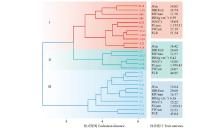
图1
27个美洲黑杨无性系第9年生长、材性聚类分析 3-54:中成4号 P. deltoides‘Zhongcheng 4’;546:中怀1号P. deltoides‘Zhonghuai 1’;540:中怀2号P. deltoides‘Zhonghuai 2’;17-2:创新杨P. deltoides‘Chuangxin’;1-116:中成5号P. deltoides‘Zhongcheng 5’;3-59:中成3号P. deltoides‘Zhongcheng 3’;2025:中林2025 P. deltoides ‘Zhonglin 2025’;K18、K25、J14、A25、A16、J27、A15、A14、A20、J11、I37、K9、K34、J16、A6、J30、A2、K16、F38、D34:美洲黑杨优良无性系编号Superior clones of P. deltoides.H: 树高 Tree height;DBH: 胸径 Diameter at breast height;RW: 年轮宽度 Ring width;BD: 基本密度 Basic density;MA: 微纤丝角 Microfibril angle;FL: 纤维长度 Fiber length;FW: 纤维宽度 Fiber width;FLR: 纤维长宽比 Fiber length-to-width ratio."
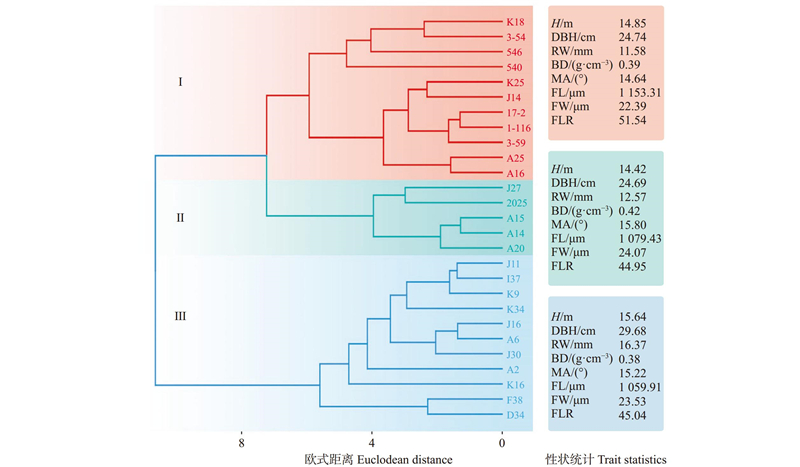
表4
美洲黑杨材性性状主成分分析"
| 性状Trait | PC1 (0.361) | PC2 (0.230) | PC3 (0.190) |
| 年轮宽度 Ring width | ?0.367 | 0.148 | ?0.575 |
| 基本密度 Basic density | 0.091 | 0.342 | 0.736 |
| 微纤丝角 Microfibril angle | ?0.318 | ?0.436 | 0.102 |
| 纤维长度 Fiber length | 0.567 | 0.279 | ?0.276 |
| 纤维宽度 Fiber width | ?0.196 | 0.743 | ?0.108 |
| 纤维长宽比 Fiber length-to-width ratio | 0.630 | ?0.203 | ?0.174 |
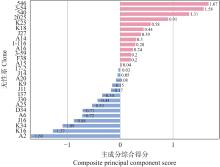
图2
27个美洲黑杨杂交无性系材性性状综合评价 546:中怀1号 P. deltoides ‘Zhonghuai 1’;3-54:中成4号 P. deltoides ‘Zhongcheng 4’;540:中怀2号 P. deltoides ‘Zhonghuai 2’;2025:中林2025 P.deltoides ‘Zhonglin 2025’;1-116:中成5号 P. deltoides ‘Zhongcheng 5’;3-59:中成3号 P. deltoides ‘Zhongcheng3’;17-2:创新杨 P. deltoides‘Chuangxin’;K25、K18、J27、A14、A16、F38、A15、J14、A20、K9、J11、I37、J30、A25、D34、A6、J16、K34、K16、A2:美洲黑杨优良无性系编号Superior clones of P. deltoides."
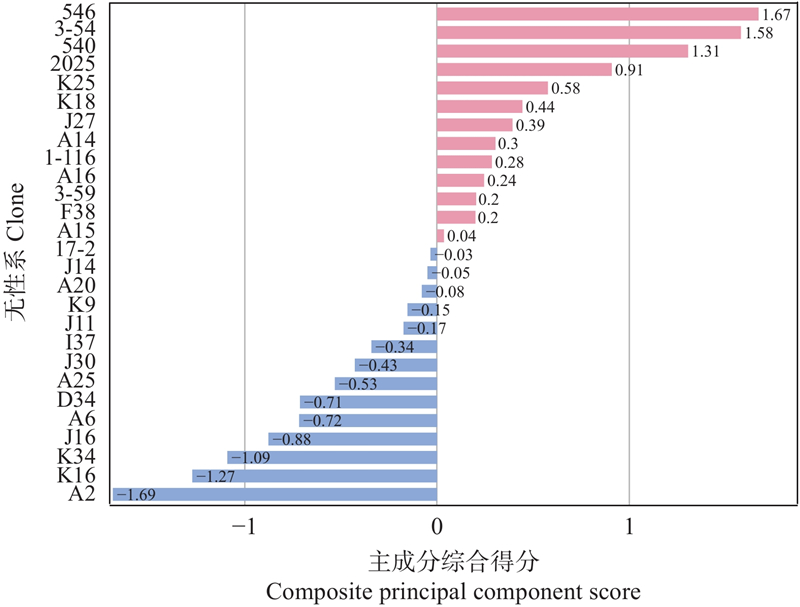
图3
不同树龄下材性性状变异系数"
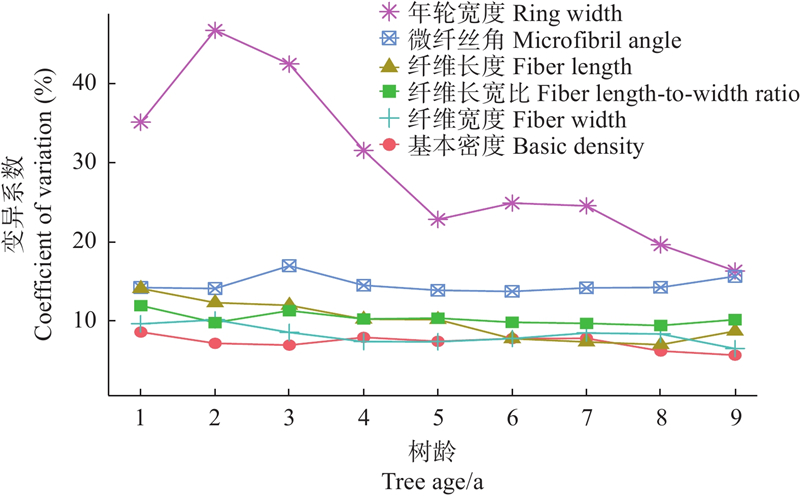
图4
材性性状径向变异模式"
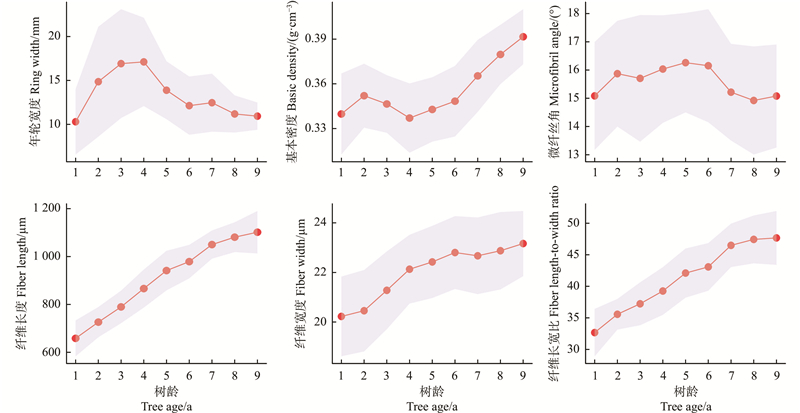
表5
第9年生长材性数据相关性分析①"
| 性状Trait | H | DBH | RW | BD | MA | FL | FW | FLR |
| H | 1 | |||||||
| DBH | 0.581** | 1 | ||||||
| RW | 0.542** | 0.846** | 1 | |||||
| BD | ?0.076 | ?0.321 | ?0.241 | 1 | ||||
| MA | ?0.178 | 0.173 | 0.131 | ?0.085 | 1 | |||
| FL | 0.175 | ?0.361 | ?0.189 | 0.063 | ?0.355 | 1 | ||
| FW | 0.125 | 0.16 | 0.243 | 0.142 | ?0.138 | 0.162 | 1 | |
| FLR | 0.058 | ?0.439* | ?0.333 | ?0.028 | ?0.224 | 0.802** | ?0.457* | 1 |
图5
基于年轮数据的材性性状相关性及性别差异 RW: 年轮宽度 Ring width; BD:基本密度 Basic density; MA: 微纤丝角 Microfibril angle; FL: 纤维长度 Fiber length; FW: 纤维宽度 Fiber width; FLR: 纤维长宽比 Fiber length-to-width ratio. 对角线表示各性状的数据分布,颜色代表不同性别;对角线下方表示两两性状分布散点图;对角线上方表示性状间的 Pearson 相关系数,包括总体相关性以及不同性别下的相关性,*表示0.05水平显著相关,**表示0.01水平显著相关,***表示0.001水平显著相关,最右一列表示各性状性别差异箱线图,最底一行表示各性状按性别划分的柱状频率分布。"
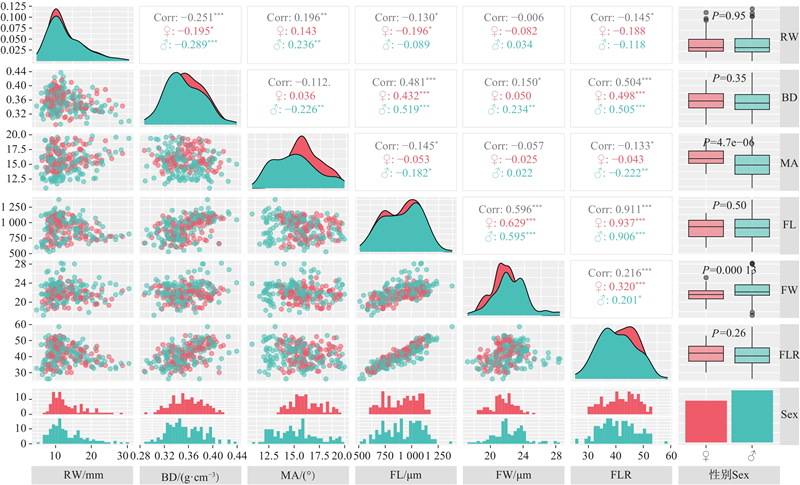
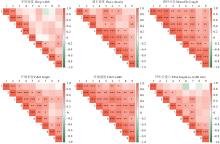
图6
不同年轮数据下材性性状年度相关性矩阵 1–9 表示不同年轮的数据。颜色深浅表示相关系数大小,颜色越深表示相关性越强; 1–9 represent data from different annual rings. Color intensity reflects the magnitude of the correlation coefficient, with darker colors indicating stronger correlations"
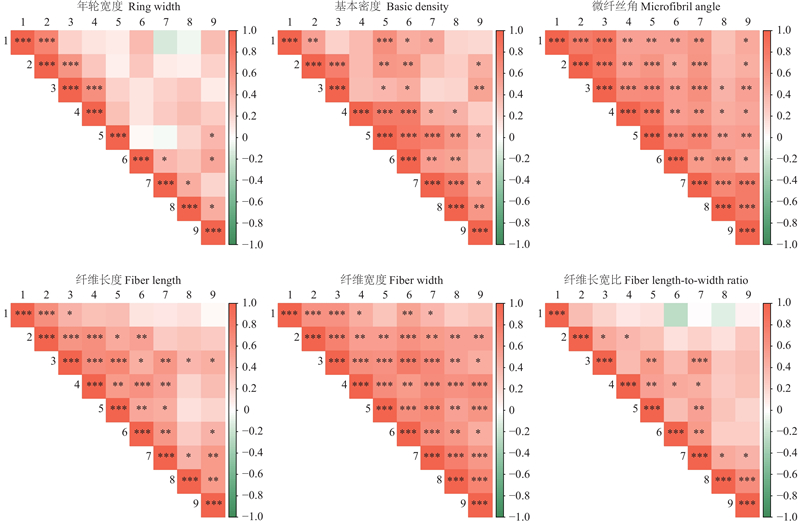
图7
年轮宽度与材性性状线性回归分析"
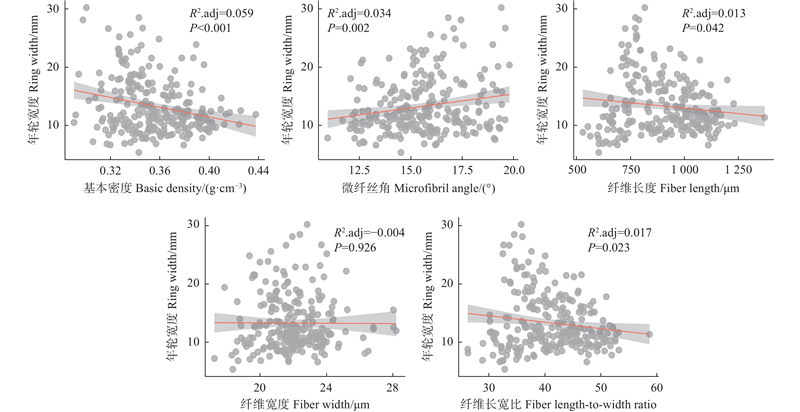
表6
影响年轮宽度的因素通径系数"
| 性状 Trait | 简单相关系数 Coefficient of simple correlation | 直接通径系数 Direct path coefficient | 间接通径系数 Indirect path coefficients | 决定系数 Coefficient of determination | ||
| BD → RW | MA → RW | FLR → RW | ||||
| BD | ?0.251*** | ?0.228 | 0 | ?0.043 | 0.002 | 0.055 |
| MA | 0.196** | 0.17 | ?0.045 | 0 | ?0.002 | 0.031 |
| FLR | ?0.145* | ?0.008 | 0.033 | ?0.025 | 0 | 0 |
|
鲍甫成, 江泽慧, 姜笑梅, 等. 中国主要人工林树种幼龄材与成熟材及人工林与天然林木材性质比较研究. 林业科学, 1998, 34 (2): 63- 76.
doi: 10.3321/j.issn:1001-7488.1998.02.010 |
|
|
Bao F C, Jiang Z H, Jiang X M, et al. Comparative studies on wood properties of juvenile mature wood and plantation natureal forest of main plantation tree species in China. Scientia Silvae Sinicae, 1998, 34 (2): 63- 76.
doi: 10.3321/j.issn:1001-7488.1998.02.010 |
|
| 康向阳. 林木遗传育种研究进展. 南京林业大学学报(自然科学版), 2020, 44 (3): 1- 10. | |
| Kang X Y. Research progress of forest genetics and tree breeding. Journal of Nanjing Forestry University (Natural Sciences Edition), 2020, 44 (3): 1- 10. | |
| 李开隆 杨传平, 刘桂丰. 黑龙江省杨树遗传育种研究进展. 东北林业大学学报, 2003, 31 (4): 45- 48. | |
| Li K L, Yang C P, Liu G F. Research progresses of genetics and breeding of Populus in Heilongjiang Province. Journal of Northeast Forestry University, 2003, 31 (4): 45- 48. | |
| 刘海峰. 2007. L&W纤维分析仪介绍. 中华纸业, 28(2): 27. | |
| Liu H F. 2007. Introduction to the L&W fiber analyzer. China Pulp & Paper Industry 28(2): 27. [in Chinese] | |
| 刘玉鑫, 颜开义, 何 伟, 等. 美洲黑杨无性系木材纤维性状遗传变异. 南京林业大学学报(自然科学版), 2020, 44 (2): 67- 74. | |
| Liu Y X, Yan K Y, He W, et al. Genetic variation of fiber traits in Populus deltoides clones. Journal of Nanjing Forestry University (Natural Sciences Edition), 2020, 44 (2): 67- 74. | |
| 吕士行, 徐锡增. 美洲黑杨及其引种展望. 南京林产工业学院学报, 1980, 4 (3): 13- 21. | |
| Lü S X, Xu X Z. Populus deltoides and their prospect of being introduced from abroad. Journal of Nanjing Institute of Forest Products Industry, 1980, 4 (3): 13- 21. | |
|
汤玉喜, 吴立勋, 吴 敏, 等. 杨树无性系生长与材性遗传变异及综合选择研究. 湖南林业科技, 2005, 32 (5): 5- 9.
doi: 10.3969/j.issn.1003-5710.2005.05.001 |
|
|
Tang Y X, Wu L X, Wu M, et al. Genetic analysis on growth and wood properties and comprehensive selection of Populus spp. clones. Hunan Forestry Science & Technology, 2005, 32 (5): 5- 9.
doi: 10.3969/j.issn.1003-5710.2005.05.001 |
|
|
汪贵斌, 曹福亮, 柳学军, 等. 落羽杉种源木材微纤丝角和纤维形态的变异. 林业科学, 2007, 43 (6): 117- 122.
doi: 10.3321/j.issn:1001-7488.2007.06.021 |
|
|
Wang G B, Cao F L, Liu X J, et al. Microfibril angles and fiber morphology characteristics of baldcypress wood. Scientia Silvae Sinicae, 2007, 43 (6): 117- 122.
doi: 10.3321/j.issn:1001-7488.2007.06.021 |
|
| 王克胜, 卞学瑜, 佟永昌, 等. 杨树无性系生长和材性的遗传变异及多性状选择. 林业科学, 1996, 32 (2): 111- 117. | |
| Wang K S, Bian X Y, Tong Y C, et al. Genetic variation in growth and wood properties and multiple-traits selection of poplar clones. Scientia Silvae Sinicae, 1996, 32 (2): 111- 117. | |
| 王明庥, 黄敏仁, 阮锡根, 等. 黑杨派新无性系木材性状的遗传改良. 南京林业大学学报, 1989, 13 (3): 9- 16. | |
| Wang M M, Huang M R, Ruan X G, et al. Genetic improvement of wood characters of new clones in the Aigeiros section. Journal of Nanjing Forestry University, 1989, 13 (3): 9- 16. | |
| 严涵薇, 程雅静, 余彤彤, 等. 10年生黑杨派无性系材性径向遗传变异分析与综合评价. 林业科学研究, 2021, 34 (6): 28- 37. | |
| Yan H W, Cheng Y J, Yu T T, et al. Radial genetic variation analysis and comprehensive evaluation of wood properties in ten-year-old section Aigeiros clones. Forest Research, 2021, 34 (6): 28- 37. | |
|
严艳兵, 潘惠新. 美洲黑杨无性系木材材性与生长性状遗传相关分析. 中南林业科技大学学报, 2021, 41 (5): 74- 81.
doi: 10.14067/j.cnki.1673-923x.2021.05.009 |
|
|
Yan Y B, Pan H X. Genetic correlation analysis of wood property and growth traits in Populus deltoides clones. Journal of Central South University of Forestry & Technology, 2021, 41 (5): 74- 81.
doi: 10.14067/j.cnki.1673-923x.2021.05.009 |
|
|
于海洋, 庞忠义, 殷春红, 等. 100个杨树无性系生长及材性变异研究. 西北林学院学报, 2023, 38 (4): 134- 142.
doi: 10.3969/j.issn.1001-7461.2023.04.17 |
|
|
Yu H Y, Pang Z Y, Yin H C, et al. Variation analysis on the growth and wood properties of 100 poplar clones. Journal of Northwest Forestry University, 2023, 38 (4): 134- 142.
doi: 10.3969/j.issn.1001-7461.2023.04.17 |
|
|
张春玲, 李淑梅, 赵自成, 等. 杨树新品种‘丹红杨’. 林业科学, 2008, 44 (1): 169.
doi: 10.3321/j.issn:1001-7488.2008.01.027 |
|
|
Zhang C L, Li S M, Zhao Z C, et al. A new poplar variety Populus deltoides CL. ‘Danhong. Scientia Silvae Sinicae, 2008, 44 (1): 169.
doi: 10.3321/j.issn:1001-7488.2008.01.027 |
|
|
张晓艳, 季新月, 王 雷, 等. 不同地点黑杨派无性系生长性状变异及其与叶片性状相关分析. 南京林业大学学报(自然科学版), 2020, 44 (3): 65- 73.
doi: 10.3969/j.issn.1000-2006.201907041 |
|
|
Zhang X Y, Ji X Y, Wang L, et al. Genetic variation in growth traits at different sites and correlationship among growth traits and leaf traits of section Aigeiros clones. Journal of Nanjing Forestry University (Natural Sciences Edition), 2020, 44 (3): 65- 73.
doi: 10.3969/j.issn.1000-2006.201907041 |
|
| 朱教君, 姜凤歧, 曾其蕴. 杨树林带木材纤维长度变化规律及其在经营中的应用. 林业科学, 1994, 30 (1): 50- 56. | |
| Zhu J J, Jiang F Q, Zeng Q Y. A study on regularity of the change of fiber length of wood in poplar shelterbelts and its application in shelterbelt management. Scientia Silvae Sinicae, 1994, 30 (1): 50- 56. | |
| Balatinecz J J, Kretschmann D E. 2001. Properties and utilization of poplar wood. NRC Research Press, National Research Council of Canada, Ottawa, ON KIA 0R6, Canada, 277−291. | |
|
Bao F C, Jiang Z H, Jiang X M, et al. Differences in wood properties between juvenile wood and mature wood in 10 species grown in China. Wood Science and Technology, 2001, 35 (4): 363- 375.
doi: 10.1007/s002260100099 |
|
| Burdon R, Kibblewhite R P, Riddell M. Wood density and kraft fibre and pulp properties of four Pinus radiata provenances. New Zealand Journal of Forestry Science, 1999, 29 (2): 214- 224. | |
| Debell D S, Singleton R, Harrington C A, et al. Wood density and fiber length in young Populus stems: relation to clone, age, growth rate, and pruning. Wood and Fiber Science, 2002, 34 (4): 529- 539. | |
|
Fang S Z, Yang W Z, Fu X X. Variation of microfibril angle and its correlation to wood properties in poplars. Journal of Forestry Research, 2004, 15, 261- 267.
doi: 10.1007/BF02844949 |
|
|
Fukatsu E, Hiraoka Y, Matsunaga K, et al. Genetic relationship between wood properties and growth traits in Larix kaempferi obtained from a diallel mating test. Journal of Wood Science, 2015, 61, 10- 18.
doi: 10.1007/s10086-014-1436-9 |
|
| Hannrup B, Cahalan C, Chantre G, et al. Genetic parameters of growth and wood quality traits in Picea abies. Scandinavian Journal of Forest Research, 2004, 19, 14- 29. | |
|
Liu Y M, Zhou L, Guan Y, et al. Radial variations to wood anatomical and chemical properties in eight poplar clones. Canadian Journal of Forest Research, 2021, 52 (1): 19- 26.
doi: 10.1139/cjfr-2020-0465 |
|
|
Ma T Y, Hou J. Trait assessment of 1122 Populus deltoides clones: unveiling correlations among growth, wood properties, and disease susceptibility. Forests, 2024, 15 (7): 1250.
doi: 10.3390/f15071250 |
|
|
Marzena N, Piotr P, Kamila P, et al. Productivity, growth patterns, and cellulosic pulp properties of hybrid aspen clones. Forests, 2019, 10 (5): 450.
doi: 10.3390/f10050450 |
|
|
Pliura A, Zhang S Y, MacKay J, et al. Genotypic variation in wood density and growth traits of poplar hybrids at four clonal trials. Forest Ecology and Management, 2007, 238 (1): 92- 106.
doi: 10.1016/j.foreco.2006.09.082 |
|
|
Raj T, Chandrasekhar K, Kumar N, et al. Lignocellulosic biomass as renewable feedstock for biodegradable and recyclable plastics production: a sustainable approach. Renewable and Sustainable Energy Reviews, 2022, 158, 112130.
doi: 10.1016/j.rser.2022.112130 |
|
|
Shen H, Xing X Y, Guan Y, et al. Radial variation studies on wood properties of Populus deltoides parents and their hybrids. BioResources, 2021, 16 (3): 4905- 4923.
doi: 10.15376/biores.16.3.4905-4923 |
|
|
Wu F, Zhang P D, Pei J C, et al. Genotypic parameters of wood density and fiber traits in triploid hybrid clones of Populus tomentosa at five clonal trials. Annals of Forest Science, 2013, 70 (7): 751- 759.
doi: 10.1007/s13595-013-0307-7 |
|
|
Wu J, Zhou Q, Sang Y R, et al. Genotype-environment interaction and stability of fiber properties and growth traits in triploid hybrid clones of Populus tomentosa. BMC Plant Biology, 2021, 21 (1): 405.
doi: 10.1186/s12870-021-03156-6 |
|
|
Xiao Y, Wang J H, Yun H L, et al. Genetic evaluation and combined selection for the simultaneous improvement of growth and wood properties in Catalpa bungei clones. Forests, 2021, 12 (7): 868.
doi: 10.3390/f12070868 |
|
|
Zhang J, Song X Q, Zhang L, et al. Agronomic performance of 27 Populus clones evaluated after two 3-year coppice rotations in Henan, China. GCB Bioenergy, 2020, 12 (2): 168- 181.
doi: 10.1111/gcbb.12662 |
|
|
Zhang Y H, Fang S Z, Tian Y, et al. Responses of radial growth, wood density and fiber traits to planting space in poplar plantations at a lowland site. Journal of Forestry Research, 2022, 33 (3): 963- 976.
doi: 10.1007/s11676-021-01382-0 |
|
|
Zhou X L, Zhang L, Zhang M, et al. Genomic selection for growth and wood properties in multi-generation hybrid populations of Populus deltoides. Horticulture Research, 2025, 12 (9): 165.
doi: 10.1093/hr/uhaf165 |
| [1] | 胡雪杨,郑一力,田家园,张振翔. 基于压力传感的微钻阻力树木年轮检测方法[J]. 林业科学, 2025, 61(6): 38-48. |
| [2] | 张静, 张伟溪, 丁昌俊, 褚延广, 苏晓华, 赵军, 苏雪辉, 苑正赛, 李政宏, 余金金, 黄秦军. 美洲黑杨亲本及其不同林龄及生长势子代叶片糖代谢的差异[J]. 林业科学, 2025, 61(5): 131-145. |
| [3] | 陈帅,党宏忠,赵英铭,黄雅茹,李明阳,刘春颖. 绿洲农田防护林树干水分传输的方位差异[J]. 林业科学, 2024, 60(7): 73-80. |
| [4] | 周小东,常顺利,王冠正,孙雪娇,张毓涛,李翔. 天山雪岭云杉径向生长响应气候变化的海拔分异[J]. 林业科学, 2024, 60(3): 45-56. |
| [5] | 申佳艳,范泽鑫,张慧,彭新华,李金花,余潇,杨文雄,李云芳,李新宇,刘悦宁,苏建荣. 云南3种松树径向生长的气候因子响应异质性[J]. 林业科学, 2024, 60(11): 48-62. |
| [6] | 李政宏,丁昌俊,张伟溪,张静,沈乐,张腾倩,丁密,苏晓华,吴钟亲,方发之. 美洲黑杨无性系苗木对不同光周期处理的生长与生理响应[J]. 林业科学, 2023, 59(3): 127-144. |
| [7] | 戴晓港,陈晨,薛良交,吴怀通,尹佟明. 基于物种特异性InDel标记鉴别美洲黑杨与小叶杨的杂交子代[J]. 林业科学, 2021, 57(11): 79-84. |
| [8] | 陈存,丁昌俊,张静,李波,褚延广,苏晓华,黄秦军. 美洲黑杨群体结构分析及核心种质库构建[J]. 林业科学, 2020, 56(9): 67-76. |
| [9] | 申佳艳,李帅锋,黄小波,王绍武,苏建荣. 金沙江流域不同海拔处云南松生态弹性及生长衰退过程[J]. 林业科学, 2020, 56(6): 1-11. |
| [10] | 张江涛, 杨淑红, 朱镝, 朱延林, 刘友全. 美洲黑杨2025及其2个芽变品种苗对持续干旱的生理响应及抗旱性评价[J]. 林业科学, 2018, 54(6): 33-43. |
| [11] | 路伟伟, 余新晓, 贾国栋, 李瀚之, 刘自强. 密云山区油松树轮δ13C对气温和降水量变化的响应[J]. 林业科学, 2018, 54(3): 1-7. |
| [12] | 白雪, 范泽鑫. 哀牢山中山湿性常绿阔叶林水青树年轮宽度对气候变化的响应[J]. 林业科学, 2018, 54(3): 161-167. |
| [13] | 任嘉红, 李浩, 刘辉, 叶建仁, 吴小芹. 吡咯伯克霍尔德氏菌JK-SH007对杨树根际微生物数量及功能多样性的影响[J]. 林业科学, 2016, 52(5): 126-133. |
| [14] | 丁昌俊, 张伟溪, 高暝, 黄秦军, 褚延广, 苏晓华. 不同生长势美洲黑杨转录组差异分析[J]. 林业科学, 2016, 52(3): 47-58. |
| [15] | 郭明辉, 秦磊. 人工林红松木材碳素储存量与物理特征的径向变异[J]. 林业科学, 2015, 51(1): 97-102. |
| 阅读次数 | ||||||
|
全文 |
|
|||||
|
摘要 |
|
|||||

